Expired CPR Certification at a California Daycare: What Happens During an Inspection?

California daycare licensing inspectors can cite a child care facility if any required staff member has an expired CPR or first aid certification during a visit. There is no automatic grace period once the printed expiration date passes.
Get Certified

Renew Before You’re Cited

EMSA-approved and AHA Heartsaver Pediatric renewal, on-site or in-person.

Explore Renewal Options

$0
Grace Period After Certification Expires
$150/Day
Maximum Civil Penalty for Uncorrected Deficiencies
60-90 Days
Recommended Renewal Booking Window

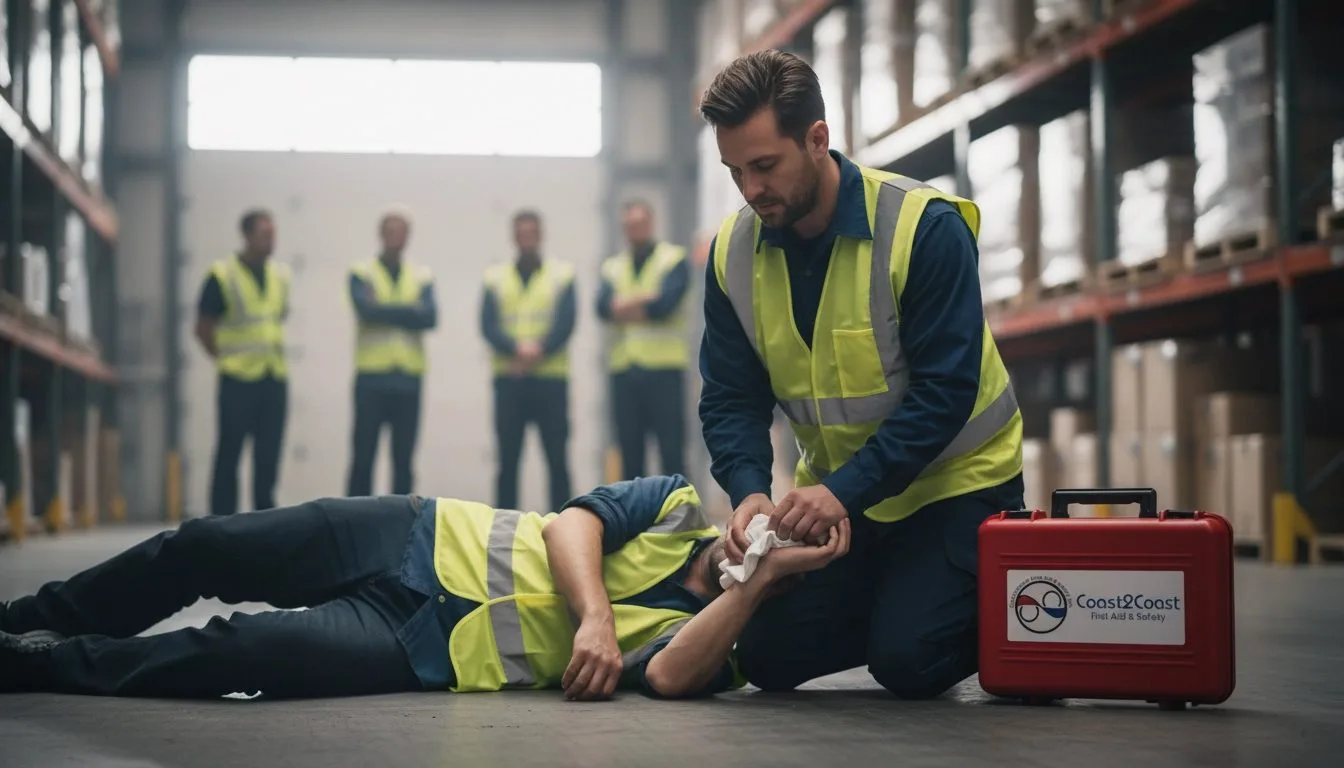
Running a daycare in California means juggling staff schedules, parent communication, lesson plans, and a mountain of regulatory paperwork. One document that can quietly slip past its expiration date, and cause serious trouble during an inspection, is a CPR certification card. If a Community Care Licensing analyst walks through your door and finds that required staff don’t hold current Pediatric First Aid and CPR certification, the consequences can range from a written deficiency to civil penalties and even threats to your license.

This article breaks down exactly what happens when expired CPR certification at a California daycare is discovered, what inspectors look for during the review, and how to prevent a lapse in certification from ever becoming a problem.

Key Takeaways

  • California daycare licensing inspectors can cite a child care facility if any required staff member has an expired CPR or first aid certification during a visit. Under Health & Safety Code § 1596.866, at least one person on site must hold current EMSA-approved Pediatric First Aid and CPR certification (including CPR AED) at all times children are present.
  • Expired CPR certification at a California daycare can trigger deficiencies, corrective action plans, civil penalties, or, in serious patterns, impact your facility’s license status, potentially leading to suspension or revocation.
  • There is no automatic grace period after certification expires. The moment the printed expiration date passes, the provider is considered non-compliant until they complete a renewal course.
  • Childcare operators can avoid issues by tracking expiration dates in a centralized log, scheduling a renewal course 60 to 90 days before certification expires, and ensuring certified coverage on every shift.
  • As of January 1, 2026, California law (AB 2317) also requires that Pediatric First Aid and CPR training include instruction on anaphylaxis prevention and emergency epinephrine auto-injector use.

Overview: CPR Certification Rules for California Daycares

California’s Health & Safety Code § 1596.866 requires that a licensed child care facility, whether a center or family child care home, maintain at least one person on site with current, EMSA-approved Pediatric First Aid and CPR certification whenever children are present. This requirement applies during all operating hours, including field trips and facility outings. The law names the American Red Cross, the American Heart Association, and other EMSA-approved training programs as accepted issuers of CPR certification.

“Current” means the certification has not passed its printed expiration date. Standard CPR certification from organizations like Red Cross or AHA is typically valid for two years from the date of issue, but inspectors go strictly by the date printed on the certificate, not by when the holder “plans to” complete a renewal course. If you need a broader understanding of how certification works in this state, the Complete Guide to CPR and First Aid Certification in California covers the full landscape.

It’s important to understand the difference between a general adult CPR certification and the specific EMSA Child Care Pediatric First Aid and CPR training required under Community Care Licensing rules. A generic workplace CPR AED certification, even a valid one, does not satisfy California daycare licensing standards unless it is specifically EMSA-approved and covers pediatric and infant emergencies. Workplace requirements outside childcare, healthcare settings included, often accept a broader range of CPR levels, but daycare licensing does not. This article focuses on what happens during a daycare licensing inspection specifically.
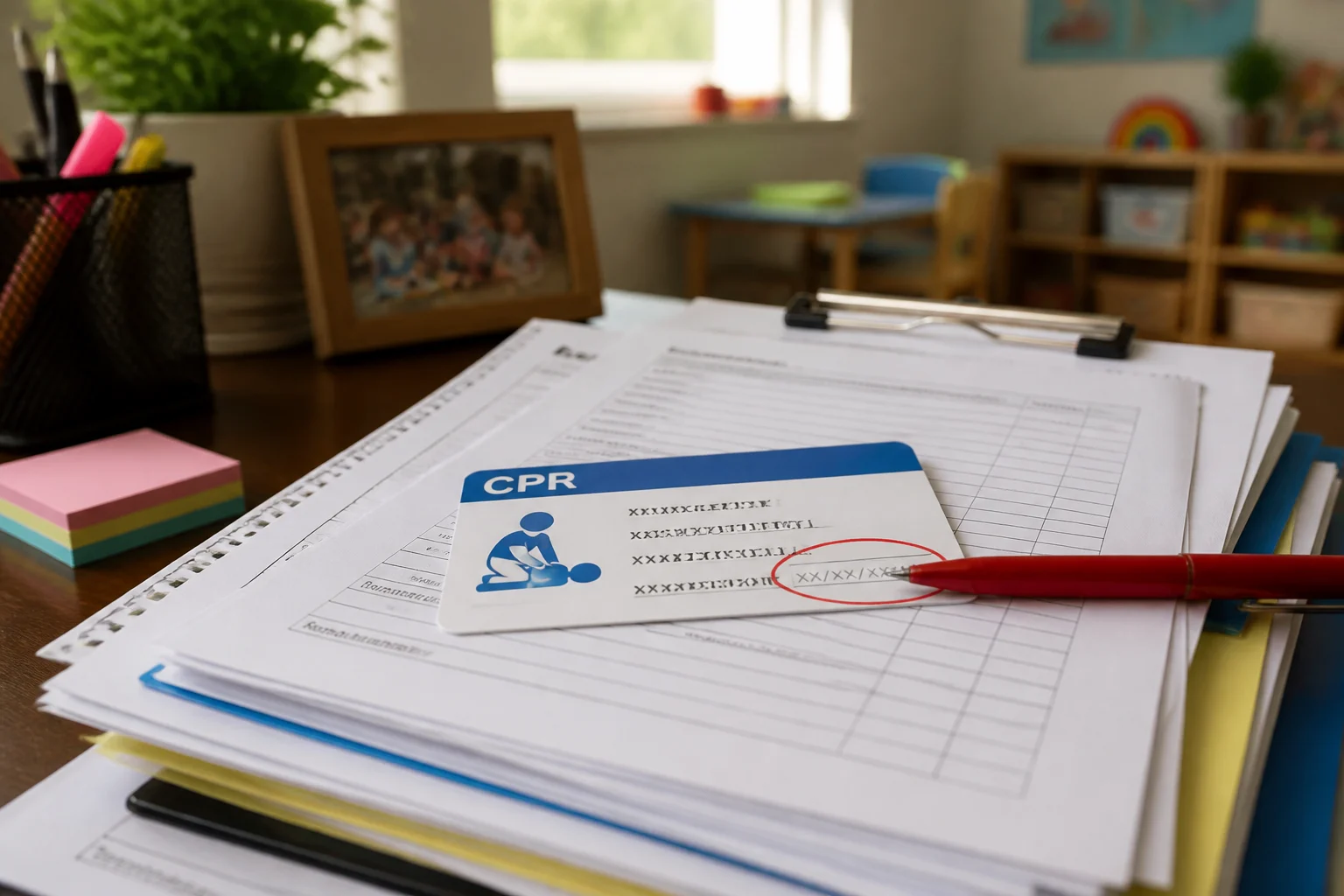
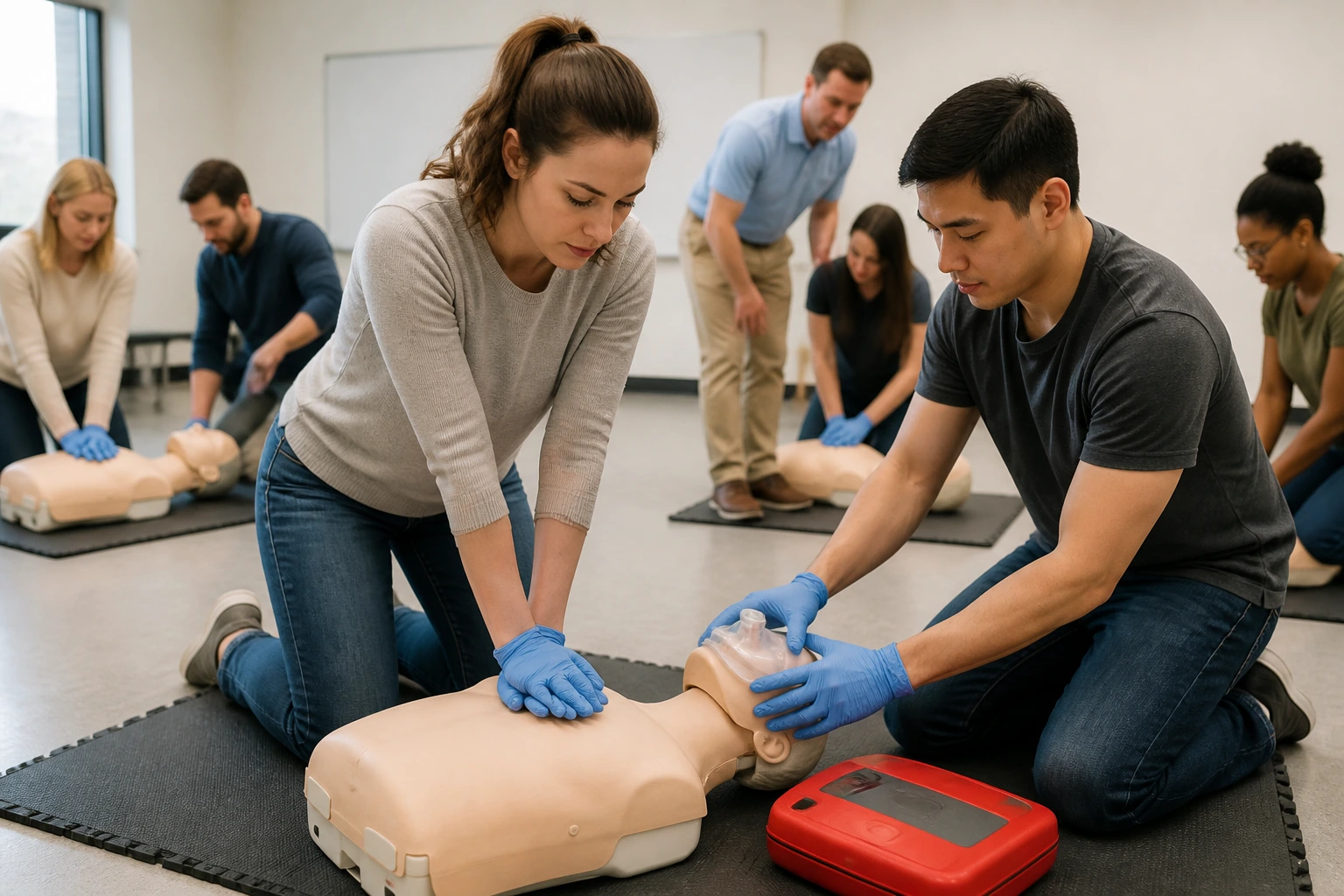
cpr paperwork


What Inspectors Look For During a California Daycare Visit

Community Care Licensing (CCL) analysts, part of the California Department of Social Services, conduct both announced and unannounced inspections of daycare centers and family child care homes. These visits are thorough. Inspectors don’t just walk through the building, they sit down with your training and certification files.

During a typical visit, inspectors will ask to see CPR and first aid certification for directors and all relevant staff, staff schedules and time sheets, children’s attendance records, and individual staff files to confirm that someone with current Pediatric First Aid and CPR certification is present, in person, at all times children are in care.

Requirement What the Inspector Checks
Approved provider EMSA-approved, Red Cross, AHA, or accredited college/university
Course type Pediatric First Aid and CPR (not adult-only)
Dates Clear issue date and expiration date printed on the certificate
Name match Staff member’s name must match a valid photo ID
Physical presence The certified person must be physically on site, not just scheduled

Inspectors may also confirm that the certified person is available to respond to a cardiac emergency or breathing emergency, not off-premises running errands while children are in the building.

What Counts as an “Expired” CPR Certification in California

In California daycare licensing, “expired” means any certification where the printed expiration date has passed, even by one day. There is no formal licensing grace period. Once the date listed on the certificate passes, it no longer satisfies the requirement, and the staff member’s card joins the growing list of CPR certifications that expire quietly if no one is tracking dates.

Standard Red Cross and American Heart Association CPR AED and first aid certification is typically valid for two years. However, it must be the EMSA-approved pediatric version to count toward daycare licensing. A certificate from a course that only covers adult CPR, or one from a non-approved provider, is treated as though it doesn’t exist for licensing purposes. BLS (Basic Life Support) certification, often used in healthcare and clinical settings, is a related but distinct credential, it’s typically required for nurses or medical staff rather than standard daycare classroom roles, so don’t assume a BLS card automatically satisfies childcare licensing without confirming it’s the pediatric, EMSA-recognized version.

If a CPR or first aid certificate is illegible, damaged, missing dates, or cannot be verified through the issuing organization, inspectors may treat it as invalid, effectively the same as expired. Keep certification cards in good condition and store digital copies in staff files as a backup.

Immediate Consequences When CPR Certification Is Expired During an Inspection

When a CCL analyst discovers that required CPR or first aid certification has expired, they document the non-compliance in a Licensing Evaluation Report (typically the LIC 809 form). The deficiency is cited under personnel requirements referencing Health & Safety Code § 1596.866 and relevant sections of Title 22, California Code of Regulations § 100016.

The deficiency is typically classified by severity: Type B poses a potential health, safety, or personal rights risk, this is the more common classification when some certified staff are still present but individual certification has lapsed. Type A poses an immediate risk to health and safety, this applies when no one on site holds valid certification while children are in care.

Compliance Note: A typical enforcement scenario looks like this: two staff members’ CPR certification lapses on the same date. If other certified staff remain present and coverage requirements are still met, the deficiency is usually documented as Type B with a Plan of Correction due date requiring the director to schedule a renewal course promptly.

Immediate outcomes can include a written citation on the LIC 809 report, a requirement to post the report where parents can review it, a Plan of Correction that must be completed within the timeframe the analyst sets based on severity, and civil penalties if the deficiency is not corrected within the specified window. Under Health and Safety Code § 1596.99, penalties can reach $1,000 for a repeat violation plus $100 per day it continues uncorrected, and separately, Title 22 authorizes penalties of $50 to $150 per day for uncorrected deficiencies more broadly.

The severity of consequences depends on whether any certified staff remain on site, how long certification has been expired, and whether children were ever left without properly certified coverage.
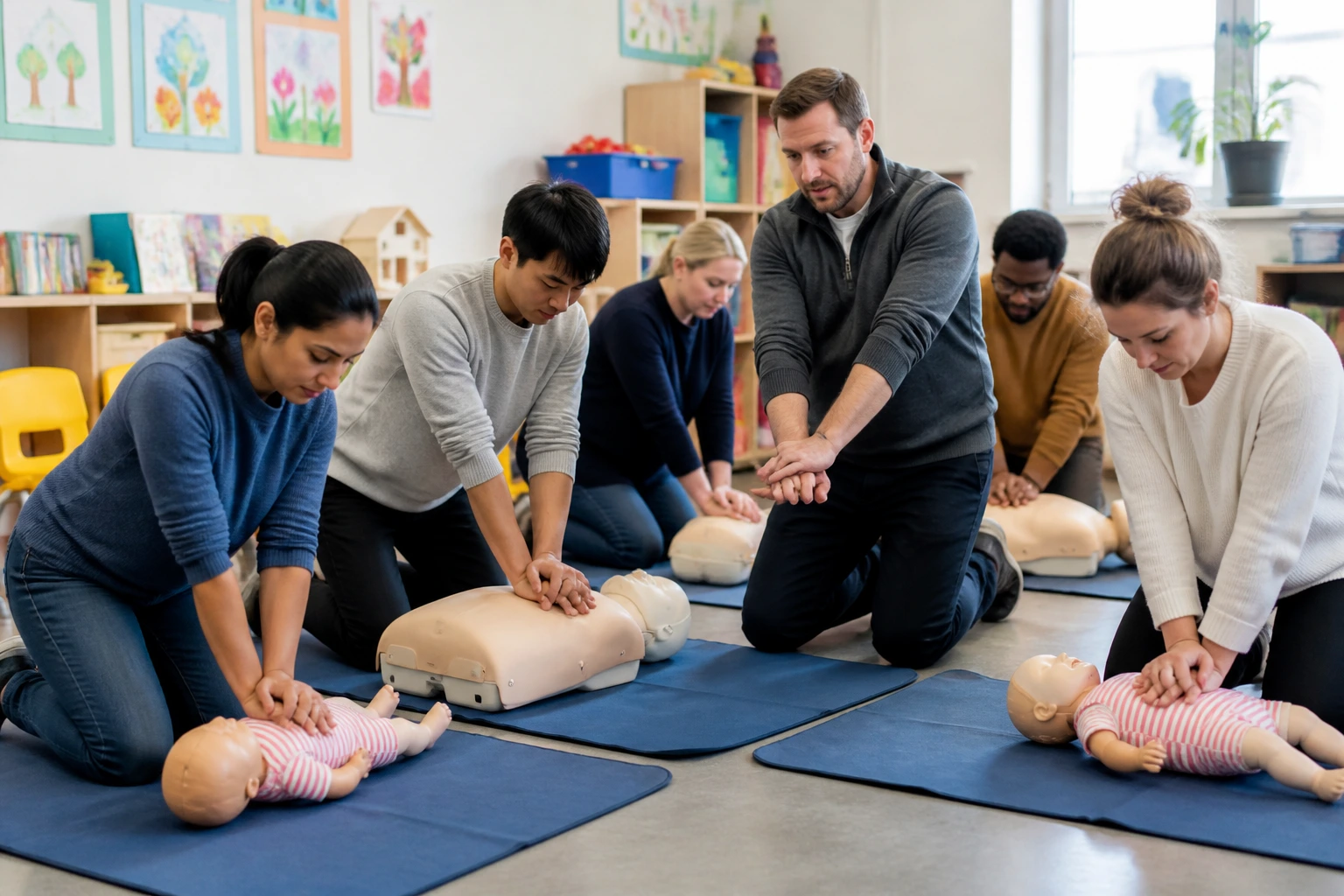
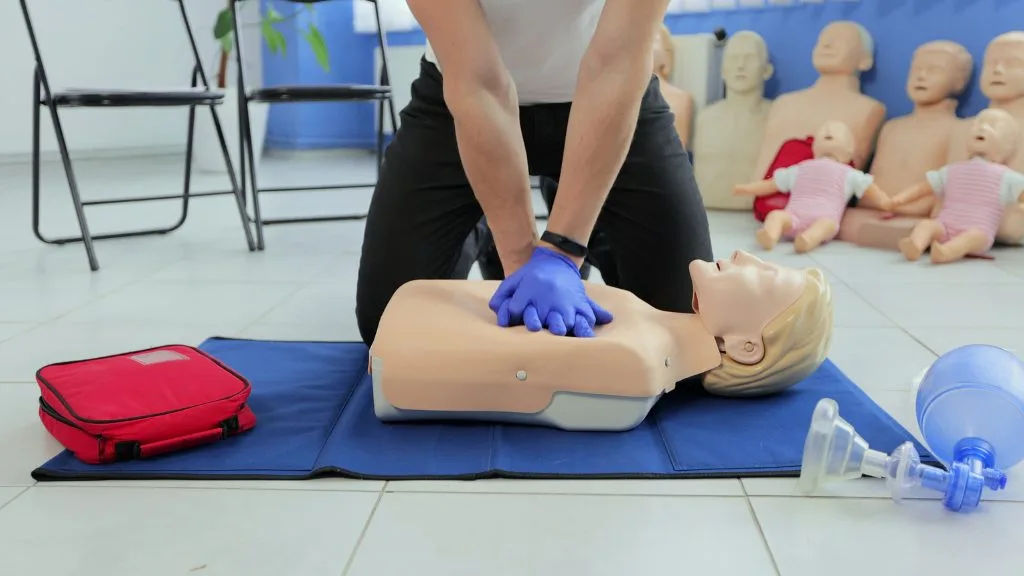
preschool cpr class


Potential Longer-Term Impacts for Daycare Operators

A single expired certification deficiency, corrected promptly, is unlikely to shut down your daycare. But repeated findings create a compliance history that follows your facility. All deficiency reports are publicly visible through CCL’s online database, meaning parents, referral agencies, and subsidy programs can see every citation.

Multiple or serious violations can lead to increased inspection frequency and more intensive monitoring by CCL, escalating civil penalties, and suspension or revocation proceedings if you fail to correct deficiencies within the window the licensing agency sets.

The reputational impact shouldn’t be underestimated. Parents who see posted deficiency notices may question the daycare’s commitment to child safety. And beyond compliance, maintaining current certification directly affects your legal liability. If a child is injured during a cardiac emergency or a choking incident and the staff on duty were not properly certified, your exposure in a lawsuit, and the likelihood that your insurer denies the claim, increases significantly. Insurers in the healthcare and childcare space increasingly ask directly whether staff hold current, EMSA-approved certification before extending or renewing a policy.

Expired Certification vs. No Certified Staff Present

There’s an important distinction between two scenarios inspectors encounter.

Scenario 1: Some staff have valid Pediatric First Aid and CPR certification; others have expired certification. The facility still meets the minimum coverage requirement because at least one certified person is on site. Individual staff members with expired certification will be cited, but the overall risk classification is usually lower (Type B).

Scenario 2: All staff on site have expired certification or no training at all. This is far more serious. No one present during childcare hours holds valid certification, creating an immediate health and safety risk. Inspectors may classify this as Type A.

In severe cases, inspectors could require immediate corrective measures, such as limiting enrollment or reducing the number of children present, adjusting operating hours until a certified person arrives, sending uncertified staff home and bringing in a qualified substitute, or temporarily restricting activities until compliance is restored.

The bottom line: never schedule a shift where the only person with children is someone whose CPR certification has lapsed. That single gap in coverage is where a manageable paperwork issue turns into an actual risk to a child’s life.

How Far in Advance to Renew CPR and First Aid Certification for California Daycare

The best way to avoid expired certification is to never let it get close to the edge. Schedule your renewal course 60 to 90 days before the expiration date on your current certification. This buffer accounts for class availability, instructor schedules, and the unexpected delays that come with running a busy daycare.

As long as certification is still current, staff can generally register for a shorter recertification course rather than the full class. Once certification expires, most providers, including Red Cross and AHA, require a full initial course, which takes more class time and costs more. That’s a strong incentive to complete recertification early rather than waiting for the printed expiration date to force the issue. For details on what a recertification course involves, Coast2Coast breaks down the process clearly, and a knowledgeable instructor can advise on the most convenient option for your team’s schedule.

Many childcare employers set internal renewal requirements stricter than the legal minimum, for example, requiring staff to complete their renewal course within 30 days before expiration to ensure continuous compliance across all shifts without cutting it close. Use digital calendars or HR systems to track expiration dates and send automated reminders several months in advance, with flexible scheduling that works around your staff’s availability. A little planning now is far more helpful than scrambling to register a staff member for the next available class after an inspector has already flagged the gap.

Why the 2-Year Cycle Isn’t Just a Paperwork Rule

The 2-year renewal requirement reflects how quickly CPR skills actually fade, not an arbitrary bureaucratic timeline. Research shows CPR skills decline significantly within 6 to 12 months without practice, and studies have found that less than half of trained individuals can still pass a CPR skills test after just one year. Compression depth, rhythm, and confidence under pressure all degrade faster than most people expect, which matters enormously in a genuine life-threatening emergency where hesitation costs time.

Guidelines and techniques also evolve. Advancements in CPR science periodically require certification updates, compression-to-breath ratios, AED protocols, and pediatric-specific guidance have all been revised in recent years. A certificate that’s been sitting in a drawer for two years doesn’t just risk a citation, it may reflect outdated technique that could affect whether a life is saved. That’s the real reason renewing before your certification expires matters more than treating it as a box to check for an inspector, and it’s why an instructor’s in-person demonstration of current technique is worth far more than the card itself.

Acceptable CPR/First Aid Courses for California Childcare Providers

California law requires EMSA-approved Pediatric First Aid and CPR training for licensed daycare providers. Not every CPR class qualifies. The training must be specifically approved by the Emergency Medical Services Authority and cover pediatric CPR, AED use, and first aid geared to infants and children.

Organization Key Requirement
American Red Cross Must be the EMSA-approved childcare version
American Heart Association Must include pediatric CPR/AED and first aid
EMSA-approved programs Listed on the EMSA website; must include hands-on skills
Accredited college/university Must meet EMSA content standards

Generic adult-only CPR or online coursework-only certification, even if valid for other workplace requirements, does not meet California daycare licensing standards unless explicitly EMSA-approved for childcare. If you’re a teacher working in a school-based program, check the specific CPR certification requirements for teachers in California to understand where daycare and school rules overlap.

Since January 1, 2026, all new and renewal training must also include instruction on anaphylaxis prevention and the emergency use of epinephrine auto-injectors under AB 2317.

Online, Blended, and On-Site CPR Training for Daycare Staff

Modern CPR training comes in several formats: fully in-person classroom instruction, blended learning (online theory plus in-person skills testing), and private on-site group training delivered at the daycare itself.

For daycare compliance, the CPR portion of your training must include a hands-on skills evaluation. Purely online coursework with no skills component is generally not accepted by California CCL when EMSA approval is required. The theory portion, covering topics like recognizing breathing emergencies, understanding when to use an AED, and responding to an infant choking, can sometimes be completed online, but the practical skills must be demonstrated with an instructor present in person before any EMS-recognized certification is issued.

On-site and group training offers real advantages for daycare operators: all staff can complete training on the same date, simplifying logistics, class scenarios can be tailored to the daycare environment and the specific equipment in your building, and coverage planning is easier when everyone renews together (though staggering is still recommended). Employers who invest in a convenient, on-site format tend to see higher completion rates than centers that leave scheduling entirely up to individual staff.

Coast2Coast First Aid & Aquatics is an authorized provider delivering EMSA-approved Pediatric CPR & First Aid and AHA Heartsaver Pediatric training and certification directly across California, including on-site group sessions built around the daycare schedule, alongside our Canadian Red Cross programs across Canada.

Preventing Lapses: Practical Compliance Tips for California Daycares

Proactive planning is the only reliable way to avoid having expired certification discovered during an inspection. Here’s what works: create a centralized training log listing each staff member’s CPR, AED, and first aid expiration dates, course types (EMSA Child Care, Pediatric First Aid and CPR), and renewal status, a simple spreadsheet works, but HR platforms with automated alerts are even better. Build a scheduling policy so no staff member is scheduled alone with children unless their Pediatric First Aid and CPR certification will remain valid for the entire shift, and ideally for at least 60 more days.

Stagger renewal dates so not all staff expire at once. If everyone completed training together two years ago, split them into two groups this time around so you always maintain certified coverage. Maintain a surplus of certified staff on each shift to cover vacations, illness, and turnover, don’t operate at the bare minimum. Budget for training annually so renewal expenses don’t catch you off guard.

What to Do If You Discover Expired CPR Certification Before or During an Inspection

You’re reviewing files the night before an inspection, or worse, the inspector is already in the building, and you realize a staff member’s certification expired last month. Here’s what to do.

Immediate steps: remove uncertified staff from unsupervised child care roles, do not count them as the certified person on duty. Confirm that at least one person with current EMSA Child Care CPR and first aid certification remains on site, in person, at all times during operating hours. Register the affected staff member for a renewal course or full CPR training class without delay, same-week or next-week class scheduling shows good faith.

During the inspection: show proof of enrollment in a renewal course and document any interim safety measures you’ve put in place. Be honest with the inspector, attempting to hide the lapse or present expired certification as valid will make things worse. A deficiency may still be written, inspectors are required to document what they find, but prompt action and a clear plan of correction demonstrate that the community you serve can remain confident in your commitment to child safety.

Once staff complete their renewal course, submit updated certification to CCL immediately. Don’t wait for the next scheduled review.

How Coast2Coast First Aid & Aquatics Supports California Daycare CPR Compliance

Coast2Coast First Aid & Aquatics is an authorized provider delivering EMSA-approved Pediatric First Aid and CPR certification and AHA Heartsaver Pediatric training directly across California, alongside our Canadian Red Cross programs across Canada. For daycare operators facing an urgent renewal need, we can prioritize scheduling and issue same-day digital certification upon successful completion.

Best practices we build into every renewal course include early renewal before the expiration date, not after, blended learning where allowed, combining online education with in-person skills testing, coordinated team training days focused on infant and child emergencies so staff feel prepared and confident, and instructors with specific experience in childcare and pediatric scenarios who can answer questions about how each skill applies to your classroom.

For directors managing an entire team, we can also help map staff expiration dates so your whole center recertifies on a predictable schedule, reducing the odds of a surprise gap during your next inspection.

Check the EMSA Sticker Rules

Know exactly what your certificate needs before an inspection.

Check the Sticker Rules

See the Full 16-Hour Breakdown

CPR/First Aid is only half of California’s licensing requirement.

See the Full Breakdown

Key Takeaway

An expired CPR certificate becomes non-compliant the day after it lapses, no grace period, no exceptions. Whether it’s classified Type A or Type B depends entirely on whether certified coverage remains on site. Track expiration dates centrally, renew 60 to 90 days early, and if a gap is ever found, act immediately and document every corrective step you take.

Get Certified

Get Started with California Certification

Find the right course level and book with a 99% pass rate.

Get Started

FAQ: Expired CPR Certification in California Daycare Settings

Q1: Is there any grace period after my CPR certification expires for California daycare licensing?

A: Community Care Licensing does not recognize a formal grace period. Once the expiration date on your Pediatric First Aid and CPR certificate has passed, it no longer satisfies the daycare requirement. Some training providers may allow late renewals as a courtesy, but this does not change the licensing expectation: you must maintain certification continuously while children are in care. If your certification has lapsed, act immediately to complete a renewal or full course.

Q2: Can I keep working in a daycare classroom if my CPR certification expired last week?

A: California regulations expect at least one person with current EMSA-approved Pediatric First Aid and CPR certification on site whenever children are present. An individual with expired certification should not be the sole or primary caregiver. Staff with expired certification should be removed from roles where they qualify as the certified person on duty until they complete a renewal course or full certification class. They may still assist in the classroom alongside a currently certified colleague, but they cannot be counted toward compliance.

Q3: Does an online-only CPR course meet California daycare requirements?

A: For licensed childcare, California generally requires EMSA-approved Pediatric First Aid and CPR training that includes in-person skills testing. Most online-only CPR certification does not meet this requirement. Before relying on any online CPR certification for daycare compliance, confirm with EMSA’s list of approved training programs and your local licensing analyst. A blended course with online theory and an in-person skills pass can be a helpful, convenient option where accepted.

More FAQs: Edge Cases and Third-Party Staff

Q4: What happens if an inspector finds expired CPR certification but no children are present?

A: If the facility is technically open but children are not on site at that moment, the inspector may still cite the expired certification because it relates to readiness for normal operating hours. The severity of the deficiency may be influenced by how quickly the lapse is corrected and whether children were ever left without properly certified staff in the past. Even outside active childcare hours, expired certification signals a compliance gap that inspectors are obligated to document.

Q5: Do volunteers and substitutes need current Pediatric First Aid and CPR certification in California daycares?

A: Licensing rules focus on ensuring at least one person with current EMSA-approved Pediatric First Aid and CPR certification is present whenever children are in care, regardless of whether that person is a regular employee, a substitute, or a qualified volunteer. Many centers require all regular classroom staff and long-term substitutes to maintain current CPR and first aid certification as internal policy. Check your specific license conditions and your liability insurer’s requirements, as standards can vary by program type.

This article is for general educational purposes only and is not legal advice. Confirm current requirements with Community Care Licensing or EMSA before enrolling in a course or responding to a licensing citation.

Reviewed By: Ashkon Pourheidary, B.Sc. Hons Neuroscience, Co-Founder of Coast2Coast First Aid & Aquatics and Canadian Red Cross Instructor Trainer since 2011.

Source: California Health and Safety Code Section 1596.866

AHA Heartsaver Pediatric vs. EMSA Certification: Which Does Title 22 Accept

California Title 22 requires licensed childcare providers to hold current pediatric first aid and pediatric CPR certification from an approved source. Both EMSA-approved training and the specific AHA Heartsaver Pediatric course are accepted pathways.
Get Certified

Book Either EMSA-Approved or AHA Heartsaver Pediatric

Two accepted pathways, one provider, across California.

Explore Childcare CPR Courses

2
Accepted Pathways: EMSA-Approved or AHA Heartsaver Pediatric
8 Hours
Minimum EMSA-Approved Course Length
2 Years
Certification Validity for Both Pathways

Key Takeaways

  • California Title 22 requires licensed childcare providers to hold current pediatric first aid and pediatric CPR certification from an approved source. Understanding the difference between an AHA Heartsaver Pediatric card and an EMSA-approved certificate can save you from licensing headaches.
  • California EMSA-approved pediatric first aid and CPR certification is the gold standard for licensed childcare facilities. Not every CPR course or aid certification qualifies.
  • AHA Heartsaver Pediatric First Aid CPR AED is accepted under Title 22 as a recognized equivalent. It’s one of the two accepted pathways alongside EMSA-approved training specifically, without needing an EMSA sticker.
  • Childcare providers, preschool teachers, and daycare operators should always confirm acceptance with their licensing analyst or California Community Care Licensing before enrolling.
  • Coast2Coast First Aid & Aquatics is an authorized provider delivering both EMSA-approved Pediatric First Aid & CPR and AHA Heartsaver Pediatric certification directly across California, so whichever pathway fits your situation, you can complete it with one provider.

Introduction: Why This Comparison Matters for Childcare Providers

If you work in a licensed childcare setting in California, holding the correct pediatric first aid and CPR AED certification is not optional. It’s a licensing requirement under California’s Title 22 regulations, enforced by Community Care Licensing, with training standards set by the California Emergency Medical Services Authority (EMSA). Without it, a center risks citations, fines, or closure.

Two certifications frequently come up in conversation: the AHA Heartsaver Pediatric First Aid CPR AED course offered by the American Heart Association, and the EMSA-approved Pediatric First Aid and CPR certification designed specifically for child care providers. They sound similar, cover overlapping content, and both involve cardiopulmonary resuscitation and automated external defibrillator training. But they’re governed by different organizations and serve different regulatory purposes.

This article answers a critical question: does an AHA Heartsaver Pediatric card satisfy California Title 22, or do you need something more? The short answer is that both pathways are valid, but you need to make sure you’re taking the specific pediatric version of each, not a generic adult or workplace course.

What Does Title 22 Require for Childcare CPR & First Aid?

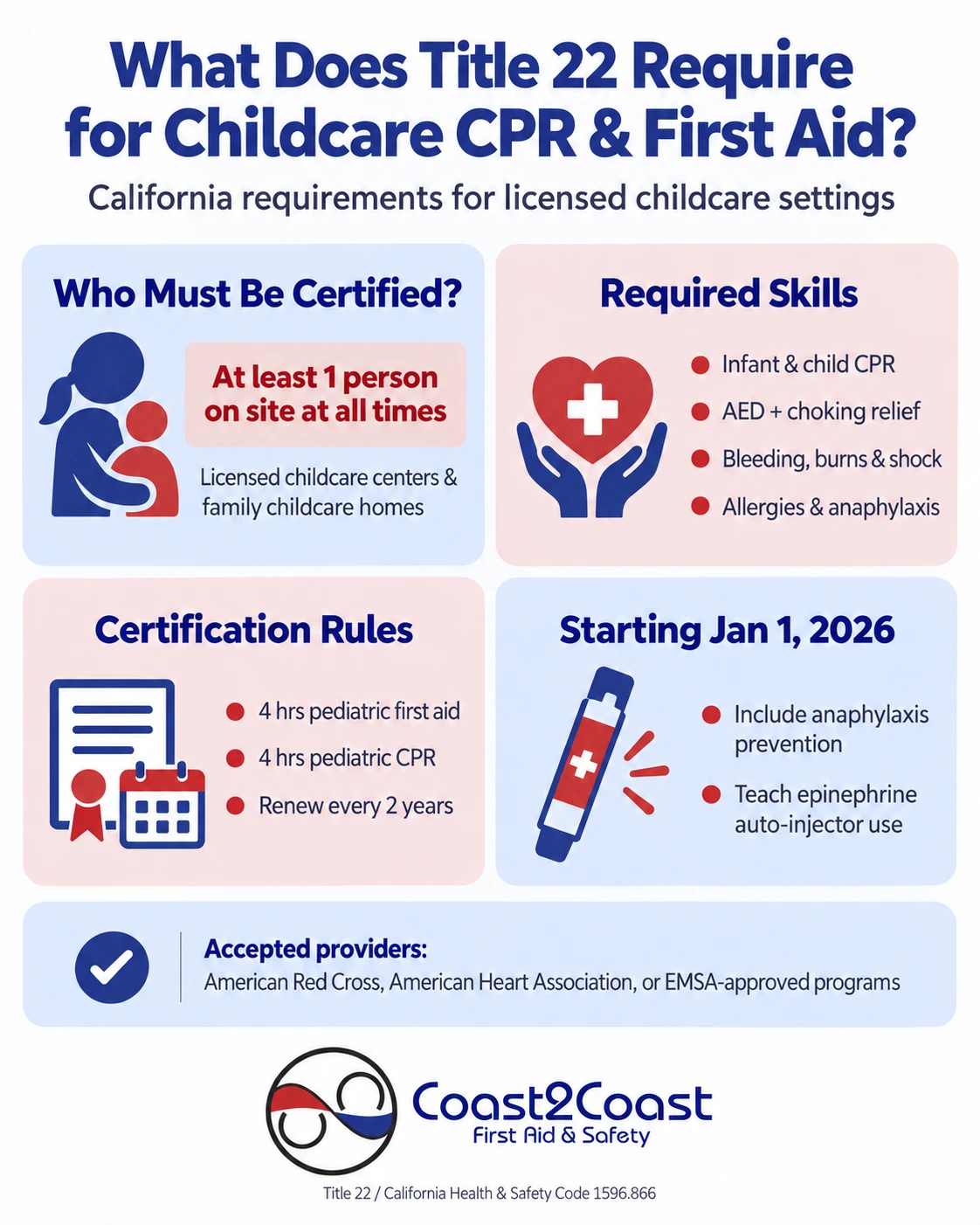
“Title 22” refers to the California Code of Regulations governing child care licensing, which sets health and safety training standards for licensed childcare centers and family childcare homes. Under California Health & Safety Code Section 1596.866, at least one person on site at all times must hold current pediatric first aid and pediatric CPR certification.

The required skills include:

  • Infant CPR and child CPR techniques.
  • AED use for pediatric emergencies.
  • Choking relief for conscious and unconscious victims.
  • First aid for bleeding, burns, shock, and common injuries.
  • Recognition and management of allergic reactions and anaphylaxis.
  • Basic life support concepts for medical emergencies.

These certifications must come from the American Red Cross, the American Heart Association, or a training program approved by EMSA. Initial courses must be at least eight hours total (four hours of pediatric first aid plus four hours of pediatric CPR), and certificates must be renewed every two years to remain valid.

Starting January 1, 2026, courses must also include prevention and treatment of anaphylaxis and the use of epinephrine auto-injectors.

For Directors

Certify Your Whole Childcare Staff On-Site

Book one group session at your center so every teacher meets the same Title 22 pathway.

Book Group Training

What Is EMSA-Approved Pediatric First Aid & CPR Certification?

EMSA is the California Emergency Medical Services Authority, the state agency that authorizes specific aid training programs to meet childcare licensing requirements. When you see “EMSA-approved” on a course listing, it means the provider has gone through a formal application process with EMSA, submitting curriculum details, instructor qualifications, and evaluation plans for review.

What makes a class EMSA-approved:

  • Curriculum content aligned with EMSA pediatric standards.
  • Minimum eight hours for initial certification (four hours first aid, four hours CPR).
  • In-person hands-on practice for CPR, AED, and first aid skills.
  • An instructor-to-student ratio of no more than 1:12 during skills practice.
  • No fully online course format for initial childcare certification.

EMSA approval is program- and provider-specific. A training center might offer both EMSA-approved childcare programs and other programs that are not EMSA-approved, all under the same brand. Not all EMSA-approved courses are AHA courses either. Some are built on American Red Cross curriculum instead. The approval itself is valid for two years and must be renewed by the training program.

See What Counts as Pediatric CPR

Make sure your course actually qualifies before you book.

Compare Course Types

What Is AHA Heartsaver Pediatric First Aid CPR AED?

The American Heart Association is a widely recognized authority in CPR certification, emergency cardiovascular care, and evidence-based guidelines for resuscitation, developed with input from cardiology and emergency medicine experts. Its Heartsaver courses are among the most widely recognized in the country.

The Heartsaver Pediatric First Aid CPR AED course is designed for childcare providers, teachers, babysitters, and parents who need pediatric-focused first aid and CPR AED skills. It covers pediatric CPR for infants and children, including responding to cardiac arrest, AED training and proper AED use on pediatric patients, choking relief techniques, pediatric first aid for common illnesses and injuries (bleeding, burns, allergic reactions, breathing difficulties), and safety and prevention strategies for childcare environments.

Course format options include traditional classroom instruction (approximately four hours) and blended learning (roughly three hours of online theory plus about 2.25 hours of in-person skills session). On successful completion, participants receive a two-year completion card.

Book AHA Heartsaver Pediatric or EMSA-Approved CPR

Both Title 22 pathways, with hands-on infant and child skills testing and 2026 anaphylaxis training.

View Pediatric CPR Courses

Does AHA Heartsaver Pediatric Automatically Meet EMSA / Title 22?

Here’s the nuance many childcare providers get tripped up on. AHA Heartsaver Pediatric First Aid CPR AED is formally recognized by California’s Emergency Medical Services Authority as equivalent to an EMSA-approved course. It’s specifically exempt from needing the EMSA sticker. But the course still needs to be the correct pediatric-specific version, not a generic adult Heartsaver CPR/AED or Heartsaver First Aid course.

Compliance Note: When shopping for a course, look for explicit phrases such as “AHA Heartsaver Pediatric First Aid CPR AED” or “EMSA-approved Pediatric First Aid & CPR for Child Care Providers.” If the listing only says “CPR/AED” or “First Aid” without the pediatric-specific wording, or if it’s a Heartsaver course built for general workplace audiences, it likely won’t satisfy your licensing requirement. Always contact your California Community Care Licensing analyst to confirm acceptance before enrolling if you have any doubt.

AHA Heartsaver Pediatric vs EMSA Courses: Key Differences

Aspect AHA Heartsaver Pediatric EMSA-Approved Pediatric First Aid & CPR
Regulatory role AHA provides curriculum and certification; formally recognized as a Title 22 equivalent EMSA approves which courses satisfy California childcare licensing directly
Sticker requirement Exempt, no EMSA sticker needed Requires the EMSA sticker on the completion card
Initial course length ~4 hours classroom or ~5.25 hours blended Minimum 8 hours (4 hours first aid + 4 hours CPR)
Course format Classroom or blended (online + in-person skills) In-person or hybrid; no fully online option
Certificate wording “Heartsaver Pediatric First Aid CPR AED” References EMSA or “Pediatric First Aid & CPR for Child Care Providers”
Skills testing Required in both formats Required; instructor-to-student ratio capped at 1:12
Card validity 2 years 2 years
Anaphylaxis content (2026+) Included in updated pediatric course Mandatory under updated EMSA standards

The critical takeaway: these are two different accepted pathways with different hour requirements and different documentation standards, not one course dressed up two ways. Make sure you’re booking the right one for your specific role and check that it’s the pediatric-specific version either way.

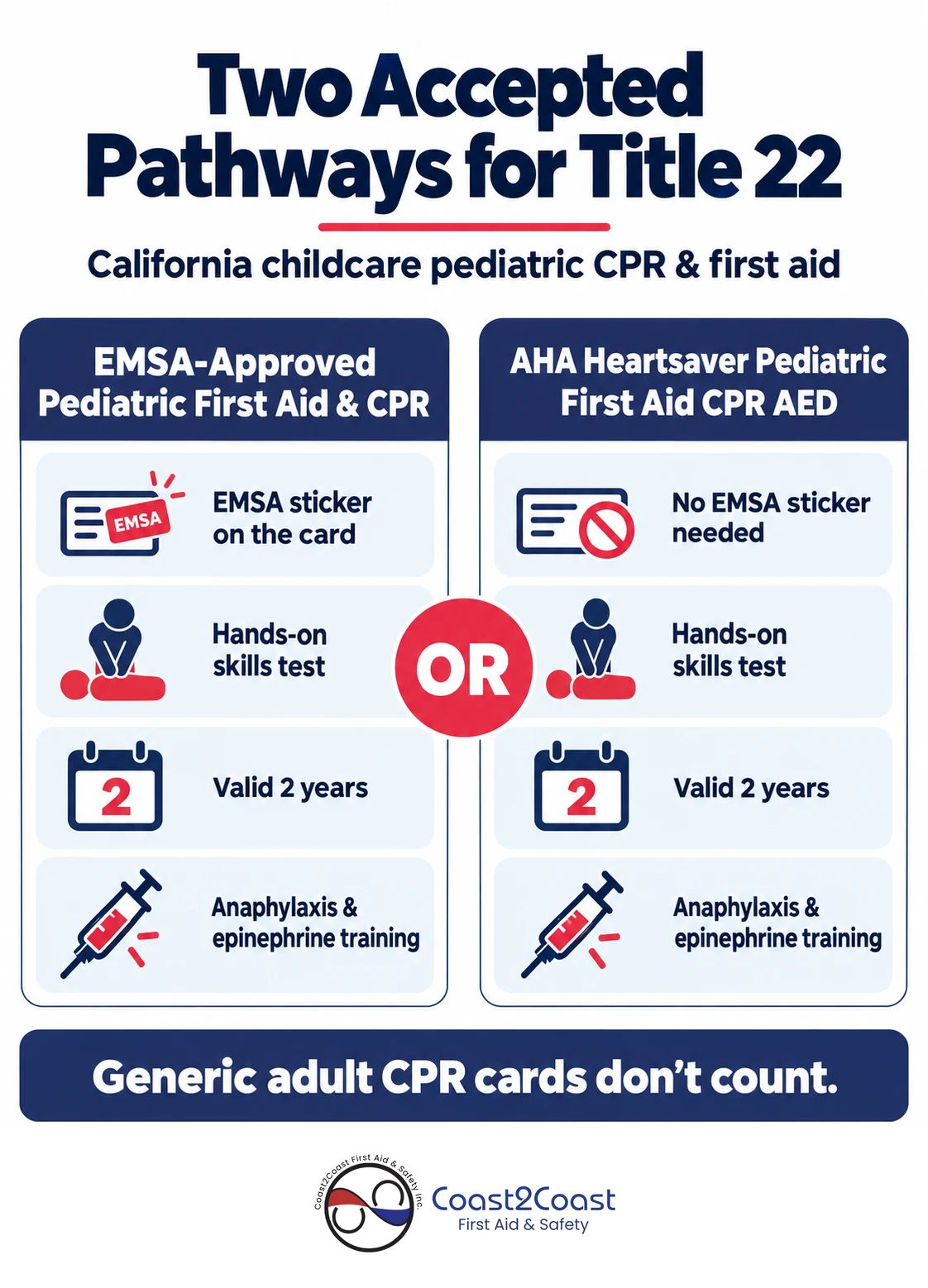
Two Title 22 pathways for California childcare CPR: EMSA-approved pediatric course or AHA Heartsaver Pediatric

Which Certification Does Title 22 Accept for Childcare Providers?

What Does Title 22 Require for Childcare CPR & First Aid

Both. Title 22 accepts EMSA-approved Pediatric First Aid and CPR for childcare providers, and it separately accepts AHA Heartsaver Pediatric First Aid CPR AED as a recognized equivalent.

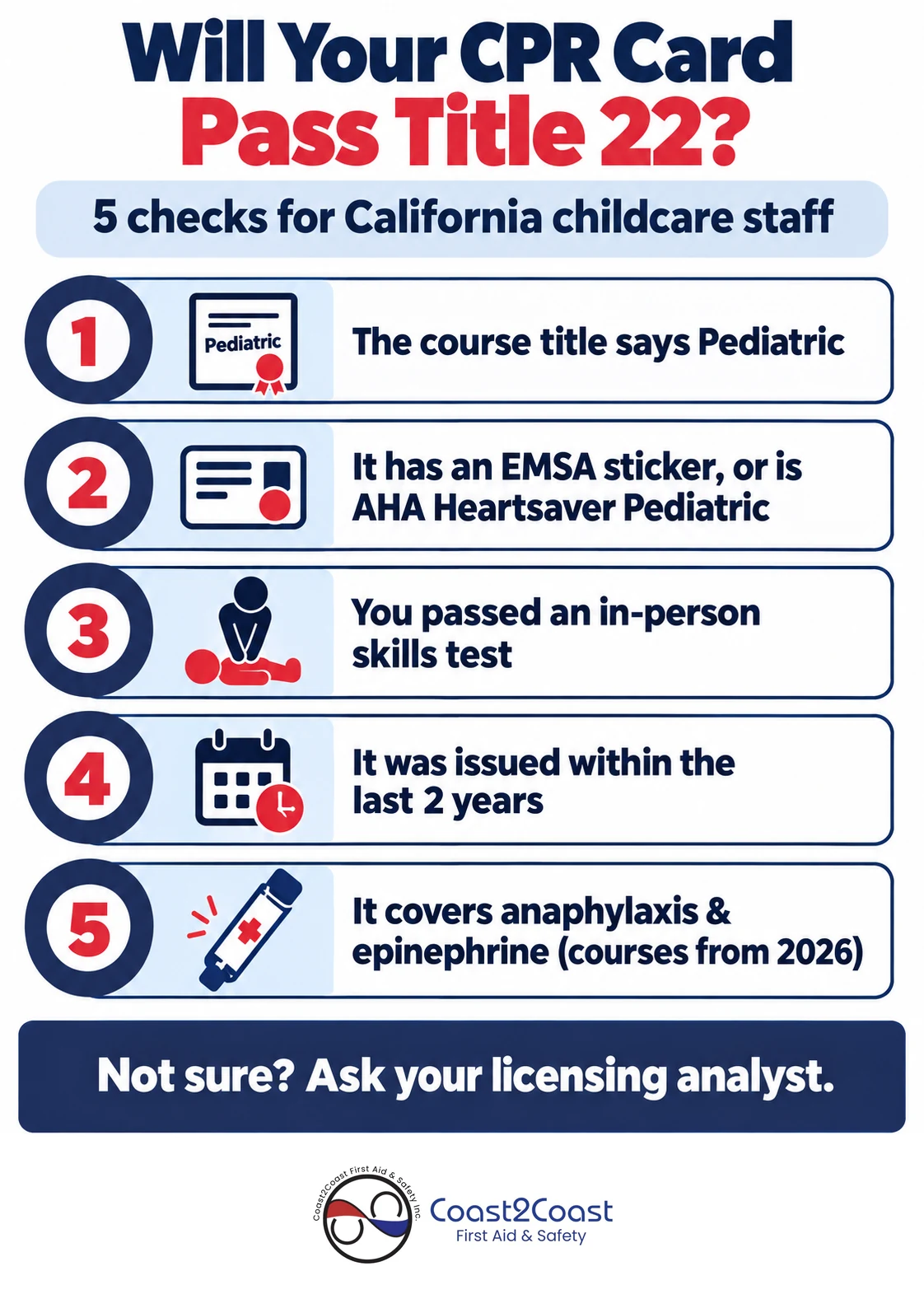
California Child Care Licensing looks for either the EMSA sticker and approval language, or the specific “Heartsaver Pediatric First Aid CPR AED” course title from AHA. A generic CPR AED card from another organization, or an adult-only workplace course, will not satisfy Title 22 regardless of which brand issued it.

If you’re an out-of-state or international learner planning to work in California childcare, you should deliberately choose one of these two pathways when scheduling your classes. A generic aid CPR AED card from another state or country will likely not satisfy Title 22.

How to Verify That a Course Is EMSA-Approved

Verifying approval before registering saves time, money, and licensing headaches. Check the EMSA website’s list of approved pediatric first aid and CPR training programs by organization name and region, or confirm the specific course title is “AHA Heartsaver Pediatric First Aid CPR AED.” Ask the training provider directly whether the class is EMSA-approved or the qualifying AHA course for California Title 22 childcare. Confirm that in-person skills practice is included, course length meets the applicable minimum, and the certificate validity period is two years. Check whether the course includes anaphylaxis and epinephrine auto-injector training, which is now required. If you already hold a card and are unsure, contact your local California Community Care Licensing office with a copy for verification.

Title 22 CPR card checklist for California childcare staff: pediatric title, EMSA sticker or AHA Heartsaver, 2 years

Read Our EMSA Sticker Guide

When you need the sticker, and when an AHA card is enough.

See the Sticker Guide

Who Should Take Each Course Type?

California licensed childcare providers, including daycare staff, preschool teachers in licensed centers, and after-school childcare employees, generally must take either an EMSA-approved pediatric course or the AHA Heartsaver Pediatric course specifically. This is a non-negotiable licensing requirement.

Babysitters, nannies, parents, and K-12 school staff outside licensed childcare settings may choose AHA Heartsaver Pediatric, other Heartsaver courses, or similar first aid course options depending on employer requirements.

Healthcare providers such as RNs, EMTs, and paramedics typically need Basic Life Support certification or ACLS rather than EMSA childcare-specific training, though they may add pediatric first aid training if working closely with young children.

Course Format Options: In-Person, Blended, and Online

In-person classroom courses, whether EMSA-approved or AHA Heartsaver Pediatric, are instructor-led and include hands-on practice with manikins and AED trainers, giving participants experience with real-world scenarios such as a choking infant or a child in cardiac arrest. This format satisfies all requirements for both pathways.

Blended learning combines online theory with a required in-person skills session. AHA offers this for Heartsaver Pediatric, and some EMSA-approved providers use this model too. The key is that the in-person portion must cover CPR, AED skills, and first aid instruction with adequate time, and must be delivered by a provider recognized for that specific course.

Online-only CPR or first aid certification (no in-person testing) is generally not accepted for California childcare Title 22, even if the course advertises an “instant card” or “fast first aid course.” Both accepted pathways require skills demonstration with instructors present.

How Coast2Coast Delivers Both Options in California

Coast2Coast First Aid & Aquatics is an authorized provider delivering both EMSA-approved Pediatric First Aid & CPR and AHA Heartsaver Pediatric certification directly across California.

If you’re deciding between the two pathways, our team can help you confirm which one your specific employer or licensing analyst expects, and get you booked into the correct course rather than guessing. Whether your role calls for the 8-hour EMSA-approved course or the AHA Heartsaver Pediatric format, we deliver both with the mandatory hands-on skills session included.

If you hold a pediatric CPR certification from another state or country and plan to work in California childcare, it likely isn’t listed on EMSA’s approved programs for Title 22 compliance, but you don’t need to search for a separate California provider once you’re here: Coast2Coast can complete either the EMSA-approved course or the AHA Heartsaver Pediatric course for you directly.

New · AI Study Tool
Coasty mascot — Coast2Coast AI First Aid and CPR tutor

Coasty

North America's first AI-powered First Aid & CPR tutor, part of the Coast2Coast First Aid Student Companion app. Coasty explains First Aid, CPR/AED, BLS, and course concepts in simple language so you can review topics, take quizzes, and build confidence before, during, and after class. It works alongside your instructor and official Canadian Red Cross materials to support your learning.

Meet Coasty →

Renewal, Recertification, and Keeping Skills Current

Regular recertification is not just a checkbox for licensing. It directly affects how well a person can respond to a real pediatric emergency. Skill decay is real, and refreshing your knowledge of CPR, first aid, and AED use keeps you ready to provide professional help when seconds matter.

Both EMSA-approved pediatric first aid and CPR and AHA Heartsaver Pediatric certifications remain valid for two years. After that, a renewal or full course is required, and under EMSA rules, renewal courses must still total at least eight hours for that specific pathway.

To stay in compliance, schedule recertification before your card expires to avoid licensing gaps, and consider informal practice or workplace drills every six to twelve months to maintain confidence between formal renewals.

Practical Steps to Choose the Right Pediatric CPR & First Aid Course

For California licensed childcare providers: confirm you’re in a Title 22-licensed role (daycare, licensed preschool, family childcare home), check whether your employer or licensing analyst has a preference between the EMSA-approved and AHA Heartsaver Pediatric pathways, ensure the course title mentions the pediatric-specific wording for whichever pathway you choose, confirm in-person skills practice is included, and verify the course covers anaphylaxis and epinephrine auto-injectors (required from January 2026).

For non-licensed caregivers, parents, and youth leaders: focus on reputable brands with hands-on practice and relevant pediatric content, and choose a first aid training course that matches your actual setting (home, school, camp).

Regardless of where you are, the well-being of the children in your care depends on having current, practical knowledge and the confidence to use it.

Key Takeaway

Title 22 accepts two distinct pathways: the 8-hour EMSA-approved Pediatric First Aid & CPR course, or the specific AHA Heartsaver Pediatric First Aid CPR AED course, exempt from the EMSA sticker but still requiring the pediatric-specific title and a real in-person skills check. Neither a generic adult CPR card nor a workplace-focused Heartsaver course satisfies the requirement. Confirm which pathway your employer expects, and book the correct one the first time.

Get Certified

Get Started with California Certification

Find the right course level and book with a 99.9% pass rate.

Get Started

FAQ

Q1: Is an online-only AHA Heartsaver Pediatric course enough for California Title 22?

A: No. An online-only AHA Heartsaver Pediatric course with no in-person skills session is generally not acceptable for California childcare Title 22 compliance. Both accepted pathways require hands-on training and skills testing for CPR, AED, and first aid. If you choose a blended AHA course, the in-person portion must include a real skills check. A fully online “instant card” offering will not meet licensing requirements regardless of the brand behind it.

Q2: How can I tell if my current AHA Heartsaver Pediatric card is accepted for Title 22?

A: Check that the course title specifically says “Heartsaver Pediatric First Aid CPR AED,” not a general adult CPR/AED or Heartsaver First Aid card. If your card is the correct pediatric-specific version and included the required in-person skills session, it should be accepted without needing an EMSA sticker. If you’re still unsure, contact your California Community Care Licensing office with a copy of your card for verification.

Q3: Do school teachers in K-12 settings need EMSA-approved pediatric certification?

A: Requirements differ significantly. Many K-12 teachers are not subject to the same Title 22 childcare rules and may only need CPR AED or standard first aid certification depending on their school district’s policy. Check with your school district HR department or safety officer to confirm exactly which certification they require, as some districts have their own specific mandates.

More FAQs: Cross-Border and Ongoing Practice

Q4: Can I use a pediatric first aid certification from another state or country to work in California childcare?

A: Certifications from other states or countries may meet the standards where they were issued, but California EMSA does not generally list out-of-state or foreign training programs as approved for Title 22 childcare roles. If you’re relocating to California and plan to work in a licensed childcare setting, plan to complete either an EMSA-approved Pediatric First Aid and CPR course or an AHA Heartsaver Pediatric course after arrival. Confirm with your Community Care Licensing analyst before your start date.

Q5: How often should childcare providers refresh pediatric CPR and first aid skills even if the card is still valid?

A: While your certification is valid for two years, many safety experts recommend informal refreshers or practice sessions every six to twelve months. Skill retention for low-frequency but high-stakes events like pediatric cardiac arrest drops significantly without reinforcement. Combining formal recertification with periodic practice is the most effective way to ensure you can respond confidently when a child’s safety depends on your assistance.

This article is for general educational purposes only. Confirm current requirements with Community Care Licensing or EMSA before enrolling in a course or submitting a license application.

Reviewed By: Ashkon Pourheidary, B.Sc. Hons Neuroscience, Co-Founder of Coast2Coast First Aid & Aquatics and Canadian Red Cross Instructor Trainer since 2011.

Source: California Emergency Medical Services Authority (EMSA)

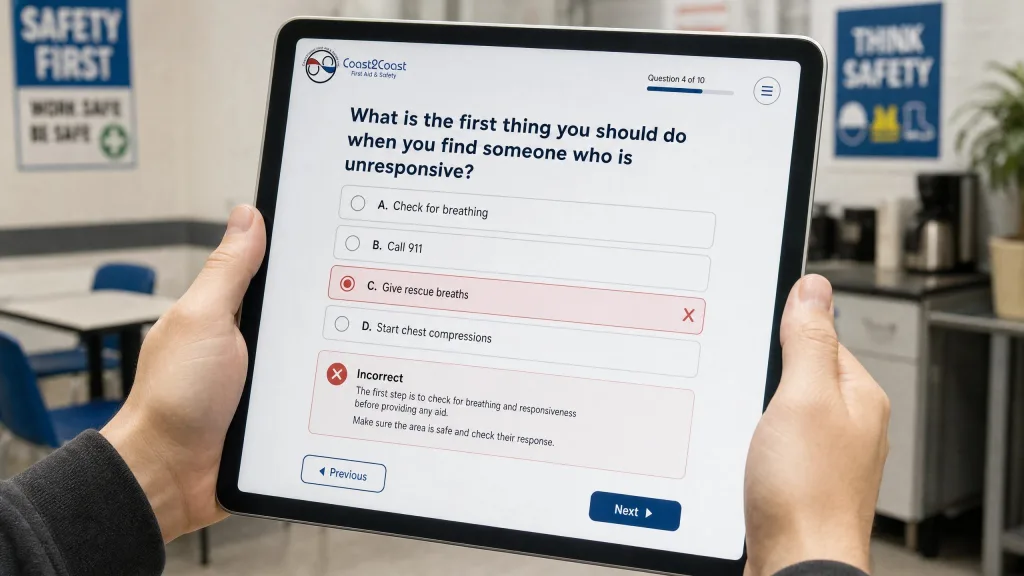
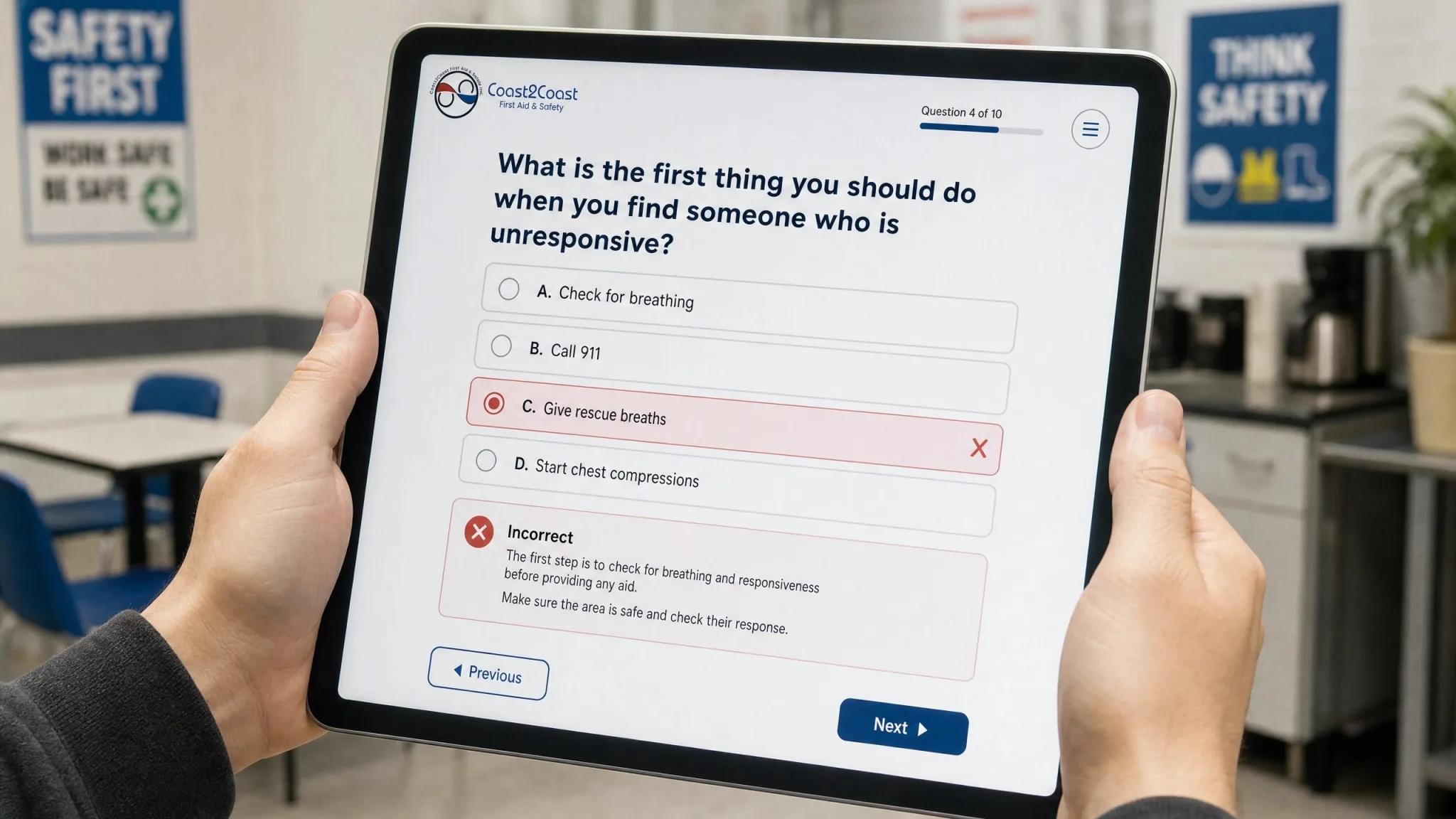
I Failed My First Aid Quiz: What Happens Next?

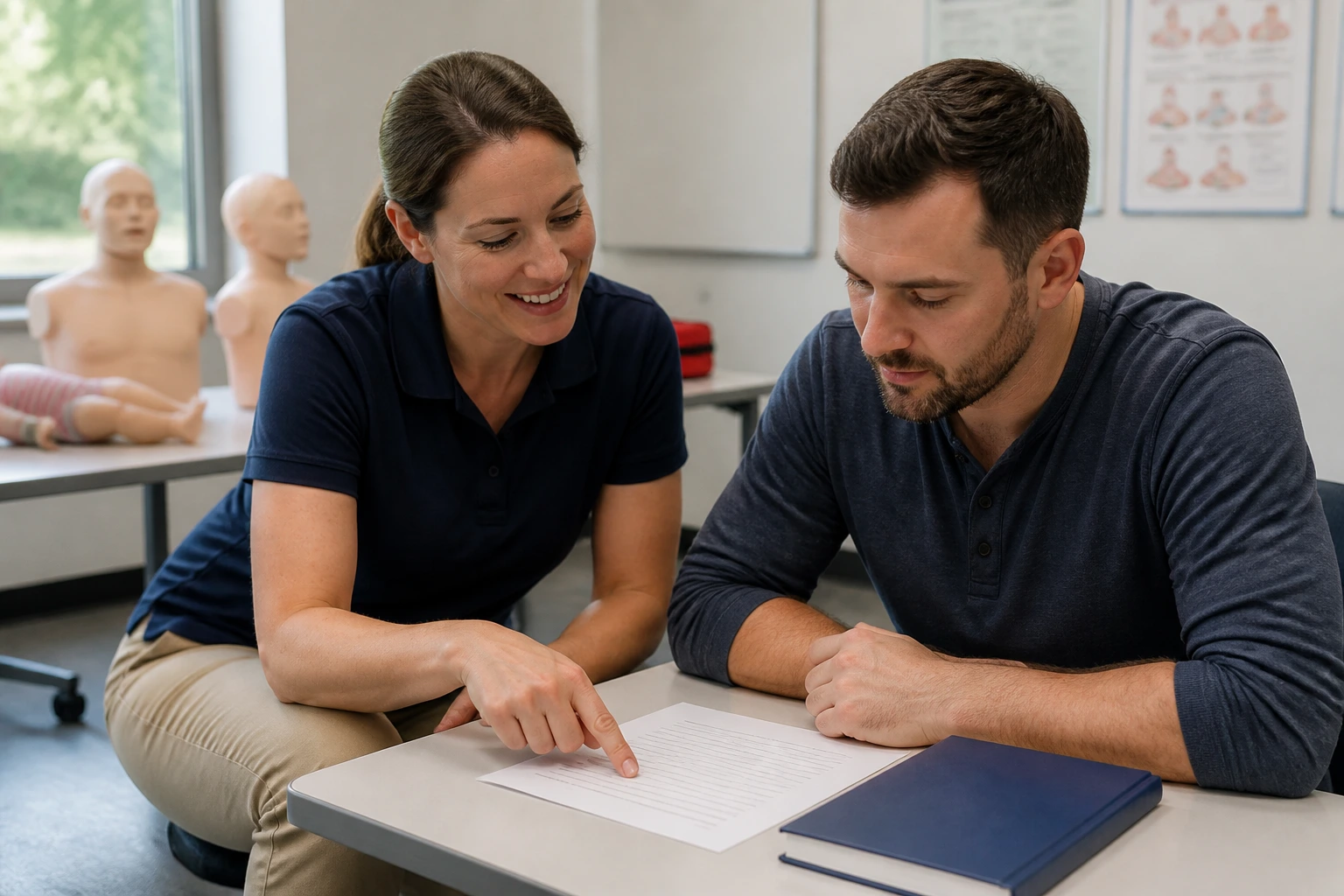
Instructor Helping Student
Failing a written quiz does not mean failing the course. Instructors typically review the material and offer a re-test immediately to ensure comprehension.
Find A Course

Build First Aid Knowledge That Actually Sticks

Hands-on practice is what makes a written quiz feel easy.

Explore First Aid Courses

150,000+
Students Certified Since 2011
3 Goals
Preserve Life, Prevent Deterioration, Promote Recovery
80%
Typical Passing Score on a First Aid Quiz

Your quiz comes back and there’s a number on it that isn’t what you hoped for. Your stomach drops. Maybe you glance around the room wondering if anyone else saw. The thought that follows is almost always the same: “Does this mean I failed the whole course?”

It doesn’t. A missed quiz score is one data point in a course built to make sure you actually retain what you learned, not a verdict on whether you belong in the room.

Key Takeaways

  • Failing a first aid quiz is common and does not mean failing the course.
  • Instructors typically review missed material and offer a retest, often the same day.
  • A first aid quiz tests knowledge of emergency response principles, not memorization tricks.
  • The three primary goals of first aid are to preserve life, prevent deterioration, and promote recovery.
  • The written quiz and the hands-on skills test are usually assessed and completed separately.

Why Failing a First Aid Quiz Feels Bigger Than It Is

Nobody sits down for a first aid quiz feeling neutral about it. You’ve spent hours in a first aid class learning how to help someone in a medical emergency, and a quiz can feel like a referendum on whether you’re actually capable of doing that. That worry is understandable, but it’s based on a misread of what the quiz is actually for.

A first aid quiz exists to check your first aid knowledge before you leave the room, not to gatekeep who gets to help. If a question trips you up, that’s the system working exactly as intended. It caught a gap while you’re still sitting next to an instructor who can close it, instead of leaving that gap to surface for the first time in a real medical emergency.

The first step to feeling less anxious about a missed question is separating “I got this wrong” from “I am not capable.” Those are two very different statements, and only the first one is actually true.

Instructor Helping Student


What Actually Happens After You Fail

Here’s the practical sequence, in plain terms.

Your instructor reviews which questions you missed and why. Most quizzes aren’t pass/fail with no explanation attached, a good one gives you a score and tells you exactly which topic each missed question was testing. That distinction matters: a wrong answer on a choking question and a wrong answer on a burns question point you toward two completely different sections of the material to revisit.

From there, your instructor typically walks through the correct answer and the reasoning behind it. This isn’t a formality, it’s the actual point of the exercise. Then you get another attempt, often the same day, sometimes after a short break to review the specific topic that tripped you up.

Completing the retest correctly is what unlocks your certification, alongside the hands-on skills portion, which is usually assessed separately from the written quiz. One low score on your first attempt doesn’t sit on your permanent record. What matters is that you understand the material by the time you finish the course.

Why Instructors Quiz You in the First Place

A quiz isn’t there to catch you out. It’s there to test your knowledge of emergency response principles in a low-stakes setting, so any gaps get fixed before they matter.

Think of it as a quiz summary of your entire first aid class rather than a separate hurdle. If you can correctly work through scene safety, choking, bleeding, and CPR questions on paper, you’re far more likely to work through them correctly under pressure. That’s really what “test your knowledge” means here, confirming the material is there before you need it for real.

Common First Aid Quiz Topics: What to Expect

Most first aid quizzes draw from the same core set of topics. Reviewing them here won’t replace your course material, but it will help you see the shape of what’s typically being tested.

Scene Safety and the Primary Survey

Always check that the scene is safe before helping an injured person. It’s important to secure the scene before rendering first aid, checking for hazards like traffic, fire, or unstable structures before you approach. From there, the primary survey follows the sequence taught in your Coast2Coast course: check for danger, check the person’s response, check their airway, check their breathing, check circulation. The recovery position is used for someone who is unconscious but breathing, it keeps the airway clear while you wait for help. Wearing gloves is important when administering first aid if they’re available.

Choking

The universal sign for choking is clutching the throat with one or both hands. If someone is coughing forcefully, encourage them to keep coughing, forceful coughing is often the body’s own way of clearing an airway. Only intervene with back blows or abdominal thrusts if the cough becomes weak or silent.

CPR and Using an AED

Immediate CPR is required for someone who is unconscious and not breathing normally. Chest compressions and rescue breaths follow the ratio taught in your course, pushing hard and fast on the chest, and an AED should be applied as soon as one is available. Most AED units guide you through pad placement with voice prompts once turned on. CPR certification is essential for emergency responders and anyone who wants to act confidently and correctly in the moments before paramedics arrive. Call 9-1-1 for any life threatening emergency before starting CPR, or have someone else call while you begin.

student cpr


Heart Attack and Stroke Warning Signs

Heart attack symptoms often include chest pressure or pain, discomfort spreading to the arm, jaw, or back, shortness of breath, and sometimes nausea or fatigue rather than obvious chest pain. Signs of a stroke, sudden weakness on one side of the face, arm, or leg, along with slurred speech, are another common quiz topic. Both are life threatening, and both require an immediate call to 9-1-1, not a wait-and-see approach.

Severe Bleeding and Shock

Applying direct pressure is the first step to control heavy bleeding, use a clean cloth and maintain firm, steady pressure over the wound. If someone is bleeding heavily, direct pressure is more important than elevating the limb, elevation can help but should never come at the cost of maintaining pressure. Watch for signs of shock, pale or clammy skin, rapid breathing, weakness, and keep the person warm and lying down if it’s safe to do so.

Burns

Cool a burn under cool running water for at least 10 minutes, longer for more severe burns. Alcohol or butter should not be applied to burns for treatment, despite the old advice you may have heard. Cover the burn loosely once it’s been cooled, and never apply ice directly to a burn, ice is reserved for a different category of injury entirely.

Head Injuries

Any head injury involving loss of consciousness, confusion, or vomiting needs urgent medical attention. Even when someone insists they feel fine, monitor closely for worsening symptoms, encourage rest, and don’t let them dismiss it just because there’s no visible wound.

Severe Allergic Reactions

Always ask about allergies when assessing a casualty for first aid. Severe symptoms of an allergic reaction can include swelling of the face or throat and difficulty breathing, this is anaphylaxis, and it’s life threatening. If the person has an epinephrine auto-injector, help them use it and call 9-1-1 immediately.

Sprains and Strains: The R.I.C.E. Method

The acronym R.I.C.E. stands for Rest, Ice, Compression, and Elevation. Rest the injured area, apply ice to reduce swelling, use compression with a bandage, and elevate the limb above heart level where possible.

What Belongs in a First Aid Kit

A first aid kit should contain essential items for treating injuries: sterile dressings, adhesive bandages, gauze, gloves, a triangular bandage, scissors, and any personal medications a workplace or household regularly needs on hand.

Compliance Note: Under OSHA’s first aid standard (29 CFR 1910.151), employers are required to ensure that trained first aid providers are available in the workplace in the absence of timely medical assistance. A quiz retake does not extend your certification timeline — your certificate is only issued once both the written and practical portions are successfully completed.

Quick Knowledge Check

Try these before you look at the answers. This isn’t a substitute for your course quiz, just a way to see where your recall stands right now.

  1. What’s the universal sign for choking?
  2. How long should you cool a minor burn under running water?
  3. What should you check for before approaching an injured person?
  4. What does the acronym R.I.C.E. stand for?
  5. Should you elevate a heavily bleeding limb before or after applying direct pressure?

Answers: 1) Clutching the throat with one or both hands. 2) At least 10 minutes. 3) That the scene is safe. 4) Rest, Ice, Compression, Elevation. 5) After, direct pressure comes first.

If you got most of these right, your instincts are solid, the retest is just a formality. If a couple caught you off guard, that’s useful information, not a bad sign, now you know exactly what to review.

Safety Tip: If a topic on the quiz genuinely confuses you, don’t guess and move on. Ask your instructor to walk through it before you leave class. A few minutes of clarification now is far more useful than uncertainty in a real emergency later.

How to Prepare for a Retest Without Spiraling

Give yourself a few minutes before you attempt the retest, not to cram, but to breathe and re-center. Reread the specific section tied to whatever you got wrong rather than re-reading the entire manual, focused review beats panicked review every time.

If your instructor offers to walk through the material with you, take them up on it. This is exactly the kind of support instructors are trained to give, and asking for it is a sign of good judgment, not weakness.

Why This Matters Beyond the Classroom

First aid training is essential for workplace safety, and employers must comply with health and safety regulations that require certified first aiders on-site. That’s part of why the quiz exists: it’s not busywork, it’s confirmation that the knowledge is actually there when it’s needed. First aid training can save lives in emergencies, and a quiz you retake and pass properly is worth more than one you scraped through on a lucky guess.

If you’re taking this course through your CPR/AED training or an Intermediate First Aid course, the same principle applies whether you’re brand new or coming back for recertification: a retest isn’t a setback, it’s the process doing its job.

Learn These Skills Hands-On, Not Just on Paper

BLS training builds the same confidence a quiz can only test.

Find a BLS Class

Bring Consistent First Aid Standards to Your Workplace

Group training keeps your whole team certified and compliant together.

Train Your Team

Key Takeaway

Failing a first aid quiz is common and does not disqualify you from certification. A quick review and retest, often the same day, is the normal process, and understanding why an answer was wrong matters far more than the score itself.

Get Certified

Join 150,000+ Students Who Are Certified

Find a class near you and take the first step today.

Find a Location Near You

Frequently Asked Questions: Failing a First Aid Quiz

Q1: Will failing a quiz affect my final certification or show up on my employer’s record?

A: No. Certification is based on successfully completing the course overall, including a passed quiz and skills assessment, not on your very first attempt at either. Employers generally only see whether you hold a valid, current certificate. Instructors don’t report individual quiz attempts unless a workplace specifically arranges that kind of internal reporting, which is uncommon for standard course enrollment.

Q2: How many times can I retake a first aid quiz if I don’t pass?

A: Policies vary slightly by course and instructor, but most allow at least one immediate retest after reviewing the missed material, and instructors will work with you further if a second attempt still doesn’t go well. The goal is genuine comprehension, not limiting your attempts. If you’re unsure of the specific policy for your class, ask your instructor directly at the start of the day.

Q3: What’s a passing score on a typical first aid quiz?

A: Most recognized providers, including the American Heart Association and the American Red Cross, require a minimum score of 80% on the written evaluation. Your instructor will confirm the exact threshold for your specific course. The number matters less than making sure you understand the reasoning behind any question you missed.

Q4: Do I need to retake the entire course if I fail the quiz?

A: No. A failed quiz typically leads to a focused review and a retest, not a full course repeat. Retaking the entire course from scratch is reserved for much rarer situations, like missing significant class time. For the vast majority of students, a quiz stumble is resolved within the same session.

Q5: What topics are most commonly covered on a first aid quiz?

A: Expect questions on scene safety, the primary survey, choking, CPR and AED use, severe bleeding, shock, burns, head injuries, and severe allergic reactions. Course-specific quizzes may also include sprains, strains, and first aid kit contents. These topics map directly to the skills you’ll practice hands-on during the course.

Q6: Is the quiz open-book or closed-book?

A: This depends on the course and instructor, some quizzes are closed-book to test recall under simulated pressure, while others allow reference materials since the goal is comprehension rather than memorization. Ask your instructor at the start of class so you know what to expect and can prepare accordingly.

Q7: What should I do if I’m feeling too anxious to focus during the quiz?

A: Pause, take a slow breath, and read the question again rather than pushing through in a rush. If your mind goes blank on a specific question, move on and come back to it once you’ve regained focus. Letting your instructor know you’re feeling anxious before the quiz starts can also help, they can offer a quieter space or a few extra minutes if needed.

More FAQs: Retesting and Moving Forward

Q8: Can I ask my instructor for extra help before retesting?

A: Yes, and it’s encouraged. Instructors expect students to ask questions about material they found confusing, that’s part of what the review period between attempts is for. Asking for help is a sign that you’re taking the material seriously, not a sign that you’re behind.

Q9: What if I fail the quiz a second time?

A: A second missed attempt usually leads to a more focused, one-on-one review with your instructor before a further retest. It’s uncommon, but it happens, and instructors are equipped to work through it with you rather than treat it as a dead end. The goal remains the same: making sure you genuinely understand the material before you finish the course.

Q10: Does a low quiz score mean I’m not cut out for first aid work?

A: No. A quiz score reflects how well you recalled specific material on a specific day, not your overall capability or character. Many capable, confident first responders struggled with a written quiz at some point in their training. What matters is that you close the gap before you leave the course, and the retest process exists specifically to help you do that.

Q11: Will recertification quizzes be harder than my first course?

A: Not necessarily harder, but they will assume you already have a working foundation, so pacing may feel quicker. If it’s been a while since your last course, a bit of review beforehand can help close any gaps that opened up over time. Recertification is designed to refresh and confirm your knowledge, not to introduce entirely new material.

Q12: How can I study effectively between the quiz and the retest?

A: Focus specifically on the topic tied to each question you missed rather than rereading the whole manual. Try explaining the concept out loud in your own words, if you can teach it back clearly, you likely understand it well enough for the retest. A short, focused review beats a long, unfocused one every time.

Q13: What if English isn’t my first language and the wording is confusing?

A: Let your instructor know. Many instructors can rephrase a confusing question, clarify unfamiliar terms, or give you a bit more time to work through the language itself. The quiz is meant to test your first aid knowledge, not your vocabulary, and instructors generally want to remove that barrier wherever they can.

Q14: Are practical skills assessed separately from the written quiz?

A: Yes. Most courses assess your hands-on skills, like CPR technique or bandaging, separately from the written quiz. Struggling with one doesn’t automatically affect the other, and instructors evaluate both to get a complete picture of your readiness, not just a single score.

Q15: How soon after failing can I retake the quiz?

A: Often the same day, right after a short review of the material you missed. Some courses build in a brief pause to let the correction sink in before you try again. The exact timing depends on your specific course structure, so check with your instructor if you’re unsure.

This article is for general educational purposes only and does not replace certified first aid, CPR, or mental health training. In a medical emergency, call 9-1-1 or your local emergency number immediately.

Reviewed By: Ashkon Pourheidary, B.Sc. Hons Neuroscience, Co-Founder of Coast2Coast First Aid & Aquatics and Red Cross Instructor Trainer since 2011.

Source: OSHA, First Aid Standard (29 CFR 1910.151)

Personal Trainer CPR Certification: What California Trainers Need to Know

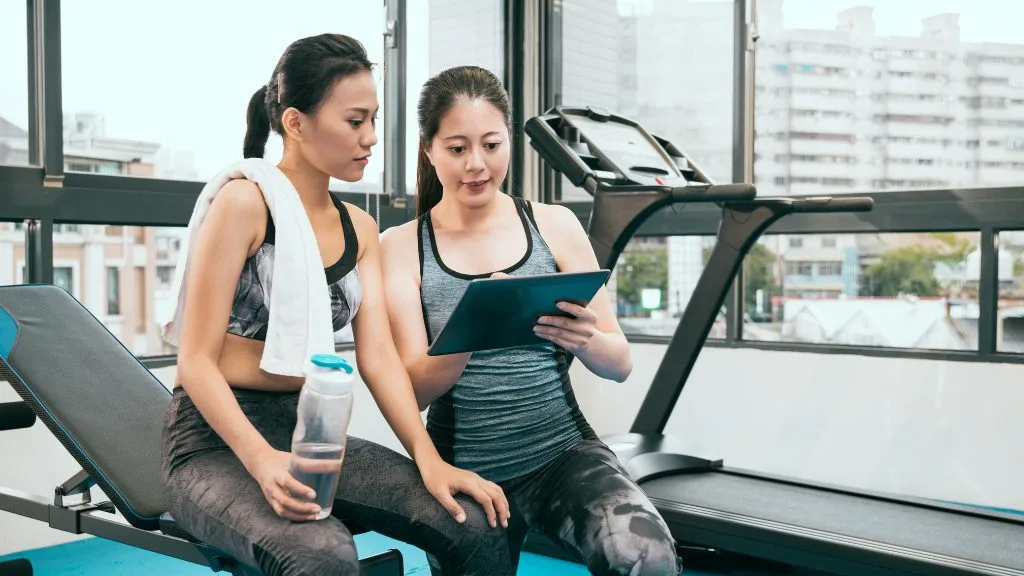
Fitness Instructor

California does not license personal trainers, but nearly every NCCA-accredited certifying body, including NASM, ACE, ACSM, and ISSA, requires current Adult CPR/AED certification before candidates can test or work with clients. Some employers also require Pediatric CPR/AED for trainers who work with families or youth. In practice, CPR/AED certification functions as the industry’s real entry requirement, even though no government license exists.

CPR / AED Training

Get Adult & Pediatric CPR/AED Certified

Meet your certifying body’s requirement with a hands-on course built for fitness professionals across California.

View CPR/AED Courses

$5B+
Estimated size of California’s fitness market in 2023
15,000+
Fitness-related businesses operating across California
$73,421
Average annual salary for a personal trainer in California

Personal trainers in California don’t need a state license, but nearly every major certifying body and gym still requires current CPR and AED certification before you can train clients. Whether you’re studying for NASM, ACE, ACSM, or ISSA, CPR/AED is one prerequisite you can’t skip. This guide covers licensing rules, CPR/AED requirements by certifying body, regional considerations across California, and answers to the questions trainers ask most before booking a course.

Do Personal Trainers Need a License in California?

No. California does not require a state-issued license to work as a personal trainer, unlike professions such as physical therapy or nursing. That doesn’t mean the field is unregulated in practice, though. Most gyms, studios, and liability insurers won’t hire or cover a trainer without an accredited personal trainer certification and a current CPR/AED credential. In effect, certification plus CPR/AED functions as the industry’s real barrier to entry, even without a government license behind it.

What CPR Certification Do Personal Trainers Need?

Personal trainer certification requirements almost universally include CPR training and AED certification at the Adult level. Every NCCA-accredited body, including NASM, ACE, ACSM, ISSA, and NSCA, requires a valid Adult CPR/AED certification before candidates can sit for their exam, and every certified personal trainer must keep it current throughout their career. It’s one of the most commonly overlooked requirements, since candidates tend to focus on studying for the certification exam itself.

First Aid Instructor

CPR/AED Requirements by Certifying Body

Each major certifying body sets its own timeline for CPR/AED, though the baseline requirement is consistent across the industry.

  • NASM: The National Academy of Sports Medicine requires a valid CPR/AED certification before candidates are eligible to sit for the NASM Certified Personal Trainer exam.
  • ACE: The American Council on Exercise has the same baseline expectation, requiring current CPR/AED at both initial certification and every two-year renewal.
  • ACSM: The American College of Sports Medicine tightened its policy in 2022, removing the grace period that once allowed candidates to test before completing CPR/AED training. Candidates must now finish CPR/AED before scheduling an ACSM exam.
  • ISSA: ISSA’s requirements follow the same pattern: a high school diploma or GED, current CPR/AED certification, and a passing exam score.

Personal Trainer Certification California: What the Requirements Look Like

Outside of the CPR/AED requirement, certification rules in California mirror the rest of the country. Candidates generally need to be at least 18 years old, hold a high school diploma or GED, and complete an NCCA-accredited certification program. These programs are widely available online and in person, and many trainers study online before scheduling the required in-person CPR/AED skills session. This is true for every personal trainer in California, regardless of which certifying body they choose.

Do You Need Pediatric CPR Too?

Adult CPR/AED covers the baseline requirement almost everywhere, but some employers ask for more. Trainers working at family-oriented gyms, youth sports programs, or facilities that also serve children may be asked to complete Pediatric CPR training in addition to Adult certification. Check with your employer or certifying body before assuming Adult-only coverage is enough, since requirements can vary by facility.

Safety Tip: If your gym serves both adults and children, in the same facility or across different class times, ask specifically whether Pediatric AED pad placement and compression depth differ from what you learned in your Adult course. The techniques are related but not identical.

Where to Get CPR/AED Certified in California

Coast2Coast offers Adult and Pediatric CPR certification courses designed for personal trainers and fitness professionals across California, with both in-person and blended learning formats available.

Key takeaway: California doesn’t license personal trainers, but Adult CPR/AED certification is required by nearly every major certifying body and most employers, making it the closest thing the industry has to a mandatory credential.

Find a CPR/AED Course Near You in California

In-person skills sessions are available at Coast2Coast training locations throughout the state.

See Course Locations

CPR/AED Rules Across Major California Cities

California is one of the largest fitness markets in the country, and CPR/AED expectations often depend on facility type rather than city. Still, a few regional patterns are worth knowing before you start job hunting or building a client base as a personal trainer in California.

Los Angeles

Los Angeles has one of the largest concentrations of gyms, boutique studios, and personal training businesses in the state. Large chains typically require Adult CPR/AED as a condition of employment, and some family-oriented clubs also ask for Pediatric coverage. Independent trainers building client bases through in-home or outdoor sessions often need a current CPR/AED card for liability insurance.

San Diego and the Bay Area

Outdoor training is especially popular in San Diego and the Bay Area, from beach bootcamps to park-based sessions. Some cities require permits for group fitness instruction on public land, and these permits often require proof of current CPR/AED. Gyms in these regions follow the statewide standard, expecting Adult CPR/AED at hire and renewal.

Orange County and the Inland Empire

Orange County and the Inland Empire have seen steady growth in gyms, community centers, and youth-focused fitness programs. Trainers working with recreational leagues are more likely to encounter Pediatric CPR/AED requirements alongside standard Adult certification, since no city in the region issues its own trainer license.

How to Choose the Right CPR Course

Not all CPR/AED courses are treated equally by certifying bodies, so it helps to check a few details before signing up.

  • Check for accreditation: Look for courses issued by recognized providers such as the American Heart Association or American Red Cross. Most NCCA-accredited certifications only accept cards from these providers, so confirm acceptance before paying.
  • Confirm hands-on practice is included: A course that only covers theory won’t prepare you to respond in an emergency, and many certifying bodies won’t accept it. Choose a course with hands-on CPR training using a mannequin and an AED trainer device, even if part of the coursework happens online.
  • Match the certification level to your clients: If you’ll work with families or youth programs, ask whether Pediatric CPR/AED is expected alongside Adult. It’s often cheaper to complete both levels at once.
  • Time it around your exam: Most certifying bodies want proof of CPR/AED before you schedule your exam, so complete it a few weeks ahead as a buffer in case a skills session needs rescheduling.

Certify Your Entire Training Team

Running a studio or gym? Book on-site Adult and Pediatric CPR/AED training for your whole staff at once.

Book Group Training

Choosing a Certification Body: What Makes Each One Different

Beyond CPR/AED, each major certifying body has its own reputation and focus area worth considering, and the right choice matters just as much for a personal trainer in California as the CPR/AED requirement itself.

  • NASM (the industry gold standard): NASM, the National Academy of Sports Medicine, is widely considered the gold standard for personal trainer certification, largely due to its emphasis on corrective exercise and evidence-based programming.
  • ACE (behavior change and client coaching): Focuses on behavior change strategies and coaching diverse clients, a strong choice for building long-term client relationships.
  • NSCA (best for working with athletes): Highly respected for working with athletes, given its focus on strength and conditioning science.
  • ISSA (flexible, self-paced learning): Known for flexible, self-paced online study, appealing to trainers balancing certification with a job.

Most people complete a personal trainer certification program in about two to six months, regardless of which body they choose. Trainers who are still deciding which path fits their goals can review course options before committing to a specific certifying body.

Fitness Training

The California Fitness Job Market and Trainer Salaries

California’s fitness market was valued at approximately $5 billion in 2023, and the state is home to more than 15,000 fitness-related businesses. With a population surpassing 39 million people, demand for a personal trainer in California remains strong, and Los Angeles is recognized as one of the country’s leading hubs for fitness culture. Many trainers work at fitness centers or as an independent fitness instructor, and California’s personal training scene keeps growing alongside this demand. The average personal trainer salary in California is around $73,421 per year, with a typical range between $52,965 and $90,196 depending on experience, location, and client base. In San Francisco specifically, median total pay for personal trainers reaches about $91,000 annually. Nationwide, employment of fitness trainers is projected to grow 14 percent from 2023 to 2033, much faster than most occupations, reflecting a competitive fitness industry for certified fitness trainers.

Get Certified

Add Pediatric CPR/AED to Your Certifications

Working with families or youth clients? Round out your Adult CPR/AED with Pediatric certification.

Explore Pediatric Training

Frequently Asked Questions: Personal Trainer CPR Certification 2026

Q1: Is CPR required to be a personal trainer?

A: Yes. While no U.S. state legally requires it to call yourself a personal trainer, every major NCCA-accredited certifying body requires current CPR/AED before you can test or work with clients. This applies to independent trainers too, since most liability insurers ask for proof of current CPR/AED before issuing or renewing a policy. This holds true whether you’re a personal trainer in California or working in any other state.

Q2: What level of CPR certification do personal trainers need?

A: Most certifying bodies require Adult CPR/AED at minimum. Some employers, particularly those serving families or youth, also require Pediatric CPR/AED alongside it. This applies to gym-based trainers and independent fitness instructors alike.

Q3: How much does CPR certification cost for personal trainers?

A: A standalone CPR/AED certification typically costs between $50 and $150, separate from the cost of the personal trainer certification itself.

Q4: Can personal trainers get CPR certified fully online?

A: Not usually. Most certifying bodies, including ACSM, require an in-person skills evaluation, since an online-only course can’t verify you can perform compressions or use an AED correctly.

Q5: How long is CPR certification valid, and when should I renew?

A: Most CPR/AED certifications are valid for two years, matching the renewal cycle for NASM, ACE, ACSM, and ISSA. Renew a few weeks early, since class schedules can fill up.

Q6: Can I transfer CPR certification between certifying bodies, and does it vary by state?

A: Yes, in most cases. A CPR/AED card from a recognized provider like the American Heart Association or American Red Cross is generally accepted by NASM, ACE, ACSM, ISSA, and NSCA nationwide. It’s still worth double-checking with your specific certifying body, as acceptance policies can change.

Q7: What happens if my CPR certification expires?

A: If your CPR/AED certification lapses, most certifying bodies will flag your personal trainer certification as non-compliant until you renew, and some gyms will suspend you from working with clients until you show a current card.

More FAQs: CPR Certification for California Trainers

Q8: Does CPR certification cost count as a business expense for trainers?

A: Yes. CPR/AED certification, along with personal trainer exam fees and study materials, generally qualifies as a deductible business expense for self-employed trainers. Keep receipts and consult a tax professional to confirm specifics.

Q9: Does first aid training help alongside CPR certification?

A: Yes. While CPR covers cardiac emergencies specifically, a broader first aid course prepares a trainer to handle sprains, cuts, and other common injuries during sessions. Some programs bundle first aid training with CPR certification for convenience.

Q10: Do personal trainers need CPR certification for online-only coaching businesses?

A: Usually yes, if the certifying body requires it to maintain active status. Even trainers who coach clients remotely and never touch a client in person are typically still required to hold current Adult CPR/AED to keep their personal trainer certification active, since the requirement is tied to the credential itself rather than the delivery format. Some insurers also ask remote coaches to maintain it in case a client needs emergency guidance during a live session.

Q11: Are CPR requirements different for group fitness instructors than personal trainers?

A: No. Group fitness instructors face the same baseline expectation as personal trainers. Most certifying organizations and gyms require current Adult CPR/AED for anyone leading exercise sessions, whether one-on-one or in a class setting, since the emergency risk during physical exertion doesn’t change based on class size.

Q12: Can I use an out-of-state CPR certification if I move to California?

A: Yes, in most cases. CPR/AED certifications from recognized national providers such as the American Heart Association or American Red Cross are valid nationwide and don’t need to be reissued when you relocate. What matters more is whether the card is still within its two-year validity window, since an expired certification won’t satisfy a California employer or certifying body regardless of which state issued it.

Q13: Do personal trainers working with older adults need any additional certification?

A: Not typically beyond Adult CPR/AED, though some facilities serving older adults ask trainers to complete additional coursework in chronic disease considerations or fall prevention. Adult CPR/AED remains the core safety requirement, since cardiac events are the primary emergency risk trainers are expected to be prepared for regardless of client age.

Q14: What’s the difference between a CPR certification and a personal trainer certification?

A: A personal trainer certification, such as NASM or ACE, qualifies you to design and lead exercise programs and typically takes two to six months to complete. CPR/AED certification is a separate, much shorter credential focused specifically on responding to cardiac emergencies. The two are not interchangeable, and nearly every personal trainer certification requires a current CPR/AED card as a prerequisite rather than including it as part of the coursework.

Q15: Does liability insurance for personal trainers require proof of CPR certification?

A: Yes, in most cases. Most professional liability insurance providers for personal trainers ask for a current CPR/AED card before issuing or renewing a policy, since it demonstrates a baseline ability to respond to a cardiac emergency. Letting your certification lapse can put your coverage at risk even if your personal trainer certification itself is still active.

Final Thoughts: Fitness Association Requirements for California Trainers

Whether you work as a gym-based personal trainer or a fitness instructor running your own sessions, current CPR/AED certification is one of the few requirements every path shares. Many trainers build experience at fitness centers before branching out on their own, and every personal trainer in California should treat CPR/AED as a non-negotiable line item on their certification checklist. A personal training certification is only half the equation without that credential on file, and every certified personal trainer benefits from staying eligible for personal trainer jobs as their fitness career grows, whether that means exercise physiology coursework, a strength training specialization, or broader recognition as a fitness professional. Across the broader fitness industry, employers increasingly expect fitness professionals to bring more than programming skills, and organizations like American Fitness Professionals and Associates offer continuing education built for this audience. Personal training certification bodies also review CPR compliance during renewal audits, whether trainers choose in-person classes or online CPR courses with a hands-on skills check.

If you’re researching personal trainer certification california for the first time, the short version is this: choose an NCCA-accredited program, complete Adult CPR/AED training early, and confirm any Pediatric requirements with your employer before you start working with clients.

This article is for general informational purposes only and does not constitute legal, insurance, or certification advice. Requirements from certifying bodies, employers, and insurers can change; always confirm current CPR/AED and certification requirements directly with NASM, ACE, ACSM, ISSA, NSCA, or your employer before relying on the information above.

Reviewed by: Coast2Coast First Aid & Aquatics Compliance Team, July 27, 2026

Sources: U.S. Bureau of Labor Statistics, Occupational Outlook Handbook, Fitness Trainers and Instructors; NASM, ACE, ACSM, and ISSA certifying body requirements as published by each organization.

High Paying Jobs for Teenagers: Why Lifeguarding Beats Fast Food

Lifeguard tower at the beach
Lifeguards often earn more per hour than fast food workers and get overtime, certification pay bumps, and real career pathways that fast food jobs typically do not. For teens weighing their first job, the pay difference can be significant once training, location, and Los Angeles County’s own salary data are factored in.

Get Certified

Get Certified in First Aid, CPR & AED

Find a Course Near You

$510,283
Highest-Paid LA County Lifeguard Captain (2021)
~$22/hr
Average Lifeguard Pay in Los Angeles
90+
LA County Lifeguards Earning $200K+ (2021)

This comparison walks through how lifeguard pay stacks up against fast food wages, what certification lifeguards need to get hired, and why the job’s long-term earning potential often gets overlooked by first-time job seekers.

How Much Do Lifeguards Actually Make?

Lifeguards’ pay varies by employer, but it consistently outpaces the federal minimum wage that many entry-level fast food positions still start at. Municipal pools, YMCAs, and private clubs typically pay lifeguards above minimum wage from day one, and pay tends to climb quickly with experience and additional certifications. According to the Bureau of Labor Statistics, lifeguards and other recreational protective service workers often see higher median hourly wages than combined food preparation and serving roles nationally.

Some employers also offer full-time positions to year-round staff, which come with added perks such as health benefits, free facility access, or paid training hours, making total compensation even more competitive. Unlike many entry-level food service jobs, a lifeguard salary is also tied to a certification you keep for years, which means the earning potential is not capped at whatever the local minimum wage happens to be. On Indeed, the average lifeguard salary in Los Angeles currently sits around $22 an hour, based on dozens of job postings collected over the past three years, well above what most entry-level fast food jobs pay in the same market.

lifeguard on duty

Los Angeles County Lifeguard Salary: Why the Numbers Stand Out

While teenagers working their first summer won’t start at these rates, Los Angeles County lifeguard salary numbers made national headlines in 2021 and show the ultimate earning ceiling of the profession. A public payroll report from Open the Books found the county’s highest-paid lifeguard captain earned $510,283 in a single year, nearly half of it from overtime pay alone. The county’s lifeguard chief was the second-highest earner that year at $463,517, and more than 90 lifeguards across LA County earned at least $200,000, largely through overtime shifts stacked on top of base pay.

LA County by the Numbers: Captain and Chief Pay

Those figures reflect the top of a very steep ladder, not a typical starting wage. They show how far a lifeguard salary can climb with seniority, certification, and overtime in LA County specifically. Reaching lifeguard captain or lifeguard chief status takes years of experience and strong leadership skills, since these roles involve managing a full team of lifeguards who protect swimmers across dozens of beaches at once. It is a legitimate long-term career path, not just a summer job, for anyone willing to complete the certification requirements and put in the years. Starting as a beach lifeguard and working up through the ranks shows why the earning ceiling in this field is higher than most people expect.

Lifeguarding vs. Fast Food: Comparing the Two Most Common Jobs for Teenagers

Fast food workers and lifeguards are the two jobs teenagers consider most often, and they differ in more than just the uniform.

Pay: Lifeguards typically start above minimum wage and gain raises tied to certification level and experience. Fast food wages are usually flat, with raises tied to tenure rather than a skill credential.

Work environment: Lifeguards work outdoors or poolside, with responsibility for public safety. Fast food work is indoor, fast paced, and customer service heavy.

Resume value: A lifeguard certification signals a real, transferable safety credential that employers recognize. Fast food experience demonstrates reliability but rarely a specific skill set.

Physical demand: Lifeguards need swimming ability and physical readiness for emergencies. Fast food work is physically demanding in different ways, with long periods on your feet indoors.

Neither job is easy, but for the teen who was always the strongest swimmer in the group, or the kid who spent every summer at the pool, lifeguarding is often the stronger entry point into the workforce on pure earning potential. It also builds soft skills like communication and collaboration that carry over into almost any future job.

Best Summer Jobs for Teens and College Students

Lifeguarding regularly ranks among the best summer jobs for teens and college students because it combines decent pay with flexible scheduling around camps, community pools, and California beaches. It is also seasonal by nature, which fits a school schedule far better than year-round retail or food service roles. Other popular options for teens include babysitting, pet sitting, yard work, tutoring, and working as a party helper, with pay ranging from roughly $13 to $80 an hour depending on the role and skill level. Lifeguarding stands out among these because it combines strong pay with a nationally recognized safety certification.

What Does the Job Actually Involve?

Day to day, lifeguards monitor and protect swimmers, enforce pool or beach rules, perform routine safety checks, and respond to emergencies using CPR, first aid, and rescue skills. Depending on the facility, lifeguards may also assist a swimmer with a disability using facility-specific pool access protocols. It is more responsibility than most entry-level jobs, which is part of why the pay reflects that.

Water rescue training

What It Takes to Become a Lifeguard

Most lifeguards need a lifeguarding certification that includes CPR, AED, and first aid training, commonly through the American Red Cross or a similar recognized provider. This instruction usually covers water rescue techniques, spinal injury management, and emergency response protocols. Coast2Coast offers CPR and AED certification courses and broader first aid instruction that align with what most lifeguarding programs require before hiring.

Compliance Note: Teens under 18 also need to keep California’s own rules in mind. Minors generally need a work permit from their school to work. State labor law also restricts the hours minors can work on school days, which is worth planning around before applying to any lifeguarding job.

Start Your CPR & AED Certification

View CPR/AED Courses

Camps and municipal recreation departments hiring multiple lifeguards at once sometimes coordinate group certification sessions to get their whole summer team certified together. Teens can also check local job boards for openings, since programs like Youth@Work and HIRE LA’s Youth Program connect eligible youth ages 14 to 24 with paid work experience.

Certify Your Whole Summer Team Together

Explore Group Training

Is Lifeguarding a Good Part-Time Job for Students?

For students who can swim confidently and want a part-time job with real earning potential, lifeguarding is a strong option. It pays competitively, builds a resume-worthy credential, and offers a physically active alternative to indoor food service work. If you are exploring your certification options, reach out to a training provider to find a course that fits your schedule before the summer hiring season starts.

Many recreation departments also hire lifeguards as full-time employees during peak summer months, often with added benefits like paid sick time or discounted programs for family members.

Key Takeaway: Lifeguarding consistently out-earns fast food work for teens, especially in Los Angeles County, California, and the certification behind it holds value well beyond a single summer job.

Take the Next Step

Talk to a Certification Specialist

Contact Coast2Coast

Frequently Asked Questions: Lifeguarding Jobs for Teens

Q1: Is lifeguarding a good job for teenagers?

A: Yes. Lifeguards get competitive pay, flexible summer scheduling, and a real safety credential that fast food and retail jobs typically do not provide. It also builds confidence and responsibility at a young age.

Q2: How much more do lifeguards make than fast food workers?

A: Lifeguards’ pay varies by employer and region, but a lifeguard salary commonly starts above minimum wage and increases with certification level. Many fast food positions, by contrast, stay closer to the local minimum wage baseline for longer.

Q3: Why do LA County lifeguards get paid so much?

A: LA County’s lifeguard salary structure includes significant overtime pay for senior roles like lifeguard captain and lifeguard chief. A 2021 public payroll report found some lifeguards earned over $200,000 a year, though that reflects senior staff with years of seniority, not typical entry-level pay.

Q4: Do lifeguards need a work permit in California?

A: Most minors do. California generally requires workers under 18 to hold a valid work permit from their school before starting a job, including lifeguarding positions at pools, camps, or beaches. Employers and recreation departments typically handle scheduling around these requirements, but it helps to apply for the permit early so it does not delay a hiring decision.

Q5: Does lifeguard certification cost money?

A: Costs vary by provider and location, but most CPR, AED, and lifeguarding certification courses run somewhere between $150 and $400. Some employers, camps, or municipal recreation departments cover part or all of the cost for new hires, so it is worth asking before enrolling in a course independently.

This article is for general informational purposes only and does not constitute legal, financial, or employment advice. Salary figures cited are drawn from third-party sources current as of the dates noted and may change. Readers should confirm current requirements with their employer, school, or the relevant government agency before making employment decisions.

About the Author & Reviewer

Written and reviewed by Ashkon Pourheidary, B.Sc. Hons Neuroscience, founder of Coast2Coast First Aid and Safety Inc. and a Canadian Red Cross Instructor Trainer since 2011.

Sources: U.S. Bureau of Labor Statistics; Open the Books public payroll report (2021); Indeed lifeguard salary data, Los Angeles, CA; California Department of Industrial Relations, Division of Labor Standards Enforcement.

N95 vs. KN95: Which Mask Actually Passes an OSHA Fit Test?

N95 vs. KN95 mask

N95 vs. KN95: Which Mask Actually Passes an OSHA Fit Test?

Only a NIOSH-approved N95 respirator can complete an OSHA-compliant fit test. KN95 masks are certified under China’s GB2626 standard rather than NIOSH’s 42 CFR Part 84, so most workplace respiratory protection programs cannot use them to satisfy fit testing requirements. The two masks may look similar and filter to a comparable standard, but only one of them is built for a documented, repeatable fit test.

If you’re choosing respiratory protection for yourself, your staff, or a job site, this guide explains how N95 and KN95 masks differ, how respirator approval standards affect workplace use, and when OSHA fit testing requirements apply. It’s especially relevant for healthcare workers, employers, industrial hygienists, safety professionals, and anyone who needs reliable protection from airborne hazards while staying compliant with workplace rules.

Only a NIOSH-approved N95 respirator, tested under 42 CFR Part 84, can satisfy OSHA’s fit testing requirements under 29 CFR 1910.134. KN95 masks are certified under China’s GB2626-2019 standard instead, so most workplace respiratory protection programs cannot use them to meet fit testing rules. Fit testing itself uses one of two methods, qualitative or quantitative, to confirm that a specific respirator forms an airtight seal on an individual’s face.

Team Training

Building a Complete Workplace Safety Program?

Respirator compliance is only one piece of a safe workplace. Coast2Coast delivers onsite CPR, first aid, and safety training for teams across the US.

Explore Onsite Team Training

95%
Minimum filtration efficiency required for both N95 and KN95 masks
15-20 Min
Typical length of a standard respirator fit test
1x / Year
Minimum frequency OSHA requires for respirator fit testing

What Is the Difference Between N95 and KN95 Masks?

Both N95 and KN95 respirators are designed to filter at least 95 percent of airborne particles, including small aerosols. The difference is not filtration efficiency. It is certification. N95 respirators are tested and approved by the National Institute for Occupational Safety and Health (NIOSH), a US federal agency, under a strict batch-testing and quality-control process. KN95 masks follow China’s GB2626-2019 standard, which uses different testing protocols and is not NIOSH-certified. That distinction matters most in regulated workplaces, where OSHA requires respiratory protection equipment to be NIOSH-approved before it can be used in a formal respiratory protection program.

The two masks are built a little differently too. N95 respirators typically use head straps that wrap around the crown and base of the skull, pulling the mask snugly against the face from two points. KN95 masks generally use ear loops instead, and an ear-loop design tends to fit more loosely, since it relies on two small anchor points near the ears rather than a full head strap.

Both are generally intended to be single-use, disposable items. Neither one is designed to be washed and reused indefinitely, no matter which standard it was certified under.

It’s also worth knowing that counterfeit and substandard KN95 products have shown up in the US market more often than counterfeit N95s. That’s largely because KN95 production doesn’t go through the same kind of independent oversight NIOSH applies to N95 respirators, so a KN95 label alone isn’t a reliable guarantee of quality.

For that reason, N95 masks are generally the better fit for workplaces with genuinely poor air quality, where a verified seal and filtration rate actually matter.

Why Only NIOSH-Approved Respirators Pass an OSHA Fit Test

OSHA’s Respiratory Protection Standard, 29 CFR 1910.134, requires employers to fit test any tight-fitting respirator used to protect workers from airborne hazards. Because that standard is built around NIOSH-approved equipment, a KN95 mask generally falls outside the fit-testing process entirely.

Some KN95 models were granted temporary use authorizations during supply shortages, but those exceptions do not make a KN95 equivalent to an N95 in a workplace program. For healthcare workers, industrial hygienists, and anyone required to complete annual respirator fit testing, the practical answer is straightforward: the respirator has to be NIOSH-approved before a fit test can even begin.

It helps to remember what a respirator actually is in regulatory terms: one piece of personal protective equipment among several, and one that only works if the agency behind its certification standards, the Occupational Safety and Health Administration, can verify how it performs in practice.

Compliance Note: OSHA requires employers to keep fit test records on file, including the respirator make and model, test method, and pass or fail result. These records need to be available for review and updated every time an employee is retested.

How Employers Choose a Respirator Category

Not every job that calls for a respirator calls for an N95. OSHA and NIOSH sort respirators into several categories, and the right one depends on the hazard, not personal preference.

Filtering Facepiece Respirators

An N95 is technically a filtering facepiece respirator, a NIOSH classification for masks that filter particles through the mask material itself rather than through a separate cartridge. Other filtering facepiece respirators include the N99 and N100, which filter at higher efficiency levels for more hazardous environments. These are particulate respirators, meaning they’re built to capture solid and liquid particles rather than gases or vapors, and their particulate filter material is what earns them a NIOSH rating in the first place.

Half-Mask, Powered, and Cartridge Respirators

Elastomeric half-mask respirators are reusable rubber or silicone masks fitted with replaceable cartridges instead of built-in filtration, and they’re common in industrial settings where the same worker uses the same respirator for months at a time. Not all cartridges filter the same hazard, either. Organic vapor cartridges are built for vapors and gases, while particulate cartridges are built for dust and aerosols, so choosing the right one depends on what’s actually in the air.

Powered air-purifying respirators, or PAPRs, are a separate category of air-purifying respirators that use a battery-powered blower to push filtered air into a hood or loose-fitting mask. That design removes some of the fit sensitivity that comes with a tight seal, which is one reason PAPRs show up often in healthcare settings.

Employers generally choose a category based on the hazard’s permissible exposure limit, the maximum airborne concentration OSHA allows a worker to be exposed to over a set period. A NIOSH-approved N95 can provide adequate protection below certain exposure thresholds, but higher-hazard workplace environments call for a half-mask or powered air-purifying respirator instead.

face mask fitting

What Is a Respirator Fit Test?

A respirator fit test checks whether a specific mask, in a specific size, creates an airtight seal against an individual’s face. Even a NIOSH-approved N95 will leak air around the edges if it is the wrong size or shape for the wearer, which defeats its filtration benefit.

Fit testing is separate from a user seal check, which a wearer performs alone each time they put a respirator on. A user seal check comes in two forms: a positive-pressure check, done by exhaling gently and confirming the mask puffs out slightly without air leaking around the edges, and a negative-pressure check, done by inhaling sharply with the respirator sealed off and confirming it collapses slightly against the face. A fit test is administered by a trained evaluator, uses one of two recognized fit testing methods, either qualitative fit testing or quantitative fit testing, and produces a documented pass or fail result before anyone is cleared to test respirators on the job.

Qualitative Fit Testing

Qualitative fit testing relies on the wearer’s senses. The test administrator introduces a harmless test agent, often a sweet or bitter-tasting aerosol, into a hood or enclosure around the wearer’s head. If the wearer cannot taste or smell the agent while performing a set of exercises, such as talking, bending over, and moving their head side to side, the respirator passes. Some administrators use irritant smoke instead of a taste-based aerosol, and the wearer passes by not coughing or reacting to it, which reaches the same pass or fail result through a different sense entirely.

Quantitative Respirator Fit Testing

Quantitative respirator fit testing uses a fit testing instrument, most often a particle-counting machine, to measure the actual number of particles inside versus outside the mask, rather than relying on the wearer’s perception. This method typically requires a small hole fitted into the respirator so the instrument can sample air from inside the mask while the wearer moves through the same exercises used in qualitative testing. Some quantitative methods generate a test aerosol, such as corn oil, and pair it with a condensation nuclei counter to take these measurements. Quantitative fit testing produces a numerical fit factor rather than a pass or fail based on perception, and it is generally required for respirators used in higher-hazard environments.

Get Your Team CPR and First Aid Certified

Respirator programs work best alongside a workforce that’s also prepared for medical emergencies. Coast2Coast offers CPR and AED courses for individuals and groups across the US.

View CPR/AED Courses

When Do You Need to Be Retested?

A passed fit test doesn’t last forever. OSHA, formally the Occupational Safety and Health Administration, requires a new fit test at least once a year, and it requires one sooner if anything changes about how a respirator fits an individual’s face. The most common trigger is a significant weight change, gain or loss, since it reshapes the contours a respirator has to seal against. Noticeable weight loss around the cheeks or jaw is a common example. Facial surgery, scarring, or significant dental work can have the same effect. A new respirator model always requires its own fit test too, even for someone who has already passed with a different model, since no two respirator designs seal exactly the same way. This applies whether the original test used qualitative fit testing or quantitative fit testing, and each successful retest should be documented by date, just like the original.

Facial Hair and Respirator Fit Testing

OSHA prohibits facial hair that crosses the sealing surface of a tight-fitting respirator, and that rule applies no matter how neatly trimmed a beard or mustache is. Beards and mustaches interfere with the seal of any tight-fitting respirator, which is why the rule isn’t really about appearance at all.

Even a day or two of stubble along the jawline can be enough to break a respirator’s seal during testing. That’s why most fit test administrators require participants to be clean-shaven along the sealing surface on the day of the test, and why anyone who grows facial hair after passing needs to be retested before wearing that respirator again.

Safety Tip: If your job requires annual fit testing, schedule it for a day when you can arrive clean-shaven along the sealing surface. Even light stubble can cause an otherwise well-fitting respirator to fail the test.

Who Needs Respirator Fit Testing?

Wearing tight-fitting respirators on the job is what triggers this requirement in the first place. Anyone required by their employer to wear a tight-fitting respirator as part of a job duty needs to complete respirator fit testing, and OSHA requires it before initial use and at least annually after that, using either qualitative fit testing or quantitative fit testing depending on the respirator and workplace. Jobs that require fit testing span healthcare workers handling airborne pathogens, construction and manufacturing employees exposed to dust or chemical hazards, and laboratory staff. Respirator fit testing requirements also include a medical evaluation to confirm the employee can safely wear a respirator, along with respirator fit testing training so workers understand how to inspect, don, and maintain their equipment between tests.

Complete First Aid Training for Your Industry

Whether you’re in healthcare, construction, or manufacturing, Coast2Coast builds first aid programs around the specific risks your team faces on the job.

Browse First Aid Courses

What Happens During an N95 Mask Fit Test?

An n95 mask fit test typically starts with a brief medical questionnaire, followed by selecting a respirator model and size. The wearer puts on the respirator and performs a user seal check around the nose and mouth before the formal test begins. During the n95 respirator fit test itself, the wearer completes a series of standardized movements while the qualitative or quantitative method runs. The entire process usually takes fifteen to twenty minutes, and facial hair along the sealing surface will break the respirator’s seal and cause most people to fail, regardless of mask size.

Selecting the right mask

What Do You Need for a Fit Test?

Most administrators use a standardized n95 fit test form to record the respirator model, size, test method, and pass or fail outcome, since OSHA requires these records to be retained. Testers rely on a n95 fit test kit that includes the hood, nebulizer, and test solutions for qualitative testing, or a particle-counting machine for quantitative fit testing. Employees generally do not need to bring anything beyond a clean-shaven face along the respirator’s sealing surface and any prescription eyewear they wear on the job.

Onsite vs. Individual Respirator Fit Testing

Many hospitals, clinics, and large employers schedule onsite respirator fit testing, bringing a certified tester and equipment directly to the workplace to test groups of employees in a single visit. This approach is common for annual renewals across entire departments. Smaller employers or individuals sometimes schedule fit testing through an occupational health clinic instead. Either approach must follow the same OSHA-compliant testing methods, whether it’s qualitative fit testing or quantitative fit testing, and produce the same documentation, regardless of where the test takes place.

Key Takeaway

KN95 respirators may be a reasonable choice for everyday public use, but they are not a substitute for a NIOSH-approved N95 in any workplace where OSHA respirator fit testing is required. A respirator remains effective only if it forms a genuine seal, and that’s exactly what a fit test is there to confirm.

Get Started

Have Questions About Workplace Safety Training?

Our team can help you figure out which courses fit your industry, headcount, and compliance needs.

Contact Our Team

Frequently Asked Questions: N95 vs. KN95 Respirator Fit Testing 2026

Q1: What is the main difference between N95 and KN95 masks?

A: The main difference is certification, not filtration efficiency. Both mask types filter at least 95 percent of airborne particles. N95 respirators are tested and approved by NIOSH under 42 CFR Part 84, a strict US federal batch-testing process. KN95 masks are certified under China’s GB2626-2019 standard, which uses different testing protocols and carries no NIOSH approval. That distinction is what determines whether a mask can be used in a formal workplace respiratory protection program.

Q2: Can a KN95 mask pass an OSHA fit test?

A: No. OSHA’s Respiratory Protection Standard, 29 CFR 1910.134, is built around NIOSH-approved equipment, so a KN95 mask generally falls outside the fit testing process entirely. Some KN95 models received temporary use authorizations during past supply shortages, but those exceptions never made a KN95 equivalent to an N95 in a workplace respiratory protection program. A respirator needs NIOSH approval before a fit test can even begin.

Q3: Are N95 and KN95 masks equally effective at filtering particles?

A: Both are designed to filter at least 95 percent of airborne particles, including small aerosols, so filtration efficiency on paper is comparable. The practical difference comes down to fit and oversight. N95 respirators go through independent NIOSH batch testing, while KN95 production does not receive the same level of oversight, which is part of why counterfeit and substandard KN95 products have shown up more often in the US market.

Q4: Why do N95 masks use head straps instead of ear loops?

A: N95 respirators typically use head straps that wrap around the crown and base of the skull, pulling the mask against the face from two points for a tighter, more consistent seal. KN95 masks generally use ear loops instead, which rely on two smaller anchor points near the ears and tend to produce a looser fit. That fit difference is a major reason N95 respirators are better suited to formal fit testing.

Q5: How often does OSHA require respirator fit testing?

A: OSHA requires a new fit test at least once a year for anyone who wears a tight-fitting respirator on the job. A new test is also required sooner if anything changes about how the respirator fits an individual’s face, such as significant weight change, facial surgery, scarring, or switching to a new respirator model. Each successful fit test needs to be documented by date.

Q6: What is the difference between qualitative and quantitative fit testing?

A: Qualitative fit testing relies on the wearer’s senses, using a taste, smell, or irritant agent to determine a pass or fail result. Quantitative fit testing uses a fit testing instrument, typically a particle-counting machine, to measure the actual number of particles inside versus outside the mask, producing a numerical fit factor rather than a result based on perception. Higher-hazard environments generally require quantitative fit testing.

Q7: What happens during a respirator fit test?

A: A trained evaluator selects a respirator model and size, and the wearer performs a user seal check before the formal test begins. The wearer then completes a series of standardized movements, such as talking, bending over, and moving their head side to side, while the qualitative or quantitative method runs. The entire process usually takes fifteen to twenty minutes and ends with a documented pass or fail result.

More FAQs: Respirator Compliance and Workplace Requirements

Q8: Who is required to complete a respirator fit test?

A: Anyone required by their employer to wear a tight-fitting respirator as part of a job duty needs to complete respirator fit testing, before initial use and at least annually after that. This commonly includes healthcare workers handling airborne pathogens, construction and manufacturing employees exposed to dust or chemical hazards, and laboratory staff. Requirements also include a medical evaluation and training on how to inspect, don, and maintain the equipment.

Q9: Can facial hair affect a respirator fit test?

A: Yes. OSHA prohibits facial hair that crosses the sealing surface of a tight-fitting respirator, no matter how neatly trimmed it is. Even a day or two of stubble along the jawline can be enough to break the seal during testing. Most fit test administrators require participants to be clean-shaven along the sealing surface on the day of the test.

Q10: What triggers the need for a new fit test besides the annual requirement?

A: A new fit test is required whenever something changes about how a respirator fits an individual’s face. Significant weight change, gain or loss, is the most common trigger, since it reshapes the contours a respirator has to seal against. Facial surgery, scarring, significant dental work, and switching to a new respirator model all require a fresh fit test as well.

Q11: What is a user seal check, and is it the same as a fit test?

A: No. A user seal check is a quick self-performed check a wearer does every time they put a respirator on, either by exhaling gently to confirm the mask puffs out slightly, or inhaling sharply to confirm it collapses against the face. A fit test is a separate, formal process administered by a trained evaluator and produces an official documented result.

Q12: What is the difference between a filtering facepiece respirator and an elastomeric half-mask respirator?

A: A filtering facepiece respirator, like an N95, filters particles through the mask material itself and is typically single-use. An elastomeric half-mask respirator is a reusable rubber or silicone mask fitted with replaceable cartridges instead of built-in filtration, and it is common in industrial settings where the same worker uses the same respirator for months at a time.

Q13: Are powered air-purifying respirators (PAPRs) fit tested the same way as N95 masks?

A: PAPRs use a battery-powered blower to push filtered air into a hood or loose-fitting mask, which removes some of the fit sensitivity that comes with a tight seal. Because of this looser design, PAPRs do not always require the same tight-seal fit testing as an N95, though employers still need to follow OSHA’s respiratory protection program requirements for the category being used.

Q14: Can an employer conduct fit testing onsite instead of sending employees to a clinic?

A: Yes. Many hospitals, clinics, and large employers schedule onsite respirator fit testing, bringing a certified tester and equipment directly to the workplace to test groups of employees in a single visit. Smaller employers or individuals sometimes use an occupational health clinic instead. Either approach must follow the same OSHA-compliant testing methods and produce the same documentation.

Q15: Are counterfeit KN95 masks a common problem in the US?

A: Yes. Counterfeit and substandard KN95 products have shown up in the US market more often than counterfeit N95s. This is largely because KN95 production does not go through the same kind of independent oversight that NIOSH applies to N95 respirators, so a KN95 label alone is not a reliable guarantee of quality.

This article is for general informational purposes only and does not constitute legal, medical, or regulatory compliance advice. Employers are responsible for confirming their respiratory protection program meets all applicable OSHA requirements. Consult OSHA directly or a qualified occupational health and safety professional for guidance specific to your workplace.

About This Article

Reviewed by the Coast2Coast First Aid & Aquatics Safety Training Team. Coast2Coast First Aid Inc. provides first aid, CPR/AED, and workplace safety training across the United States and Canada.

Source: Occupational Safety and Health Administration, 29 CFR 1910.134, Respiratory Protection Standard (cited above).

Earthquake Safety & First Aid Kit Guide (2026) | Coast2Coast

Earthquake Safety First Aid kit: What to know - Coast2Coast First Aid

California sits on top of more than 15,000 known faults, and the state records thousands of earthquakes every year, most too small to notice, some not. There’s no warning system that gives you more than a few seconds of lead time, which means real earthquake preparedness comes down to two things: knowing exactly what to do the moment the ground starts moving, and having an earthquake emergency kit stocked and stored before you ever need it. This guide covers both, sourced from FEMA, the CDC, USGS, and California’s own emergency management agencies.

Key Takeaways

  • The only response recommended by FEMA, the CDC, USGS, and the American Red Cross during an earthquake is Drop, Cover, and Hold On. Running outside, standing in a doorway, and the “triangle of life” are discredited or outdated advice.
  • Most earthquake injuries come from falling or flying objects, not collapsing buildings. Securing heavy furniture with anti-tip anchors prevents injuries before the shaking ever starts.
  • Guidance on emergency supplies varies: FEMA’s baseline is 3 days, most earthquake kits are built for 3 to 7 days, and Los Angeles guidance recommends preparing for 7 to 10 days of self-sufficiency.
  • A basic first aid kit isn’t built for earthquake injuries. Your earthquake kit needs trauma-grade bleeding control, splinting materials, dust masks, and enough supplies for several days.
  • Earthquake kits should include first aid, lighting, and sanitation supplies together, not just bandages. Equipment without training only gets you halfway, which is why hands-on first aid and CPR training completes the kit.

During the Earthquake: Drop, Cover, and Hold On

Every major emergency management agency, FEMA’s Ready.gov, the CDC, USGS, and the American Red Cross, recommends the same response the moment you feel shaking or get an earthquake alert:

  1. Drop onto your hands and knees before the earthquake knocks you down.
  2. Cover your head and neck with your arms, and get under a sturdy table or desk if one is nearby. If there’s no shelter, crawl next to an interior wall, away from windows.
  3. Hold on to your shelter, or to your own head and neck, until the ground stops moving completely.
  • If you’re in bed, stay there and cover your head with a pillow.
  • If you’re in a car, pull over away from overpasses, bridges, and power lines, and stay inside with your seatbelt on.
  • If you’re outdoors, move to open ground away from buildings, trees, and power lines, then drop and cover anyway, since falling debris is still a risk even without a building overhead.

Earthquake Myths That Can Get You Hurt

Standing in a doorway does not protect you. This was reasonable advice for older adobe construction, but in a modern building a doorway isn’t structurally stronger than the rest of the room, and it doesn’t shield you from falling and flying objects, the leading cause of earthquake injury.

The “triangle of life” is not a credible method. This advice, which circulated widely online, tells people to curl up next to large furniture instead of taking cover under it. It’s been directly discredited by structural engineers and emergency management experts.

Running outside during an earthquake is dangerous, not safer. The ground itself is moving, glass and debris are falling from buildings, and you’re far more likely to be injured trying to run than staying put and taking cover.

After the Shaking Stops

  • Check yourself first, then the people around you. You can’t help anyone if you’re injured and don’t realize it.
  • Expect aftershocks, and be ready to drop, cover, and hold on again.
  • Check for gas leaks immediately. Fires are one of the most significant risks after a major earthquake, usually from ruptured gas lines. Natural gas has a distinctive rotten-egg smell; if you notice it, evacuate, shut off your gas at the main valve if you know how, and call your gas company from outside. Don’t use matches, lighters, or light switches. Keep a fire extinguisher in an accessible spot and know how to use it, since a small fire caught early is very different from one that isn’t.
  • Check for other hazards: damaged water lines, downed power lines, and structural damage like cracked walls, before moving around freely.
  • If your building is damaged, get out and stay out until it’s inspected. Don’t use elevators.
  • If you’re near the coast and the shaking was long or severe, California’s coastal cities, including Los Angeles, Long Beach, and San Diego, carry tsunami risk from major offshore earthquakes. Move inland or to higher ground immediately rather than waiting for an official warning.
  • If you’re trapped, protect your mouth from dust, tap on a pipe or wall to signal your location, and use a whistle rather than shouting.

Before the Earthquake: Secure Your Space

Most earthquake injuries come from things falling on people, which means some of the highest-value preparedness work happens long before any shaking starts. Secure heavy furniture like bookcases, dressers, and water heaters to wall studs with anti-tip anchors or straps. Move heavy and breakable items to low shelves, and keep beds and seating areas away from tall furniture and large windows. Cabinet doors can fly open during a strong earthquake and empty their contents across the floor, so consider latches on upper kitchen cabinets. Securing your space costs little and directly prevents the most common category of injury.

Make a Family Communication Plan

A major earthquake can knock out local phone lines and overload cell networks exactly when family members are trying to reach each other. Create a family communication plan before an earthquake occurs, not after. This is the part of disaster preparedness that costs nothing and gets skipped most often.

  • Pick two meeting spots: one near home, and one outside your neighborhood in case family members can’t get back.
  • Designate an out-of-state contact everyone checks in with, since long-distance calls and texts often go through when local lines fail.
  • Make sure every person in the household, including kids, knows the plan and has the contact’s number written down somewhere that isn’t just a phone.
  • Texts usually get through before calls do after a disaster, so agree in advance that a short text is the first move.
  • While you’re at it, walk the household through where the fire extinguisher, gas shutoff, and main emergency kit are stored, so any family member can find them alone. Emergency preparedness that lives in one person’s head isn’t a plan; it’s a single point of failure.

Water and Food: How Much Your Emergency Kit Needs

Water is the single most important item in any earthquake emergency kit. The standard baseline is one gallon of water per person per day for drinking and basic sanitation, which means storing three gallons of water per person for a 72-hour supply. Each person in your household needs their own count, including kids. That’s the floor, not the ceiling: most earthquake kits are built for 3 to 7 days of emergency supplies, Los Angeles County guidance currently recommends supplies for up to 10 days, and LA’s own utility guidance has recommended preparing for at least a week of self-sufficiency per person. After a major earthquake, water systems can take longer to repair than anyone plans for.

For emergency food, choose nonperishable food that doesn’t increase thirst: canned fruit, canned beans, energy bars, and other food items that need no cooking. Commercially packaged emergency food and water is often rated to last up to five years, but check dates on anything you assemble yourself and refresh stored water every six months. Keep a manual can opener with the food supplies, plus purification tablets as a backup in case your main drinking water supply is compromised. Store extra emergency food for pets if you have them.

First Aid Supplies: What to Pack in Your Earthquake Emergency Kit

A basic drugstore kit is built for paper cuts and headaches, not for what earthquakes actually produce: lacerations from broken glass, crush injuries, fractures from falling debris, and burns from damaged gas lines. The first aid section of your earthquake emergency kit reduces infection risk after injuries and lets you treat multiple people over several days. Here’s what to pack:

Wound care and bleeding control:

  • Pain relievers and gauze pads, the two items no kit should be without
  • Assorted adhesive bandages and sterile gauze in multiple sizes
  • Rolled gauze and adhesive cloth tape
  • Antiseptic wipes and antibiotic ointment, which reduce infection risk when wounds can’t be professionally cleaned for days
  • At least two large trauma dressings and triangular bandages for slings
  • Elastic bandages for compression and support
  • A commercial tourniquet, only if you’ve had training on using one

Tools:

  • Trauma shears, tweezers, and safety pins
  • Duct tape, which reinforces bandages and turns a piece of cardboard into a workable splint

Medications:

  • Acetaminophen and ibuprofen in adult and child doses
  • Antihistamines and oral rehydration salts
  • A several-day supply of personal prescriptions

Protective items:

  • Nitrile gloves and dust masks or N95 respirators, since structural damage fills the air with concrete dust
  • Instant cold packs and emergency blankets (the mylar type)
  • Safety goggles

CPR readiness:

  • A compact CPR barrier mask, the same kind taught in a standard CPR/AED course

Know your limits with any kit. Don’t move someone with a suspected spinal injury unless they’re in immediate danger like fire or further collapse, and tuck a short written action plan inside the kit for when stress clouds your thinking.

Emergency Supplies Beyond First Aid

Earthquake kits should include first aid, lighting, and sanitation supplies as one system, because injuries are only part of what the days after a quake demand. Round out your emergency supplies with:

  • Lighting and power supplies: a headlamp per person (headlamps beat handheld flashlights when you’re treating someone), light sticks as a no-battery backup, extra batteries stored outside their devices to prevent corrosion, a hand crank or battery radio for official updates, and a power bank to keep your cell phone alive. A hand crank radio doubles as a phone charger in some models, and light sticks are safe around suspected gas leaks where anything with a spark isn’t.
  • Tools: a multi-tool, a wrench for the gas shutoff, work gloves, and plastic sheeting or a tarp for shelter and dust barriers. These tools support treatment directly, since you can’t help anyone you can’t safely reach.
  • Sanitation supplies: heavy-duty plastic bags, hygiene basics, and hand sanitizer for each person.
  • Documents and cash: a water resistant pouch with copies of important documents (ID, insurance, medication lists, emergency contacts) plus small bills in cash, since card readers and ATMs need power.
  • Personal items: spare eyeglasses, a change of clothes, and a sleeping bag or warm blanket per person. Personal items are the easiest category to forget and the one every person in the household needs individually. A sleeping bag matters more in colder regions and mountain areas.
  • Sturdy shoes and work gloves under your bed, since broken glass on the floor at night is one of the first hazards after an earthquake.

Where to Store Your Earthquake Emergency Kit

A perfectly packed emergency kit stored in the wrong place is worthless if fallen furniture blocks the room it’s in. Distribute your emergency supplies so at least one kit stays within reach no matter which part of the home is blocked.

  • Home: keep the main earthquake bag or bin in a low, secure, convenient location near a common exit, like a ground-floor hallway closet. Easy access matters more than tidiness; don’t bury your emergency kit behind seasonal storage where access takes ten minutes of digging.
  • Bedroom: a small under-bed pouch with sturdy shoes, a flashlight, and gloves covers the first minutes of a night-time earthquake for each person.
  • Car: a smaller emergency kit with water pouches, snacks, a blanket, and a phone charger belongs in every car, since a quake can strike while you’re on the road or keep you from getting home. Heat degrades supplies faster in a car, so check your car kit more often.
  • Go bag: if you need to evacuate, a backpack-style go bag you can grab and carry beats a heavy bin. Pack your go bag with the essentials one person would want for 72 hours away from home, and make an earthquake bag for each person in the household rather than one shared bag nobody can lift.
  • Coverage: aim for at least one kit per person or small group across your household, so nobody is cut off from essential emergency supplies if part of the home becomes blocked.

Special Considerations for Kids, Older Adults, and Pets

Earthquakes don’t affect everyone in a household the same way, and your earthquake emergency kit should account for that. The base supplies above cover a healthy adult; these additions to the kit cover everyone else.

  • Children need pediatric pain relievers with weight-based dosing clearly labeled, plus a small comfort item packed with their supplies.
  • Older adults need extra prescription medications (especially cardiac and blood pressure), backup eyeglasses, hearing-aid batteries, and medication schedules in large print added to the kit.
  • Chronic conditions need specific planning: spare inhalers, glucose tablets, an insulated pouch for insulin, and copies of care plans.
  • Pets need several days of food, collapsible bowls, a leash, vaccination records, and basic pet supplies, plus simple tools like a muzzle or carrier if you’d need to move an injured animal.

Keeping Your Emergency Kit Ready

An unmaintained emergency kit gives you false confidence. Check your earthquake emergency kit at least annually, and every six months for anything perishable: water, food, medications, and batteries. Extra batteries drain even in storage, so test them on each check and keep extra batteries in their original packaging until needed. Rotate stored food into regular meals before expiry and replace it with fresh supplies. Mark the container with the last inspection date and the next one, so it’s obvious at a glance when the kit is due. After any real earthquake or drill, restock any emergency supplies you used and add whatever the experience showed was missing. Preparing once and forgetting isn’t emergency preparedness; keeping the kit current is.

A quick semi-annual checklist: confirm water and food dates, swap in extra batteries where needed, test the hand crank radio and flashlights, verify every family member still knows where each earthquake bag is and has clear access to it, and check that tools like the gas wrench and work gloves haven’t wandered off to the garage toolbox. Ten minutes twice a year is all it takes to prepare properly.

What Real Earthquakes Show

The 1989 Loma Prieta earthquake, magnitude 6.9, caused 63 deaths and 3,757 injuries across the San Francisco Bay Area and Santa Cruz region. The 2014 South Napa earthquake in Northern California sent more than 87 patients to a single hospital in the hours after the quake. Neither event waited for emergency services to catch up before people needed care. The gap between the ground settling and help arriving is exactly what a stocked kit and basic treatment skills are meant to cover.

Common Earthquake Injuries and the Skills That Matter

  • Cuts and bleeding from broken glass are extremely common. Controlling bleeding with direct pressure is one of the most immediately useful skills after a quake.
  • Fractures and sprains from falling objects usually need to be immobilized in the position found, using whatever sturdy material is available, not straightened.
  • Cardiac events can be triggered by the stress and exertion of a major earthquake. Immediate CPR can double or triple survival chances, and an ambulance may take far longer than usual when roads are blocked and emergency services are overwhelmed.
  • Burns from ruptured gas lines or damaged appliances need cool water and a covering, never ice, which worsens the damage.

Our broader guide to first aid for natural disasters covers wildfires, floods, and heat waves alongside earthquakes if you want the fuller California picture.

Practice Actually Matters

Reading about Drop, Cover, and Hold On and doing it under pressure are different things. The Great California ShakeOut, held every October, is a free statewide drill that millions of people use to build the muscle memory for those first few seconds of a real earthquake emergency. It’s also a natural annual trigger to check your kit, refresh emergency supplies, prepare replacements for anything expired, and walk through your family communication plan together. Earthquake preparedness is a habit, not a purchase, and the households that prepare on a schedule are the ones whose kits actually work when tested.

Training Completes the Kit

Everything above assumes you can act on your own knowledge before help arrives. After a major earthquake, that window can stretch from hours to days: roads get blocked, emergency call volumes spike, and crews are spread across an entire region at once. For however long that takes, you and the people near you are the only response available.

Coast2Coast First Aid & Safety offers hands-on CPR, AED, and emergency response training across California, including Los Angeles, Long Beach, San Diego, Sacramento, and San Jose. Our full course lineup covers the skills that turn a stocked emergency kit into a real capability, and you can find your nearest California training location to prepare before the next drill, or the next real one.

Frequently Asked Questions

Question 1: How much water should I store for an earthquake?

Answer: One gallon per person per day, which works out to three gallons per person for a 72-hour supply. That’s the baseline; most earthquake kits are built for 3 to 7 days, and Los Angeles guidance recommends preparing for 7 to 10 days of self-sufficiency. Refresh stored water every six months and keep purification tablets as a backup.

Question 2: What’s the difference between a basic first aid kit and an earthquake emergency kit?

Answer: A basic kit handles minor cuts and headaches. An earthquake emergency kit needs trauma-grade bleeding control like large dressings and a tourniquet, splinting materials, dust masks, pain relievers and gauze pads in quantity, and enough emergency supplies to treat several injuries across several days without restocking.

Question 3: Is standing in a doorway the safest place during an earthquake?

Answer: No. In modern buildings a doorway offers no more structural protection than the rest of the room and doesn’t shield you from falling objects, which cause most earthquake injuries. Drop, Cover, and Hold On under a sturdy table or against an interior wall is the current recommendation from FEMA, the CDC, and USGS.

Question 4: How often should I check my earthquake emergency kit?

Answer: At least once a year for the full kit, and every six months for anything perishable: water, food, medications, and batteries. Mark the container with your last check date. Commercially packaged emergency food and water can last up to five years, but self-assembled supplies expire much sooner.

Question 5: Why do I need a family communication plan if everyone has a cell phone?

Answer: Because local phone lines and cell networks are often overloaded or down after a major earthquake, exactly when everyone tries to call at once. A plan with two meeting spots and an out-of-state contact gives your family a way to reconnect that doesn’t depend on local networks working.

Question 6: Should I run outside if an earthquake starts while I’m inside?

Answer: No. The ground is moving and glass and debris are falling from buildings, so you’re more likely to be injured running than staying put. Drop, cover, and hold on until the movement stops completely.

Question 7: Do supplies matter if nobody in the house has first aid training?

Answer: Supplies without training only get you partway. Knowing how to control bleeding, immobilize a fracture, recognize shock, and perform CPR is what determines whether the contents of your kit actually help someone. A hands-on first aid and CPR course covers exactly these skills, and it pairs naturally with building the kit itself.

OSHA First Aid Training Requirements for California Employers (2026 Guide)

Group of diverse participants practicing CPR on a mannequin during an American Red Cross OSHA-approved first aid course, with Coast2Coast training materials visible and a cityscape bridge in the background

California employers face some of the most detailed first aid and CPR obligations in the country, and a lot of what’s published online about them is either outdated or applies the wrong regulation to the wrong workplace. Whether you run a warehouse in the Central Valley, a construction crew on a freeway project, or a small office in San Diego, understanding what Cal/OSHA actually expects from your first aid program affects worker safety, legal liability, and inspection outcomes. This guide breaks down the real regulatory requirements, current 2026 updates, practical staffing benchmarks, and how certification renewal fits into staying compliant.

A note before we start: this is general information to help you understand the regulatory landscape, not legal advice. For a definitive answer on your specific workplace, talk to a licensed employment attorney or request a Cal/OSHA consultation.

Key Takeaways

  • Federal OSHA (29 CFR 1910.151, 29 CFR 1926.50) and California’s Title 8 CCR Section 3400 and Section 1512 require a trained first aid provider when a workplace isn’t near a clinic or hospital, but none of these set a strict headcount ratio for most workplaces.
  • A stricter rule with an explicit 5-minute response time and CPR mandate, Title 8 CCR Section 8351, is frequently misapplied online as a general California requirement. It’s actually specific to shipbuilding, ship repair, and ship breaking operations.
  • As of a January 2026 Cal/OSHA Standards Board proposal, sections 1512 and 3400 are being updated to align first aid kit contents with the ANSI/ISEA Z308.1-2021 standard.
  • Certifications from the American Red Cross or American Heart Association are valid for 2 years, and there’s no official grace period once a card expires.
  • Coast2Coast First Aid & Safety delivers OSHA-approved, hands-on CPR and first aid training across California, including Los Angeles, Long Beach, San Diego, Sacramento, and San Jose.

Does OSHA Actually Require CPR and First Aid Training?

The honest answer is that it depends on your workplace, and the regulatory language is less specific than most compliance articles make it sound.

Federal OSHA, formally the Occupational Safety and Health Administration, sets its general industry standard at 29 CFR 1910.151(b): in the absence of an infirmary, clinic, or hospital in near proximity to the workplace, a person or persons must be adequately trained to render first aid. For construction, 29 CFR 1926.50 sets a similar expectation. Neither standard names “CPR” directly or specifies an exact response time, though OSHA compliance guidance has historically suggested that a life-threatening injury on a job site should reasonably be reached, and a first aid kit made readily accessible, within about 3 to 4 minutes. That’s interpretive guidance rather than a hard number written into the regulation itself, but it’s a useful practical benchmark when you’re deciding how many trained responders you actually need and where to place your kits.

California is a state-plan state, meaning Cal/OSHA runs its own occupational safety and health program that must meet or exceed the federal floor. Two sections of the California Code of Regulations, Title 8, do most of the work for general California employers:

  • Title 8 CCR Section 3400, part of the General Industry Safety Orders and titled Medical Services and First Aid, mirrors the federal language: absent nearby immediate medical care, a person must be adequately trained to render first aid, with training equal to the American Red Cross or the Mine Safety and Health Administration.
  • Title 8 CCR Section 1512 (Construction Safety Orders, Emergency Medical Services) requires construction employers to provide a weatherproof first aid kit on every job site and ensure a suitable number of appropriately trained first aid providers are available, with kit contents approved by a consulting physician.

Neither section sets a hard, universal response-time number for a general worksite. Calling emergency services and waiting is not, on its own, treated as adequate preparation when a workplace has foreseeable serious injury risks and no trained employees on-site.

Some industries face more stringent first aid and CPR requirements than the general standard. Construction and agriculture both have their own vertical standards layered on top of Section 3400, and operations like logging, confined spaces work, and high-voltage electrical work carry additional first aid obligations specific to those hazards.

The Section 8351 Confusion: It’s Not a General California Requirement

Title 8 CCR Section 8351 is a real regulation, and it is genuinely stricter: it requires a first aid provider to reach an injured employee within 5 minutes, explicitly requires that provider be trained in CPR, and requires current certifications from a recognized organization. The catch is where it sits: Subchapter 18, Ship Building, Ship Repairing and Ship Breaking Safety Orders. It applies to shipyard and vessel operations, not to offices, retail stores, restaurants, warehouses, or most manufacturing and construction sites, even though the underlying idea, matching your number of first aid providers to your actual workplace hazards, is sound guidance for any employer.

A number of compliance articles cite Section 8351’s 5-minute rule and explicit CPR mandate as if they apply broadly across California. They don’t. If you’re not operating a shipyard or vessel repair facility, your general obligation runs through Section 3400 or Section 1512, not Section 8351. Treating your workplace as if the stricter standard applies isn’t a bad safety instinct, but it overstates the actual legal requirement for most employers.

First Aid Kit Requirements Are Getting an Update in 2026

California employers must provide adequate first aid supplies, and the specific first aid kit rules are changing. As of a proposal presented to California’s Occupational Safety and Health Standards Board on January 15, 2026, both Section 1512 (construction) and Section 3400 (general industry) are being revised to align first aid kit contents with the ANSI/ISEA Z308.1-2021 standard rather than the older, outdated supply lists currently on the books. The proposed rules aim to modernize what counts as an adequate kit and make the location of first aid kits clearly marked and readily accessible to every employee, including those at remote worksites or in work vehicles.

The ANSI standards distinguish two kit classes:

Feature Class A (Lower Risk) Class B (Higher Risk)
Typical setting Offices, light commercial Manufacturing, construction, warehouses
Core contents Adhesive bandages, tape, antiseptic, burn dressing, exam gloves, triangular bandage All Class A items, plus a tourniquet, splint, larger trauma pads, additional gloves, cold packs
Container Fixed or portable, indoor Rugged, weatherproof

Beyond the ANSI minimums, employers are expected to assess the unique hazards of their own workplace and add specialized first aid supplies where the standard kit falls short, things like eye drench bottles, chemical burn dressings, or additional trauma pads for higher-risk sites. Whatever kit class fits your workplace, Cal/OSHA expects supplies to be kept sanitary and weatherproof, inspected regularly, and restocked immediately after use, and OSHA compliance guidance treats a kit that isn’t readily accessible within a few minutes of any work area as functionally the same as not having one. Special hazards, like corrosive chemicals, require additional equipment such as eyewash stations under Section 3400(d). If your kit contents haven’t been reviewed since before 2021, this proposed rulemaking is a good trigger to do it now rather than after an inspection flags it.

Some Industries Face Stricter Rules Than the General Standard

The general requirements under Section 3400 and Section 1512 aren’t the whole picture for every employer. Some industries have more stringent first aid and CPR requirements layered on top, including construction and agriculture, where California maintains its own vertical standards with kit content tables tied to crew size and job site conditions. Confined spaces work, logging, and high-voltage electrical work carry additional first aid obligations too, reflecting the specific hazards workers face in those environments. If you operate in one of these sectors, check whether a vertical standard applies to you before assuming the general industry order (Section 3400) covers your full obligation. Your regulatory authority for confirming which standard applies is Cal/OSHA itself, not a general compliance guide.

What This Means in Practice

Even though Section 3400 and Section 1512 don’t spell out “CPR” by name or set a specific ratio for most employers, Cal/OSHA enforcement and industry practice both treat CPR-trained first aid responders as the practical way most employers demonstrate they’ve met the “adequately trained” bar, particularly where:

  • The nearest clinic or hospital isn’t genuinely close by
  • Work involves machinery, heights, electrical hazards, confined spaces, or chemical exposure
  • Employees work outdoors in California heat, a well-documented risk factor
  • The site runs multiple shifts, including nights and weekends, when staffing gaps are more likely

California also doesn’t treat offices as automatically exempt. Cal/OSHA evaluates whether an employer took reasonable steps to prepare for a foreseeable medical emergency, not how dangerous the work feels day to day. Cardiac events, falls, and other medical emergencies happen in professional office settings too.

How Many Employees Actually Need Training?

There’s no fixed statewide ratio for general workplaces. The requirement is that trained first aid providers be available during working hours when a workplace isn’t close to emergency medical care. In practice, the right number of trained employees depends on:

  • How many shifts you run, including nights and weekends
  • How many locations or floors your business operates across
  • Normal absence, vacation, and turnover rates among employees
  • The specific workplace hazards present at your worksite

A reasonable starting benchmark many safety consultants recommend is training somewhere around 10 to 15 percent of your workforce, adjusted upward for higher-risk employers like construction, warehousing, or outdoor work in California heat. Cross-training supervisors or shift leads helps prevent gaps when your primary first aid provider calls in sick or is on vacation. Employers who under-invest here often discover the gap only after an inspection or an actual incident, which is a far more expensive way to find out than a routine staffing review.

CPR and AED Training Expectations

Cal/OSHA and most California licensing boards expect first aid and CPR training to be hands-on and delivered by a recognized provider, not just a set of online modules. A 100% online, no-skills-check course does not meet California certification requirements. Blended learning, where theory is completed through online modules and participants attend an in-person session for manikin and AED practice, is generally accepted, since the hands-on skills assessment is the part that actually matters for compliance. Hands-on practice builds the muscle memory needed for effective CPR delivery under pressure, which is exactly what a passive, lecture-only format can’t replicate.

Core skills a compliant course should cover include basic first aid, adult CPR and AED use, choking response, control of severe bleeding, shock management, and recognizing common emergencies like stroke, seizures, and severe allergic reactions. Some sectors need more: childcare and schools often require pediatric-specific training, and healthcare professionals in hospital or clinical settings typically need BLS rather than a standard layperson course.

Early CPR can double or triple survival rates in cardiac arrest, which is a big part of why regulators and employers alike treat this training as closer to essential than optional, even in workplaces that don’t feel high-risk day to day.

Certification Validity and Renewal

Whatever regulation applies to your workplace, the underlying certifications need to stay current, or they don’t count toward compliance at all.

American Red Cross and American Heart Association certifications are valid for 2 years from the completion date. A common myth is that there’s a 30-day grace period after expiration. That used to be common practice at some providers, but it’s largely gone now. Once a card expires, most providers, Coast2Coast included, require the full initial course rather than a shorter renewal, since a lapsed certificate is functionally the same as having no trained responder at all from a compliance standpoint.

Here’s what CPR and BLS renewal actually costs at our Los Angeles and Long Beach locations, part of our full course lineup:

Course Format Price
BLS Provider Renewal Fully in-class $65–$75
HeartCode BLS Renewal Blended $65–$75
BLS Provider (full course) Fully in-class $75–$85
HeartCode BLS (full course) Blended $75–$85

Renewal assumes you already know the material and just need a refresher plus a skills check, which is why it’s shorter and cheaper than the full course. To qualify for a renewal rate, your existing certificate generally needs to still be valid; once it lapses, you’re back to full-course pricing. Some employers, particularly in healthcare, require recertification more often than the standard 2 years even though the card itself remains technically valid longer, so it’s worth confirming your specific workplace policy rather than assuming the standard timeline applies.

Recordkeeping and Inspection Readiness

During a Cal/OSHA inspection, evaluators typically review what an employer did in advance, not what they hoped would happen. Missing or outdated training records are one of the most common citation triggers, even at workplaces that did train employees at some point. Keep track of:

  • Who’s currently certified, in what, and through which organization (Red Cross, AHA, or equivalent)
  • Certification issue and expiration dates
  • A written first aid and CPR policy integrated into your Injury and Illness Prevention Program (IIPP)
  • First aid kit inspection logs, noting dates and any items replaced, and confirmation that kits remain readily accessible to every work area

A simple shared spreadsheet is usually enough. The goal is being able to show consistent coverage for injured employees across shifts and locations, not a single certificate from three years ago tucked in a drawer.

Common Mistakes California Employers Make

Most Cal/OSHA citations in this area stem from avoidable gaps rather than obscure technicalities:

  • Assuming a call to 911 alone satisfies the “adequately trained” requirement
  • Having first aid kits on-site but no trained responder on every shift
  • Letting certifications lapse without a system to catch it before an inspection does
  • Treating an office environment as automatically exempt from any first aid planning
  • Using outdated kit contents that haven’t been reviewed against the current ANSI standard

Putting It All Together

None of this has to be complicated once it’s set up correctly. California employers need trained first aid providers on-site when medical care isn’t immediately nearby, kits stocked to the current ANSI standard for their specific hazards, and certifications kept current with a real hands-on skills check behind them. Most general workplaces fall under Section 3400, construction falls under Section 1512, and the stricter 5-minute CPR rule under Section 8351 applies specifically to shipbuilding, not to every business in California. Get those pieces right, keep your training and kits documented, and you’ve covered the core of what Cal/OSHA actually expects from a workplace safety program, regardless of whether your team feels high-risk or low-risk day to day.

How Coast2Coast Helps California Employers Stay Compliant

Coast2Coast First Aid & Safety is an American Red Cross Authorized Training Provider and American Heart Association-aligned training site, delivering OSHA-approved CPR, AED, and first aid certification across California, including Los Angeles, Long Beach, San Diego, Sacramento, and San Jose. We offer on-site group training, sending a certified instructor directly to your workplace so you can train an entire shift at once instead of sending employees out individually. That makes it easier to maintain consistent coverage across shifts and keep your documentation organized in one place.

Our full course lineup covers the certification levels most California employers need, from general workplace CPR and first aid to BLS for healthcare settings. See why employer-funded first aid and CPR training makes sense for the business case beyond compliance, or find your nearest California training location.

Frequently Asked Questions

Question 1: Does every California business need CPR-certified employees?

Answer: Not by explicit rule for most workplaces. Title 8 CCR Section 3400 requires a person adequately trained to render first aid when a workplace isn’t near a clinic or hospital, but it doesn’t name CPR specifically or apply a fixed ratio. In practice, most employers treat CPR training as the practical way to meet that “adequately trained” standard.

Question 2: Is the 5-minute response rule real?

Answer: Yes, but it’s specific to shipbuilding, ship repair, and ship breaking operations under Title 8 CCR Section 8351, not a general California workplace requirement. Most employers fall under Section 3400 or Section 1512, neither of which sets a specific response-time number in the regulatory text itself.

Question 3: Are offices exempt from first aid requirements because the work isn’t dangerous?

Answer: No. Cal/OSHA evaluates whether an employer prepared for foreseeable emergencies, not how dangerous the work feels. Medical emergencies can happen in any workplace, and treating an office as automatically exempt is a common and risky assumption.

Question 4: How often does CPR certification need to be renewed for compliance?

Answer: American Red Cross and American Heart Association certifications are valid for 2 years. There’s no official grace period after expiration, so an employer relying on a lapsed certificate is not actually meeting the “adequately trained” standard, regardless of how recently it expired.

Question 5: Can a fully online CPR course satisfy Cal/OSHA requirements?

Answer: No. Cal/OSHA and most licensing bodies expect a hands-on skills assessment with a qualified instructor. Blended learning, where theory is completed online and the skills check happens in person, is generally accepted, but a course with no in-person component isn’t.

Question 6: Are small businesses exempt from these requirements?

Answer: No. The requirement to provide adequate first aid and, where applicable, trained CPR responders applies regardless of company size, including employers with only one or two workers. Small employers still need to designate and train at least one person, maintain a compliant first aid kit, and document their emergency procedures.

Question 7: Are California employers required to have an AED on-site?

Answer: Not universally. AEDs aren’t legally required for every California employer, though many industries and building types are increasingly expected to have them. If you do install one, you become responsible for its maintenance, employee training on its use, and any related signage requirements, so it’s worth building AED use directly into your first aid and CPR training rather than treating it as a separate purchase.

CPR Week 2026: The Updated CPR Rules Most People Miss

Group of adults practicing CPR chest compressions on a manikin during Coast2Coast CPR Week 2026 certification training

CPR Week 2026, officially National CPR and AED Awareness Week, runs June 1 to 7. For a teen or adult who suddenly collapses, skip the pulse check: confirm the person is unresponsive and not breathing normally, call 911, and push hard and fast in the center of the chest at 100 to 120 compressions per minute. Hands-only CPR is recommended for untrained bystanders helping a collapsed adult, while rescue breaths still matter for infants, children, and drowning or overdose emergencies.

CPR Week 2026

7 in 10 Cardiac Arrests Happen at Home

The person whose life you save is most likely someone you love. Get certified this CPR Week.

Find a CPR and AED Course

350,000
out-of-hospital cardiac arrests in the US each year
7 in 10
happen at home, not in public or at a hospital
2x to 3x
higher survival when a bystander starts CPR immediately

Picture CPR and you probably imagine a 1990s TV scene: two fingers on the neck, a panicked “There’s no pulse,” then dramatic rescue breaths. That script is outdated, and in a real emergency it could cost a life. CPR Week 2026 is as much about unlearning as learning. Here are the five rules that have changed, and what each one means in practice.

Quick Reference: What Changed

Here are the five biggest updates. The rest of this article explains each one.

What you may have learned The 2026 reality
Check for a pulse before you start. Skip the pulse. Look for breathing; if unresponsive, start compressions.
Mouth-to-mouth is required. Hands-only CPR for untrained bystanders helping a collapsed adult.
CPR is different for women. The technique is identical. Hands go in the center of the chest.
Stop if you hear a crack. Keep pushing. Rib injuries happen but they heal.
An AED could shock the wrong person. AEDs analyze the rhythm first. They will not shock a healthy heart.

What Is National CPR Week, and When Is It in 2026?

CPR Week 2026, formally National CPR and AED Awareness Week, runs June 1–7 under a 2007 Congressional resolution. The American Heart Association leads the national effort with free classes and community campaigns, and many accredited training providers run certification and recertification classes throughout the week. Whether you call it CPR Week, CPR Awareness Week, or cpr aed awareness week, the goal is the same: replace the outdated version in your head with the current science. More than 1,600 people experience cardiac arrest each day in the U.S. Bystander CPR can double or even triple survival rates — which is exactly why this week exists.

Why Does Outdated CPR Knowledge Put Lives at Risk?

About 350,000 Americans have an out-of-hospital cardiac arrest each year, and roughly 90 percent do not survive. Every minute a cardiac arrest victim goes without intervention, survival odds plunge by 7% to 10%, but immediate bystander CPR slows that drop to 3% to 4% per minute. The barrier is mainly the outdated, complicated script most people carry in their heads, even though the importance of immediate action during a cardiac emergency is the ultimate factor in survival. The October 2025 AHA Guidelines keep stripping that complexity away. A classroom CPR and AED course is the fastest way to build real confidence. Roughly 70% of sudden cardiac arrests happen at home or in private residential settings. When a person’s heart stops beating, their chance of survival drops by roughly 10% for every minute without intervention. Certified courses teach the proper use of chest compressions and an AED together, which can significantly increase survival rates.

Hands-On Practice

Reading the Steps Is Not the Same as Doing Them

Practice the 2026 technique on a manikin with a certified instructor near you.

Find a Class Near You

Why You Should Not Check for a Pulse First

For decades, training told you to find a pulse before compressions. The 2026 reality: skip it. Under adrenaline, your own pulse is easy to feel in your fingertips and easy to mistake for the victim’s, and checking burns seconds. Tap the shoulder and shout, look at the chest for 5 to 10 seconds for normal breathing (gasping does not count), and if the person is unresponsive and not breathing normally, call 911 and push hard and fast in the center of the chest. If you are alone, put 911 on speaker first.

Safety Tip: Set your compression tempo to 100 to 120 beats per minute, roughly the rhythm of “Stayin’ Alive.” Push at least two inches deep and let the chest fully recoil between compressions so the heart can refill.

checking for a pulse

Do You Still Need to Give Rescue Breaths?

For many bystanders, mouth-to-mouth is the biggest barrier to acting. Many bystanders also hesitate because they lack confidence or fear causing harm, which makes simple guidance especially important. The 2026 reality: for a collapsed teen or adult, hands-only CPR is recommended. At the moment of cardiac arrest the blood still holds an oxygen reserve, so the immediate problem is circulation, not oxygen. Every pause for breaths drops the pressure you built toward zero. Continuous compressions at 100 to 120 per minute, roughly the tempo of “Stayin’ Alive,” keep that blood moving to the brain, because brain damage can begin after just 4 minutes and death can occur within 4 to 6 minutes.

When Rescue Breaths Are Still Essential

Rescue breaths remain critical for infants, children, and victims of drowning or drug overdose, because those arrests typically start as a breathing problem, and sudden cardiac arrest can still arise in youth emergencies where rapid CPR and AED use matters. The 2025 AHA Guidelines reinforce this and note that children aged 12 and older can reasonably be taught CPR and AED use. It is also the number one cause of death in youth athletes. Safe Kids has partnered with Tina Charles on sports safety clinics that have reached over 1,000 child participants, underscoring why AED and CPR education matters in youth sports. If you care for children as a caregiver or parent or work near water, a full first aid and CPR course covering both compressions and rescue breaths is worth the time.

Should Women Receive CPR from a Bystander?

Research shows women who suffer cardiac arrest in public are significantly less likely to receive bystander CPR than men, due to fear of inappropriate touching and a false belief that female anatomy makes CPR harder. Both are myths. Cardiovascular disease is the leading cause of death in women, and the technique is identical for everyone. Place the heel of your hand in the center of the chest and push hard and fast. A woman’s breasts do not change hand placement. If using an AED, move clothing aside so pads sit on bare skin.

Put These Updated Rules Into Practice

Knowing CPR is step one, and practical instruction helps you feel prepared to act. A certified instructor puts those skills in your hands with real practice on a manikin, including AED training, so you can act without hesitation when it counts.

Learn This Skill in a Real Classroom

Hands-on manikin and AED practice with a certified instructor.

View First Aid and CPR Courses

What If You Break a Rib or Do It Wrong?

Fear of causing harm is one of the most common reasons many people hesitate to get involved and freeze. The 2026 reality: any CPR is far better than none. Effective compressions push at least two inches deep, and that force can crack a rib. But a person in cardiac arrest is clinically dead, so once you are involved, you cannot make it worse. A broken rib heals. Brain death does not reverse. If you feel a pop or hear a crack, keep going.

Are You Protected by Good Samaritan Laws?

Yes. All 50 states have Good Samaritan laws protecting bystanders who give emergency help in good faith, as long as they act reasonably and do not expect payment. You do not need certification to be covered. These laws exist so that fear of a lawsuit never stops someone from stepping in.

Can You Accidentally Shock Someone With an AED?

CPR keeps blood moving; an AED shocks a chaotic rhythm back toward normal. Many people fear opening the cabinet, worried they might shock someone who merely fainted. Modern AEDs prevent that: once on, a calm voice guides each step and the device analyzes the heart’s rhythm before allowing a shock. It only fires when one is needed, so you cannot shock a healthy heart. The bigger problem is access: only half of US workers can locate the nearest AED. Tina Charles, a WNBA All-Star, has also pushed for better AED access as part of community health preparedness to help prevent sudden cardiac arrest in youth athletes. Our team can help through the contact page.

Using an AED

How Can You Take Part in CPR Week 2026 (June 1–7)?

Until the ambulance arrives, you are the first responder, and the best use of CPR Week 2026 is to turn what you just read into a skill you can actually perform. Reading about chest compressions is not the same as feeling the right depth and rhythm under your own hands. The fastest way to close that gap is a short, hands-on class with a certified instructor, where you practice compressions and AED use on a manikin until they feel automatic. About 7 in 10 cardiac arrests happen at home, so the person you are training to help is most likely someone you love. Spend a few hours with us this week and walk out ready to act without hesitation.

CPR Week 2026

Come Take a Class With Us This CPR Week

A few hours with a certified instructor is all it takes to be ready when it counts. Reserve your seat today.

Register for a CPR Class

Key Takeaway

For CPR Week 2026: skip the pulse check, skip rescue breaths on a collapsed adult, give the same care regardless of gender, and use an AED without fear. Call 911, push hard and fast at 100 to 120 per minute, and deploy the AED as soon as one is available. It will not shock a heart that does not need it. Good Samaritan laws protect you in all 50 states.

Only Half of US Workers Can Find Their AED

Group CPR and first aid training closes that gap. Bring a certified instructor to your workplace this CPR Week.

Set Up Group Training

Frequently Asked Questions: CPR Week 2026

Q1: When is CPR Week 2026?

A: CPR Week 2026 runs June 1 to 7. Formally called National CPR and AED Awareness Week, and sometimes listed as cpr aed awareness week, it falls on the first seven days of June every year under a 2007 Congressional resolution and is led by the American Heart Association. Its purpose is to encourage more people to learn CPR and AED use, raise awareness through public campaigns, and help more people save a life while updating the public on guidelines that have changed since they last took a class.

Q2: Why shouldn’t you check for a pulse before starting CPR?

A: Checking for a pulse wastes time and is unreliable for untrained responders. Under stress, your own heartbeat is easy to feel in your fingertips, which can fool you into thinking a victim’s heart is beating when it has stopped. Skip the pulse check entirely. Tap the person and shout, then look for normal breathing for 5 to 10 seconds. If the person is unresponsive and not breathing normally, call 911 and begin chest compressions right away.

Q3: What is hands-only CPR?

A: Hands-only CPR is cardiopulmonary resuscitation without mouth-to-mouth breaths. For a teen or adult who suddenly collapses, an untrained bystander pushes hard and fast in the center of the chest at 100 to 120 compressions per minute without stopping for breaths. It works because the blood still carries an oxygen reserve at the moment of collapse, so the priority is circulation. Removing the breaths also makes bystanders far more willing to act, and that can save a life.

More FAQs: Women and the Law

Q4: Is CPR different for women?

A: No. The technique is identical for women and men. Place the heel of your hand in the center of the chest, on the breastbone, and push hard and fast regardless of anatomy. A woman’s breasts do not change hand placement or interfere with compressions. If you use an AED, move clothing and undergarments aside so the pads sit on bare skin. Research shows women receive bystander CPR less often than men due to fear of inappropriate contact, and that hesitation costs lives.

Q5: Can you be sued for performing CPR without certification?

A: No. You do not need certification or medical credentials to legally perform CPR in an emergency. All 50 states have Good Samaritan laws that protect people who voluntarily give emergency aid in good faith, provided they act reasonably and do not expect payment. These laws exist specifically so that fear of liability does not stop bystanders from helping. The far greater risk is doing nothing, since a cardiac arrest victim who receives no CPR has very little chance of survival.

Disclaimer: This article is for general informational purposes only and does not replace professional medical advice or hands-on CPR and first aid training. Always call 911 in an emergency. For certification, take an accredited course with a qualified instructor.

About This Article and Our Sources

Written and reviewed by Ashkon Pourheidary, B.Sc. (Hons) Neuroscience and a certified first aid and CPR instructor since 2011. Reviewed against the 2025 American Heart Association Guidelines for CPR and Emergency Cardiovascular Care (Circulation, October 2025), the AHA 2025 Heart Disease and Stroke Statistics Update, and AHA CPR Facts and Statistics.

First Aid Knowledge Gaps: What 20,000 Exams Reveal

Warehouse worker in yellow safety vest performing lay rescuer first aid on a fallen coworker while other workers in high-visibility vests look on in industrial setting

COAST2COAST FIRST AID · RESEARCH & INSIGHTS · MAY 2026

The Workplace Injury Costing California $2.2 Billion a Year Is Not the One Anyone Is Training For — New Data From 20,000+ Canadian Exams Shows Where Certified Responders Actually Fail

The workplace injury costing California an estimated $2.2 billion a year is not the one anyone is training for. Data from more than 20,000 written first aid exams from our Canadian certification network shows where certified responders actually fail — and why California, with no written knowledge assessment requirement, has no way to see it.

By Ashkon Pour-Heidary, HBSc Neuroscience · American Red Cross & Canadian Red Cross Instructor Trainer · Founder, Coast2Coast First Aid

May 2026 · c2cfirstaidaquatics.com/us/first-aid-knowledge-gap-report

An analysis of more than 20,000 written first aid certification exams from Coast2Coast First Aid’s Canadian network shows that certified lay rescuers most often answer incorrectly on bone, muscle and joint injuries (27.7% wrong) and bleeding and wound care (23.8% wrong), far more often than on CPR and defibrillation (9.4% wrong). Because California does not require a written knowledge assessment for workplace first aid certification, it has no way to detect these same gaps. Coast2Coast is asking Cal/OSHA to add a written knowledge assessment to the Section 3400 standard, in addition to the existing practical skills demonstration.

27.7%
wrong-answer rate on bone, muscle & joint injuries
23.8%
wrong-answer rate on bleeding & wound care
9.4%
wrong-answer rate on CPR & defibrillation

There is a moment every first aid instructor knows. The student in front of you has just passed. They have the certificate. They are heading for the door. And somewhere in the back of your mind is a question you cannot fully answer: are they actually ready?

I know that question personally. I passed my first first aid course at 19. I had the card. When the moment came to demonstrate what I actually knew — a practical assessment for an emergency response team at the University of Toronto — I could not perform. The certificate said I was ready. I was not.

That experience is the reason Coast2Coast First Aid exists, and it is the reason we built the technology to finally answer that question at scale.

instructor analysis session

Why We Built This Platform — First, For Ourselves

We need to be clear about something up front: we did not build this digital testing platform to publish research. We built it because we run a training organization that cares whether its students actually learn what they came to learn — and we needed answers we could not get from paper exams that end up filed in a drawer.

Coast2Coast First Aid co-founder Aryan Sekhavati built the proprietary in-classroom testing platform — the first of its kind among first aid and CPR training providers in North America — to capture written exam responses in real time across every classroom in the network. Before this platform existed, exam responses were graded on paper, filed away, and never aggregated. We use the data it generates in three ways, every day, internally:

First, we look at network-wide question patterns. Which specific questions produce the highest rate of wrong answers across thousands of students? That tells us where our curriculum needs more time, more scenarios, more reinforcement. It is a signal we cannot get any other way.

Second, we look at classroom-level concentration. Is the gap broad across the network, or concentrated in specific classrooms? Broad patterns drive curriculum revision. Concentrated patterns drive targeted support to specific locations.

Third, we look at instructor baseline data. Every instructor has a network-wide expected range based on student outcomes. When a specific instructor’s student results consistently fall outside that range, the data prompts a coaching conversation — lesson plan review, time on high-miss topics, an improvement plan. Not a disciplinary process. A development one, driven by what the data shows.

This is internal quality assurance. It is how we make sure our students get what they came for, and how we make sure our instructors are set up to succeed.

But the more data we accumulated, the clearer one thing became: the knowledge gaps we were finding were not random. They were patterns. Consistent. Stable across thousands of students. Pointing at the same topics, again and again. That is when we decided to share what we were seeing publicly — because the implications go beyond our own classrooms.

We will soon make a version of this platform available to our California students. Those enrolled in first aid and CPR courses in Los Angeles will have the option to complete an in-class knowledge quiz to solidify their understanding and be better prepared for real-world emergencies — giving California workers the same feedback loop that has been driving improvement in our Canadian network. Our intent is to publish California-specific data as it accumulates, with the same transparency as this report.

What 20,000 Exams Show

The industry’s attention has long centered on CPR. Chest compressions, AED use, airway management — these dominate public awareness, instructor training time, and regulatory conversation. The data from more than 20,000 digitally captured certification exams in our network confirms that focus is working. Questions related to CPR and defibrillation produce an incorrect answer rate of just 9.4%.

The topics producing consistent wrong answers — in patterns stable enough across thousands of students to act on — are the ones nobody is talking about.

Knowledge Gap Analysis
 

About this data. These exam responses were captured between July 2025 and May 2026 across our Canadian certification network. The primary dataset covers the Standard First Aid & CPR/AED Level C cohort [13] — the Canadian equivalent of the American Red Cross Adult and Pediatric First Aid/CPR/AED course [12] that California employers accept for workplace compliance under Cal/OSHA Title 8, Section 3400. [11] That regulation is where this entire policy conversation begins, and where we will return at the end.

Two Knowledge Gaps That Matter Most in the Workplace

We want to focus on two findings specifically, because they are where the data most directly intersects with the kinds of injuries that happen on California worksites every day.

Bone, muscle and joint injuries — 27.7% wrong-answer rate

Among the 13,684 attempts we analyzed in this category, more than one in four lay rescuers — the term used in workplace safety regulations for a non-healthcare employee trained in first aid — answered the bone and muscle injury question incorrectly. These were students who attended the course, sat the exam, and passed certification.

Incorrect bone and muscle response is not a neutral outcome. Moving a patient before stabilizing a fracture can turn a contained break into a displaced or compound injury, escalating it from a splint-and-monitor situation into a surgical one. Failing to recognize when not to move someone risks secondary injury, including potential spinal complications. Incorrect immobilization can extend recovery time and increase the risk of long-term impairment.

This matters in California specifically because musculoskeletal disorders are the leading category of workplace injuries in the United States, with 937,620 DART cases reported in 2023–2024. [3] California tracks its own state-specific injury data through the California Survey of Occupational Injuries and Illnesses, administered by the California Department of Industrial Relations in cooperation with the U.S. Bureau of Labor Statistics — the same SOII methodology that produces the national figures. [14] Given that the same injury categories dominate workplace injuries nationally, it is reasonable to expect they do in California as well.

Bleeding and wound care — 23.8% wrong-answer rate

Across 30,759 attempts — by far our largest dataset for any single category — nearly one in four lay rescuers gave the wrong answer to questions about bleeding and wound care. This is significant because hemorrhage control is consistently identified in peer-reviewed research as one of the most critical and most poorly performed lay-rescuer interventions.

A systematic literature review published in Acta Anaesthesiologica Scandinavica found that incorrect first aid was administered in up to 83.7% of cases by lay rescuers to trauma victims, with airway handling and hemorrhage control specifically identified as particular areas of concern. [2] The same review estimated that correct first aid could have reduced mortality by 1.8–4.5%.

Incorrect wound care has direct consequences in workplace settings: a wound that could have been controlled at the first aid level escalates into one requiring medical treatment beyond first aid — turning a non-recordable incident into an OSHA recordable claim. Inadequate hemorrhage control in serious cases is life-threatening. The training is supposed to address these scenarios. The data suggests that, even with certification, almost a quarter of trained lay rescuers cannot reliably answer the underlying knowledge question.

What these two findings have in common: they are both about the kinds of routine, common workplace injuries that ordinary lay rescuers will actually encounter. They are not exotic scenarios. They are the everyday situations the training is supposed to prepare them for. And the data shows that, across thousands of students, the training is not consistently doing that — not at a level our network can see, and certainly not at a level California has any way to measure.

Why We Believe California Has the Same Gaps

We need to be transparent: the 27.7% and 23.8% figures come from our Canadian network. We cannot tell you California’s exact rate, because California does not require a written knowledge assessment for lay rescuers. There is no California number to publish. What we can show, however, is that the conditions producing these gaps are present in California for five independently verifiable reasons.

The curriculum is similar.

American Red Cross and Canadian Red Cross first aid courses are both built on the guidelines of the International Liaison Committee on Resuscitation — the same international evidence body, the same review cycle, the same underlying science. [10] The correct answer to “what do you do when a wound dressing saturates with blood” is the same in Los Angeles as it is in Toronto.

The certification framework is comparable.

The American Red Cross Adult and Pediatric First Aid/CPR/AED course — what California employers accept for workplace compliance [12] — is the US equivalent of the Canadian Standard First Aid & CPR/AED Level C course in our dataset. [13] Both operate under the same international Red Cross movement, the same certification methodology, the same ILCOR standards. The main difference is that in Canada this course takes about 14–16 hours, while in the United States the course averages 4–6 hours depending on class size. That difference matters: if the same knowledge has to be transferred in roughly a third of the time, the gaps our written assessment reveals are likely to be at least as severe in the United States — possibly more so.

Human physiology does not change at the border.

The cognitive decisions our data shows lay rescuers struggle with — when to stabilize before moving, when to apply a sling, what to do when a wound dressing saturates, when to call for additional help — are difficult under pressure for the same reasons in any jurisdiction. The difficulty is not cultural. It is a function of how the material was taught, how much scenario practice the student got, and whether anyone measured what they retained. None of those variables are specific to Canada.

The workplace injury patterns are the same.

Musculoskeletal disorders are the leading category of US workplace injuries — 937,620 DART cases reported by the Bureau of Labor Statistics in 2023–2024. [3] California participates in the same Survey of Occupational Injuries and Illnesses methodology, with state-specific data published by the California Department of Industrial Relations. [14] Bleeding and wound care issues are routine workplace events across construction, manufacturing, hospitality, healthcare support, and warehousing. The categories where our data shows the biggest knowledge gaps are exactly the kinds of injuries California workplaces report regularly.

We are in California now, teaching the same program.

Coast2Coast First Aid has operated in Los Angeles since November 2025. We use the same curriculum, the same testing methodology, and the same instructor standards in our California classrooms that produced this dataset. We do not yet have enough US exams to publish California-specific numbers, but our intent is to. When we do, we will share that data too — with the same transparency. However, as apposed to the Canada where our students are required to complete the test, in California, we are unable to make this mandatory, making a head wind for data collection.

knowledge gap tablet

What’s at Stake Financially

The relationship between first-aid knowledge and injury outcomes is not a clean dollars-in, dollars-out equation — real workplace injuries are caused by many factors, and no single training improvement produces a guaranteed financial return. What the research does consistently show is the same shape: better-prepared lay rescuers correlate with better outcomes for injured workers, and better outcomes translate into measurable financial benefit across the system.

937,620
Musculoskeletal disorder DART cases in US, 2023–2024 [3]
$20B+
Direct workers’ comp costs for MSDs annually (OSHA/NIOSH)
~$2.2B
California’s estimated share (approx. 11% of US workforce)
69M
US workdays lost to injury in 2024 (NSC) [6]

How better-prepared lay rescuers shift outcomes.

OSHA’s 2012 white paper on Injury and Illness Prevention Programs documents that workplaces implementing comprehensive prevention programs — which include emergency response and first aid capability as core elements — typically see workplace injury and illness rates reduced by 15 to 35 percent. [1] Verified first aid knowledge is one piece of that larger picture, but it is a piece California currently has no way to measure.

When a lay rescuer responds effectively to a workplace injury, the injury tends to stay manageable. The worker recovers faster. The claim stays smaller. The team returns to baseline sooner. When a lay rescuer does not have the knowledge — when they move a patient who shouldn’t be moved, miss the signs of a serious injury, or apply incorrect wound care — the same injury can escalate, with direct workers’ compensation consequences. The average workers’ compensation claim for all injuries is $47,316. For fracture, crush, or dislocation injuries, it averages $66,467. [7]

OSHA’s official Safety Pays calculator documents that indirect costs of a workplace injury — overtime to backfill the role, hiring and training a temporary replacement, supervisor and HR time, OSHA documentation, team disruption — range from 1.1 times the direct cost for severe injuries to 4.5 times the direct cost for less severe ones. [5] Other OSHA materials describe these indirect cost categories in detail. [6] Median time away from work for a serious musculoskeletal injury is 8 days, and California employers carry claims history through the experience modification factor (X-mod), which influences premium pricing over a multi-year period. California’s benchmark advisory premium rate is currently $1.38 per $100 of payroll. [8]

Lets be clear, we are not asserting that any single training improvement produces a fixed dollar return. We are saying that the research consistently shows the same shape: when lay rescuers are better prepared, injuries stay contained more often, recoveries are faster, and financial pressure on the system eases. OSHA and ASSP research on well-implemented safety programs has cited returns ranging from $4 to $6 per dollar invested. [9] Verified first aid knowledge — measured, tracked, and improved over time — is part of that picture.


What This Means — and What We’re Asking California to Consider

Let us return to the question we opened with — the one every first aid instructor knows, the one I could not answer as a student myself: are they actually ready?

We built this platform to answer that question for our own organization — to know which curriculum topics need more time, which classrooms need targeted support, which instructors would benefit from coaching. That work is internal, ongoing, and is the reason we believe our network is in a position to share findings like these credibly.

But the same data has shown us something we cannot ignore. California — the state where we now operate and where we are committed to growing — has no equivalent way to see this layer of the certification picture. No one does. And that is a problem worth fixing.

Cal/OSHA Title 8, Section 3400 currently requires that workplace lay rescuers be “adequately trained to render first aid” at a standard equal to the American Red Cross. [11] Adequacy is measured through demonstrated physical skills — compressions, wound dressing, patient positioning. Those tests are essential and must not be replaced. They tell you whether someone can perform the technique.

What physical demonstration cannot reach is the cognitive layer underneath. When to act. In what order. What to do when the first approach doesn’t work. Whether the lay rescuer recognizes the signs of a serious bone or muscle injury, knows what to do when a wound dressing saturates with blood, and understands why the order of operations matters. Those are knowledge questions. They can only be measured by asking them.

Without that measurement, California has no way to know whether its certified lay rescuer workforce is actually prepared for the cognitive demands of a workplace emergency — only that they were able to demonstrate physical skills in a controlled setting. Skill demonstration and knowledge assessment are not redundant. They are complementary. Together they answer two different questions: “can this person perform the procedure?” and “does this person understand when, why, and how to apply it?” Both need answering.

Our specific request: We are asking Cal/OSHA and the California Occupational Safety and Health Standards Board to consider adding a written knowledge assessment requirement to the standard for workplace first aid certification under Section 3400 — in addition to the existing practical skills demonstration, not in place of it.

Why this matters for California: Coupling a written knowledge assessment with the physical skills test would close a measurement gap that currently makes it impossible for California to know whether certified lay rescuers are genuinely ready. It would create a feedback loop that drives continuous improvement in workplace safety training across the state — the same loop our internal platform creates for our organization. And it would put California at the front of a national standard worth leading on.

This is not a regulatory burden. The infrastructure exists. The methodology is proven. The American Red Cross already builds written knowledge content into its curriculum. What is missing is the requirement that it be measured.

We are sharing this data because we believe California is the state that takes this step first. The technology is in place. The argument is on the page. The decision is one regulatory action away.

“We built this platform to support our students, our instructors, and our internal quality. What it has shown us has implications well beyond our own classrooms. Our Canadian network data, drawn from more than 20,000 exams where written assessment is already standard, shows the gap is real and concentrated exactly where it hurts most. If knowledge gaps exist at these rates in a program with rigorous written testing, they are unlikely to be smaller in California, where no written test exists at all. California has the opportunity to set a standard that ensures every certified lay rescuer in the state — every person trained to help a coworker when something goes wrong — has demonstrated not only that they can perform the skill, but that they understand when and how to apply it. That is what genuine readiness looks like. And that is what California’s workers deserve.”

— Ashkon Pour-Heidary, HBSc Neuroscience · American Red Cross & Canadian Red Cross Instructor Trainer · Emergency Medical Responder Instructor Trainer · Founder, Coast2Coast First Aid

Key Takeaway

The most dangerous workplace first aid knowledge gaps are not in CPR. They are in the routine injuries lay rescuers actually encounter most: broken bones, sprains, and bleeding. California cannot currently measure these gaps because it requires no written knowledge assessment. Adding one to the Cal/OSHA Section 3400 standard, alongside the existing skills demonstration, would close that blind spot.

Workplace Training

Train Your Team With Verified, Measured Knowledge

Coast2Coast delivers first aid and CPR training to California workplaces using the same curriculum and standards behind this report.

Explore Group Training for Your Workplace

References & Sources

Every claim in this report is linked to its source below. Reference numbers in the text are clickable. Each entry includes a direct URL to the original.

  1. OSHA Injury and Illness Prevention Programs White Paper (January 2012). Implementation of prevention programs reduces injuries by 15–35%. https://www.osha.gov/sites/default/files/OSHA-white-paper-january2012sm.pdf
  2. Tannvik TD, Bakke HK, Wisborg T. “A systematic literature review on first aid provided by laypeople to trauma victims.” Acta Anaesthesiologica Scandinavica, 2012. Incorrect first aid was given in up to 83.7% of cases; airway handling and haemorrhage control were particular areas of concern; correct first aid could have reduced mortality by 1.8–4.5%. https://pmc.ncbi.nlm.nih.gov/articles/PMC3495299/
  3. National Safety Council Injury Facts, citing U.S. Bureau of Labor Statistics. 937,620 musculoskeletal disorder DART cases in private sector, 2023–2024. https://injuryfacts.nsc.org/work/safety-topics/musculoskeletal-injuries/
  4. National Safety Council Injury Facts. 2024 total cost of work injuries: $181.4 billion. Wage and productivity losses: $54.9 billion. 69 million workdays lost. https://injuryfacts.nsc.org/work/costs/work-injury-costs/
  5. OSHA Safety Pays Individual Injury Estimator — Background. Indirect-to-direct cost ratio ranges from 4.5× for minor injuries (direct costs under $3,000) to 1.1× for more severe injuries (direct costs over $10,000). Indirect costs include lost productivity, training replacement workers, overtime, accident investigation, and administrative burden. https://www.osha.gov/safetypays/background
  6. OSHA. “Business Case for Safety and Health — Costs.” Indirect costs include training replacement employees, investigation, lost productivity, administrative burden. https://www.osha.gov/businesscase/costs
  7. National Council on Compensation Insurance (NCCI), reported via NSC Injury Facts. Average cost for all workers’ comp claims, 2022–2023: $47,316. Fracture/crush/dislocation category average: $66,467. https://injuryfacts.nsc.org/work/costs/workers-compensation-costs/
  8. California Department of Insurance, Press Release, July 12, 2024. Commissioner Lara issued advisory pure premium rate of $1.38 per $100 of payroll, effective September 1, 2024. https://www.insurance.ca.gov/0400-news/0100-press-releases/2024/release029-2024.cfm
  9. SafetyPro Resources, citing OSHA and American Society of Safety Professionals (ASSP) research. Well-implemented safety programs typically deliver 200–600% ROI within three years. https://www.safetyproresources.com/blog/building-cost-effective-safety-program-calculating-roi
  10. International Liaison Committee on Resuscitation. American Red Cross and Canadian Red Cross first aid curricula are both built on ILCOR evidence guidelines. https://www.ilcor.org
  11. California Code of Regulations, Title 8, Section 3400. “Medical Services and First Aid.” Employees must be adequately trained to render first aid, with training equal to that of the American Red Cross. No written knowledge assessment is required. https://www.dir.ca.gov/title8/3400.html
  12. American Red Cross. “Adult and Pediatric First Aid/CPR/AED” course. The OSHA-compliant workplace first aid course in the United States. Typical duration: approximately 4–6 hours including online portion and in-person skills session. https://www.redcross.org/take-a-class/classes/adult-and-pediatric-first-aid%2Fcpr%2Faed/LP-00005000.html
  13. Canadian Red Cross. “Standard First Aid & CPR/AED Level C” course. The Canadian equivalent of the US Adult and Pediatric First Aid/CPR/AED course. Typical duration: 14–16 hours of in-person instruction. https://www.redcross.ca/training-and-certification/course-descriptions/first-aid-training/standard-first-aid-cpr
  14. California Department of Industrial Relations, Office of Policy, Research and Legislation. Nonfatal Occupational Injuries and Illnesses in California — Survey of Occupational Injuries and Illnesses (SOII), administered jointly with the U.S. Bureau of Labor Statistics. State-specific data on workplace injury counts and incidence rates by industry, case type, and worker characteristics. https://www.dir.ca.gov/oprl/nonfatal.htm

About Coast2Coast First Aid

An authorized American Red Cross Training Partner and an American Heart Association Aligned Training Site operating across North America, with Los Angeles operations established in November 2025. Founded in 2014, the company has certified more than 150,000 individuals. Founder Ashkon Pour-Heidary holds a Bachelor of Science in Neuroscience (University of Toronto) and is a certified Instructor Trainer for both the American Red Cross and the Canadian Red Cross, as well as an Emergency Medical Responder Instructor Trainer.

Full dataset and methodology available to journalists, researchers, regulators, and policymakers on request.

About the Author

Ashkon Pour-Heidary, HBSc Neuroscience

Ashkon is the founder of Coast2Coast First Aid and a certified Instructor Trainer for both the American Red Cross and the Canadian Red Cross, as well as an Emergency Medical Responder Instructor Trainer. He holds a Bachelor of Science in Neuroscience from the University of Toronto and has led the certification of more than 150,000 individuals across North America. His work focuses on closing the gap between holding a certificate and being genuinely ready to respond.

Media Kit Press Assets
Lay Rescuer in Action
Featured Image
Lay Rescuer in Action
Open Full Size
Instructor Analysis Session
Editorial
Instructor Analysis Session
Open Full Size
Knowledge Gap Tablet
Data Visual
Knowledge Gap — Tablet
Open Full Size
Knowledge Gap Data Chart
Chart — Approved for Reprint
Knowledge Gap Data Chart
Open Full Size
Coast2Coast First Aid Logo
Official Logo
Coast2Coast First Aid & Safety
Open Full Size