OSHA-Compliant · American Red Cross Training Partner
First Aid and CPR Classes
Learning CPR and first aid matters whether your job asks for it or not. Choose from four American Red Cross CPR first aid certifications — adult, pediatric, both, or first aid alone. Every one runs fully in person or as blended learning, and lasts two years.
Course Types
American Red Cross First Aid and CPR Certification Courses
Our four CPR and first aid courses differ by who you are trained to help. Adult stops at adults. Pediatric covers infants and children. Adult and Pediatric is both. The First Aid course drops the resuscitation component. A certified instructor teaches every class, and CPR training always puts an AED trainer in your hands.
Two ways to take any of these courses. Pick blended learning — an online CPR and first aid portion of the training first, then a shorter classroom session — or fully in person, with no video or computer requirement.
- Online blended training
-
Adult First Aid/CPR/AED
Online: 40 minutes – 3 hours, 15 minutes
In-Class: 1 hour, 45 minutes
- All in-class training
-
Adult First Aid/CPR/AED
3.5 hours
Learn more
- Course content
-
View all 14 course topics
- Asthma Emergencies
- Anaphylaxis
- Burns
- Choking
- Diabetic Emergencies
- External Bleeding and Severe Trauma
- Environmental Emergencies
- Heart Attack
- Poisoning
- Neck, Head and Spinal Injuries
- Stroke
- Seizure
- CPR for Adults
- AED use for Adults
Resuscitation skills on their own? See the CPR/AED courses.
- Requirements
-
100% attendance
75% on the knowledge test
- Certification
- American Red Cross certificate, valid 2 years
For sites where only adults are present: offices, warehouses, retail floors, construction crews. You practice compressions and rescue breaths on an adult manikin, run an AED trainer, and work through the first aid procedures a bystander needs first.
Hands-on skills testing with automated external defibrillator is part of both formats.
- Online blended training
-
Adult and Pediatric First Aid/CPR/AED
Online: 45 minutes – 3 hours, 30 minutes
In-Class: 2 hours, 30 minutes
- All in-class training
-
Adult and Pediatric First Aid/CPR/AED
3 hours, 45 minutes
Learn more
- Course content
-
View all 16 course topics
- Asthma Emergencies
- Anaphylaxis
- Burns
- Choking
- Diabetic Emergencies
- External Bleeding and Severe Trauma
- Environmental Emergencies
- Heart Attack
- Poisoning
- Neck, Head and Spinal Injuries
- Stroke
- Seizure
- CPR for Adults
- AED use for Adults
- CPR for Infants and Children
- AED use for Infants and Children
Highlighted topics are the pediatric skills.
- Requirements
-
100% attendance
75% on the knowledge test
- Certification
- American Red Cross certificate, valid 2 years
Our top-selling course, and the one to book when your employer has not named a level. It adds resuscitation for infants and children, so a teacher, coach, daycare worker or parent walks out covered for every age in the room.
A child is not a small adult. Compression depth, hand position and the choking sequence all change. You practice both sets on age-specific manikins, then take the skills test. Both age groups sit on one CPR first aid certificate.
- Online blended training
-
Pediatric First Aid/CPR/AED
Online: 40 minutes – 3 hours, 15 minutes
In-Class: 2 hours, 25 minutes
- All in-class training
-
Pediatric First Aid/CPR/AED
3.5 hours
Learn more
- Course content
-
View all 14 course topics
- Asthma Emergencies
- Anaphylaxis
- Burns
- Choking
- Diabetic Emergencies
- External Bleeding and Severe Trauma
- Environmental Emergencies
- Heart Attack
- Poisoning
- Neck, Head and Spinal Injuries
- Stroke
- Seizure
- CPR for Infants and Children
- AED use for Infants and Children
- Requirements
-
100% attendance
75% on the knowledge test
- Certification
- American Red Cross certificate, valid 2 years
Built for people who spend their day with children: childcare staff, school employees, camp leaders, babysitters and parents. Here you learn to provide CPR to infants and children only, which is what most child care licensing bodies ask to see.
You cover the same illness and injury emergencies as the adult course, then run them through a pediatric lens.
- Online blended training
-
First Aid
Online: 35 minutes – 2 hours, 35 minutes
In-Class: 1 hour, 15 minutes
- All in-class training
-
First Aid
2.5 hours
Learn more
- Course content
-
View all 12 course topics
- Asthma Emergencies
- Anaphylaxis
- Burns
- Choking
- Diabetic Emergencies
- External Bleeding and Severe Trauma
- Environmental Emergencies
- Heart Attack
- Poisoning
- Neck, Head and Spinal Injuries
- Stroke
- Seizure
No CPR or AED component. If your employer asks for CPR certification, choose one of the other three.
- Requirements
-
100% attendance
75% on the knowledge test
- Certification
- American Red Cross certificate, valid 2 years
First aid without the resuscitation component — the shortest route to a recognized certificate, and the only course here without CPR training.
Choose it when you already hold a current CPR certification, or when the requirement is first aid only. You still work through all twelve emergencies, from environmental injuries to anaphylaxis, and a certified instructor signs off your first aid skills.
Why Coast2Coast
Why Students Choose Coast2Coast for First Aid Certification
Our CPR first aid classes cover what US employers ask for: American Red Cross certification, OSHA-compliant training, a certificate within 48 hours, and a free 90-day skills retake before you have to administer CPR for real.
Ready to Register?
Start your registration for CPR and first aid training: select your region, choose your city and click the button.
You May Also Like
CPR/AED and Basic Life Support Training
Already covered on first aid? Our CPR courses teach resuscitation on its own at three levels. Healthcare professionals whose roles touch patient safety need Basic Life Support, which licensed clinical staff renew every year.
Inside the Classroom
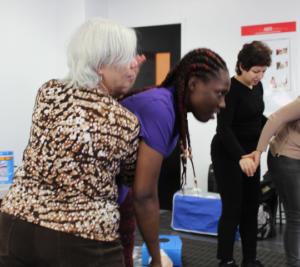
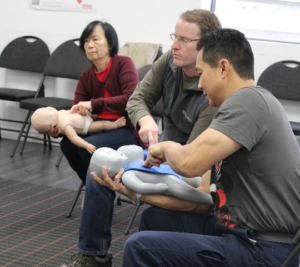
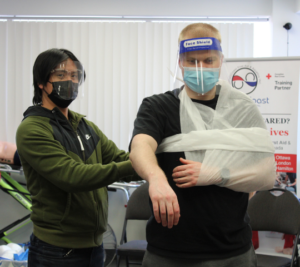
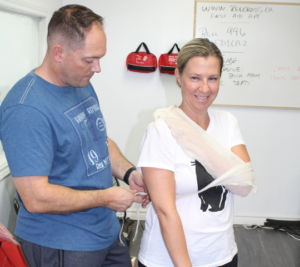
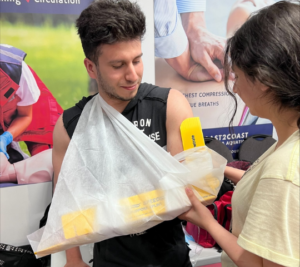
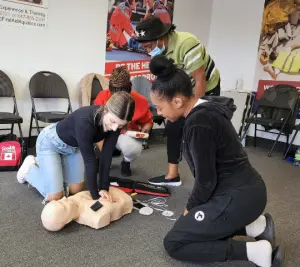
The Skills You Will Practice
Common Questions
Frequently Asked Questions
What is the difference between a First Aid/CPR/AED class and a First Aid class?
A First Aid/CPR/AED class teaches resuscitation on top of injury and illness care. A First Aid course drops the resuscitation half. Our CPR first aid training adds compressions, rescue breaths and defibrillator use to the twelve emergencies every course covers. Want resuscitation without the injury care? Our CPR/AED courses teach those.
Which first aid certification do US employers ask for?
Most ask for a first aid certification that includes CPR and defibrillator use, because OSHA expects a trained responder on site. Adult First Aid/CPR/AED suits a workplace with only adults; daycares, schools, camps and pools need pediatric coverage. Licensed healthcare workers need Basic Life Support. Ask what your employer accepts, then book the CPR first aid certification that matches.
How long does CPR certification last?
Two years from the day you pass. Every CPR first aid course on this page carries the same window. Put the expiry in your calendar. Renewing while your card is valid keeps you in one shorter class; letting it lapse means sitting the full course again.
Can I get CPR certification online?
No. An online CPR course with no classroom session does not produce a certification an employer will accept. You can cover the theory online, and our blended option works that way: the online portion of the training first, then a shorter classroom session with a certified instructor. Only the skills test proves you can push hard and fast on a chest. Every CPR first aid class ends with one.
What is in the online portion of blended CPR training?
Video, reading and short quizzes you finish at your own pace before class. Times vary depending on which course you book: the online module runs from 35 minutes to about three and a half hours. You arrive having covered it, so the classroom CPR first aid training is skills only. Prefer face to face? Every course also runs fully in person.
What is the difference between adult CPR and pediatric CPR?
Adult CPR uses two hands and a deeper compression. Pediatric CPR changes the hand position, the depth and the rhythm. An infant takes two fingers. A child takes one hand, sometimes two. Adult alone covers an office; adult plus pediatric covers a school, pool deck or family home. You practice both on age-specific manikins.
Do I need basic first aid knowledge before I start?
No. Every class starts from zero and assumes no medical background. Plenty walk in with no first aid education. Our CPR first aid training fits parents, coaches and site crews, and plenty book it for their loved ones rather than for a job. A cardiac arrest can happen in your own home as easily as at work, which makes a trained bystander the vital link between the collapse and the ambulance. CPR and first aid are practical skills, not academic ones.
What CPR skills will I practice in class?
Compressions, rescue breaths, choking response and defibrillator use — all on manikins, all watched by a certified instructor. Hands-on skills testing with automated external defibrillator is part of every CPR first aid class we run. You open the case, place the pads and follow the prompts on an AED trainer. You also cover the recovery position, severe bleeding and the first aid techniques for choking.
How soon will I get my first aid certificate?
Within 48 hours of a successful skills evaluation. Your digital certificate reaches you by email, ready to forward to an employer or licensing body. It carries the same two-year expiry your CPR certification runs on. Tell your instructor if you need proof of your CPR first aid certificate sooner.
Do you run group or onsite CPR/AED first aid training?
Yes. We bring CPR/AED first aid training to your workplace, or set up a private class at one of our facilities. Groups make sense when a whole team needs the same card. We run 100+ courses every week. Call 1-866-291-9121 to arrange group CPR training or price a private CPR/AED first aid class.
What if I want more practice after my CPR/AED first aid class?
Come back and practice again. Every student gets a free 90-day skills practice retake at no additional cost. If you finish your CPR/AED first aid training and still feel shaky on compression depth, book inside 90 days and run the skills again with an instructor. It is one reason our CPR first aid training carries a 99.9% student success rate.
Where can I take CPR and first aid classes?
Pick your region in the class finder above, choose your city, and book the date that works. We run CPR and first aid classes across the United States, with 100+ courses every week. Over 150,000 participants have trained with us across North America. Blended and fully in-person CPR first aid classes both appear there. Our US training home page covers the full range of CPR/AED first aid training we offer.