OSHA-Compliant · American Heart Association Aligned Training Site
American Heart Association Training
Coast2Coast First Aid & Safety is an American Heart Association Aligned Training Site running AHA Basic Life Support for healthcare professionals. Join us for one in-person session of 4 to 5 hours, or choose HeartCode BLS: theory online, then your skills check in class. Either path certifies you for two years.
About the Organization
A Leader in Heart Health and Resuscitation Training
The American Heart Association is dedicated to advancing heart and brain health through public awareness, advocacy, and training. Its resuscitation guidelines shape how compressions are timed, how deep they go, and how a team moves through a cardiac arrest. Hospitals and nursing programs build their requirements around that science, which is why job postings name the AHA.
Its research funding goes after cardiovascular disease and stroke, and the guidelines get revised as evidence lands. Each revision reflects science reviewed by resuscitation researchers worldwide, so American Heart Association CPR guidelines track the latest research, not the habits of whoever trained you. That is what an American Heart Association logo on a certificate signals.
See the two AHA BLS courses →-
One body of science
Compression depth, rate and ventilation ratios come from the same research.
-
Certificate valid two years
Basic Life Support runs on a two-year cycle. Check the date on the card.
-
Named on the job posting
Hospitals and nursing programs often ask for AHA BLS by name. If yours does, this is the card.
-
Skills tested in the room
Every recognized BLS certification ends with an instructor watching your hands. No exceptions.
The AHA Catalog
How AHA Certification Levels Fit Together
The American Heart Association stacks its courses in tiers, and clinical roles sit on the middle one. Find the tier your job posting names, then book that one.
See Class DatesProvider training assumes you work in health care. Basic Life Support is the entry point, and Advanced Cardiovascular Life Support (ACLS) and Pediatric Advanced Life Support (PALS) courses add rhythms, drugs and airway management. Coast2Coast holds authorization to deliver AHA BLS Provider, ACLS and PALS.
- BLS, ACLS, PALS all run on a two-year card
- PALS certification is the pediatric layer above BLS
- ACLS skills get assessed in the room, like BLS
HeartCode is the AHA blended line. Students complete the online portion at their own pace, then book the skills portion in class. The catalog covers every provider level: online HeartCode BLS, online HeartCode ACLS and online HeartCode PALS. We run HeartCode BLS for the same course completion card as the classroom.
- One short in person skills session finishes it
- Initial certification or renewal
Heartsaver courses are written for community members and workplace responders, not clinicians. This page covers provider training, so if a posting names Heartsaver we will point you at the right training. Where a role needs resuscitation only, a workplace CPR certification is what the manager meant.
- Provider level: BLS, ACLS and PALS
- Below it: Heartsaver, for non-clinical roles
Course Types
The AHA Basic Life Support Courses We Offer
Basic Life Support is built for the people who respond first at work: nurses, medical and dental staff, therapists, and students starting placements. A workplace CPR class teaches you to help until the professionals arrive. BLS trains you to be the help.
You get one certificate, whichever of the two formats you choose. Compression depth, breath timing and switching rescuers cannot be tested online, so both routes put you in a classroom. Basic Life Support runs fully in person. With HeartCode BLS, the theory is online.
- All in-class training
-
Basic Life Support (BLS)
4 to 5 hours teaching time
Initial certification and renewal
- Prerequisites
-
None
No medical background is assumed. Students entering nursing, dental, respiratory therapy and paramedic programs take it before their first placement.
Learn more
- Course content
-
View all 5 focus areas
- High-performance CPR for adults, children, and infants
- Bag-mask devices and automated external defibrillators
- Team dynamics during multi-rescuer resuscitation
- Airway obstruction response techniques
- Early recognition in cardiac emergencies
BLS is not a first aid certification. If your role also needs bleeding control, burns and anaphylaxis, add one of the first aid courses.
- Requirements
-
100% attendance of the course
84% score on the multiple choice knowledge test (21 of 25)
- Certification
- American Heart Association certificate will be issued, valid for 2 years
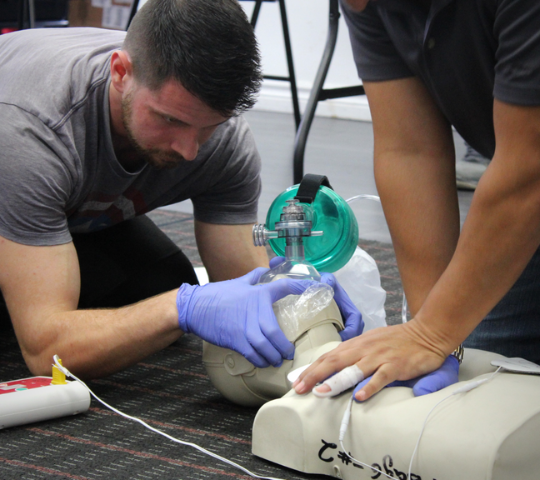
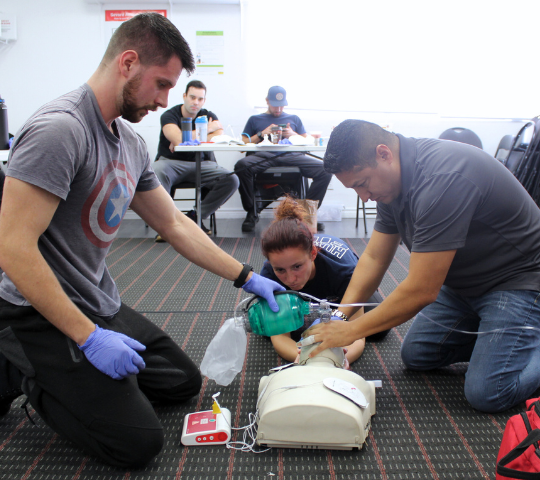
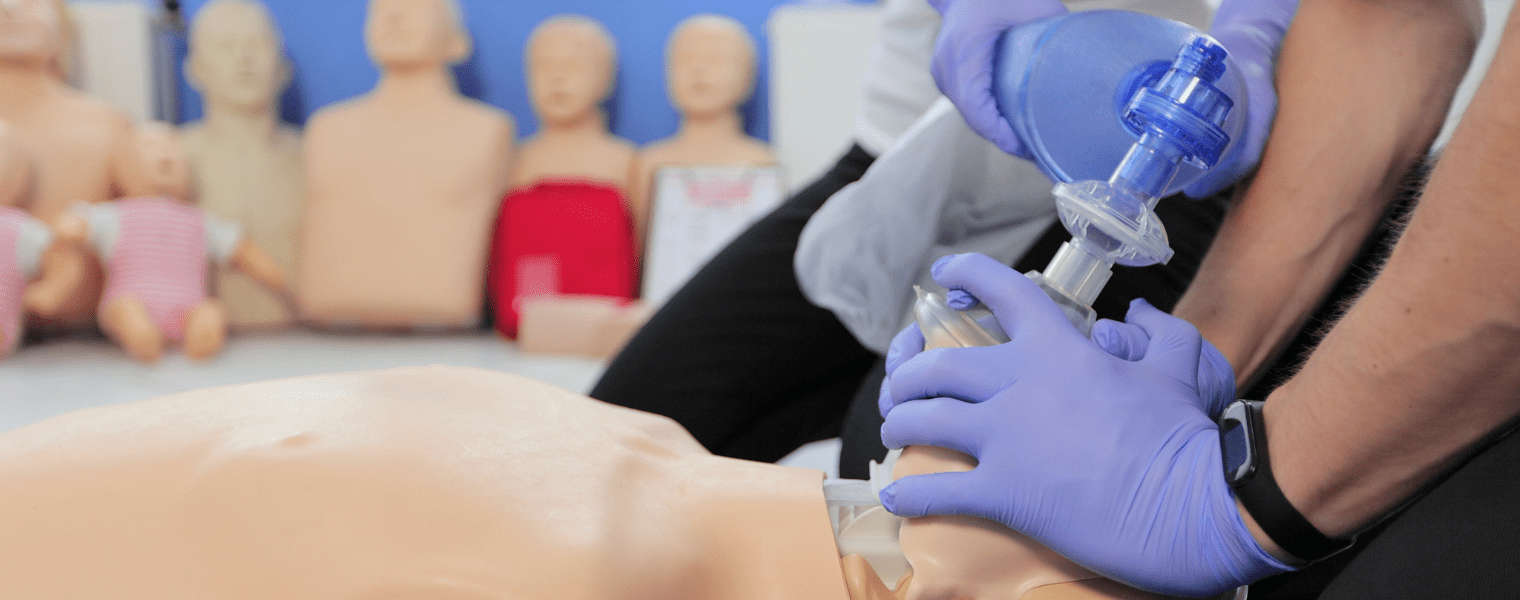
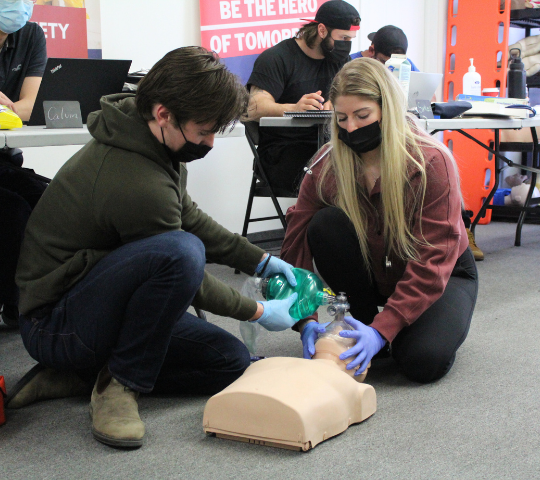
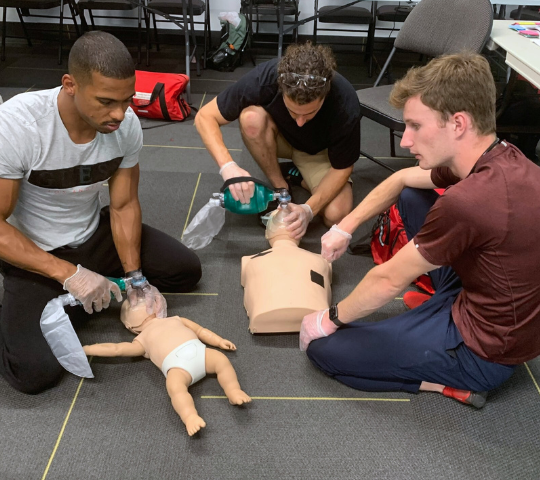
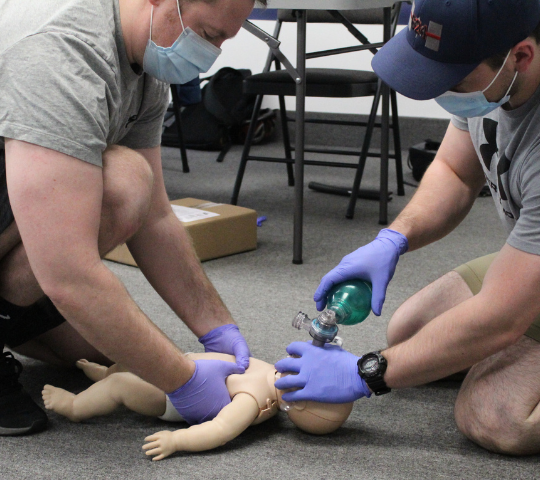
The class opens with assessment rather than compressions. You learn to size up a scene fast and order your actions, so you still function when the room fills with people. Compressions on adult, child and infant manikins follow.
Teamwork is what separates BLS from a standard CPR class. You call out what you are doing, trade places mid-cycle without losing rhythm, and keep one person coordinating. Hands-on skills testing with automated external defibrillator is part of the session.
- Blended learning
-
HeartCode BLS
1 to 2 hours of online coursework
Then a 30 to 60 minute skills check
- Available as
-
BLS Provider (initial)
BLS Renewal
Learn more
- Course content
-
The same five American Heart Association focus areas as the classroom course, split across two sittings.
The skills evaluation happens in person with an AHA instructor. Not optional, not remote, which is why no BLS certification is truly online end to end.
- Prerequisites
-
None for the initial course
For renewal, bring your current certificate
- Requirements
-
Same as the classroom course
84% on the knowledge test, and the skills check attended in full
- Certification
- American Heart Association certificate will be issued, valid for 2 years
HeartCode exists for the clinician whose schedule, not commitment, is the obstacle. Nurses on rotating shifts take the theory in pieces, then book one short visit for the skills check.
Why Coast2Coast
Why Healthcare Providers Train With Us
Most healthcare professionals need their BLS done before a deadline: a new job, a placement, paperwork due Friday. What counts is how fast the certificate lands and how many dates you get.
Choosing a Course
Which Training Does Your Role Need?
Two questions sort most bookings: do you work in health care, and did anyone name a provider in writing? Healthcare professionals need provider-level BLS. Everyone else needs the workplace tier, where CPR and first aid skills sit on one card. Coast2Coast trains participants on both sides of that line, so tell us whether you need CPR, first aid or both.
- 99.9%Student success rate
- 100+Courses each week
- 2 yrsCertification valid
- 2014Training since
-
Clinical staff and students
Healthcare professionals on a ward, in a clinic or heading into a placement need AHA certification at provider level. No medical training is assumed, so book before your program starts.
-
What class size buys you
Class size decides how many turns you get on a manikin. Ask about class size when you book.
-
Instructors who coach
Our expert instructors give clear instructions, then watch your hands and correct them. Every student gets hands on practice before anything counts.
-
Whole teams at once
On site training brings the instructor and the AED trainers to you, and our group training options start at eight participants. Flexible scheduling covers day and evening dates.
Ready to Register?
Start your registration for a Basic Life Support class: pick your region, choose your city, click the button.
You May Also Like
First Aid and CPR/AED Training
BLS is meant for clinical roles. For a workplace card, our workplace courses pair CPR and first aid in one sitting: Adult First Aid/CPR/AED, Adult and Pediatric First Aid/CPR/AED, and Pediatric First Aid/CPR/AED. They build first aid skills for severe bleeding, burns, allergic reactions and strokes, and the CPR, first aid and AED use inside them scales to the ages you will meet. Resuscitation only? CPR/AED runs at three levels: Adult CPR/AED for adults, Pediatric CPR/AED for infant CPR and children, and Adult and Pediatric CPR/AED for all three. Both come in blended learning and fully in person formats, and a workplace with an AED and first aid kit still needs people trained to use them.
Inside the Classroom
The Skills You Will Practice
Renewals
Keeping Your AHA Certification Current
Renewal courses use the same two formats: a classroom session, or HeartCode BLS with the theory online. Course requirements do not soften for a renewal, and an instructor still watches your compressions. Nobody gets unlimited attempts at a skills check, so what you get is a free 90-day skills practice retake at no additional cost, plus hands on CPR training that fixes your hand position before it counts.
A renewal only works while the certificate is still valid.
Common Questions
American Heart Association and BLS Questions, Answered
Does Coast2Coast offer American Heart Association courses?
Yes. We are an AHA Aligned Training Site and we run American Heart Association Basic Life Support. Take it fully in person in one four to five hour session, or as HeartCode BLS: theory online, skills evaluation in class. Both run as initial certification or renewal, for two years.
What is the American Heart Association?
A nonprofit dedicated to advancing heart and brain health through public awareness, advocacy, and training. American Heart Association CPR guidelines set the numbers clinicians work to: how fast to compress, how deep, how breaths are timed. Training organizations build on that research, which is why the name turns up so often.
Will my employer accept an AHA BLS certificate?
Yes, and many name it specifically. Hospitals across the United States are used to seeing an American Heart Association card, and California hospitals accept AHA credentials like BLS, ACLS and PALS as standard. Authorized providers issue official AHA course completion cards, so what you hand a credentialing office is verifiable. Still worth a quick email to your manager before you pay for a seat.
What is BLS training?
BLS is a four to five hour course that teaches healthcare providers to run a resuscitation as a team. It is the AHA’s core certification for clinical professionals. You cover rapid assessment, high-quality CPR for adults, children and infants, AED use, obstructed airway and cardiac emergency recognition. The pace is clinical: fewer explanations, more repetitions until your hands hold the sequence.
Is BLS the same as CPR-HCP?
It replaced it. Healthcare provider CPR was once sold under its own name; that curriculum moved into Basic Life Support. If a placement coordinator or a licensing body asks for HCP-level CPR, Basic Life Support satisfies it.
Is BLS different than CPR?
Yes. BLS includes CPR, but CPR on its own is a smaller course. A workplace CPR class trains one rescuer. BLS trains you as the help: two rescuers, an AED, ventilation support and a clean handoff. If your employer wrote only "CPR" and you work in a clinical setting, ask which they mean. Our CPR/AED courses cover the workplace levels, and our first aid classes put CPR and first aid on one card.
Who should take this course?
Anyone whose license, employer, or clinical program names it. That usually means nurses, medical assistants, dental staff, therapists, pharmacy staff, students, firefighters and hospital security teams. There is no prerequisite, so many book a month before placement.
Which AHA course do I need if I do not work in health care?
Heartsaver CPR AED is the AHA course for non-healthcare workers who need CPR credentials. Heartsaver courses satisfy Cal/OSHA workplace safety mandates for CPR, and they sit one tier below provider level. This page covers provider-level BLS, so if a manager asked for Heartsaver, call us.
What are the 4 elements of Basic Life Support?
Recognize the emergency, get help moving, start compressions, and defibrillate early. They run in that order, and each buys time for the next. Recognition comes first because everything after it depends on reading the patient correctly. Compressions keep blood moving; only an AED resets a shockable rhythm.
Can I get BLS certified online?
No, and online-only CPR training may not satisfy an employer requirement at all. A BLS certification an employer accepts always includes a skills assessment with an instructor in the room. Blended learning is the middle route: 1 to 2 hours of online coursework, then a 30 to 60 minute in-person skills check. Fully in person runs four to five hours.
How long is a BLS certification valid?
Two years from the date you pass. The expiry date is printed on your American Heart Association certificate, so check it. Expired BLS cards create compliance problems for healthcare workers, and a lapsed card means sitting the initial course again. Renewal courses focus on skill reinforcement and guideline updates, so book about two months out.
What do I need to pass, and how soon do I get my certificate?
100% attendance and an 84% score on the multiple choice knowledge test, which is 21 correct answers out of 25. Your instructor also assesses your skills as you work. Your digital certificate is issued within 48 hours, so a coordinator can have it the same week.
Where can I take a BLS class?
Pick your region in the class finder above, choose your city, and book a date. AHA CPR classes: CA sites in Sacramento, San Diego, San Jose and Santa Ana all run AHA CPR training for healthcare professionals. Our US training facilities page lists every site, and over 150,000 participants have trained with us across North America. On site training is available for businesses and schools and it takes group bookings, so call 1-866-291-9121 to certify a department at once.
Training You Can Trust
Confident Hands, Not Just a Card
At Coast2Coast First Aid & Safety, we think everyone should feel capable in an emergency, so we build classes around hands-on practice with reliable equipment and current technique. Not sure which certification your role needs, or whether CPR and first aid belong on one card? Call and we will tell you straight.