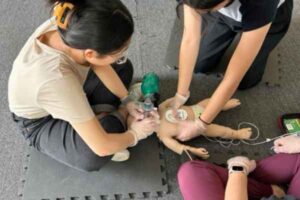

- Most Canadian workplaces require Intermediate/Standard First Aid with CPR/AED Level C. Smaller or lower-risk sites may accept Basic/Emergency First Aid; match your posting.
- Ontario runs on WSIB Regulation 1101; Alberta on OHS Code Part 11. The required level scales with workplace size, hazard, and distance to medical help.
- Online-only certificates do not meet workplace rules. WSIB and provincial regulators require an in-person skills assessment, so choose in-class or blended.
- Your certificate is yours. It is issued in your name, valid three years, and stays with you even if your employer paid or you change jobs.
- Good Samaritan laws protect reasonable rescuers, trained or not. The answers below cover who pays, industry rules, and booking team training.
First aid at work is set by provincial rules, not one national law: Ontario workplaces follow WSIB Regulation 1101, Alberta follows OHS Code Part 11, and other provinces set their own. This guide answers the questions Canadian workers and employers ask most about workplace first aid and CPR, from which course you need and how many first-aiders are required to who pays, who owns the certificate, and industry-specific rules. Use the search box or the table of contents to jump to a topic.
Reviewed by a Canadian Red Cross Instructor Trainer.
Workplace First Aid Requirements
What the law expects and which course most Canadian workplaces require.
Q1: What are the first aid requirements for Ontario workplaces?
A: Ontario workplaces fall under WSIB Regulation 1101, which sets the first aid kit, station, and trained-personnel rules by workplace size. Small sites need a worker with at least Basic/Emergency First Aid on each shift; larger sites need someone with Intermediate/Standard First Aid. The certificate must come from an approved provider such as the Canadian Red Cross and stays valid three years.
Adapted from real questions asked on: r/ottawa
Q2: What first aid course do most Ontario workplaces require?
A: For most workplaces the standard is Intermediate/Standard First Aid with CPR/AED Level C, which meets WSIB Regulation 1101 for workplaces of six or more. Smaller or lower-risk sites may accept Basic/Emergency First Aid. Always confirm the exact level named in your job posting or health and safety policy before you book.
Adapted from real questions asked on: r/askTO
Q3: What training is mandatory for employees in Ontario workplaces?
A: Beyond WSIB first aid coverage, most Ontario employers must provide health and safety awareness training, WHMIS where chemicals are present, and role-specific training such as working at heights in construction. First aid is one piece of a broader duty to keep workers safe, so check your sector’s rules alongside the first aid requirement.
Q4: How many employees need to be first aid trained in a workplace?
A: Enough to cover every shift. Ontario’s Regulation 1101 requires at least one trained first-aider present whenever work is underway, scaling the required certificate level with headcount. Alberta OHS Code Part 11 takes a hazard-based approach instead. The practical rule is simple: never leave a shift without a certified first-aider on site.
Adapted from real questions asked on: Reddit
Q5: How many first aiders are required in a workplace in Canada?
A: It depends on the province, the number of workers, the hazard level, and how far the site is from medical help. Low-risk offices may need one trained person; remote or high-hazard sites need more, sometimes with Intermediate or Advanced training. Check your provincial regulator, because the count and required level are set locally, not nationally.
Q6: What are Alberta’s OHS first aid requirements?
A: Alberta sets first aid under Alberta OHS Code Part 11, which scales requirements by hazard level, number of workers, and travel time to medical aid. Higher-hazard or remote worksites need more first-aiders and higher training levels. Our Alberta questions guide breaks the rules down for Calgary, Edmonton, and industrial sites.
Adapted from real questions asked on: r/alberta
Q7: What first aid or CPR certification do jobs usually ask for?
A: Most workplaces ask for Intermediate/Standard First Aid with CPR/AED Level C. Public-facing and lower-risk roles may accept a CPR/AED Level C card alone, while healthcare roles require Basic Life Support. The safest move is to match the exact wording in the posting, since employers name the level they will accept.
Adapted from real questions asked on: r/ottawa
Q8: Is an online-only first aid certificate valid for a workplace?
A: No. WSIB and provincial regulators require an in-person skills assessment, so a fully online certificate does not meet workplace requirements on its own. A blended course (online theory plus an in-class skills day) does qualify. Look for a Canadian Red Cross certificate earned with a hands-on component.
Adapted from real questions asked on: Reddit
WSIB, OHS & Approved Certificates
What approved really means and how to confirm a provider counts.
Q9: What does WSIB approved mean for a first aid course?
A: It means the training meets the standards WSIB accepts for workplace first aid under Regulation 1101, delivered by a recognized provider such as the Canadian Red Cross. WSIB does not run courses itself. When a job asks for a WSIB approved certificate, it means a hands-on course from an approved provider, not an online-only card.
Q10: Is Coast2Coast first aid training WSIB approved?
A: Yes. Coast2Coast delivers Canadian Red Cross first aid and CPR training, which is WSIB approved for Ontario workplaces when completed with the in-class skills portion. You receive a Canadian Red Cross certificate valid for three years. Book the level your workplace requires through our course locations.
Q11: What first aid must an employer provide under WSIB?
A: Under Regulation 1101 an Ontario employer must supply a stocked first aid kit sized to the workplace, keep it accessible, post the WSIB first aid poster, and ensure a trained first-aider is on duty each shift. Details are on the WSIB first aid page. Employers, not workers, are responsible for meeting these duties.
Q12: Does a Canadian Red Cross certificate meet WSIB requirements?
A: Yes, when the course includes the in-class skills assessment. The Canadian Red Cross is an approved training partner, and its Basic/Emergency and Intermediate/Standard First Aid certificates satisfy WSIB Regulation 1101 at the matching workplace size. Keep the certificate current, since it expires after three years.
Q13: Is my Ontario first aid certificate valid in other provinces?
A: Usually, because Canadian Red Cross certification is recognized nationally, but each province sets its own workplace rules and required levels. A move to Alberta, for example, means checking Alberta OHS Code Part 11. The certificate travels; the workplace requirement is local, so confirm the level your new employer or province expects.
Who Pays & Certificate Ownership
Employer duties around paying for, timing, and owning your training.
Q14: Can my employer require first aid certification before I start work?
A: Yes. Employers can make a valid first aid or CPR certificate a condition of the role, and many safety-sensitive jobs do. What varies is who arranges and pays for it. If the certificate is a job requirement, ask during hiring whether the employer provides the training or expects you to arrive already certified.
Adapted from real questions asked on: r/canadianlaw
Q15: Does my employer have to pay for required first aid training in Ontario?
A: When first aid training is mandatory for the job, it is generally treated as a work requirement, and many Ontario employers cover the cost and the time. There is no simple universal rule, so it comes down to your employment terms. Raise it directly: ask whether the course and paid time are provided before you enrol yourself.
Adapted from real questions asked on: r/ontario
Q16: Does my Alberta employer have to pay for mandatory first aid training?
A: If Alberta OHS or the job requires the training, employers commonly arrange and pay for it as part of meeting their safety duties. Practice varies by employer, so confirm before booking. Group training is often the cheapest route, which is why many Alberta employers certify whole teams at once rather than reimbursing individuals.
Adapted from real questions asked on: r/alberta
Q17: Who owns my first aid certificate if my employer paid for the course?
A: The certificate is issued in your name by the Canadian Red Cross, so it stays with you and remains valid for its full three years even if you change jobs. An employer pays for the training, not for ownership of your credential. You can list it on your resume and use it at your next role.
Adapted from real questions asked on: r/ontario
Q18: Should first aid training happen on paid work time?
A: When the certificate is a job requirement, many employers treat the course as work and pay for the time, but this depends on your employment agreement rather than a blanket rule. If it matters to you, confirm it in writing before the course. Group on-site sessions make paid training easier for employers to schedule.
Industry-Specific Requirements
Oil and gas, security, construction, healthcare, and childcare roles.
Q19: Do oil and gas jobs in Alberta require first aid and H2S Alive?
A: Commonly both. Many Alberta energy sites require Intermediate/Standard First Aid with CPR plus H2S Alive, which is a separate energy-safety ticket, not a first aid course. They cover different risks, so employers list them separately. Check the posting, and see our Alberta guide for how site rules work.
Adapted from real questions asked on: r/alberta
Q20: What certifications do entry-level oil rig or camp jobs need?
A: Typically a current Intermediate/Standard First Aid and CPR certificate, H2S Alive, and often Common Safety Orientation (CSO or similar). Some contractors add ground disturbance or fall protection. First aid and CPR are the portable pieces you can complete before applying, which shortens your path onto a crew.
Adapted from real questions asked on: r/alberta
Q21: Why do security guard jobs require CPR certification?
A: Guards are often first on scene for collapses, overdoses, and injuries, so licensing and employers expect a current CPR/AED certificate, usually CPR/AED Level C. It shortens the gap before EMS arrives. Many guards pair it with Intermediate/Standard First Aid to handle wounds and medical emergencies as well.
Adapted from real questions asked on: r/securityguards
Q22: What certifications set you apart for construction work in Alberta?
A: Beyond Intermediate/Standard First Aid and CPR, employers value fall protection, ground disturbance, WHMIS, and the Common Safety Orientation. Trades on energy sites add H2S Alive. First aid and CPR are quick, portable wins that show a site you are ready to work while you build the rest of your safety tickets.
Adapted from real questions asked on: r/CalgaryJobs
Q23: Do healthcare workplaces require BLS instead of a regular CPR course?
A: Yes. Hospitals, clinics, and long-term care require Basic Life Support for healthcare providers, which adds pulse checks, two-rescuer CPR, and bag-valve-mask ventilation that a lay CPR/AED course does not cover. A CPR/AED Level C card will not substitute. Our BLS questions guide explains what employers and programs expect.
Adapted from real questions asked on: r/cna
Q24: What first aid do I need to work at a daycare in Canada?
A: Licensed childcare staff generally need first aid that includes infant and child CPR, and in Ontario that means Intermediate/Standard First Aid. Requirements vary by province, so confirm your local licensing rule. Our childcare and babysitting guide covers daycare, ECE, and nanny requirements in detail.
Adapted from real questions asked on: r/ECEProfessionals
Good Samaritan Law & Liability
Whether you can be sued for helping in an emergency, and your obligations.
Q25: Can I be sued for helping someone in an emergency in Canada?
A: Good Samaritan laws in provinces such as Ontario and Alberta protect people who voluntarily help in an emergency, as long as they act reasonably and are not grossly negligent. Successful suits against ordinary rescuers are very rare. This is general information, not legal advice, but the law is designed to encourage you to step in.
Adapted from real questions asked on: r/askTO
Q26: Does Good Samaritan protection cover trained first-aiders?
A: Yes. Protection applies whether you are trained or not, provided you act voluntarily, within your level of training, and without gross negligence. Training actually helps, because acting within a recognized standard of care is exactly what the law expects. Do what your course taught, and do not attempt beyond it.
Adapted from real questions asked on: r/emergencymedicine
Q27: Am I legally required to help if I have first aid training?
A: In most of Canada there is no general legal duty for a bystander to rescue, even if trained, though a duty can arise from your job or a special relationship. Quebec is the exception, with a duty to assist under its Charter. On the job, your workplace role may require you to respond, so know your own policy.
Booking Workplace & Group Training
Group courses, formats, validity, and keeping your team current.
Q28: Can you train our whole team on-site?
A: Yes. Private and group training brings a Canadian Red Cross instructor to your workplace, or runs your team through one of our facilities together. It is usually the most cost-effective way to certify multiple staff and keeps everyone on the same renewal date, which simplifies compliance records.
Q29: Is Online Blended training valid for workplace requirements?
A: Yes, as long as you complete the in-class skills day. Blended courses put the theory online and reserve classroom time for hands-on practice and the skills assessment that WSIB and provincial regulators require. A fully online course with no in-person component does not meet workplace rules on its own.
Q30: How long is a workplace first aid certificate valid?
A: A Canadian Red Cross first aid and CPR certificate is valid three years. Basic Life Support, used in healthcare, is valid one year. Diarize the expiry, because most workplaces will not accept a lapsed card. You can confirm currency directly with the Canadian Red Cross.
Q31: How often should workplace first-aiders recertify?
A: Renew before the three-year expiry to stay compliant; healthcare BLS renews yearly. Skills fade with time, so on-schedule renewal keeps both your certificate and your confidence current. Our full questions guide explains renewal windows and what happens if a certificate lapses.
Q32: Where can I find WSIB approved courses near me?
A: Use our course locations page to pick a facility, choose the level your workplace requires, and see available dates. Coast2Coast delivers WSIB approved Canadian Red Cross training across Ontario, with locations in Alberta as well. Group and on-site options are available for teams.
Questions were selected from Canadian workplace search demand and public forum discussions in communities such as r/ontario, r/alberta, r/canadianlaw, and r/securityguards. Answers were edited for clarity, aligned with WSIB Regulation 1101 and Alberta OHS Code Part 11, and reviewed by a certified instructor. First aid rules vary by province, workplace size, and hazard level, so readers should confirm the exact requirement with their regulator or employer.
Match the first aid level your workplace and province require, use an approved in-person or blended course (not online-only), keep the certificate current, and remember it stays yours. When a team needs training, on-site group courses are usually the fastest and cheapest way to stay compliant.
This guide is provided for general informational purposes and does not replace certified training or personalized medical advice. In an emergency, call 911. Course requirements are set by employers, regulators and licensing bodies, so always confirm the exact certificate your organization requires.
Written by Godwin Orilua and reviewed by Ashkon Pourheidary, B.Sc. Hons Neuroscience, Co-Founder and Canadian Red Cross Instructor Trainer at Coast2Coast First Aid Inc. Source questions referenced from public Reddit and Quora discussions and Google search data; answers follow current program standards.
Coast2Coast First Aid & Aquatics delivers Canadian Red Cross first aid, CPR, and Basic Life Support training for workplaces across Ontario and Alberta, including private on-site group courses. To book workplace training or certify a team, visit our course locations page.