
If you’re a new child care provider in California, the “16-hour training requirement” can feel like a wall of jargon. Most people hear “16 hours” and assume it means two full days of CPR practice. It doesn’t. California requires 16 hours of training for childcare licensing, split into two completely separate courses, each serving a different purpose, and mixing them up can delay your license or get you cited during an inspection. This guide breaks down exactly what each course covers, who needs it, and how to stay compliant.
Key Takeaways
- California requires a total of 16 hours of EMSA approved health and safety training for licensed child care providers: 8 hours must cover Pediatric CPR and First Aid, plus 8 hours of Preventive Health and Safety Practices.
- CPR/First Aid and preventive health are two separate 8-hour courses, each with its own completion certificate and EMSA sticker, even when taken over a single weekend.
- Pediatric CPR and First Aid certification must be renewed every two years, while Preventive Health and Safety training is a one-time requirement for licensing unless regulations change.
- Both courses must be completed before opening a licensed facility or being counted in staff-to-child ratios at most California programs.
- Coast2Coast First Aid & Aquatics is an authorized provider delivering EMSA-approved Pediatric First Aid & CPR and AHA Heartsaver Pediatric courses directly across California, so you can complete both halves of the 16-hour requirement with a provider you can verify.
How the 16-Hour California Childcare Training Requirement Works
Community care licensing in California, governed by Health and Safety Code Section 1596.866, requires most licensed child care providers to complete 16 total hours of training before caring for children. This requirement applies to both family child care homes and child care centers across the state.
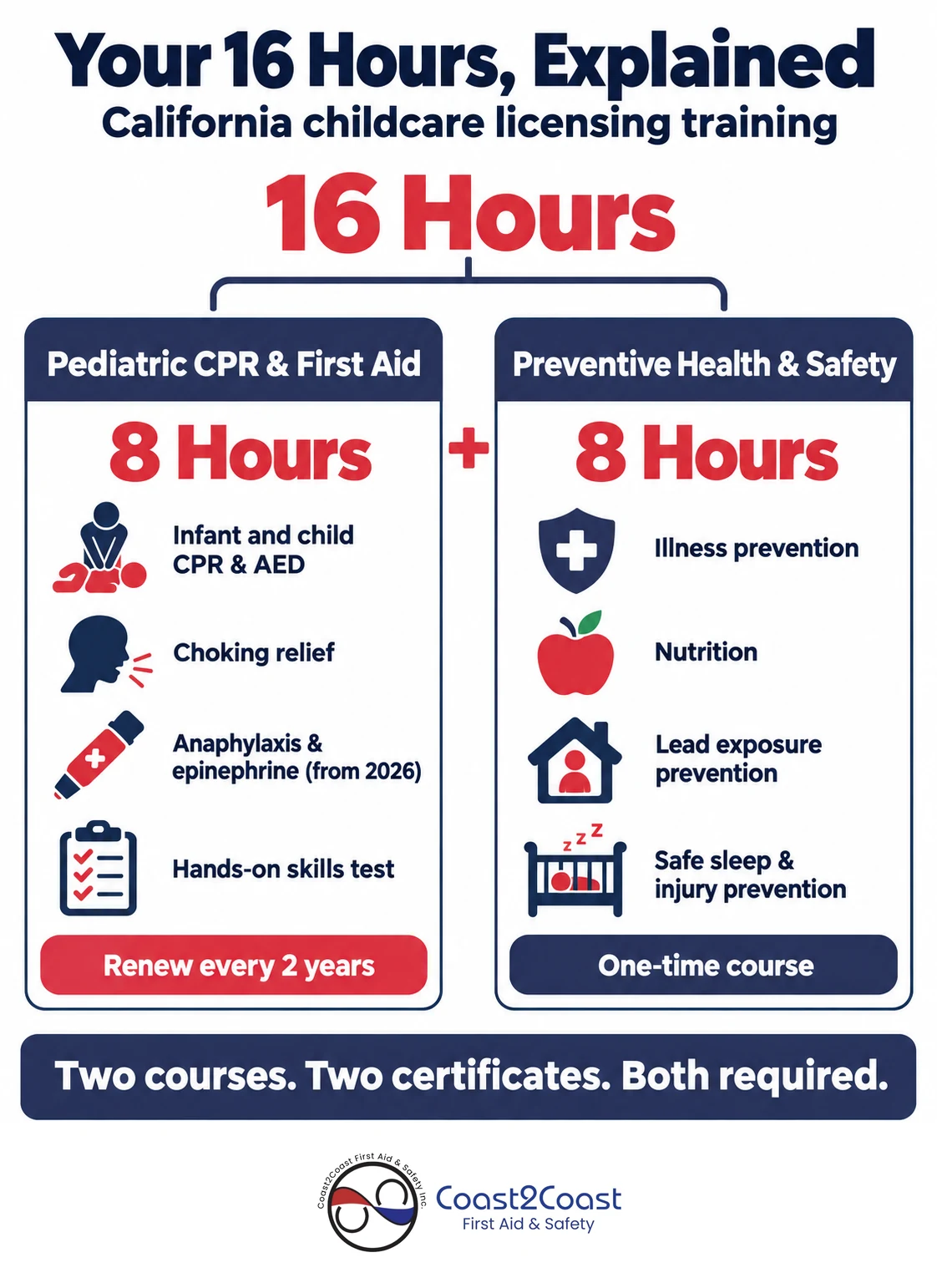
The 16 hours break down into two distinct components: EMSA training for childcare providers is 8 hours long for Pediatric First Aid and Pediatric CPR, focused on emergency response skills like CPR, choking relief, and injury management for infants and children, and a separate 8 hours of Preventive Health and Safety Practices (PHSP), focused on illness prevention, nutrition, lead poisoning prevention, and daily safety policies.
Many new family child care home licensees and childcare center staff mistakenly assume the entire 16 hours is CPR training. It is not. These are two different EMSA approved components, each with separate certificates, separate content, and separate renewal rules. Both courses cover health, safety, and emergency preparedness topics, but from opposite ends: one prepares you to respond, the other prepares you to prevent.
Both must be completed before opening a licensed daycare or starting work as a teacher or assistant in most California child care programs. If you show up to a licensing inspection with only one of the two, you are not in compliance.
Train Your Whole Childcare Staff On-Site
Book one group session at your center so every teacher and aide meets the CPR half of the 16-hour requirement together.
What Counts as Pediatric CPR and First Aid in California?
The CPR and first aid portion is 8 hours of hands-on emergency skills training required by California law for licensed child care providers. CPR training focuses on emergency intervention during life-threatening incidents, and this course is specifically pediatric, meaning it focuses on the unique physiology and emergency needs of infants and children rather than adults.
Typical content areas include:
- Infant and child CPR techniques, including chest compressions, rescue breaths, and AED use with pediatric pads or settings.
- Choking relief for infants and children (and often adults present in childcare settings).
- Pediatric first aid for bleeding, burns, fractures, allergic reactions, asthma, fevers, seizures, and head injuries.
- Recognizing when to call 9-1-1 and how to work with emergency medical services responders on scene.
- As of January 1, 2026, instruction in the prevention and treatment of anaphylaxis and use of epinephrine auto-injectors.
Courses must be EMSA approved and will typically follow curriculum from recognized organizations like the American Red Cross or American Heart Association, as permitted under California statute. EMSA-approved training includes hands-on skills assessment, and training may be completed in person or via blended learning (online theory plus in person skills evaluation), but it must include hands-on skills practice. EMSA requires pediatric first aid and CPR to be taught in person, or as a hybrid with a live virtual lecture and in-person skills practice and testing. Recorded video can only supplement a live instructor.
Coast2Coast First Aid & Aquatics is an authorized provider delivering both EMSA-approved and AHA Heartsaver Pediatric CPR and first aid training directly across California. When comparing local classes, verify that the course is pediatric-focused. Generic workplace or adult-only CPR will not satisfy your licensing requirements, even if it comes from a well-known provider.
Book EMSA-Approved Pediatric CPR & First Aid
The 8-hour CPR and first aid half of your 16 hours, with hands-on skills testing and 2026 anaphylaxis training.
What Is Preventive Health and Safety Practices Training?
Preventive health and safety practices training is a separate 8-hour EMSA approved class that many providers mistakenly think is “extra CPR.” It is not. EMSA requires 8 hours of preventive health training, and this course focuses entirely on illness and injury prevention, the systems, safety policies, and daily practices that protect children before an emergency ever happens. Preventive health training emphasizes disease prevention and environmental safety over emergency response, and courses include practical steps and short practice activities like reviewing sample checklists, role-playing exclusion-policy conversations, and walking through incident-log entries rather than physical skills stations.
Typical topics covered include infection control, handwashing, cleaning, disinfecting, and prevention of infectious diseases and outbreaks, safe food handling, nutrition basics, and avoiding foodborne illness, since childhood nutrition guidelines are covered in the Preventive Health training as required content added by Assembly Bill 290 in 2013. The training also covers lead poisoning prevention, since lead poisoning prevention is a mandated topic in the Preventive Health training covering water, paint, soil, and consumer products, required for licenses issued after July 1, 2020.
Additional topics include safe sleep practices and injury prevention, since implementation of these safety practices aims to lower risks of Sudden Infant Death Syndrome and other preventable childhood injuries both indoors and outdoors, medication administration policies, health records documentation, allergy management, and exclusion policies for sick children, and child abuse reporting obligations and emergency preparedness planning.
PH&S courses are offered by EMSA-approved training programs statewide, and the lead exposure portion follows the California Department of Public Health’s child care lead poisoning prevention curriculum.
This course is classroom or live-online discussion based. There are no CPR manikins involved. It focuses on long-term health safety systems rather than emergency response skills.
Preventive Health and Safety training is a one-time requirement for each person in the qualifying role, unlike CPR which must be renewed. However, providers should check current California EMSA and community care licensing updates for any changes, particularly when moving between facility types or roles.
CPR vs. Preventive Health: Key Differences at a Glance
| CPR/First Aid | Preventive Health | |
|---|---|---|
| Focus | Emergency intervention during life-threatening incidents, choking, cardiac arrest, severe bleeding, allergic reactions, seizures | Disease prevention and environmental safety through daily practices, sanitation, nutrition, and documentation |
| Format | Skills-heavy with manikins, hands-on practice, individual skills testing | Practical steps and short practice activities, checklists, case studies, and interactive instruction |
| Renewal | Every two years to maintain current certification | A one-time requirement for licensing, unless regulations change |
| Certificate | Completion certificate with EMSA sticker on your pediatric CPR/first aid card | Completion certificate with EMSA sticker on your Preventive Health certificate |
Some training organizations schedule both courses in a single weekend, often marketed as “16 hours of health and safety training.” Participants still receive two distinct completion certificates issued after successful training, each with its own EMSA sticker. Understanding this distinction matters because one expires and the other generally does not.
Who Needs the 16-Hour EMSA Childcare Training in California?
Health and Safety Code Section 1596.866 requires that at least one director or teacher at each day care center, and each family child care home licensee who provides care, must complete the full 16 hours. In practice, most licensing offices expect it from a broader range of staff.
Common roles that must complete the training: family child care home licensees and their assistants, childcare center directors, teachers, and teacher’s aides counted in staff-to-child ratios, and large family childcare providers with additional staffing.
Some roles, such as volunteers or administrative staff with no direct supervision responsibilities, may have different or limited requirements. Check with your specific regional Child Care Licensing office to confirm, or ask our team which course your role needs.
The CPR and first aid portion must be kept current at all times while supervising children, including during off-site activities like field trips. The preventive health course is typically verified at initial licensure or initial employment. Requirements may vary slightly by facility type, so confirming with a local licensing program analyst is always a good step.
Understanding EMSA Approval and the EMSA Sticker
California’s Emergency Medical Services Authority sets the standards for childcare health and safety training, approves providers and curricula, and oversees compliance statewide.
When a course is “EMSA approved,” it means the course content meets EMSA’s standards for either pediatric CPR/first aid or preventive health, the instructor or organization is on EMSA’s approved list for childcare training, and participants receive a completion certificate after training that includes an official EMSA sticker as proof for licensing inspectors.
The EMSA sticker itself is a small adhesive label placed on the course completion certificate. It indicates which type of course was completed and is required by community care licensing to verify compliance. Training programs pay EMSA a per-certificate fee plus a program review fee when seeking initial approval to issue stickers.
Coast2Coast First Aid & Aquatics delivers both EMSA-approved courses and AHA Heartsaver Pediatric training directly in California, giving you two verified, licensing-accepted pathways under one provider.
Read Our EMSA Sticker Guide
When you need the sticker, and when an AHA card is enough.
Course Formats: In-Person, Blended, and Online Options
California childcare providers can often choose between in person, blended, and online training formats depending on the course type and EMSA rules.
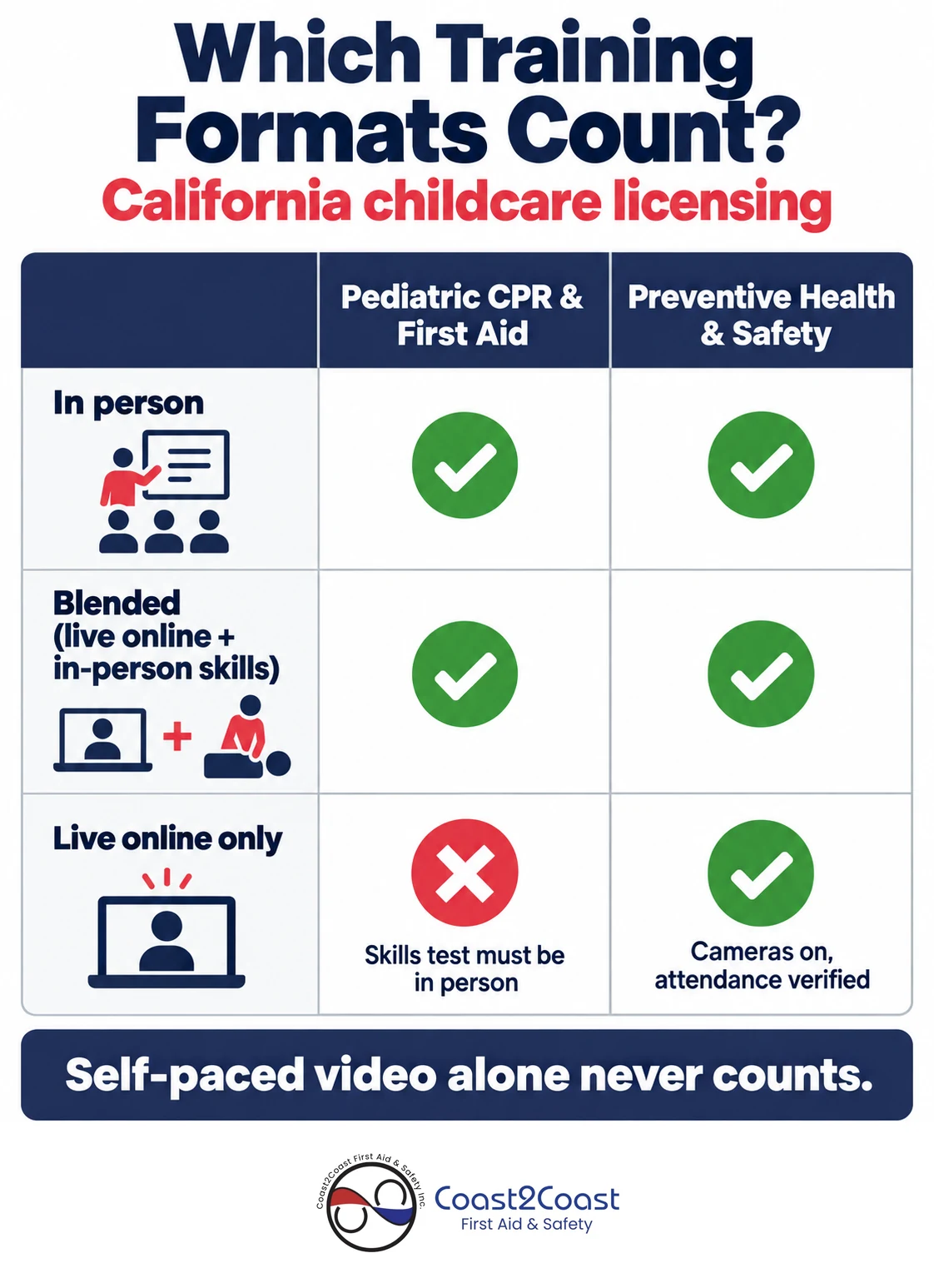
CPR/First Aid formats: in person, traditional classroom with manikins, ideal for hands-on practice and direct instructor feedback; blended learning, online theory modules completed at home, followed by an in person skills check with an EMSA approved instructor.
Preventive Health formats: in person, classroom lecture and discussion at a childcare center or training site; online training, since California EMSA training can be completed via Zoom or a similar interactive webinar, permitted as long as it meets EMSA standards and attendance is verified throughout the session. Online courses can be completed from home via Zoom, provided cameras stay on and participation is documented.
A critical distinction: online courses for CPR that have no in person skills testing will not satisfy EMSA and community care licensing requirements for child care providers. EMSA does not accept self-paced, video-only formats for these certifications. If a program is offered online without any hands-on evaluation, it does not qualify. Preventive Health, by contrast, is one of the few EMSA-recognized components that can be completed live online without an in-person component, precisely because it doesn’t involve hands-on physical skills.
Providers in remote areas can look for live-online preventive health classes and blended CPR courses through EMSA approved providers to reduce travel time while still meeting state requirements. Some organizations offer flexible scheduling to accommodate providers who cannot take a full weekday off.
What to Expect on Training Day: CPR/First Aid for Child Care
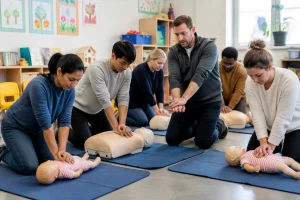
CPR and first aid training for child care is active and hands-on, often scheduled as a single 8-hour day. Expect to move, kneel, and practice skills repeatedly.
A typical day looks like this:
- Short orientation, safety briefing, and introduction to manikins and AED trainers.
- Skill stations rotating through compressions, ventilations, AED use, and choking relief on infant and child manikins.
- Scenario practice covering situations like asthma attacks, anaphylaxis with epinephrine auto-injectors, playground injuries, and how CPR differs for adults versus children and infants.
- A written quiz and instructor-led review of key points.
Wear comfortable clothing. You will be kneeling on the floor and may need to demonstrate competency individually to earn your certification. Students who cannot complete the skills portion will not receive a passing card.
At the end of an EMSA approved class, childcare providers receive a pediatric CPR/first aid completion certificate from an approved organization (such as the American Red Cross or American Heart Association) and an EMSA sticker confirming childcare-appropriate training, valid for licensing review (or, for AHA Heartsaver Pediatric cards specifically, no sticker is needed at all).
This is one of the most practical courses you will take as a child care provider. The skills you learn here are designed to keep children alive until paramedics arrive.
What to Expect in Preventive Health and Safety Training
Preventive health training is more policy- and systems-focused. It is usually delivered in a quieter, discussion-based classroom or live webinar environment. No manikins, no kneeling, but no less important.
A typical 8-hour session includes an overview of California childcare regulations related to health and safety, including accessibility obligations as they apply to inclusive care, modules on disease transmission, immunizations, and exclusion policies for sick children, discussions on nutrition, food safety, and allergy management in a childcare center or family child care home, lead exposure and lead poisoning prevention content specific to California housing and water systems, and a review of documentation practices: incident logs, medication logs, allergy plans, and health records. Training includes managing infectious disease control and sanitation procedures throughout, since disease prevention and environmental safety sit at the core of the curriculum.
This course often includes practical checklists and sample forms that participants can take back to their facility to strengthen daily practices. Interactive questions, case studies, and small group discussions are common, especially in live Zoom formats where learners share real-world scenarios from their own programs.
The preventive health certificate must bear an EMSA sticker to count toward the 16-hour requirement, just like CPR/first aid. Without that sticker, your licensing inspector may not accept it.
Renewals, Recordkeeping, and Compliance Tips
Staying compliant involves tracking expiration dates and keeping documents accessible for community care licensing visits. A missed renewal can shut down your ability to operate on site with children.
Renewal basics: Pediatric CPR/First Aid certification must be renewed every two years. Check the date printed on the card and schedule your renewal class well in advance. Preventive Health and Safety training is a one-time requirement for licensing, usually requiring no renewal for the same position and facility type, though if regulations change or you move into a new role, you may need updated training.
Recordkeeping tips:
- Keep copies (paper and digital) of all certificates and EMSA stickers at the childcare center or family child care home.
- Maintain a staff training log with completion and expiration dates for each person.
- Schedule renewal reminders at least 3 to 6 months before CPR/first aid expiry to avoid lapses.
Licensing program analysts may request documentation during inspections or when a new license is issued. Missing or expired CPR cards can delay your opening or result in citations.
Directors should build CPR/first aid and health safety training into onboarding for all new staff and budget for regular recertification. Treat it the same way you budget for rent or insurance. It is a non-negotiable cost of operating a licensed child care program in California. Parents expect it, and the law requires it.
How Coast2Coast First Aid & Aquatics Supports California Childcare Providers
Coast2Coast First Aid & Aquatics is an authorized provider delivering EMSA-approved Pediatric First Aid & CPR, AHA Heartsaver Pediatric courses, and BLS training directly across California.
What California childcare providers get with Coast2Coast: hands-on, scenario-based skills practice for CPR/AED and pediatric first aid, blended learning options that balance online theory with in-person skills checks, same-day digital certification issued upon successful completion, and clear renewal timelines so you’re never caught off guard by an expiring card.
If you’re exploring what a complete CPR and first aid certification process looks like, our Complete Guide to CPR and First Aid Certification in California covers the broader landscape, and our guides on EMSA CPR vs. Standard Pediatric CPR and the EMSA sticker requirement go deeper on those specific questions.
See EMSA vs Standard Pediatric CPR
Make sure the CPR half of your 16 hours is the right course.
California’s 16-hour requirement is two separate 8-hour courses, not one long CPR class. Pediatric CPR & First Aid needs hands-on skills and renews every two years. Preventive Health & Safety can be completed live online and is generally a one-time requirement. Both need their own EMSA sticker (or, for CPR, a qualifying AHA Heartsaver Pediatric card) before you can open your facility or count toward staff-to-child ratios.
Get Started with California Certification
Find the right course level and book with a 99.9% pass rate.
Frequently Asked Questions
Q1: Is the 16-hour childcare training requirement the same everywhere in California?
A: Health and Safety Code Section 1596.866 sets a statewide baseline, 8 hours CPR/first aid plus 8 hours preventive health, for most licensed child care providers. However, details can vary slightly by facility type (family child care homes versus child care centers) and by how individual regional licensing offices interpret the statute. If you operate a specialized program like a school-age center, overnight care facility, or a program serving children with disabilities, additional or modified requirements may apply. Always confirm specifics with your regional community care licensing office or a licensing program analyst before assuming the standard 16 hours is all you need.
Q2: Can I use a non-EMSA CPR card (for example, workplace first aid) for child care licensing?
A: General CPR or workplace first aid cards, even from respected organizations, may not meet childcare licensing rules unless the course is EMSA approved and pediatric-focused. Licensing inspectors look for two things: pediatric content and either the EMSA sticker or a qualifying AHA Heartsaver Pediatric card. A standard workplace first aid card or a general adult CPR class simply will not have either. If your card does not show both, expect to be asked to retake an approved class specifically for child care. This applies regardless of whether the original course was from a reputable provider.
Q3: Do I have to take all 16 hours at once, or can I split CPR and Preventive Health over time?
A: You can complete the 8-hour CPR/first aid and 8-hour preventive health courses on different dates and with different EMSA approved instructors. Many providers find it easier to take one course per weekend. However, both must be completed before you can open a licensed childcare facility or be counted in the staff-to-child ratio, so new staff should schedule training as early as possible. Some providers take advantage of flexible scheduling options to fit both courses into their onboarding period without overwhelming themselves.
More FAQs: Portability and Verification
Q4: Will California accept CPR/First Aid or Preventive Health training I took in another state or country?
A: Out-of-state or international training, including Canadian certificates, is rarely accepted for California childcare licensing because EMSA approval and stickers are state-specific. If you are moving to California from another state or country and plan to work as a childcare provider, plan to take EMSA approved pediatric CPR/first aid and preventive health courses again, or a qualifying AHA Heartsaver Pediatric course. Transcripts from accredited colleges or universities may satisfy part of the preventive health requirement under certain conditions outlined in the statute, but this is limited and should be verified with EMSA or your licensing office before relying on it.
Q5: How do I verify that a course I’m considering is truly EMSA approved for childcare providers?
A: Before paying or registering, ask the training provider directly whether the course is EMSA approved for child care and whether it includes the official EMSA sticker on completion (or confirm it’s a qualifying AHA Heartsaver Pediatric course, which doesn’t need one), check the EMSA website’s list of approved child care training programs and instructors, and confirm that the course name includes “pediatric” CPR/first aid or “Preventive Health and Safety Practices for Child Care,” not just generic CPR or a broad prevention class.
Reviewed By: Ashkon Pourheidary, B.Sc. Hons Neuroscience, Co-Founder of Coast2Coast First Aid & Aquatics and Canadian Red Cross Instructor Trainer since 2011.
Source: California Health and Safety Code Section 1596.866