
Running a daycare in California means juggling staff schedules, parent communication, lesson plans, and a mountain of regulatory paperwork. One document that can quietly slip past its expiration date, and cause serious trouble during an inspection, is a CPR certification card. If a Community Care Licensing analyst walks through your door and finds that required staff don’t hold current Pediatric First Aid and CPR certification, the consequences can range from a written deficiency to civil penalties and even threats to your license.
This article breaks down exactly what happens when expired CPR certification at a California daycare is discovered, what inspectors look for during the review, and how to prevent a lapse in certification from ever becoming a problem.
Key Takeaways
- California daycare licensing inspectors can cite a child care facility if any required staff member has an expired CPR or first aid certification during a visit. Under Health & Safety Code § 1596.866, at least one person on site must hold current EMSA-approved Pediatric First Aid and CPR certification (including CPR AED) at all times children are present.
- Expired CPR certification at a California daycare can trigger deficiencies, corrective action plans, civil penalties, or, in serious patterns, impact your facility’s license status, potentially leading to suspension or revocation.
- There is no automatic grace period after certification expires. The moment the printed expiration date passes, the provider is considered non-compliant until they complete a renewal course.
- Childcare operators can avoid issues by tracking expiration dates in a centralized log, scheduling a renewal course 60 to 90 days before certification expires, and ensuring certified coverage on every shift.
- As of January 1, 2026, California law (AB 2317) also requires that Pediatric First Aid and CPR training include instruction on anaphylaxis prevention and emergency epinephrine auto-injector use.
Overview: CPR Certification Rules for California Daycares
California’s Health & Safety Code § 1596.866 requires that a licensed child care facility, whether a center or family child care home, maintain at least one person on site with current, EMSA-approved Pediatric First Aid and CPR certification whenever children are present. This requirement applies during all operating hours, including field trips and facility outings. The law names the American Red Cross, the American Heart Association, and other EMSA-approved training programs as accepted issuers of CPR certification.
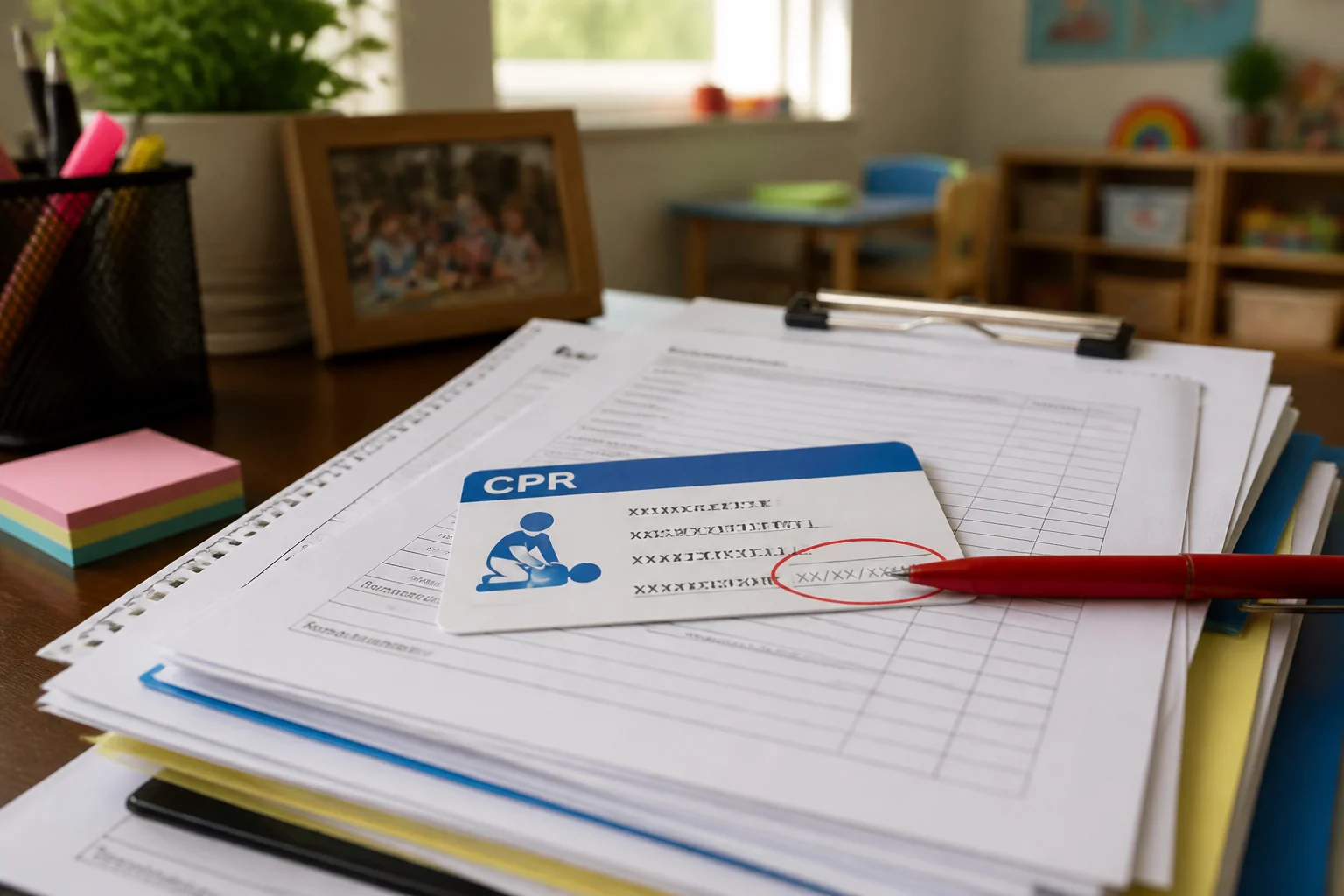
“Current” means the certification has not passed its printed expiration date. Standard CPR certification from organizations like Red Cross or AHA is typically valid for two years from the date of issue, but inspectors go strictly by the date printed on the certificate, not by when the holder “plans to” complete a renewal course. If you need a broader understanding of how certification works in this state, the Complete Guide to CPR and First Aid Certification in California covers the full landscape.
It’s important to understand the difference between a general adult CPR certification and the specific EMSA Child Care Pediatric First Aid and CPR training required under Community Care Licensing rules. A generic workplace CPR AED certification, even a valid one, does not satisfy California daycare licensing standards unless it is specifically EMSA-approved and covers pediatric and infant emergencies. Workplace requirements outside childcare, healthcare settings included, often accept a broader range of CPR levels, but daycare licensing does not. This article focuses on what happens during a daycare licensing inspection specifically.
What Inspectors Look For During a California Daycare Visit
Community Care Licensing (CCL) analysts, part of the California Department of Social Services, conduct both announced and unannounced inspections of daycare centers and family child care homes. These visits are thorough. Inspectors don’t just walk through the building, they sit down with your training and certification files.
During a typical visit, inspectors will ask to see CPR and first aid certification for directors and all relevant staff, staff schedules and time sheets, children’s attendance records, and individual staff files to confirm that someone with current Pediatric First Aid and CPR certification is present, in person, at all times children are in care.
| Requirement | What the Inspector Checks |
|---|---|
| Approved provider | EMSA-approved, Red Cross, AHA, or accredited college/university |
| Course type | Pediatric First Aid and CPR (not adult-only) |
| Dates | Clear issue date and expiration date printed on the certificate |
| Name match | Staff member’s name must match a valid photo ID |
| Physical presence | The certified person must be physically on site, not just scheduled |
Inspectors may also confirm that the certified person is available to respond to a cardiac emergency or breathing emergency, not off-premises running errands while children are in the building.
What Counts as an “Expired” CPR Certification in California
In California daycare licensing, “expired” means any certification where the printed expiration date has passed, even by one day. There is no formal licensing grace period. Once the date listed on the certificate passes, it no longer satisfies the requirement, and the staff member’s card joins the growing list of CPR certifications that expire quietly if no one is tracking dates.
Standard Red Cross and American Heart Association CPR AED and first aid certification is typically valid for two years. However, it must be the EMSA-approved pediatric version to count toward daycare licensing. A certificate from a course that only covers adult CPR, or one from a non-approved provider, is treated as though it doesn’t exist for licensing purposes. BLS (Basic Life Support) certification, often used in healthcare and clinical settings, is a related but distinct credential, it’s typically required for nurses or medical staff rather than standard daycare classroom roles, so don’t assume a BLS card automatically satisfies childcare licensing without confirming it’s the pediatric, EMSA-recognized version.
If a CPR or first aid certificate is illegible, damaged, missing dates, or cannot be verified through the issuing organization, inspectors may treat it as invalid, effectively the same as expired. Keep certification cards in good condition and store digital copies in staff files as a backup.
Immediate Consequences When CPR Certification Is Expired During an Inspection
When a CCL analyst discovers that required CPR or first aid certification has expired, they document the non-compliance in a Licensing Evaluation Report (typically the LIC 809 form). The deficiency is cited under personnel requirements referencing Health & Safety Code § 1596.866 and relevant sections of Title 22, California Code of Regulations § 100016.
The deficiency is typically classified by severity: Type B poses a potential health, safety, or personal rights risk, this is the more common classification when some certified staff are still present but individual certification has lapsed. Type A poses an immediate risk to health and safety, this applies when no one on site holds valid certification while children are in care.
Immediate outcomes can include a written citation on the LIC 809 report, a requirement to post the report where parents can review it, a Plan of Correction that must be completed within the timeframe the analyst sets based on severity, and civil penalties if the deficiency is not corrected within the specified window. Under Health and Safety Code § 1596.99, penalties can reach $1,000 for a repeat violation plus $100 per day it continues uncorrected, and separately, Title 22 authorizes penalties of $50 to $150 per day for uncorrected deficiencies more broadly.
The severity of consequences depends on whether any certified staff remain on site, how long certification has been expired, and whether children were ever left without properly certified coverage.
Potential Longer-Term Impacts for Daycare Operators
A single expired certification deficiency, corrected promptly, is unlikely to shut down your daycare. But repeated findings create a compliance history that follows your facility. All deficiency reports are publicly visible through CCL’s online database, meaning parents, referral agencies, and subsidy programs can see every citation.
Multiple or serious violations can lead to increased inspection frequency and more intensive monitoring by CCL, escalating civil penalties, and suspension or revocation proceedings if you fail to correct deficiencies within the window the licensing agency sets.
The reputational impact shouldn’t be underestimated. Parents who see posted deficiency notices may question the daycare’s commitment to child safety. And beyond compliance, maintaining current certification directly affects your legal liability. If a child is injured during a cardiac emergency or a choking incident and the staff on duty were not properly certified, your exposure in a lawsuit, and the likelihood that your insurer denies the claim, increases significantly. Insurers in the healthcare and childcare space increasingly ask directly whether staff hold current, EMSA-approved certification before extending or renewing a policy.
Expired Certification vs. No Certified Staff Present
There’s an important distinction between two scenarios inspectors encounter.
Scenario 1: Some staff have valid Pediatric First Aid and CPR certification; others have expired certification. The facility still meets the minimum coverage requirement because at least one certified person is on site. Individual staff members with expired certification will be cited, but the overall risk classification is usually lower (Type B).
Scenario 2: All staff on site have expired certification or no training at all. This is far more serious. No one present during childcare hours holds valid certification, creating an immediate health and safety risk. Inspectors may classify this as Type A.
In severe cases, inspectors could require immediate corrective measures, such as limiting enrollment or reducing the number of children present, adjusting operating hours until a certified person arrives, sending uncertified staff home and bringing in a qualified substitute, or temporarily restricting activities until compliance is restored.
The bottom line: never schedule a shift where the only person with children is someone whose CPR certification has lapsed. That single gap in coverage is where a manageable paperwork issue turns into an actual risk to a child’s life.
How Far in Advance to Renew CPR and First Aid Certification for California Daycare
The best way to avoid expired certification is to never let it get close to the edge. Schedule your renewal course 60 to 90 days before the expiration date on your current certification. This buffer accounts for class availability, instructor schedules, and the unexpected delays that come with running a busy daycare.
As long as certification is still current, staff can generally register for a shorter recertification course rather than the full class. Once certification expires, most providers, including Red Cross and AHA, require a full initial course, which takes more class time and costs more. That’s a strong incentive to complete recertification early rather than waiting for the printed expiration date to force the issue. For details on what a recertification course involves, Coast2Coast breaks down the process clearly, and a knowledgeable instructor can advise on the most convenient option for your team’s schedule.
Many childcare employers set internal renewal requirements stricter than the legal minimum, for example, requiring staff to complete their renewal course within 30 days before expiration to ensure continuous compliance across all shifts without cutting it close. Use digital calendars or HR systems to track expiration dates and send automated reminders several months in advance, with flexible scheduling that works around your staff’s availability. A little planning now is far more helpful than scrambling to register a staff member for the next available class after an inspector has already flagged the gap.
Why the 2-Year Cycle Isn’t Just a Paperwork Rule
The 2-year renewal requirement reflects how quickly CPR skills actually fade, not an arbitrary bureaucratic timeline. Research shows CPR skills decline significantly within 6 to 12 months without practice, and studies have found that less than half of trained individuals can still pass a CPR skills test after just one year. Compression depth, rhythm, and confidence under pressure all degrade faster than most people expect, which matters enormously in a genuine life-threatening emergency where hesitation costs time.
Guidelines and techniques also evolve. Advancements in CPR science periodically require certification updates, compression-to-breath ratios, AED protocols, and pediatric-specific guidance have all been revised in recent years. A certificate that’s been sitting in a drawer for two years doesn’t just risk a citation, it may reflect outdated technique that could affect whether a life is saved. That’s the real reason renewing before your certification expires matters more than treating it as a box to check for an inspector, and it’s why an instructor’s in-person demonstration of current technique is worth far more than the card itself.
Acceptable CPR/First Aid Courses for California Childcare Providers
California law requires EMSA-approved Pediatric First Aid and CPR training for licensed daycare providers. Not every CPR class qualifies. The training must be specifically approved by the Emergency Medical Services Authority and cover pediatric CPR, AED use, and first aid geared to infants and children.
| Organization | Key Requirement |
|---|---|
| American Red Cross | Must be the EMSA-approved childcare version |
| American Heart Association | Must include pediatric CPR/AED and first aid |
| EMSA-approved programs | Listed on the EMSA website; must include hands-on skills |
| Accredited college/university | Must meet EMSA content standards |
Generic adult-only CPR or online coursework-only certification, even if valid for other workplace requirements, does not meet California daycare licensing standards unless explicitly EMSA-approved for childcare. If you’re a teacher working in a school-based program, check the specific CPR certification requirements for teachers in California to understand where daycare and school rules overlap.
Since January 1, 2026, all new and renewal training must also include instruction on anaphylaxis prevention and the emergency use of epinephrine auto-injectors under AB 2317.
Online, Blended, and On-Site CPR Training for Daycare Staff
Modern CPR training comes in several formats: fully in-person classroom instruction, blended learning (online theory plus in-person skills testing), and private on-site group training delivered at the daycare itself.
For daycare compliance, the CPR portion of your training must include a hands-on skills evaluation. Purely online coursework with no skills component is generally not accepted by California CCL when EMSA approval is required. The theory portion, covering topics like recognizing breathing emergencies, understanding when to use an AED, and responding to an infant choking, can sometimes be completed online, but the practical skills must be demonstrated with an instructor present in person before any EMS-recognized certification is issued.
On-site and group training offers real advantages for daycare operators: all staff can complete training on the same date, simplifying logistics, class scenarios can be tailored to the daycare environment and the specific equipment in your building, and coverage planning is easier when everyone renews together (though staggering is still recommended). Employers who invest in a convenient, on-site format tend to see higher completion rates than centers that leave scheduling entirely up to individual staff.
Coast2Coast First Aid & Aquatics is an authorized provider delivering EMSA-approved Pediatric CPR & First Aid and AHA Heartsaver Pediatric training and certification directly across California, including on-site group sessions built around the daycare schedule, alongside our Canadian Red Cross programs across Canada.
Preventing Lapses: Practical Compliance Tips for California Daycares
Proactive planning is the only reliable way to avoid having expired certification discovered during an inspection. Here’s what works: create a centralized training log listing each staff member’s CPR, AED, and first aid expiration dates, course types (EMSA Child Care, Pediatric First Aid and CPR), and renewal status, a simple spreadsheet works, but HR platforms with automated alerts are even better. Build a scheduling policy so no staff member is scheduled alone with children unless their Pediatric First Aid and CPR certification will remain valid for the entire shift, and ideally for at least 60 more days.
Stagger renewal dates so not all staff expire at once. If everyone completed training together two years ago, split them into two groups this time around so you always maintain certified coverage. Maintain a surplus of certified staff on each shift to cover vacations, illness, and turnover, don’t operate at the bare minimum. Budget for training annually so renewal expenses don’t catch you off guard.
What to Do If You Discover Expired CPR Certification Before or During an Inspection
You’re reviewing files the night before an inspection, or worse, the inspector is already in the building, and you realize a staff member’s certification expired last month. Here’s what to do.
Immediate steps: remove uncertified staff from unsupervised child care roles, do not count them as the certified person on duty. Confirm that at least one person with current EMSA Child Care CPR and first aid certification remains on site, in person, at all times during operating hours. Register the affected staff member for a renewal course or full CPR training class without delay, same-week or next-week class scheduling shows good faith.
During the inspection: show proof of enrollment in a renewal course and document any interim safety measures you’ve put in place. Be honest with the inspector, attempting to hide the lapse or present expired certification as valid will make things worse. A deficiency may still be written, inspectors are required to document what they find, but prompt action and a clear plan of correction demonstrate that the community you serve can remain confident in your commitment to child safety.
Once staff complete their renewal course, submit updated certification to CCL immediately. Don’t wait for the next scheduled review.
How Coast2Coast First Aid & Aquatics Supports California Daycare CPR Compliance
Coast2Coast First Aid & Aquatics is an authorized provider delivering EMSA-approved Pediatric First Aid and CPR certification and AHA Heartsaver Pediatric training directly across California, alongside our Canadian Red Cross programs across Canada. For daycare operators facing an urgent renewal need, we can prioritize scheduling and issue same-day digital certification upon successful completion.
Best practices we build into every renewal course include early renewal before the expiration date, not after, blended learning where allowed, combining online education with in-person skills testing, coordinated team training days focused on infant and child emergencies so staff feel prepared and confident, and instructors with specific experience in childcare and pediatric scenarios who can answer questions about how each skill applies to your classroom.
For directors managing an entire team, we can also help map staff expiration dates so your whole center recertifies on a predictable schedule, reducing the odds of a surprise gap during your next inspection.
Check the EMSA Sticker Rules
Know exactly what your certificate needs before an inspection.
See the Full 16-Hour Breakdown
CPR/First Aid is only half of California’s licensing requirement.
An expired CPR certificate becomes non-compliant the day after it lapses, no grace period, no exceptions. Whether it’s classified Type A or Type B depends entirely on whether certified coverage remains on site. Track expiration dates centrally, renew 60 to 90 days early, and if a gap is ever found, act immediately and document every corrective step you take.
Get Started with California Certification
Find the right course level and book with a 99% pass rate.
FAQ: Expired CPR Certification in California Daycare Settings
Q1: Is there any grace period after my CPR certification expires for California daycare licensing?
A: Community Care Licensing does not recognize a formal grace period. Once the expiration date on your Pediatric First Aid and CPR certificate has passed, it no longer satisfies the daycare requirement. Some training providers may allow late renewals as a courtesy, but this does not change the licensing expectation: you must maintain certification continuously while children are in care. If your certification has lapsed, act immediately to complete a renewal or full course.
Q2: Can I keep working in a daycare classroom if my CPR certification expired last week?
A: California regulations expect at least one person with current EMSA-approved Pediatric First Aid and CPR certification on site whenever children are present. An individual with expired certification should not be the sole or primary caregiver. Staff with expired certification should be removed from roles where they qualify as the certified person on duty until they complete a renewal course or full certification class. They may still assist in the classroom alongside a currently certified colleague, but they cannot be counted toward compliance.
Q3: Does an online-only CPR course meet California daycare requirements?
A: For licensed childcare, California generally requires EMSA-approved Pediatric First Aid and CPR training that includes in-person skills testing. Most online-only CPR certification does not meet this requirement. Before relying on any online CPR certification for daycare compliance, confirm with EMSA’s list of approved training programs and your local licensing analyst. A blended course with online theory and an in-person skills pass can be a helpful, convenient option where accepted.
More FAQs: Edge Cases and Third-Party Staff
Q4: What happens if an inspector finds expired CPR certification but no children are present?
A: If the facility is technically open but children are not on site at that moment, the inspector may still cite the expired certification because it relates to readiness for normal operating hours. The severity of the deficiency may be influenced by how quickly the lapse is corrected and whether children were ever left without properly certified staff in the past. Even outside active childcare hours, expired certification signals a compliance gap that inspectors are obligated to document.
Q5: Do volunteers and substitutes need current Pediatric First Aid and CPR certification in California daycares?
A: Licensing rules focus on ensuring at least one person with current EMSA-approved Pediatric First Aid and CPR certification is present whenever children are in care, regardless of whether that person is a regular employee, a substitute, or a qualified volunteer. Many centers require all regular classroom staff and long-term substitutes to maintain current CPR and first aid certification as internal policy. Check your specific license conditions and your liability insurer’s requirements, as standards can vary by program type.
Reviewed By: Ashkon Pourheidary, B.Sc. Hons Neuroscience, Co-Founder of Coast2Coast First Aid & Aquatics and Canadian Red Cross Instructor Trainer since 2011.
Source: California Health and Safety Code Section 1596.866