
Quick Answer
To get CPR certified in California, enroll in an American Red Cross-approved course that includes hands-on skills practice with CPR manikins and an AED trainer. Most standard CPR and AED courses take two to four hours and issue a certification card valid for two years. Fully online courses without an in-person component are generally not accepted by California employers or regulatory bodies.
2–4 hrs
Typical course duration
2 years
Certification validity
70%
Of cardiac arrests happen at home
What You Will Learn
- How to choose a recognized CPR training provider in California
- How to register and prepare for a CPR and AED certification course
- What to expect during the course and skills assessment
- Which California professions require current CPR certification by law
- The difference between CPR-A, CPR-B, CPR-C, and BLS certification levels
- How and when to recertify before your card expires
How Do You Choose the Right CPR Provider in California?
When seeking CPR certification in California, the first step is selecting a provider whose credentials are recognized by employers, healthcare regulators, and the state. The two most widely accepted issuing bodies are the American Red Cross and the American Heart Association. Courses from either organization are accepted in healthcare settings, schools, childcare facilities, and workplaces across all 50 states.
Coast2Coast First Aid delivers American Red Cross-approved certification courses at locations throughout California, including Los Angeles, Long Beach, San Diego, Irvine, and Riverside. Each course follows the most current evidence-based guidelines and includes hands-on practice that employers and regulators require.
When comparing providers, look for these features:
- In-person or blended learning options — a hands-on skills component is required for most employment and regulatory purposes
- Combined CPR, AED, and First Aid coverage — most employers prefer a single certification that covers all three areas
- Flexible scheduling — evening, weekend, and weekday classes are widely available
- Same-day card issuance — digital and printed certification cards should be available on the day of training
- Group or private training options — businesses can arrange private group training at their own location
Your certification card will be valid for two years from the date of issue. After expiration, a renewal course is required to maintain active certification. Many employers require renewal before the card technically expires to ensure continuous coverage without a lapse.
How Do You Register and Prepare for CPR Training in California?
Once you have identified a provider, registering is straightforward. Evening and weekend classes fill quickly, so booking in advance is advisable. To enroll in a California CPR course, follow these steps:
- Book your spot early. Evening and weekend sessions are the most popular and fill fastest.
- Confirm the course scope. Verify that the course covers CPR, AED, and any First Aid components your employer or role requires.
- Bring a valid photo ID. This is typically the only document needed for both new and renewal certifications.
- Complete any online pre-work. Blended learning courses require you to finish one to two hours of online theory modules before attending the in-person skills session. Complete these in advance to make the most of class time.
- Dress appropriately. Wear comfortable, flexible clothing and closed-toe shoes. You will be kneeling and practicing compressions on a manikin at floor level.
It is also worth reviewing the provider’s cancellation and rescheduling policy before booking. If you are organizing certification for a team, ask about group rates since many providers, including Coast2Coast, offer reduced pricing for multiple participants booked together through group training programs.
What Happens During a CPR Certification Course?
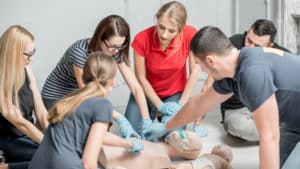
A standard CPR and AED certification course combines instruction with hands-on practice. Most courses are structured around the following core competencies:
- Airway, Breathing, and Circulation (the ABCs). Instructors walk through the recognition of cardiac arrest and the priority sequence for intervention.
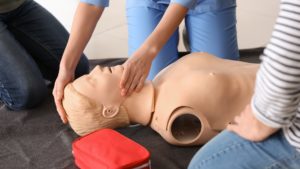
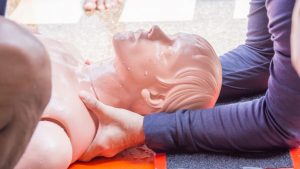
- Hands-only CPR technique. You will practice compression depth, rate, and rhythm on adult, child, and infant manikins until technique is consistent and accurate.
- AED operation. You will practice powering on an AED trainer, applying pads, and delivering a simulated shock safely while CPR continues.
- Choking relief. Abdominal thrust technique for conscious and unconscious patients, including modified procedures for infants.
- Basic first aid. Addressing bleeding, suspected fractures, and how to manage interruptions to CPR in a real emergency.
At the end of the course, participants complete a skills assessment and a short written evaluation. Upon passing both, a digital or printed certification card is issued on the spot. Instructors provide real-time feedback throughout the practical portion, so even participants with no prior emergency training leave with genuine confidence in their technique.
A standard CPR and AED course typically runs four to five hours. A combined First Aid and CPR course may run six to eight hours. BLS courses for healthcare professionals focus on team-based resuscitation scenarios and take three to four hours.
Who Needs CPR Certification in California?
While CPR knowledge benefits everyone, a number of California professions are legally or contractually required to maintain current certification. Understanding which category applies to you helps you choose the correct certification level from the outset.
Healthcare and Clinical Professions
Nurses, physicians, paramedics, dental professionals, and other clinical staff are typically required to hold Basic Life Support (BLS) certification as a condition of employment and licensure. Standard consumer-level CPR cards are not sufficient for clinical roles. ACLS (Advanced Cardiovascular Life Support) may also be required for certain hospital and emergency medicine positions.
Education and Childcare
The California Education Code requires public school teachers to hold current CPR and first aid training. Many school districts treat this as a condition of employment rather than a voluntary recommendation. Childcare providers and daycare workers are also regulated under California law, with CPR and first aid certification required for licensing. Our babysitting and child care training course covers the pediatric-specific skills that teachers and caregivers need most.
Fitness, Aquatics, and Trades
Personal trainers, lifeguards, and construction workers frequently require CPR certification to meet employer requirements and applicable California occupational health regulations. Cal/OSHA recommends first aid and CPR training in all high-risk workplaces, and many employers treat this recommendation as a mandatory standard.
Community Members and Families
No profession is required for CPR training to be worthwhile. The American Heart Association reports that nearly 70 percent of out-of-hospital cardiac arrests occur in homes, meaning family members are statistically the most likely bystanders. Parents, grandparents, babysitters, and community volunteers all benefit from knowing how to respond in the critical minutes before emergency services arrive.
What Is the Difference Between CPR-A, CPR-B, CPR-C, and BLS?
CPR certification levels are structured around the patient populations covered:
- CPR-A (Adult). Covers CPR techniques for adult patients only.
- CPR-B (Infant and Child). Covers CPR for infants and children only.
- CPR-C (Adult, Child, and Infant). The most comprehensive level, covering all age groups. This is the standard recommended for most workplace and community settings.
- BLS (Basic Life Support). Designed for healthcare professionals. Covers team-based resuscitation, two-rescuer CPR, barrier device use, and advanced airway management. Required for most clinical employment in California.
- AED. Often bundled with CPR-C, covering the recognition of shockable rhythms and the safe operation of an Automated External Defibrillator.
For most non-clinical purposes in California, including workplace compliance, school employment, and personal preparedness, a CPR-C and AED certification is the appropriate choice. If you are unsure which level your employer or licensing body requires, ask directly before booking.
California Compliance Note
Cal/OSHA regulations recommend first aid and CPR training for employees in all high-risk workplaces. The California Education Code requires CPR and first aid training for public school teachers. Childcare licensing regulations require current CPR certification for all operators and staff. Healthcare professionals must hold BLS certification issued by a recognized provider such as the American Red Cross or American Heart Association. Check with your licensing body or employer for the specific level and renewal interval required for your role.
Key Takeaway
CPR certification in California requires completing an American Red Cross or American Heart Association-approved course that includes in-person hands-on practice. Most courses take two to four hours, certifications are valid for two years, and cards are issued on the day of training. Healthcare workers need BLS-level certification; CPR-C plus AED is the right choice for most non-clinical roles. Set a calendar reminder to recertify before your card expires so your certification remains active and continuous.
Get Certified
Ready to Get Your CPR Certification?
Find a course near you across California. In-person and blended options available with same-day card issuance.
Frequently Asked Questions: 2026 CPR Certification in California
Sources & Regulatory References
- Cal/OSHA, Title 8 California Code of Regulations — First Aid and Emergency Medical Services requirements for California workplaces
- California Education Code, Section 51202 and related provisions — CPR training requirements for public school teachers and student instruction
- American Heart Association — “Cardiac Arrest Statistics” (out-of-hospital cardiac arrest occurrence data)
- American Red Cross — CPR/AED and BLS certification program standards and guidelines
- California Department of Social Services, Community Care Licensing Division — CPR and first aid certification requirements for childcare facility licensing
Reviewed by: Ashkon Pourheidary, B.Sc. (Hons), Co-Founder & Instructor Trainer, Coast2Coast First Aid & Aquatics. Certified First Aid and CPR Instructor since 2011; Instructor Trainer since 2013.