
COAST2COAST FIRST AID · RESEARCH & INSIGHTS · MAY 2026
The Workplace Injury Costing California $2.2 Billion a Year Is Not the One Anyone Is Training For — New Data From 20,000+ Canadian Exams Shows Where Certified Responders Actually Fail
The workplace injury costing California an estimated $2.2 billion a year is not the one anyone is training for. Data from more than 20,000 written first aid exams from our Canadian certification network shows where certified responders actually fail — and why California, with no written knowledge assessment requirement, has no way to see it.
By Ashkon Pour-Heidary, HBSc Neuroscience · American Red Cross & Canadian Red Cross Instructor Trainer · Founder, Coast2Coast First Aid
May 2026 · c2cfirstaidaquatics.com/us/first-aid-knowledge-gap-report
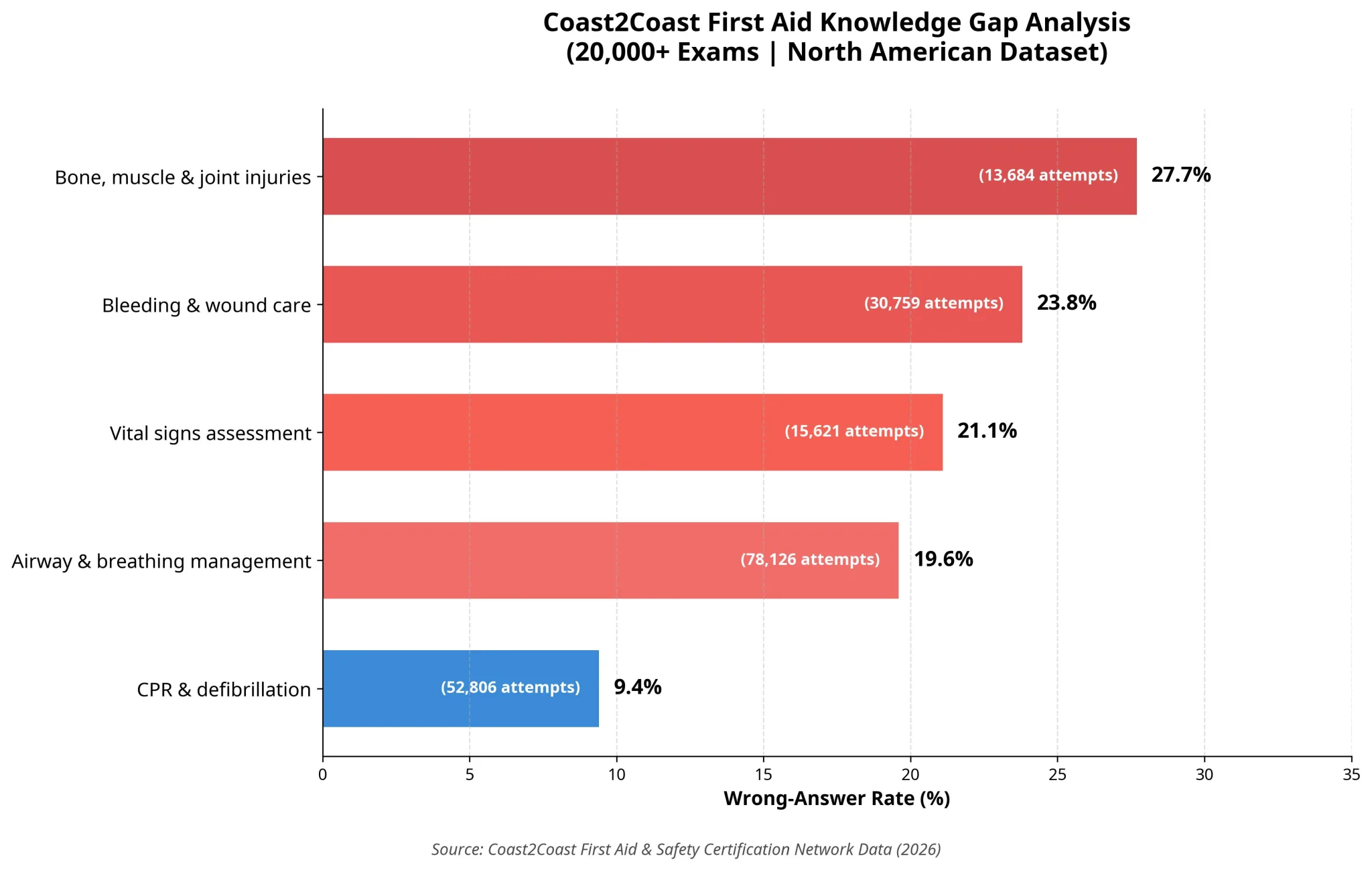
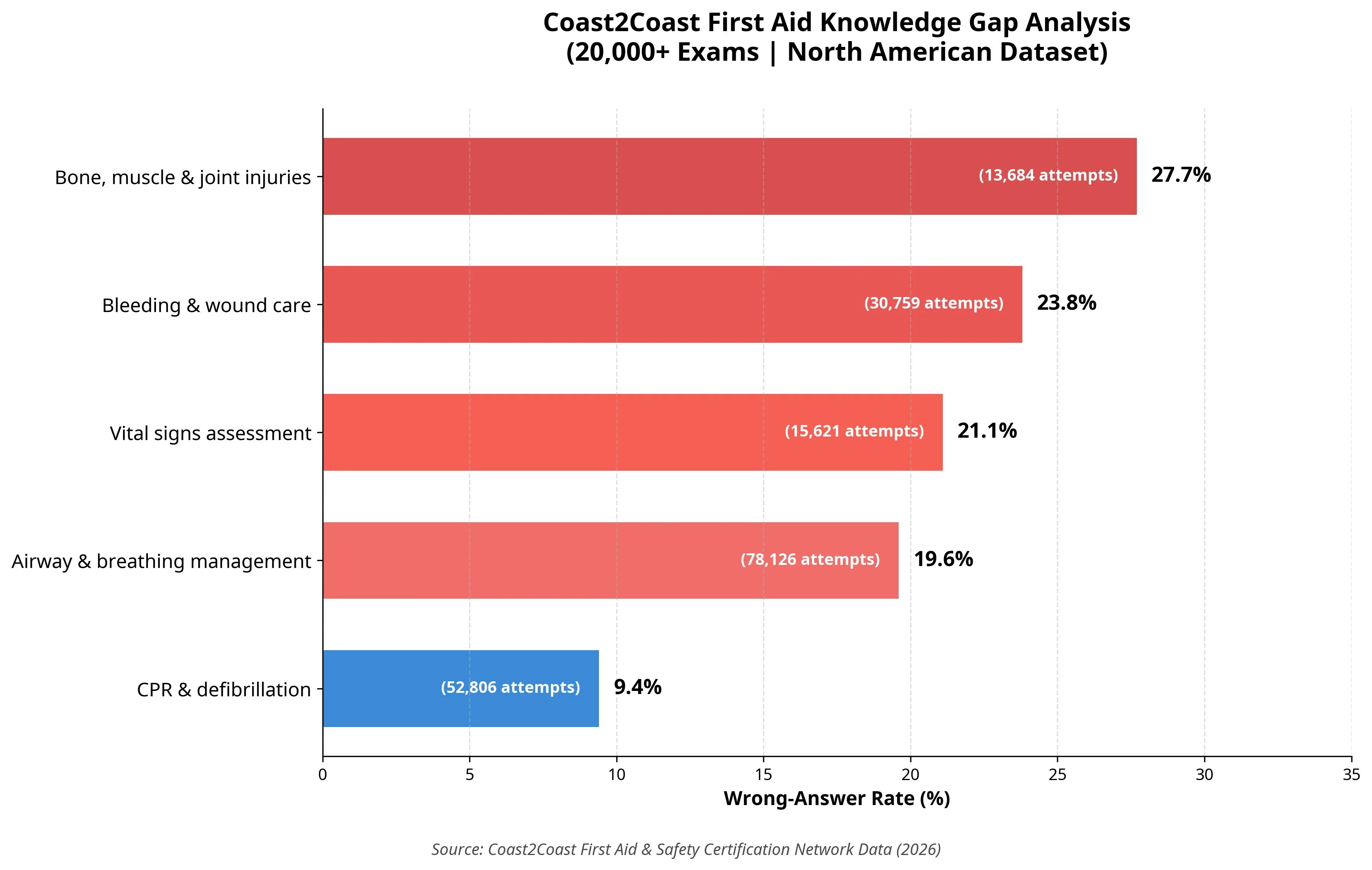
An analysis of more than 20,000 written first aid certification exams from Coast2Coast First Aid’s Canadian network shows that certified lay rescuers most often answer incorrectly on bone, muscle and joint injuries (27.7% wrong) and bleeding and wound care (23.8% wrong), far more often than on CPR and defibrillation (9.4% wrong). Because California does not require a written knowledge assessment for workplace first aid certification, it has no way to detect these same gaps. Coast2Coast is asking Cal/OSHA to add a written knowledge assessment to the Section 3400 standard, in addition to the existing practical skills demonstration.
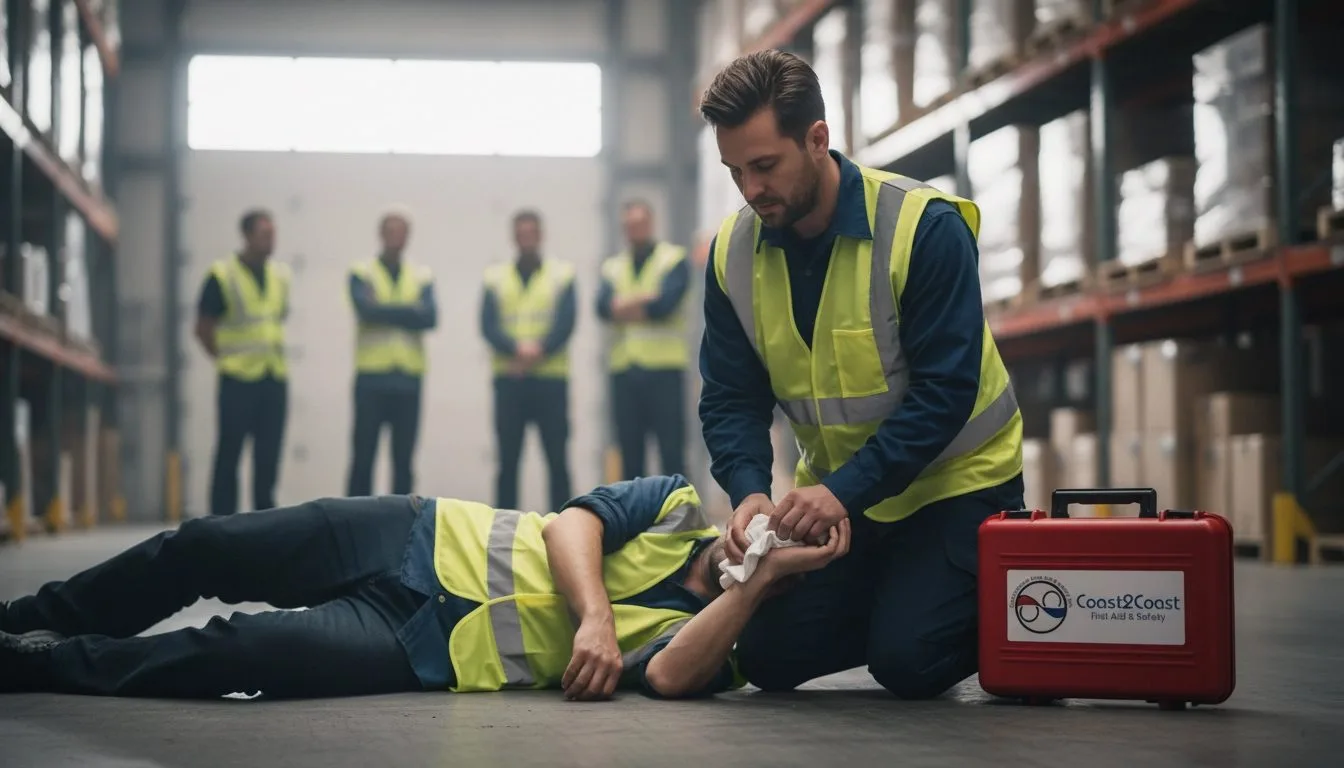
There is a moment every first aid instructor knows. The student in front of you has just passed. They have the certificate. They are heading for the door. And somewhere in the back of your mind is a question you cannot fully answer: are they actually ready?
I know that question personally. I passed my first first aid course at 19. I had the card. When the moment came to demonstrate what I actually knew — a practical assessment for an emergency response team at the University of Toronto — I could not perform. The certificate said I was ready. I was not.
That experience is the reason Coast2Coast First Aid exists, and it is the reason we built the technology to finally answer that question at scale.
Why We Built This Platform — First, For Ourselves
We need to be clear about something up front: we did not build this digital testing platform to publish research. We built it because we run a training organization that cares whether its students actually learn what they came to learn — and we needed answers we could not get from paper exams that end up filed in a drawer.
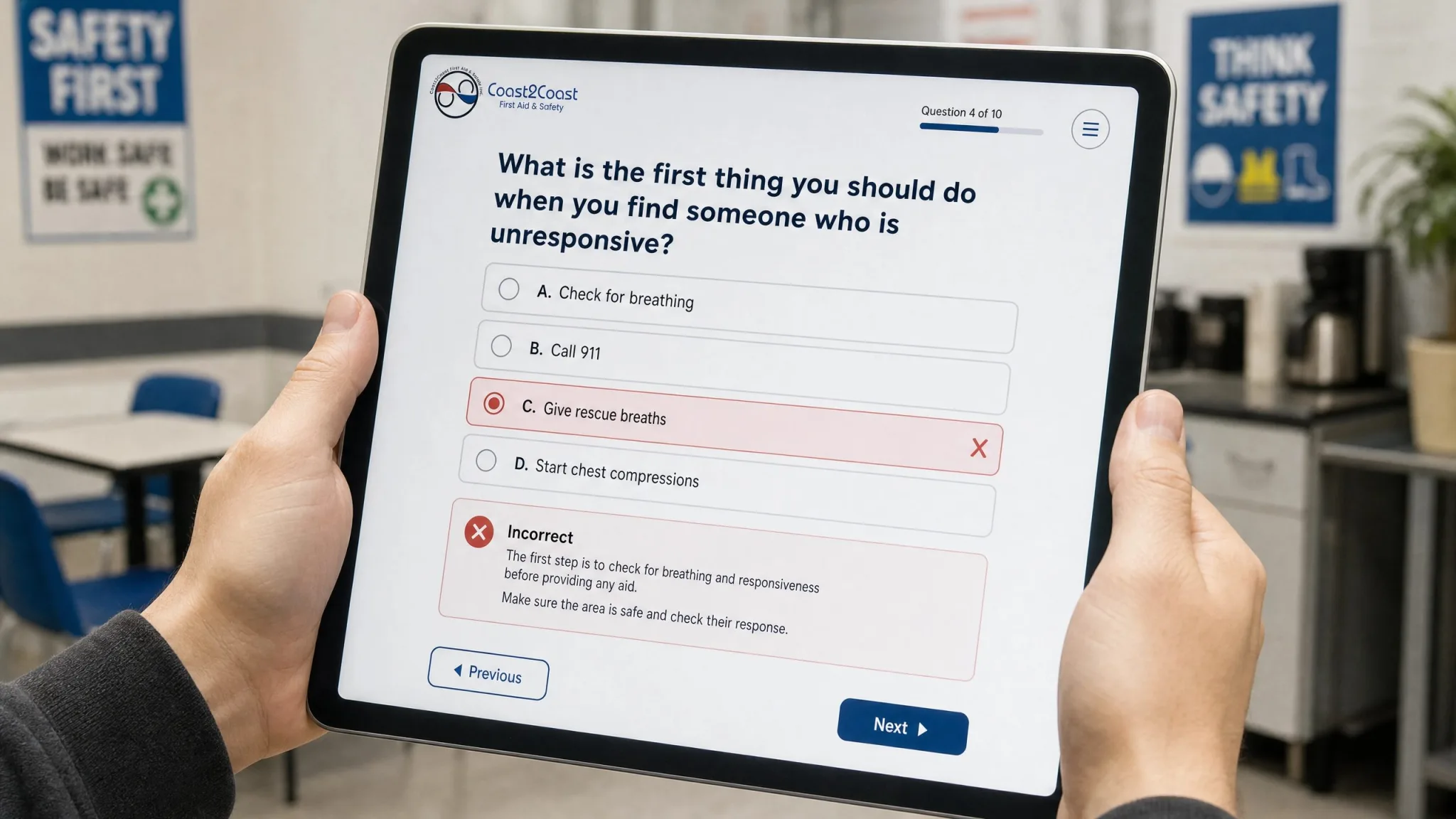
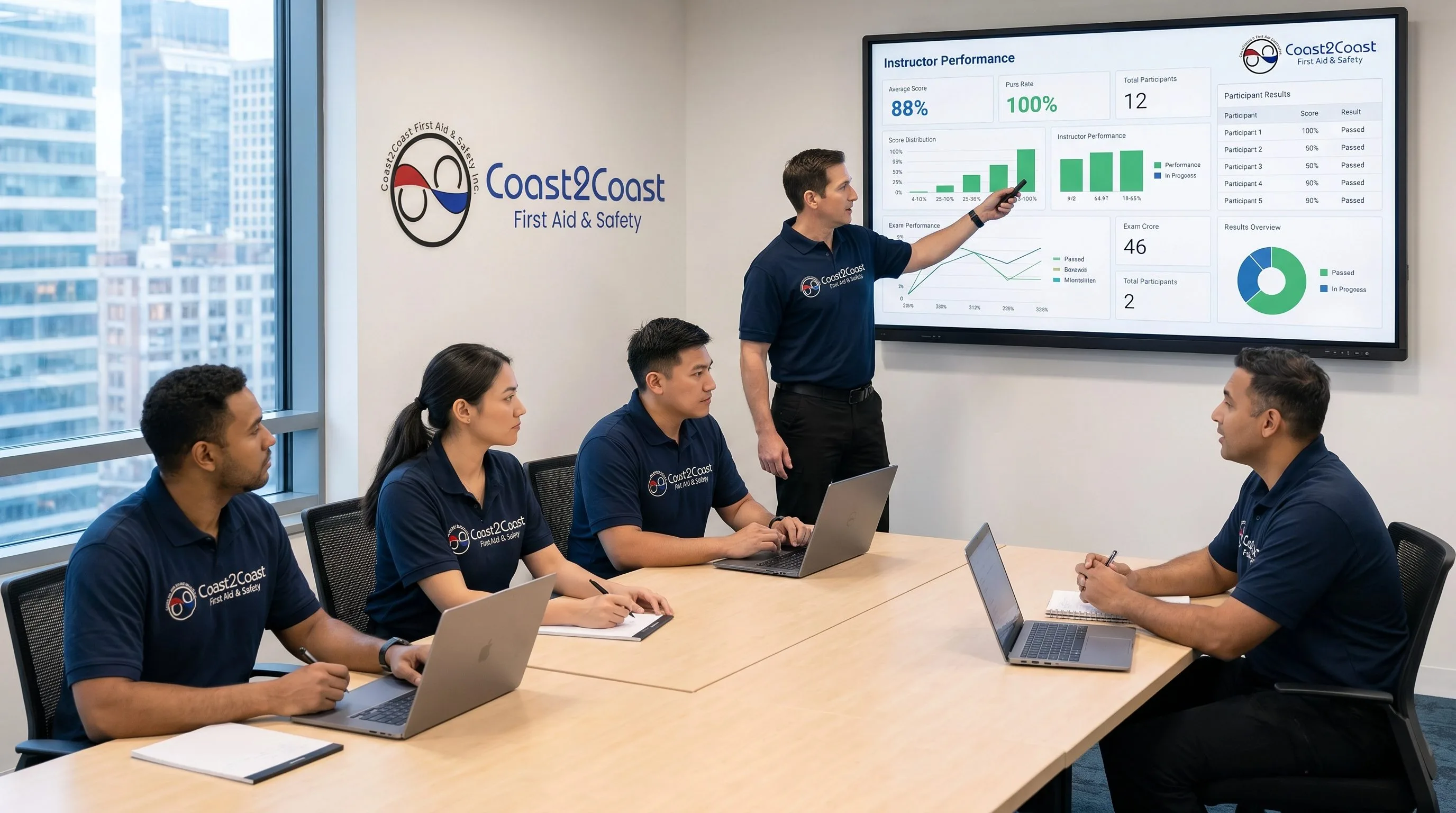
Coast2Coast First Aid co-founder Aryan Sekhavati built the proprietary in-classroom testing platform — the first of its kind among first aid and CPR training providers in North America — to capture written exam responses in real time across every classroom in the network. Before this platform existed, exam responses were graded on paper, filed away, and never aggregated. We use the data it generates in three ways, every day, internally:
First, we look at network-wide question patterns. Which specific questions produce the highest rate of wrong answers across thousands of students? That tells us where our curriculum needs more time, more scenarios, more reinforcement. It is a signal we cannot get any other way.
Second, we look at classroom-level concentration. Is the gap broad across the network, or concentrated in specific classrooms? Broad patterns drive curriculum revision. Concentrated patterns drive targeted support to specific locations.
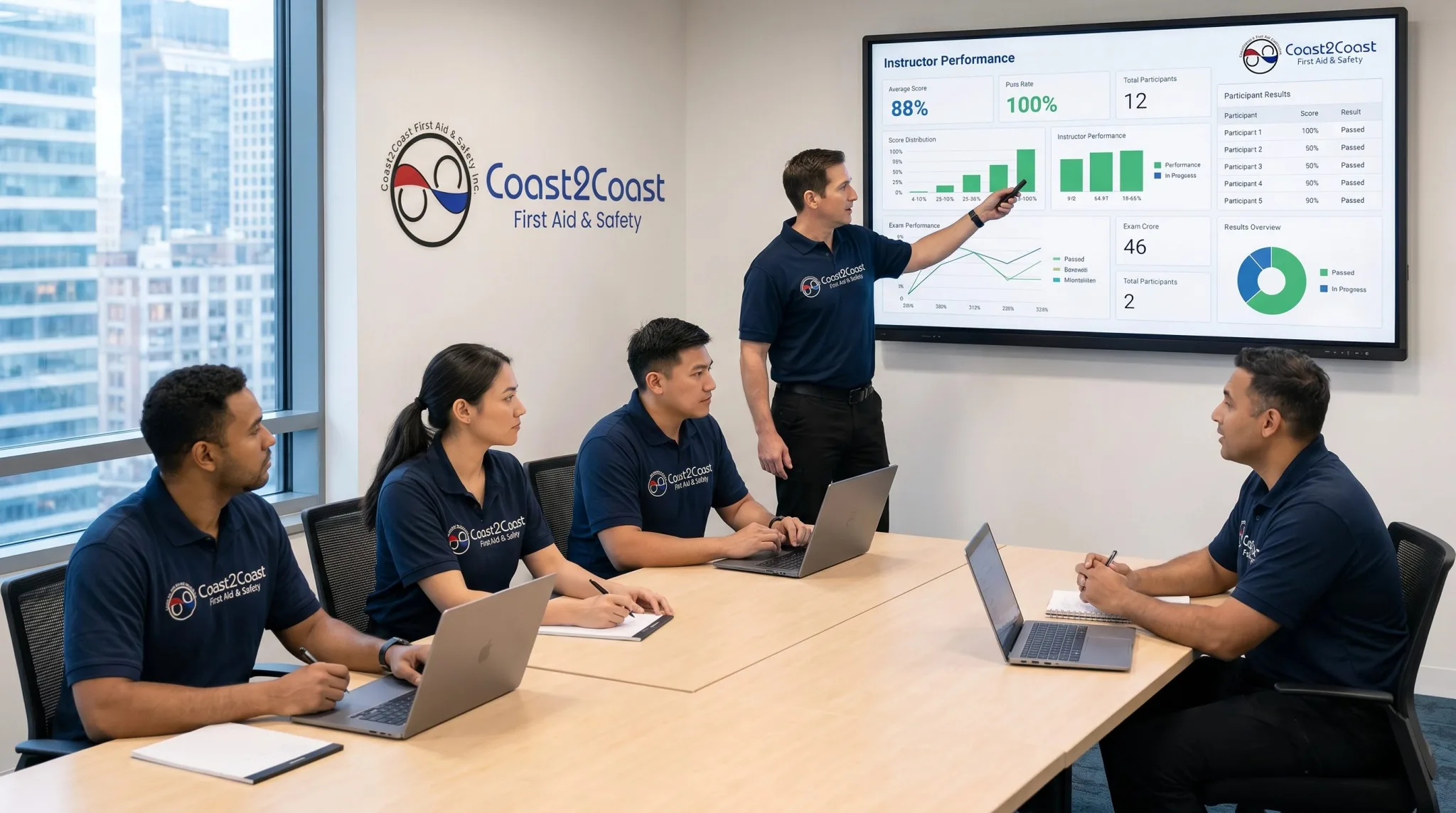
Third, we look at instructor baseline data. Every instructor has a network-wide expected range based on student outcomes. When a specific instructor’s student results consistently fall outside that range, the data prompts a coaching conversation — lesson plan review, time on high-miss topics, an improvement plan. Not a disciplinary process. A development one, driven by what the data shows.
This is internal quality assurance. It is how we make sure our students get what they came for, and how we make sure our instructors are set up to succeed.
But the more data we accumulated, the clearer one thing became: the knowledge gaps we were finding were not random. They were patterns. Consistent. Stable across thousands of students. Pointing at the same topics, again and again. That is when we decided to share what we were seeing publicly — because the implications go beyond our own classrooms.
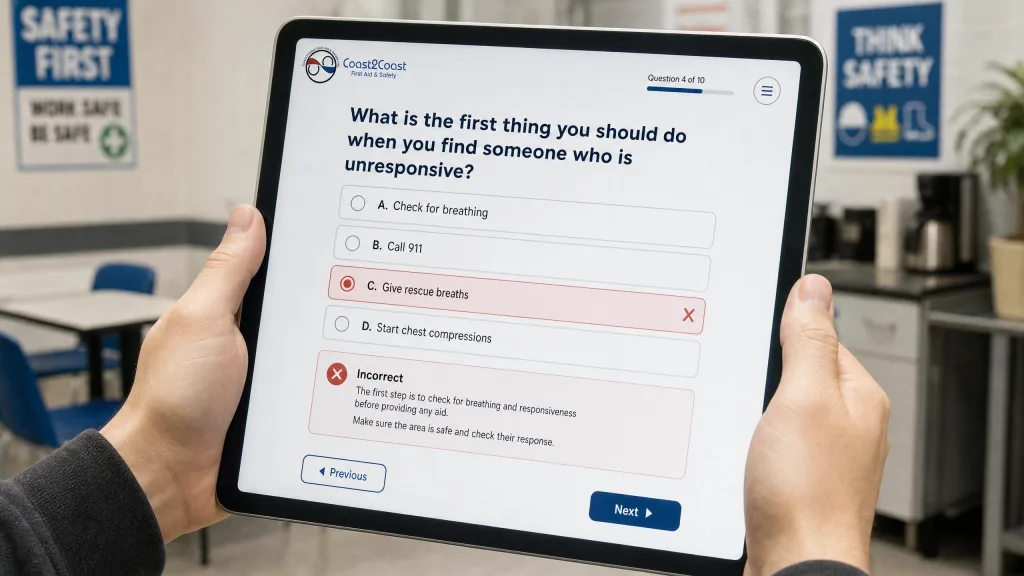
We will soon make a version of this platform available to our California students. Those enrolled in first aid and CPR courses in Los Angeles will have the option to complete an in-class knowledge quiz to solidify their understanding and be better prepared for real-world emergencies — giving California workers the same feedback loop that has been driving improvement in our Canadian network. Our intent is to publish California-specific data as it accumulates, with the same transparency as this report.
What 20,000 Exams Show
The industry’s attention has long centered on CPR. Chest compressions, AED use, airway management — these dominate public awareness, instructor training time, and regulatory conversation. The data from more than 20,000 digitally captured certification exams in our network confirms that focus is working. Questions related to CPR and defibrillation produce an incorrect answer rate of just 9.4%.
The topics producing consistent wrong answers — in patterns stable enough across thousands of students to act on — are the ones nobody is talking about.
About this data. These exam responses were captured between July 2025 and May 2026 across our Canadian certification network. The primary dataset covers the Standard First Aid & CPR/AED Level C cohort [13] — the Canadian equivalent of the American Red Cross Adult and Pediatric First Aid/CPR/AED course [12] that California employers accept for workplace compliance under Cal/OSHA Title 8, Section 3400. [11] That regulation is where this entire policy conversation begins, and where we will return at the end.
Two Knowledge Gaps That Matter Most in the Workplace
We want to focus on two findings specifically, because they are where the data most directly intersects with the kinds of injuries that happen on California worksites every day.
Bone, muscle and joint injuries — 27.7% wrong-answer rate
Among the 13,684 attempts we analyzed in this category, more than one in four lay rescuers — the term used in workplace safety regulations for a non-healthcare employee trained in first aid — answered the bone and muscle injury question incorrectly. These were students who attended the course, sat the exam, and passed certification.
Incorrect bone and muscle response is not a neutral outcome. Moving a patient before stabilizing a fracture can turn a contained break into a displaced or compound injury, escalating it from a splint-and-monitor situation into a surgical one. Failing to recognize when not to move someone risks secondary injury, including potential spinal complications. Incorrect immobilization can extend recovery time and increase the risk of long-term impairment.
This matters in California specifically because musculoskeletal disorders are the leading category of workplace injuries in the United States, with 937,620 DART cases reported in 2023–2024. [3] California tracks its own state-specific injury data through the California Survey of Occupational Injuries and Illnesses, administered by the California Department of Industrial Relations in cooperation with the U.S. Bureau of Labor Statistics — the same SOII methodology that produces the national figures. [14] Given that the same injury categories dominate workplace injuries nationally, it is reasonable to expect they do in California as well.
Bleeding and wound care — 23.8% wrong-answer rate
Across 30,759 attempts — by far our largest dataset for any single category — nearly one in four lay rescuers gave the wrong answer to questions about bleeding and wound care. This is significant because hemorrhage control is consistently identified in peer-reviewed research as one of the most critical and most poorly performed lay-rescuer interventions.
A systematic literature review published in Acta Anaesthesiologica Scandinavica found that incorrect first aid was administered in up to 83.7% of cases by lay rescuers to trauma victims, with airway handling and hemorrhage control specifically identified as particular areas of concern. [2] The same review estimated that correct first aid could have reduced mortality by 1.8–4.5%.
Incorrect wound care has direct consequences in workplace settings: a wound that could have been controlled at the first aid level escalates into one requiring medical treatment beyond first aid — turning a non-recordable incident into an OSHA recordable claim. Inadequate hemorrhage control in serious cases is life-threatening. The training is supposed to address these scenarios. The data suggests that, even with certification, almost a quarter of trained lay rescuers cannot reliably answer the underlying knowledge question.
What these two findings have in common: they are both about the kinds of routine, common workplace injuries that ordinary lay rescuers will actually encounter. They are not exotic scenarios. They are the everyday situations the training is supposed to prepare them for. And the data shows that, across thousands of students, the training is not consistently doing that — not at a level our network can see, and certainly not at a level California has any way to measure.
Why We Believe California Has the Same Gaps
We need to be transparent: the 27.7% and 23.8% figures come from our Canadian network. We cannot tell you California’s exact rate, because California does not require a written knowledge assessment for lay rescuers. There is no California number to publish. What we can show, however, is that the conditions producing these gaps are present in California for five independently verifiable reasons.
The curriculum is similar.
American Red Cross and Canadian Red Cross first aid courses are both built on the guidelines of the International Liaison Committee on Resuscitation — the same international evidence body, the same review cycle, the same underlying science. [10] The correct answer to “what do you do when a wound dressing saturates with blood” is the same in Los Angeles as it is in Toronto.
The certification framework is comparable.
The American Red Cross Adult and Pediatric First Aid/CPR/AED course — what California employers accept for workplace compliance [12] — is the US equivalent of the Canadian Standard First Aid & CPR/AED Level C course in our dataset. [13] Both operate under the same international Red Cross movement, the same certification methodology, the same ILCOR standards. The main difference is that in Canada this course takes about 14–16 hours, while in the United States the course averages 4–6 hours depending on class size. That difference matters: if the same knowledge has to be transferred in roughly a third of the time, the gaps our written assessment reveals are likely to be at least as severe in the United States — possibly more so.
Human physiology does not change at the border.
The cognitive decisions our data shows lay rescuers struggle with — when to stabilize before moving, when to apply a sling, what to do when a wound dressing saturates, when to call for additional help — are difficult under pressure for the same reasons in any jurisdiction. The difficulty is not cultural. It is a function of how the material was taught, how much scenario practice the student got, and whether anyone measured what they retained. None of those variables are specific to Canada.
The workplace injury patterns are the same.
Musculoskeletal disorders are the leading category of US workplace injuries — 937,620 DART cases reported by the Bureau of Labor Statistics in 2023–2024. [3] California participates in the same Survey of Occupational Injuries and Illnesses methodology, with state-specific data published by the California Department of Industrial Relations. [14] Bleeding and wound care issues are routine workplace events across construction, manufacturing, hospitality, healthcare support, and warehousing. The categories where our data shows the biggest knowledge gaps are exactly the kinds of injuries California workplaces report regularly.
We are in California now, teaching the same program.
Coast2Coast First Aid has operated in Los Angeles since November 2025. We use the same curriculum, the same testing methodology, and the same instructor standards in our California classrooms that produced this dataset. We do not yet have enough US exams to publish California-specific numbers, but our intent is to. When we do, we will share that data too — with the same transparency. However, as apposed to the Canada where our students are required to complete the test, in California, we are unable to make this mandatory, making a head wind for data collection.
What’s at Stake Financially
The relationship between first-aid knowledge and injury outcomes is not a clean dollars-in, dollars-out equation — real workplace injuries are caused by many factors, and no single training improvement produces a guaranteed financial return. What the research does consistently show is the same shape: better-prepared lay rescuers correlate with better outcomes for injured workers, and better outcomes translate into measurable financial benefit across the system.
How better-prepared lay rescuers shift outcomes.
OSHA’s 2012 white paper on Injury and Illness Prevention Programs documents that workplaces implementing comprehensive prevention programs — which include emergency response and first aid capability as core elements — typically see workplace injury and illness rates reduced by 15 to 35 percent. [1] Verified first aid knowledge is one piece of that larger picture, but it is a piece California currently has no way to measure.
When a lay rescuer responds effectively to a workplace injury, the injury tends to stay manageable. The worker recovers faster. The claim stays smaller. The team returns to baseline sooner. When a lay rescuer does not have the knowledge — when they move a patient who shouldn’t be moved, miss the signs of a serious injury, or apply incorrect wound care — the same injury can escalate, with direct workers’ compensation consequences. The average workers’ compensation claim for all injuries is $47,316. For fracture, crush, or dislocation injuries, it averages $66,467. [7]
OSHA’s official Safety Pays calculator documents that indirect costs of a workplace injury — overtime to backfill the role, hiring and training a temporary replacement, supervisor and HR time, OSHA documentation, team disruption — range from 1.1 times the direct cost for severe injuries to 4.5 times the direct cost for less severe ones. [5] Other OSHA materials describe these indirect cost categories in detail. [6] Median time away from work for a serious musculoskeletal injury is 8 days, and California employers carry claims history through the experience modification factor (X-mod), which influences premium pricing over a multi-year period. California’s benchmark advisory premium rate is currently $1.38 per $100 of payroll. [8]
Lets be clear, we are not asserting that any single training improvement produces a fixed dollar return. We are saying that the research consistently shows the same shape: when lay rescuers are better prepared, injuries stay contained more often, recoveries are faster, and financial pressure on the system eases. OSHA and ASSP research on well-implemented safety programs has cited returns ranging from $4 to $6 per dollar invested. [9] Verified first aid knowledge — measured, tracked, and improved over time — is part of that picture.
What This Means — and What We’re Asking California to Consider
Let us return to the question we opened with — the one every first aid instructor knows, the one I could not answer as a student myself: are they actually ready?
We built this platform to answer that question for our own organization — to know which curriculum topics need more time, which classrooms need targeted support, which instructors would benefit from coaching. That work is internal, ongoing, and is the reason we believe our network is in a position to share findings like these credibly.
But the same data has shown us something we cannot ignore. California — the state where we now operate and where we are committed to growing — has no equivalent way to see this layer of the certification picture. No one does. And that is a problem worth fixing.
Cal/OSHA Title 8, Section 3400 currently requires that workplace lay rescuers be “adequately trained to render first aid” at a standard equal to the American Red Cross. [11] Adequacy is measured through demonstrated physical skills — compressions, wound dressing, patient positioning. Those tests are essential and must not be replaced. They tell you whether someone can perform the technique.
What physical demonstration cannot reach is the cognitive layer underneath. When to act. In what order. What to do when the first approach doesn’t work. Whether the lay rescuer recognizes the signs of a serious bone or muscle injury, knows what to do when a wound dressing saturates with blood, and understands why the order of operations matters. Those are knowledge questions. They can only be measured by asking them.
Without that measurement, California has no way to know whether its certified lay rescuer workforce is actually prepared for the cognitive demands of a workplace emergency — only that they were able to demonstrate physical skills in a controlled setting. Skill demonstration and knowledge assessment are not redundant. They are complementary. Together they answer two different questions: “can this person perform the procedure?” and “does this person understand when, why, and how to apply it?” Both need answering.
Our specific request: We are asking Cal/OSHA and the California Occupational Safety and Health Standards Board to consider adding a written knowledge assessment requirement to the standard for workplace first aid certification under Section 3400 — in addition to the existing practical skills demonstration, not in place of it.
Why this matters for California: Coupling a written knowledge assessment with the physical skills test would close a measurement gap that currently makes it impossible for California to know whether certified lay rescuers are genuinely ready. It would create a feedback loop that drives continuous improvement in workplace safety training across the state — the same loop our internal platform creates for our organization. And it would put California at the front of a national standard worth leading on.
This is not a regulatory burden. The infrastructure exists. The methodology is proven. The American Red Cross already builds written knowledge content into its curriculum. What is missing is the requirement that it be measured.
We are sharing this data because we believe California is the state that takes this step first. The technology is in place. The argument is on the page. The decision is one regulatory action away.
“We built this platform to support our students, our instructors, and our internal quality. What it has shown us has implications well beyond our own classrooms. Our Canadian network data, drawn from more than 20,000 exams where written assessment is already standard, shows the gap is real and concentrated exactly where it hurts most. If knowledge gaps exist at these rates in a program with rigorous written testing, they are unlikely to be smaller in California, where no written test exists at all. California has the opportunity to set a standard that ensures every certified lay rescuer in the state — every person trained to help a coworker when something goes wrong — has demonstrated not only that they can perform the skill, but that they understand when and how to apply it. That is what genuine readiness looks like. And that is what California’s workers deserve.”
— Ashkon Pour-Heidary, HBSc Neuroscience · American Red Cross & Canadian Red Cross Instructor Trainer · Emergency Medical Responder Instructor Trainer · Founder, Coast2Coast First Aid
Key Takeaway
The most dangerous workplace first aid knowledge gaps are not in CPR. They are in the routine injuries lay rescuers actually encounter most: broken bones, sprains, and bleeding. California cannot currently measure these gaps because it requires no written knowledge assessment. Adding one to the Cal/OSHA Section 3400 standard, alongside the existing skills demonstration, would close that blind spot.
Workplace Training
Train Your Team With Verified, Measured Knowledge
Coast2Coast delivers first aid and CPR training to California workplaces using the same curriculum and standards behind this report.
Explore Group Training for Your WorkplaceReferences & Sources
Every claim in this report is linked to its source below. Reference numbers in the text are clickable. Each entry includes a direct URL to the original.
- OSHA Injury and Illness Prevention Programs White Paper (January 2012). Implementation of prevention programs reduces injuries by 15–35%. https://www.osha.gov/sites/default/files/OSHA-white-paper-january2012sm.pdf
- Tannvik TD, Bakke HK, Wisborg T. “A systematic literature review on first aid provided by laypeople to trauma victims.” Acta Anaesthesiologica Scandinavica, 2012. Incorrect first aid was given in up to 83.7% of cases; airway handling and haemorrhage control were particular areas of concern; correct first aid could have reduced mortality by 1.8–4.5%. https://pmc.ncbi.nlm.nih.gov/articles/PMC3495299/
- National Safety Council Injury Facts, citing U.S. Bureau of Labor Statistics. 937,620 musculoskeletal disorder DART cases in private sector, 2023–2024. https://injuryfacts.nsc.org/work/safety-topics/musculoskeletal-injuries/
- National Safety Council Injury Facts. 2024 total cost of work injuries: $181.4 billion. Wage and productivity losses: $54.9 billion. 69 million workdays lost. https://injuryfacts.nsc.org/work/costs/work-injury-costs/
- OSHA Safety Pays Individual Injury Estimator — Background. Indirect-to-direct cost ratio ranges from 4.5× for minor injuries (direct costs under $3,000) to 1.1× for more severe injuries (direct costs over $10,000). Indirect costs include lost productivity, training replacement workers, overtime, accident investigation, and administrative burden. https://www.osha.gov/safetypays/background
- OSHA. “Business Case for Safety and Health — Costs.” Indirect costs include training replacement employees, investigation, lost productivity, administrative burden. https://www.osha.gov/businesscase/costs
- National Council on Compensation Insurance (NCCI), reported via NSC Injury Facts. Average cost for all workers’ comp claims, 2022–2023: $47,316. Fracture/crush/dislocation category average: $66,467. https://injuryfacts.nsc.org/work/costs/workers-compensation-costs/
- California Department of Insurance, Press Release, July 12, 2024. Commissioner Lara issued advisory pure premium rate of $1.38 per $100 of payroll, effective September 1, 2024. https://www.insurance.ca.gov/0400-news/0100-press-releases/2024/release029-2024.cfm
- SafetyPro Resources, citing OSHA and American Society of Safety Professionals (ASSP) research. Well-implemented safety programs typically deliver 200–600% ROI within three years. https://www.safetyproresources.com/blog/building-cost-effective-safety-program-calculating-roi
- International Liaison Committee on Resuscitation. American Red Cross and Canadian Red Cross first aid curricula are both built on ILCOR evidence guidelines. https://www.ilcor.org
- California Code of Regulations, Title 8, Section 3400. “Medical Services and First Aid.” Employees must be adequately trained to render first aid, with training equal to that of the American Red Cross. No written knowledge assessment is required. https://www.dir.ca.gov/title8/3400.html
- American Red Cross. “Adult and Pediatric First Aid/CPR/AED” course. The OSHA-compliant workplace first aid course in the United States. Typical duration: approximately 4–6 hours including online portion and in-person skills session. https://www.redcross.org/take-a-class/classes/adult-and-pediatric-first-aid%2Fcpr%2Faed/LP-00005000.html
- Canadian Red Cross. “Standard First Aid & CPR/AED Level C” course. The Canadian equivalent of the US Adult and Pediatric First Aid/CPR/AED course. Typical duration: 14–16 hours of in-person instruction. https://www.redcross.ca/training-and-certification/course-descriptions/first-aid-training/standard-first-aid-cpr
- California Department of Industrial Relations, Office of Policy, Research and Legislation. Nonfatal Occupational Injuries and Illnesses in California — Survey of Occupational Injuries and Illnesses (SOII), administered jointly with the U.S. Bureau of Labor Statistics. State-specific data on workplace injury counts and incidence rates by industry, case type, and worker characteristics. https://www.dir.ca.gov/oprl/nonfatal.htm
About Coast2Coast First Aid
An authorized American Red Cross Training Partner and an American Heart Association Aligned Training Site operating across North America, with Los Angeles operations established in November 2025. Founded in 2014, the company has certified more than 150,000 individuals. Founder Ashkon Pour-Heidary holds a Bachelor of Science in Neuroscience (University of Toronto) and is a certified Instructor Trainer for both the American Red Cross and the Canadian Red Cross, as well as an Emergency Medical Responder Instructor Trainer.
Full dataset and methodology available to journalists, researchers, regulators, and policymakers on request.
About the Author
Ashkon Pour-Heidary, HBSc Neuroscience
Ashkon is the founder of Coast2Coast First Aid and a certified Instructor Trainer for both the American Red Cross and the Canadian Red Cross, as well as an Emergency Medical Responder Instructor Trainer. He holds a Bachelor of Science in Neuroscience from the University of Toronto and has led the certification of more than 150,000 individuals across North America. His work focuses on closing the gap between holding a certificate and being genuinely ready to respond.