N95 vs. KN95: Which Mask Actually Passes an OSHA Fit Test?

N95 vs. KN95 mask

N95 vs. KN95: Which Mask Actually Passes an OSHA Fit Test?

Only a NIOSH-approved N95 respirator can complete an OSHA-compliant fit test. KN95 masks are certified under China’s GB2626 standard rather than NIOSH’s 42 CFR Part 84, so most workplace respiratory protection programs cannot use them to satisfy fit testing requirements. The two masks may look similar and filter to a comparable standard, but only one of them is built for a documented, repeatable fit test.

If you’re choosing respiratory protection for yourself, your staff, or a job site, this guide explains how N95 and KN95 masks differ, how respirator approval standards affect workplace use, and when OSHA fit testing requirements apply. It’s especially relevant for healthcare workers, employers, industrial hygienists, safety professionals, and anyone who needs reliable protection from airborne hazards while staying compliant with workplace rules.

Only a NIOSH-approved N95 respirator, tested under 42 CFR Part 84, can satisfy OSHA’s fit testing requirements under 29 CFR 1910.134. KN95 masks are certified under China’s GB2626-2019 standard instead, so most workplace respiratory protection programs cannot use them to meet fit testing rules. Fit testing itself uses one of two methods, qualitative or quantitative, to confirm that a specific respirator forms an airtight seal on an individual’s face.

Team Training

Building a Complete Workplace Safety Program?

Respirator compliance is only one piece of a safe workplace. Coast2Coast delivers onsite CPR, first aid, and safety training for teams across the US.

Explore Onsite Team Training

95%
Minimum filtration efficiency required for both N95 and KN95 masks
15-20 Min
Typical length of a standard respirator fit test
1x / Year
Minimum frequency OSHA requires for respirator fit testing

What Is the Difference Between N95 and KN95 Masks?

Both N95 and KN95 respirators are designed to filter at least 95 percent of airborne particles, including small aerosols. The difference is not filtration efficiency. It is certification. N95 respirators are tested and approved by the National Institute for Occupational Safety and Health (NIOSH), a US federal agency, under a strict batch-testing and quality-control process. KN95 masks follow China’s GB2626-2019 standard, which uses different testing protocols and is not NIOSH-certified. That distinction matters most in regulated workplaces, where OSHA requires respiratory protection equipment to be NIOSH-approved before it can be used in a formal respiratory protection program.

The two masks are built a little differently too. N95 respirators typically use head straps that wrap around the crown and base of the skull, pulling the mask snugly against the face from two points. KN95 masks generally use ear loops instead, and an ear-loop design tends to fit more loosely, since it relies on two small anchor points near the ears rather than a full head strap.

Both are generally intended to be single-use, disposable items. Neither one is designed to be washed and reused indefinitely, no matter which standard it was certified under.

It’s also worth knowing that counterfeit and substandard KN95 products have shown up in the US market more often than counterfeit N95s. That’s largely because KN95 production doesn’t go through the same kind of independent oversight NIOSH applies to N95 respirators, so a KN95 label alone isn’t a reliable guarantee of quality.

For that reason, N95 masks are generally the better fit for workplaces with genuinely poor air quality, where a verified seal and filtration rate actually matter.

Why Only NIOSH-Approved Respirators Pass an OSHA Fit Test

OSHA’s Respiratory Protection Standard, 29 CFR 1910.134, requires employers to fit test any tight-fitting respirator used to protect workers from airborne hazards. Because that standard is built around NIOSH-approved equipment, a KN95 mask generally falls outside the fit-testing process entirely.

Some KN95 models were granted temporary use authorizations during supply shortages, but those exceptions do not make a KN95 equivalent to an N95 in a workplace program. For healthcare workers, industrial hygienists, and anyone required to complete annual respirator fit testing, the practical answer is straightforward: the respirator has to be NIOSH-approved before a fit test can even begin.

It helps to remember what a respirator actually is in regulatory terms: one piece of personal protective equipment among several, and one that only works if the agency behind its certification standards, the Occupational Safety and Health Administration, can verify how it performs in practice.

Compliance Note: OSHA requires employers to keep fit test records on file, including the respirator make and model, test method, and pass or fail result. These records need to be available for review and updated every time an employee is retested.

How Employers Choose a Respirator Category

Not every job that calls for a respirator calls for an N95. OSHA and NIOSH sort respirators into several categories, and the right one depends on the hazard, not personal preference.

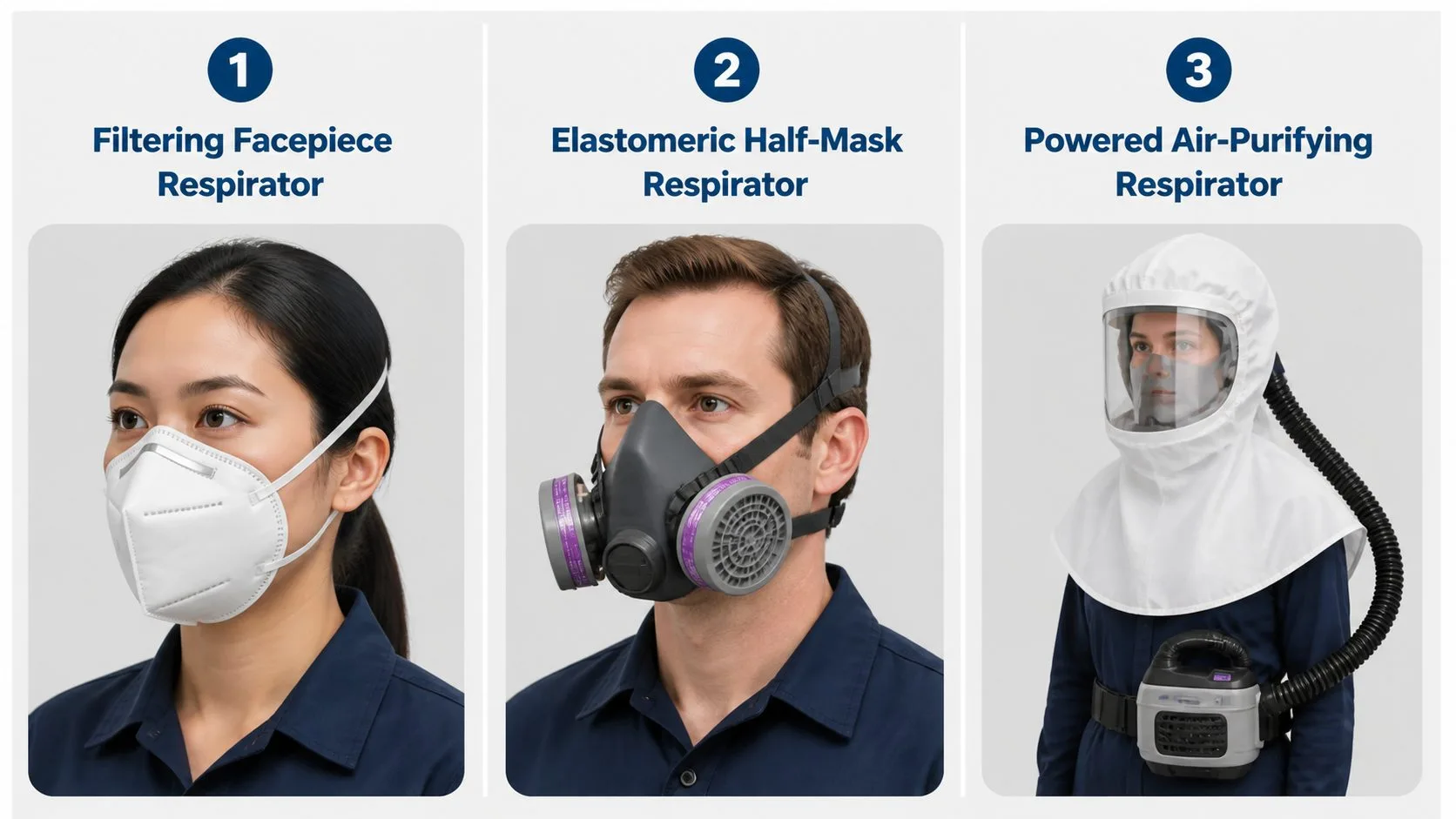
Filtering Facepiece Respirators

An N95 is technically a filtering facepiece respirator, a NIOSH classification for masks that filter particles through the mask material itself rather than through a separate cartridge. Other filtering facepiece respirators include the N99 and N100, which filter at higher efficiency levels for more hazardous environments. These are particulate respirators, meaning they’re built to capture solid and liquid particles rather than gases or vapors, and their particulate filter material is what earns them a NIOSH rating in the first place.

Half-Mask, Powered, and Cartridge Respirators

Elastomeric half-mask respirators are reusable rubber or silicone masks fitted with replaceable cartridges instead of built-in filtration, and they’re common in industrial settings where the same worker uses the same respirator for months at a time. Not all cartridges filter the same hazard, either. Organic vapor cartridges are built for vapors and gases, while particulate cartridges are built for dust and aerosols, so choosing the right one depends on what’s actually in the air.

Powered air-purifying respirators, or PAPRs, are a separate category of air-purifying respirators that use a battery-powered blower to push filtered air into a hood or loose-fitting mask. That design removes some of the fit sensitivity that comes with a tight seal, which is one reason PAPRs show up often in healthcare settings.

Employers generally choose a category based on the hazard’s permissible exposure limit, the maximum airborne concentration OSHA allows a worker to be exposed to over a set period. A NIOSH-approved N95 can provide adequate protection below certain exposure thresholds, but higher-hazard workplace environments call for a half-mask or powered air-purifying respirator instead.

face mask fitting

What Is a Respirator Fit Test?

A respirator fit test checks whether a specific mask, in a specific size, creates an airtight seal against an individual’s face. Even a NIOSH-approved N95 will leak air around the edges if it is the wrong size or shape for the wearer, which defeats its filtration benefit.

Fit testing is separate from a user seal check, which a wearer performs alone each time they put a respirator on. A user seal check comes in two forms: a positive-pressure check, done by exhaling gently and confirming the mask puffs out slightly without air leaking around the edges, and a negative-pressure check, done by inhaling sharply with the respirator sealed off and confirming it collapses slightly against the face. A fit test is administered by a trained evaluator, uses one of two recognized fit testing methods, either qualitative fit testing or quantitative fit testing, and produces a documented pass or fail result before anyone is cleared to test respirators on the job.

Qualitative Fit Testing

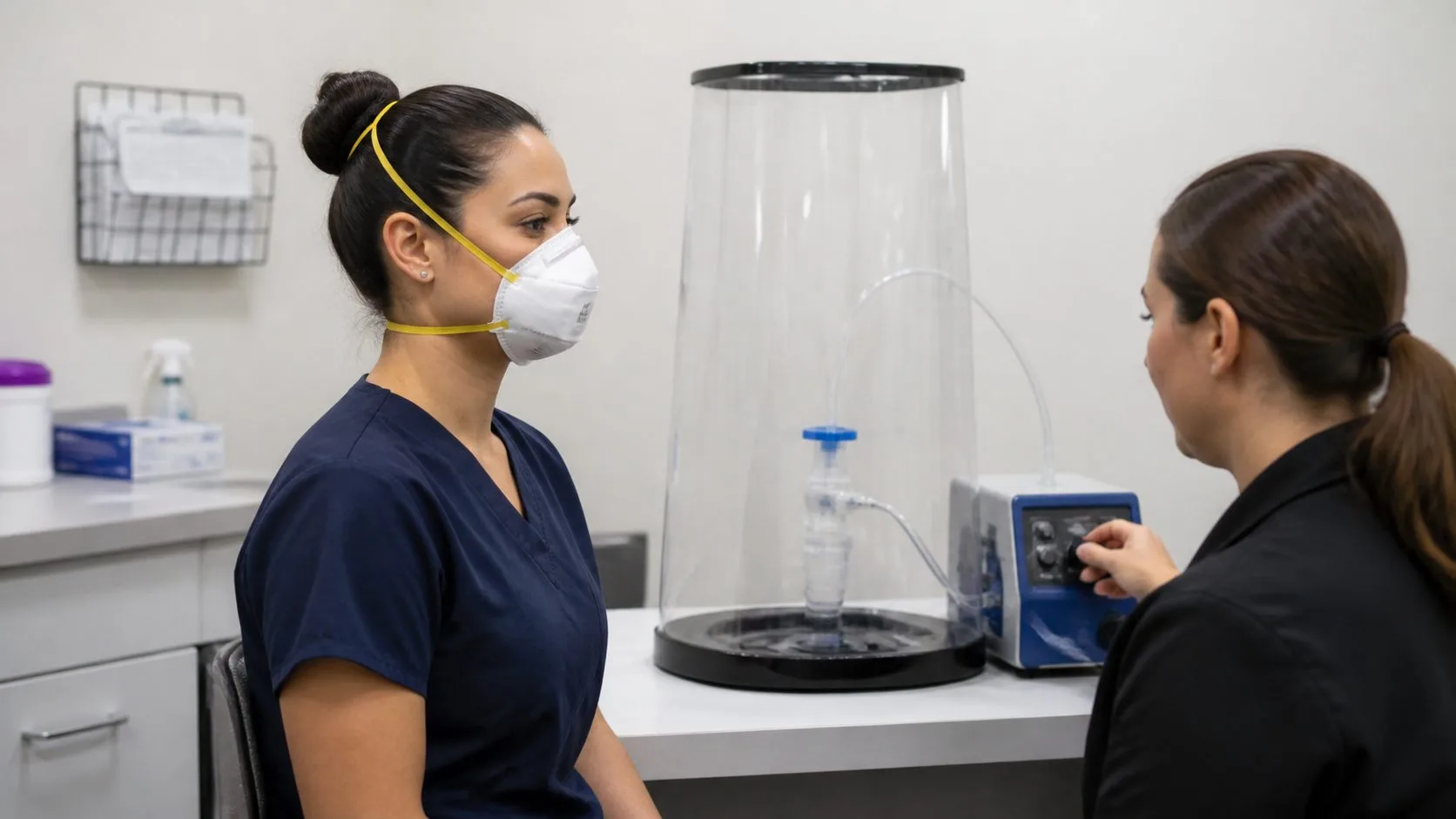
Qualitative fit testing relies on the wearer’s senses. The test administrator introduces a harmless test agent, often a sweet or bitter-tasting aerosol, into a hood or enclosure around the wearer’s head. If the wearer cannot taste or smell the agent while performing a set of exercises, such as talking, bending over, and moving their head side to side, the respirator passes. Some administrators use irritant smoke instead of a taste-based aerosol, and the wearer passes by not coughing or reacting to it, which reaches the same pass or fail result through a different sense entirely.

Quantitative Respirator Fit Testing

Quantitative respirator fit testing uses a fit testing instrument, most often a particle-counting machine, to measure the actual number of particles inside versus outside the mask, rather than relying on the wearer’s perception. This method typically requires a small hole fitted into the respirator so the instrument can sample air from inside the mask while the wearer moves through the same exercises used in qualitative testing. Some quantitative methods generate a test aerosol, such as corn oil, and pair it with a condensation nuclei counter to take these measurements. Quantitative fit testing produces a numerical fit factor rather than a pass or fail based on perception, and it is generally required for respirators used in higher-hazard environments.

Get Your Team CPR and First Aid Certified

Respirator programs work best alongside a workforce that’s also prepared for medical emergencies. Coast2Coast offers CPR and AED courses for individuals and groups across the US.

View CPR/AED Courses

When Do You Need to Be Retested?

A passed fit test doesn’t last forever. OSHA, formally the Occupational Safety and Health Administration, requires a new fit test at least once a year, and it requires one sooner if anything changes about how a respirator fits an individual’s face. The most common trigger is a significant weight change, gain or loss, since it reshapes the contours a respirator has to seal against. Noticeable weight loss around the cheeks or jaw is a common example. Facial surgery, scarring, or significant dental work can have the same effect. A new respirator model always requires its own fit test too, even for someone who has already passed with a different model, since no two respirator designs seal exactly the same way. This applies whether the original test used qualitative fit testing or quantitative fit testing, and each successful retest should be documented by date, just like the original.

Facial Hair and Respirator Fit Testing

OSHA prohibits facial hair that crosses the sealing surface of a tight-fitting respirator, and that rule applies no matter how neatly trimmed a beard or mustache is. Beards and mustaches interfere with the seal of any tight-fitting respirator, which is why the rule isn’t really about appearance at all.

Even a day or two of stubble along the jawline can be enough to break a respirator’s seal during testing. That’s why most fit test administrators require participants to be clean-shaven along the sealing surface on the day of the test, and why anyone who grows facial hair after passing needs to be retested before wearing that respirator again.

Safety Tip: If your job requires annual fit testing, schedule it for a day when you can arrive clean-shaven along the sealing surface. Even light stubble can cause an otherwise well-fitting respirator to fail the test.

Who Needs Respirator Fit Testing?

Wearing tight-fitting respirators on the job is what triggers this requirement in the first place. Anyone required by their employer to wear a tight-fitting respirator as part of a job duty needs to complete respirator fit testing, and OSHA requires it before initial use and at least annually after that, using either qualitative fit testing or quantitative fit testing depending on the respirator and workplace. Jobs that require fit testing span healthcare workers handling airborne pathogens, construction and manufacturing employees exposed to dust or chemical hazards, and laboratory staff. Respirator fit testing requirements also include a medical evaluation to confirm the employee can safely wear a respirator, along with respirator fit testing training so workers understand how to inspect, don, and maintain their equipment between tests.

Complete First Aid Training for Your Industry

Whether you’re in healthcare, construction, or manufacturing, Coast2Coast builds first aid programs around the specific risks your team faces on the job.

Browse First Aid Courses

What Happens During an N95 Mask Fit Test?

An n95 mask fit test typically starts with a brief medical questionnaire, followed by selecting a respirator model and size. The wearer puts on the respirator and performs a user seal check around the nose and mouth before the formal test begins. During the n95 respirator fit test itself, the wearer completes a series of standardized movements while the qualitative or quantitative method runs. The entire process usually takes fifteen to twenty minutes, and facial hair along the sealing surface will break the respirator’s seal and cause most people to fail, regardless of mask size.

Selecting the right mask

What Do You Need for a Fit Test?

Most administrators use a standardized n95 fit test form to record the respirator model, size, test method, and pass or fail outcome, since OSHA requires these records to be retained. Testers rely on a n95 fit test kit that includes the hood, nebulizer, and test solutions for qualitative testing, or a particle-counting machine for quantitative fit testing. Employees generally do not need to bring anything beyond a clean-shaven face along the respirator’s sealing surface and any prescription eyewear they wear on the job.

Onsite vs. Individual Respirator Fit Testing

Many hospitals, clinics, and large employers schedule onsite respirator fit testing, bringing a certified tester and equipment directly to the workplace to test groups of employees in a single visit. This approach is common for annual renewals across entire departments. Smaller employers or individuals sometimes schedule fit testing through an occupational health clinic instead. Either approach must follow the same OSHA-compliant testing methods, whether it’s qualitative fit testing or quantitative fit testing, and produce the same documentation, regardless of where the test takes place.

Key Takeaway

KN95 respirators may be a reasonable choice for everyday public use, but they are not a substitute for a NIOSH-approved N95 in any workplace where OSHA respirator fit testing is required. A respirator remains effective only if it forms a genuine seal, and that’s exactly what a fit test is there to confirm.

Get Started

Have Questions About Workplace Safety Training?

Our team can help you figure out which courses fit your industry, headcount, and compliance needs.

Contact Our Team

Frequently Asked Questions: N95 vs. KN95 Respirator Fit Testing 2026

Q1: What is the main difference between N95 and KN95 masks?

A: The main difference is certification, not filtration efficiency. Both mask types filter at least 95 percent of airborne particles. N95 respirators are tested and approved by NIOSH under 42 CFR Part 84, a strict US federal batch-testing process. KN95 masks are certified under China’s GB2626-2019 standard, which uses different testing protocols and carries no NIOSH approval. That distinction is what determines whether a mask can be used in a formal workplace respiratory protection program.

Q2: Can a KN95 mask pass an OSHA fit test?

A: No. OSHA’s Respiratory Protection Standard, 29 CFR 1910.134, is built around NIOSH-approved equipment, so a KN95 mask generally falls outside the fit testing process entirely. Some KN95 models received temporary use authorizations during past supply shortages, but those exceptions never made a KN95 equivalent to an N95 in a workplace respiratory protection program. A respirator needs NIOSH approval before a fit test can even begin.

Q3: Are N95 and KN95 masks equally effective at filtering particles?

A: Both are designed to filter at least 95 percent of airborne particles, including small aerosols, so filtration efficiency on paper is comparable. The practical difference comes down to fit and oversight. N95 respirators go through independent NIOSH batch testing, while KN95 production does not receive the same level of oversight, which is part of why counterfeit and substandard KN95 products have shown up more often in the US market.

Q4: Why do N95 masks use head straps instead of ear loops?

A: N95 respirators typically use head straps that wrap around the crown and base of the skull, pulling the mask against the face from two points for a tighter, more consistent seal. KN95 masks generally use ear loops instead, which rely on two smaller anchor points near the ears and tend to produce a looser fit. That fit difference is a major reason N95 respirators are better suited to formal fit testing.

Q5: How often does OSHA require respirator fit testing?

A: OSHA requires a new fit test at least once a year for anyone who wears a tight-fitting respirator on the job. A new test is also required sooner if anything changes about how the respirator fits an individual’s face, such as significant weight change, facial surgery, scarring, or switching to a new respirator model. Each successful fit test needs to be documented by date.

Q6: What is the difference between qualitative and quantitative fit testing?

A: Qualitative fit testing relies on the wearer’s senses, using a taste, smell, or irritant agent to determine a pass or fail result. Quantitative fit testing uses a fit testing instrument, typically a particle-counting machine, to measure the actual number of particles inside versus outside the mask, producing a numerical fit factor rather than a result based on perception. Higher-hazard environments generally require quantitative fit testing.

Q7: What happens during a respirator fit test?

A: A trained evaluator selects a respirator model and size, and the wearer performs a user seal check before the formal test begins. The wearer then completes a series of standardized movements, such as talking, bending over, and moving their head side to side, while the qualitative or quantitative method runs. The entire process usually takes fifteen to twenty minutes and ends with a documented pass or fail result.

More FAQs: Respirator Compliance and Workplace Requirements

Q8: Who is required to complete a respirator fit test?

A: Anyone required by their employer to wear a tight-fitting respirator as part of a job duty needs to complete respirator fit testing, before initial use and at least annually after that. This commonly includes healthcare workers handling airborne pathogens, construction and manufacturing employees exposed to dust or chemical hazards, and laboratory staff. Requirements also include a medical evaluation and training on how to inspect, don, and maintain the equipment.

Q9: Can facial hair affect a respirator fit test?

A: Yes. OSHA prohibits facial hair that crosses the sealing surface of a tight-fitting respirator, no matter how neatly trimmed it is. Even a day or two of stubble along the jawline can be enough to break the seal during testing. Most fit test administrators require participants to be clean-shaven along the sealing surface on the day of the test.

Q10: What triggers the need for a new fit test besides the annual requirement?

A: A new fit test is required whenever something changes about how a respirator fits an individual’s face. Significant weight change, gain or loss, is the most common trigger, since it reshapes the contours a respirator has to seal against. Facial surgery, scarring, significant dental work, and switching to a new respirator model all require a fresh fit test as well.

Q11: What is a user seal check, and is it the same as a fit test?

A: No. A user seal check is a quick self-performed check a wearer does every time they put a respirator on, either by exhaling gently to confirm the mask puffs out slightly, or inhaling sharply to confirm it collapses against the face. A fit test is a separate, formal process administered by a trained evaluator and produces an official documented result.

Q12: What is the difference between a filtering facepiece respirator and an elastomeric half-mask respirator?

A: A filtering facepiece respirator, like an N95, filters particles through the mask material itself and is typically single-use. An elastomeric half-mask respirator is a reusable rubber or silicone mask fitted with replaceable cartridges instead of built-in filtration, and it is common in industrial settings where the same worker uses the same respirator for months at a time.

Q13: Are powered air-purifying respirators (PAPRs) fit tested the same way as N95 masks?

A: PAPRs use a battery-powered blower to push filtered air into a hood or loose-fitting mask, which removes some of the fit sensitivity that comes with a tight seal. Because of this looser design, PAPRs do not always require the same tight-seal fit testing as an N95, though employers still need to follow OSHA’s respiratory protection program requirements for the category being used.

Q14: Can an employer conduct fit testing onsite instead of sending employees to a clinic?

A: Yes. Many hospitals, clinics, and large employers schedule onsite respirator fit testing, bringing a certified tester and equipment directly to the workplace to test groups of employees in a single visit. Smaller employers or individuals sometimes use an occupational health clinic instead. Either approach must follow the same OSHA-compliant testing methods and produce the same documentation.

Q15: Are counterfeit KN95 masks a common problem in the US?

A: Yes. Counterfeit and substandard KN95 products have shown up in the US market more often than counterfeit N95s. This is largely because KN95 production does not go through the same kind of independent oversight that NIOSH applies to N95 respirators, so a KN95 label alone is not a reliable guarantee of quality.

This article is for general informational purposes only and does not constitute legal, medical, or regulatory compliance advice. Employers are responsible for confirming their respiratory protection program meets all applicable OSHA requirements. Consult OSHA directly or a qualified occupational health and safety professional for guidance specific to your workplace.

About This Article

Reviewed by the Coast2Coast First Aid & Aquatics Safety Training Team. Coast2Coast First Aid Inc. provides first aid, CPR/AED, and workplace safety training across the United States and Canada.

Source: Occupational Safety and Health Administration, 29 CFR 1910.134, Respiratory Protection Standard (cited above).

Earthquake Safety & First Aid Kit Guide (2026) | Coast2Coast

Earthquake Safety First Aid kit: What to know - Coast2Coast First Aid

California sits on top of more than 15,000 known faults, and the state records thousands of earthquakes every year, most too small to notice, some not. There’s no warning system that gives you more than a few seconds of lead time, which means real earthquake preparedness comes down to two things: knowing exactly what to do the moment the ground starts moving, and having an earthquake emergency kit stocked and stored before you ever need it. This guide covers both, sourced from FEMA, the CDC, USGS, and California’s own emergency management agencies.

Key Takeaways

  • The only response recommended by FEMA, the CDC, USGS, and the American Red Cross during an earthquake is Drop, Cover, and Hold On. Running outside, standing in a doorway, and the “triangle of life” are discredited or outdated advice.
  • Most earthquake injuries come from falling or flying objects, not collapsing buildings. Securing heavy furniture with anti-tip anchors prevents injuries before the shaking ever starts.
  • Guidance on emergency supplies varies: FEMA’s baseline is 3 days, most earthquake kits are built for 3 to 7 days, and Los Angeles guidance recommends preparing for 7 to 10 days of self-sufficiency.
  • A basic first aid kit isn’t built for earthquake injuries. Your earthquake kit needs trauma-grade bleeding control, splinting materials, dust masks, and enough supplies for several days.
  • Earthquake kits should include first aid, lighting, and sanitation supplies together, not just bandages. Equipment without training only gets you halfway, which is why hands-on first aid and CPR training completes the kit.

During the Earthquake: Drop, Cover, and Hold On

Every major emergency management agency, FEMA’s Ready.gov, the CDC, USGS, and the American Red Cross, recommends the same response the moment you feel shaking or get an earthquake alert:

  1. Drop onto your hands and knees before the earthquake knocks you down.
  2. Cover your head and neck with your arms, and get under a sturdy table or desk if one is nearby. If there’s no shelter, crawl next to an interior wall, away from windows.
  3. Hold on to your shelter, or to your own head and neck, until the ground stops moving completely.
  • If you’re in bed, stay there and cover your head with a pillow.
  • If you’re in a car, pull over away from overpasses, bridges, and power lines, and stay inside with your seatbelt on.
  • If you’re outdoors, move to open ground away from buildings, trees, and power lines, then drop and cover anyway, since falling debris is still a risk even without a building overhead.

Earthquake Myths That Can Get You Hurt

Standing in a doorway does not protect you. This was reasonable advice for older adobe construction, but in a modern building a doorway isn’t structurally stronger than the rest of the room, and it doesn’t shield you from falling and flying objects, the leading cause of earthquake injury.

The “triangle of life” is not a credible method. This advice, which circulated widely online, tells people to curl up next to large furniture instead of taking cover under it. It’s been directly discredited by structural engineers and emergency management experts.

Running outside during an earthquake is dangerous, not safer. The ground itself is moving, glass and debris are falling from buildings, and you’re far more likely to be injured trying to run than staying put and taking cover.

After the Shaking Stops

  • Check yourself first, then the people around you. You can’t help anyone if you’re injured and don’t realize it.
  • Expect aftershocks, and be ready to drop, cover, and hold on again.
  • Check for gas leaks immediately. Fires are one of the most significant risks after a major earthquake, usually from ruptured gas lines. Natural gas has a distinctive rotten-egg smell; if you notice it, evacuate, shut off your gas at the main valve if you know how, and call your gas company from outside. Don’t use matches, lighters, or light switches. Keep a fire extinguisher in an accessible spot and know how to use it, since a small fire caught early is very different from one that isn’t.
  • Check for other hazards: damaged water lines, downed power lines, and structural damage like cracked walls, before moving around freely.
  • If your building is damaged, get out and stay out until it’s inspected. Don’t use elevators.
  • If you’re near the coast and the shaking was long or severe, California’s coastal cities, including Los Angeles, Long Beach, and San Diego, carry tsunami risk from major offshore earthquakes. Move inland or to higher ground immediately rather than waiting for an official warning.
  • If you’re trapped, protect your mouth from dust, tap on a pipe or wall to signal your location, and use a whistle rather than shouting.

Before the Earthquake: Secure Your Space

Most earthquake injuries come from things falling on people, which means some of the highest-value preparedness work happens long before any shaking starts. Secure heavy furniture like bookcases, dressers, and water heaters to wall studs with anti-tip anchors or straps. Move heavy and breakable items to low shelves, and keep beds and seating areas away from tall furniture and large windows. Cabinet doors can fly open during a strong earthquake and empty their contents across the floor, so consider latches on upper kitchen cabinets. Securing your space costs little and directly prevents the most common category of injury.

Make a Family Communication Plan

A major earthquake can knock out local phone lines and overload cell networks exactly when family members are trying to reach each other. Create a family communication plan before an earthquake occurs, not after. This is the part of disaster preparedness that costs nothing and gets skipped most often.

  • Pick two meeting spots: one near home, and one outside your neighborhood in case family members can’t get back.
  • Designate an out-of-state contact everyone checks in with, since long-distance calls and texts often go through when local lines fail.
  • Make sure every person in the household, including kids, knows the plan and has the contact’s number written down somewhere that isn’t just a phone.
  • Texts usually get through before calls do after a disaster, so agree in advance that a short text is the first move.
  • While you’re at it, walk the household through where the fire extinguisher, gas shutoff, and main emergency kit are stored, so any family member can find them alone. Emergency preparedness that lives in one person’s head isn’t a plan; it’s a single point of failure.

Water and Food: How Much Your Emergency Kit Needs

Water is the single most important item in any earthquake emergency kit. The standard baseline is one gallon of water per person per day for drinking and basic sanitation, which means storing three gallons of water per person for a 72-hour supply. Each person in your household needs their own count, including kids. That’s the floor, not the ceiling: most earthquake kits are built for 3 to 7 days of emergency supplies, Los Angeles County guidance currently recommends supplies for up to 10 days, and LA’s own utility guidance has recommended preparing for at least a week of self-sufficiency per person. After a major earthquake, water systems can take longer to repair than anyone plans for.

For emergency food, choose nonperishable food that doesn’t increase thirst: canned fruit, canned beans, energy bars, and other food items that need no cooking. Commercially packaged emergency food and water is often rated to last up to five years, but check dates on anything you assemble yourself and refresh stored water every six months. Keep a manual can opener with the food supplies, plus purification tablets as a backup in case your main drinking water supply is compromised. Store extra emergency food for pets if you have them.

First Aid Supplies: What to Pack in Your Earthquake Emergency Kit

A basic drugstore kit is built for paper cuts and headaches, not for what earthquakes actually produce: lacerations from broken glass, crush injuries, fractures from falling debris, and burns from damaged gas lines. The first aid section of your earthquake emergency kit reduces infection risk after injuries and lets you treat multiple people over several days. Here’s what to pack:

Wound care and bleeding control:

  • Pain relievers and gauze pads, the two items no kit should be without
  • Assorted adhesive bandages and sterile gauze in multiple sizes
  • Rolled gauze and adhesive cloth tape
  • Antiseptic wipes and antibiotic ointment, which reduce infection risk when wounds can’t be professionally cleaned for days
  • At least two large trauma dressings and triangular bandages for slings
  • Elastic bandages for compression and support
  • A commercial tourniquet, only if you’ve had training on using one

Tools:

  • Trauma shears, tweezers, and safety pins
  • Duct tape, which reinforces bandages and turns a piece of cardboard into a workable splint

Medications:

  • Acetaminophen and ibuprofen in adult and child doses
  • Antihistamines and oral rehydration salts
  • A several-day supply of personal prescriptions

Protective items:

  • Nitrile gloves and dust masks or N95 respirators, since structural damage fills the air with concrete dust
  • Instant cold packs and emergency blankets (the mylar type)
  • Safety goggles

CPR readiness:

  • A compact CPR barrier mask, the same kind taught in a standard CPR/AED course

Know your limits with any kit. Don’t move someone with a suspected spinal injury unless they’re in immediate danger like fire or further collapse, and tuck a short written action plan inside the kit for when stress clouds your thinking.

Emergency Supplies Beyond First Aid

Earthquake kits should include first aid, lighting, and sanitation supplies as one system, because injuries are only part of what the days after a quake demand. Round out your emergency supplies with:

  • Lighting and power supplies: a headlamp per person (headlamps beat handheld flashlights when you’re treating someone), light sticks as a no-battery backup, extra batteries stored outside their devices to prevent corrosion, a hand crank or battery radio for official updates, and a power bank to keep your cell phone alive. A hand crank radio doubles as a phone charger in some models, and light sticks are safe around suspected gas leaks where anything with a spark isn’t.
  • Tools: a multi-tool, a wrench for the gas shutoff, work gloves, and plastic sheeting or a tarp for shelter and dust barriers. These tools support treatment directly, since you can’t help anyone you can’t safely reach.
  • Sanitation supplies: heavy-duty plastic bags, hygiene basics, and hand sanitizer for each person.
  • Documents and cash: a water resistant pouch with copies of important documents (ID, insurance, medication lists, emergency contacts) plus small bills in cash, since card readers and ATMs need power.
  • Personal items: spare eyeglasses, a change of clothes, and a sleeping bag or warm blanket per person. Personal items are the easiest category to forget and the one every person in the household needs individually. A sleeping bag matters more in colder regions and mountain areas.
  • Sturdy shoes and work gloves under your bed, since broken glass on the floor at night is one of the first hazards after an earthquake.

Where to Store Your Earthquake Emergency Kit

A perfectly packed emergency kit stored in the wrong place is worthless if fallen furniture blocks the room it’s in. Distribute your emergency supplies so at least one kit stays within reach no matter which part of the home is blocked.

  • Home: keep the main earthquake bag or bin in a low, secure, convenient location near a common exit, like a ground-floor hallway closet. Easy access matters more than tidiness; don’t bury your emergency kit behind seasonal storage where access takes ten minutes of digging.
  • Bedroom: a small under-bed pouch with sturdy shoes, a flashlight, and gloves covers the first minutes of a night-time earthquake for each person.
  • Car: a smaller emergency kit with water pouches, snacks, a blanket, and a phone charger belongs in every car, since a quake can strike while you’re on the road or keep you from getting home. Heat degrades supplies faster in a car, so check your car kit more often.
  • Go bag: if you need to evacuate, a backpack-style go bag you can grab and carry beats a heavy bin. Pack your go bag with the essentials one person would want for 72 hours away from home, and make an earthquake bag for each person in the household rather than one shared bag nobody can lift.
  • Coverage: aim for at least one kit per person or small group across your household, so nobody is cut off from essential emergency supplies if part of the home becomes blocked.

Special Considerations for Kids, Older Adults, and Pets

Earthquakes don’t affect everyone in a household the same way, and your earthquake emergency kit should account for that. The base supplies above cover a healthy adult; these additions to the kit cover everyone else.

  • Children need pediatric pain relievers with weight-based dosing clearly labeled, plus a small comfort item packed with their supplies.
  • Older adults need extra prescription medications (especially cardiac and blood pressure), backup eyeglasses, hearing-aid batteries, and medication schedules in large print added to the kit.
  • Chronic conditions need specific planning: spare inhalers, glucose tablets, an insulated pouch for insulin, and copies of care plans.
  • Pets need several days of food, collapsible bowls, a leash, vaccination records, and basic pet supplies, plus simple tools like a muzzle or carrier if you’d need to move an injured animal.

Keeping Your Emergency Kit Ready

An unmaintained emergency kit gives you false confidence. Check your earthquake emergency kit at least annually, and every six months for anything perishable: water, food, medications, and batteries. Extra batteries drain even in storage, so test them on each check and keep extra batteries in their original packaging until needed. Rotate stored food into regular meals before expiry and replace it with fresh supplies. Mark the container with the last inspection date and the next one, so it’s obvious at a glance when the kit is due. After any real earthquake or drill, restock any emergency supplies you used and add whatever the experience showed was missing. Preparing once and forgetting isn’t emergency preparedness; keeping the kit current is.

A quick semi-annual checklist: confirm water and food dates, swap in extra batteries where needed, test the hand crank radio and flashlights, verify every family member still knows where each earthquake bag is and has clear access to it, and check that tools like the gas wrench and work gloves haven’t wandered off to the garage toolbox. Ten minutes twice a year is all it takes to prepare properly.

What Real Earthquakes Show

The 1989 Loma Prieta earthquake, magnitude 6.9, caused 63 deaths and 3,757 injuries across the San Francisco Bay Area and Santa Cruz region. The 2014 South Napa earthquake in Northern California sent more than 87 patients to a single hospital in the hours after the quake. Neither event waited for emergency services to catch up before people needed care. The gap between the ground settling and help arriving is exactly what a stocked kit and basic treatment skills are meant to cover.

Common Earthquake Injuries and the Skills That Matter

  • Cuts and bleeding from broken glass are extremely common. Controlling bleeding with direct pressure is one of the most immediately useful skills after a quake.
  • Fractures and sprains from falling objects usually need to be immobilized in the position found, using whatever sturdy material is available, not straightened.
  • Cardiac events can be triggered by the stress and exertion of a major earthquake. Immediate CPR can double or triple survival chances, and an ambulance may take far longer than usual when roads are blocked and emergency services are overwhelmed.
  • Burns from ruptured gas lines or damaged appliances need cool water and a covering, never ice, which worsens the damage.

Our broader guide to first aid for natural disasters covers wildfires, floods, and heat waves alongside earthquakes if you want the fuller California picture.

Practice Actually Matters

Reading about Drop, Cover, and Hold On and doing it under pressure are different things. The Great California ShakeOut, held every October, is a free statewide drill that millions of people use to build the muscle memory for those first few seconds of a real earthquake emergency. It’s also a natural annual trigger to check your kit, refresh emergency supplies, prepare replacements for anything expired, and walk through your family communication plan together. Earthquake preparedness is a habit, not a purchase, and the households that prepare on a schedule are the ones whose kits actually work when tested.

Training Completes the Kit

Everything above assumes you can act on your own knowledge before help arrives. After a major earthquake, that window can stretch from hours to days: roads get blocked, emergency call volumes spike, and crews are spread across an entire region at once. For however long that takes, you and the people near you are the only response available.

Coast2Coast First Aid & Safety offers hands-on CPR, AED, and emergency response training across California, including Los Angeles, Long Beach, San Diego, Sacramento, and San Jose. Our full course lineup covers the skills that turn a stocked emergency kit into a real capability, and you can find your nearest California training location to prepare before the next drill, or the next real one.

Frequently Asked Questions

Question 1: How much water should I store for an earthquake?

Answer: One gallon per person per day, which works out to three gallons per person for a 72-hour supply. That’s the baseline; most earthquake kits are built for 3 to 7 days, and Los Angeles guidance recommends preparing for 7 to 10 days of self-sufficiency. Refresh stored water every six months and keep purification tablets as a backup.

Question 2: What’s the difference between a basic first aid kit and an earthquake emergency kit?

Answer: A basic kit handles minor cuts and headaches. An earthquake emergency kit needs trauma-grade bleeding control like large dressings and a tourniquet, splinting materials, dust masks, pain relievers and gauze pads in quantity, and enough emergency supplies to treat several injuries across several days without restocking.

Question 3: Is standing in a doorway the safest place during an earthquake?

Answer: No. In modern buildings a doorway offers no more structural protection than the rest of the room and doesn’t shield you from falling objects, which cause most earthquake injuries. Drop, Cover, and Hold On under a sturdy table or against an interior wall is the current recommendation from FEMA, the CDC, and USGS.

Question 4: How often should I check my earthquake emergency kit?

Answer: At least once a year for the full kit, and every six months for anything perishable: water, food, medications, and batteries. Mark the container with your last check date. Commercially packaged emergency food and water can last up to five years, but self-assembled supplies expire much sooner.

Question 5: Why do I need a family communication plan if everyone has a cell phone?

Answer: Because local phone lines and cell networks are often overloaded or down after a major earthquake, exactly when everyone tries to call at once. A plan with two meeting spots and an out-of-state contact gives your family a way to reconnect that doesn’t depend on local networks working.

Question 6: Should I run outside if an earthquake starts while I’m inside?

Answer: No. The ground is moving and glass and debris are falling from buildings, so you’re more likely to be injured running than staying put. Drop, cover, and hold on until the movement stops completely.

Question 7: Do supplies matter if nobody in the house has first aid training?

Answer: Supplies without training only get you partway. Knowing how to control bleeding, immobilize a fracture, recognize shock, and perform CPR is what determines whether the contents of your kit actually help someone. A hands-on first aid and CPR course covers exactly these skills, and it pairs naturally with building the kit itself.

OSHA First Aid Training Requirements for California Employers (2026 Guide)

Group of diverse participants practicing CPR on a mannequin during an American Red Cross OSHA-approved first aid course, with Coast2Coast training materials visible and a cityscape bridge in the background

California employers face some of the most detailed first aid and CPR obligations in the country, and a lot of what’s published online about them is either outdated or applies the wrong regulation to the wrong workplace. Whether you run a warehouse in the Central Valley, a construction crew on a freeway project, or a small office in San Diego, understanding what Cal/OSHA actually expects from your first aid program affects worker safety, legal liability, and inspection outcomes. This guide breaks down the real regulatory requirements, current 2026 updates, practical staffing benchmarks, and how certification renewal fits into staying compliant.

A note before we start: this is general information to help you understand the regulatory landscape, not legal advice. For a definitive answer on your specific workplace, talk to a licensed employment attorney or request a Cal/OSHA consultation.

Key Takeaways

  • Federal OSHA (29 CFR 1910.151, 29 CFR 1926.50) and California’s Title 8 CCR Section 3400 and Section 1512 require a trained first aid provider when a workplace isn’t near a clinic or hospital, but none of these set a strict headcount ratio for most workplaces.
  • A stricter rule with an explicit 5-minute response time and CPR mandate, Title 8 CCR Section 8351, is frequently misapplied online as a general California requirement. It’s actually specific to shipbuilding, ship repair, and ship breaking operations.
  • As of a January 2026 Cal/OSHA Standards Board proposal, sections 1512 and 3400 are being updated to align first aid kit contents with the ANSI/ISEA Z308.1-2021 standard.
  • Certifications from the American Red Cross or American Heart Association are valid for 2 years, and there’s no official grace period once a card expires.
  • Coast2Coast First Aid & Safety delivers OSHA-approved, hands-on CPR and first aid training across California, including Los Angeles, Long Beach, San Diego, Sacramento, and San Jose.

Does OSHA Actually Require CPR and First Aid Training?

The honest answer is that it depends on your workplace, and the regulatory language is less specific than most compliance articles make it sound.

Federal OSHA, formally the Occupational Safety and Health Administration, sets its general industry standard at 29 CFR 1910.151(b): in the absence of an infirmary, clinic, or hospital in near proximity to the workplace, a person or persons must be adequately trained to render first aid. For construction, 29 CFR 1926.50 sets a similar expectation. Neither standard names “CPR” directly or specifies an exact response time, though OSHA compliance guidance has historically suggested that a life-threatening injury on a job site should reasonably be reached, and a first aid kit made readily accessible, within about 3 to 4 minutes. That’s interpretive guidance rather than a hard number written into the regulation itself, but it’s a useful practical benchmark when you’re deciding how many trained responders you actually need and where to place your kits.

California is a state-plan state, meaning Cal/OSHA runs its own occupational safety and health program that must meet or exceed the federal floor. Two sections of the California Code of Regulations, Title 8, do most of the work for general California employers:

  • Title 8 CCR Section 3400, part of the General Industry Safety Orders and titled Medical Services and First Aid, mirrors the federal language: absent nearby immediate medical care, a person must be adequately trained to render first aid, with training equal to the American Red Cross or the Mine Safety and Health Administration.
  • Title 8 CCR Section 1512 (Construction Safety Orders, Emergency Medical Services) requires construction employers to provide a weatherproof first aid kit on every job site and ensure a suitable number of appropriately trained first aid providers are available, with kit contents approved by a consulting physician.

Neither section sets a hard, universal response-time number for a general worksite. Calling emergency services and waiting is not, on its own, treated as adequate preparation when a workplace has foreseeable serious injury risks and no trained employees on-site.

Some industries face more stringent first aid and CPR requirements than the general standard. Construction and agriculture both have their own vertical standards layered on top of Section 3400, and operations like logging, confined spaces work, and high-voltage electrical work carry additional first aid obligations specific to those hazards.

The Section 8351 Confusion: It’s Not a General California Requirement

Title 8 CCR Section 8351 is a real regulation, and it is genuinely stricter: it requires a first aid provider to reach an injured employee within 5 minutes, explicitly requires that provider be trained in CPR, and requires current certifications from a recognized organization. The catch is where it sits: Subchapter 18, Ship Building, Ship Repairing and Ship Breaking Safety Orders. It applies to shipyard and vessel operations, not to offices, retail stores, restaurants, warehouses, or most manufacturing and construction sites, even though the underlying idea, matching your number of first aid providers to your actual workplace hazards, is sound guidance for any employer.

A number of compliance articles cite Section 8351’s 5-minute rule and explicit CPR mandate as if they apply broadly across California. They don’t. If you’re not operating a shipyard or vessel repair facility, your general obligation runs through Section 3400 or Section 1512, not Section 8351. Treating your workplace as if the stricter standard applies isn’t a bad safety instinct, but it overstates the actual legal requirement for most employers.

First Aid Kit Requirements Are Getting an Update in 2026

California employers must provide adequate first aid supplies, and the specific first aid kit rules are changing. As of a proposal presented to California’s Occupational Safety and Health Standards Board on January 15, 2026, both Section 1512 (construction) and Section 3400 (general industry) are being revised to align first aid kit contents with the ANSI/ISEA Z308.1-2021 standard rather than the older, outdated supply lists currently on the books. The proposed rules aim to modernize what counts as an adequate kit and make the location of first aid kits clearly marked and readily accessible to every employee, including those at remote worksites or in work vehicles.

The ANSI standards distinguish two kit classes:

Feature Class A (Lower Risk) Class B (Higher Risk)
Typical setting Offices, light commercial Manufacturing, construction, warehouses
Core contents Adhesive bandages, tape, antiseptic, burn dressing, exam gloves, triangular bandage All Class A items, plus a tourniquet, splint, larger trauma pads, additional gloves, cold packs
Container Fixed or portable, indoor Rugged, weatherproof

Beyond the ANSI minimums, employers are expected to assess the unique hazards of their own workplace and add specialized first aid supplies where the standard kit falls short, things like eye drench bottles, chemical burn dressings, or additional trauma pads for higher-risk sites. Whatever kit class fits your workplace, Cal/OSHA expects supplies to be kept sanitary and weatherproof, inspected regularly, and restocked immediately after use, and OSHA compliance guidance treats a kit that isn’t readily accessible within a few minutes of any work area as functionally the same as not having one. Special hazards, like corrosive chemicals, require additional equipment such as eyewash stations under Section 3400(d). If your kit contents haven’t been reviewed since before 2021, this proposed rulemaking is a good trigger to do it now rather than after an inspection flags it.

Some Industries Face Stricter Rules Than the General Standard

The general requirements under Section 3400 and Section 1512 aren’t the whole picture for every employer. Some industries have more stringent first aid and CPR requirements layered on top, including construction and agriculture, where California maintains its own vertical standards with kit content tables tied to crew size and job site conditions. Confined spaces work, logging, and high-voltage electrical work carry additional first aid obligations too, reflecting the specific hazards workers face in those environments. If you operate in one of these sectors, check whether a vertical standard applies to you before assuming the general industry order (Section 3400) covers your full obligation. Your regulatory authority for confirming which standard applies is Cal/OSHA itself, not a general compliance guide.

What This Means in Practice

Even though Section 3400 and Section 1512 don’t spell out “CPR” by name or set a specific ratio for most employers, Cal/OSHA enforcement and industry practice both treat CPR-trained first aid responders as the practical way most employers demonstrate they’ve met the “adequately trained” bar, particularly where:

  • The nearest clinic or hospital isn’t genuinely close by
  • Work involves machinery, heights, electrical hazards, confined spaces, or chemical exposure
  • Employees work outdoors in California heat, a well-documented risk factor
  • The site runs multiple shifts, including nights and weekends, when staffing gaps are more likely

California also doesn’t treat offices as automatically exempt. Cal/OSHA evaluates whether an employer took reasonable steps to prepare for a foreseeable medical emergency, not how dangerous the work feels day to day. Cardiac events, falls, and other medical emergencies happen in professional office settings too.

How Many Employees Actually Need Training?

There’s no fixed statewide ratio for general workplaces. The requirement is that trained first aid providers be available during working hours when a workplace isn’t close to emergency medical care. In practice, the right number of trained employees depends on:

  • How many shifts you run, including nights and weekends
  • How many locations or floors your business operates across
  • Normal absence, vacation, and turnover rates among employees
  • The specific workplace hazards present at your worksite

A reasonable starting benchmark many safety consultants recommend is training somewhere around 10 to 15 percent of your workforce, adjusted upward for higher-risk employers like construction, warehousing, or outdoor work in California heat. Cross-training supervisors or shift leads helps prevent gaps when your primary first aid provider calls in sick or is on vacation. Employers who under-invest here often discover the gap only after an inspection or an actual incident, which is a far more expensive way to find out than a routine staffing review.

CPR and AED Training Expectations

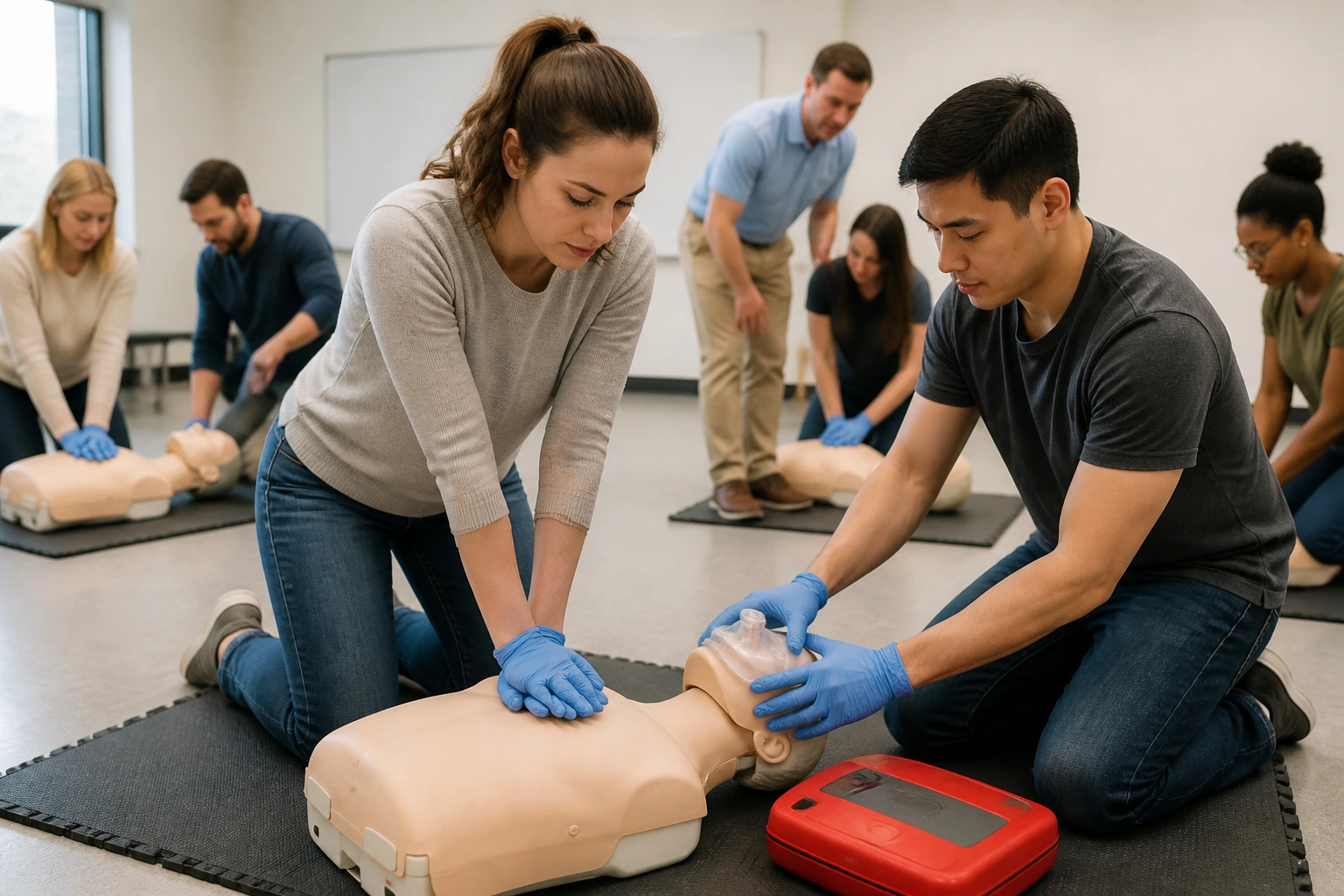
Cal/OSHA and most California licensing boards expect first aid and CPR training to be hands-on and delivered by a recognized provider, not just a set of online modules. A 100% online, no-skills-check course does not meet California certification requirements. Blended learning, where theory is completed through online modules and participants attend an in-person session for manikin and AED practice, is generally accepted, since the hands-on skills assessment is the part that actually matters for compliance. Hands-on practice builds the muscle memory needed for effective CPR delivery under pressure, which is exactly what a passive, lecture-only format can’t replicate.

Core skills a compliant course should cover include basic first aid, adult CPR and AED use, choking response, control of severe bleeding, shock management, and recognizing common emergencies like stroke, seizures, and severe allergic reactions. Some sectors need more: childcare and schools often require pediatric-specific training, and healthcare professionals in hospital or clinical settings typically need BLS rather than a standard layperson course.

Early CPR can double or triple survival rates in cardiac arrest, which is a big part of why regulators and employers alike treat this training as closer to essential than optional, even in workplaces that don’t feel high-risk day to day.

Certification Validity and Renewal

Whatever regulation applies to your workplace, the underlying certifications need to stay current, or they don’t count toward compliance at all.

American Red Cross and American Heart Association certifications are valid for 2 years from the completion date. A common myth is that there’s a 30-day grace period after expiration. That used to be common practice at some providers, but it’s largely gone now. Once a card expires, most providers, Coast2Coast included, require the full initial course rather than a shorter renewal, since a lapsed certificate is functionally the same as having no trained responder at all from a compliance standpoint.

Here’s what CPR and BLS renewal actually costs at our Los Angeles and Long Beach locations, part of our full course lineup:

Course Format Price
BLS Provider Renewal Fully in-class $65–$75
HeartCode BLS Renewal Blended $65–$75
BLS Provider (full course) Fully in-class $75–$85
HeartCode BLS (full course) Blended $75–$85

Renewal assumes you already know the material and just need a refresher plus a skills check, which is why it’s shorter and cheaper than the full course. To qualify for a renewal rate, your existing certificate generally needs to still be valid; once it lapses, you’re back to full-course pricing. Some employers, particularly in healthcare, require recertification more often than the standard 2 years even though the card itself remains technically valid longer, so it’s worth confirming your specific workplace policy rather than assuming the standard timeline applies.

Recordkeeping and Inspection Readiness

During a Cal/OSHA inspection, evaluators typically review what an employer did in advance, not what they hoped would happen. Missing or outdated training records are one of the most common citation triggers, even at workplaces that did train employees at some point. Keep track of:

  • Who’s currently certified, in what, and through which organization (Red Cross, AHA, or equivalent)
  • Certification issue and expiration dates
  • A written first aid and CPR policy integrated into your Injury and Illness Prevention Program (IIPP)
  • First aid kit inspection logs, noting dates and any items replaced, and confirmation that kits remain readily accessible to every work area

A simple shared spreadsheet is usually enough. The goal is being able to show consistent coverage for injured employees across shifts and locations, not a single certificate from three years ago tucked in a drawer.

Common Mistakes California Employers Make

Most Cal/OSHA citations in this area stem from avoidable gaps rather than obscure technicalities:

  • Assuming a call to 911 alone satisfies the “adequately trained” requirement
  • Having first aid kits on-site but no trained responder on every shift
  • Letting certifications lapse without a system to catch it before an inspection does
  • Treating an office environment as automatically exempt from any first aid planning
  • Using outdated kit contents that haven’t been reviewed against the current ANSI standard

Putting It All Together

None of this has to be complicated once it’s set up correctly. California employers need trained first aid providers on-site when medical care isn’t immediately nearby, kits stocked to the current ANSI standard for their specific hazards, and certifications kept current with a real hands-on skills check behind them. Most general workplaces fall under Section 3400, construction falls under Section 1512, and the stricter 5-minute CPR rule under Section 8351 applies specifically to shipbuilding, not to every business in California. Get those pieces right, keep your training and kits documented, and you’ve covered the core of what Cal/OSHA actually expects from a workplace safety program, regardless of whether your team feels high-risk or low-risk day to day.

How Coast2Coast Helps California Employers Stay Compliant

Coast2Coast First Aid & Safety is an American Red Cross Authorized Training Provider and American Heart Association-aligned training site, delivering OSHA-approved CPR, AED, and first aid certification across California, including Los Angeles, Long Beach, San Diego, Sacramento, and San Jose. We offer on-site group training, sending a certified instructor directly to your workplace so you can train an entire shift at once instead of sending employees out individually. That makes it easier to maintain consistent coverage across shifts and keep your documentation organized in one place.

Our full course lineup covers the certification levels most California employers need, from general workplace CPR and first aid to BLS for healthcare settings. See why employer-funded first aid and CPR training makes sense for the business case beyond compliance, or find your nearest California training location.

Frequently Asked Questions

Question 1: Does every California business need CPR-certified employees?

Answer: Not by explicit rule for most workplaces. Title 8 CCR Section 3400 requires a person adequately trained to render first aid when a workplace isn’t near a clinic or hospital, but it doesn’t name CPR specifically or apply a fixed ratio. In practice, most employers treat CPR training as the practical way to meet that “adequately trained” standard.

Question 2: Is the 5-minute response rule real?

Answer: Yes, but it’s specific to shipbuilding, ship repair, and ship breaking operations under Title 8 CCR Section 8351, not a general California workplace requirement. Most employers fall under Section 3400 or Section 1512, neither of which sets a specific response-time number in the regulatory text itself.

Question 3: Are offices exempt from first aid requirements because the work isn’t dangerous?

Answer: No. Cal/OSHA evaluates whether an employer prepared for foreseeable emergencies, not how dangerous the work feels. Medical emergencies can happen in any workplace, and treating an office as automatically exempt is a common and risky assumption.

Question 4: How often does CPR certification need to be renewed for compliance?

Answer: American Red Cross and American Heart Association certifications are valid for 2 years. There’s no official grace period after expiration, so an employer relying on a lapsed certificate is not actually meeting the “adequately trained” standard, regardless of how recently it expired.

Question 5: Can a fully online CPR course satisfy Cal/OSHA requirements?

Answer: No. Cal/OSHA and most licensing bodies expect a hands-on skills assessment with a qualified instructor. Blended learning, where theory is completed online and the skills check happens in person, is generally accepted, but a course with no in-person component isn’t.

Question 6: Are small businesses exempt from these requirements?

Answer: No. The requirement to provide adequate first aid and, where applicable, trained CPR responders applies regardless of company size, including employers with only one or two workers. Small employers still need to designate and train at least one person, maintain a compliant first aid kit, and document their emergency procedures.

Question 7: Are California employers required to have an AED on-site?

Answer: Not universally. AEDs aren’t legally required for every California employer, though many industries and building types are increasingly expected to have them. If you do install one, you become responsible for its maintenance, employee training on its use, and any related signage requirements, so it’s worth building AED use directly into your first aid and CPR training rather than treating it as a separate purchase.

CPR Week 2026: The Updated CPR Rules Most People Miss

Group of adults practicing CPR chest compressions on a manikin during Coast2Coast CPR Week 2026 certification training

CPR Week 2026, officially National CPR and AED Awareness Week, runs June 1 to 7. For a teen or adult who suddenly collapses, skip the pulse check: confirm the person is unresponsive and not breathing normally, call 911, and push hard and fast in the center of the chest at 100 to 120 compressions per minute. Hands-only CPR is recommended for untrained bystanders helping a collapsed adult, while rescue breaths still matter for infants, children, and drowning or overdose emergencies.

CPR Week 2026

7 in 10 Cardiac Arrests Happen at Home

The person whose life you save is most likely someone you love. Get certified this CPR Week.

Find a CPR and AED Course

350,000
out-of-hospital cardiac arrests in the US each year
7 in 10
happen at home, not in public or at a hospital
2x to 3x
higher survival when a bystander starts CPR immediately

Picture CPR and you probably imagine a 1990s TV scene: two fingers on the neck, a panicked “There’s no pulse,” then dramatic rescue breaths. That script is outdated, and in a real emergency it could cost a life. CPR Week 2026 is as much about unlearning as learning. Here are the five rules that have changed, and what each one means in practice.

Quick Reference: What Changed

Here are the five biggest updates. The rest of this article explains each one.

What you may have learned The 2026 reality
Check for a pulse before you start. Skip the pulse. Look for breathing; if unresponsive, start compressions.
Mouth-to-mouth is required. Hands-only CPR for untrained bystanders helping a collapsed adult.
CPR is different for women. The technique is identical. Hands go in the center of the chest.
Stop if you hear a crack. Keep pushing. Rib injuries happen but they heal.
An AED could shock the wrong person. AEDs analyze the rhythm first. They will not shock a healthy heart.

What Is National CPR Week, and When Is It in 2026?

CPR Week 2026, formally National CPR and AED Awareness Week, runs June 1–7 under a 2007 Congressional resolution. The American Heart Association leads the national effort with free classes and community campaigns, and many accredited training providers run certification and recertification classes throughout the week. Whether you call it CPR Week, CPR Awareness Week, or cpr aed awareness week, the goal is the same: replace the outdated version in your head with the current science. More than 1,600 people experience cardiac arrest each day in the U.S. Bystander CPR can double or even triple survival rates — which is exactly why this week exists.

Why Does Outdated CPR Knowledge Put Lives at Risk?

About 350,000 Americans have an out-of-hospital cardiac arrest each year, and roughly 90 percent do not survive. Every minute a cardiac arrest victim goes without intervention, survival odds plunge by 7% to 10%, but immediate bystander CPR slows that drop to 3% to 4% per minute. The barrier is mainly the outdated, complicated script most people carry in their heads, even though the importance of immediate action during a cardiac emergency is the ultimate factor in survival. The October 2025 AHA Guidelines keep stripping that complexity away. A classroom CPR and AED course is the fastest way to build real confidence. Roughly 70% of sudden cardiac arrests happen at home or in private residential settings. When a person’s heart stops beating, their chance of survival drops by roughly 10% for every minute without intervention. Certified courses teach the proper use of chest compressions and an AED together, which can significantly increase survival rates.

Hands-On Practice

Reading the Steps Is Not the Same as Doing Them

Practice the 2026 technique on a manikin with a certified instructor near you.

Find a Class Near You

Why You Should Not Check for a Pulse First

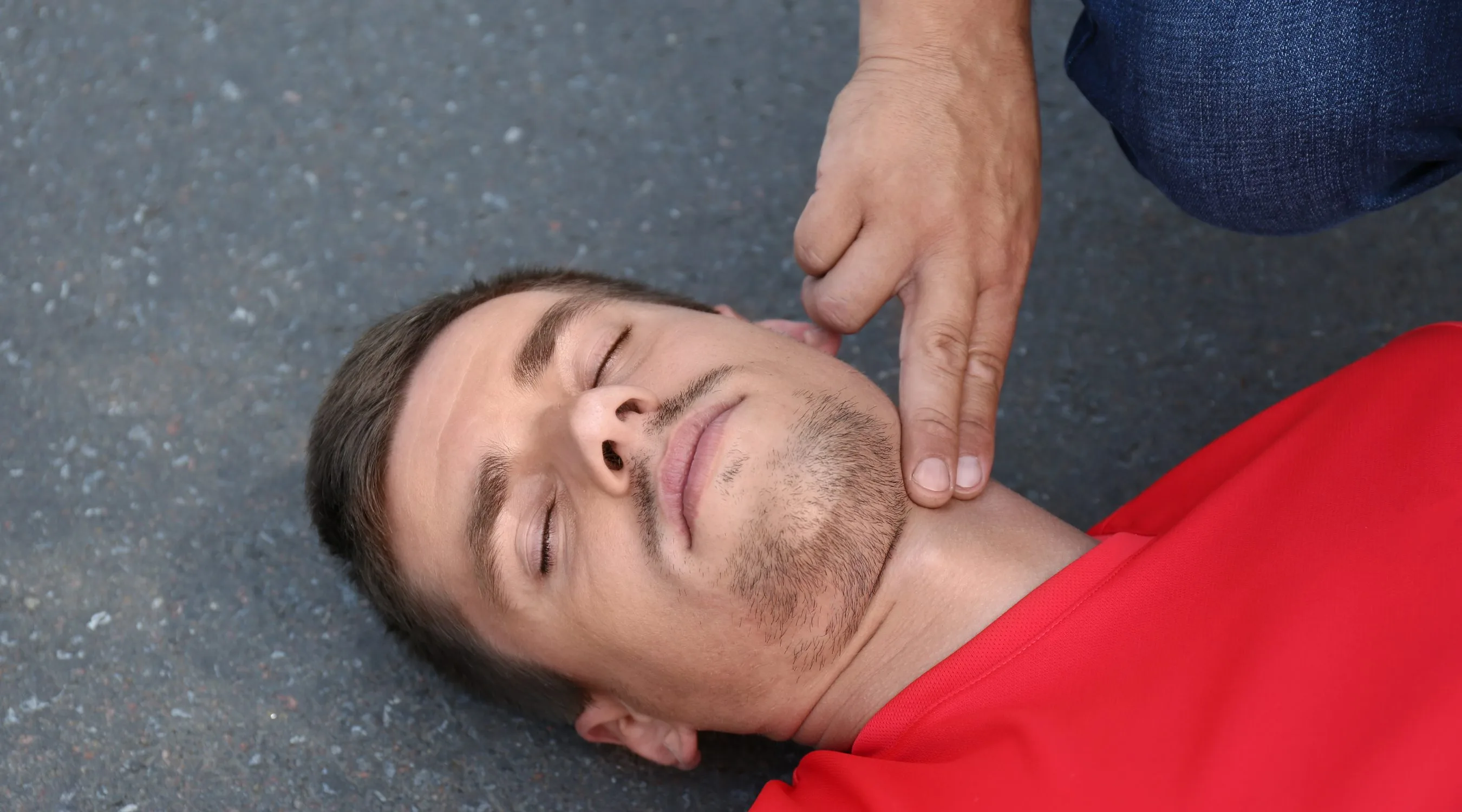
For decades, training told you to find a pulse before compressions. The 2026 reality: skip it. Under adrenaline, your own pulse is easy to feel in your fingertips and easy to mistake for the victim’s, and checking burns seconds. Tap the shoulder and shout, look at the chest for 5 to 10 seconds for normal breathing (gasping does not count), and if the person is unresponsive and not breathing normally, call 911 and push hard and fast in the center of the chest. If you are alone, put 911 on speaker first.

Safety Tip: Set your compression tempo to 100 to 120 beats per minute, roughly the rhythm of “Stayin’ Alive.” Push at least two inches deep and let the chest fully recoil between compressions so the heart can refill.

checking for a pulse

Do You Still Need to Give Rescue Breaths?

For many bystanders, mouth-to-mouth is the biggest barrier to acting. Many bystanders also hesitate because they lack confidence or fear causing harm, which makes simple guidance especially important. The 2026 reality: for a collapsed teen or adult, hands-only CPR is recommended. At the moment of cardiac arrest the blood still holds an oxygen reserve, so the immediate problem is circulation, not oxygen. Every pause for breaths drops the pressure you built toward zero. Continuous compressions at 100 to 120 per minute, roughly the tempo of “Stayin’ Alive,” keep that blood moving to the brain, because brain damage can begin after just 4 minutes and death can occur within 4 to 6 minutes.

When Rescue Breaths Are Still Essential

Rescue breaths remain critical for infants, children, and victims of drowning or drug overdose, because those arrests typically start as a breathing problem, and sudden cardiac arrest can still arise in youth emergencies where rapid CPR and AED use matters. The 2025 AHA Guidelines reinforce this and note that children aged 12 and older can reasonably be taught CPR and AED use. It is also the number one cause of death in youth athletes. Safe Kids has partnered with Tina Charles on sports safety clinics that have reached over 1,000 child participants, underscoring why AED and CPR education matters in youth sports. If you care for children as a caregiver or parent or work near water, a full first aid and CPR course covering both compressions and rescue breaths is worth the time.

Should Women Receive CPR from a Bystander?

Research shows women who suffer cardiac arrest in public are significantly less likely to receive bystander CPR than men, due to fear of inappropriate touching and a false belief that female anatomy makes CPR harder. Both are myths. Cardiovascular disease is the leading cause of death in women, and the technique is identical for everyone. Place the heel of your hand in the center of the chest and push hard and fast. A woman’s breasts do not change hand placement. If using an AED, move clothing aside so pads sit on bare skin.

Put These Updated Rules Into Practice

Knowing CPR is step one, and practical instruction helps you feel prepared to act. A certified instructor puts those skills in your hands with real practice on a manikin, including AED training, so you can act without hesitation when it counts.

Learn This Skill in a Real Classroom

Hands-on manikin and AED practice with a certified instructor.

View First Aid and CPR Courses

What If You Break a Rib or Do It Wrong?

Fear of causing harm is one of the most common reasons many people hesitate to get involved and freeze. The 2026 reality: any CPR is far better than none. Effective compressions push at least two inches deep, and that force can crack a rib. But a person in cardiac arrest is clinically dead, so once you are involved, you cannot make it worse. A broken rib heals. Brain death does not reverse. If you feel a pop or hear a crack, keep going.

Are You Protected by Good Samaritan Laws?

Yes. All 50 states have Good Samaritan laws protecting bystanders who give emergency help in good faith, as long as they act reasonably and do not expect payment. You do not need certification to be covered. These laws exist so that fear of a lawsuit never stops someone from stepping in.

Can You Accidentally Shock Someone With an AED?

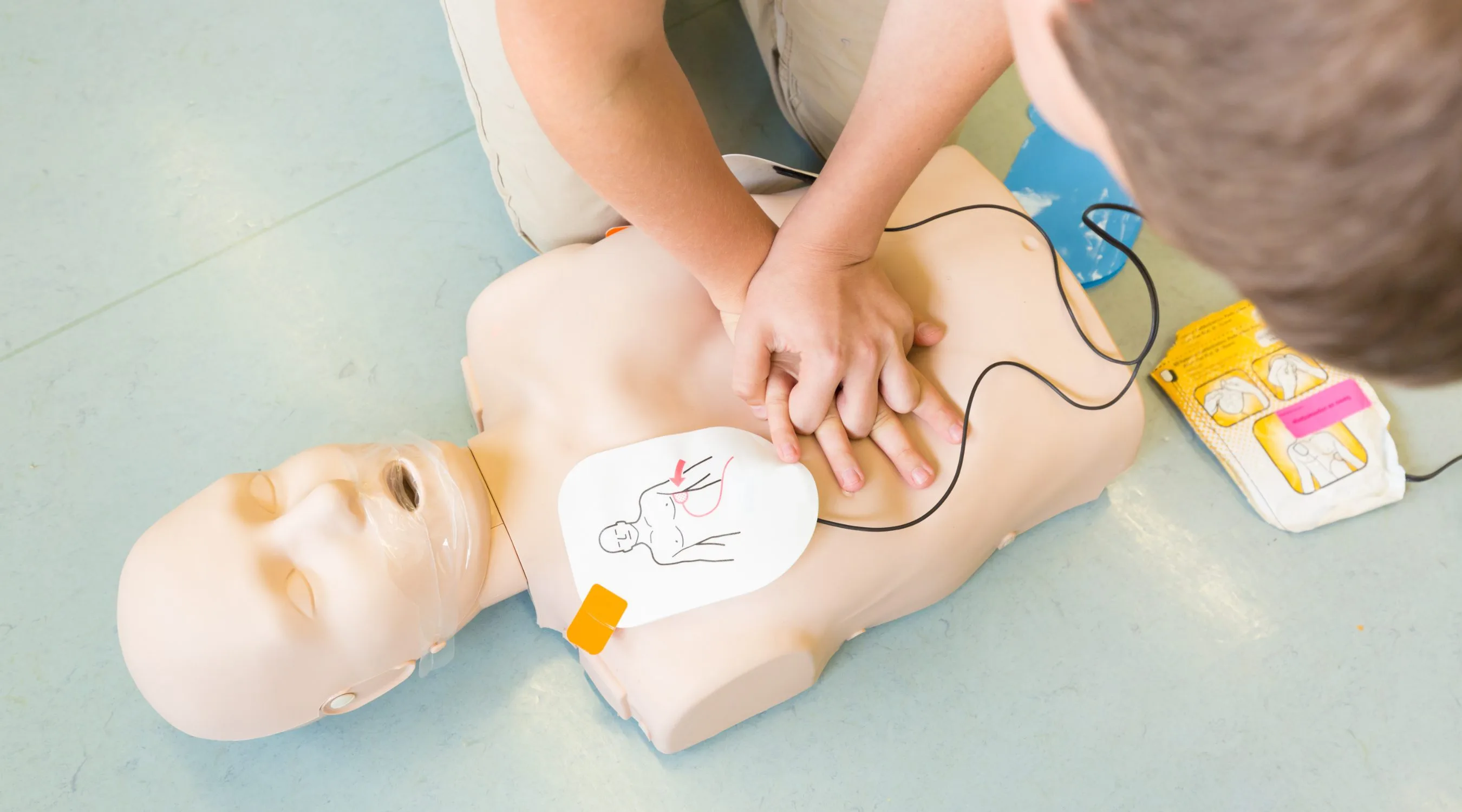
CPR keeps blood moving; an AED shocks a chaotic rhythm back toward normal. Many people fear opening the cabinet, worried they might shock someone who merely fainted. Modern AEDs prevent that: once on, a calm voice guides each step and the device analyzes the heart’s rhythm before allowing a shock. It only fires when one is needed, so you cannot shock a healthy heart. The bigger problem is access: only half of US workers can locate the nearest AED. Tina Charles, a WNBA All-Star, has also pushed for better AED access as part of community health preparedness to help prevent sudden cardiac arrest in youth athletes. Our team can help through the contact page.

Using an AED

How Can You Take Part in CPR Week 2026 (June 1–7)?

Until the ambulance arrives, you are the first responder, and the best use of CPR Week 2026 is to turn what you just read into a skill you can actually perform. Reading about chest compressions is not the same as feeling the right depth and rhythm under your own hands. The fastest way to close that gap is a short, hands-on class with a certified instructor, where you practice compressions and AED use on a manikin until they feel automatic. About 7 in 10 cardiac arrests happen at home, so the person you are training to help is most likely someone you love. Spend a few hours with us this week and walk out ready to act without hesitation.

CPR Week 2026

Come Take a Class With Us This CPR Week

A few hours with a certified instructor is all it takes to be ready when it counts. Reserve your seat today.

Register for a CPR Class

Key Takeaway

For CPR Week 2026: skip the pulse check, skip rescue breaths on a collapsed adult, give the same care regardless of gender, and use an AED without fear. Call 911, push hard and fast at 100 to 120 per minute, and deploy the AED as soon as one is available. It will not shock a heart that does not need it. Good Samaritan laws protect you in all 50 states.

Only Half of US Workers Can Find Their AED

Group CPR and first aid training closes that gap. Bring a certified instructor to your workplace this CPR Week.

Set Up Group Training

Frequently Asked Questions: CPR Week 2026

Q1: When is CPR Week 2026?

A: CPR Week 2026 runs June 1 to 7. Formally called National CPR and AED Awareness Week, and sometimes listed as cpr aed awareness week, it falls on the first seven days of June every year under a 2007 Congressional resolution and is led by the American Heart Association. Its purpose is to encourage more people to learn CPR and AED use, raise awareness through public campaigns, and help more people save a life while updating the public on guidelines that have changed since they last took a class.

Q2: Why shouldn’t you check for a pulse before starting CPR?

A: Checking for a pulse wastes time and is unreliable for untrained responders. Under stress, your own heartbeat is easy to feel in your fingertips, which can fool you into thinking a victim’s heart is beating when it has stopped. Skip the pulse check entirely. Tap the person and shout, then look for normal breathing for 5 to 10 seconds. If the person is unresponsive and not breathing normally, call 911 and begin chest compressions right away.

Q3: What is hands-only CPR?

A: Hands-only CPR is cardiopulmonary resuscitation without mouth-to-mouth breaths. For a teen or adult who suddenly collapses, an untrained bystander pushes hard and fast in the center of the chest at 100 to 120 compressions per minute without stopping for breaths. It works because the blood still carries an oxygen reserve at the moment of collapse, so the priority is circulation. Removing the breaths also makes bystanders far more willing to act, and that can save a life.

More FAQs: Women and the Law

Q4: Is CPR different for women?

A: No. The technique is identical for women and men. Place the heel of your hand in the center of the chest, on the breastbone, and push hard and fast regardless of anatomy. A woman’s breasts do not change hand placement or interfere with compressions. If you use an AED, move clothing and undergarments aside so the pads sit on bare skin. Research shows women receive bystander CPR less often than men due to fear of inappropriate contact, and that hesitation costs lives.

Q5: Can you be sued for performing CPR without certification?

A: No. You do not need certification or medical credentials to legally perform CPR in an emergency. All 50 states have Good Samaritan laws that protect people who voluntarily give emergency aid in good faith, provided they act reasonably and do not expect payment. These laws exist specifically so that fear of liability does not stop bystanders from helping. The far greater risk is doing nothing, since a cardiac arrest victim who receives no CPR has very little chance of survival.

Disclaimer: This article is for general informational purposes only and does not replace professional medical advice or hands-on CPR and first aid training. Always call 911 in an emergency. For certification, take an accredited course with a qualified instructor.

About This Article and Our Sources

Written and reviewed by Ashkon Pourheidary, B.Sc. (Hons) Neuroscience and a certified first aid and CPR instructor since 2011. Reviewed against the 2025 American Heart Association Guidelines for CPR and Emergency Cardiovascular Care (Circulation, October 2025), the AHA 2025 Heart Disease and Stroke Statistics Update, and AHA CPR Facts and Statistics.

First Aid Knowledge Gaps: What 20,000 Exams Reveal

Warehouse worker in yellow safety vest performing lay rescuer first aid on a fallen coworker while other workers in high-visibility vests look on in industrial setting

COAST2COAST FIRST AID · RESEARCH & INSIGHTS · MAY 2026

The Workplace Injury Costing California $2.2 Billion a Year Is Not the One Anyone Is Training For — New Data From 20,000+ Canadian Exams Shows Where Certified Responders Actually Fail

The workplace injury costing California an estimated $2.2 billion a year is not the one anyone is training for. Data from more than 20,000 written first aid exams from our Canadian certification network shows where certified responders actually fail — and why California, with no written knowledge assessment requirement, has no way to see it.

By Ashkon Pour-Heidary, HBSc Neuroscience · American Red Cross & Canadian Red Cross Instructor Trainer · Founder, Coast2Coast First Aid

May 2026 · c2cfirstaidaquatics.com/us/first-aid-knowledge-gap-report

An analysis of more than 20,000 written first aid certification exams from Coast2Coast First Aid’s Canadian network shows that certified lay rescuers most often answer incorrectly on bone, muscle and joint injuries (27.7% wrong) and bleeding and wound care (23.8% wrong), far more often than on CPR and defibrillation (9.4% wrong). Because California does not require a written knowledge assessment for workplace first aid certification, it has no way to detect these same gaps. Coast2Coast is asking Cal/OSHA to add a written knowledge assessment to the Section 3400 standard, in addition to the existing practical skills demonstration.

27.7%
wrong-answer rate on bone, muscle & joint injuries
23.8%
wrong-answer rate on bleeding & wound care
9.4%
wrong-answer rate on CPR & defibrillation

There is a moment every first aid instructor knows. The student in front of you has just passed. They have the certificate. They are heading for the door. And somewhere in the back of your mind is a question you cannot fully answer: are they actually ready?

I know that question personally. I passed my first first aid course at 19. I had the card. When the moment came to demonstrate what I actually knew — a practical assessment for an emergency response team at the University of Toronto — I could not perform. The certificate said I was ready. I was not.

That experience is the reason Coast2Coast First Aid exists, and it is the reason we built the technology to finally answer that question at scale.

instructor analysis session

Why We Built This Platform — First, For Ourselves

We need to be clear about something up front: we did not build this digital testing platform to publish research. We built it because we run a training organization that cares whether its students actually learn what they came to learn — and we needed answers we could not get from paper exams that end up filed in a drawer.

Coast2Coast First Aid co-founder Aryan Sekhavati built the proprietary in-classroom testing platform — the first of its kind among first aid and CPR training providers in North America — to capture written exam responses in real time across every classroom in the network. Before this platform existed, exam responses were graded on paper, filed away, and never aggregated. We use the data it generates in three ways, every day, internally:

First, we look at network-wide question patterns. Which specific questions produce the highest rate of wrong answers across thousands of students? That tells us where our curriculum needs more time, more scenarios, more reinforcement. It is a signal we cannot get any other way.

Second, we look at classroom-level concentration. Is the gap broad across the network, or concentrated in specific classrooms? Broad patterns drive curriculum revision. Concentrated patterns drive targeted support to specific locations.

Third, we look at instructor baseline data. Every instructor has a network-wide expected range based on student outcomes. When a specific instructor’s student results consistently fall outside that range, the data prompts a coaching conversation — lesson plan review, time on high-miss topics, an improvement plan. Not a disciplinary process. A development one, driven by what the data shows.

This is internal quality assurance. It is how we make sure our students get what they came for, and how we make sure our instructors are set up to succeed.

But the more data we accumulated, the clearer one thing became: the knowledge gaps we were finding were not random. They were patterns. Consistent. Stable across thousands of students. Pointing at the same topics, again and again. That is when we decided to share what we were seeing publicly — because the implications go beyond our own classrooms.

We will soon make a version of this platform available to our California students. Those enrolled in first aid and CPR courses in Los Angeles will have the option to complete an in-class knowledge quiz to solidify their understanding and be better prepared for real-world emergencies — giving California workers the same feedback loop that has been driving improvement in our Canadian network. Our intent is to publish California-specific data as it accumulates, with the same transparency as this report.

What 20,000 Exams Show

The industry’s attention has long centered on CPR. Chest compressions, AED use, airway management — these dominate public awareness, instructor training time, and regulatory conversation. The data from more than 20,000 digitally captured certification exams in our network confirms that focus is working. Questions related to CPR and defibrillation produce an incorrect answer rate of just 9.4%.

The topics producing consistent wrong answers — in patterns stable enough across thousands of students to act on — are the ones nobody is talking about.

Knowledge Gap Analysis
 

About this data. These exam responses were captured between July 2025 and May 2026 across our Canadian certification network. The primary dataset covers the Standard First Aid & CPR/AED Level C cohort [13] — the Canadian equivalent of the American Red Cross Adult and Pediatric First Aid/CPR/AED course [12] that California employers accept for workplace compliance under Cal/OSHA Title 8, Section 3400. [11] That regulation is where this entire policy conversation begins, and where we will return at the end.

Two Knowledge Gaps That Matter Most in the Workplace

We want to focus on two findings specifically, because they are where the data most directly intersects with the kinds of injuries that happen on California worksites every day.

Bone, muscle and joint injuries — 27.7% wrong-answer rate

Among the 13,684 attempts we analyzed in this category, more than one in four lay rescuers — the term used in workplace safety regulations for a non-healthcare employee trained in first aid — answered the bone and muscle injury question incorrectly. These were students who attended the course, sat the exam, and passed certification.

Incorrect bone and muscle response is not a neutral outcome. Moving a patient before stabilizing a fracture can turn a contained break into a displaced or compound injury, escalating it from a splint-and-monitor situation into a surgical one. Failing to recognize when not to move someone risks secondary injury, including potential spinal complications. Incorrect immobilization can extend recovery time and increase the risk of long-term impairment.

This matters in California specifically because musculoskeletal disorders are the leading category of workplace injuries in the United States, with 937,620 DART cases reported in 2023–2024. [3] California tracks its own state-specific injury data through the California Survey of Occupational Injuries and Illnesses, administered by the California Department of Industrial Relations in cooperation with the U.S. Bureau of Labor Statistics — the same SOII methodology that produces the national figures. [14] Given that the same injury categories dominate workplace injuries nationally, it is reasonable to expect they do in California as well.

Bleeding and wound care — 23.8% wrong-answer rate

Across 30,759 attempts — by far our largest dataset for any single category — nearly one in four lay rescuers gave the wrong answer to questions about bleeding and wound care. This is significant because hemorrhage control is consistently identified in peer-reviewed research as one of the most critical and most poorly performed lay-rescuer interventions.

A systematic literature review published in Acta Anaesthesiologica Scandinavica found that incorrect first aid was administered in up to 83.7% of cases by lay rescuers to trauma victims, with airway handling and hemorrhage control specifically identified as particular areas of concern. [2] The same review estimated that correct first aid could have reduced mortality by 1.8–4.5%.

Incorrect wound care has direct consequences in workplace settings: a wound that could have been controlled at the first aid level escalates into one requiring medical treatment beyond first aid — turning a non-recordable incident into an OSHA recordable claim. Inadequate hemorrhage control in serious cases is life-threatening. The training is supposed to address these scenarios. The data suggests that, even with certification, almost a quarter of trained lay rescuers cannot reliably answer the underlying knowledge question.

What these two findings have in common: they are both about the kinds of routine, common workplace injuries that ordinary lay rescuers will actually encounter. They are not exotic scenarios. They are the everyday situations the training is supposed to prepare them for. And the data shows that, across thousands of students, the training is not consistently doing that — not at a level our network can see, and certainly not at a level California has any way to measure.

Why We Believe California Has the Same Gaps

We need to be transparent: the 27.7% and 23.8% figures come from our Canadian network. We cannot tell you California’s exact rate, because California does not require a written knowledge assessment for lay rescuers. There is no California number to publish. What we can show, however, is that the conditions producing these gaps are present in California for five independently verifiable reasons.

The curriculum is similar.

American Red Cross and Canadian Red Cross first aid courses are both built on the guidelines of the International Liaison Committee on Resuscitation — the same international evidence body, the same review cycle, the same underlying science. [10] The correct answer to “what do you do when a wound dressing saturates with blood” is the same in Los Angeles as it is in Toronto.

The certification framework is comparable.

The American Red Cross Adult and Pediatric First Aid/CPR/AED course — what California employers accept for workplace compliance [12] — is the US equivalent of the Canadian Standard First Aid & CPR/AED Level C course in our dataset. [13] Both operate under the same international Red Cross movement, the same certification methodology, the same ILCOR standards. The main difference is that in Canada this course takes about 14–16 hours, while in the United States the course averages 4–6 hours depending on class size. That difference matters: if the same knowledge has to be transferred in roughly a third of the time, the gaps our written assessment reveals are likely to be at least as severe in the United States — possibly more so.

Human physiology does not change at the border.

The cognitive decisions our data shows lay rescuers struggle with — when to stabilize before moving, when to apply a sling, what to do when a wound dressing saturates, when to call for additional help — are difficult under pressure for the same reasons in any jurisdiction. The difficulty is not cultural. It is a function of how the material was taught, how much scenario practice the student got, and whether anyone measured what they retained. None of those variables are specific to Canada.

The workplace injury patterns are the same.

Musculoskeletal disorders are the leading category of US workplace injuries — 937,620 DART cases reported by the Bureau of Labor Statistics in 2023–2024. [3] California participates in the same Survey of Occupational Injuries and Illnesses methodology, with state-specific data published by the California Department of Industrial Relations. [14] Bleeding and wound care issues are routine workplace events across construction, manufacturing, hospitality, healthcare support, and warehousing. The categories where our data shows the biggest knowledge gaps are exactly the kinds of injuries California workplaces report regularly.

We are in California now, teaching the same program.

Coast2Coast First Aid has operated in Los Angeles since November 2025. We use the same curriculum, the same testing methodology, and the same instructor standards in our California classrooms that produced this dataset. We do not yet have enough US exams to publish California-specific numbers, but our intent is to. When we do, we will share that data too — with the same transparency. However, as apposed to the Canada where our students are required to complete the test, in California, we are unable to make this mandatory, making a head wind for data collection.

knowledge gap tablet

What’s at Stake Financially

The relationship between first-aid knowledge and injury outcomes is not a clean dollars-in, dollars-out equation — real workplace injuries are caused by many factors, and no single training improvement produces a guaranteed financial return. What the research does consistently show is the same shape: better-prepared lay rescuers correlate with better outcomes for injured workers, and better outcomes translate into measurable financial benefit across the system.

937,620
Musculoskeletal disorder DART cases in US, 2023–2024 [3]
$20B+
Direct workers’ comp costs for MSDs annually (OSHA/NIOSH)
~$2.2B
California’s estimated share (approx. 11% of US workforce)
69M
US workdays lost to injury in 2024 (NSC) [6]

How better-prepared lay rescuers shift outcomes.

OSHA’s 2012 white paper on Injury and Illness Prevention Programs documents that workplaces implementing comprehensive prevention programs — which include emergency response and first aid capability as core elements — typically see workplace injury and illness rates reduced by 15 to 35 percent. [1] Verified first aid knowledge is one piece of that larger picture, but it is a piece California currently has no way to measure.

When a lay rescuer responds effectively to a workplace injury, the injury tends to stay manageable. The worker recovers faster. The claim stays smaller. The team returns to baseline sooner. When a lay rescuer does not have the knowledge — when they move a patient who shouldn’t be moved, miss the signs of a serious injury, or apply incorrect wound care — the same injury can escalate, with direct workers’ compensation consequences. The average workers’ compensation claim for all injuries is $47,316. For fracture, crush, or dislocation injuries, it averages $66,467. [7]

OSHA’s official Safety Pays calculator documents that indirect costs of a workplace injury — overtime to backfill the role, hiring and training a temporary replacement, supervisor and HR time, OSHA documentation, team disruption — range from 1.1 times the direct cost for severe injuries to 4.5 times the direct cost for less severe ones. [5] Other OSHA materials describe these indirect cost categories in detail. [6] Median time away from work for a serious musculoskeletal injury is 8 days, and California employers carry claims history through the experience modification factor (X-mod), which influences premium pricing over a multi-year period. California’s benchmark advisory premium rate is currently $1.38 per $100 of payroll. [8]

Lets be clear, we are not asserting that any single training improvement produces a fixed dollar return. We are saying that the research consistently shows the same shape: when lay rescuers are better prepared, injuries stay contained more often, recoveries are faster, and financial pressure on the system eases. OSHA and ASSP research on well-implemented safety programs has cited returns ranging from $4 to $6 per dollar invested. [9] Verified first aid knowledge — measured, tracked, and improved over time — is part of that picture.


What This Means — and What We’re Asking California to Consider

Let us return to the question we opened with — the one every first aid instructor knows, the one I could not answer as a student myself: are they actually ready?

We built this platform to answer that question for our own organization — to know which curriculum topics need more time, which classrooms need targeted support, which instructors would benefit from coaching. That work is internal, ongoing, and is the reason we believe our network is in a position to share findings like these credibly.

But the same data has shown us something we cannot ignore. California — the state where we now operate and where we are committed to growing — has no equivalent way to see this layer of the certification picture. No one does. And that is a problem worth fixing.

Cal/OSHA Title 8, Section 3400 currently requires that workplace lay rescuers be “adequately trained to render first aid” at a standard equal to the American Red Cross. [11] Adequacy is measured through demonstrated physical skills — compressions, wound dressing, patient positioning. Those tests are essential and must not be replaced. They tell you whether someone can perform the technique.

What physical demonstration cannot reach is the cognitive layer underneath. When to act. In what order. What to do when the first approach doesn’t work. Whether the lay rescuer recognizes the signs of a serious bone or muscle injury, knows what to do when a wound dressing saturates with blood, and understands why the order of operations matters. Those are knowledge questions. They can only be measured by asking them.

Without that measurement, California has no way to know whether its certified lay rescuer workforce is actually prepared for the cognitive demands of a workplace emergency — only that they were able to demonstrate physical skills in a controlled setting. Skill demonstration and knowledge assessment are not redundant. They are complementary. Together they answer two different questions: “can this person perform the procedure?” and “does this person understand when, why, and how to apply it?” Both need answering.

Our specific request: We are asking Cal/OSHA and the California Occupational Safety and Health Standards Board to consider adding a written knowledge assessment requirement to the standard for workplace first aid certification under Section 3400 — in addition to the existing practical skills demonstration, not in place of it.

Why this matters for California: Coupling a written knowledge assessment with the physical skills test would close a measurement gap that currently makes it impossible for California to know whether certified lay rescuers are genuinely ready. It would create a feedback loop that drives continuous improvement in workplace safety training across the state — the same loop our internal platform creates for our organization. And it would put California at the front of a national standard worth leading on.

This is not a regulatory burden. The infrastructure exists. The methodology is proven. The American Red Cross already builds written knowledge content into its curriculum. What is missing is the requirement that it be measured.

We are sharing this data because we believe California is the state that takes this step first. The technology is in place. The argument is on the page. The decision is one regulatory action away.

“We built this platform to support our students, our instructors, and our internal quality. What it has shown us has implications well beyond our own classrooms. Our Canadian network data, drawn from more than 20,000 exams where written assessment is already standard, shows the gap is real and concentrated exactly where it hurts most. If knowledge gaps exist at these rates in a program with rigorous written testing, they are unlikely to be smaller in California, where no written test exists at all. California has the opportunity to set a standard that ensures every certified lay rescuer in the state — every person trained to help a coworker when something goes wrong — has demonstrated not only that they can perform the skill, but that they understand when and how to apply it. That is what genuine readiness looks like. And that is what California’s workers deserve.”

— Ashkon Pour-Heidary, HBSc Neuroscience · American Red Cross & Canadian Red Cross Instructor Trainer · Emergency Medical Responder Instructor Trainer · Founder, Coast2Coast First Aid

Key Takeaway

The most dangerous workplace first aid knowledge gaps are not in CPR. They are in the routine injuries lay rescuers actually encounter most: broken bones, sprains, and bleeding. California cannot currently measure these gaps because it requires no written knowledge assessment. Adding one to the Cal/OSHA Section 3400 standard, alongside the existing skills demonstration, would close that blind spot.

Workplace Training

Train Your Team With Verified, Measured Knowledge

Coast2Coast delivers first aid and CPR training to California workplaces using the same curriculum and standards behind this report.

Explore Group Training for Your Workplace

References & Sources

Every claim in this report is linked to its source below. Reference numbers in the text are clickable. Each entry includes a direct URL to the original.

  1. OSHA Injury and Illness Prevention Programs White Paper (January 2012). Implementation of prevention programs reduces injuries by 15–35%. https://www.osha.gov/sites/default/files/OSHA-white-paper-january2012sm.pdf
  2. Tannvik TD, Bakke HK, Wisborg T. “A systematic literature review on first aid provided by laypeople to trauma victims.” Acta Anaesthesiologica Scandinavica, 2012. Incorrect first aid was given in up to 83.7% of cases; airway handling and haemorrhage control were particular areas of concern; correct first aid could have reduced mortality by 1.8–4.5%. https://pmc.ncbi.nlm.nih.gov/articles/PMC3495299/
  3. National Safety Council Injury Facts, citing U.S. Bureau of Labor Statistics. 937,620 musculoskeletal disorder DART cases in private sector, 2023–2024. https://injuryfacts.nsc.org/work/safety-topics/musculoskeletal-injuries/
  4. National Safety Council Injury Facts. 2024 total cost of work injuries: $181.4 billion. Wage and productivity losses: $54.9 billion. 69 million workdays lost. https://injuryfacts.nsc.org/work/costs/work-injury-costs/
  5. OSHA Safety Pays Individual Injury Estimator — Background. Indirect-to-direct cost ratio ranges from 4.5× for minor injuries (direct costs under $3,000) to 1.1× for more severe injuries (direct costs over $10,000). Indirect costs include lost productivity, training replacement workers, overtime, accident investigation, and administrative burden. https://www.osha.gov/safetypays/background
  6. OSHA. “Business Case for Safety and Health — Costs.” Indirect costs include training replacement employees, investigation, lost productivity, administrative burden. https://www.osha.gov/businesscase/costs
  7. National Council on Compensation Insurance (NCCI), reported via NSC Injury Facts. Average cost for all workers’ comp claims, 2022–2023: $47,316. Fracture/crush/dislocation category average: $66,467. https://injuryfacts.nsc.org/work/costs/workers-compensation-costs/
  8. California Department of Insurance, Press Release, July 12, 2024. Commissioner Lara issued advisory pure premium rate of $1.38 per $100 of payroll, effective September 1, 2024. https://www.insurance.ca.gov/0400-news/0100-press-releases/2024/release029-2024.cfm
  9. SafetyPro Resources, citing OSHA and American Society of Safety Professionals (ASSP) research. Well-implemented safety programs typically deliver 200–600% ROI within three years. https://www.safetyproresources.com/blog/building-cost-effective-safety-program-calculating-roi
  10. International Liaison Committee on Resuscitation. American Red Cross and Canadian Red Cross first aid curricula are both built on ILCOR evidence guidelines. https://www.ilcor.org
  11. California Code of Regulations, Title 8, Section 3400. “Medical Services and First Aid.” Employees must be adequately trained to render first aid, with training equal to that of the American Red Cross. No written knowledge assessment is required. https://www.dir.ca.gov/title8/3400.html
  12. American Red Cross. “Adult and Pediatric First Aid/CPR/AED” course. The OSHA-compliant workplace first aid course in the United States. Typical duration: approximately 4–6 hours including online portion and in-person skills session. https://www.redcross.org/take-a-class/classes/adult-and-pediatric-first-aid%2Fcpr%2Faed/LP-00005000.html
  13. Canadian Red Cross. “Standard First Aid & CPR/AED Level C” course. The Canadian equivalent of the US Adult and Pediatric First Aid/CPR/AED course. Typical duration: 14–16 hours of in-person instruction. https://www.redcross.ca/training-and-certification/course-descriptions/first-aid-training/standard-first-aid-cpr
  14. California Department of Industrial Relations, Office of Policy, Research and Legislation. Nonfatal Occupational Injuries and Illnesses in California — Survey of Occupational Injuries and Illnesses (SOII), administered jointly with the U.S. Bureau of Labor Statistics. State-specific data on workplace injury counts and incidence rates by industry, case type, and worker characteristics. https://www.dir.ca.gov/oprl/nonfatal.htm

About Coast2Coast First Aid

An authorized American Red Cross Training Partner and an American Heart Association Aligned Training Site operating across North America, with Los Angeles operations established in November 2025. Founded in 2014, the company has certified more than 150,000 individuals. Founder Ashkon Pour-Heidary holds a Bachelor of Science in Neuroscience (University of Toronto) and is a certified Instructor Trainer for both the American Red Cross and the Canadian Red Cross, as well as an Emergency Medical Responder Instructor Trainer.

Full dataset and methodology available to journalists, researchers, regulators, and policymakers on request.

About the Author

Ashkon Pour-Heidary, HBSc Neuroscience

Ashkon is the founder of Coast2Coast First Aid and a certified Instructor Trainer for both the American Red Cross and the Canadian Red Cross, as well as an Emergency Medical Responder Instructor Trainer. He holds a Bachelor of Science in Neuroscience from the University of Toronto and has led the certification of more than 150,000 individuals across North America. His work focuses on closing the gap between holding a certificate and being genuinely ready to respond.

Media Kit Press Assets
Lay Rescuer in Action
Featured Image
Lay Rescuer in Action
Open Full Size
Instructor Analysis Session
Editorial
Instructor Analysis Session
Open Full Size
Knowledge Gap Tablet
Data Visual
Knowledge Gap — Tablet
Open Full Size
Knowledge Gap Data Chart
Chart — Approved for Reprint
Knowledge Gap Data Chart
Open Full Size
Coast2Coast First Aid Logo
Official Logo
Coast2Coast First Aid & Safety
Open Full Size