
In This Guide
Get Certified in CPR, AED & First Aid
Practice the ABCs, chest compressions, and AED use hands-on with a certified instructor, not just a video.
Emergencies happen every day, and if you’re ever faced with an unconscious person, a few crucial steps can decide what happens next. One of the most important actions you can take is CPR, chest compressions combined with rescue breathing, which meaningfully raises the odds of survival until paramedics arrive.
Coast2Coast’s First Aid & CPR courses, including the ones offered at our North York facility and at training locations across Ontario, walk you through all of this hands-on: the ABC assessment, CPR Level A and Level C, AED use, and how it all changes for infants and children.
The ABCs of CPR sit inside a bigger framework the Canadian Red Cross calls Check, Call, Care, the primary assessment every first aider works through when they reach a hurt or ill person. Checking the person means checking their Airway, Breathing, and Circulation, in that order, and being ready to perform CPR with chest compressions and rescue breathing if needed.
A – Airway
Start by confirming the airway is open. The airway is the passage that carries air into and out of the lungs, so a blocked airway makes it physically impossible to breathe no matter what else you do. To open it in most adults, perform a head-tilt/chin-lift: tilt the head back and lift the chin until it’s the highest point, which shifts the tongue away from the back of the throat.
Skip this step if the person is speaking, moaning, or crying, since that already confirms the airway is open. Open the airway first, then check for breathing over 5 to 10 seconds. If the person isn’t breathing normally, you may need to give two rescue breaths to help oxygenate the lungs before moving into chest compressions.
Jaw thrust opens the airway without moving the neck. Place your hands on either side of the person’s head and lift the jaw upward and forward using your thumbs and fingers to support the lower jaw. This pulls the tongue and soft tissue away from the back of the throat, letting air flow more freely, without the head-tilt that a head-tilt/chin-lift requires.
Jaw thrust is a core part of Basic Life Support (BLS) and advanced life support (ALS) protocols, and it’s usually combined with other measures, like a bag-valve mask or an advanced airway device such as an endotracheal tube, to keep a patient’s breathing supported.
Read more on why this first step matters so much in our guide to the importance of the airway, breathing, and circulation check, or build the skill hands-on in our North York CPR/AED course.
Inquire About CPR Training
Ready to learn the ABCs of CPR in a hands-on training course? Call us today to find an upcoming course date.
B – Breathing
Next comes checking for breathing. As part of your assessment, confirm whether the person is breathing normally within a window of 5 to 10 seconds, no longer. Turn your face toward the person’s chest, keep it just above their mouth, and listen for breath sounds while watching for the chest to rise and fall.
Here’s how to check for breathing:
- Look for the chest rising and falling, or air moving in and out of the nose or mouth.
- Place your ear near the person’s nose and mouth and listen for breath sounds.
- Place your hand on the person’s chest and feel for movement as they breathe.
If all you notice is an infrequent gasp, the person isn’t breathing normally. That gasp is agonal respiration, a reflex action that’s irregular and doesn’t move useful air. Agonal breathing shows up as irregular, shallow breaths, sometimes with gurgling or grunting, and it’s a common pattern in unconscious adults or people in cardiac arrest.
Agonal breathing is a clear sign of severe oxygen deprivation, often tied to cardiac arrest, where the heart has stopped beating effectively and blood flow has stopped with it. Prompt action matters here. Begin CPR immediately if you’re trained, combining chest compressions with rescue breaths to restore blood flow and oxygen delivery.
Agonal breathing can also show up in other emergencies, including respiratory distress, pneumonia, or a severe airway obstruction. If you see it, call 911 right away and start basic life support measures. If you’re trained, that means chest compressions followed by rescue breaths.
C – Check Circulation
When checking circulation, look for life-threatening bleeding and signs of shock, such as pale, moist, or cool skin. Control severe bleeding immediately, and run a quick head-to-toe check of the person. Normal breathing usually means the heart is still beating, but if breathing isn’t normal, the heart may stop soon too, and that’s your cue to start chest compressions right away to keep blood moving and protect brain function until help arrives.
If you suspect a spinal injury, move the person as little as possible while you assess and provide care.
At more advanced training levels like Basic Life Support (BLS) and Emergency Medical Responder (EMR), the circulation check adds a pulse check: carotid for unresponsive adults and children, brachial for unresponsive infants.
If an AED is nearby, use it as soon as possible alongside chest compressions. The next two sections cover exactly how CPR Level A and Level C differ, and how to use an AED step by step, since circulation is where these two skills come together.
What’s the Difference Between CPR Level A and CPR Level C?
CPR Level A trains you to help adults. CPR Level C covers the same adult skills and adds separate techniques for children and infants, since compression depth, rate, and hand placement change by age. Both levels teach the same ABC assessment you just read about, applied to different age groups.
Canadian workplaces overwhelmingly ask for Level C over Level A, including sites governed by WSIB requirements, because it prepares staff for a wider range of people, not just adult coworkers. Parents, educators, childcare workers, and coaches need Level C for the same reason: the people around them span every age group. A personal trainer working only with adult clients might reasonably choose Level A, while a daycare worker, camp counsellor, or lifeguard almost always needs Level C.
Two other levels round out the system. CPR Level B covers infant and child response without the adult content, and suits specific caregiving roles more than general workplace certification. CPR Level HCP, also called Basic Life Support (BLS), is built for healthcare providers and clinical staff, covering team-based resuscitation and bag-valve mask use that go beyond a general workplace course.
Coast2Coast’s full breakdown of CPR Level A, B, C, and HCP covers course length, prerequisites, and who typically needs each level in more depth.
How Do You Use an AED, Step by Step?
An AED, short for automated external defibrillator, checks a person’s heart rhythm and delivers a shock if the rhythm needs one. The device talks you through each step out loud, so someone with no medical background can use one with confidence, no advanced training required.
Using an AED follows the same sequence every time:
- Turn the unit on. Voice prompts start immediately on most models.
- Bare the person’s chest and remove wet clothing. Pads need dry, direct skin contact to get an accurate reading.
- Place the two pads where the diagram on the device shows, typically one below the right collarbone and one on the lower left ribs.
- Step back while the AED analyzes the heart rhythm. Contact with the person during this step can throw off the reading.
- If a shock is advised, the AED tells everyone to clear the area and either delivers it automatically or prompts you to press the shock button.
- Restart chest compressions right after the shock, following the AED’s prompts, until paramedics take over or the person shows signs of life.
CPR and an AED do different jobs. CPR keeps blood and oxygen moving to the brain, which buys time until a shock can actually correct the heart’s rhythm. One doesn’t replace the other, which is exactly why both are part of every Coast2Coast CPR/AED course.
A few situations catch people off guard. If the AED analyzes the rhythm and says a shock isn’t advised, that’s a normal outcome, not a malfunction. Some cardiac arrest rhythms simply aren’t shockable, and the device will tell you to resume CPR instead. For a child under 8 or under about 55 pounds, use pediatric pads and a pediatric dose attenuator if the AED has one. If pediatric pads aren’t available, adult pads work as a substitute for a child in a true emergency, placed so they don’t touch each other. Metal jewelry or a medication patch under a pad should be moved aside, not left in place, since either can interfere with the shock or burn the skin. A person lying in a puddle of water should be moved to a dry surface first, since standing water can conduct the shock away from the body.
AEDs are built for whoever reaches the person first, not only paramedics or nurses, which is why you’ll find them mounted on walls in gyms, shopping malls, community centres, schools, and workplaces across Canada. A device sitting in a hallway only helps if someone nearby knows to grab it and start compressions while it powers up, so pairing an AED with certified staff is what actually makes it useful in an emergency. Coast2Coast runs private group and workplace CPR/AED training for organizations that want their whole team certified at once.
Build these skills hands-on in a Standard First Aid & CPR/AED course, practicing on real training AEDs and manikins rather than reading about it.
Why Do CPR and AEDs Matter So Much in the First Few Minutes?
Cardiac arrest punishes hesitation. Survival chances drop by roughly 10% for each minute that passes without CPR, and by 7 to 10% for each minute that passes without defibrillation. A lack of oxygen can start damaging the brain within 4 to 6 minutes, often faster than an ambulance can reach the scene, especially outside a major city.
Bystanders carry more of this weight than most people assume. Around 80% of cardiac arrests happen at home, usually in front of a partner or family member rather than a stranger trained to respond. Cardiovascular disease is also the leading cause of death worldwide, linked to an estimated 17.3 million deaths a year, which is part of why the Government of Canada has pushed to put more AEDs in public spaces.
CPR alone can double or triple a person’s odds of survival compared to no bystander action at all. It doesn’t fix a shockable heart rhythm on its own, but it keeps circulation going long enough for an AED, or paramedics, to take over. Resuscitation researchers describe this sequence as the chain of survival: recognizing the emergency and calling 911, starting CPR immediately, defibrillating with an AED as soon as one is available, and getting the person to advanced medical care. Break any link in that chain and the odds drop, which is why the ABC assessment you just learned exists: it’s how you find out, in seconds, which links in that chain you need to start.
What Is Hands-Only CPR, and When Should You Use It?
Hands-only CPR means chest compressions with no rescue breaths, and it’s what an untrained bystander should do for an adult who suddenly collapses. If the person doesn’t respond and isn’t breathing normally, including if they’re only gasping, call 911 and start compressions right away.
For an adult, press hard and fast in the center of the chest:
- Depth: at least 2 inches (about 5 cm)
- Rate: 100 to 120 compressions per minute
- Let the chest fully rise back up between compressions
- Keep going until paramedics arrive, an AED shows up, or the person starts moving or breathing on their own
Hands-only CPR raises survival odds far above doing nothing while help is on the way, and it removes the hesitation some bystanders feel about rescue breaths on a stranger. Trained responders, including anyone certified through a Coast2Coast course, learn the full cycle instead: 30 chest compressions followed by 2 rescue breaths, repeated until an AED arrives. That ratio matters most in drowning, choking, opioid overdose, and infant or child cardiac arrest, where the person collapsed from a lack of oxygen rather than a sudden heart rhythm problem.
A common mistake is stopping compressions too often. Every pause, even to check for a pulse, lets blood pressure in the brain fall back toward zero, and it takes several compressions to build it back up. Fatigue matters too: quality tends to drop off after about two minutes of continuous compressions, so when a second trained person is available, switching roles every two minutes keeps compression quality higher for longer. It’s one more reason group CPR and AED training for a whole household or workplace beats certifying just one person.
How Do the ABCs and CPR Change for Infants and Children?
The same three checks apply to infants and children, but several details change because of how much smaller and more fragile a baby’s airway and chest are.
- Airway: use a gentler head tilt on an infant than you would on an adult. Over-tilting can actually kink and close a baby’s airway instead of opening it.
- Breathing: the same 5 to 10 second look, listen, and feel check applies, though an infant’s breaths are smaller and can be harder to see.
- Circulation: check the brachial pulse, on the inside of the upper arm, instead of the carotid pulse used on adults and children.
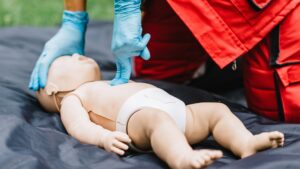
If CPR becomes necessary for an infant, under about 12 months, compressions use two fingers in the center of the chest, just below the nipple line, at a shallower depth of about 1.5 inches, at the same 100 to 120 compressions per minute as adult CPR. Rescue breaths are small, gentle puffs covering both the mouth and nose at once, since a full adult-sized breath can injure a baby’s lungs. Choking response changes too: caregivers use alternating back blows and chest thrusts on an infant instead of the abdominal thrusts used on older children and adults, since abdominal thrusts can injure an infant’s internal organs.
Child CPR, for kids roughly 1 to 8 years old, sits between the two: one or two hands depending on the child’s size, a compression depth of about 2 inches, and the same 100 to 120 compression rate. A caregiver’s instinct is often to compress gently on a baby, out of fear of causing harm, but compressions that are too shallow don’t move enough blood to matter. The guidance for a genuine cardiac arrest calls for firm, deliberate pressure at the full 1.5-inch depth, even though it can feel forceful.
Infants go into cardiac arrest for different reasons than adults, including choking, respiratory infection, congenital heart defects, or SIDS, so recognizing the early signs, like limpness, blue-tinged lips, or a lack of response to touch and voice, matters just as much here as it does with an adult. Parents who take a Child Care First Aid course learn all three age-specific techniques together rather than piecing them together from memory during an actual emergency.
Get Certified in Child Care First Aid & Infant CPR
Built for parents, educators, and childcare workers who need hands-on infant and child response skills.
Learn First Aid & CPR: Which Course Is Right for You?
The ABCs of CPR are only part of what you need to know when an emergency happens. These skills need practice, not just reading, so that when something happens, you can act quickly and with confidence. That’s part of why First Aid & CPR training is now mandatory for many professionals across different industries. Police officers, nurses, and even office workers are often required to keep a valid first aid and CPR certification for their role.
Coast2Coast runs the full range of CPR and AED certification options in Canada. The right one depends on who you need to be ready to help and whether your workplace has a specific requirement:
- Standard First Aid with CPR/AED Level C: the certification most Canadian workplaces require, pairing a full first aid curriculum with CPR and AED skills for adults, children, and infants. Usually the safest default when a job posting just says “first aid certified.”
- Emergency First Aid with CPR/AED Level C: a shorter course covering core first aid and CPR/AED basics, often enough for a minimum workplace requirement. See Emergency First Aid & CPR/AED Level C.
- Basic Life Support (BLS) / CPR-HCP: built for healthcare providers and clinical staff, with team-based resuscitation and multi-rescuer scenarios. See Basic Life Support (BLS).
- Emergency Medical Responder (EMR): a more advanced program for anyone working toward paramedicine or a first-responder role. See Emergency Medical Responder Program.
- Child Care First Aid: focused on infant and child CPR, choking response, and the emergencies specific to childcare.
- Recertification courses: a shorter refresher for anyone whose certificate is close to expiring. See CPR/AED Recertification.
Coast2Coast also runs blended learning options for some of these courses, completing the theory online and attending in person for hands-on CPR and AED practice, since no course can certify hands-on skills through video alone. Not sure which level applies to your role? Coast2Coast’s course selector guide can help, and course length runs anywhere from a single day for Emergency First Aid up to eight days for the full EMR program.
Training with Coast2Coast teaches you life-saving skills and builds the confidence to actually use them when someone is in distress, from the ABC assessment through chest compressions, AED use, and rescue breaths. You’ll practice assessing a person’s chest for breathing movement, managing airway and breathing issues, and using the contents of a first aid kit effectively, hands-on exercises that prepare you for a real emergency, not just the theory behind it.
We’re proud to support the community of North York in preparing for emergencies. Register for one of our Canadian Red Cross First Aid and CPR training courses and practice the ABCs of CPR on our professional training equipment.
Key Takeaway
The ABCs, Airway, Breathing, Circulation, are the order every first aider follows on an unconscious person. CPR Level A covers adults, while Level C adds children and infants and is what most Canadian workplaces require. An AED reads a person’s heart rhythm and walks anyone through delivering a shock with voice prompts, and pairing it with immediate hands-only CPR can double or triple survival chances. Infant CPR swaps full hand compressions for shallower, faster, two-finger compressions. Hands-on certification is what turns all of this into muscle memory instead of theory.
Join 200,000+ Canadians Who Are Certified
Choose from Coast2Coast locations across Ontario and build the skills and confidence to help in an emergency.
Frequently Asked Questions: ABCs of CPR & AED 2026
Q1: What do the letters ABC stand for in CPR?
A: ABC stands for Airway, Breathing, and Circulation, the three checks a first aider works through in order when responding to someone who is unconscious. Airway comes first because a blocked airway means nothing else matters until it’s clear. Breathing comes next, checked for 5 to 10 seconds. Circulation comes last, covering severe bleeding, signs of shock, and starting chest compressions if breathing isn’t normal. The Canadian Red Cross teaches ABC as part of its broader Check, Call, Care framework.
Q2: How do you open someone’s airway, and when do you need a jaw thrust instead of a head-tilt?
A: For most adults, tilt the head back and lift the chin until it’s the highest point, a head-tilt/chin-lift, which pulls the tongue away from the back of the throat. Skip this step if the person is talking, moaning, or crying, since that already confirms an open airway. If a head or spinal injury is suspected, use a jaw thrust instead: lift the jaw forward with your thumbs and fingers without tilting the neck, so you don’t risk worsening a spinal injury.
Q3: How long should you check for breathing, and what does agonal breathing mean?
A: Check for no more than 5 to 10 seconds, looking, listening, and feeling for the chest to rise and fall. An occasional gasp, called agonal breathing, is not real breathing. It’s a reflex that shows up in cardiac arrest and does not deliver useful oxygen. Mistaking agonal gasps for normal breathing is one of the most common reasons bystanders delay CPR, so treat gasping as a sign to start CPR immediately, not a sign someone is fine.
Q4: What do you check during the circulation step, and when do you need a pulse check?
A: Check for severe bleeding and signs of shock, such as pale, cool, or moist skin, and control major bleeding immediately. Standard First Aid and CPR Level A or C focus on breathing and visible circulation rather than a formal pulse check, since pulse checks can be unreliable under stress. Pulse checks are taught at Basic Life Support (BLS) and Emergency Medical Responder (EMR) levels, using the carotid pulse in adults and children and the brachial pulse in infants.
Q5: What is the difference between CPR Level A and CPR Level C?
A: CPR Level A trains you to respond to adults, covering chest compressions, rescue breaths, and choking response. CPR Level C includes everything in Level A plus separate techniques for children and infants, since compression depth, rate, and hand placement change by age. Most Canadian workplaces require Level C over Level A because it prepares staff for a wider range of people, including a coworker’s visiting child or a customer. Parents, teachers, and childcare workers almost always need Level C specifically.
Q6: What is CPR Level B, and what about CPR Level HCP or Basic Life Support?
A: CPR Level B covers infant and child response without the adult content included in Level A or C, and it suits specific caregiving roles more than general workplace certification. CPR Level HCP, also called Basic Life Support (BLS), is built for healthcare providers and clinical staff, covering team-based resuscitation and bag-valve mask use that go beyond a general workplace course. Nurses, paramedics, and dentists typically need HCP or BLS instead of Level A or C.
Q7: Can anyone use an AED, or do you need medical training?
A: Yes. AEDs are built for members of the public to use safely with little or no medical background. The device gives step-by-step voice prompts, analyzes the person’s heart rhythm on its own, and only advises a shock when one is appropriate. It won’t let you shock someone who doesn’t need it. Basic CPR and AED training still helps by building the confidence to move fast, since hesitation in the first minute of cardiac arrest can change the outcome.
More FAQs: AED Use, Hands-Only CPR & Infant CPR
Q8: How do you use an AED step by step?
A: Turn the AED on and follow its voice prompts. Bare the person’s chest, remove wet clothing, and place the two pads where the diagram shows, usually below the right collarbone and on the lower left ribs. Step back while it analyzes the rhythm, since contact can throw off the reading. If a shock is advised, make sure no one is touching the person, then let the AED deliver it or press the shock button when prompted. Resume chest compressions right after.
Q9: Is it safe to touch someone while an AED is analyzing their heart rhythm?
A: No. Everyone, including the person giving care, needs to stand clear while the AED analyzes the heart rhythm and while it delivers a shock. Contact during analysis can throw off the reading and lead to an inaccurate result. The AED will usually say “analyzing, stand clear” out loud, which is the cue to step back until it finishes.
Q10: Do AED pads work if a person’s chest is wet, and what about pediatric pads for kids?
A: AED pads need dry, direct skin contact to work reliably, so remove wet clothing and wipe the chest dry before applying them. For a child under 8 or under about 55 pounds, use pediatric pads and a pediatric dose attenuator if the AED has one. If pediatric pads aren’t available, adult pads work as a substitute in a true emergency, placed so they don’t touch each other.
Q11: What is hands-only CPR, and is it enough on its own?
A: Hands-only CPR is continuous chest compressions with no rescue breaths, and it’s what an untrained bystander should do for an adult who suddenly collapses and isn’t breathing normally. It keeps blood and oxygen circulating until an AED or paramedics arrive. Hands-only CPR raises survival odds well above taking no action, though full CPR training, including rescue breaths, still matters for situations like infant emergencies or drowning.
Q12: How much does starting CPR immediately actually matter?
A: It matters more than most people expect. Survival chances drop by roughly 10% for each minute CPR is delayed after cardiac arrest, and a lack of oxygen can start damaging the brain within 4 to 6 minutes. Starting hands-only CPR right away, even before an AED or paramedics arrive, can double or triple a person’s chance of survival compared to waiting for help to show up.
Q13: How is infant CPR different from adult and child CPR?
A: Infant CPR uses two fingers instead of two hands, placed in the center of the chest just below the nipple line, at a shallower depth of about 1.5 inches compared to the adult 2-inch depth, at the same 100 to 120 compressions per minute. Rescue breaths for an infant are small, gentle puffs covering both the mouth and nose. Choking response also differs, using back blows and chest thrusts instead of the abdominal thrusts used on older children and adults.
Q14: Why does hypothermia change how long you check the ABCs?
A: A severely cold body can slow breathing and heart rate down so much that a normal 5 to 10 second check might miss faint signs of life. For a person with suspected hypothermia, check the airway, breathing, and circulation for at least 60 seconds before concluding there are no signs of life. This extra time helps prevent starting CPR on someone whose slowed vital signs would otherwise have been missed.
Q15: Which CPR and AED course should you take, and where can you get certified in Canada?
A: Standard First Aid with CPR/AED Level C is the safest default for most Canadian workplaces. Emergency First Aid suits lower-risk roles, Basic Life Support suits healthcare providers, and Child Care First Aid suits parents and childcare workers. Coast2Coast First Aid & Aquatics runs Canadian Red Cross courses at facilities across Ontario, including North York, covering the ABCs, CPR, AED use, and choking response hands-on.
Reviewed & Sourced
Reviewed by a Coast2Coast Certified Lead CPR & AED Instructor. Last updated August 29, 2026.
Reference: Government of Canada, National Automated External Defibrillator (AED) Initiative.