
Cardiopulmonary resuscitation (CPR) as we know it took shape between the late 1950s, when researchers showed that mouth-to-mouth rescue breathing could keep a person oxygenated, and 1960, when closed-chest compressions were shown to move blood. Every cardiac arrest is different, though, and the standard procedure has been around for decades, so researchers and instructors have kept refining it. You now have options built for specific situations.
Mouth-to-mouth resuscitation, also called rescue breathing or rescue breaths, is what a rescuer does to push air into the lungs of a person who can’t breathe on their own. Plenty of Canadians know CPR yet hesitate to use it on a stranger because they worry about catching an illness, and that worry centres on mouth-to-mouth contact. You have alternatives, and the most common ones take minutes to learn.
What Are the Alternatives to Mouth-to-Mouth CPR?
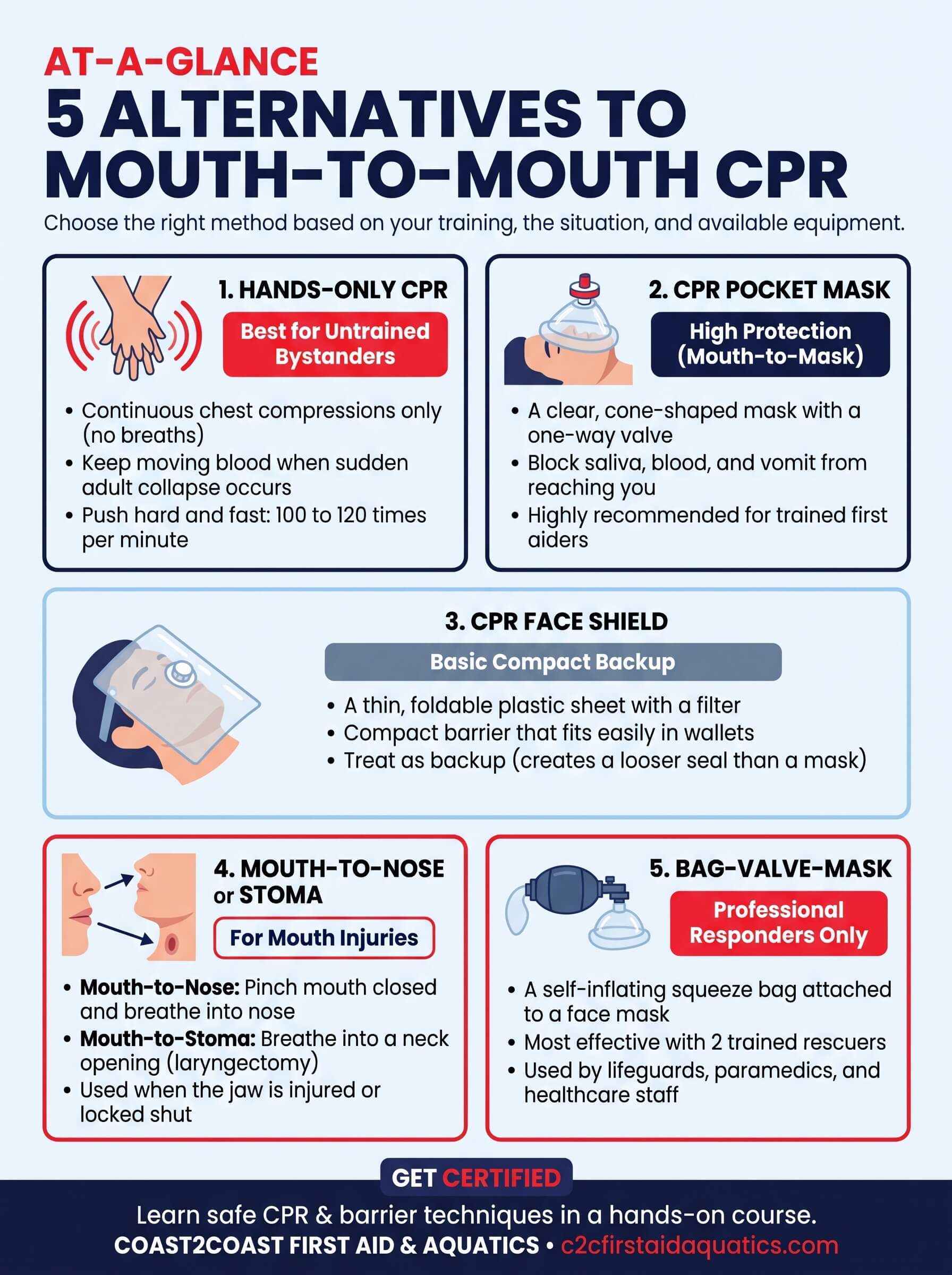
You have five main options. Which one fits depends on your training, the equipment within reach, and why the person collapsed.
Hands-Only CPR
Hands-only CPR means continuous chest compressions with no rescue breaths. For an adult who suddenly collapses and isn’t breathing normally, call 911, send someone for an AED, and push hard and fast in the centre of the chest: at least 5 cm (2 inches) deep, at 100 to 120 compressions per minute. In the first few minutes of a sudden cardiac arrest, the blood still carries oxygen, so keeping it moving matters most. Our guide to the ABCs of CPR covers hands-only CPR technique, depth, and rescuer switching in more detail.
CPR Pocket Mask (Mouth-to-Mask)
A pocket mask is a clear, cone-shaped mask that covers the person’s mouth and nose. You breathe through a one-way valve on top, and the valve and filter keep the person’s saliva, blood, or vomit away from you. Pocket masks also give a better seal than a face shield, and they fit infants, children, and adults when you choose the right size. Every hands-on CPR course uses them, and you can carry one in a small case on a keychain, in a glovebox, or in a work bag. Coast2Coast stocks CPR pocket masks and first aid supplies for workplaces and training programs.
CPR Face Shield
A face shield is a thin plastic sheet with a filter or valve in the centre that you lay over the person’s mouth. It folds small enough for a wallet. A shield gives you a physical barrier, but it seals less well than a pocket mask and it doesn’t fully stop fluids from reaching you, so treat it as a backup when a mask isn’t available.
Mouth-to-Nose and Mouth-to-Stoma Breathing
If you can’t open the person’s mouth, or the mouth has a serious injury, close the mouth and breathe into the nose instead. Mouth-to-nose breathing also helps when you can’t get a good seal around the lips. A person who has had their voice box removed (a laryngectomy) breathes through a stoma, an opening at the front of the neck. For that person, give rescue breaths into the stoma, using a pocket mask over the opening if you have one.
Bag-Valve-Mask (Trained Rescuers)
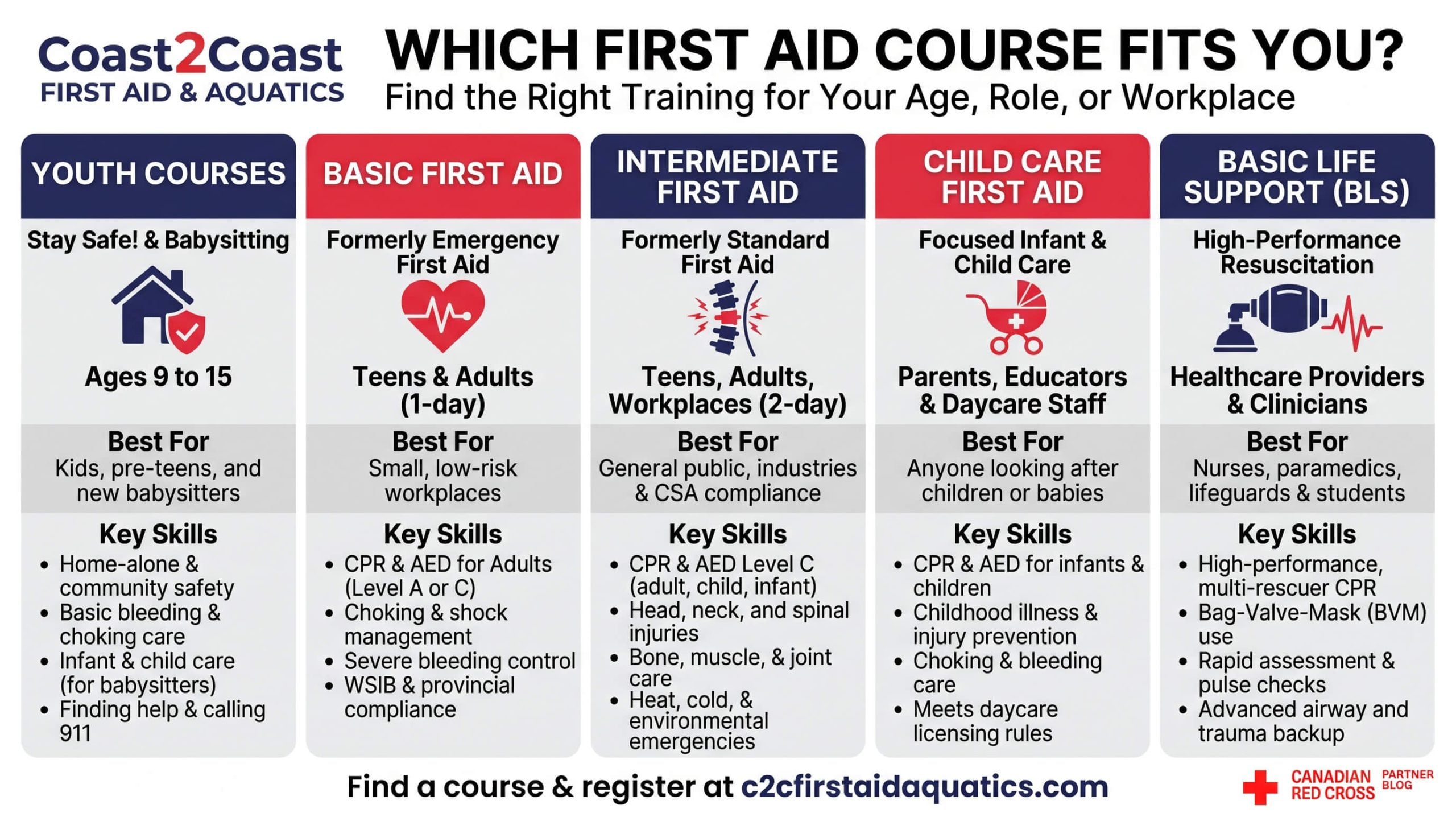
A bag-valve-mask (BVM) is a self-inflating bag attached to a face mask. Squeezing the bag pushes air into the lungs, and it can connect to supplemental oxygen. BVMs work best with two trained rescuers, one holding the mask seal and one squeezing the bag, because one person struggles to do both well. Healthcare providers, lifeguards, and first responders learn BVM use in Basic Life Support (BLS) training. For a bystander, a pocket mask is the practical choice.
Practise With a Real Pocket Mask
Give rescue breaths through a mask on a training manikin with a certified instructor watching your seal and chest rise.
When to Give Mouth-to-Mouth Resuscitation
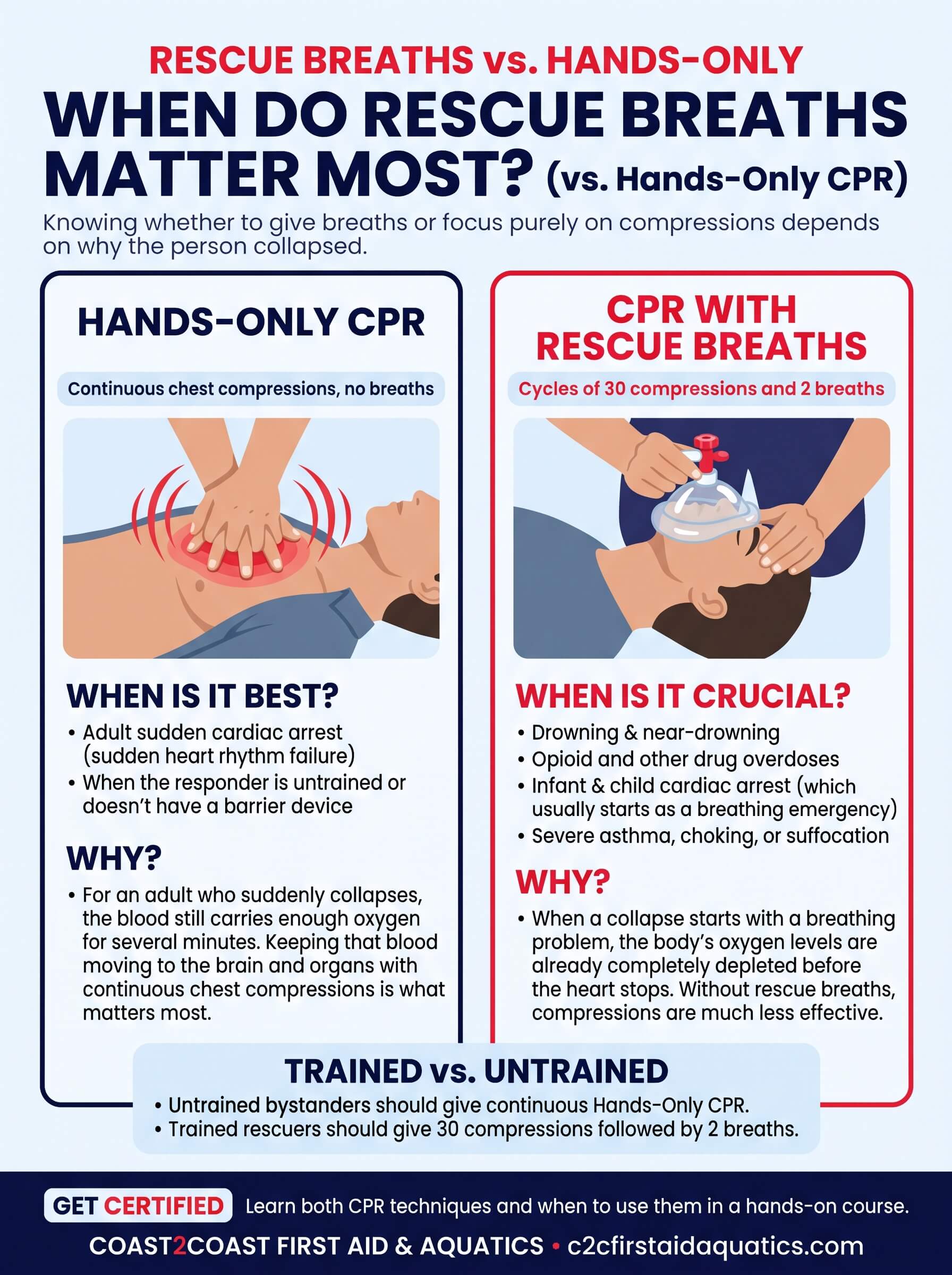
Rescue breaths give oxygen to a person who has stopped breathing or is only gasping. They matter most when the person collapsed from a lack of oxygen rather than a sudden heart rhythm problem, because the blood has already run low on oxygen before the heart stopped.
Situations where rescue breaths carry the most weight include:
- Cardiac arrest in infants and children, which usually starts with a breathing problem rather than a heart problem
- Drowning and near-drowning
- Opioid and other drug overdoses, which slow or stop breathing
- A severe asthma attack that leads to respiratory arrest
- Poisoning, including carbon monoxide poisoning
- Choking, after the airway obstruction has been cleared
Doing rescue breaths safely takes practice: opening the airway, sealing the mouth, and watching for chest rise all happen at once. You build those skills in hands-on CPR/AED training, where an instructor checks your technique on a manikin.
How符号 Give Mouth-to-Mouth Resuscitation
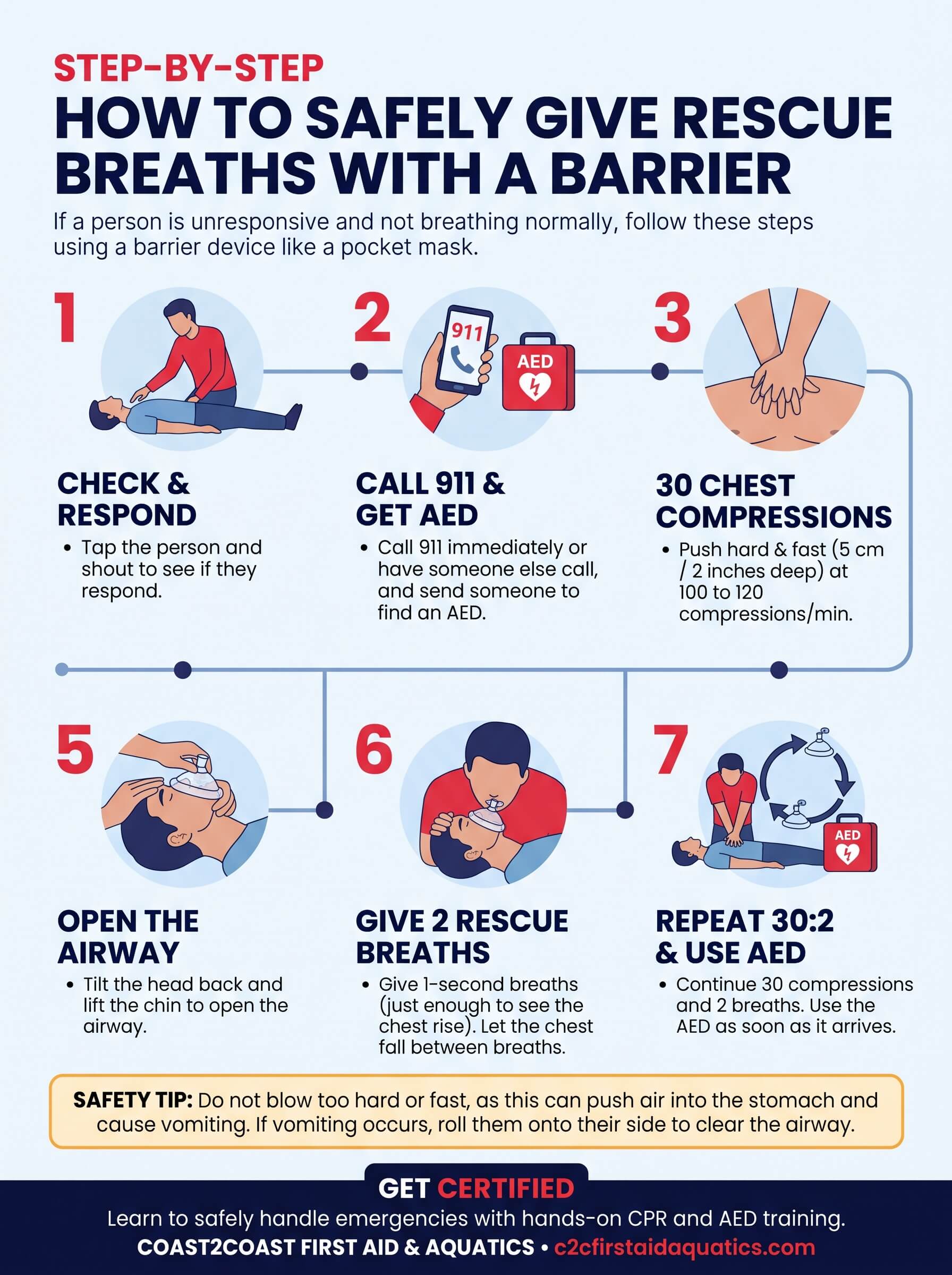
The steps below follow the adult sequence taught in Canadian Red Cross first aid and CPR courses. Rescue breaths come after chest compressions in an adult, not before.
- Check the scene for danger, then tap the person and shout to check for a response.
- If they don’t respond, call 911 or have someone else call, and send someone for an AED.
- Roll the person onto their back on a firm, flat surface.
- Open the airway: place one hand on the forehead and two fingers under the bony part of the chin, then tilt the head back.
- Check for breathing for 5 to 10 seconds. Watch the chest, and put your ear near the mouth and nose to listen and feel for air. Occasional gasps do not count as normal breathing.
- If the person isn’t breathing normally, start CPR with 30 chest compressions in the centre of the chest.
- Open the airway again. Pinch the nose, seal your mouth over the person’s mouth (or place a pocket mask over the mouth and nose), and give a breath lasting about 1 second, with just enough air to make the chest rise.
- Let the chest fall, then give a second breath. For an infant, cover both the mouth and nose with your mouth and give small, gentle puffs.
- If the first breath doesn’t make the chest rise, re-tilt the head and try once more before going back to compressions. If you see an object in the mouth, remove it.
- Repeat cycles of 30 compressions and 2 breaths without long pauses.
- Use the AED as soon as it arrives and follow its voice prompts.
- Keep going until the person shows signs of life, paramedics or another trained rescuer take over, you are too exhausted to continue, or the scene becomes unsafe.
Lay rescuers and first aiders don’t check for a pulse, and you shouldn’t stop every few cycles to check one. Pulse checks belong to healthcare provider training such as BLS. Every pause in compressions lets blood flow to the brain fall back toward zero, so if a second trained person is nearby, switch roles about every 2 minutes instead of stopping to rest.
If you have no CPR training, or you aren’t willing to give breaths, do hands-only CPR. Continuous compressions give an adult a far better chance than doing nothing while you wait for help.
Certificate Close to Expiring?
Refresh your rescue breathing, compression, and AED skills in a shorter recertification course.
How Effective is the Mouth-to-Mouth CPR
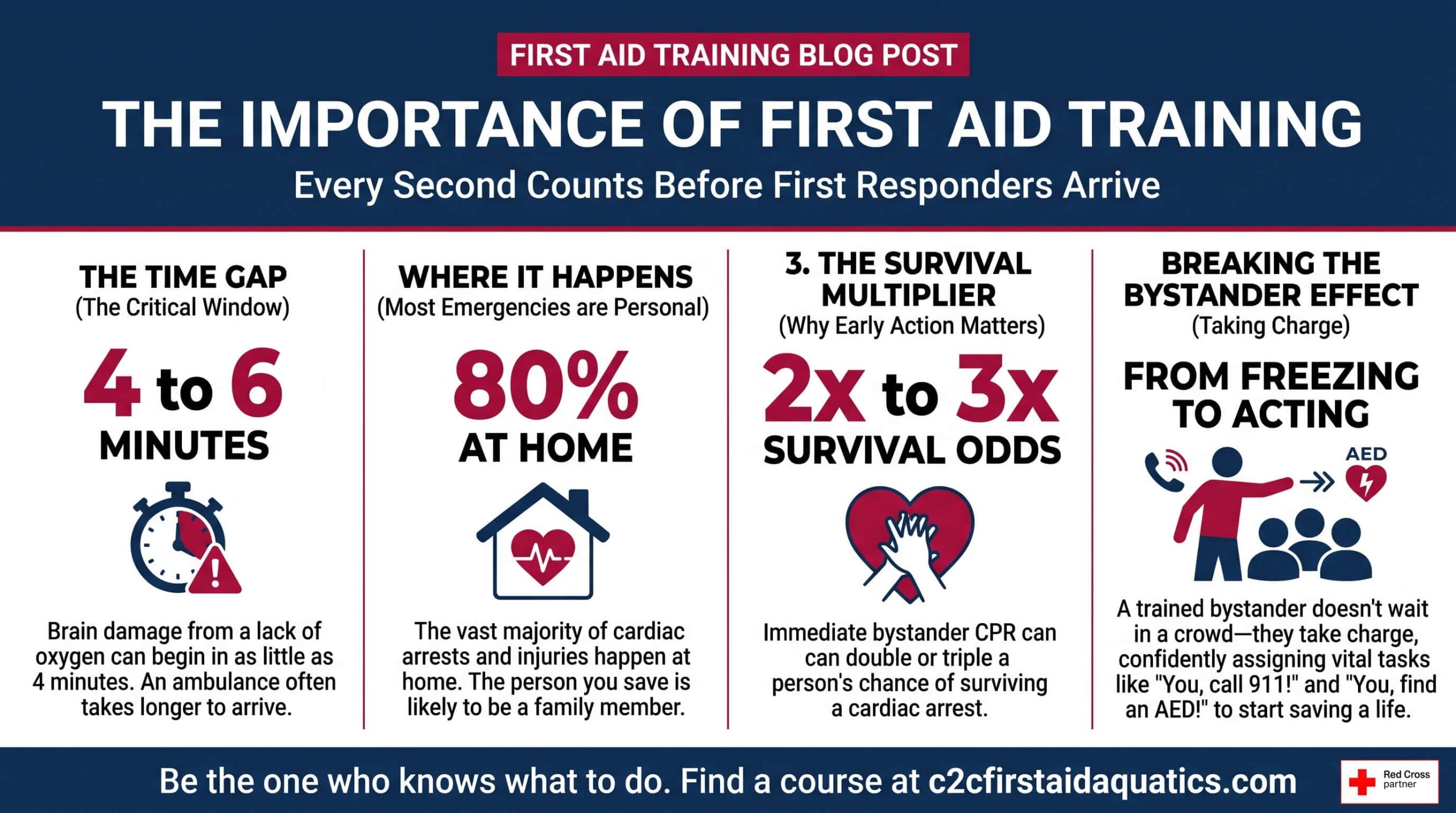
Research on adult cardiac arrest shows that bystander chest compressions drive survival more than rescue breaths do, especially when the rescuer has no training. In a witnessed, sudden adult collapse, hands-only CPR performs about as well as CPR with breaths in the first several minutes. That finding is why resuscitation guidelines now tell untrained bystanders to start compressions right away rather than hesitate over breaths.
Rescue breaths still have a clear role. Trained rescuers who give quality breaths with short pauses help people whose arrest started with a breathing problem, and they help any patient once CPR runs long enough for the oxygen in the blood to run out.
Why Mouth-to-Mouth CPR has Adverse Effects
Mouth-to-mouth causes problems in three ways. First, many bystanders fear giving it to a stranger, so they freeze or delay CPR altogether, and that delay lowers the person’s chance of survival. Second, every set of breaths interrupts chest compressions, and compressions are what keep blood moving to the brain. Third, poor technique, such as breathing too hard or with the head not tilted, fills the stomach with air and can cause vomiting.
In a sudden adult cardiac arrest, the blood still holds oxygen for the first few minutes, so restoring circulation comes first. Children and infants are different: their arrests usually start with a breathing problem, so they need rescue breaths early.
Do I Have to Give Mouth-to-Mouth During CPR?
Sometimes, yes. A person whose cardiac arrest started with a breathing emergency, such as drowning or a drug overdose, may have little oxygen left in their blood. For them, rescue breaths can make the difference, and trained rescuers should give them, ideally through a pocket mask.
Paramedics and hospital teams go further with advanced airway devices, such as a tube placed in the windpipe, to send oxygen straight into the lungs. Those tools require professional training and aren’t something a bystander uses. Your job as a bystander is simpler: start CPR, give breaths if you’re trained and willing, and get an AED on the person fast.
Other ways to deliver breaths include mouth-to-nose breathing when the mouth is injured or can’t be opened, and mouth-to-mask breathing, the most common method in workplaces because it protects the rescuer from cross-infection.
Need Breaths and BVM Skills for Your Job?
Healthcare providers and first responders learn two-rescuer CPR, pulse checks, and bag-valve-mask ventilation in BLS.
Is It Safe to Give Rescue Breaths to a Stranger?
The risk of catching an infection while giving CPR is very low, and documented cases of infection passed through rescue breathing are rare. Using a barrier device lowers that risk further. A pocket mask with a one-way valve keeps your mouth away from the person’s mouth, saliva, and blood, and it is the option first aid instructors recommend you carry.
Your choice still matters. If you don’t have a barrier device and you don’t want to give mouth-to-mouth to a stranger, give hands-only CPR. You can stay confident giving full CPR with breaths to family members, where the people you’re most likely to help live with you anyway.
Workplaces that want staff ready to respond, with masks in every first aid kit and people trained to use them, often certify a whole team at once through private group training, so every shift has someone who can respond.
Train Your Whole Team on Site
Certify staff together in CPR, AED use, and safe rescue breathing at your workplace.
How Do Rescue Breaths Change for Children and Infants?
Children and infants depend more on rescue breaths than adults do, because most of their cardiac arrests begin with a breathing problem, such as choking, a respiratory infection, or drowning. For that reason, trained rescuers give breaths as part of CPR on children and infants rather than relying on compressions alone.
- Child (about 1 to 8 years): tilt the head back slightly less than for an adult and give breaths of about 1 second each, with just enough air to see the chest rise.
- Infant (under 1 year): keep the head in a neutral position, cover both the mouth and nose with your mouth or an infant pocket mask, and give small, gentle puffs. A full adult breath can injure a baby’s lungs.
- Pocket mask sizing: use an infant or child mask if you have one. Many adult masks also fit an infant when you turn them upside down, so the narrow end sits over the chin.
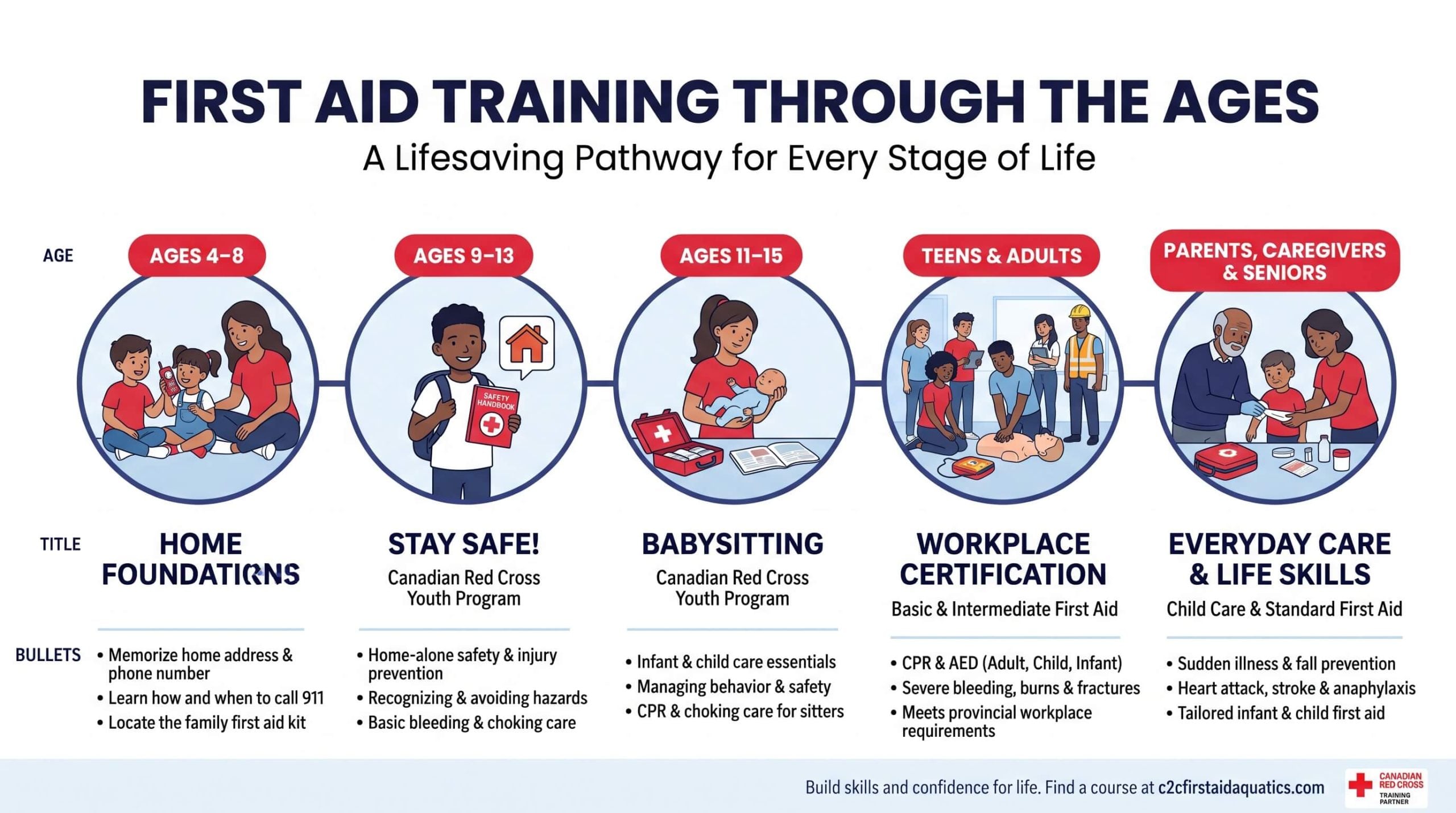
Parents, early childhood educators, and coaches learn these breathing techniques alongside infant choking response in Child Care First Aid & CPR.
Learn Infant and Child Rescue Breaths
Practise breaths, compressions, and choking response on infant and child manikins.
Where You can Learn the New Ways of Performing CPR
CPR keeps changing. In the 1960s, mouth-to-mouth breathing and closed-chest compressions became the core of resuscitation. Today, the evidence points to fast, high-quality chest compressions as the priority for most adults in cardiac arrest, with rescue breaths reserved for trained rescuers and the situations that need them.
Reading about CPR helps, but you only learn to seal a mask, watch for chest rise, and keep compressions deep after you practise with a manikin. Intermediate First Aid (formerly Standard First Aid) with CPR/AED Level C covers adults, children, and infants, including rescue breaths with a pocket mask and AED use. Whether you need certification for your workplace or want to help the people around you, Coast2Coast runs Canadian Red Cross courses at training locations across Canada, so you can learn the latest techniques and be ready when someone needs you.
Key Takeaway
Yes, you have alternatives to mouth-to-mouth CPR. Hands-only CPR, with continuous chest compressions, is the right choice for an untrained or unwilling bystander helping an adult who suddenly collapses. A CPR pocket mask with a one-way valve lets trained rescuers give breaths without direct mouth contact. Rescue breaths still matter for drowning, overdose, and infant and child cardiac arrest, so hands-on training in both is the best preparation.
Join 200,000+ Canadians Who Are Certified
Find a Coast2Coast CPR, AED, and first aid course location and practise rescue breaths hands-on.
Frequently Asked Questions: Alternatives to Mouth-to-Mouth CPR 2026
Q1: What are the alternatives to mouth-to-mouth CPR?
A: The main alternatives are hands-only CPR, a CPR pocket mask, a CPR face shield, mouth-to-nose or mouth-to-stoma breathing, and a bag-valve-mask for trained rescuers. Hands-only CPR uses continuous chest compressions with no breaths and suits an untrained bystander helping an adult who suddenly collapses. A pocket mask with a one-way valve is the most practical way for a trained rescuer to give breaths without direct mouth contact. The right option depends on your training, the equipment you have, and why the person collapsed.
Q2: Is hands-only CPR as good as CPR with rescue breaths?
A: For an adult who suddenly collapses from a heart problem, hands-only CPR works about as well as CPR with breaths in the first several minutes, because the blood still carries oxygen. For drowning, drug overdose, and infant or child cardiac arrest, CPR with rescue breaths gives better results, since those arrests usually start with a lack of oxygen. Untrained bystanders should give hands-only CPR. Trained rescuers should give 30 compressions followed by 2 breaths.
Q3: Can you do CPR without mouth-to-mouth?
A: Yes. You can give hands-only CPR, which means pushing hard and fast in the centre of the chest at 100 to 120 compressions per minute without stopping for breaths. Call 911 first and send someone for an AED. You can also give rescue breaths through a pocket mask or face shield so your mouth never touches the person’s mouth. Hands-only CPR is the recommended choice for anyone who is untrained or not willing to give breaths to a stranger.
Q4: What is a CPR pocket mask?
A: A CPR pocket mask is a clear, cone-shaped mask that fits over a person’s mouth and nose. You breathe into a one-way valve on top, and the valve and filter stop saliva, blood, and vomit from reaching you. Pocket masks seal better than face shields and come in sizes for adults, children, and infants. They fold into a small case, so you can keep one on a keychain, in a car, or in a workplace first aid kit.
Q5: Can you catch a disease from giving mouth-to-mouth CPR?
A: The risk is very low. Documented cases of infection passed through rescue breathing are rare. Using a pocket mask with a one-way valve lowers the risk further by keeping your mouth away from the person’s saliva and blood. If you don’t have a barrier device and don’t want to give breaths to a stranger, give hands-only CPR instead, which still gives an adult a much better chance of survival than doing nothing.
Q6: When should you give rescue breaths?
A: Give rescue breaths when you are trained and the person is unresponsive and not breathing normally. Breaths matter most when the person collapsed from a lack of oxygen, such as drowning, opioid overdose, severe asthma, carbon monoxide poisoning, or cardiac arrest in an infant or child. In an adult, start with 30 chest compressions, then open the airway and give 2 breaths of about 1 second each, just enough to make the chest rise.
Q7: How long should each rescue breath last?
A: Each rescue breath should last about 1 second, with just enough air to make the chest visibly rise. Breathing harder or faster than that pushes air into the stomach, which can cause vomiting and makes the next breaths less effective. Let the chest fall before you give the second breath. For an infant, give small, gentle puffs that cover both the mouth and nose, since a full adult breath can injure a baby’s lungs.
More FAQs: Rescue Breaths, Masks & Safety
Q8: What should you do if the chest doesn’t rise during a rescue breath?
A: Re-tilt the head and lift the chin to open the airway again, then make sure you have a good seal and try once more. If the chest still doesn’t rise, go back to chest compressions, since a blocked airway is possible. Before your next set of breaths, look in the mouth and remove any object you can see. Don’t sweep blindly with your fingers, because that can push an object deeper.
Q9: Should you check for a pulse before giving CPR?
A: No. Lay rescuers and first aiders don’t check for a pulse, because pulse checks are hard to do accurately under stress and waste time. Instead, check whether the person responds and whether they are breathing normally for 5 to 10 seconds. Occasional gasps don’t count as normal breathing. If the person isn’t breathing normally, start CPR. Pulse checks are taught to healthcare providers in Basic Life Support (BLS) training.
Q10: What is mouth-to-nose rescue breathing?
A: Mouth-to-nose breathing means sealing the person’s mouth closed and breathing into their nose instead. You use it when you can’t open the mouth, when the mouth or jaw is badly injured, or when you can’t get a good seal around the lips. Give each breath over about 1 second and watch for the chest to rise. A pocket mask covers both the mouth and nose, so it also works in these situations.
Q11: Who uses a bag-valve-mask during CPR?
A: Healthcare providers, paramedics, lifeguards, and other trained first responders use a bag-valve-mask. The device is a self-inflating bag attached to a face mask, and squeezing the bag pushes air into the lungs. It works best with two trained rescuers, one sealing the mask and one squeezing the bag. Because it takes practice to use well, bystanders should use a pocket mask or hands-only CPR instead.
Q12: What should you do if someone vomits during CPR?
A: Roll the person onto their side to let the vomit drain, then clear the mouth with your fingers or a cloth. Roll them back onto their back, open the airway, and continue CPR. Vomiting is common during CPR, often because rescue breaths were given too hard or too fast. A pocket mask with a one-way valve protects you from contact with vomit while you continue giving breaths.
Q13: Do infants and children need rescue breaths during CPR?
A: Yes. Most cardiac arrests in infants and children begin with a breathing problem, such as choking, drowning, or a respiratory infection, so their blood is already low on oxygen when the heart stops. Trained rescuers should give rescue breaths as part of CPR for infants and children. For an infant, cover both the mouth and nose and give small, gentle puffs. If you are untrained, give compressions and get help rather than doing nothing.
Q14: Should you carry a CPR mask with you?
A: Carrying a CPR pocket mask is a good idea if you have CPR training. Masks fold into small cases that fit on a keychain, in a glovebox, or in a work bag, and having one removes the main reason people hesitate to give rescue breaths to a stranger. Many workplace first aid kits in Canada already include a CPR barrier device. Make sure you know how to seal the mask, which you learn in a hands-on CPR course.
Q15: Where can you learn rescue breathing and the alternatives to mouth-to-mouth CPR?
A: You learn rescue breathing, pocket mask use, and hands-only CPR in a hands-on CPR/AED or first aid course with a certified instructor. Intermediate First Aid (formerly Standard First Aid) with CPR/AED Level C covers adults, children, and infants. Coast2Coast First Aid & Aquatics runs Canadian Red Cross courses across Canada, where you practise breaths through a mask, compressions, and AED use on training manikins rather than watching a video.
Reviewed & Sourced
Reviewed by a Coast2Coast Certified Lead CPR & AED Instructor. Last updated November 6, 2026. CPR sequence aligned with the Canadian Red Cross first aid and CPR curriculum taught in Coast2Coast courses.
Reference: Government of Canada, National Automated External Defibrillator (AED) Initiative.