The Ultimate Canadian First Aid & CPR FAQ: 100 Real Questions Answered

EMR student practicing patient assessment on mannequin during emergency medical responder training
Key takeaways
  • Certificates expire. Canadian Red Cross first aid and CPR certificates are valid for three years; Basic Life Support (BLS) is valid for one year.
  • Pick the course by who is asking. Intermediate First Aid (formerly Standard First Aid) is the two-day course most workplaces require; Basic First Aid (formerly Emergency First Aid) is the one-day version; BLS is the standard for healthcare providers.
  • Course names are transitioning across Canada. The Canadian Red Cross uses Intermediate/Standard First Aid and Basic/Emergency First Aid so learners recognize both the newer and established names; the terminology used by employers and regulators may vary by province.
  • Online-only training does not meet recognized certification requirements. Practical first aid and CPR skills must be assessed in person, so WSIB, Alberta OHS and most employers require it. Legitimate blended courses combine online theory with an instructor-led skills session.
  • The 100 answers below cover the rest: costs, renewals, workplace rules, BLS, childcare, and real emergency skills.
100
Questions answered in plain language
10
Categories, from course levels to careers
80+
Answers informed by real Reddit & Quora discussions
3 Yrs
Typical First Aid/CPR validity; BLS is 1 year

Every week, Canadians ask the same first aid questions in the same places: Reddit threads in r/askTO and r/Calgary, Quora posts about broken ribs and expired cards, and Google searches that start with “how long” or “do I need.” This guide answers 100 common questions Canadians ask about first aid, CPR and BLS courses, in plain language, aligned with Canadian Red Cross guidelines and reviewed by an instructor trainer. Use the search box or the table of contents to jump to a topic. Many answers link to the original Reddit and Quora discussions that helped identify what Canadians are asking.

Reviewed by a Canadian Red Cross Instructor Trainer.

Browse by Category

Showing all 100 questions.

First Aid & CPR Basics

Plain-answer fundamentals for anyone new to first aid and CPR training.

Certification & Course Levels

Which course you actually need: Standard vs Emergency, CPR levels, and how certifications stack.

Cost, Duration & Booking

What courses cost, how long they take, and how to book solo or as a group.

Certify Your Whole Team Together

Learn About Group Training

Online, Blended & In-Person

What counts, what doesn’t, and how blended courses actually work.

Recertification, Renewal & Expiry

Validity periods, grace periods, and what to do when a certificate lapses.

BLS for Healthcare Providers

Basic Life Support: who needs it, how it differs from CPR-C, and how renewal works.

Basic Life Support for Healthcare Providers

View BLS Courses

Workplace Requirements & Compliance

WSIB, Alberta OHS, and what the law expects from workplaces and bystanders.

Childcare, Babysitting & Parents

Certification for babysitters, nannies, ECEs, and parents of young children.

Canadian Red Cross Babysitting & Stay Safe! Courses

See Youth Courses

CPR, AED & Choking Skills

The questions people are often afraid to ask in class, answered straight.

Jobs, Careers & Resumes

How certifications translate into work, from resumes to instructor pathways.

Editorial Method: How This Guide Was Prepared

Questions were selected from Canadian search demand and public forum discussions. Answers were edited for clarity, checked against current Canadian Red Cross program information and provincial regulator sources, and reviewed by a Canadian Red Cross Instructor Trainer. Representative forum examples are linked as provenance; primary sources support clinical and regulatory claims.

Key Takeaway

Match the certificate to the requirement: Intermediate/Standard First Aid for most workplaces, Basic/Emergency First Aid for the basics, Basic Life Support for healthcare. Take the skills portion in person, and renew before the printed expiry date. Everything else is detail, and it is answered above.

Get Certified This Week

Weekly Courses Across Ontario & Alberta, Certified Same Day

Find a Course Near You

This guide is provided for general informational purposes and does not replace certified training or personalized medical advice. In an emergency, call 911. Course requirements are set by employers, regulators and licensing bodies, so always confirm the exact certificate your organization requires.

Reviewed By

Written by Godwin Orilua and reviewed by Ashkon Pourheidary, B.Sc. Hons Neuroscience, Co-Founder and Canadian Red Cross Instructor Trainer at Coast2Coast First Aid Inc. Questions were identified from public Reddit and Quora discussions and common Google searches. Forum links show where people ask these questions; factual answers were reviewed against current Canadian Red Cross program materials and relevant provincial regulatory guidance where applicable.

About Coast2Coast First Aid

Coast2Coast First Aid Inc. is a Canadian Red Cross Training Partner delivering first aid, CPR and Basic Life Support programs across Ontario and Alberta, for individuals, workplaces and organizations. For more information, visit c2cfirstaidaquatics.com.
Free BLS, First Aid & CPR Course 2026 Guide to Get Certified for $0

  • Executive Summary: The Deal at a Glance

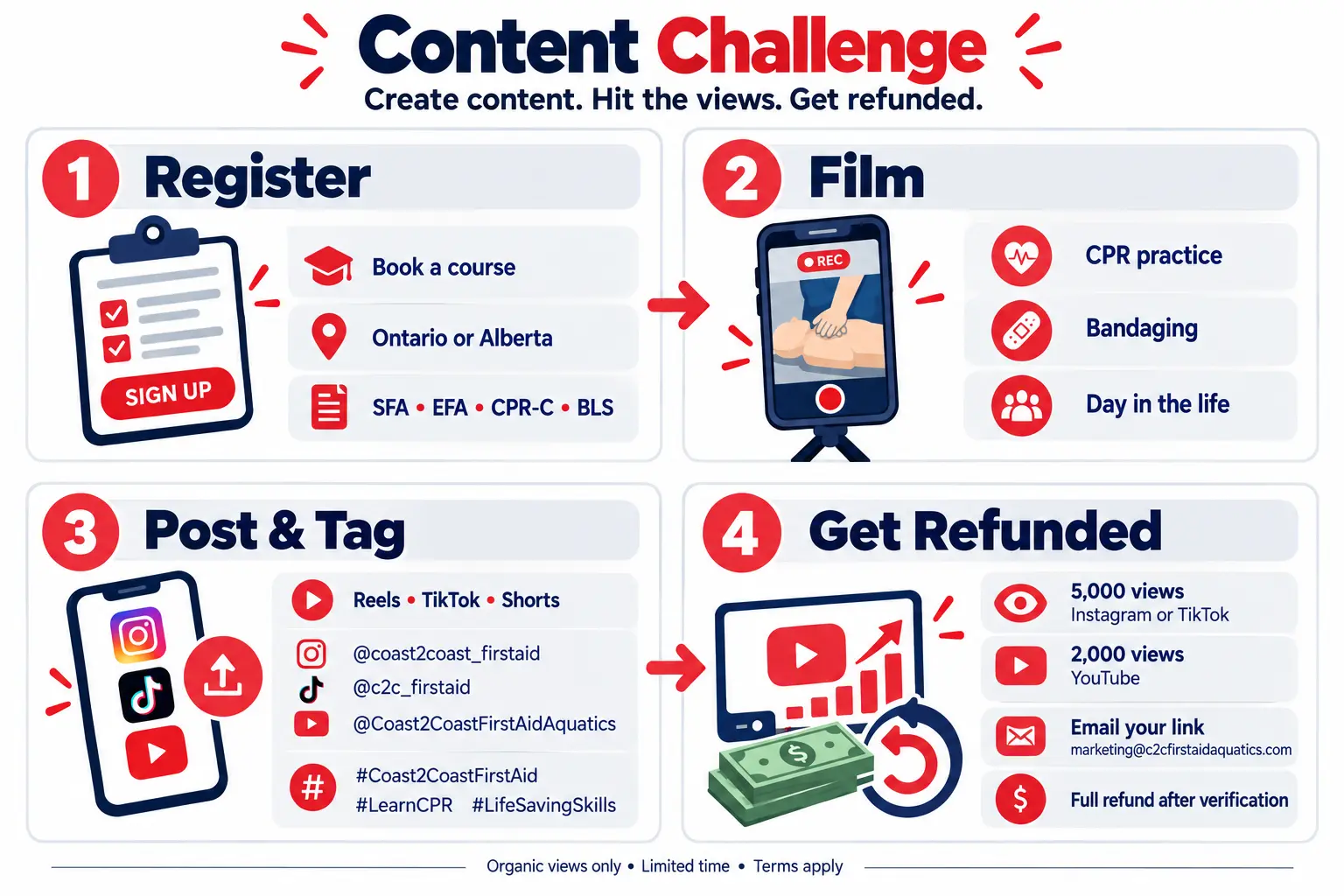
    The Offer: Register for a course, film your experience, and post it online.

    The Content Rule: While we love authentic ‘Day in the Life’ vlogs, your training experience must be the main focus of the video. Ensure your time at Coast2Coast takes up a significant portion of your reel (at least 10-15 seconds) rather than just a passing clip.

    The Goal: Hit 5,000 views on Instagram, TikTok OR 2,000 views on YouTube.

    The Reward: A FULL REFUND of your course fee.

    Eligible Courses: Standard First Aid, Emergency First Aid, CPR Level C, and Basic Life Support (BLS).

    Locations: Toronto, Brampton, Ottawa, Calgary, Edmonton, and more.

    Terms and conditions apply. Views must be organic. Limited time offer.


We know that for students, job seekers, and healthcare professionals, training costs can add up. You are constantly searching for a free first aid and cpr course or a free bls course near me, only to find that most “free” options online are just informational videos that don’t offer the official WSIB-approved certification you need to actually get hired.

At Coast2Coast First Aid & Aquatics, we believe life-saving education should be accessible to everyone. That is why we are launching our biggest student-creator campaign ever. We are giving you the chance to turn your creativity into cash—literally.

Here is your complete guide on how to get official Red Cross training for $0, plus everything you need to know about choosing the right course.

How It Works: 4 Steps to a Free Course

You don’t need to be a professional influencer to qualify. You just need a smartphone and a little creativity during your training session.

1. Register for Your Course

Sign up for any of our eligible training sessions across Ontario or Alberta. You pay for the course upfront to secure your spot.

2. Film Your Experience

During your class (during break times or practice sessions, ensuring you don’t disrupt the class), capture content!

  • Film yourself practicing CPR on a mannequin.

  • Show off your bandaging skills.

  • Share a “Day in the Life” of getting certified.

3. Post & Tag Us

Upload your video to Instagram Reels, TikTok or YouTube Shorts.

4. Hit the Views & Get Paid

If your video hits 5,000 Views on Instagram, TikTok OR 2,000 Views on YouTube, email us at marketing [at] c2cfirstaidaquatics.com and mention that you have took part in this challenge and you have hit the mark by sending us the link! Once verified, we will issue a full refund to your original payment method.

(Terms and conditions apply. Views must be organic. Offer valid for a limited time.)

How It Works 4 Steps to a Free Course


Why Are We Doing This?

We want to spread awareness about the importance of CPR and First Aid. When you search for a first aid and cpr course free, you often find non-accredited videos that won’t help you get a job. We want to change that.

By sharing your journey, you aren’t just getting a free cpr course; you are inspiring your friends and followers to learn skills that save lives.

Wait, Which Course Do I Need? (The Ultimate Guide)

Before you sign up and start filming, you need to make sure you are taking the right course. Choosing the wrong certification is the most common mistake students make.

Here is a simple breakdown to help you pick the perfect training for your needs.

1. Standard First Aid & CPR/AED Level C

  • Best For: Construction workers, daycare staff, lifeguards, and general workplace compliance.

  • What It Covers: This is our most comprehensive course. It covers everything from spinal injuries and bone fractures to severe bleeding and CPR for adults, children, and infants.

  • Validity: 3 Years.

2. Emergency First Aid & CPR/AED Level C

  • Best For: Security guards, fitness instructors, government employees, or those needing a basic overview.

  • What It Covers: A shorter, 1-day course focusing on immediate life-saving interventions like choking, CPR, and using an AED.

  • Validity: 3 Years.

3. Basic Life Support (BLS)

  • Best For: Healthcare professionals (Nurses, Dentists, Paramedics, Firefighters).

  • What It Covers: This is a high-intensity, fast-paced course that focuses on high-performance CPR, trauma response, and team dynamics in a clinical setting.

  • Validity: 1 Year (Annual renewal is required).

The “Blended Learning” Advantage

If you are looking for an online cpr course free of classroom time, “Blended Learning” is the closest you can get while still remaining certified.

How It Works:

  1. Online Theory: You complete the “textbook” portion of the course online, at your own pace, from the comfort of your home.

  2. In-Class Skills: You attend a shorter, focused in-person session to practice hands-on skills.

Why Students Love It:

  • Flexible: Study late at night or on weekends.

  • Efficient: Cut your classroom time in half.

  • WSIB & OHS Approved: Yes, it is fully recognized by employers in Ontario and Alberta.

Tips to Go Viral (and Get Your Refund)

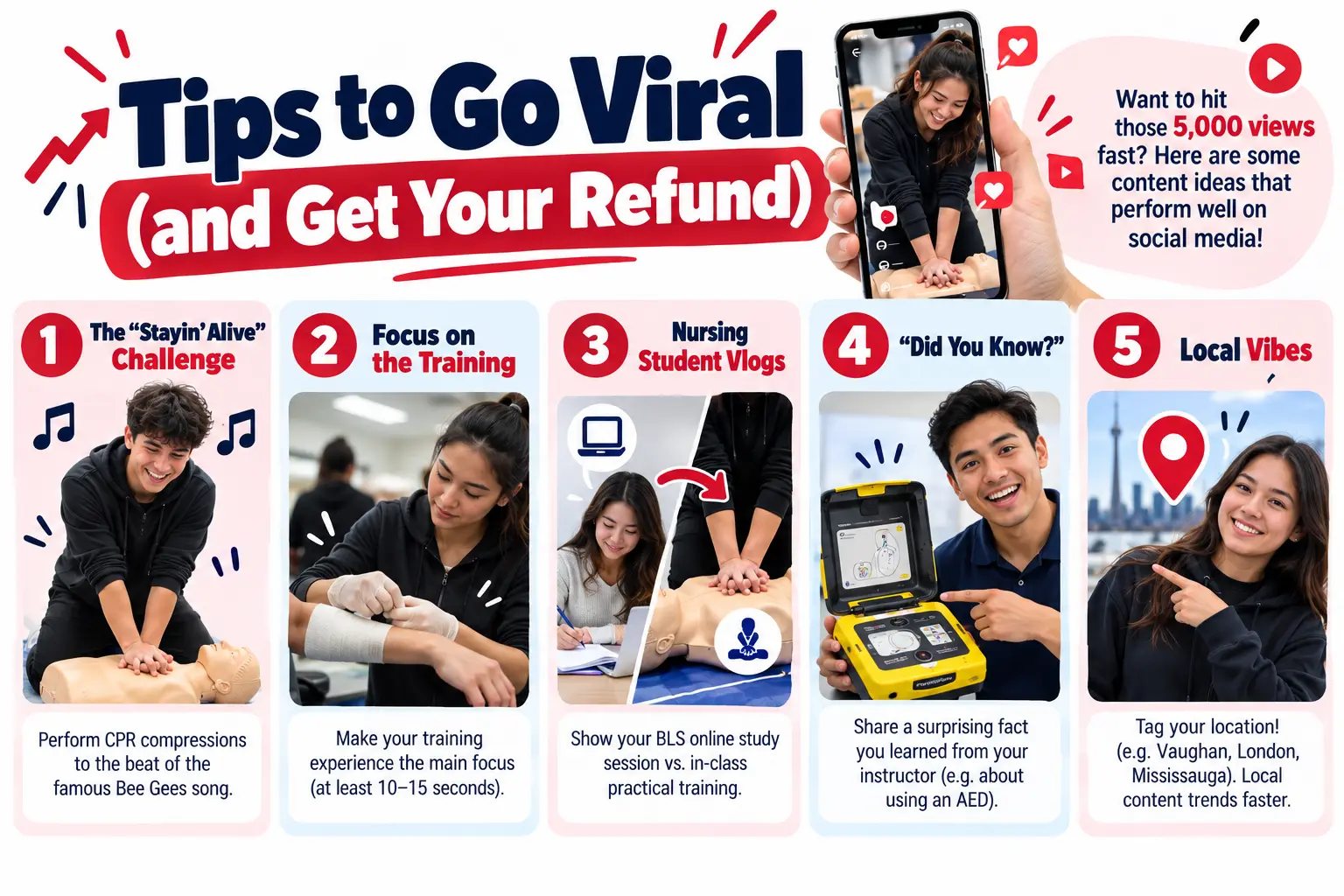
Want to hit those 5,000 views fast to secure your refund? Here are some content ideas that perform well on social media:

  • The “Stayin’ Alive” Challenge: Perform CPR compressions to the beat of the famous Bee Gees song.

  • Keep it focused on the training: While we love authentic ‘Day in the Life’ vlogs, your training experience must be the main focus of the video. Ensure your time at Coast2Coast takes up a significant portion of your reel (at least 10-15 seconds) rather than just a passing clip.

  • Nursing Student Vlogs: Show the reality of your BLS course online free study session vs. the intense in-class practical training.

  • “Did You Know?”: Share a surprising fact you learned from your Coast2Coast instructor (e.g., “I bet you didn’t know this about using an AED…”).

  • Local Vibes: Tag your location! Whether it’s First Aid in Vaughan, CPR in London, or Training in Mississauga, local content trends faster.

(Terms and conditions apply. Views must be organic. Offer valid for a limited time.)
Tips to Go Viral and Get Refunds


Frequently Asked Questions (FAQ)

We know you have questions. Here are the answers to the most common queries about our courses and the refund offer.

About the “Free Course” Offer

1. Is this really a free first aid and cpr course with certificate? Yes! You pay upfront to reserve your seat and receive your official Canadian Red Cross certificate. However, if you meet the social media view requirements, we refund 100% of your fee, effectively making it a free cpr course with certificate.

2. Can I find a free bls course near me? Official BLS (Basic Life Support) training usually requires payment because it is a professional-level certification. However, our campaign applies to BLS courses too! If you are a nursing student looking for a free bls course, this challenge is your best route to getting certified for free.

3. Does this apply to the online cpr course free portion? Our courses are “Blended Learning,” meaning you do half online and half in-class. The refund covers the entire cost of the training, including the online access and the in-person workshop.

4. I am looking for a free cpr refresher course. Does this count? Absolutely. Whether it is a full certification or a cpr refresher course online free of charge (via refund), the challenge applies as long as you are registered in a Coast2Coast session.

5. Can my video just be a vlog of my entire day?
While we love authentic ‘Day in the Life’ vlogs, your training experience must be the main focus of the video. Ensure your time at Coast2Coast takes up a significant portion of your reel (at least 10-15 seconds) rather than just a passing clip.

6. Is this available in my city? This offer is valid at all Coast2Coast locations. So whether you are searching for a free cpr course Toronto, free cpr course Ottawa, free cpr course Calgary, or a free cpr course Belleville, you are eligible to participate!

About Certification & Validity

6. Is the certificate WSIB approved? Yes. Unlike many generic online free cpr course options you find on the web, our training is fully WSIB (Ontario) and OHS (Alberta) approved.

7. How long is my First Aid certificate valid? For Standard and Emergency First Aid, your certificate is valid for 3 years. If you take Basic Life Support (BLS), you must renew it every 1 year.

8. Can I recertify instead of taking the full course? Yes! If your current Standard First Aid certificate has not expired yet, you can take a shorter Recertification Course. This saves you time and money.

9. Can I do the cpr course online free without attending class? No. To get the official certificate, you must attend the in-class skills session. Purely online courses are rarely accepted by employers in Canada.

10. What if I lose my certificate? All Canadian Red Cross certificates are digital. You can access your profile online at any time to download a new copy for free.

Logistics & Details

11. Do I need to bring my own equipment? No. We provide all mannequins, AED trainers, and first aid supplies.

12. Can I get a free cpr course with certificate if I am not a student? Yes! This offer is open to everyone—students, parents, teachers, and professionals.

13. What if I am taking the course for a group? The refund applies to the individual who posts the content. If you book for a group, each person can post their own video to try and earn their own refund.

14. Does the bls course free offer include the manual? The digital eBook is included in your course registration.

15. How long does the refund take? Once you email us your video link and we verify the views, the refund is typically processed within 5-10 business days.

16. Can I combine this with other promo codes? Since the reward is a full refund, it cannot be combined with other discounts. You are getting the whole course for free!

17. What hashtags should I use to help it go viral? We recommend using local tags like #TorontoLife, #CalgaryViews, or #StudentLife alongside our official tag #Coast2CoastFirstAid.

18. Where do I send my video link? Send your booking ID and the link to your viral video to our marketing team email (listed on our contact page) with the subject line “Go Viral Refund Claim.”

19. What if I don’t hit the view count? You still walk away with a valuable, federally recognized certification that boosts your resume. You have nothing to lose!

20. Can I post on TikTok instead? Currently, our tracking is set up for Instagram Reels, TikTok and YouTube Shorts as they allow for the best reach verification. However, feel free to cross-post to TikTok for extra exposure!

Ready to Go Viral?

Don’t settle for an unaccredited online free cpr course that your employer won’t accept. Get the Gold Standard of Red Cross training, have fun filming it, and let us foot the bill.

Find Your Course & Register Now

(Terms and conditions apply. Views must be organic. Offer valid for a limited time.)

Comprehensive Natural Disaster First Aid: Essential Preparedness Guide for the USA

Fire fighters putting down a fire in Los Angeles

A great number of individuals know the importance of first aid training, but very few know how critical it is to be CPR and emergency response certified. In the US, we have the luxury of living a reasonably safe life, but natural disasters can strike anytime. We have hurricanes and earthquakes, as well as wildfires and floods. The truth is that the state of emergency takes place when we least expect it. The recent wildfires in LA, for example, show just how terrible things can go in an instant, forcing thousands to move and communities left in ruins. In these cases, having an emergency first aid kit and the knowledge of how to utilize it properly can save lives.

Continue reading

First Aid and CPR Training for Dental Professionals

A dentist treating her patient in a clinic.

While your expertise lies in the intricacies of dental care, have you ever paused to consider the critical role that First and CPR knowledge and skills play in ensuring the well-being of your patients and staff? Dental offices, like any healthcare setting, are not immune to unexpected medical emergencies. From minor incidents like fainting to life-threatening events like cardiac arrest, the ability to respond swiftly and effectively can make all the difference. First Aid and CPR training for dental professionals in a clinic could help enhance efficiency, safeguard well-being and improve the overall reputation of the clinic.

Continue reading

Essential First Aid and CPR Training for PSW

Essential First Aid and CPR Training for PSW

Being a Personal Support Worker (PSW) requires you to play a very significant role in the lives of people who rely on you on a daily basis. It requires being prepared for the unexpected, which proves your dedication to improve their quality of life to support them. First Aid and CPR training are not only essential tools for PSWs but are also required for employment.

Continue reading

Why Do Healthcare Professionals Need BLS Certification?

why healthcare professionals need bls certification

Basic Life Support Certification is proof of completing the foundational BLS training. Participants of the BLS course learn the theoretical and hands-on skills required to ensure the best possible patient outcomes in breathing emergencies and cardiac arrest, particularly in fast-paced environments like hospitals and during emergencies. Healthcare professionals, first responders, rescuers, sports doctors, and dentists need BLS certification.

There are several ways Basic Life Support training can impact your career. Besides providing you with the latest life-saving protocols for breathing emergencies, advanced CPR training increases your confidence levels.

For those that are confused, there is a slight difference between BLS and HCP. Basic Life Support training was previously known as CPR-HCP. Certifications expired every three years. In April 2019, the Canadian government required healthcare professionals to update their training on an annual basis. Due to this change, the course is now called Basic Life Support and it provides students more information and skills required for their profession.

Continue reading to find out why healthcare professionals need BLS certification!

What is BLS?

Basic Life Support training provides healthcare professionals and first responders with the skills required to help unresponsive people during breathing emergencies, trauma, etc. The course includes CPR/AED training for all age groups and various other skills.

One of the most common conditions where BLS is required is cardiac arrest. Other cases where the patient is deprived of their vital oxygen supply include choking or drowning. Within a few minutes, a patient can suffer permanent brain damage from a lack of oxygen. In the absence of advanced equipment, BLS training allows healthcare professionals to maximize the chance of a possible outcome for the patient by administering resuscitation and chest compressions as a team.

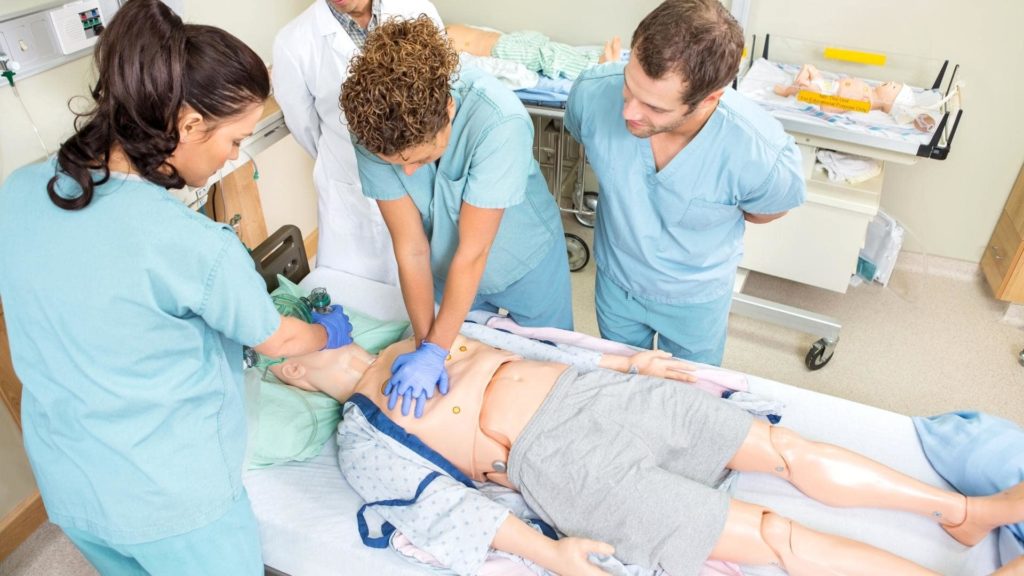
Four medical professionals in scrubs practice CPR on a medical dummy in a clinical setting. One person performs chest compressions while another manages the airway. Two others observe closely, with medical equipment visible in the background.

During the training, participants learn the correct order of CPR and the cycles of CPR.

Expect to learn the following skills in BLS:

  • Advanced CPR algorithms (adults, children, and babies)
  • Use of an automated external defibrillator (AED)
  • Removing airway obstructions in children and adults
  • Single and multi rescuer resuscitation
  • Use of ventilation devices
  • Anaphylaxis
  • Trauma
  • Opioid emergencies
  • Six rights of medication and more!

BLS requires the correct sequence of chest compressions, airway, and breathing, in adults, children, and infants. These components contribute to blood flow and oxygen in life-threatening situations. During training, you learn about the chest compression rate, chest compression depth, chest recoil, and ventilation. You also learn how to perform this in the proper cycles.

Register for First Aid Training

Register today for a First Aid training course and learn how to deal with emergencies and keep your loved ones safe! Check out our facilities and book your spot now.

The importance of BLS

Promptly administering advanced CPR can save a person’s life from cardiac or respiratory arrest. Recertifying annually keeps healthcare professionals updated with any new developments.

BLS training teaches students the proper way to administer the life-saving skills required by healthcare professionals and other related industries. These skills are vital for people who offer direct patient care. At Coast2Coast, we offer private/group training for healthcare industry teams; reach out to our customer service reps to find the best option for your needs.

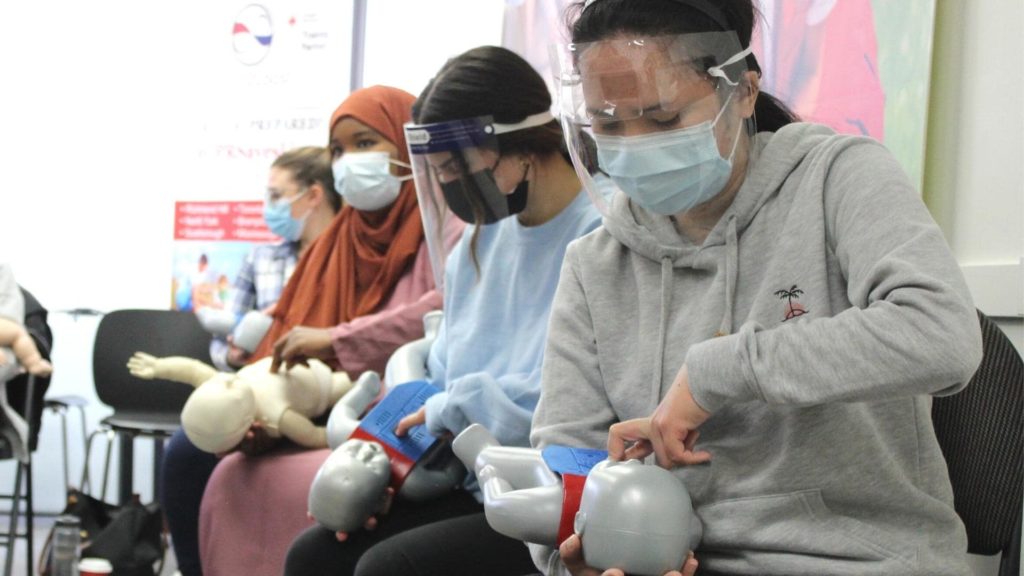
A group of people wearing face masks and shields practice CPR on infant mannequins, seated in a classroom setting. They are focused and engaged in learning the life-saving technique. Posters are visible in the background.

BLS Certification Validity

Basic Life Support certificates remain valid for one year after they are issued. In order to take our Renewal course, you must hold a BLS certificate. Annual retraining ensures that participants retain their confidence and skills. Besides the regular retraining, make sure to get your BLS certificate from an accredited provider such as Coast2Coast First Aid!

Coast2Coast BLS Programs

Coast2Coast has multiple programs to choose from, depending on your work requirements. These are Basic Life Support (HCP), Airway Management & Oxygen Therapy, and Accredited Heart and Stroke Basic Life Support. All the courses teach various life-saving skills, including recognizing cardiac arrest. Participants learn how to respond promptly and confidently, applying the elements of Basic Life Support.

BLS is a 4-hour training course available in morning, afternoon, and evening classes to ensure everyone finds a time slot that suits them. The Basic Life Support and Renewal courses have the same duration, but the Renewal option is offered at a lower rate. If you register for the Renewal, you must bring a copy of your current certificate to class to receive your discount.

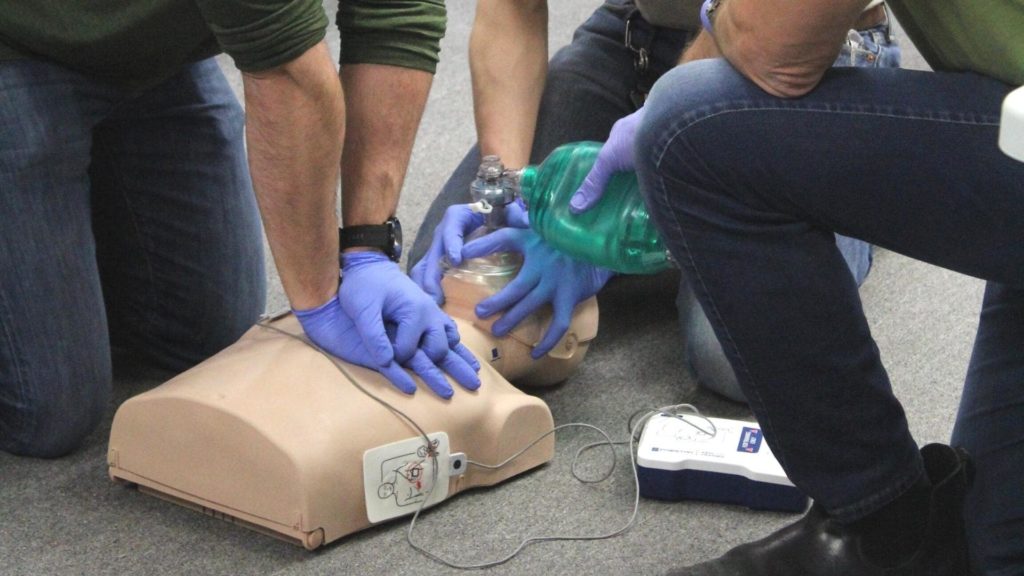
Three individuals practice CPR on a mannequin. Two compress the chest, and one uses a bag mask for ventilation. An automated external defibrillator (AED) is positioned nearby. All are wearing blue gloves.

Airway Management & Oxygen Therapy is a two-hour intensive training course that provides the skills to offer supplemental oxygen and create an airway when needed. Students learn how to create oropharyngeal, nasopharyngeal, and supraglottic airways in patients. This training also covers the safe handling and assembling of equipment such as oxygen tanks. Oftentimes, this training is taken together with Basic Life Support training by healthcare professionals, first responders, and rescue workers.

Coast2Coast provides Canadian Red Cross Basic Life Support courses in the Greater Toronto Area, Western Ontario, and Eastern Ontario. Learn more about the locations, dates, and times of the various BLS courses HERE.

We hope you’ve learned why healthcare professionals need BLS certification!

Master the Essentials of Life Support!

Join our Basic Life Support (BLS) course and learn critical skills to save lives in emergencies. Our expert instructors will guide you through hands-on training and the latest techniques to help you respond effectively.