
A First Aid and CPR test has two parts: a practical skills test, where you respond to emergency scenarios with CPR, AED use, choking care and other skills, and a written knowledge evaluation. Canadian Red Cross certification also requires a mark of at least 75% on the written part and attendance at 100% of the course. Everything on the test is taught in class.
75%
Minimum mark on the written knowledge evaluation
100%
Of the course you must attend and take part in
3 years
How long Canadian Red Cross First Aid and CPR certification lasts
Which First Aid and CPR Test Will You Take?
There is no single first aid test. Each Canadian Red Cross course level has its own First Aid and CPR test, built around the skills that course teaches. The higher the level, the more topics the first aid exam covers:
- CPR Level A: CPR, AED use and choking care for adults.
- CPR Level C: adds CPR and choking care for children and babies.
- Basic First Aid (formerly Emergency First Aid): adds Check, Call, Care, breathing and circulation emergencies and wound care.
- Intermediate First Aid (formerly Standard First Aid): adds head and spine injuries, bone, muscle and joint injuries, sudden medical emergencies and environmental emergencies.
So the standard first aid test, now called the intermediate first aid test, covers more ground than a CPR-only test. Still deciding whether to train? Read why first aid training matters.
One day of training
Start With Basic First Aid and CPR Level C
Learn CPR, AED use, choking care and wound care with hands-on practice.
What Happens in the Practical CPR Test?
The practical part is scenario-based. Your instructor describes an emergency and you respond as if it were real. To pass, you must successfully demonstrate the skills and critical steps for your course level.
What Skills Are Tested?
- CPR on an adult manikin, plus child and baby manikins in Level C
- AED pad placement and use
- Choking care: alternate any two of back blows, abdominal thrusts and chest thrusts, up to 5 of each
- Bleeding control and wound care in first aid courses
Here is what to know for CPR test day: give cycles of 30 compressions and 2 breaths, push at least 5 cm deep on an adult and keep a rate of at least 100 compressions per minute. If a choking person becomes unresponsive, call 9-1-1 and begin CPR, starting with chest compressions.
Practise before you are tested
Build Confidence in a CPR/AED Course
Instructors coach your compression depth and rate on manikins until it feels natural.
What Is on the First Aid Written Test?
The first aid written test, called the written knowledge evaluation, checks that you understand the steps behind each skill. Expect first aid test questions on the topics your course covers, such as:
- Check, Call, Care and when to call 9-1-1
- Recognizing cardiac arrest, stroke and breathing emergencies
- CPR test questions on compression depth, rate and the 30:2 ratio
- Choking care for adults, children and babies
- Bleeding, wound care and, in Intermediate First Aid, bone, joint and spine injuries
How Many Questions Should You Expect?
Canadian Red Cross course descriptions list the pass mark, not a question count, so how many questions are on the first aid test depends on your course level. A CPR written test covers fewer topics than an Intermediate First Aid test. Either way, you need at least 75%.
Learn at your own pace
Do the Theory Online, the Skills in Class
Blended courses let you study the theory first, then practise and test in class.
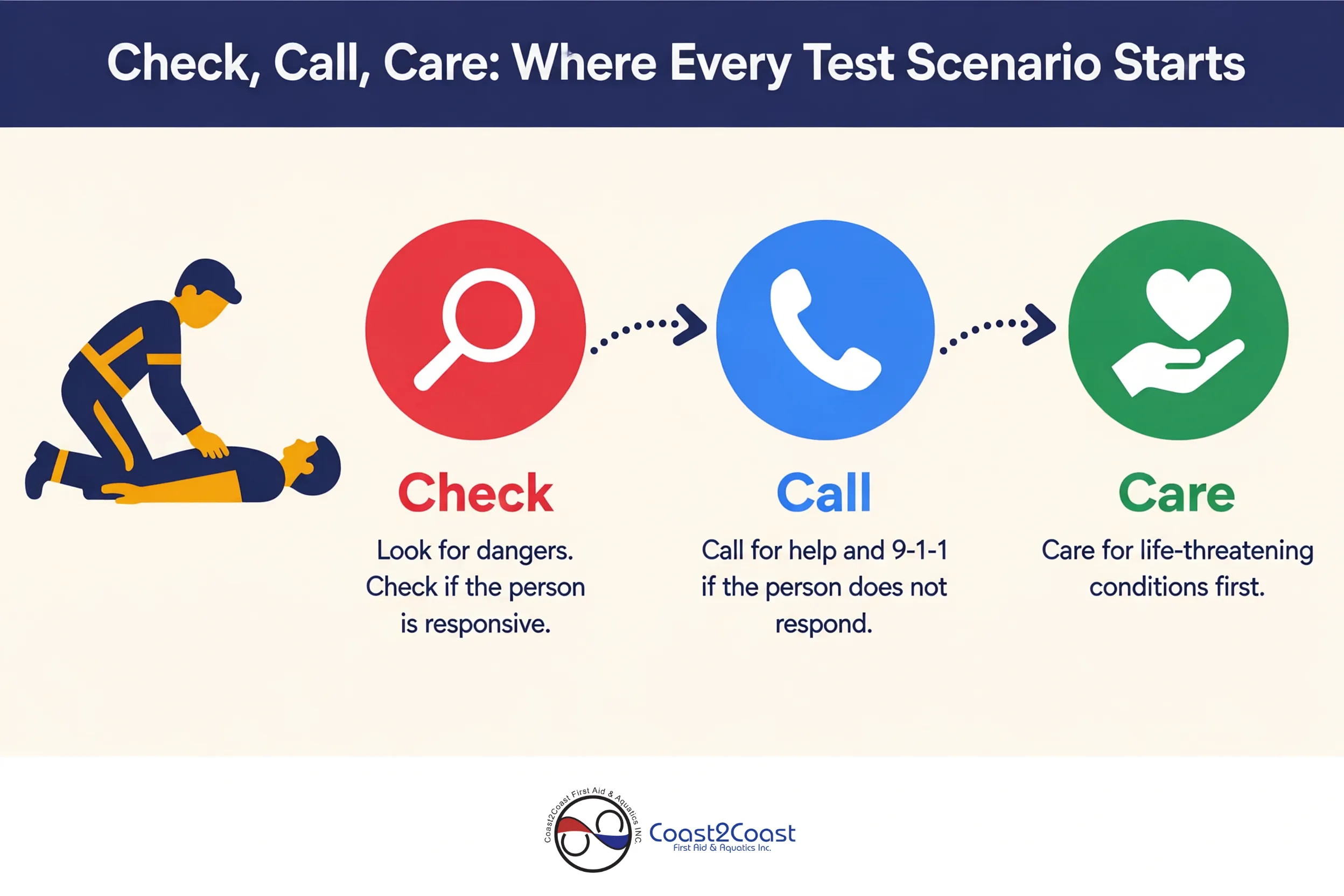
Check, Call, Care: Where Every Test Scenario Starts
The first thing to do in a first aid emergency is to check the scene. The Canadian Red Cross teaches you to stay calm, look for dangers and never risk your own safety. Every Canadian Red Cross first aid test builds on three steps:
- Check: Look for dangers. Check if the person is responsive.
- Call: Call for help and 9-1-1 if the person does not respond.
- Care: Care for life-threatening conditions first.
Acronyms You Should Know
- FAST: Heart and Stroke’s stroke signs. Face: is it drooping? Arms: can you raise both? Speech: is it slurred or jumbled? Time: to call 9-1-1.
- ABCs: airway, breathing and circulation, checked during Check.
- 30:2: 30 compressions to 2 breaths in each CPR cycle.
Not sure which test you need?
Find the Right Course Level
Answer a few questions to match your job or family needs to a course.
How Do You Pass the First Aid and CPR Exam?
To earn Canadian Red Cross certification, you must meet three requirements:
- Successfully demonstrate skills and critical steps
- Score at least 75% on the written knowledge evaluation
- Attend and take part in 100% of the course
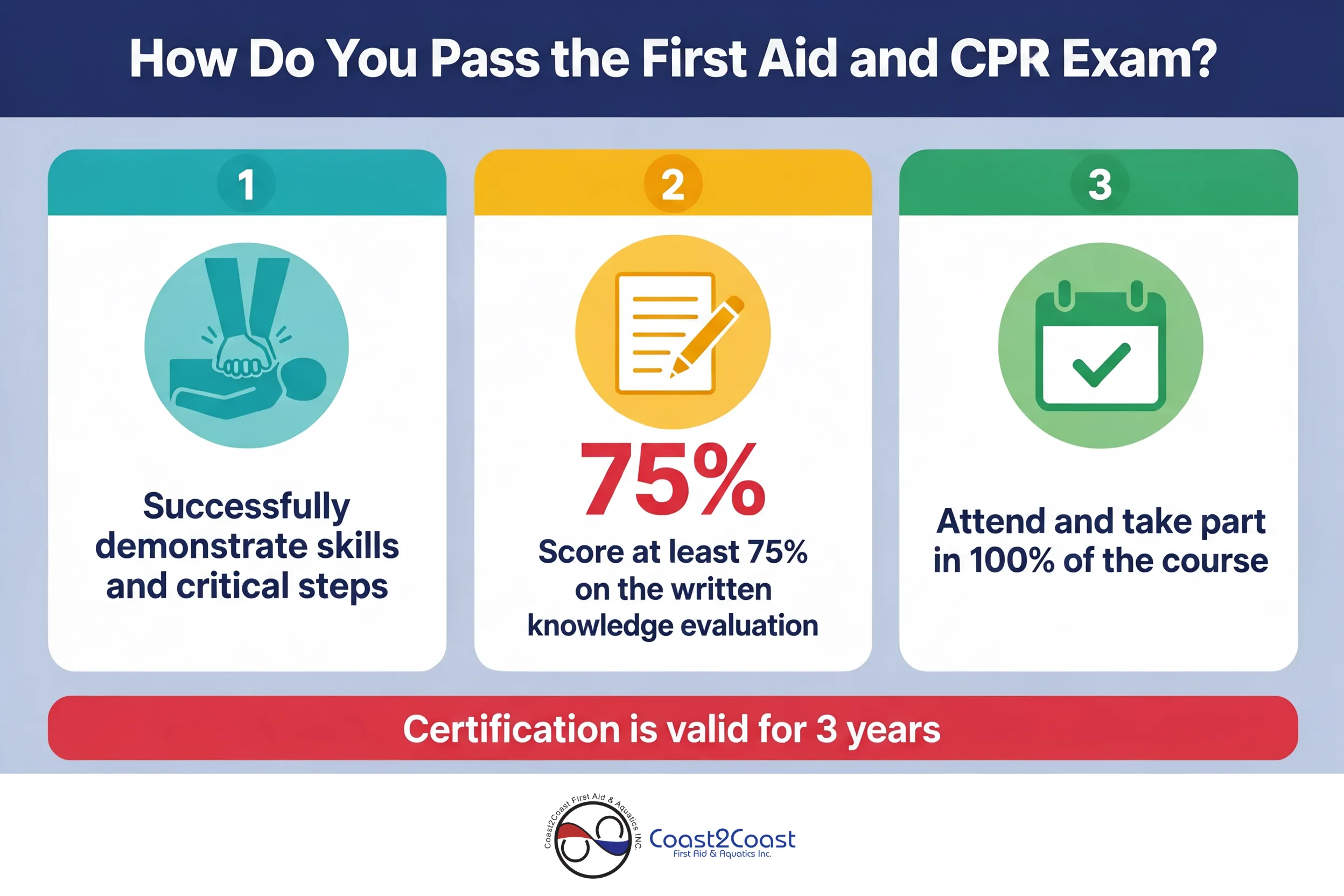
If you score below 75%, your instructor reviews the questions you missed and you can re-test in class. Certification is valid for 3 years.
How Hard Is the CPR Exam?
Most people find the CPR exam manageable. It covers only what your instructor teaches, and you practise every skill before you are tested. Ask questions during practice and review the steps before the written part. Coast2Coast reports a 99.9% pass rate.
Training a team?
Certify Your Whole Team Together
Private group courses bring certified instructors to your workplace or ours.
Did the Canadian Red Cross First Aid Test Change in 2026?
In Ontario, the WSIB updated its First Aid Program on June 22, 2026, in line with CSA Z1210:24. Emergency First Aid is now Basic First Aid, and Standard First Aid is now Intermediate First Aid. Certificates issued up to June 21, 2026 remain valid until they expire, and the WSIB first aid requirements still set the level by shift size.
Before your certificate expires, you can renew it with shorter recertification courses. Coast2Coast teaches the same Canadian Red Cross program at every location, including Toronto and Midtown Toronto.
Key Takeaway
A First Aid and CPR test has two parts: a practical skills test and a written knowledge evaluation with a 75% pass mark. Every scenario starts with Check, Call, Care. Attend the full course, practise every skill and ask questions, and you will be ready for both parts. Certification lasts 3 years.
Questions before you book?
Join 200,000+ Students Certified by Coast2Coast
Not sure which test level you need? Our team can help you choose.
Frequently Asked Questions: First Aid and CPR Test 2026
Q1: What is asked during a First Aid and CPR test?
A: A First Aid and CPR test asks you to show and explain the skills taught in your course. In the practical part, you respond to scenarios using Check, Call, Care, CPR, AED use and choking care. In the written knowledge evaluation, you answer questions on recognizing emergencies and choosing the right care. Canadian Red Cross courses require a mark of at least 75% on the written part.
Q2: How many questions are on the first aid test?
A: The number of questions depends on your course level. Canadian Red Cross course descriptions publish the pass mark, at least 75%, but not a fixed question count. A CPR written test covers fewer topics than an Intermediate First Aid test. Every question comes from material your instructor teaches in class, so attending and taking part in the full course is the best preparation.
Q3: What kind of First Aid and CPR test questions should you expect?
A: Expect First Aid and CPR test questions about the steps you practise in class. Common topics include Check, Call, Care, when to call 9-1-1, recognizing cardiac arrest and stroke, compression depth and rate, the 30:2 ratio and choking care for adults, children and babies. First aid courses add questions on bleeding, wound care and, in Intermediate First Aid, bone, joint and spine injuries.
Q4: Is the CPR test hard?
A: No. Most people find the CPR test manageable because it covers only what the instructor teaches, and you practise each skill on a manikin before you are tested. To certify, you must demonstrate the skills and critical steps, attend the full course and score at least 75% on the written evaluation. Coast2Coast reports a 99.9% pass rate for learners who complete its courses.
Q5: What is the first thing to do in a first aid emergency?
A: The first thing to do in a first aid emergency is to check the scene. The Canadian Red Cross teaches you to stay calm, look for dangers and never risk your own safety. Then check whether the person is responsive and check their airway, breathing and circulation. Call for help and 9-1-1 if the person does not respond, then give care.
Q6: What skills are tested in the practical CPR test?
A: The practical CPR test checks that you can respond to a scenario from start to finish. You show Check, Call, Care, chest compressions and breaths on a manikin, and AED pad placement and use. Choking care is also tested. In CPR Level C, you also demonstrate CPR and choking care on child and baby manikins. You must perform the critical steps of each skill correctly.
Q7: What compression rate and depth should you know for a Canadian Red Cross CPR test?
A: On a Canadian Red Cross CPR test, you show cycles of 30 compressions and 2 breaths. HealthLinkBC guidance for adults is to push at least 5 cm deep at a rate of at least 100 compressions per minute. For children and babies, press down at least one-third of the depth of the chest. Your instructor coaches your rate and depth during practice.
More FAQs: Passing, Retests and Certification
Q8: What happens if you fail the first aid written test?
A: If you score below 75% on the first aid written test, you are not out of options. Under Canadian Red Cross guidance for in-class courses, your instructor reviews the questions you answered incorrectly and you can re-test in class to reach a passing mark. You still need to attend and take part in 100% of the course and demonstrate the required skills to be certified.
Q9: Do you have to attend the whole course to pass?
A: Yes. Canadian Red Cross certification requires you to attend and take part in 100% of the course. Missing part of the class means missing the skills practice and content that the test covers, so you cannot certify. Plan for the full schedule, because published teaching times, such as 14 hours for Intermediate First Aid with CPR Level C, do not include breaks.
Q10: How long is a Canadian Red Cross first aid certificate valid?
A: Canadian Red Cross First Aid and CPR certificates are valid for 3 years. This includes Basic First Aid and Intermediate First Aid with CPR Level A or C, as well as stand-alone CPR Level A or C courses. Before your certificate expires, you can take a shorter recertification course where available. CPR Level A cannot be recertified, so learners at that level take the full course again.
Q11: What is the difference between the standard first aid test and the intermediate first aid test?
A: They are the same course level under a new name. On June 22, 2026, the WSIB updated Ontario’s First Aid Program in line with CSA Z1210:24, and Standard First Aid became Intermediate First Aid. Emergency First Aid became Basic First Aid. Certificates issued up to June 21, 2026 remain valid until they expire, so an older Standard First Aid certificate still counts until its expiry date.
Q12: Can you take a first aid certification test online?
A: No. You can complete part of the theory online in a blended course, but a Canadian Red Cross first aid certification test requires an in-class session where you demonstrate skills such as CPR, AED use and choking care to an instructor. Hands-on practice matters because CPR is a physical skill, and certification requires you to successfully demonstrate skills and critical steps.
Q13: Is the written test the same for CPR and first aid courses?
A: No. A CPR written test focuses on CPR, AED use and choking care for the age groups in your level. A first aid exam adds questions on the other topics in your course, such as wound care and, in Intermediate First Aid, head and spine injuries, sudden medical emergencies and environmental emergencies. The pass mark is the same for both: at least 75%.
Q14: What does FAST stand for in first aid?
A: FAST is the Heart and Stroke memory aid for recognizing a stroke. Face: is it drooping? Arms: can you raise both? Speech: is it slurred or jumbled? Time: to call 9-1-1. Knowing FAST helps you spot a stroke quickly and call 9-1-1 without delay, because a person showing any one of these signs needs emergency help right away.
Q15: What should you do if a choking person becomes unresponsive?
A: Call 9-1-1 and begin CPR, starting with chest compressions. This is the Canadian Red Cross step for adults and children who become unresponsive while choking. Before that point, alternate between any two of back blows, abdominal thrusts and chest thrusts, giving up to 5 of each, until the object comes out or the person begins to breathe or cough.
About the Author and Reviewer
Written and reviewed by Ashkon Pourheidary, B.Sc. (Hons) Neuroscience, co-founder of Coast2Coast First Aid & Aquatics and a First Aid and CPR instructor since 2011 and a Canadian Red Cross Instructor Trainer since 2013. Coast2Coast is a Top 3 Canadian Red Cross Training Partner and has certified more than 200,000 students.
Sources
- Canadian Red Cross, Intermediate/Standard First Aid & CPR course description: topics, 14 hours in-class teaching time (breaks excluded), 75% written knowledge evaluation, 100% attendance, skills and critical steps, 3-year certification
- Canadian Red Cross, Emergency First Aid fact sheet and CPR/AED course description: course content, CPR Level A (adult) and Level C (child and baby), 3-year certification, CPR Level A not recertifiable
- Canadian Red Cross Help Centre, What if I am unable to complete the criteria for certification: in-class re-test after the instructor reviews incorrect answers
- Canadian Red Cross, Check, Call, Care poster and Care for a Choking Adult and Choking Child posters
- Heart and Stroke Foundation of Canada, FAST stroke signs poster
- HealthLinkBC (Government of British Columbia), CPR Basics: compression rate, depth and 30:2 ratio
- Workplace Safety and Insurance Board (WSIB), First Aid Program: June 22, 2026 update, CSA Z1210:24, new course names, certificate validity and shift-size requirements