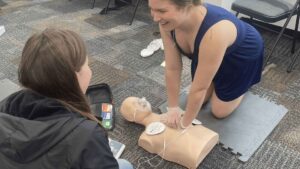

Make Sure Every Shift Has a Trained First Aider
Book on-site first aid and CPR/AED training for your team before the holiday party season, at your workplace or ours.
Book Group TrainingIn This Guide
- Why plan safety into your office Halloween party?
- How do you keep Halloween decorations fire-safe at work?
- How should you handle food and allergies at a work potluck?
- What costume guidelines keep employees safe at work?
- Should you serve alcohol at an office Halloween party?
- Who is your trained first aider during the party?
- What should your office Halloween party safety checklist include?
- How does group first aid training cover every shift?
- Frequently Asked Questions
An office Halloween party is one of the easiest morale boosts of the year. A costume contest, a potluck and a few decorations can bring teams together across departments, and hybrid staff often make a point of coming in for it. It is also one of the few days when a workplace fills up with open-flame candles, dangling decorations, loose costumes, shared food and sometimes alcohol, all at once.
Halloween falls on a Saturday in 2026, so most workplaces will celebrate on Friday, October 30. That is just three weeks after Fire Prevention Week (October 4 to 10), which makes it a good moment to put fire safety habits into practice. This checklist is written for HR managers, office managers, health and safety representatives and joint health and safety committee members who want a fun party without an incident report on Monday.
Why plan safety into your office Halloween party?
Most Halloween workplace incidents are ordinary injuries in an unusual setting: a trip over a costume tail on the stairs, a cut during a pumpkin carving contest, a fall from a chair while hanging streamers, a guest who eats a cookie with nuts they did not know were there. None of these require dramatic planning to prevent. They require someone to walk through the space with a safety mindset a few days before the party.
Planning ahead also protects inclusion. Not everyone celebrates Halloween, for cultural, religious or personal reasons, and a party that feels mandatory can create tension. Clear, friendly guidelines shared in advance let people know what to expect, what to wear and how to take part, or not, without awkwardness.
A good rule of thumb: assign one organizer to fun and one to safety. The safety lead checks decorations, food, costumes and first aid readiness, and is the person staff go to if something goes wrong.
Train Your Whole Team for Every Shift
Workplace first aid programs built around your team size, hazards and schedule, delivered at your site or ours.
Explore Workplace TrainingHow do you keep Halloween decorations fire-safe at work?
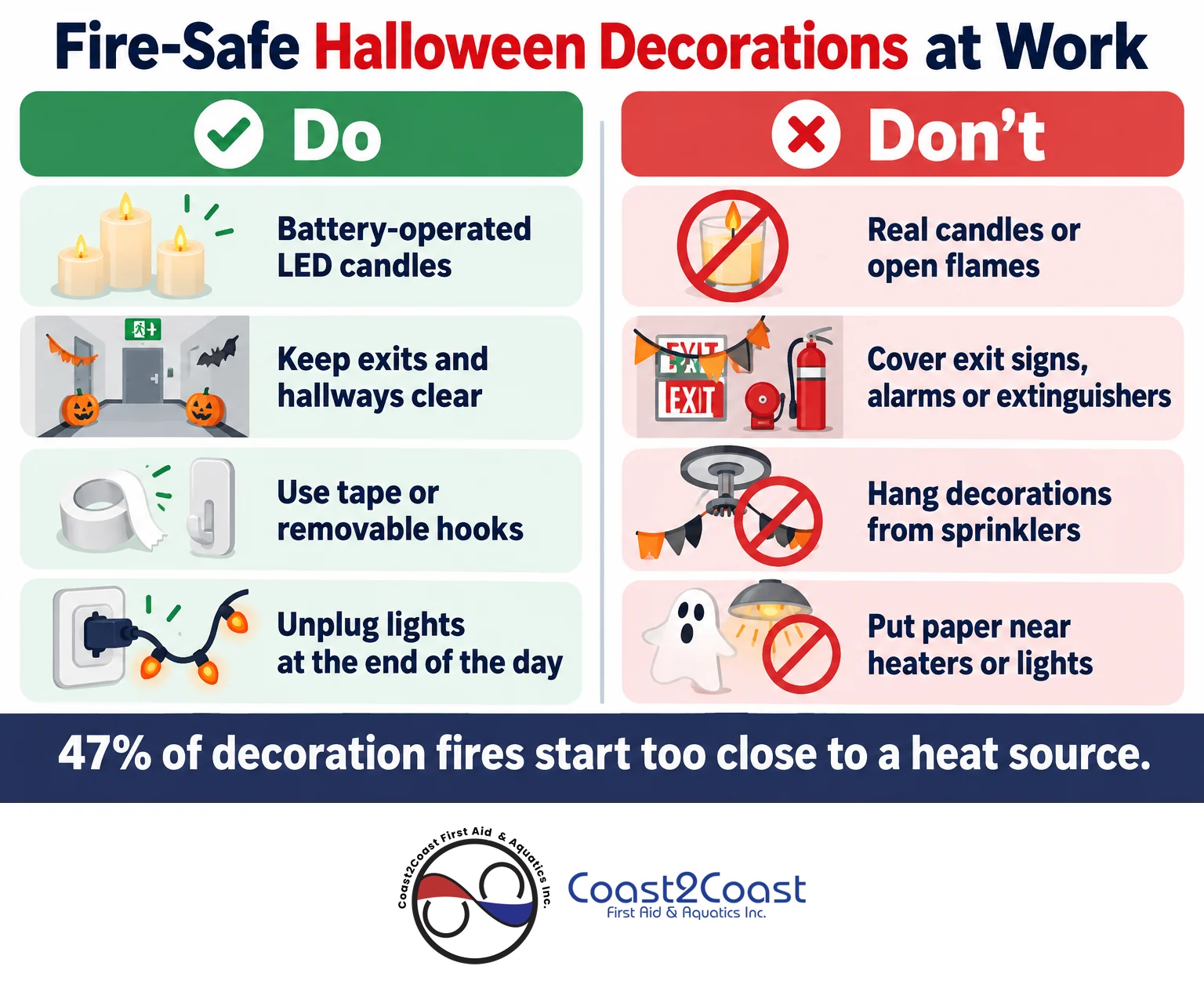
The National Fire Protection Association (NFPA) reports that decorations are the first item to ignite in an estimated 835 home fires each year. Nearly half of those fires happen because a decoration was too close to a heat source, and about one-third start with candles. Workplaces face the same risks, plus sprinkler systems, fire exits and electrical loads that decorations can interfere with.
Use battery-operated candles, not open flames
Swap every real candle, including inside jack-o’-lanterns, for battery-operated LED candles or string lights. Flameless options look almost identical in a dim room and remove the single biggest decoration fire risk. If your party includes a pumpkin carving contest, consider pumpkin painting or decorating instead, which avoids both flames and knife cuts.
Keep exits, extinguishers and fire equipment clear
- Keep hallways, stairwells and exit doors completely clear of props, hay bales and seating.
- Never cover exit signs, fire alarm pull stations, smoke detectors or fire extinguishers.
- Do not hang anything from sprinkler heads or pipes, since it can damage the head or block the spray.
- Keep dried decorations such as corn stalks, hay and crepe paper away from exits and heat.
Keep decorations off heaters, lights and outlets
Keep paper, fabric and fake cobwebs away from space heaters, halogen lamps, light fixtures and computer vents. Plug decorative lights directly into a wall outlet or an approved power bar, avoid daisy-chaining extension cords, and turn everything off at the end of the day. Use tape or removable adhesive hooks instead of push pins, and use a proper step ladder, not a rolling office chair, when hanging decorations up high.
Charge light-up costumes and decorations safely
The theme of Fire Prevention Week 2026 is safe charging of lithium-ion batteries, which power many light-up costumes, props and wireless decorations. Use only the charger that came with the device, charge on a hard surface away from costumes and paper, unplug once fully charged, and stop using any battery that is swollen, hot or smells unusual.
Think twice about fog machines, dry ice and strobe lights
Fog machines can set off smoke detectors and create slippery floors. Dry ice is extremely cold (−78.5°C) and can burn skin on contact, and it releases carbon dioxide gas that can build up in small, poorly ventilated rooms. Never put dry ice directly in drinks. Strobe and flashing lights can trigger seizures in people with photosensitive epilepsy, so skip them or post a warning at the entrance.
How should you handle food and allergies at a work potluck?
Potlucks are one of the best parts of an office party, and one of the most common sources of allergic reactions at work. Colleagues may not know about each other’s allergies, dishes arrive from home kitchens without ingredient lists, and Halloween candy often contains peanuts, tree nuts, milk, egg, soy, wheat or sesame.
Ask about allergies before the menu is set
Include a simple line in the party invitation: “Please let the organizers know about any food allergies so we can plan safely.” Keep responses private and share only what the person agrees to share. If a colleague has a severe allergy, ask whether they would prefer a nut-free or allergen-free event, and where they keep their epinephrine.
Label every dish and keep nut-free options separate
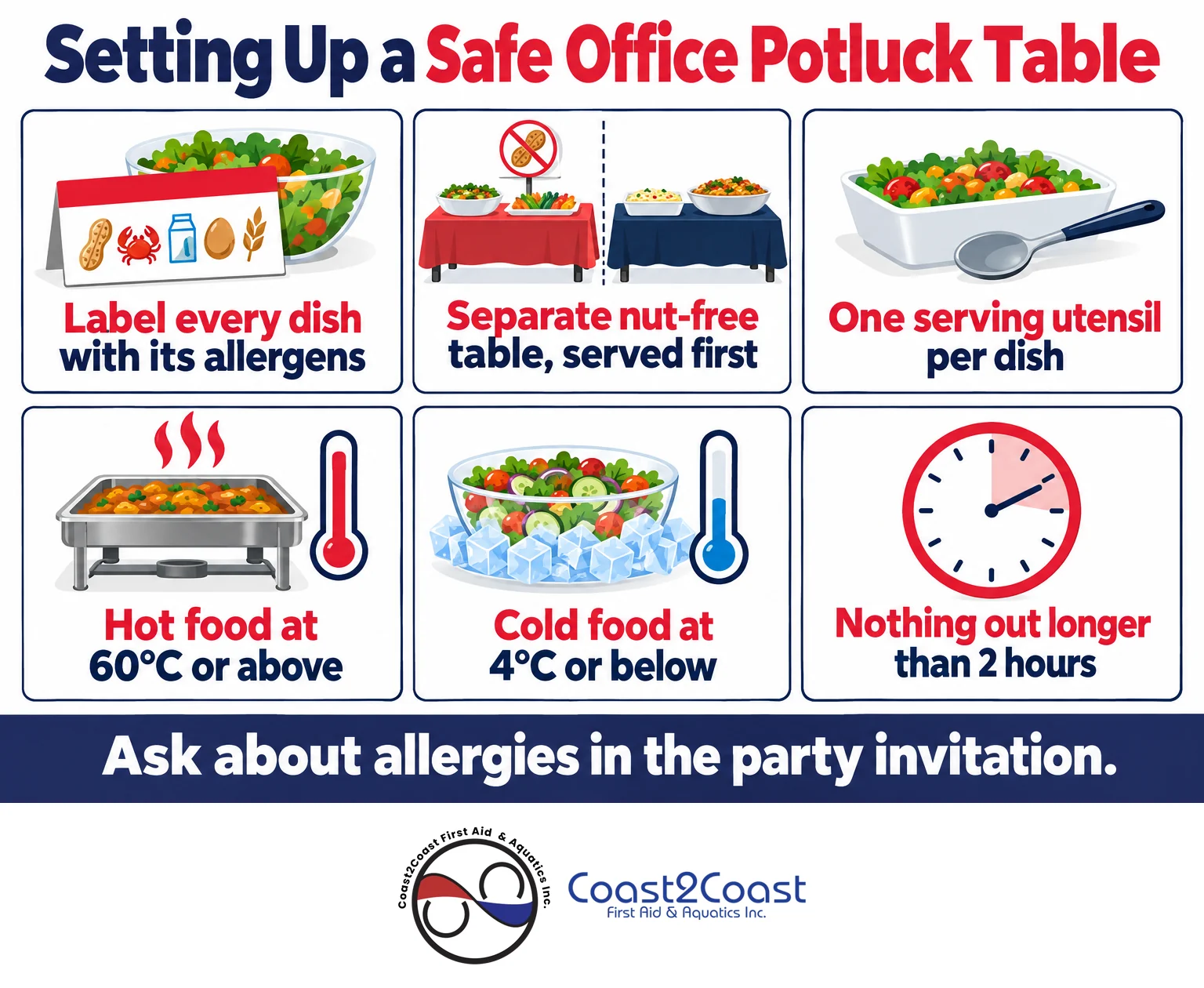
- Ask everyone who brings a dish to fill in a label card with the dish name and its priority allergens, such as “Contains: peanut, milk, wheat.”
- Keep packaging from store-bought items so labels can be checked.
- Set up a separate, clearly marked table for nut-free or allergen-free dishes, and serve it first.
- Give every dish its own serving utensil.
- Wash hands with soap and water after handling nuts or other allergens, since hand sanitizer does not remove food proteins.
For guidance on recognizing a reaction and giving epinephrine, see our guide to food allergies at Thanksgiving and holiday gatherings, which covers the same steps for any shared meal.
Keep hot foods hot and cold foods cold
Health Canada advises throwing out perishable food that has been left at room temperature for more than two hours. Keep hot dishes at or above 60°C in slow cookers or chafing dishes, and cold dishes at or below 4°C on ice or in the office fridge. Put out fresh platters rather than topping up old ones, and send leftovers home in sealed, labelled containers.
Learn These Skills in a Real Classroom
Practise choking relief, epinephrine auto-injector use, bleeding control and CPR with an AED in our Intermediate (Standard) First Aid & CPR/AED course.
View First Aid CoursesWhat costume guidelines keep employees safe at work?
Costumes are the highlight of most office Halloween parties, and a few simple guidelines, shared at least a week ahead, keep them safe and respectful.
Avoid trip hazards and loose costume pieces
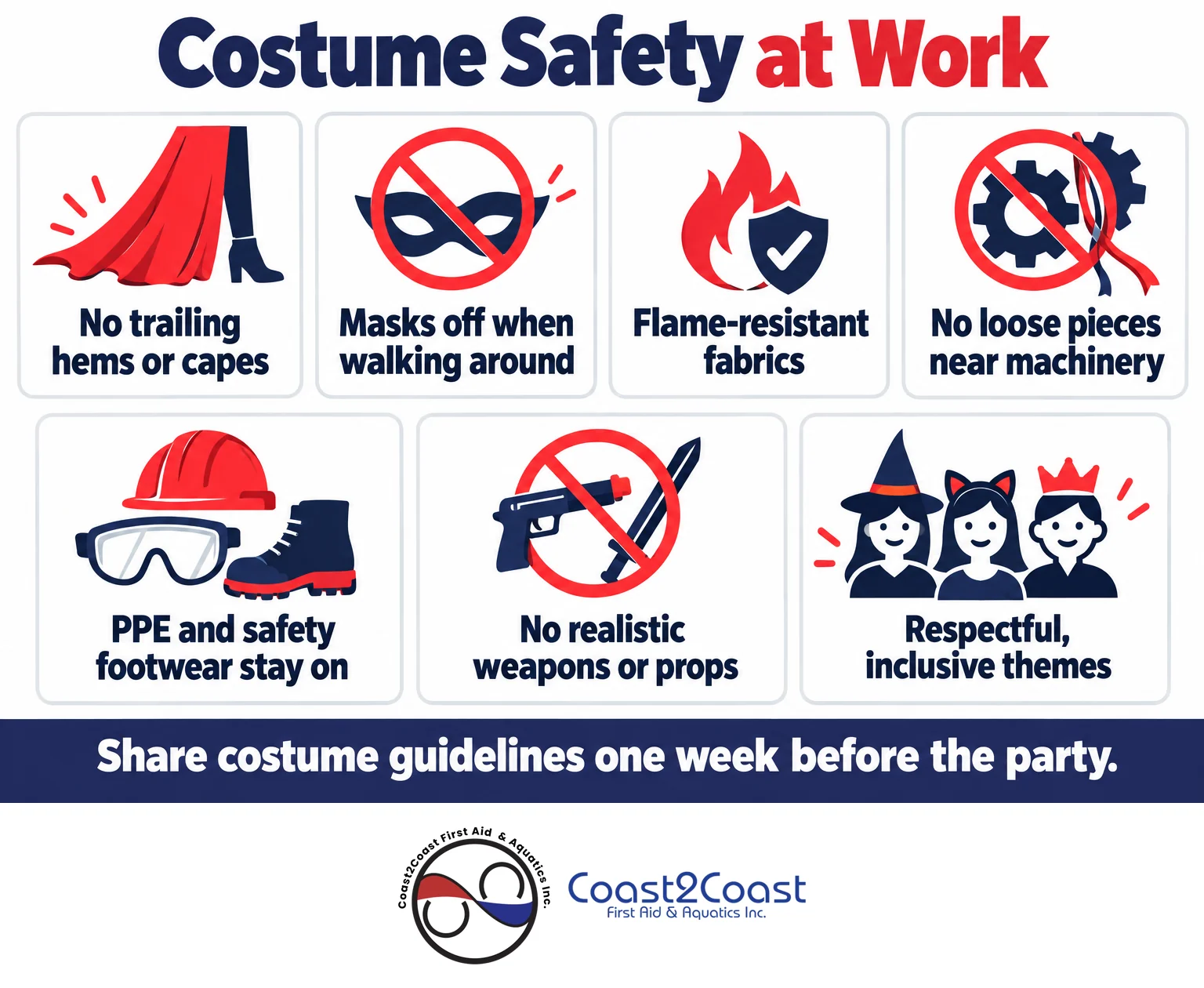
Long capes, trailing hems, tails and oversized shoes cause trips, especially on stairs and in crowded rooms. Encourage costumes that end above the ankle and footwear employees can walk in normally. In warehouses, kitchens, labs, manufacturing and other settings with machinery, loose fabric, dangling accessories and jewellery can get caught in equipment. In these workplaces, costumes should never replace required personal protective equipment (PPE) or safety footwear, and it may be safest to limit costumes to the party area only.
Watch for masks that block vision
Full-face masks limit peripheral vision and make it harder to see steps, doors and people. Encourage face paint or masks that are removed when moving through the building. Many workplaces also ask employees not to wear masks that fully hide their identity, which helps security, reception and customer-facing staff.
Choose flame-resistant fabrics and skip realistic props
Costumes near candles, heaters or light fixtures should be made of flame-resistant material. Leave realistic-looking weapons, even toy ones, at home, since they can alarm visitors, customers and security staff.
Keep costumes inclusive and professional
Ask employees to avoid costumes that stereotype or mock a culture, religion, race, gender or disability, as well as sexually suggestive or political costumes. These can breach workplace harassment and human rights policies and leave colleagues feeling unwelcome. Suggest inclusive themes instead, such as movie characters, book characters, puns or a team costume. Make costumes optional, and give people who do not celebrate an easy way to take part, such as judging the contest or joining a trivia game.
Think about customer-facing staff
If employees work with customers, clients or patients, decide in advance whether costumes are appropriate at the front desk, on sales calls or in clinical areas. A simple option is to allow a themed accessory, such as Halloween ears or a festive shirt, for customer-facing roles, and save full costumes for the party itself.
Keep scares and pranks friendly
Jump scares, hidden props and pranks can cause falls, spilled hot drinks and real distress, especially for colleagues with anxiety, heart conditions or past trauma. Ask staff to skip pranks entirely, keep “haunted” decorations in a clearly marked area people can choose to enter, and never block doorways or stairs with props designed to startle.
Should you serve alcohol at an office Halloween party?
Many workplaces choose an alcohol-free Halloween party, especially when it is held during work hours. If you do serve alcohol:
- Serve food alongside drinks and offer good non-alcoholic options.
- Use drink tickets or a set end time for service, and consider a licensed bartender.
- Never serve alcohol in areas with machinery, vehicles or active work.
- Arrange safe rides home, such as taxi vouchers or a designated driver program.
- Remind staff that workplace conduct and harassment policies apply at every work event.
Alcohol also makes allergic reactions harder to recognize and can make them more severe, which is another reason to keep food labelled and a first aider available.
Who is your trained first aider during the party?
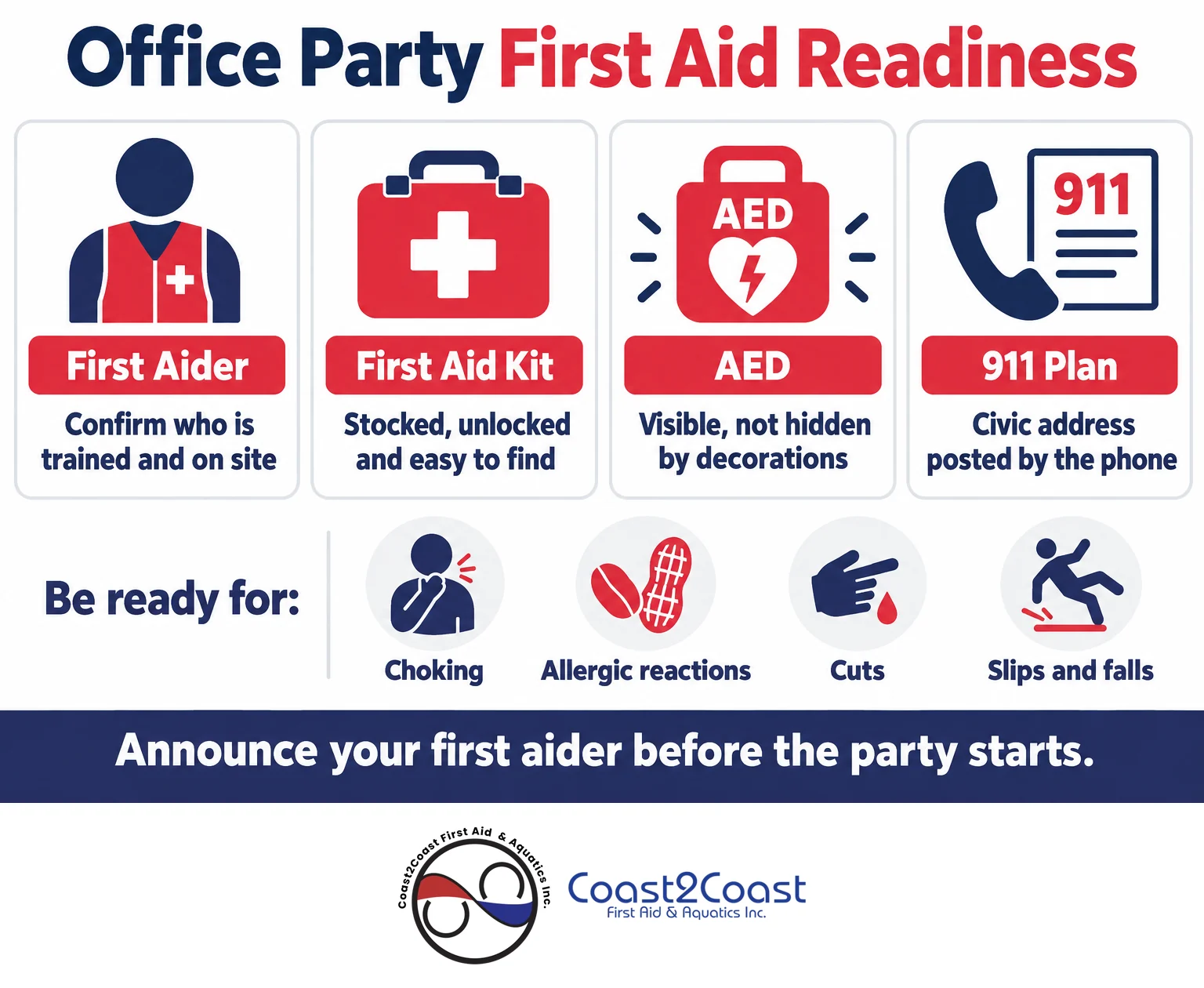
Every party checklist should answer one question before the doors open: if someone chokes, collapses, has an allergic reaction or cuts a hand, who responds first, and do they know where the equipment is?
Know who is trained on shift
In Ontario, Regulation 1101 under the Workplace Safety and Insurance Act requires employers covered by WSIB to have a first aid station with a trained first aider in charge on every shift, with the training level set by the number of workers on that shift. Alberta’s OHS Code (Part 11) sets first aid requirements based on the number of workers, hazard level and distance to medical care. A party can change who is in the building, so check that your trained first aiders are actually attending, not off-site or working from home. Our guide to WSIB first aid requirements in 2026 explains which training level each workplace size needs.
Know where the first aid kit and AED are
Before the party, confirm that the first aid kit is stocked and unlocked, and that the automated external defibrillator (AED) is visible and not hidden behind decorations or party tables. Tell staff where both are during your party announcement, and post the building’s civic address near the phone so anyone can give it to a 911 dispatcher.
Be ready for choking, allergic reactions and cuts
The most likely party emergencies are choking on food or candy, allergic reactions from shared dishes, cuts from carving knives or broken decorations, and slips or falls. A trained first aider should be ready to:
- Recognize the signs of choking and give back blows and abdominal thrusts.
- Recognize anaphylaxis, help give epinephrine and call 911.
- Control bleeding with direct pressure.
- Start CPR and use an AED if someone collapses and is not breathing normally.
If families or children are invited, remember that hard candy, popcorn, whole grapes and nuts are choking hazards for young children. Keep them out of reach of toddlers.
What should your office Halloween party safety checklist include?
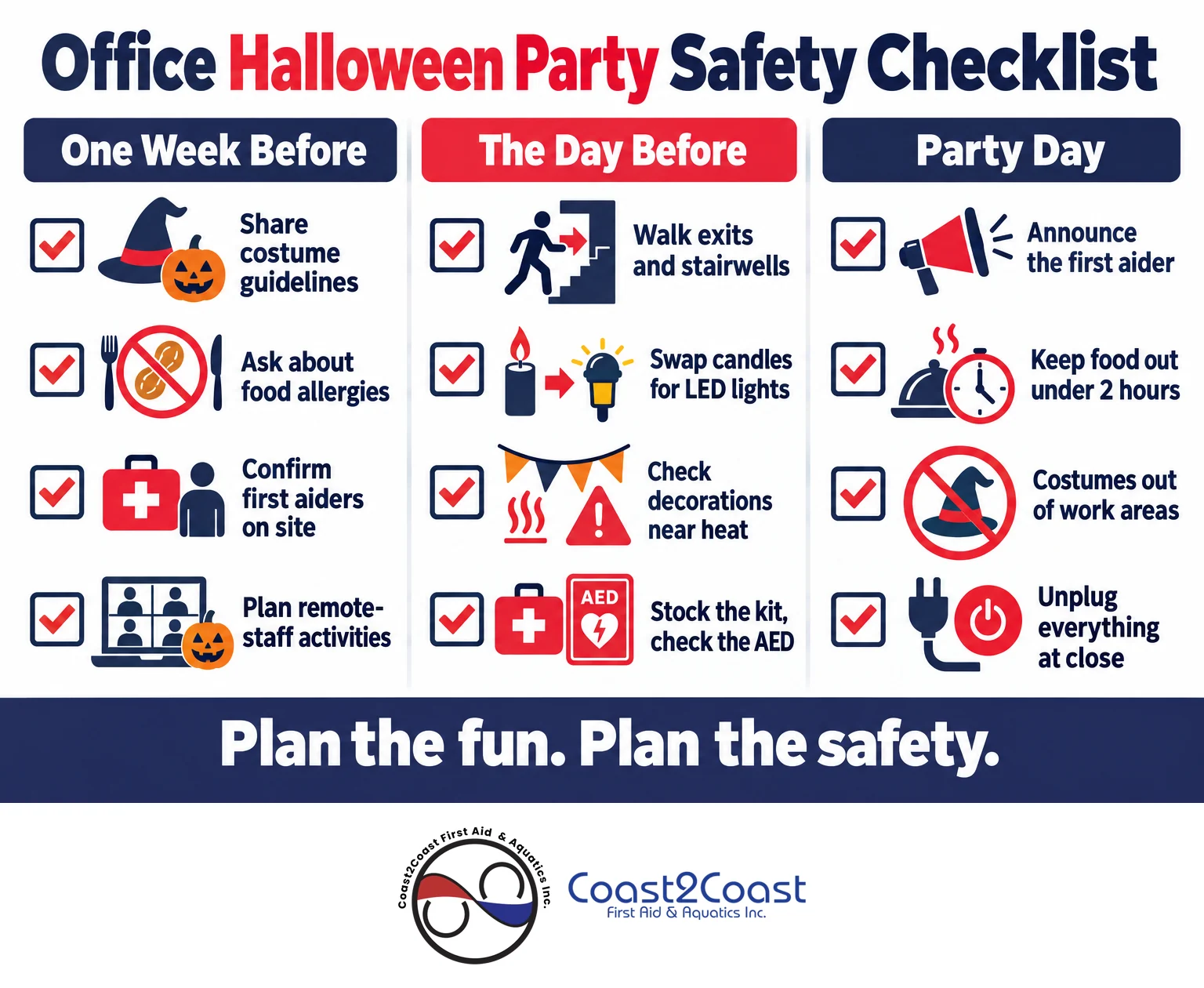
Use this checklist in the week before your party. Print it, share it with your health and safety representative, and tick each item off.
One week before
- Share the date, theme and costume guidelines, and make participation optional.
- Ask about food allergies and dietary needs in the invitation.
- Confirm which trained first aiders will be on site during the party.
- Plan activities for remote and hybrid staff, such as a virtual costume contest or trivia.
- Decide whether alcohol will be served, and if so, how rides home will work.
The day before
- Walk the space: exits, stairwells and hallways clear, fire equipment visible.
- Replace real candles with battery-operated lights.
- Check that decorations are away from heaters, lights and outlets, and nothing hangs from sprinklers.
- Stock and unlock the first aid kit, and check that the AED is visible and ready.
- Prepare allergen label cards, serving utensils and a separate allergen-free table.
On party day
- Announce who the first aider is and where the first aid kit and AED are.
- Keep hot food hot, cold food cold, and nothing out for more than two hours.
- Keep costumes and props out of machinery and work areas.
- Turn off and unplug decorations and chargers at the end of the day.
How does group first aid training cover every shift?
Parties, busy seasons and staff turnover all expose the same gap: the one trained person is not always in the building. Training several people on each team, across shifts, departments and floors, means someone ready to respond is always nearby.
A private group class brings a certified instructor to your workplace, or books a session at one of our training locations, so your team trains together on your schedule. Canadian Red Cross first aid courses, including Basic (Emergency) and Intermediate (Standard) First Aid & CPR/AED, cover choking, severe allergic reactions and epinephrine, bleeding control, CPR and AED use. Ontario employers can choose WSIB-approved first aid and CPR training to meet Regulation 1101, and organizations across Canada can use our workplace first aid training programs to build coverage for every shift. Teams that only need resuscitation skills can take a standalone CPR/AED course.
Key Takeaway
A safe office Halloween party needs flameless decorations kept clear of exits, heaters and sprinklers, costume guidelines that prevent trips and blocked vision, a potluck with every dish labelled for allergens and nothing left out longer than two hours, and optional participation. Before the party starts, confirm who your trained first aider is, and tell everyone where the first aid kit and AED are kept.
Join 200,000+ Canadians Who Are Certified
Canadian Red Cross first aid and CPR training with a 99.9% pass rate and digital certificates within 48 hours.
Find a Course LocationFrequently Asked Questions: Office Halloween Party Safety 2026
Q1: What should be on an office Halloween party safety checklist?
A: An office Halloween party safety checklist should cover five areas. Decorations should be flameless and kept clear of exits, heaters, outlets and sprinklers. Costume guidelines should prevent trip hazards, vision-blocking masks and offensive themes. Food should be labelled for allergens and kept at safe temperatures. Alcohol, if served, should come with limits and rides home. First aid readiness means a trained first aider on site and a stocked first aid kit and AED everyone can find.
Q2: What are 5 Halloween safety tips for the workplace?
A: Five key Halloween safety tips for the workplace are: use battery-operated candles instead of open flames; keep exits, stairwells, fire alarms and extinguishers clear of decorations; set costume guidelines that avoid trip hazards, full-face masks and loose pieces near machinery; label every potluck dish with its allergens and keep nut-free food separate; and confirm a trained first aider is on site, with a stocked first aid kit and an AED that everyone knows how to find.
Q3: Can you use real candles at an office Halloween party?
A: It is best not to. Candles start about one-third of home decoration fires, according to the National Fire Protection Association, and an office full of paper decorations, costumes and people increases the risk. Battery-operated LED candles and string lights look almost identical in a dim room, including inside jack-o’-lanterns, and remove the flame completely. Many building managers and fire safety plans do not allow open flames in offices at all, so check your building’s rules before planning decorations.
Q4: Where should Halloween decorations not be placed at work?
A: Halloween decorations should never block exit doors, stairwells or hallways, and should never cover exit signs, fire alarm pull stations, smoke detectors or fire extinguishers. Do not hang anything from sprinkler heads or pipes. Keep paper, fabric, hay and fake cobwebs away from space heaters, light fixtures, outlets and computer vents. Use tape or removable hooks instead of push pins, and use a proper step ladder rather than a chair when decorating high areas.
Q5: Should employees be required to wear costumes or attend the Halloween party?
A: No. Halloween participation works best when it is optional. Some employees do not celebrate Halloween for cultural, religious or personal reasons, and others simply prefer not to dress up. Make it clear in the invitation that costumes and attendance are voluntary, and offer other ways to join in, such as judging the costume contest, playing trivia or enjoying the food. An optional approach keeps the party inclusive and avoids putting pressure on anyone.
Q6: What costumes are inappropriate for a workplace Halloween party?
A: Costumes that stereotype or mock a culture, religion, race, gender identity or disability are inappropriate at work, as are sexually suggestive costumes, political costumes and realistic-looking weapons. These can breach workplace harassment and human rights policies and make colleagues feel unwelcome. For safety, avoid long trailing costumes, full-face masks that block vision and loose pieces near machinery. Suggest inclusive themes instead, such as movie characters, book characters, puns or a group costume.
Q7: Is it safe to use dry ice or a fog machine at an office party?
A: Use them with caution, or not at all. Dry ice is about −78.5°C and can burn skin on contact, and it releases carbon dioxide gas that can build up in small, poorly ventilated rooms. Never put dry ice directly into drinks. Fog machines can set off smoke detectors and leave floors slippery. If you use either, keep the room well ventilated, handle dry ice with gloves or tongs, and check with building management first.
More FAQs: Food, Alcohol and First Aid
Q8: How do you handle food allergies at an office potluck?
A: Ask about food allergies in the party invitation and keep responses private. Ask everyone who brings a dish to label it with its name and priority allergens, such as peanut, tree nuts, milk, egg, wheat, soy or sesame, and keep packaging from store-bought items. Set up a separate, clearly marked nut-free or allergen-free table and serve it first. Give every dish its own serving spoon, and make sure colleagues with severe allergies know where their epinephrine is.
Q9: How long can potluck food sit out at a work party?
A: Health Canada advises throwing out perishable food that has been at room temperature for more than two hours. Keep hot foods at or above 60°C using slow cookers, warming trays or chafing dishes, and keep cold foods at or below 4°C on ice or in the fridge. Put out fresh platters instead of topping up old ones, and store leftovers in sealed, labelled containers. Following these steps helps prevent foodborne illness at office potlucks.
Q10: Should you serve alcohol at an office Halloween party?
A: Many workplaces choose an alcohol-free party, especially during work hours. If you serve alcohol, offer food and non-alcoholic drinks, limit service with drink tickets or a set end time, and consider a licensed bartender. Never serve alcohol near machinery, vehicles or active work areas. Arrange safe rides home, such as taxi vouchers or designated drivers, and remind staff that workplace conduct and harassment policies apply at all company events.
Q11: Do you need a first aider at an office party?
A: Yes. It is a good idea to confirm that at least one trained first aider will be at the party, even if your workplace has one on staff, because the usual first aider may be off-site or working from home that day. In Ontario, Regulation 1101 requires WSIB-covered employers to have a trained first aider in charge of the first aid station on every shift. Tell everyone who the first aider is and where the kit and AED are.
Q12: What are the most common first aid emergencies at a Halloween party?
A: The most common first aid emergencies at a Halloween party are choking on food or candy, allergic reactions to shared dishes or treats, cuts from pumpkin carving or broken decorations, and slips, trips and falls caused by costumes, dim lighting or cluttered floors. Burns from candles and injuries from falls while decorating are also possible. A trained first aider should know how to relieve choking, respond to anaphylaxis, control bleeding and start CPR with an AED.
Q13: What should you do if someone chokes at an office party?
A: If an adult is coughing forcefully, encourage them to keep coughing. If they cannot cough, speak or breathe, call 911 or have someone call, then give a combination of firm back blows between the shoulder blades and abdominal thrusts until the object comes out or the person becomes unresponsive. If they become unresponsive, start CPR and use an AED if available. First aid training lets you practise these steps on a manikin before an emergency.
Q14: Are light-up costumes and battery decorations a fire risk?
A: They can be if they are charged or used carelessly. Many light-up costumes, props and decorations use lithium-ion batteries, which are the focus of Fire Prevention Week 2026. Use only the charger that came with the device, charge on a hard surface away from paper and fabric, unplug once fully charged and do not leave items charging unattended. Stop using any battery that is swollen, hot, leaking or giving off an unusual smell.
Q15: How can employers include remote workers in Halloween celebrations?
A: Employers can include remote and hybrid workers with a virtual costume contest, Halloween-themed video call backgrounds, online trivia, a pumpkin decorating photo challenge or a team playlist. Schedule virtual activities at a time that works across locations, and mail small treats or gift cards in advance where possible. Including remote staff keeps the celebration fair for everyone and helps teams that rarely meet in person connect during the holiday season.
Reviewed & Sourced
Written by Godwin Orilua. Reviewed by the Coast2Coast First Aid & Aquatics Instructor Team, a Canadian Red Cross Training Partner. Last updated October 16, 2026.
Sources: WSIB, First Aid Program and Regulation 1101 First Aid Requirements; Alberta Occupational Health and Safety Code, Part 11: First Aid; National Fire Protection Association, Halloween decoration fire statistics (2018 to 2022) and Fire Prevention Week 2026; Health Canada, Holiday Food Safety; Compressed Gas Association, Dry Ice Safety.