Why Everyone Should Have First Aid Training

First aid training might not be your top priority, but consider that everyone should have the skills to assist others calmly in an emergency. All types of medical emergencies and accidents can happen in the home, workplace, school, and public places, and first aid training prepares you to provide the right treatment, call for help, and even save a life.

Besides helping to save lives, when a patient gets adequate help, their recovery time decreases, and for many patients, it can even save them from permanent or partial disability. Furthermore, when someone has First Aid training, they have the confidence to react in time, collect the right information, and help relieve the person’s discomfort until professional responders arrive to take over.

Who Needs First Aid Training?

We all know that some people need First Aid Certification for their professions, studies, or workplace safety requirements.

However, this does not mean that children, adolescents, and even older people who don’t require the certification should not know how to react in an emergency.

From the moment children attend school, they are ready to learn several things concerning safety, understanding an emergency, calling for help, locating first aid kits, and saving a life.

Therefore, from Grade One onwards, children can quickly progress through all levels of First Aid training until they can competently apply their knowledge in any situation and get their certification.

Since it’s so easy for children to learn First Aid, there is no reason why people of all age groups, including students and adults, should not know Emergency or Standard First Aid.

Inquire about First Aid & CPR Training Course

Certify for First Aid training  learn skills that increase their confidence and willingness to respond to others in a crisis as you complete the course with us. Call our toll-free number to know more.

At What Age Can You Take First Aid Training?

Nobody is too young or too old to learn First Aid. Adults can learn the training in just a few hours, whereas children and teens require more time.

Children are ready to start learning the most fundamental First Aid skills at around six years. These include learning their home address and telephone number, how to call 911, and identifying the different types of emergencies. In addition, First Aid courses provide safety training and teach children where to find the first aid kits in their homes and schools.

Children can quickly progress to learning about recovery positions and move on to other First Aid skills like stemming bleeding, helping someone who is choking, CPR, and using an AED.

At What Age Can You Take First Aid Training

First Aid Training Courses for all Ages

Very few people survive cardiac arrest because not enough people have the skills to perform the required hands-on CPR that would help them live. First Aid training courses for all ages helps to give people the confidence to eliminate what is known as the “bystander effect.”

However, that is just one of the various First Aid skills taught in First Aid courses. In addition, learning sessions are created to help people at all levels pick up the required knowledge that will equip them to assist others. At Coast2Coast, we offer youth programs to help youngsters acquire lifesaving skills they will use in the future.

First Aid skills can prepare everyone to deal with emergencies. However, these skills can help children to take a more active role in the home, like helping to care for a baby. Moreover, this form of youth training can also help them understand the importance of safety in their environment and when called to help others during an emergency. In addition, the skills they acquire are invaluable if they want to earn extra money by babysitting or within youth organizations and clubs.

Adults usually take Emergency or Standard First Aid courses according to their social and work needs. However, children and adolescents are also very capable of learning both Emergency First Aid and Standard First Aid.

The Importance of First Aid Training

Like adults, learning life-saving skills at a young age benefits children in several ways. First, they learn skills that increase their confidence and willingness to respond to others in a crisis.

First Aid courses allow people of all ages to save a person’s life by performing CPR in a cardiac arrest emergency. Cardiopulmonary resuscitation (CPR) offered immediately provides these patients a better chance of survival.

The younger a person learns First Aid, the better they become at responding to emergencies. Therefore, starting with the basics, beginning from a young age, children can progress to more advanced training as they grow.

These versatile skills build the confidence and communication skills required to give young people leadership qualities. Therefore, the more we encourage young people to work under pressure and adapt to a critical environment, the more we teach them about positive influences and how to create a better world for future generations. 

The Importance Of First Aid Training

Find a Training Center Near You

Coast2Coast has a vast selection of  First Aid and CPR courses to meet your personal or professional needs in Ontario. As a proud partner of the Canadian Red Cross and with WSIB approval, it has never been easier to access First Aid training nearby in the Greater Toronto Area, Western and Eastern Ontario. Act now and equip yourself with the certification that will enable you to support others.

Register for a First Aid & CPR Training Course

Choose from any of our locations across Ontario and gain the knowledge and skills to save a life!

How Does Mental Health Affect the Health of Your Heart?

A woman sitting on a bed with her eyes closed and a pained expression, holding her hand to her chest. She is wearing a light gray blouse. The background includes a wooden headboard and a blurred lamp.

Mental health remains a vital component of your complete well-being, including the health of your heart. The facade of happiness during the holiday season often masks the challenging emotions that come with celebrations. In fact, 52% of Canadians report increased levels of anxiety, depression and isolation during the holiday season. The holidays may intensify negative emotions if you already experience depression or anxiety.

Continue reading

5 Must Knows of First Aid and CPR Training

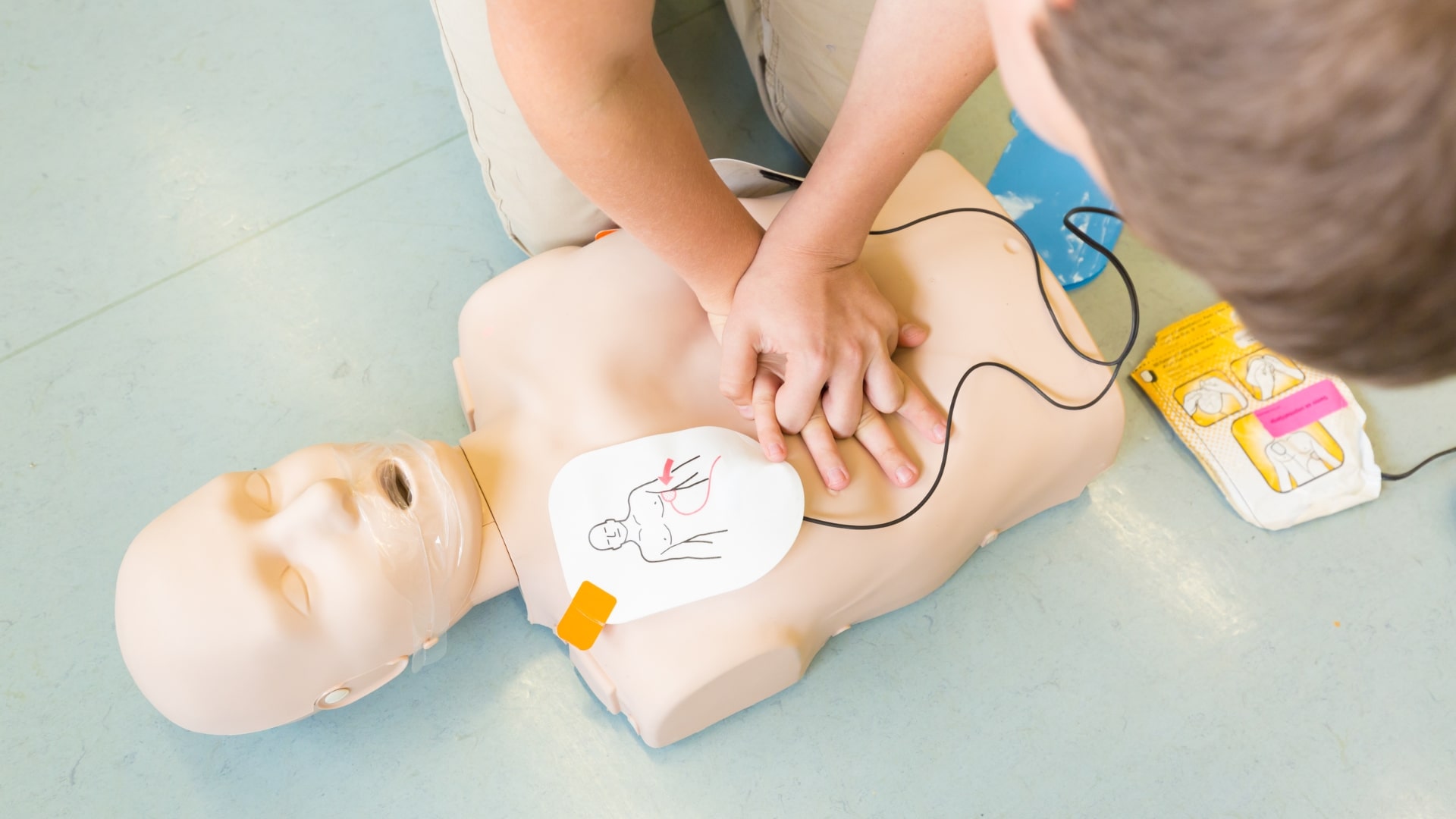
The image shows a person practicing CPR on a training mannequin. They are performing chest compressions while an automated external defibrillator (AED) is attached to the mannequin.

The term, “First Aid” refers to the emergency care given to a person who has been injured or has suddenly taken ill. This early response decreases their chances of developing future disabilities and limits the damage done by their current injury or illness.

Continue reading

CPR on a Child vs Adult: How Does It Differ?

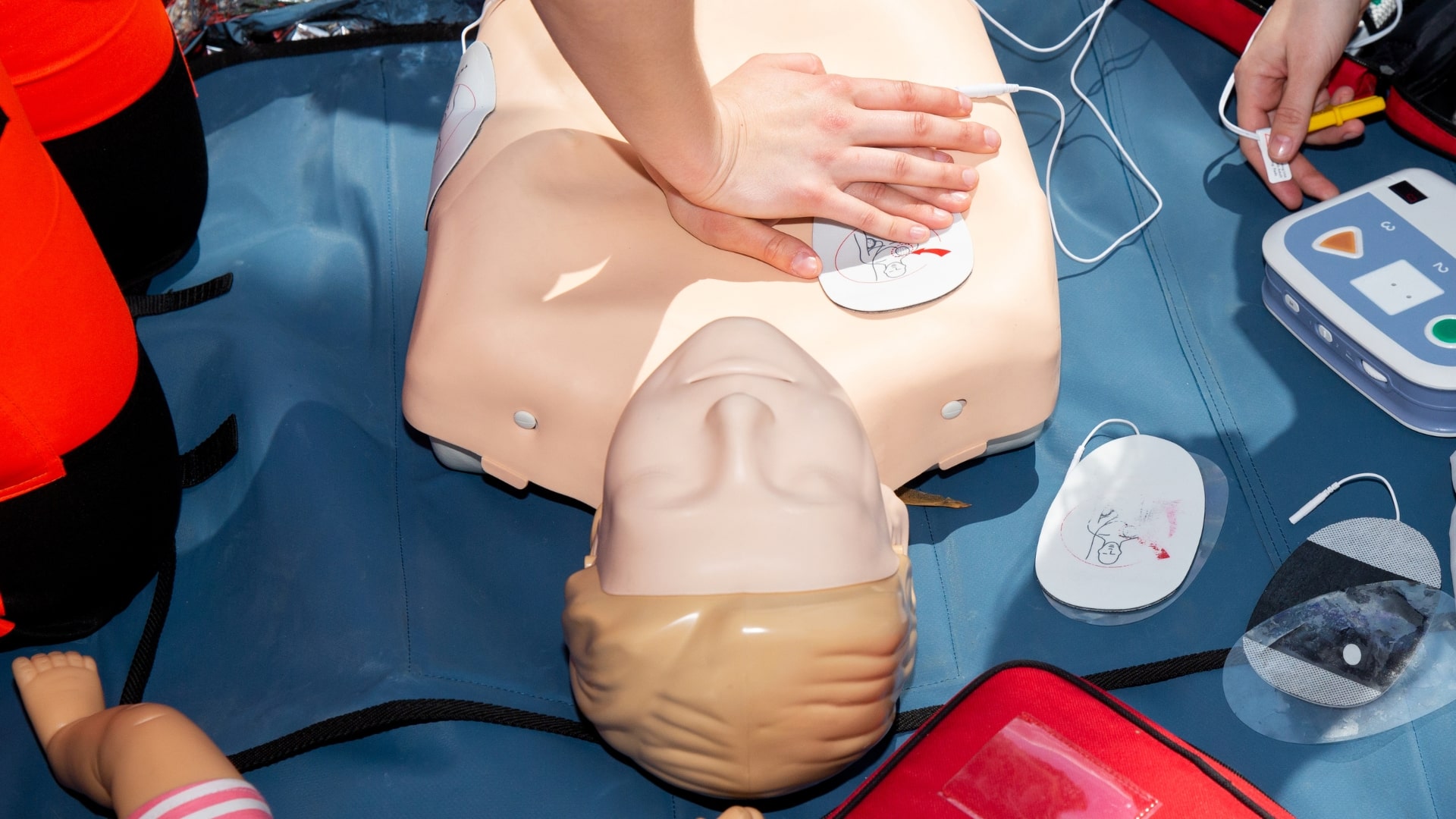
A person practices CPR on a medical training dummy. The person's hands are placed on the chest of the dummy, which is equipped with defibrillator pads. Various CPR and first aid equipment are visible around the scene.

While learning CPR may feel intimidating at first, it is a crucial skill to have in case you ever find yourself in a medical emergency situation.

Although CPR training is essential, it’s just as crucial that it is performed correctly. The key to effective CPR training is learning how to tailor the procedure according to the age of the patient.

Knowing CPR is not only a necessity for parents and caregivers, but anyone who spends time around children regularly.

CPR for adults and children may share some similarities, but some significant differences exist, especially when performing it on younger children and infants. The correct CPR training considers age group differences, preparing you to take action in a medical emergency.

What is Adult CPR?

Cardiopulmonary resuscitation (CPR) combines 30 rhythmic chest compressions and two rescue breaths used as an emergency lifesaving procedure in patients with no heartbeat. During CPR, the rescuer uses both hands to compress the chest center at a depth of two inches at a rate of 100 to 120 compressions per minute, a procedure that helps stimulate the heart physically. They then give rescue breaths using the correct quantity of air to raise the patient’s chest.

Adult CPR Example

Imagine witnessing an adult suddenly collapse in a park. You check for responsiveness—no response. You call for emergency help and position the person on their back. Starting chest compressions, you place your hands interlocked in the center of the chest, pressing down at least 2 inches deep at a rate of 120 compressions per minute. After 30 chest compressions, you tilt the head back, seal your mouth over theirs, and deliver two rescue breaths, watching for chest rise. You continue this cycle until help arrives.

Learn about First Aid & CPR/AED Course you might need

Certify for First Aid & CPR/AED training to assist someone with your life-saving skills as you complete the course with us. Call our toll-free number to know more.

What is Infant CPR?

Children have flexible bones, ensuring they don’t get hurt when CPR is required. When performing CPR on an infant, it is crucial to make a complete seal over both the infant’s mouth and nose while administering rescue breaths. However, infants require special care because they are more delicate because of their lighter weight and bone density. Therefore, children and infant CPR teaches you to check for responsiveness and a pulse in different age groups and perform rescue breaths and chest compressions.

Child CPR Example

Now, consider a scenario where a child, about 7 years old, collapses at a family gathering. You ensure the scene is safe and call for emergency assistance. The cardiopulmonary resuscitation process starts with laying the child on a firm surface; you use one hand for chest compressions, pushing down about 2 inches deep at the same rate of 120 compressions per minute. After 30 compressions, you give two rescue breaths, covering both the mouth and nose, ensuring to see the chest rise. You repeat until professional help arrives.

Recognizing Cardiac Arrest

Recognizing cardiac arrest is crucial for performing CPR effectively. Cardiac arrest occurs when the heart suddenly stops beating or fails to beat effectively. Key signs of cardiac arrest include:

  • No breathing or abnormal breathing

  • No pulse or a weak pulse

  • Unresponsiveness

  • Pale or blue-tinged skin

  • Confusion or loss of consciousness

If you suspect someone is experiencing cardiac arrest, it’s vital to call the emergency response system immediately. Once you’ve alerted emergency services, start CPR if you are trained to do so. Quick action can significantly increase the chances of survival.

Checking for Responsiveness in Children and Infants

You can gently shake a young child to see if there is any responsiveness, but you can’t do this with an infant. Since a gentle shake is unsafe for babies, the correct way to check is to tap its foot or speak loudly to see if it responds.

Checking for a Pulse

In young children, you can check for a pulse in the same way that you would for an adult at the carotid artery. However, the best way to check for their pulse in infants is on the inner upper arm, known as the brachial artery.

Giving Rescue Breaths

To perform CPR on an adult, full lung-strength rescue breaths are required for better effectiveness. However, children need gentler puffs, and baby breaths even more so. Filling your cheeks with air usually suffices for infant rescue breaths. You must always ensure that the chest rises and falls during rescue breaths to achieve adequate chest rise.

Additionally, the head is always tilted back gently when performing rescue breaths on a young child or infant.

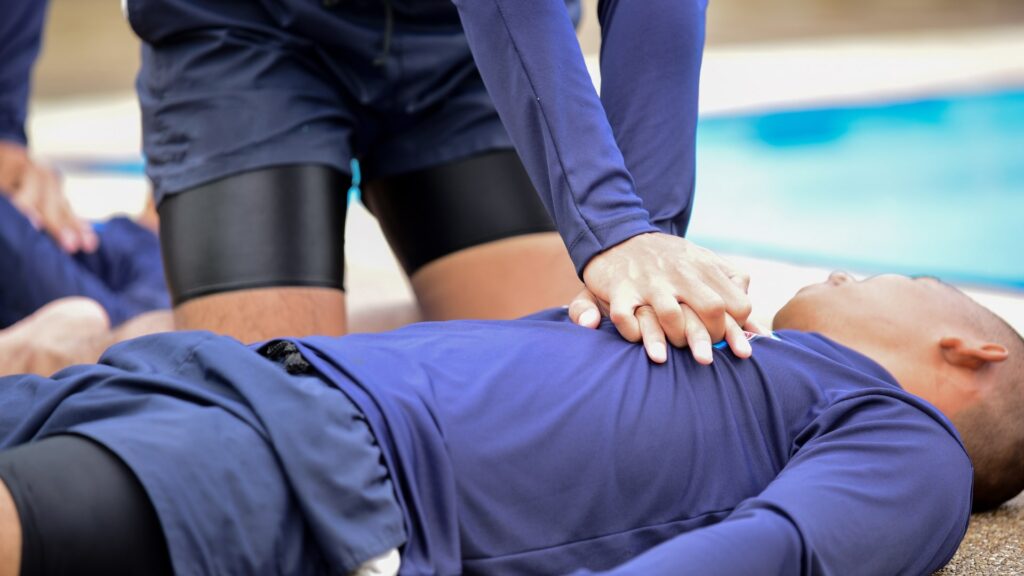
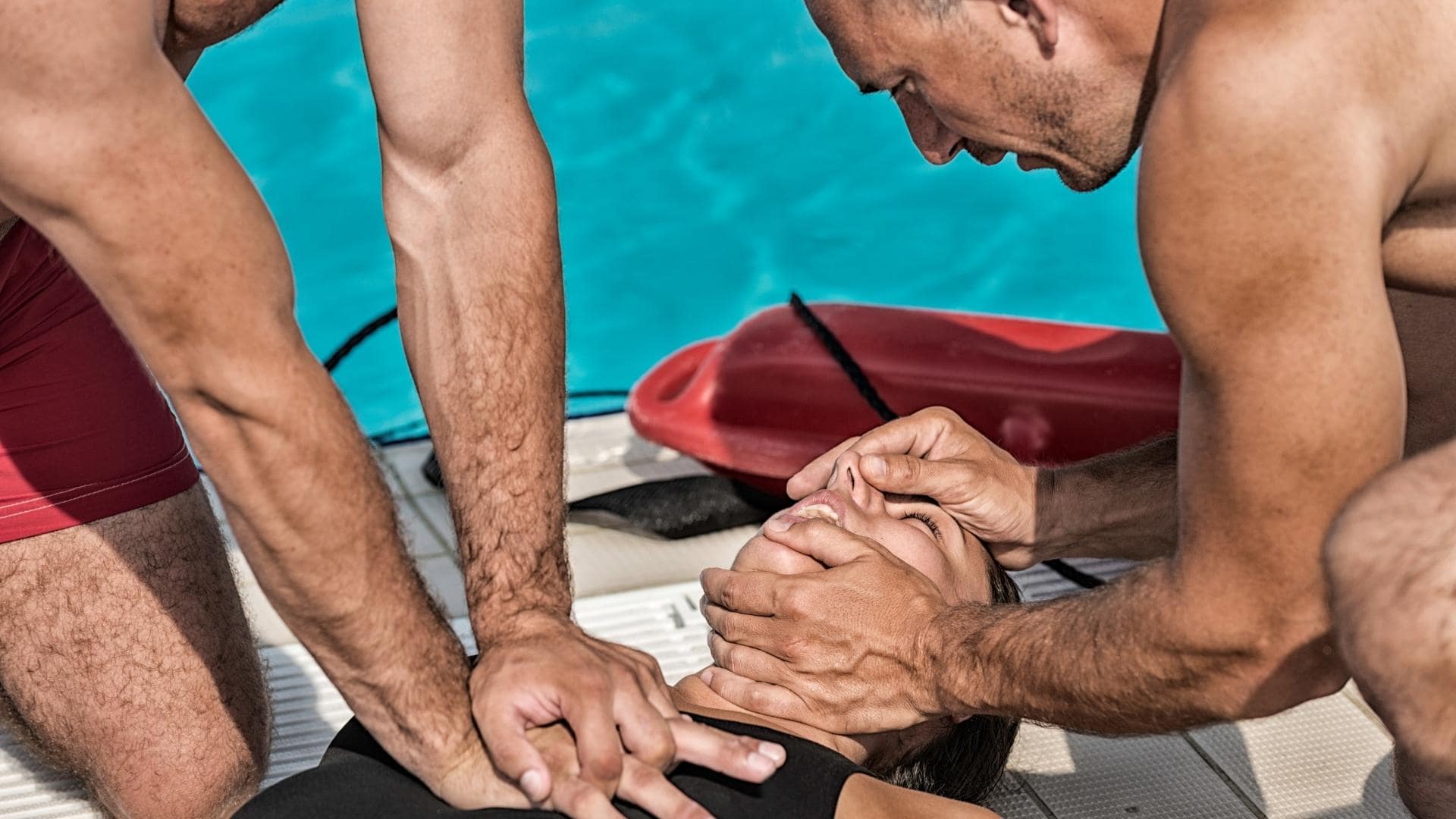
A person performing chest compressions on another person lying on the ground near a pool. Both individuals are wearing blue long-sleeved shirts and shorts. The image suggests an emergency medical response training.

Giving Chest Compressions

When giving chest compressions to infants, the CPR techniques differ; you should only use two fingers because of the size of their bodies. The depth of the compressions also changes; they are shallower than those given to adults and young children.

Calling for Emergency Response

Another difference between adult and children/infant CPR is when to call emergency services. With adults, immediately call 911 before beginning CPR unless you think they have a blocked airway.

With infants and children, always begin CPR immediately and call 911 after a few minutes or when it regains consciousness. Why is this important? Because children and infants have a better chance of survival when performed immediately, therefore you need to start chest compressions immediately. Of course, in cases where two people are present, one can perform CPR, and the other should call in all cases, whether they are adults, children, or infants.

Benefits of Learning CPR

CPR is a lifesaving procedure performed when someone’s heart stops beating. Pediatric CPR is especially important as it involves specific techniques tailored for children and infants. Research has shown that CPR increases the chances of survival for cardiac arrest victims by more than double.

CPR keeps the blood flow active in someone who has stopped breathing and has no pulse, allowing blood and oxygen to maintain the function of vital organs like the brain.

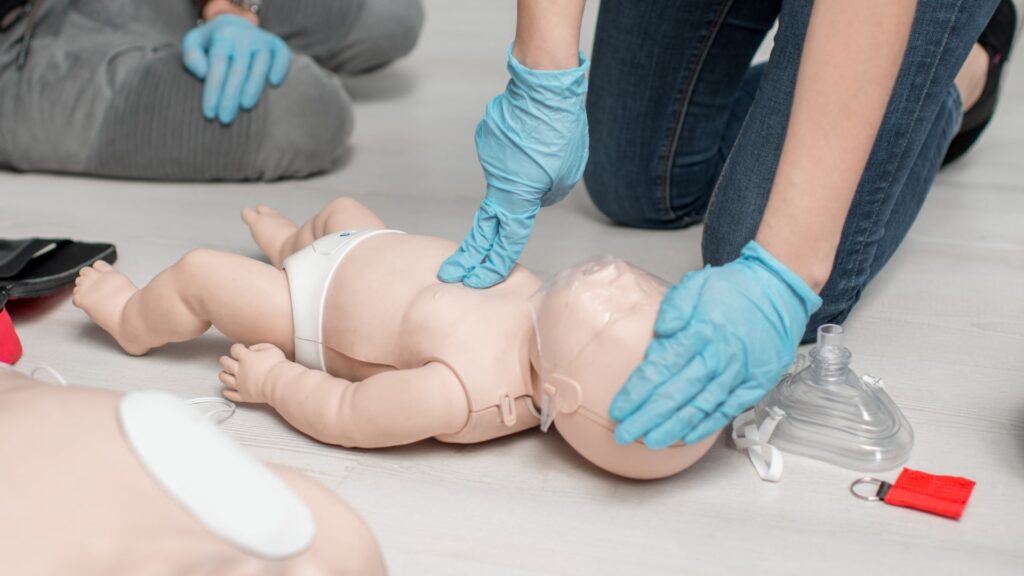
Two individuals wearing blue gloves practice CPR on an infant mannequin. One person performs chest compressions, while the other prepares a resuscitation mask next to the mannequin. Another adult mannequin torso is partially visible.

How to Prepare for Providing CPR

Training remains the best way to prepare for CPR and maintain your certification. However, logic says that even if you are untrained, it’s always best to try and do something to save someone’s life than to do nothing.

Always make sure of the following as you prepare to offer CPR:

  • Ensure a safe environment.

  • Check if the person is unconscious.

  • Call 911 first if dealing with an adult and then perform CPR, or do the opposite if it’s a child or infant. Knowing child CPR is crucial as it involves specific procedures and distinctions for children aged 1-12.

  • Use an AED only if it instructs you to proceed with delivering the shock.

  • Remember the order of CPR: compressions, airway, breathing.

Survival Rate Statistics for CPR

Brain damage occurs within minutes from a lack of oxygen. Therefore, if a person does not receive CPR immediately in an emergency like a cardiac arrest, it is improbable that they will survive if they wait for emergency services.

Recent statistics show that quickly performing CPR increases their chances of survival by nearly 45 percent in out-of-hospital situations for cardiac arrest victims helped by bystanders or relatives.

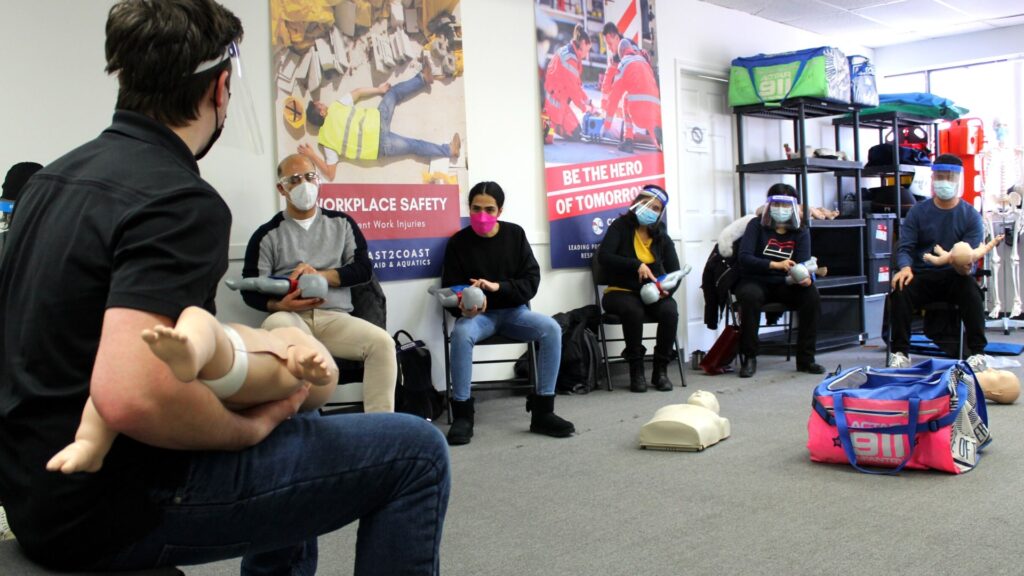
A group of people wearing masks and seated in a classroom are being instructed in infant CPR by a person holding a baby mannequin. Various training equipment and instructional posters are visible in the background.

Find a CPR Training Near You

Not only do medical emergencies happen at work, but they also take place in more familiar settings like around the house. Being certified in First Aid and CPR means that you can step up and help in any emergency situation. The more training you have, the better equipped you are to handle unforeseen situations which might come your way.

Help improve the outcomes for people in out-of-hospital situations by completing CPR training so that you are ready to take immediate action. Coast2Coast provides CPR Level A, CPR Level C, and Basic Life Support classes across Ontario in several locations, making it highly convenient for you.

Register for a First Aid & CPR Training Course

Choose from any of our locations across Ontario and gain the knowledge and skills to save a life!

How Do I Get a Basic Life Support Certification?

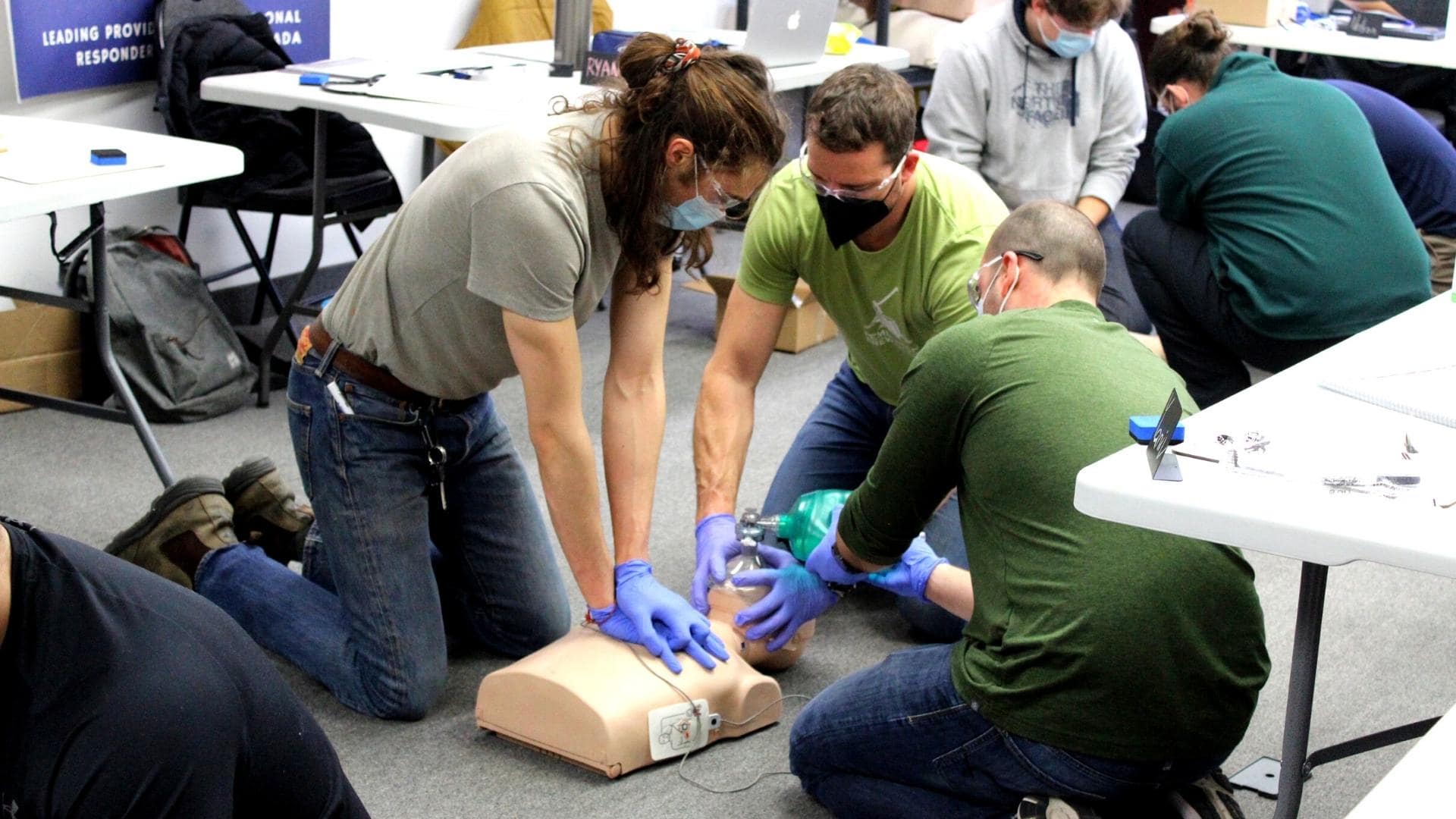
A group of people wearing masks are practicing CPR on a training mannequin. One person administers chest compressions while another uses a bag valve mask. Tables with equipment are in the background.

The increasing number of people diagnosed with cardiac health issues means millions are at risk of heart attacks and cardiac arrest. Since most of these occur outside of a hospital, Basic Life Support provides the training to help increase survival rates, particularly for cardiac arrest victims who would otherwise have minimal recovery and survival chances without help.

Continue reading

What is CPR for a Health Care Provider?

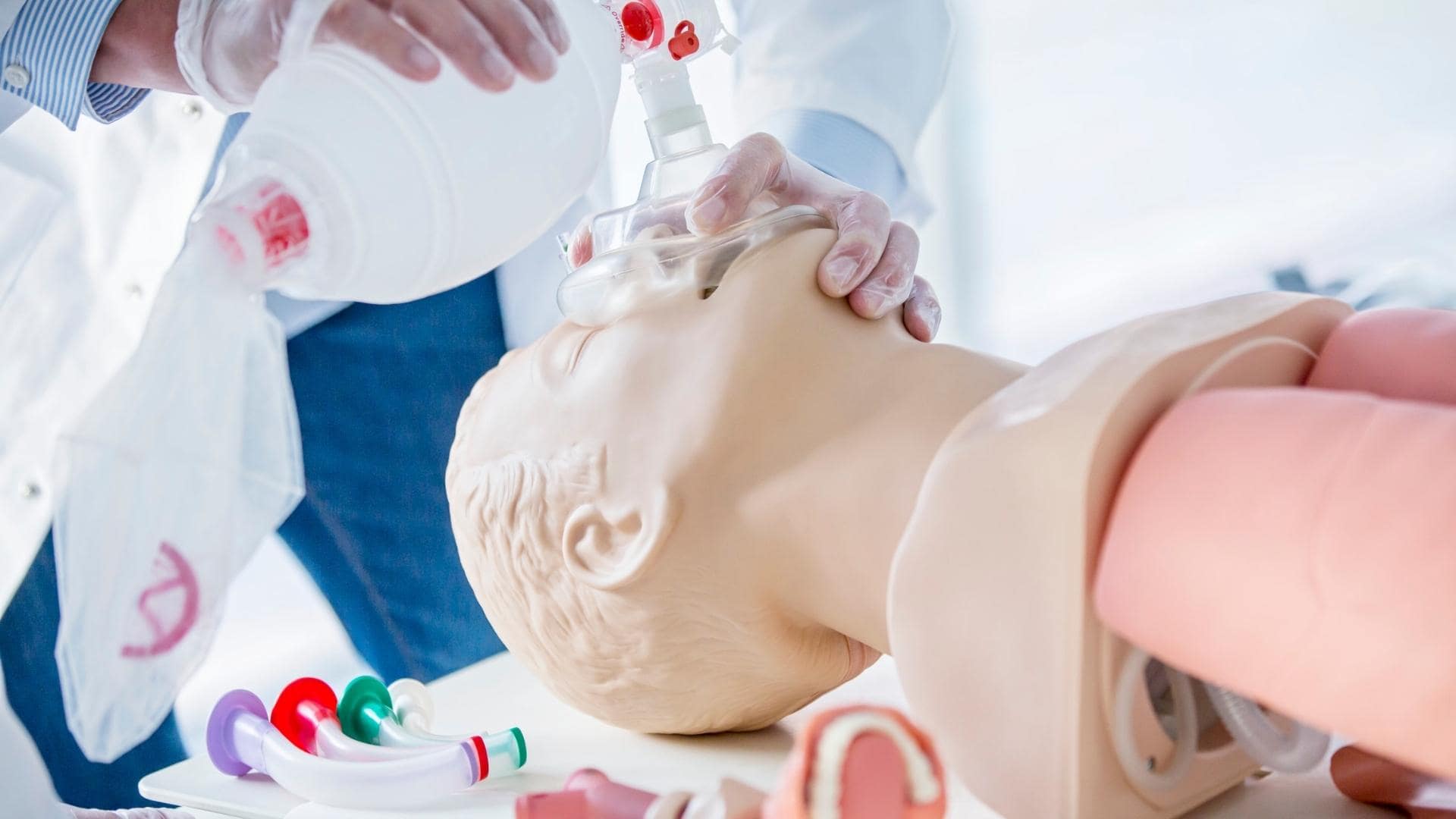
A medical professional demonstrates CPR on a realistic mannequin, using a bag valve mask for ventilation. Various airway management tools are visible in the foreground.

Healthcare professionals play a vital role in their teams as they work in fast-paced environments. They should, as a result, be skilled in performing basic life support. CPR skills are essential in the everyday lives of healthcare workers because their profession focuses on saving lives. The potential for patients going into cardiac arrest is something they need to be aware of at all times and provide help if necessary. So, what is CPR for a healthcare provider?

Continue reading

What to Wear for First Aid Training?

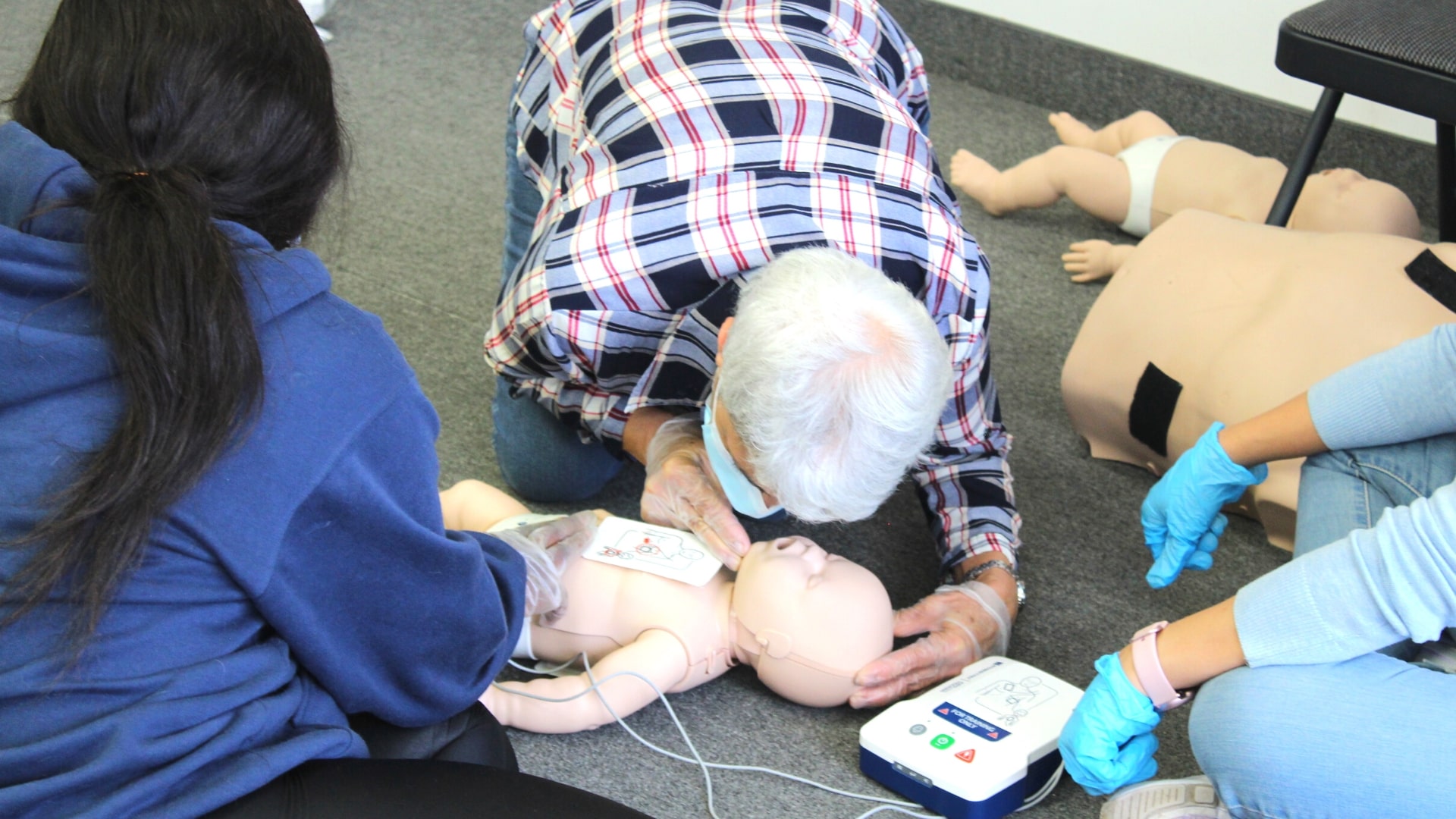
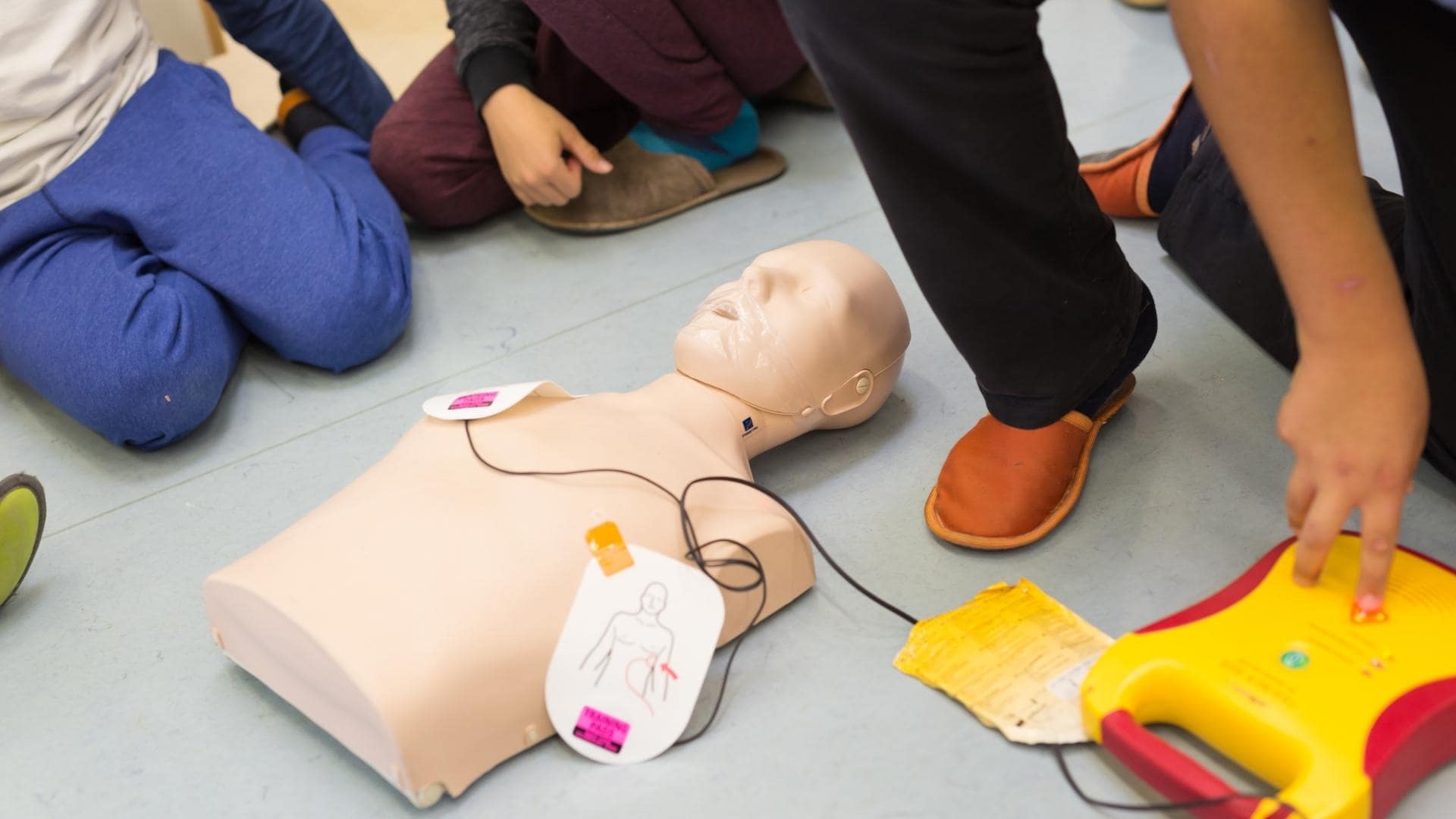
Children gather around a CPR training mannequin on the floor, with an automated external defibrillator (AED) placed nearby. The scene suggests a first aid or CPR training session.

First Aid training prepares you to help others in several situations, including accidents and medical emergencies. In addition, the theoretical knowledge and practical skills learned during a First Aid course can impact someone’s survival rate.

Continue reading

What is Standard First Aid Training?

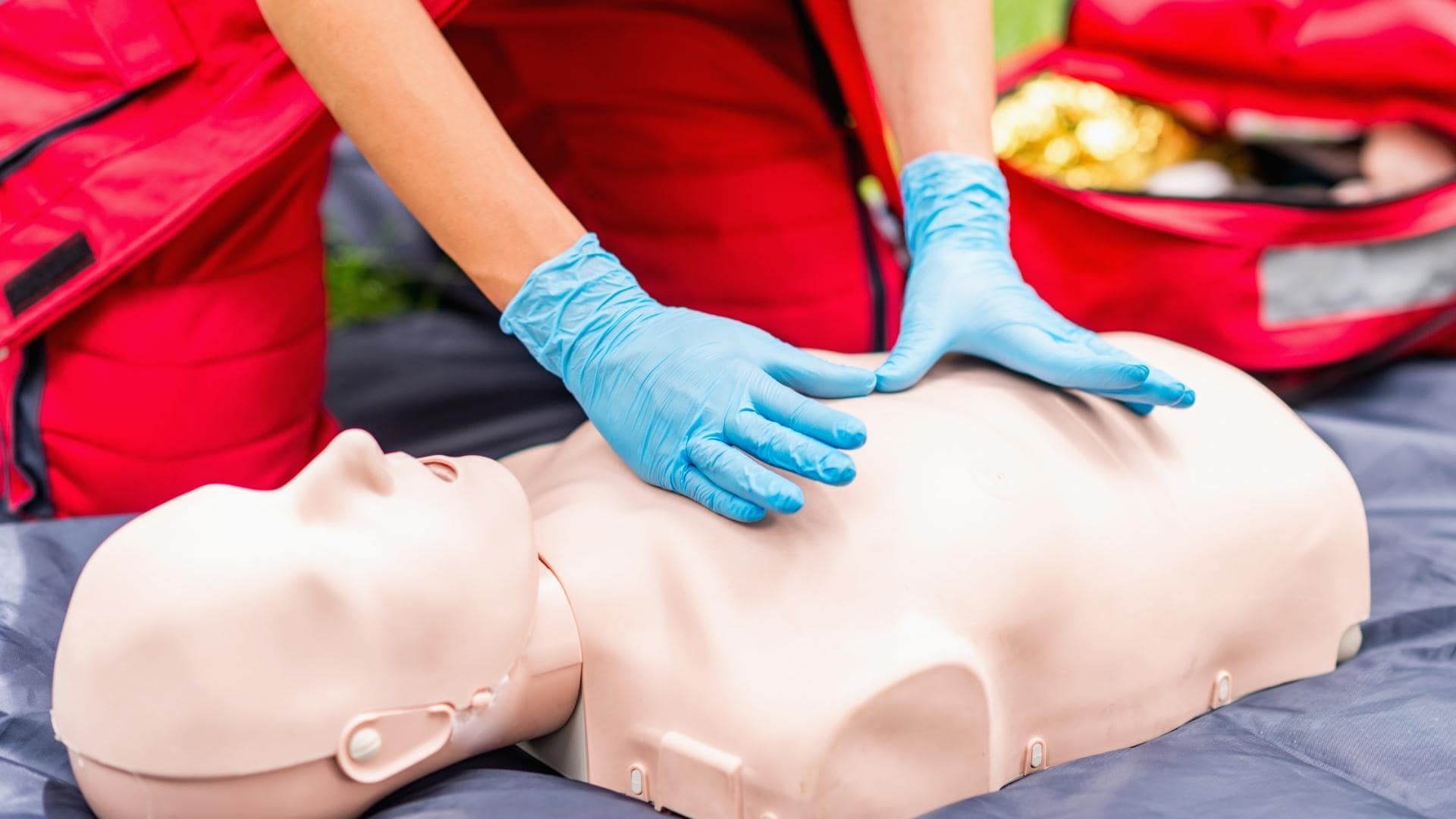
A person wearing blue gloves practices CPR on a medical mannequin. The mannequin is lying on a dark mat. A red emergency bag is partially visible in the background.

Given that injuries and illnesses can happen at any time, it’s important to be prepared. With some basic first aid knowledge, you can prevent a minor accident from becoming more serious. A medical emergency is a frightening event, but if you are trained as a first aider, you could save someone’s life.

Continue reading

Do Paramedics Need EMR Training?

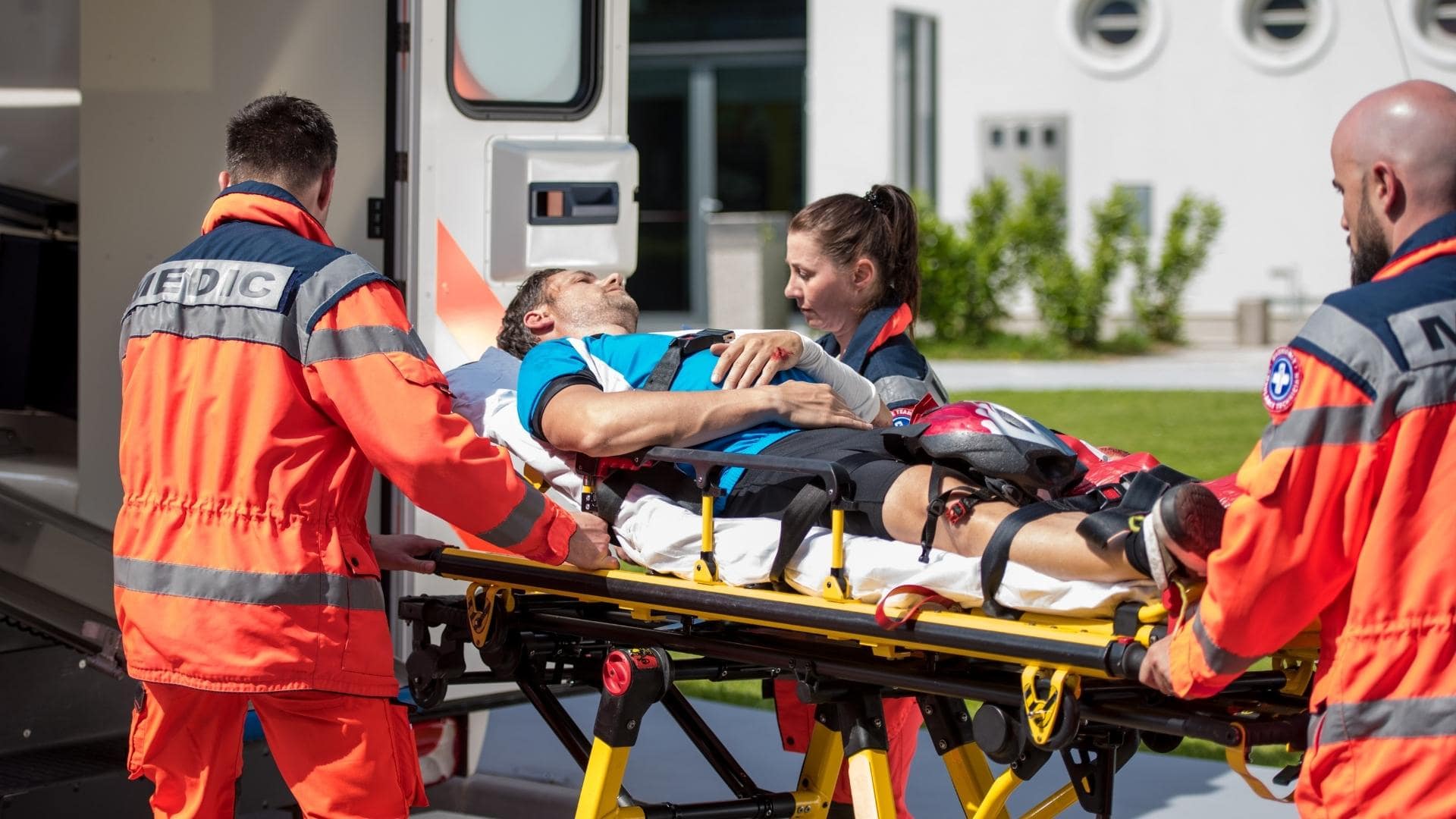
Three paramedics in bright orange uniforms transport an injured cyclist on a stretcher into an ambulance. The patient is wearing a blue shirt and a helmet, and appears conscious. The background includes a building and greenery.

Paramedics are not required by law to hold a separate Emergency Medical Responder (EMR) certificate, but EMR training is a formal prerequisite for paramedic admission programs in several Canadian provinces and provides a significant clinical advantage for aspiring practitioners. EMR training is the highest level of civilian First Aid and CPR/AED certification available in Canada, covering patient assessment, airway management, oxygen therapy, and patient transportation over approximately 80 hours of instruction. Beyond paramedicine, EMR certification opens career paths in fire departments, private ambulance services, occupational first aid, event medicine, ski patrol, and a range of other emergency health services roles.

EMR Training

Ready to Start Your EMR Journey?

The EMR course is your highest-level First Aid and CPR/AED certification. Take the first step toward a career in emergency health services.

View the EMR Course

80
Hours of EMR instruction, double the length of First Responder training
4
Paramedic licensing levels in Canada: EMR, PCP, ACP, and CCP
10+
Career fields where EMR certification provides direct employment access

Do Paramedics Need EMR Training?

Paramedics are specialized healthcare professionals trained to respond to emergency calls and deliver medical care outside a hospital setting. They form part of Emergency Response Services (ERS), working primarily in ambulances, though their roles extend to community health programs, patient transfers between medical facilities, and coverage at sporting events and industrial sites.

Paramedics are not legally required to hold a separate Emergency Medical Responder (EMR) certificate because their paramedic training already covers and surpasses all EMR competencies. However, EMR certification is listed as a mandatory prerequisite for admission to Primary Care Paramedic (PCP) programs in several Canadian provinces. Even where it is not formally required, the majority of paramedic programs expect applicants to arrive with at minimum a First Responder background, and EMR is the stronger qualifying credential.

For anyone aspiring to a career in emergency medical care, completing EMR training before entering a paramedic program provides a measurable academic and clinical advantage. It familiarizes candidates with the patient assessment frameworks, anatomical terminology, and clinical decision-making processes they will encounter throughout the licensing process.

What Is Emergency Medical Responder (EMR) Training?

Emergency Medical Responder (EMR) training is the highest level of civilian First Aid and CPR/AED certification available in Canada. The course runs approximately 80 hours and is delivered by certified instructors using a combination of instructor-led lectures, video presentations, anatomy and pathophysiology modules, practical skills stations, and fully simulated emergency scenarios.

During the EMR program, participants develop competency across a broad range of emergency care skills. They learn to provide essential life support treatments including oxygen and medication management, bleeding control, wound care, splinting, pain relief, and cardiopulmonary resuscitation (CPR). One of the most critical competencies developed in the EMR course is the ability to make accurate assessments of sick or injured patients and to follow those assessments with informed decisions about the most appropriate care and transportation to a medical facility.

The EMR course follows the National Occupational Competency Profiles (NOCP) defined by the Paramedic Association of Canada. This national framework ensures that all EMR-level practitioners meet a consistent standard of competency regardless of the province in which they train.

Core Competencies Covered in the EMR Program

EMR training develops competencies across four core domains:

Patient assessment: Primary and secondary surveys, vital sign monitoring, and documentation. EMRs are trained to identify life-threatening conditions rapidly and to communicate clinical findings accurately to receiving healthcare teams.

Airway and breathing management: Includes the use of basic airway adjuncts, bag-valve-mask ventilation, and oxygen therapy. These skills form the foundation of the EMR scope of practice and are directly transferable to paramedic training.

Circulatory support: CPR technique, AED operation, hemorrhage control using direct pressure and tourniquets, and recognition and initial management of shock states.

Musculoskeletal care and patient movement: Correct splinting and immobilization techniques, safe lifting of patients, spinal precautions, and extraction procedures in complex environments.

In addition to these clinical domains, EMR training covers scene safety and hazard recognition, crisis decision-making, basic pharmacology, and the operation of emergency equipment. Participants work through recreated incidents including trauma calls, cardiac and respiratory emergencies, and multi-patient events, building the judgment to save lives before a formal evaluation takes place.

Safety Tip: Scene safety assessment is the first step taught in every EMR scenario. Before approaching any patient, EMRs are trained to identify environmental hazards, confirm the scene is safe to enter, and call for additional resources when needed. This habit is one of the most important skills an EMR course instills.

The Written Exam and Formal Evaluation Process

At the end of the EMR program, participants complete two assessments before receiving their certificate. The written exam tests theoretical knowledge across patient assessment, anatomy, pathophysiology, pharmacology, and emergency protocols. The formal practical evaluation requires participants to perform clinical skills and manage simulated emergency scenarios under direct instructor observation.

Both assessments must be passed for successful completion and certificate issuance. The evaluation criteria are aligned to the NOCP framework, ensuring that certified EMRs meet the national competency standard. The certificate program is recognized by employers in emergency health services, occupational health, and a range of other fields where advanced first aid credentials are required.

How Does EMR Training Differ from First Responder Certification?

First Responder and EMR training share some content but are distinct credentials with different scopes of practice. A First Responder course runs approximately 40 hours and prepares participants to deliver first aid services until EMRs or paramedics arrive. The curriculum covers CPR, bleeding control, and care for a range of acute and chronic conditions, and includes crisis intervention, lifting patients, and managing multiple-casualty incidents.

Professions that commonly require First Responder certification include police officers, rescue teams, fire service personnel, lifeguards, ski patrol, sports medicine professionals, and workplace emergency response teams. It is a valuable credential and an important tier within the emergency response system.

EMR training differs in both depth and scope. At 80 hours, it requires twice the instructional time. The EMR curriculum adds pharmacology, expanded oxygen therapy, advanced patient assessment, and the training needed to oversee safe patient transportation to medical facilities. EMRs can function as independent practitioners in occupational and transport contexts where First Responders operate in a support capacity. The additional training also serves as the recognized entry point into the formal paramedic licensing process.

Compliance Note: EMR training in Canada must follow the National Occupational Competency Profiles (NOCP) as defined by the Paramedic Association of Canada. Employers in regulated industries, including industrial first aid and private ambulance services, may also require provincial registration in addition to the EMR certificate. Confirm requirements with your provincial regulatory body before applying to roles that specify EMR as a credential.

Learn CPR and First Aid in a Real Classroom

Not ready for EMR yet? A Standard First Aid course or CPR/AED certification builds the foundation you need before advancing to higher levels of training.

View Standard First Aid Courses

What Career Opportunities Does EMR Certification Open?

EMR training and certification qualify individuals for a wide range of employment roles in emergency health services and beyond. The combination of clinical depth, nationally recognized standards, and practical scenario experience makes the EMR certificate one of the most versatile credentials in the Canadian healthcare workforce.

Roles in Emergency Response Services and Fire Departments

One of the most direct career paths after EMR certification is working with provincial emergency health services as an EMR. In this role, the practitioner responds to emergency calls as part of the emergency response chain, either independently or alongside paramedics, and oversees patient transportation to appropriate medical facilities.

Many fire departments in Canada require all frontline personnel to hold at minimum a First Responder or EMR certification, because firefighters routinely arrive on medical emergencies before ambulances. EMR training gives fire department recruits a higher baseline of clinical competency, strengthening a candidate’s application and reducing the department’s onboarding training burden. The EMR credential is well-regarded in fire department hiring processes across Ontario and other provinces.

EMR certification also provides access to roles on wilderness and ski patrol teams, where responders must manage trauma and medical emergencies in remote environments without rapid access to additional first aid services or hospital backup.

Private Ambulance Services, Event Medicine, and Beyond

EMR certification qualifies individuals to work for private ambulance companies handling non-emergency patient transfers between medical facilities. In this role, the EMR monitors patient condition during transport and initiates emergency care if a complication arises. Private ambulance work is one of the most accessible entry points into paid emergency medical employment for newly certified EMRs, providing practical experience while they pursue additional training.

Certified EMRs can also gain employment in event and sports medicine, providing on-site medical coverage at concerts, motorsport events, corporate gatherings, and professional sporting events. Other roles include occupational first aid attendant in industrial and construction settings, private security medical support, coast guard service, and outdoor education.

The breadth of these opportunities reflects the EMR scope of practice: a credential that spans both the healthcare and occupational safety sectors, making it one of the most versatile certifications in Canadian first aid services.

Train Your Whole Team with Private Group Certification

Organizations in construction, industrial, security, and event sectors can bring certification directly to their workforce with a private group training session, keeping your team compliant and prepared.

Request Group Training

How Does EMR Certification Fit Into the Paramedic Career Pathway?

The Canadian paramedicine licensing process is structured as a progressive pathway with four distinct credential levels. EMR is the recognized entry point. From there, practitioners can advance through Primary Care Paramedic (PCP), Advanced Care Paramedic (ACP), and Critical Care Paramedic (CCP) training, each requiring successful completion of the previous level before proceeding.

Primary Care Paramedic (PCP) is the standard ambulance practitioner level in most Canadian provinces. PCP programs are college diploma programs that build on the EMR foundation with expanded pharmacology, advanced patient assessment, and IV therapy skills.

Advanced Care Paramedic (ACP) training represents a further step, adding a broader medication formulary, cardiac monitoring, and complex clinical interventions. ACP practitioners work in advanced life support environments and are often found in air medical and critical transport roles.

Critical Care Paramedic (CCP) is the highest tier of the paramedicine pathway, designed for specialized transport and critical care environments. CCP practitioners possess the health sciences background and clinical depth to manage complex, high-acuity patients during extended transport.

Starting with EMR certification provides career growth through a clearly structured progression. Each level of the pathway builds on the one before it, and the foundational competencies established during EMR training, including patient assessment methodology, airway management, and clinical decision-making, remain relevant throughout a practitioner’s entire career.

What Is the Importance of EMR Certification for Healthcare Professionals?

EMR training provides all professionals in emergency medical care with the knowledge and skills to make initial assessments of injured patients, provide safe and careful medical care, and oversee the transportation of a patient to an appropriate healthcare facility for further treatment. Once the course is complete, participants can demonstrate their competency through appropriate patient assessments, clinical interventions, and ongoing care management in any medical or environmental emergency.

The EMR credential is also increasingly recognized as a valuable asset for students and professionals across the broader health sciences. Nursing, kinesiology, exercise science, and other healthcare career pathways frequently recommend or require First Responder or EMR-level training before clinical placements. The structured patient assessment framework and clinical reasoning skills developed during EMR training provide a measurable foundation for academic advancement in any health-related program.

For emergency medical assistants, occupational first aid attendants, and other regulated health roles, EMR certification can fulfill provincial licensing requirements and serve as evidence of competency during formal hiring evaluations. Even where EMR training is optional rather than mandatory, it facilitates immediate employment in roles where a higher level of clinical preparedness is valued by employers.

The course content varies according to jurisdictional requirements but always adheres to the National Occupational Competency Profiles defined by the Paramedic Association of Canada, ensuring consistency across all provinces.

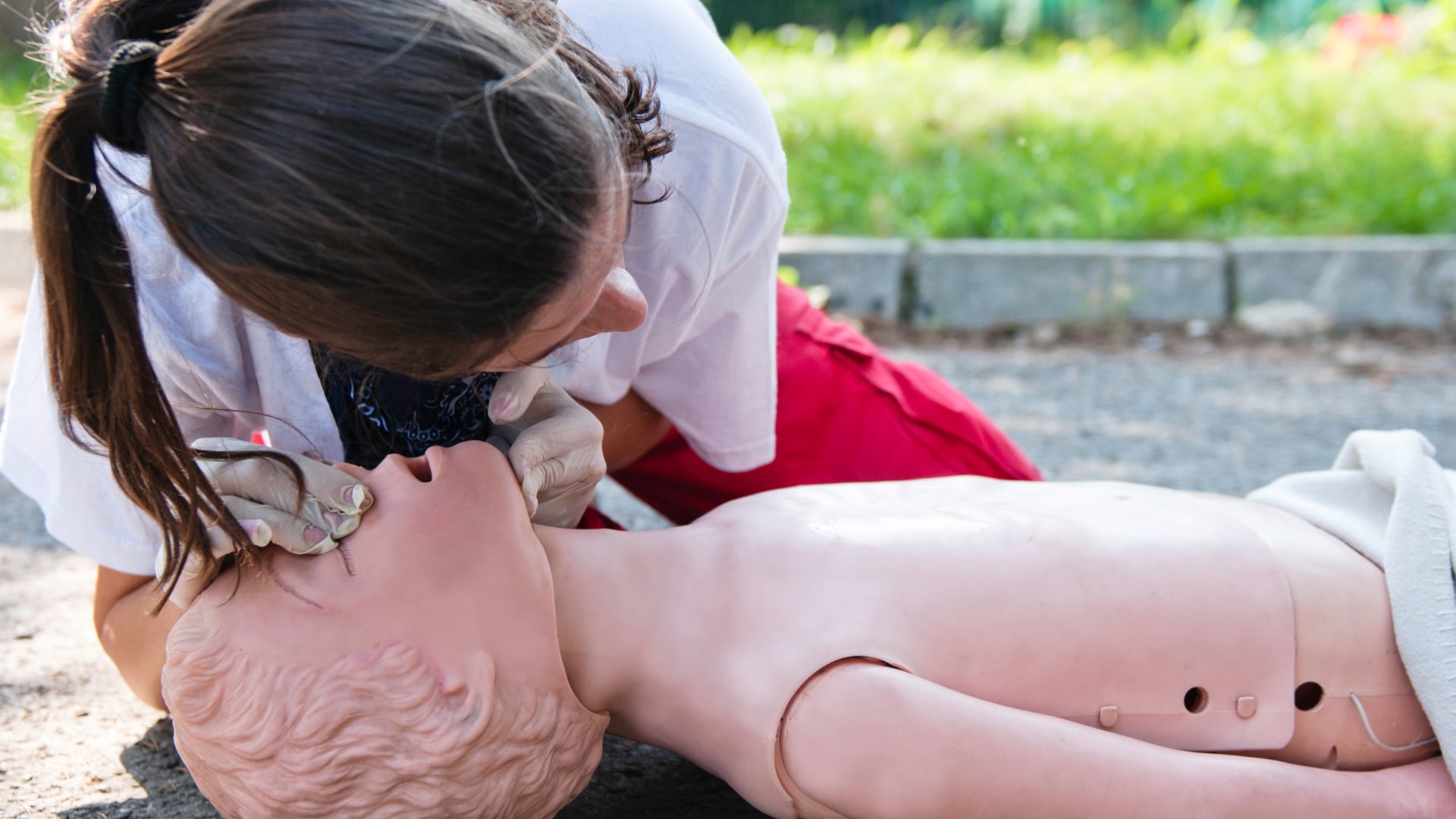
Key Takeaway

EMR training is the highest level of civilian First Aid and CPR/AED certification in Canada, covering patient assessment, airway management, oxygen therapy, cardiopulmonary resuscitation, and patient transportation over 80 hours of instruction. While paramedics are not legally required to hold a separate EMR certificate, EMR certification is a prerequisite for paramedic programs in several provinces and opens direct employment in emergency response, fire departments, private ambulance services, occupational first aid, event medicine, and a range of other health services roles. It is also the recognized first step on the four-level Canadian paramedicine career pathway.

Get Certified

Join 150,000+ Canadians Who Are Certified

EMR training, Standard First Aid, CPR/AED, and more, delivered by certified Canadian Red Cross instructors. Find a class that fits your schedule.

Find a Course Location

Frequently Asked Questions: EMR Training 2026

Q1: Do paramedics need EMR training?

A: Paramedics are not legally required to hold a separate EMR certificate because their paramedic training covers and exceeds EMR competencies. However, many paramedic programs in Canada list EMR certification as a formal prerequisite for admission, and completing EMR training before entering a paramedic program gives candidates a measurable clinical and academic advantage. For aspiring paramedics, EMR serves as the recommended first step on the pathway to full licensure.

Q2: What is Emergency Medical Responder (EMR) training?

A: Emergency Medical Responder (EMR) training is the highest level of civilian First Aid and CPR/AED certification available in Canada. The course runs approximately 80 hours and covers patient assessment, airway management, oxygen therapy, bleeding control, wound care, splinting, medication management, cardiopulmonary resuscitation (CPR), and safe patient transportation. Training follows the National Occupational Competency Profiles (NOCP) defined by the Paramedic Association of Canada, and participants must pass a written exam and a formal practical evaluation to receive their certificate.

Q3: What is the difference between a First Responder and an Emergency Medical Responder?

A: A First Responder course runs approximately 40 hours and prepares participants to provide care until EMRs or paramedics arrive. An Emergency Medical Responder course runs approximately 80 hours and includes expanded clinical content: pharmacology, oxygen therapy, advanced patient assessment, and the skills needed to supervise patient transportation. EMRs can legally function as independent practitioners in many occupational and transport contexts, whereas First Responders are trained as a support tier within the emergency response chain.

Q4: What core competencies does EMR training cover?

A: EMR training develops competencies across four domains: patient assessment (primary and secondary surveys, vital sign monitoring), airway and breathing management (including oxygen therapy and airway adjuncts), circulatory support (CPR, AED use, bleeding control, shock management), and musculoskeletal care (splinting, immobilization, safe lifting and patient extraction). Participants also receive instruction in scene safety, hazard recognition, crisis decision-making, pathophysiology, basic anatomy, and the correct use of emergency equipment.

Q5: How does the EMR written exam and formal evaluation work?

A: At the end of the EMR program, participants complete a written exam that tests theoretical knowledge of patient assessment, anatomy, pharmacology, and emergency protocols. They also undergo a formal practical evaluation in which instructors observe and score performance across simulated scenarios. Both components must be passed to receive the EMR certificate. The evaluation follows the National Occupational Competency Profiles (NOCP) framework published by the Paramedic Association of Canada.

Q6: Is EMR training a prerequisite for paramedic programs in Canada?

A: Yes. In several Canadian provinces, EMR certification is listed as a mandatory prerequisite for admission to Primary Care Paramedic (PCP) diploma programs. Even in provinces where it is not formally required, most paramedic programs expect applicants to have completed at minimum a First Responder course. EMR certification is the stronger credential and positions applicants more competitively for admission and for success during the academic and clinical components of paramedic training.

Q7: What is the difference between EMR, Primary Care Paramedic, and Advanced Care Paramedic?

A: EMR is the entry-level credential on the Canadian paramedicine pathway. Primary Care Paramedic (PCP) is the next level, requiring a college diploma program that builds on EMR competencies with expanded pharmacology and advanced assessment skills. Advanced Care Paramedic (ACP) training goes further, adding intravenous therapy, cardiac monitoring, and a broader medication formulary. Critical Care Paramedic (CCP) is the highest tier, used in specialized transport and critical care environments. Each level requires successful completion of the previous level and its licensing process.

More FAQs: EMR Certification and Career Paths

Q8: What career opportunities does EMR certification open?

A: EMR certification qualifies holders for a range of employment roles: EMR with provincial emergency health services, occupational first aid attendant in industrial or construction settings, event and sports medicine responder, private ambulance service provider for non-emergency patient transfers, ski patrol medic, member of a workplace emergency response team, and positions in private security and coast guard services. It also opens a pathway into paramedic programs, firefighting services, and outdoor education roles where advanced first aid credentials are valued.

Q9: Can an EMR work for a private ambulance service?

A: Yes. EMR certification qualifies individuals to work for private ambulance companies that handle non-emergency patient transfers between medical facilities. In this role, the EMR is responsible for monitoring patient condition during transport and for initiating emergency care if a complication arises en route. Private ambulance services represent one of the most accessible entry points into paid emergency medical work for newly certified EMRs while they build experience toward further training.

Q10: How does EMR training prepare individuals for emergency response roles in fire departments?

A: Many fire departments in Canada require all frontline personnel to hold at minimum a First Responder or EMR certification, because firefighters routinely arrive on medical emergencies before ambulances. EMR training gives fire department recruits a higher baseline of clinical competency: structured patient assessment, oxygen therapy, splinting, CPR, AED operation, and crisis decision-making in chaotic environments. Holding an EMR certificate before applying to a fire department strengthens a candidate’s application and reduces the training burden on the department at hire.

Q11: What learning methods are used in an EMR course?

A: EMR training uses a combination of learning methods to build both knowledge and hands-on competency. These include instructor-led lectures, video presentations, anatomy and pathophysiology modules, practical skills stations, and fully simulated emergency scenarios. Scenario-based practice sessions are a core feature of the curriculum: participants work through recreated incidents such as trauma calls, medical emergencies, and multi-patient events, applying their skills under observation before the formal evaluation.

Q12: Does EMR certification follow a national standard in Canada?

A: Yes. EMR training in Canada is aligned to the National Occupational Competency Profiles (NOCP) published by the Paramedic Association of Canada. The NOCP defines the minimum competencies that all EMR-level practitioners must demonstrate, ensuring that training is consistent in scope and depth regardless of the province or the training provider. Individual provinces may add jurisdiction-specific requirements on top of the NOCP baseline, particularly around licensing, registration, and scope of practice in occupational settings.

Q13: What is the EMR scope of practice?

A: The EMR scope of practice covers patient assessment (primary and secondary surveys), airway management including basic adjuncts, oxygen therapy, cardiopulmonary resuscitation (CPR) and AED operation, hemorrhage control, wound care, splinting and immobilization, basic pain management, and supervised medication administration in specific contexts. EMRs are also trained to make transportation decisions and to communicate clinical information to receiving healthcare facilities. The exact scope varies by province, but the NOCP framework defines the national minimum standard.

Q14: How long does EMR certification remain valid?

A: EMR certification validity periods vary by province and by employer requirements. In most contexts, EMR certificates require renewal every two to three years through a recertification course or a skills reassessment. Occupational and industrial roles governed by provincial occupational health and safety regulations may specify their own recertification timelines. Individuals using their EMR credential for employment are advised to confirm the recertification requirements with their provincial regulatory body or employer before their certificate expires.

Q15: Can EMR training help someone working in the health sciences or a healthcare career?

A: Yes. EMR training is widely recognized as a valuable credential for students and professionals pursuing healthcare careers. Nursing, kinesiology, exercise science, and health sciences programs frequently recommend or require First Responder or EMR-level training before clinical placements. The structured patient assessment framework, anatomy and pathophysiology content, and practical emergency skills developed during an EMR course provide a measurable foundation for academic and professional advancement in any health-related field.

Disclaimer: This article is for informational purposes only and does not constitute medical, legal, or regulatory advice. EMR training requirements and scope of practice vary by province and employer. Always confirm current requirements with your provincial regulatory body or occupational health authority before applying to roles that specify EMR certification. In any medical emergency, call 9-1-1 immediately.

Sources & Editorial Standards

This article was authored by Ashkon Pourheidary (B.Sc. Hons Neuroscience; Canadian Red Cross certified since 2011; co-founder, Coast2Coast First Aid & Aquatics) and reviewed for clinical accuracy against current Canadian paramedicine standards.

EMR competency standards referenced: National Occupational Competency Profiles (NOCP), Paramedic Association of Canada.

Coast2Coast First Aid & Aquatics is an authorized Canadian Red Cross Training Partner. Course content follows Canadian Red Cross curriculum and provincial regulatory requirements. Last reviewed: May 2026.