
WSIB-Approved Provider · Canadian Red Cross Training Partner
CPR/AED Certification Courses
Cardiopulmonary resuscitation and defibrillator training for cardiovascular and choking emergencies. Two levels: Level A covers adults, Level C adds children and babies. Both are taught by a Canadian Red Cross instructor and certify you for three years.
 4.9
4.9
Course Types
Our CPR Certification Courses
Every CPR training course puts an AED trainer in your hands, so the device stops being an unfamiliar box on a wall. Both levels cover heart attack, stroke and life-threatening bleeding alongside the resuscitation work.
Every public class date is Level C. Level A runs as private or group training only — request a private booking if that is the level you need.
- Training level
- Level C
- Prerequisites
-
None
No first aid or medical background is assumed.
- Online blended training
-
Level C
Online: 2–3 hours
In-Class: 3.5 hours practical (9:00 AM – 12:30 PM)
- All in-class training
-
Level C
6 hours teaching time
9:00 AM – 3:00 PM
Learn more
- Course content
-
View all 14 course topics
- The Red Cross
- The First Aider’s Role
- Chain of Survival Behaviours
- Recovery Position
- Check, Call, Care
- Choking — Adult
- Assisting with Medications
- Angina and Heart Attack
- CPR — Adult
- Compression-Only CPR
- Life-threatening External Bleeding
- Life-threatening Internal Bleeding
- Choking — Child and Baby
- CPR — Child and Baby
Highlighted topics are covered in Level C only, not in Level A.
- Requirements
-
100% attendance of the course
75% score on the multiple choice knowledge test
- Certification
- Certificate will be issued, valid for 3 years
The level most employers mean when they ask for certification. Adults, children and babies — compressions, rescue breaths, AED use and choking relief for all three — plus recognising a heart attack and controlling life-threatening bleeding. Six hours in class, or three and a half after an online module.
- Training level
- Level A
- Availability
-
Private and group training only
*NOTE: Level A is only available for Private Training. Every date on the public schedule is Level C.
- Prerequisites
-
None
No first aid or medical background is assumed.
- Online blended training
-
Level A
Online: 1–2 hours
In-Class: 2.5 hours practical
Start time is set when your private session is booked.
- All in-class training
-
Level A
5 hours teaching time
Learn more
- Course content
-
View all 14 course topics
- The First Aider’s Role
- Chain of Survival Behaviours
- Shock
- Lowering Risk of Infection
- Stroke
- Recovery Position
- Check, Call, Care
- Choking — Adult
- Assisting with Medications
- Angina and Heart Attack
- CPR — Adult
- Compression-Only CPR
- Life-threatening External Bleeding
- Life-threatening Internal Bleeding
*Note: the difference between the levels is who you can help — Level C adds child and baby CPR, AED and choking. See Level A or Level C below.
- Requirements
-
100% attendance of the course
75% score on the multiple choice knowledge test
- Certification
- Certificate will be issued, valid for 3 years
The same skills, adult-sized: adult compressions, AED use and choking relief, without the child and infant work. Five hours in class, or two and a half after an online module. Suited to workplaces where only adults are ever on site.
Awards & Recognition
Recognised as a Top 3 Canadian Red Cross Training Partner for 2023, 2024, 2025 consecutively.
2025 · National First Aid & CPR Provider
2025 · National Professional Responder Provider
2025 · Top 3 National Training Provider
2025 · Top 3 Provincial Training Provider
2024 · National First Aid & CPR Provider
2024 · National Professional Responder Provider
2024 · Top 3 National Training Provider
2024 · Top 3 Provincial Training Provider
2023 · National First Aid & CPR Provider
2023 · National Professional Responder Provider
2023 · Top 3 National Training Provider
2023 · Top 3 Provincial Training Provider
Why Coast2Coast
Why Workers Choose Coast2Coast First Aid & Aquatics for CPR Certification
Our CPR training checks every box workplaces, healthcare teams and organizations need: a WSIB-approved training provider, Canadian Red Cross recognition, 48-hour turnaround, and a free 90-day skills retake.
Before You Book
CPR Level A or Level C?
The difference is not difficulty — it is who you can help. A child is not a small adult: the compression depth, the hand position and the choking technique all change, and Level C is where you practise them. Level A stops at adults.
If your employer has not named a level, assume Level C. It is what the phrase “CPR certification” almost always means, and it is the only level on the public schedule.
See Level C Dates-
Level C — adults, children and babies
Compressions, AED use and choking relief for all three age groups, plus two-rescuer technique. Six hours in class, or 3.5 after the online module.
-
Level A — adults only
No child or infant compressions, no child or infant choking. Five hours in class, or 2.5 after the online module.
-
Level A is not on the public schedule
It runs as private or group training. Every date you can book online is Level C.
-
Both certify for three years
Same Canadian Red Cross certificate validity, same pass mark: full attendance and 75% on the knowledge test.
Testimonials
Hear From Our Students
What Students Say About Our Courses
4.9
Google Reviews
-
Margaret L Murre Coast2Coast Student
★★★★★
Elhamy was a very good CPR instructor — friendly and fast paced environment. I recommend this class.
-
Ying Kong Coast2Coast Student
★★★★★
Very good. I learned a lot and teacher is so great.
-
Bassel Harewood Coast2Coast Student
★★★★★
Chuck is a great teacher.
-
Dana White Coast2Coast Student
★★★★★
Scott F was a great teacher.
-
Heather J Coast2Coast Student
★★★★★
Scott did a great job with our group course. Answered all our questions and kept the class light and entertaining.
Verified Reviews from Our Students
Real feedback from participants, in their own words.
Student Feedback
Participants across our Red Cross network share their experiences.
Dozens more real stories. Real people, real results.
Three Ways to Train
Course Delivery Methods
Choose the delivery method that works best for you. Two of the three certify you for the workplace; the third is knowledge only.
Compare Dates & FormatsEverything taught in the room by a certified instructor — no computer, video or pre-work. One day, 9:00 AM to 3:00 PM for Level C.
- Hands-on training with high-quality equipment
- Best for tactile learners and teams training together
- Includes the hands-on skills test every certificate requires
Do the theory at home, then attend a shortened skills session — 9:00 AM to 12:30 PM for Level C. You leave the classroom before lunch.
- Flexible lecture study on your own schedule
- Shorter class time — best for shift workers
- Same skills test, same three-year Canadian Red Cross certificate
Looking strictly for knowledge? Work at your own pace on desktop, tablet or mobile, with no commute and no class schedule to work around.
Not WSIB-approved. There is no skills test, so it cannot certify you for work. If you need certification, choose All In-Class or Online Blended. See online training.
Renewals
Renewing a CPR/AED certificate?
Level C has a four-hour recertification, 9:00 AM to 1:00 PM, and it is repeatable — you can renew that way several times in a row. It is also the one recertification whose prerequisite need not be Canadian Red Cross: any WSIB-approved provider counts. Level A has no recertification course; when it expires you take the full course again.
Check your expiry date first — an expired certificate means retaking the full course, whichever level you hold.
You May Also Like
Basic Life Support (BLS-HCP)
If you work in healthcare, BLS is the course that replaced CPR-HCP — and booking it alongside a first aid course is cheaper than booking it alone.
- What to book
-
1 · First aid
Any First Aid & CPR course or recertification
2 · Basic Life Support
Basic Life Support (BLS-HCP)
- The discount
-
Your BLS registration is discounted when you book both courses.
They must go through as two separate registrations. The discount comes off the BLS one, not the first aid one.
- Renewal cycles differ
-
CPR 3 years, BLS 1 year
BLS is the one that comes round fastest — its renewal is 2 hours rather than 4.
Learn more
Basic Life Support (BLS-HCP) recently replaced the old HCP-level course. It is the course for healthcare providers — fast, team-based resuscitation for hospital and clinical settings. Book BLS together with any CPR course and you get the bundle discount.
Inside the Classroom
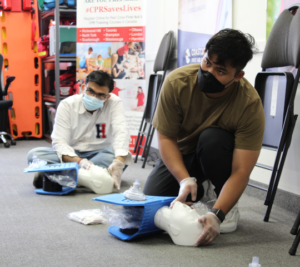
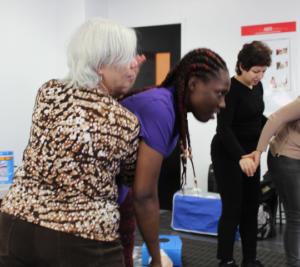
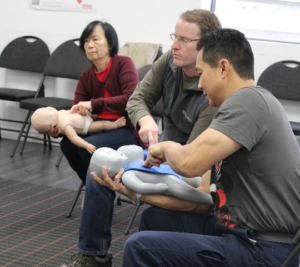
The Skills You Will Practise
Why Coast2Coast
Why Train With Coast2Coast?
Our facilities carry current manikins and AED trainers, and every CPR training class is taught by a Canadian Red Cross instructor. Over 200,000 people have trained with us since 2014 — for the workplace, and for their own peace of mind.
- 200K+People trained
- 35+Locations
- 4.9★Google rating
- 2014Training since
-
You handle a real AED trainer
Every course puts the device in your hands, pads and prompts included, so you are not meeting one for the first time in an emergency.
-
Certificate in 48 hours
Your Canadian Red Cross certificate is issued within two business days of completing the course.
-
A WSIB-approved provider
We are approved to train in Ontario, and every certifying format includes the skills test. Regulation 1101 workplace coverage needs a first aid certificate as well — CPR alone does not satisfy it.
-
Instructors who work the field
Paramedics, nurses and physicians teach every class — people who run these skills for real.
Common Questions
Frequently Asked Questions
What’s the difference between Level A and Level C?
- Level A covers adults only.
- Level C, often written CPR C, includes adults, children, and infants, plus AED use and choking relief. This is what most employers require.
Both teach single rescuer lifesaving skills and help you feel confident in an emergency.
Can I book Level A on a public course date?
No, Level A is only available for private group training. All public course dates are for Level C. If you need Level A for your group, contact us, and we’ll arrange CPR training in your city.
Which level does my employer expect?
Most workplaces expect CPR C. It’s the default safety standard in Ontario and Alberta, and required for childcare settings in Mississauga.
Do I need both first aid and CPR?
Often, yes. First aid courses cover much more—for example:
- Basic/Emergency First Aid: adds wound care
- Intermediate/Standard First Aid: adds head, spine, and bone injury management
- Advanced First Aid: for responders
Ontario’s Regulation 1101 requires first aid, not just resuscitation training, in workplaces.
Is it possible to learn CPR entirely online?
Not fully. You can learn CPR theory online, but a Canadian Red Cross certificate requires a hands-on skills test. Choose either All In-Class or Online Blended formats for real, practical training and confidence.
How long are certifications valid?
- CPR and first aid: 3 years (basic, intermediate, and advanced)
- BLS: 1 year
- PALS, PEARS, ACLS: 2 years each
Be sure to renew before your certificate expires—contact us if you’re not sure.
What does the defibrillator training cover?
You’ll learn to use an Automated External Defibrillator during a cardiac emergency. Training includes recognizing symptoms, doing CPR, and using the AED to analyze heart rhythms and deliver shocks. After each shock, you’ll resume compressions right away.
Why is speed so important with an AED?
In cardiac arrest, every minute matters—the sooner someone acts, the better the outcome. That’s why AED training is especially valuable for people in healthcare or education. We’ll practice until you can respond confidently and quickly.
Do you offer training for social service workers?
Absolutely! Basic/Emergency First Aid is available for social service workers, educators, and childcare staff in every city, including Mississauga. You’ll leave ready to provide care.
Should I also get BLS certification?
If you’re in healthcare, yes. BLS teaches core lifesaving skills and team-based clinical scenarios you’ll use in emergencies. Many social service workers take BLS too.
What will I practice during class?
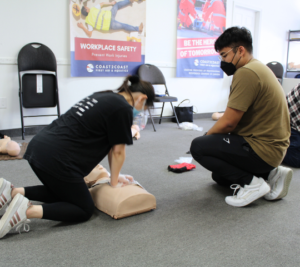
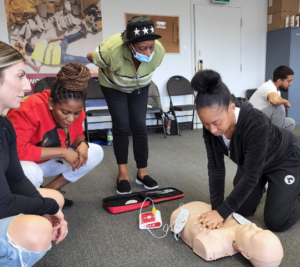
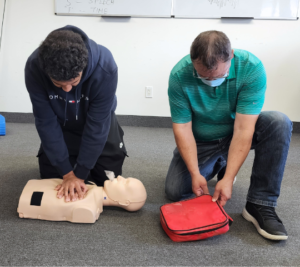
- Chest compressions and rescue breaths on adult, child, and baby manikins
- Applying pads to an AED trainer
- Back blows for choking relief
You’ll repeat these skills until they become second nature, so you’ll feel prepared and confident to help in a real emergency.
Book your CPR/AED course today
Pick a city, choose a date, and register online in under two minutes. One day, you might save a life with it.