Are There Any Alternatives to Mouth-to-Mouth CPR?

Coast2Coast First Aid banner titled “Are There Any Alternatives to Mouth-to-Mouth CPR?” showing a first aid instructor explaining a CPR pocket mask to a student at a training table

Yes. Mouth-to-mouth resuscitation is still part of full CPR in Canada, but it is not your only option. An adult who suddenly collapses can receive hands-only CPR, and a CPR pocket mask or face shield lets you give rescue breaths without direct contact. Infants, children, and people rescued from drowning still need breaths whenever you are able to give them.

Hands-On CPR Training

Find a CPR Course Near You

Practise rescue breaths, hands-only CPR, and AED use with a certified Canadian Red Cross instructor.

See All Course Locations

60,000

out-of-hospital cardiac arrests in Canada every year (Heart & Stroke)

1 in 10

people survive a cardiac arrest outside hospital (Heart & Stroke)

30:2

chest compressions to rescue breaths in full adult CPR

What Is Mouth-to-Mouth Resuscitation?

Mouth-to-mouth resuscitation, also called rescue breathing or expired air resuscitation, is a first aid technique where you breathe into a person’s mouth to push air into their lungs when they are not breathing normally. In CPR, rescue breaths are combined with chest compressions: 30 compressions followed by 2 breaths, repeated until help arrives.

It works because your lungs absorb only part of the oxygen in each breath, so the air you breathe out still contains oxygen. That is enough to add oxygen to the blood of someone who has stopped breathing, while chest compressions move that blood to the brain and heart.

The stakes are high. Heart & Stroke reports about 60,000 out-of-hospital cardiac arrests in Canada every year, and only about 1 in 10 people survive. Many bystanders hesitate because they don’t want to give mouth-to-mouth CPR to a stranger. Knowing your alternatives removes that barrier.

Not sure which CPR level you need?

Match your job or personal needs to the right certification in a few quick questions.

Find My Course

How to Give Mouth-to-Mouth Resuscitation Step by Step

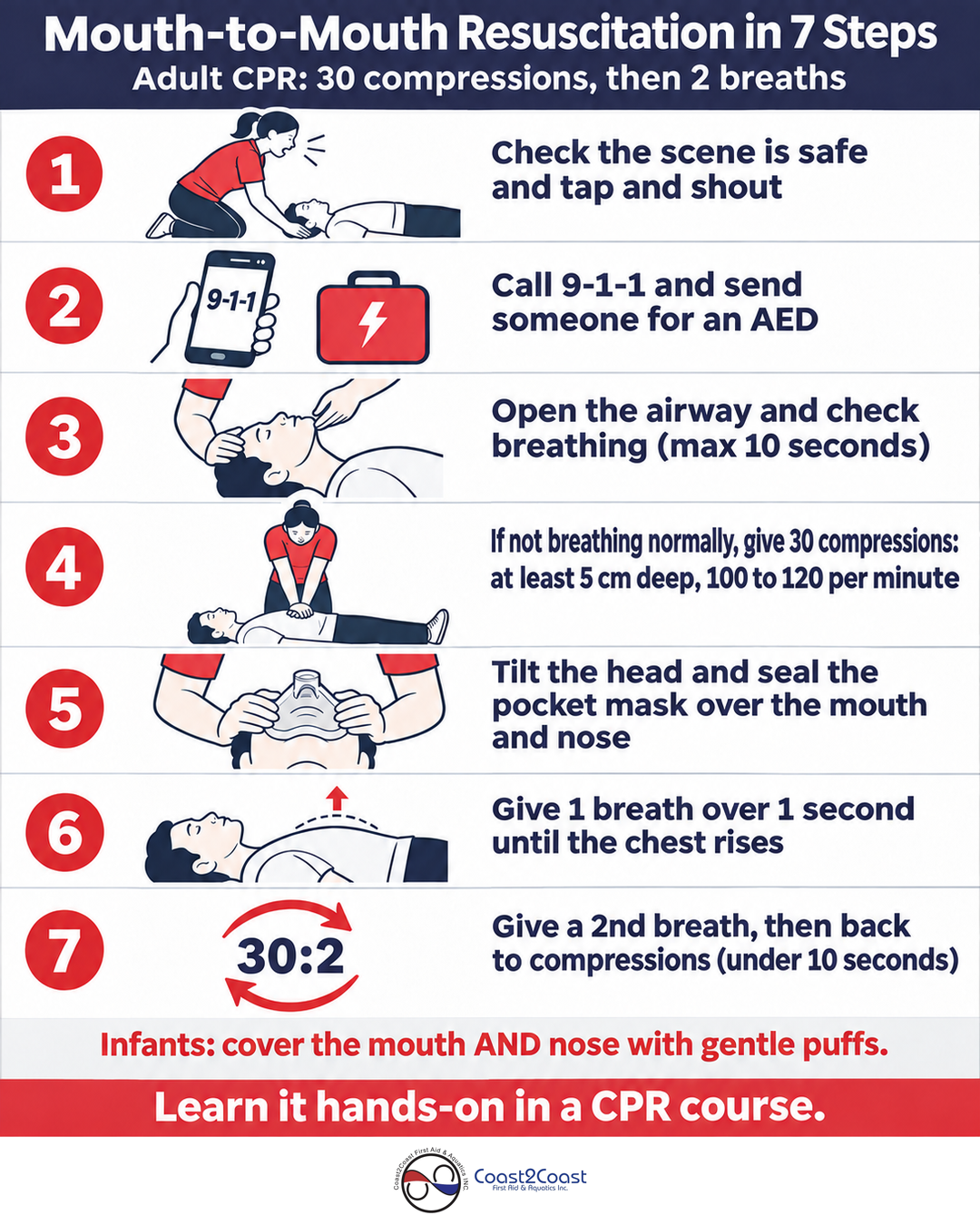
Proper mouth-to-mouth resuscitation during adult CPR follows these steps:

  1. Check that the scene is safe, then tap the person and shout to see if they respond.
  2. Call 9-1-1 and send someone to bring an AED.
  3. Open the airway with a head-tilt chin-lift and check for normal breathing for no more than 10 seconds.
  4. If they are not breathing normally, give 30 chest compressions, at least 5 cm deep, at 100 to 120 per minute.
  5. Open the airway again, pinch the nose closed, and seal your mouth over the person’s mouth or place a barrier device.
  6. Breathe in for about one second, just enough to make the chest rise, then let the chest fall.
  7. Give a second breath, then return to compressions, keeping the pause under 10 seconds.

If the first breath does not go in, re-tilt the head and try once more. If it still does not go in, return to compressions and check the mouth for a visible object before your next breaths, because the airway may be blocked.

For infants, cover both the mouth and nose with your mouth and give gentle puffs. The mouth-to-mouth breathing technique is hard to judge from reading alone, so practising on manikins in a hands-on CPR/AED course is the best way to learn the right breath size and seal.

Coast2Coast First Aid infographic showing the 7 steps of mouth-to-mouth resuscitation during adult CPR, from checking the scene and giving 30 chest compressions to giving 2 rescue breaths with a pocket mask

In-Person Skills Practice

Learn Rescue Breaths in a Real Classroom

Practise compressions, breaths, and AED use with instructor feedback on every rep.

View CPR/AED Courses

Can You Do CPR Without Mouth-to-Mouth?

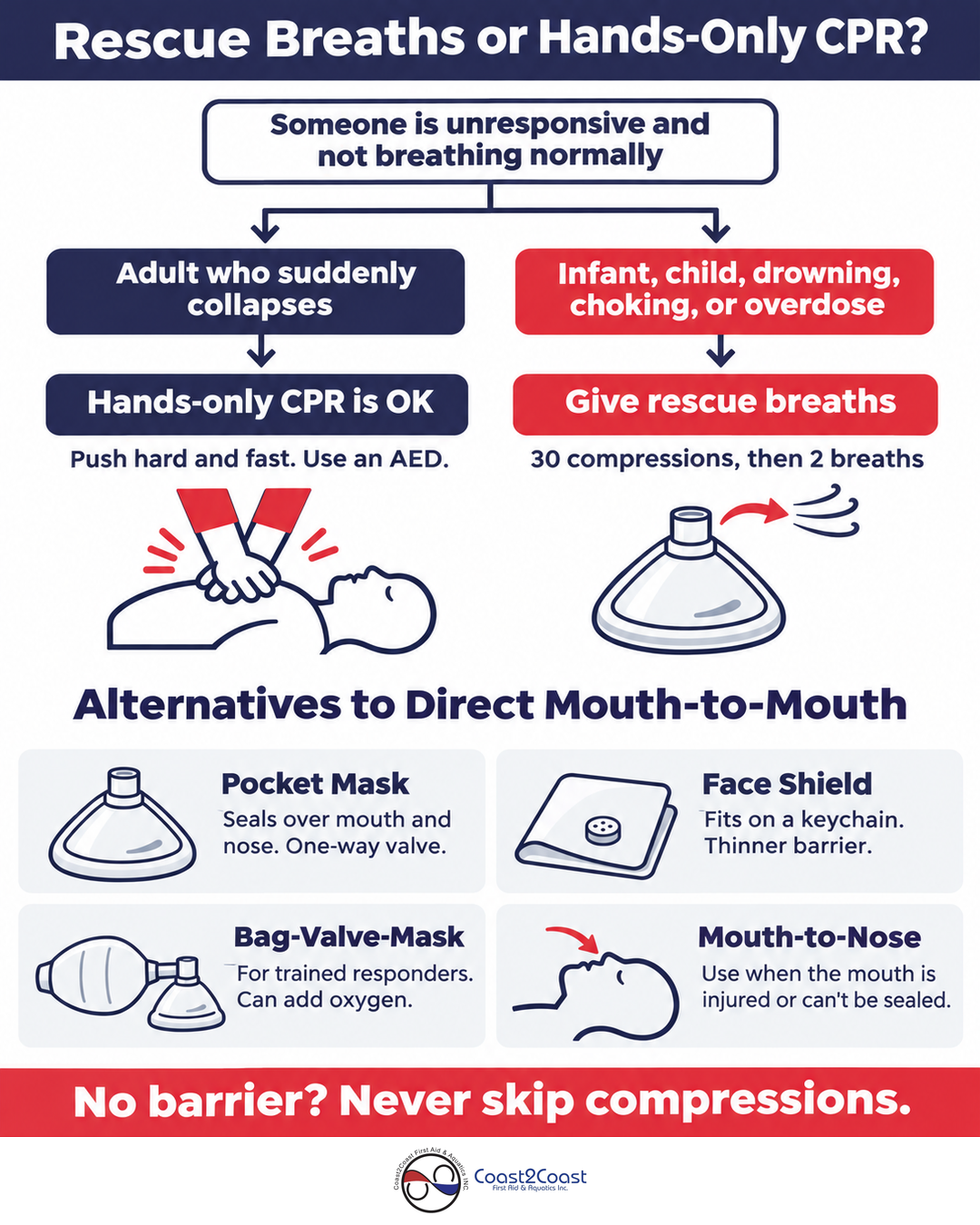
Yes. For an adult who suddenly collapses, the Canadian Red Cross accepts compression-only CPR for anyone who is unwilling, unable, or untrained to give rescue breaths. CPR with no mouth-to-mouth still circulates the oxygen already in the blood during the first minutes after a cardiac arrest.

To give hands-only CPR, call 9-1-1, push hard and fast in the centre of the chest, and keep going until an AED arrives or paramedics take over. Mouth-to-mouth is not required in this situation, and starting compressions right away matters more than anything else.

That does not mean there is no more mouth-to-mouth CPR. Breaths remain essential when the heart stopped because the person ran out of oxygen first:

  • Infants and children, whose hearts usually stop because of a breathing problem.
  • Drowning, where oxygen delivery is the core problem.
  • Choking, severe asthma attacks, and smoke inhalation.
  • Opioid overdoses, where Ontario’s naloxone instructions tell responders to give rescue breathing and/or chest compressions.

Recognizing these breathing emergencies is a core part of Intermediate First Aid (formerly Standard First Aid), which covers CPR with breaths for every age.

Build full CPR and first aid skills

Intermediate First Aid covers rescue breaths, choking, and breathing emergencies.

Explore Intermediate First Aid

What Are the Alternatives to Direct Mouth-to-Mouth Contact?

When breaths are needed, these options let you give them without putting your mouth directly on the person’s:

CPR Pocket Mask

A CPR pocket mask is a clear mask with a one-way valve that seals over the mouth and nose. It keeps saliva and vomit away from you, gives a better seal than a face shield, and many models include an oxygen inlet for trained responders.

CPR Face Shield

A face shield is a thin plastic sheet with a filter or valve that lies across the face. It folds small enough for a keychain, but the seal is harder to hold and the protection is lower than a pocket mask.

Bag-Valve-Mask

A bag-valve-mask pushes air, or supplemental oxygen, into the lungs when squeezed, so the rescuer never breathes into the person. It works best with two trained rescuers and is taught in Basic Life Support (BLS) for healthcare providers.

Mouth-to-Nose Breathing

Mouth-to-nose breathing is used when the mouth is injured, cannot be opened, or cannot be sealed, or when supporting someone in the water. It still involves direct contact, so use a pocket mask when one is available.

Coast2Coast First Aid infographic showing when to use hands-only CPR or rescue breaths, plus four alternatives to direct mouth-to-mouth: pocket mask, face shield, bag-valve-mask and mouth-to-nose breathing
Safety Tip: Keep a pocket mask in your car and bag, and check that the one-way valve is attached before you need it.

Stock your kit before an emergency

Shop pocket masks, face shields, gloves, and first aid supplies.

Shop First Aid Supplies

Is Mouth-to-Mouth Resuscitation Safe?

Catching an infection from mouth-to-mouth resuscitation is rare. The International Liaison Committee on Resuscitation (ILCOR) found only a few reported cases of disease transmission and considers CPR generally safe for rescuers. A barrier device with a one-way valve plus disposable gloves lowers the risk further. The more common problem is air entering the stomach when breaths are too forceful, which can cause vomiting. Give only enough air to make the chest rise. If the person vomits, roll them onto their side, clear the mouth, roll them back, and continue CPR.

Where Can You Learn Mouth-to-Mouth and Hands-Only CPR?

First aid mouth-to-mouth resuscitation is a hands-on skill. In CPR training, you practise rescue breaths with a pocket mask on adult, child, and infant manikins, along with hands-only CPR and AED use, while an instructor corrects your technique.

For workplaces, CSA Z1220-17 Type 2 and Type 3 first aid kits include a CPR barrier device with a one-way valve, but equipment only helps if people know how to use it. Private group training lets your team practise together so several people can respond, swap compressions, and run the AED.

Workplace Training

Train Your Whole Team

Book an on-site or private group Canadian Red Cross course around your shifts.

Request Group Training

Key Takeaway

Mouth-to-mouth resuscitation is still part of full CPR, given as 2 breaths after every 30 compressions. For an adult who suddenly collapses, hands-only CPR is an accepted alternative, and a pocket mask or face shield removes direct contact when breaths are needed. Infants, children, and drowning victims still need breaths. Never let hesitation about mouth-to-mouth stop you from starting compressions.

Get Certified

Join 200,000+ Canadians Who Are Certified

Coast2Coast is a Top 3 Canadian Red Cross Training Partner with a 99.9% pass rate.

Browse First Aid Courses

Frequently Asked Questions: Mouth-to-Mouth Resuscitation 2026

Q1: What is mouth-to-mouth resuscitation called in CPR?

A: In CPR, mouth-to-mouth resuscitation is usually called rescue breathing or giving rescue breaths. Older names include expired air resuscitation and artificial respiration. All of these terms mean the same thing: breathing air into the lungs of a person who is not breathing normally. In CPR, rescue breaths are given in cycles of 30 chest compressions followed by 2 breaths.

Q2: Is mouth-to-mouth still part of CPR in Canada?

A: Yes. Mouth-to-mouth resuscitation is still part of full CPR in Canada, given as 2 rescue breaths after every 30 chest compressions. What changed is that CPR now starts with compressions, and compression-only CPR is accepted for adults when a rescuer is unwilling, unable, or untrained to give breaths. Breaths remain recommended for infants, children, drowning, and other breathing emergencies.

Q3: Can you do CPR without mouth-to-mouth?

A: Yes. For an adult who suddenly collapses, the Canadian Red Cross accepts compression-only CPR for anyone unwilling, unable, or untrained to give rescue breaths. Call 9-1-1, send someone for an AED, and push hard and fast in the centre of the chest at 100 to 120 compressions per minute. Keep going until an AED is ready or paramedics take over.

Q4: What are the steps for mouth-to-mouth resuscitation?

A: After 30 chest compressions, open the airway with a head-tilt chin-lift. Pinch the nose closed, seal your mouth over the person’s mouth or use a barrier device, and breathe in for about one second until the chest rises. Let the chest fall, give a second breath, then return to compressions. Keep the pause for both breaths under 10 seconds.

Q5: How long should each rescue breath last?

A: Each rescue breath should last about one second, with just enough air to make the chest visibly rise. Blowing too hard or too long can push air into the stomach, which raises the risk of vomiting. Let the chest fall completely before giving the second breath, then go straight back to chest compressions so blood keeps moving to the brain.

More FAQs: Mouth-to-Mouth Safety and Training

Q6: Is there enough oxygen in your breath for mouth-to-mouth?

A: Yes. Your lungs absorb only part of the oxygen in each breath, so the air you breathe out still contains oxygen. That is enough to add oxygen to the blood of a person who has stopped breathing. Paramedics and other trained providers can add supplemental oxygen through a bag-valve-mask or a pocket mask with an oxygen inlet, but your own breath works when nothing else is available.

Q7: Should children and infants get mouth-to-mouth resuscitation?

A: Yes. Children and infants should receive full CPR with rescue breaths whenever you are able to give them, because their hearts usually stop due to a breathing problem such as choking or asthma. For an infant, cover both the mouth and nose with your mouth and give gentle puffs. If you cannot give breaths, compressions alone are still far better than doing nothing.

Q8: What should I do if a rescue breath does not go in?

A: If the first rescue breath does not make the chest rise, tilt the head back again and lift the chin to reopen the airway, then try a second breath. If it still does not go in, return to chest compressions. Before your next breaths, look in the mouth for an object and remove it only if you can see it. The airway may be blocked.

Q9: Can I catch an infection from mouth-to-mouth resuscitation?

A: Catching an infection from mouth-to-mouth resuscitation is rare. ILCOR, the international body that reviews resuscitation science, found only a few reported cases and considers CPR generally safe for rescuers. A CPR pocket mask or face shield with a one-way valve keeps the person’s exhaled air, saliva, and vomit away from you, and disposable gloves add more protection. If you have no barrier, you can give compression-only CPR to an adult who suddenly collapses.

Q10: Where can I learn mouth-to-mouth resuscitation?

A: You can learn mouth-to-mouth resuscitation in a hands-on Canadian Red Cross CPR/AED or first aid course. In class you practise rescue breaths with a pocket mask on adult, child, and infant manikins, along with hands-only CPR, AED use, and choking response, while an instructor corrects your technique. Coast2Coast First Aid and Aquatics offers public courses and private group training across Canada.

Disclaimer: This article is for general education only and is not a substitute for certified first aid and CPR training or medical advice. In an emergency, call 9-1-1 and follow the call-taker’s instructions.

Reviewed & Sourced

Reviewed by Ashkon Pourheidary, B.Sc. (Hons) Neuroscience, Canadian Red Cross Instructor Trainer since 2011 and Co-Founder of Coast2Coast First Aid and Aquatics.

Sources: Heart and Stroke Foundation of Canada, "Highs and lows: More cardiac arrests are occurring and few survive" (January 2024); Canadian Red Cross, Compression-Only CPR guidance; Ontario Ministry of Health, Naloxone 5-step instructions (January 2026); International Liaison Committee on Resuscitation (ILCOR), "Harm to rescuers from CPR" (2020). Kit standard referenced: CSA Z1220-17.

Why Everyone Should Have First Aid Training: A Guide for Every Age

Coast2Coast First Aid banner titled “Why Everyone Should Have First Aid Training: A Guide for Every Age” showing adults of different ages practising CPR on adult and infant manikins in a first aid class

Everyone should have first aid training because emergencies happen at home, at work, and in public long before paramedics arrive, and brain damage can begin within 4 to 6 minutes without oxygen. Children can start formal training at age 9 with the Canadian Red Cross Stay Safe! course, teens and adults can earn full first aid and CPR certification, and there is no upper age limit.

Courses for Every Age

Find First Aid Training Near You

Hands-on Canadian Red Cross courses for youth, adults, families, and workplaces.

See All Course Locations

60,000

out-of-hospital cardiac arrests in Canada every year (Heart & Stroke)

4 to 6 min

before brain damage can begin without oxygen

Age 9

minimum age for the Canadian Red Cross Stay Safe! course

Why Is It Important to Know First Aid?

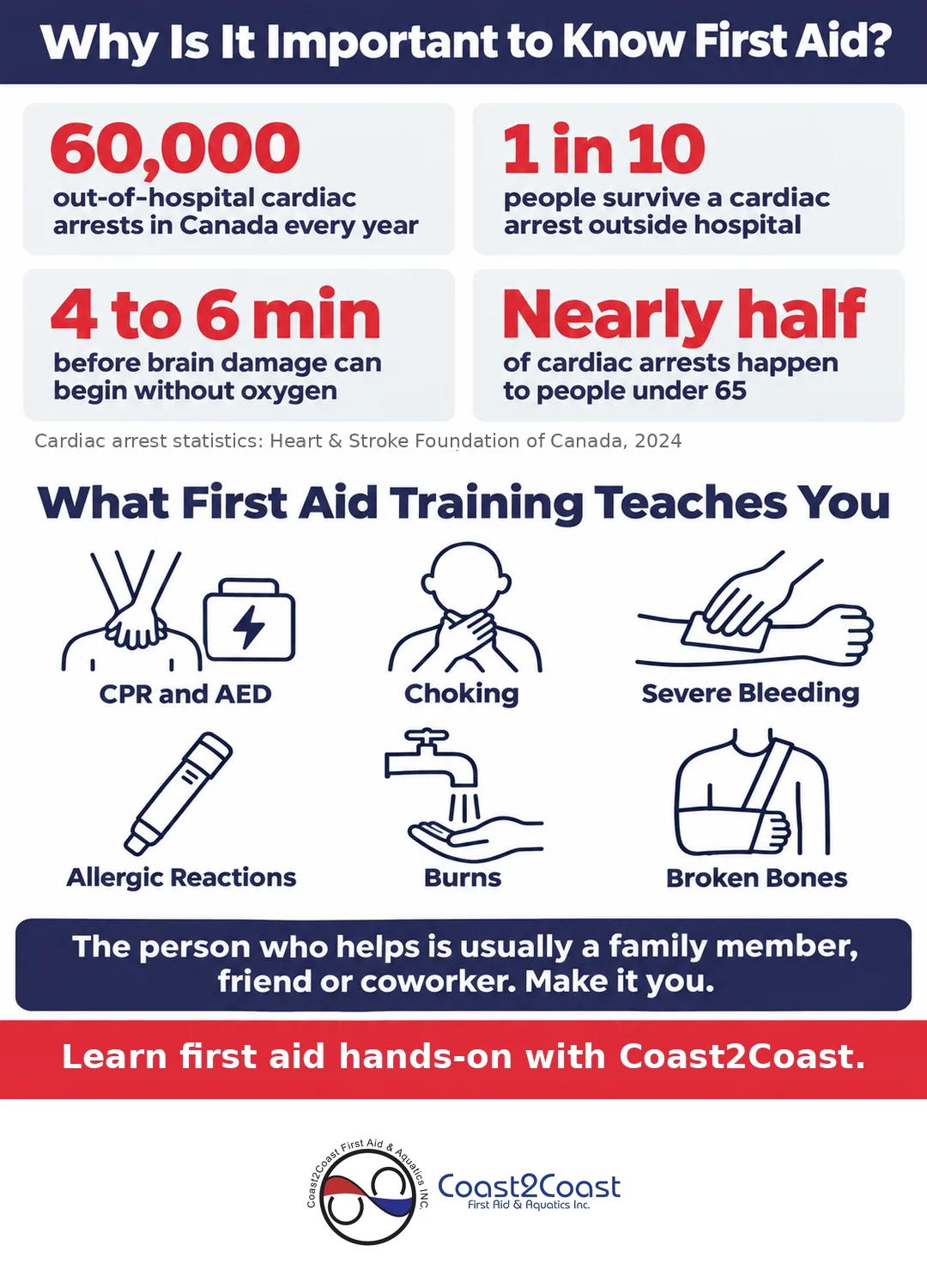
First aid is the immediate care you give someone who is injured or suddenly ill until paramedics take over. Knowing first aid is important because the first few minutes of an emergency often decide the outcome. Brain damage can begin within 4 to 6 minutes when the brain is starved of oxygen, and an ambulance can take longer than that to arrive, especially outside cities.

The numbers show why this matters for everyone, not just healthcare workers. Heart & Stroke reports about 60,000 out-of-hospital cardiac arrests in Canada each year, and only about 1 in 10 people survive. Most happen in private places like homes, and nearly half happen to people under 65. The person most likely to help is a family member, coworker, or friend.

First aid training turns bystanders into responders. It teaches you to stay calm, call 9-1-1 correctly, and act, whether that means starting CPR, stopping severe bleeding, or helping someone who is choking. It also stops small problems, like a burn or an allergic reaction, from becoming serious ones.

Coast2Coast First Aid infographic explaining why it is important to know first aid, with Canadian cardiac arrest statistics and six skills taught in first aid training: CPR and AED, choking, severe bleeding, allergic reactions, burns and broken bones

Not sure which course you need?

Answer a few quick questions to match your age, job, and goals to the right course.

Find My Course

What Does First Aid Training Teach You?

A Canadian Red Cross first aid course teaches you to recognize emergencies and respond with confidence. Depending on the level, you learn how to:

  • Perform CPR and use an AED for adults, children, and infants.
  • Help a person who is choking.
  • Control severe bleeding and treat wounds and burns.
  • Recognize a heart attack, stroke, or severe allergic reaction, and help with an epinephrine auto-injector.
  • Care for fractures, head injuries, and suspected spinal injuries until help arrives.

Every skill is practised hands-on with manikins and real equipment, so it becomes automatic. If you only need the life-saving essentials, CPR/AED courses focus on cardiac arrest and choking response.

Hands-On Skills Practice

Learn CPR and AED Skills in a Real Classroom

Practise compressions, rescue breaths, and AED use with instructor feedback on every rep.

View CPR/AED Courses

At What Age Can You Learn First Aid?

First aid is for all ages. The right starting point depends on what a person can safely do in an emergency.

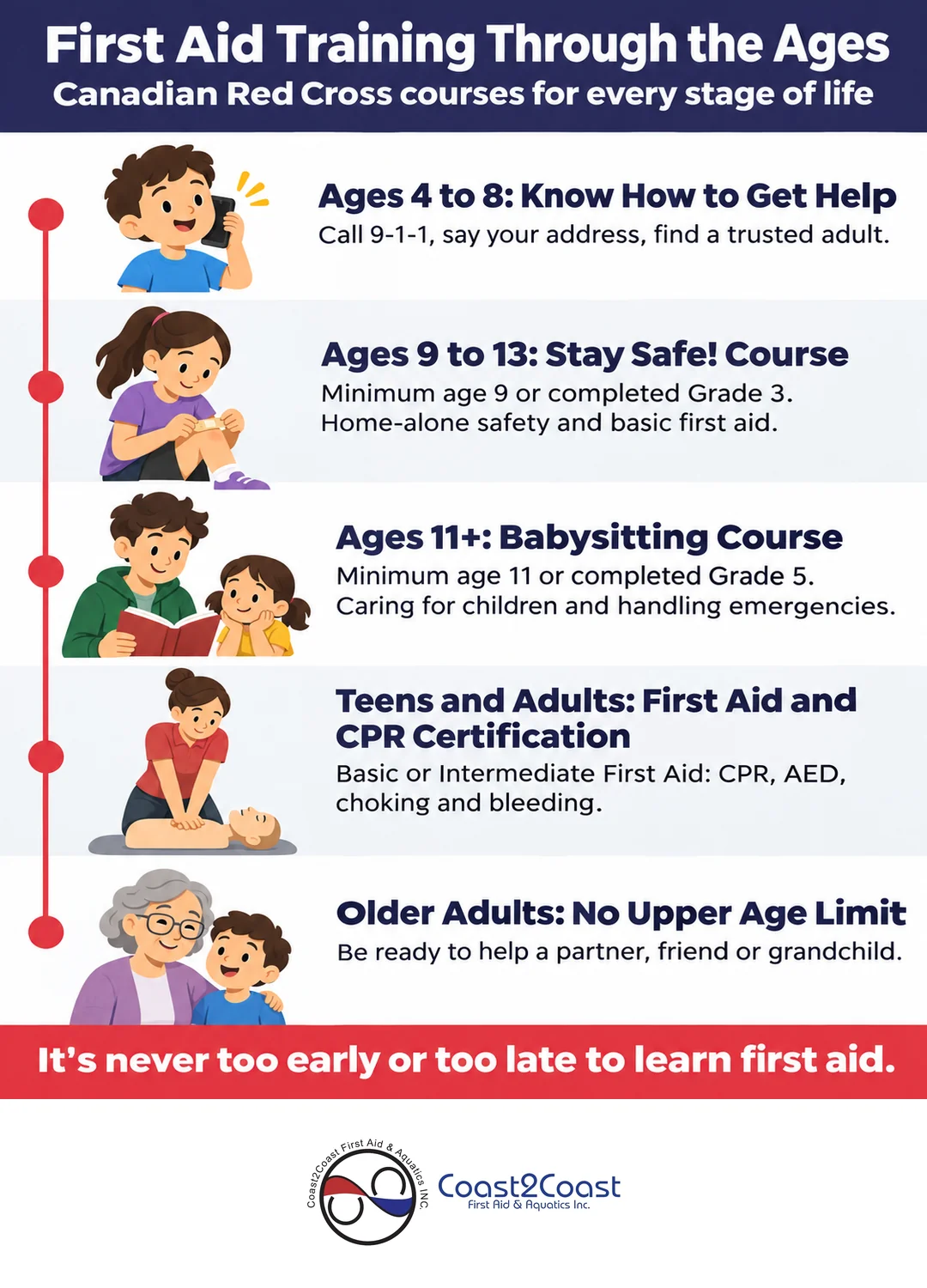
Ages 4 to 8: Knowing How to Get Help

Young children can learn to call 9-1-1, say their address, and find a trusted adult. Parents can teach these basics at home long before a formal course.

Ages 9 to 13: Canadian Red Cross Stay Safe!

Stay Safe! is designed for youth aged 9 to 13. Children must be at least 9 years old or have completed Grade 3. The 5 to 6 hour course covers staying safe at home alone, preventing injuries, and basic first aid.

Ages 11 and Up: Canadian Red Cross Babysitting

The Babysitting course requires a minimum age of 11 or completion of Grade 5. It teaches caring for younger children, preventing injuries, and handling emergencies such as choking. Both youth courses are listed on our Canadian Red Cross youth courses page.

Teens, Adults, and Older Adults

Teens can earn full first aid and CPR certification, which is often required for jobs like lifeguarding, coaching, and camp counselling. For adults, training matters at every stage, from new parents to grandparents caring for family. There is no upper age limit. If kneeling is a concern, let your instructor know before class.

Coast2Coast First Aid infographic showing first aid training at every age: children 4 to 8 learn to call 9-1-1, Stay Safe! starts at age 9, Babysitting at age 11, teens and adults earn first aid and CPR certification, and there is no upper age limit

Enrol your child in a youth course

Stay Safe! and Babysitting build confidence and real safety skills.

See Youth Courses

Which First Aid Course Should You Take?

Basic First Aid (formerly Emergency First Aid) is a shorter course focused on CPR, AED use, choking, and life-threatening emergencies. It is a good fit for parents and anyone who wants essential skills.

Intermediate First Aid (formerly Standard First Aid) covers the same core skills plus a wider range of injuries and illnesses. It is the level many workplaces require. Healthcare providers usually need Basic Life Support (BLS) instead.

Canadian Red Cross first aid and CPR certificates are typically valid for three years, while BLS is valid for one year.

Compliance Note: In Ontario, WSIB’s First Aid Program now aligns with CSA Z1210:24, which renamed Emergency First Aid to Basic First Aid and Standard First Aid to Intermediate First Aid. Other provinces set their own workplace requirements, so confirm the level you need with your provincial regulator.

Short on time?

Blended learning combines online theory with a shorter in-person skills session.

Explore Blended Courses

Why Is It Important to Have a First Aid Kit?

Training and equipment work together. A well-stocked first aid kit puts gloves, gauze, bandages, and a CPR barrier device within reach the moment an injury happens, so you don’t lose time searching or improvising.

Keep first aid kits for home, your car, and your workplace. Workplace kits must meet provincial rules, and many follow the CSA Z1220-17 first aid kit standard. Check expiry dates regularly, restock after each use, and make sure everyone knows where the kit is. Training is what turns those first aid kits and supplies into real help, because it teaches you when and how to use each item.

How Does First Aid Training Help Workplaces?

Every province requires employers to have trained first aiders and stocked first aid kits, with the details depending on the province, workforce size, and type of work. Beyond compliance, trained teams respond faster, injuries are handled correctly, and workers feel safer. Private group training lets you certify your whole team together, on site or at one of our training centres.

Workplace Training

Train Your Whole Team

Book a private group Canadian Red Cross course scheduled around your shifts.

Request Group Training

Key Takeaway

First aid training matters for everyone because emergencies happen at home, at work, and in public before paramedics arrive. Children can start at age 9 with Stay Safe!, teens and adults can earn full first aid and CPR certification, and there is no upper age limit. Pair your training with a well-stocked first aid kit, and refresh your skills before your certificate expires.

Get Certified

Join 200,000+ Canadians Who Are Certified

Coast2Coast is a Top 3 Canadian Red Cross Training Partner with a 99.9% pass rate.

Browse First Aid Courses

Frequently Asked Questions: First Aid Training for Everyone 2026

Q1: Why is it important to know first aid?

A: Knowing first aid is important because emergencies happen before paramedics can arrive. Brain damage can begin within 4 to 6 minutes when the brain is starved of oxygen, so what a bystander does in those first minutes often decides the outcome. First aid lets you call for help correctly, start CPR, use an AED, control bleeding, and help someone who is choking until professional care takes over.

Q2: What is first aid?

A: First aid is the immediate care given to a person who is injured or suddenly ill, until paramedics or other medical help takes over. It ranges from cleaning a small cut to giving CPR and using an AED during a cardiac arrest. The goals of first aid are to preserve life, prevent the condition from getting worse, and support recovery.

Q3: At what age can a child learn first aid?

A: Children can start learning first aid basics, such as how to call 9-1-1 and say their address, as early as preschool. Formal training starts with the Canadian Red Cross Stay Safe! course, which requires children to be at least 9 years old or to have completed Grade 3. The Canadian Red Cross Babysitting course requires a minimum age of 11 or completion of Grade 5.

Q4: Is there a maximum age for first aid training?

A: No. There is no maximum age for first aid training. Older adults are often the people most likely to respond to an emergency involving a spouse, friend, or grandchild, which makes first aid and CPR training especially valuable. If kneeling or mobility is a concern, tell your instructor before class so they can help you practise in a way that works for you.

Q5: What is the difference between Basic and Intermediate First Aid?

A: Basic First Aid, formerly called Emergency First Aid, is a shorter course that focuses on CPR, AED use, choking, bleeding, and other life-threatening emergencies. Intermediate First Aid, formerly called Standard First Aid, covers the same core skills plus a wider range of injuries and illnesses, such as fractures, head and spinal injuries, and environmental emergencies. The new names follow the CSA Z1210:24 standard.

More FAQs: Certificates, Kits, and the Law

Q6: How long is a first aid certificate valid in Canada?

A: Canadian Red Cross first aid and CPR certificates are typically valid for three years. Basic Life Support (BLS) certification for healthcare providers is valid for one year. Skills fade faster than certificates expire, so it is worth refreshing your training before it lapses. A recertification course is usually shorter than the full course and keeps your certificate current.

Q7: Why is it important to have a first aid kit?

A: A first aid kit is important because it puts the supplies you need, such as gloves, gauze, bandages, and a CPR barrier device, within reach the moment an injury happens. Without one, you lose valuable time searching for supplies or improvising. Keep a kit at home, in your car, and at work, check expiry dates regularly, and restock it after every use.

Q8: Can you be sued for giving first aid in Canada?

A: It is very unlikely. Good Samaritan laws protect people who give first aid in good faith and without gross negligence. In Ontario, this protection comes from the Good Samaritan Act, 2001, and other provinces have similar laws. Quebec goes further and requires people to help someone whose life is in danger, as long as it is safe to do so. Staying within your training helps protect you.

Q9: Is first aid training required at work in Canada?

A: Yes. Every province requires employers to have trained first aiders and stocked first aid kits, but the exact rules depend on the province, the number of workers, and the type of work. In Ontario, workplace first aid requirements are set by WSIB. In Alberta, they fall under the OHS Code, and Nova Scotia’s requirements fall under its Occupational Health and Safety Act.

Q10: Can you learn first aid online?

A: You can complete part of a first aid course online through blended learning, but certification still requires an in-person skills session. Skills like CPR, choking response, and applying pressure to a wound must be practised hands-on with an instructor who can check your technique. Blended learning shortens the time in class while keeping the practical training that makes your skills reliable in a real emergency.

Disclaimer: This article is for general education only and is not a substitute for certified first aid training, medical advice, or legal advice. In an emergency, call 9-1-1. Workplace first aid requirements vary by province; confirm your obligations with your provincial workplace safety regulator.

Reviewed & Sourced

Reviewed by Ashkon Pourheidary, B.Sc. (Hons) Neuroscience, Canadian Red Cross Instructor Trainer since 2011 and Co-Founder of Coast2Coast First Aid and Aquatics.

Sources: Heart and Stroke Foundation of Canada, "Highs and lows: More cardiac arrests are occurring and few survive" (January 2024) and "Cardiac arrest"; Canadian Red Cross, Stay Safe! and Babysitting course requirements and certificate validity; Workplace Safety and Insurance Board (WSIB), First Aid Program; Good Samaritan Act, 2001 (Ontario); Quebec Charter of Human Rights and Freedoms, section 2; Alberta Occupational Health and Safety Code; Nova Scotia Occupational Health and Safety Act. Training and kit standards referenced: CSA Z1210:24 and CSA Z1220-17.

The Ultimate Canadian First Aid & CPR FAQ: 100 Real Questions Answered

EMR student practicing patient assessment on mannequin during emergency medical responder training
Key takeaways
  • Certificates expire. Canadian Red Cross first aid and CPR certificates are valid for three years; Basic Life Support (BLS) is valid for one year.
  • Pick the course by who is asking. Intermediate First Aid (formerly Standard First Aid) is the two-day course most workplaces require; Basic First Aid (formerly Emergency First Aid) is the one-day version; BLS is the standard for healthcare providers.
  • Course names are transitioning across Canada. The Canadian Red Cross uses Intermediate/Standard First Aid and Basic/Emergency First Aid so learners recognize both the newer and established names; the terminology used by employers and regulators may vary by province.
  • Online-only training does not meet recognized certification requirements. Practical first aid and CPR skills must be assessed in person, so WSIB, Alberta OHS and most employers require it. Legitimate blended courses combine online theory with an instructor-led skills session.
  • The 100 answers below cover the rest: costs, renewals, workplace rules, BLS, childcare, and real emergency skills.
100
Questions answered in plain language
10
Categories, from course levels to careers
80+
Answers informed by real Reddit & Quora discussions
3 Yrs
Typical First Aid/CPR validity; BLS is 1 year

Every week, Canadians ask the same first aid questions in the same places: Reddit threads in r/askTO and r/Calgary, Quora posts about broken ribs and expired cards, and Google searches that start with “how long” or “do I need.” This guide answers 100 common questions Canadians ask about first aid, CPR and BLS courses, in plain language, aligned with Canadian Red Cross guidelines and reviewed by an instructor trainer. Use the search box or the table of contents to jump to a topic. Many answers link to the original Reddit and Quora discussions that helped identify what Canadians are asking.

Reviewed by a Canadian Red Cross Instructor Trainer.

Browse by Category

Showing all 100 questions.

First Aid & CPR Basics

Plain-answer fundamentals for anyone new to first aid and CPR training.

Certification & Course Levels

Which course you actually need: Standard vs Emergency, CPR levels, and how certifications stack.

Cost, Duration & Booking

What courses cost, how long they take, and how to book solo or as a group.

Certify Your Whole Team Together

Learn About Group Training

Online, Blended & In-Person

What counts, what doesn’t, and how blended courses actually work.

Recertification, Renewal & Expiry

Validity periods, grace periods, and what to do when a certificate lapses.

BLS for Healthcare Providers

Basic Life Support: who needs it, how it differs from CPR-C, and how renewal works.

Basic Life Support for Healthcare Providers

View BLS Courses

Workplace Requirements & Compliance

WSIB, Alberta OHS, and what the law expects from workplaces and bystanders.

Childcare, Babysitting & Parents

Certification for babysitters, nannies, ECEs, and parents of young children.

Canadian Red Cross Babysitting & Stay Safe! Courses

See Youth Courses

CPR, AED & Choking Skills

The questions people are often afraid to ask in class, answered straight.

Jobs, Careers & Resumes

How certifications translate into work, from resumes to instructor pathways.

Editorial Method: How This Guide Was Prepared

Questions were selected from Canadian search demand and public forum discussions. Answers were edited for clarity, checked against current Canadian Red Cross program information and provincial regulator sources, and reviewed by a Canadian Red Cross Instructor Trainer. Representative forum examples are linked as provenance; primary sources support clinical and regulatory claims.

Key Takeaway

Match the certificate to the requirement: Intermediate/Standard First Aid for most workplaces, Basic/Emergency First Aid for the basics, Basic Life Support for healthcare. Take the skills portion in person, and renew before the printed expiry date. Everything else is detail, and it is answered above.

Get Certified This Week

Weekly Courses Across Ontario & Alberta, Certified Same Day

Find a Course Near You

This guide is provided for general informational purposes and does not replace certified training or personalized medical advice. In an emergency, call 911. Course requirements are set by employers, regulators and licensing bodies, so always confirm the exact certificate your organization requires.

Reviewed By

Written by Godwin Orilua and reviewed by Ashkon Pourheidary, B.Sc. Hons Neuroscience, Co-Founder and Canadian Red Cross Instructor Trainer at Coast2Coast First Aid Inc. Questions were identified from public Reddit and Quora discussions and common Google searches. Forum links show where people ask these questions; factual answers were reviewed against current Canadian Red Cross program materials and relevant provincial regulatory guidance where applicable.

About Coast2Coast First Aid

Coast2Coast First Aid Inc. is a Canadian Red Cross Training Partner delivering first aid, CPR and Basic Life Support programs across Ontario and Alberta, for individuals, workplaces and organizations. For more information, visit c2cfirstaidaquatics.com.

Free BLS, First Aid & CPR Course 2026 Guide to Get Certified for $0

  • Executive Summary: The Deal at a Glance

    The Offer: Register for a course, film your experience, and post it online.

    The Content Rule: While we love authentic ‘Day in the Life’ vlogs, your training experience must be the main focus of the video. Ensure your time at Coast2Coast takes up a significant portion of your reel (at least 10-15 seconds) rather than just a passing clip.

    The Goal: Hit 5,000 views on Instagram, TikTok OR 2,000 views on YouTube.

    The Reward: A FULL REFUND of your course fee.

    Eligible Courses: Standard First Aid, Emergency First Aid, CPR Level C, and Basic Life Support (BLS).

    Locations: Toronto, Brampton, Ottawa, Calgary, Edmonton, and more.

    Terms and conditions apply. Views must be organic. Limited time offer.


We know that for students, job seekers, and healthcare professionals, training costs can add up. You are constantly searching for a free first aid and cpr course or a free bls course near me, only to find that most “free” options online are just informational videos that don’t offer the official WSIB-approved certification you need to actually get hired.

At Coast2Coast First Aid & Aquatics, we believe life-saving education should be accessible to everyone. That is why we are launching our biggest student-creator campaign ever. We are giving you the chance to turn your creativity into cash—literally.

Here is your complete guide on how to get official Red Cross training for $0, plus everything you need to know about choosing the right course.

How It Works: 4 Steps to a Free Course

You don’t need to be a professional influencer to qualify. You just need a smartphone and a little creativity during your training session.

1. Register for Your Course

Sign up for any of our eligible training sessions across Ontario or Alberta. You pay for the course upfront to secure your spot.

2. Film Your Experience

During your class (during break times or practice sessions, ensuring you don’t disrupt the class), capture content!

  • Film yourself practicing CPR on a mannequin.

  • Show off your bandaging skills.

  • Share a “Day in the Life” of getting certified.

3. Post & Tag Us

Upload your video to Instagram Reels, TikTok or YouTube Shorts.

4. Hit the Views & Get Paid

If your video hits 5,000 Views on Instagram, TikTok OR 2,000 Views on YouTube, email us at marketing [at] c2cfirstaidaquatics.com and mention that you have took part in this challenge and you have hit the mark by sending us the link! Once verified, we will issue a full refund to your original payment method.

(Terms and conditions apply. Views must be organic. Offer valid for a limited time.)
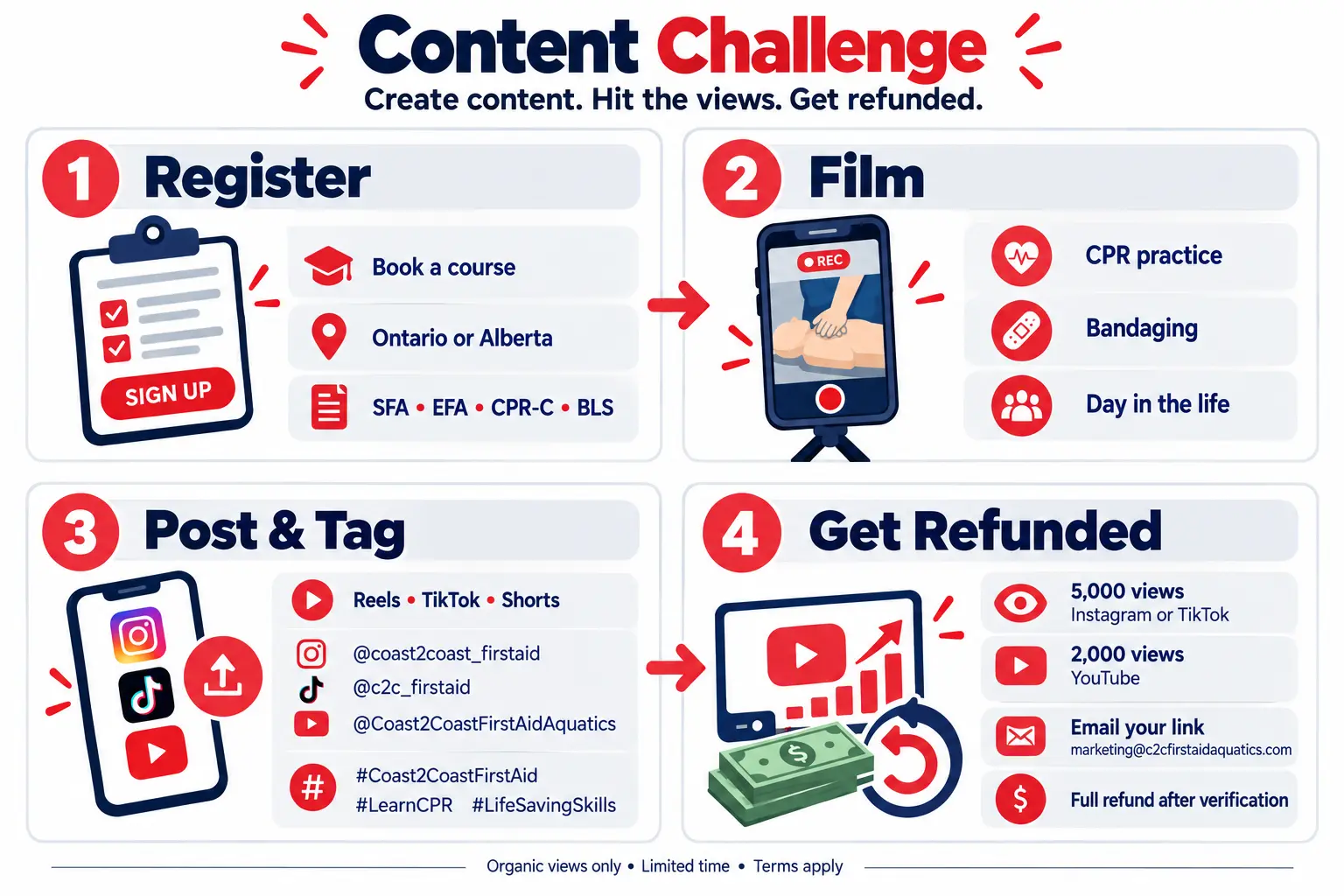
How It Works 4 Steps to a Free Course


Why Are We Doing This?

We want to spread awareness about the importance of CPR and First Aid. When you search for a first aid and cpr course free, you often find non-accredited videos that won’t help you get a job. We want to change that.

By sharing your journey, you aren’t just getting a free cpr course; you are inspiring your friends and followers to learn skills that save lives.

Wait, Which Course Do I Need? (The Ultimate Guide)

Before you sign up and start filming, you need to make sure you are taking the right course. Choosing the wrong certification is the most common mistake students make.

Here is a simple breakdown to help you pick the perfect training for your needs.

1. Standard First Aid & CPR/AED Level C

  • Best For: Construction workers, daycare staff, lifeguards, and general workplace compliance.

  • What It Covers: This is our most comprehensive course. It covers everything from spinal injuries and bone fractures to severe bleeding and CPR for adults, children, and infants.

  • Validity: 3 Years.

2. Emergency First Aid & CPR/AED Level C

  • Best For: Security guards, fitness instructors, government employees, or those needing a basic overview.

  • What It Covers: A shorter, 1-day course focusing on immediate life-saving interventions like choking, CPR, and using an AED.

  • Validity: 3 Years.

3. Basic Life Support (BLS)

  • Best For: Healthcare professionals (Nurses, Dentists, Paramedics, Firefighters).

  • What It Covers: This is a high-intensity, fast-paced course that focuses on high-performance CPR, trauma response, and team dynamics in a clinical setting.

  • Validity: 1 Year (Annual renewal is required).

The “Blended Learning” Advantage

If you are looking for an online cpr course free of classroom time, “Blended Learning” is the closest you can get while still remaining certified.

How It Works:

  1. Online Theory: You complete the “textbook” portion of the course online, at your own pace, from the comfort of your home.

  2. In-Class Skills: You attend a shorter, focused in-person session to practice hands-on skills.

Why Students Love It:

  • Flexible: Study late at night or on weekends.

  • Efficient: Cut your classroom time in half.

  • WSIB & OHS Approved: Yes, it is fully recognized by employers in Ontario and Alberta.

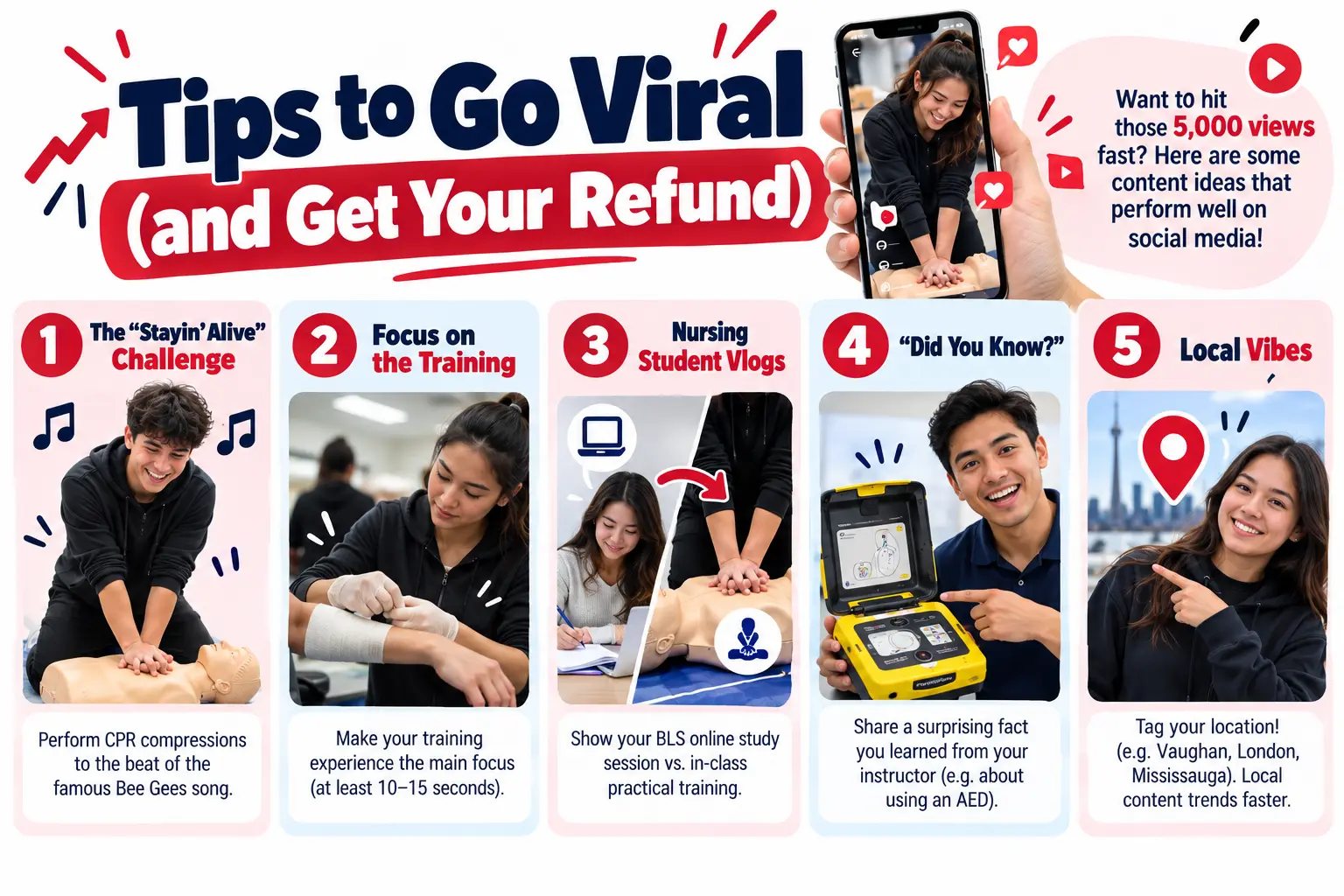
Tips to Go Viral (and Get Your Refund)

Want to hit those 5,000 views fast to secure your refund? Here are some content ideas that perform well on social media:

  • The “Stayin’ Alive” Challenge: Perform CPR compressions to the beat of the famous Bee Gees song.

  • Keep it focused on the training: While we love authentic ‘Day in the Life’ vlogs, your training experience must be the main focus of the video. Ensure your time at Coast2Coast takes up a significant portion of your reel (at least 10-15 seconds) rather than just a passing clip.

  • Nursing Student Vlogs: Show the reality of your BLS course online free study session vs. the intense in-class practical training.

  • “Did You Know?”: Share a surprising fact you learned from your Coast2Coast instructor (e.g., “I bet you didn’t know this about using an AED…”).

  • Local Vibes: Tag your location! Whether it’s First Aid in Vaughan, CPR in London, or Training in Mississauga, local content trends faster.

(Terms and conditions apply. Views must be organic. Offer valid for a limited time.)
Tips to Go Viral and Get Refunds


Frequently Asked Questions (FAQ)

We know you have questions. Here are the answers to the most common queries about our courses and the refund offer.

About the “Free Course” Offer

1. Is this really a free first aid and cpr course with certificate? Yes! You pay upfront to reserve your seat and receive your official Canadian Red Cross certificate. However, if you meet the social media view requirements, we refund 100% of your fee, effectively making it a free cpr course with certificate.

2. Can I find a free bls course near me? Official BLS (Basic Life Support) training usually requires payment because it is a professional-level certification. However, our campaign applies to BLS courses too! If you are a nursing student looking for a free bls course, this challenge is your best route to getting certified for free.

3. Does this apply to the online cpr course free portion? Our courses are “Blended Learning,” meaning you do half online and half in-class. The refund covers the entire cost of the training, including the online access and the in-person workshop.

4. I am looking for a free cpr refresher course. Does this count? Absolutely. Whether it is a full certification or a cpr refresher course online free of charge (via refund), the challenge applies as long as you are registered in a Coast2Coast session.

5. Can my video just be a vlog of my entire day?
While we love authentic ‘Day in the Life’ vlogs, your training experience must be the main focus of the video. Ensure your time at Coast2Coast takes up a significant portion of your reel (at least 10-15 seconds) rather than just a passing clip.

6. Is this available in my city? This offer is valid at all Coast2Coast locations. So whether you are searching for a free cpr course Toronto, free cpr course Ottawa, free cpr course Calgary, or a free cpr course Belleville, you are eligible to participate!

About Certification & Validity

6. Is the certificate WSIB approved? Yes. Unlike many generic online free cpr course options you find on the web, our training is fully WSIB (Ontario) and OHS (Alberta) approved.

7. How long is my First Aid certificate valid? For Standard and Emergency First Aid, your certificate is valid for 3 years. If you take Basic Life Support (BLS), you must renew it every 1 year.

8. Can I recertify instead of taking the full course? Yes! If your current Standard First Aid certificate has not expired yet, you can take a shorter Recertification Course. This saves you time and money.

9. Can I do the cpr course online free without attending class? No. To get the official certificate, you must attend the in-class skills session. Purely online courses are rarely accepted by employers in Canada.

10. What if I lose my certificate? All Canadian Red Cross certificates are digital. You can access your profile online at any time to download a new copy for free.

Logistics & Details

11. Do I need to bring my own equipment? No. We provide all mannequins, AED trainers, and first aid supplies.

12. Can I get a free cpr course with certificate if I am not a student? Yes! This offer is open to everyone—students, parents, teachers, and professionals.

13. What if I am taking the course for a group? The refund applies to the individual who posts the content. If you book for a group, each person can post their own video to try and earn their own refund.

14. Does the bls course free offer include the manual? The digital eBook is included in your course registration.

15. How long does the refund take? Once you email us your video link and we verify the views, the refund is typically processed within 5-10 business days.

16. Can I combine this with other promo codes? Since the reward is a full refund, it cannot be combined with other discounts. You are getting the whole course for free!

17. What hashtags should I use to help it go viral? We recommend using local tags like #TorontoLife, #CalgaryViews, or #StudentLife alongside our official tag #Coast2CoastFirstAid.

18. Where do I send my video link? Send your booking ID and the link to your viral video to our marketing team email (listed on our contact page) with the subject line “Go Viral Refund Claim.”

19. What if I don’t hit the view count? You still walk away with a valuable, federally recognized certification that boosts your resume. You have nothing to lose!

20. Can I post on TikTok instead? Currently, our tracking is set up for Instagram Reels, TikTok and YouTube Shorts as they allow for the best reach verification. However, feel free to cross-post to TikTok for extra exposure!

Ready to Go Viral?

Don’t settle for an unaccredited online free cpr course that your employer won’t accept. Get the Gold Standard of Red Cross training, have fun filming it, and let us foot the bill.

Find Your Course & Register Now

(Terms and conditions apply. Views must be organic. Offer valid for a limited time.)
Importance of First Aid Training: Why It Matters and Who Needs It

Two people practising CPR and AED skills on manikins during a first aid training class

The importance of first aid training goes far beyond workplace requirements. It gives everyday people the skills and confidence to respond to emergencies at home, work, school, and in public. Learn what first aid training covers in Canada, why it matters, and how it helps build safer communities.

Continue reading