
If your teen has mentioned wanting to become a lifeguard, or you’ve noticed a Bronze Medallion course on your local pool’s schedule, you’re probably wondering what it actually involves and whether your child is ready. The Bronze Medallion is the foundational lifeguarding certification in Canada, recognized by the Lifesaving Society and used by municipalities, pools, and camps across the country.
Key Takeaways
- The core Bronze Medallion swim requirement is a continuous 400m swim completed in 12 minutes, using any combination of recognizable strokes, no stopping, no resting on the wall, no touching the bottom.
- Bronze Medallion requires solid basic swimming proficiency and endurance, not elite speed. Think 16 lengths of a 25m pool at a steady, moderate pace, comparable to jogging an easy kilometre.
- Candidates must be at least 13 years of age by the exam date, or hold a current Bronze Star certification as an alternative prerequisite.
- Bronze Medallion is the gateway to the lifeguard pathway: Bronze Star → Bronze Medallion → Bronze Cross → National Lifeguard.
- Coast2Coast First Aid & Aquatics offers first aid, CPR/AED, and mobile swim training that pairs well with Bronze Medallion for teens working toward lifeguard employment.
What Is the Bronze Medallion and Who Is It For?
The course blends swimming and lifesaving strokes, water rescue skill development, and basic first aid concepts into a single program that prepares youth for real aquatic emergencies. It involves a mix of theoretical knowledge and practical skills, typically delivered over 15 to 18 hours of combined pool time and classroom learning.
At Coast2Coast First Aid & Aquatics, we focus on the complementary safety training, first aid, CPR, and aquatics instruction, that supports teens aiming for lifeguard roles. Understanding the Bronze Medallion swim requirements is the first step in helping your teen build a complete safety skill set.
Exact Bronze Medallion Swim Requirements (Answer First)
Let’s get straight to the number that concerns most parents: candidates must swim 400 metres in under 12 minutes, continuously, assessed by a Lifesaving Society instructor or examiner. No breaks. No clinging to the wall. No touching the bottom.
Here’s what 400m looks like in a real pool:
| Pool Length | Number of Lengths | Average Pace Needed |
|---|---|---|
| 25m pool | 16 lengths | ~30 seconds per length |
| 50m pool | 8 lengths | ~90 seconds per length |
Candidates complete the swim using any combination of recognizable strokes, front crawl, breaststroke, back crawl, or a mix. Stroke switches are allowed at any point. Examiners look for continuous forward motion throughout, reasonable stroke technique, controlled breathing and comfort in deep water, and consistent pacing that shows endurance rather than sprinting and stalling.
The 400m endurance swim is the headline fitness challenge, but the course also includes other timed elements like rescue-object swims, towing drills, and retrieval tasks. Averaging 30 seconds per 25m length is a steady, moderate effort. Many candidates who pass finish between 9 and 11 minutes. It’s not a race, it’s proof you can sustain effort in the water without stopping.
How Strong a Swimmer Do You Really Need to Be?
This is the question behind the question. Parents want to know: does my teen need to be on a swim team? The honest answer is no. Bronze Medallion requires swimming proficiency and endurance, not competitive-athlete performance. Think “capable and confident swimmer,” not “podium finisher.”
Concrete self-checks before registration:
- Distance: Can your teen swim 300 to 400m continuously at a relaxed pace without stopping? If yes, they’re in solid shape.
- Deep water comfort: Can they jump into deep water, tread water for 3 to 5 minutes, and stay calm? This matters as much as the swim itself.
- Stroke quality: Can they swim front crawl, breaststroke, and back crawl with basic good form, near the surface, breathing rhythmically, not gasping?
The 12-minute target for 400m is comparable to jogging an easy kilometre on land. Teens who’ve passed higher-level swim lesson programs are typically ready with a few weeks of extra practice. A weak swimmer who panics in deep water will need more preparation time, but that doesn’t mean the goal is out of reach.
Common worries teens have: “I’ll get out of breath” (mixing strokes helps), “I’ll be the slowest” (the swim is individually timed, not a race), and “my front crawl isn’t great” (consistent practice over 4 to 6 weeks usually fixes this). If your teen is borderline, speak with the course provider, many offer a brief swim assessment or recommend a few private or mobile swimming lessons to close the gap before the course starts.
Age, Prerequisites, and When Teens Should Take Bronze Medallion
The standard Lifesaving Society prerequisite is straightforward: candidates must be at least 13 years of age by the exam date, or qualify by successfully completing the Bronze Star program as an alternative prerequisite, regardless of age (though most Bronze Star candidates are 11 to 13).
A teen who is already 13 does not need Bronze Star certification to register, provided their swimming is strong enough. Bronze Star is helpful preparation, it builds endurance, introduces self-rescue, and develops basic lifesaving skills, but it is not mandatory for candidates who meet the age requirement.
| Award | Common Age | Notes |
|---|---|---|
| Bronze Star | 11 to 12 | Optional but recommended prep |
| Bronze Medallion | 13 to 14 | First major lifesaving certification |
| Bronze Cross | 14 to 15 | Prerequisite for National Lifeguard |
| National Lifeguard | 15 to 16 | Full lifeguard certification |
Starting later is perfectly fine, there is no upper age limit. Parents should confirm specific prerequisites and scheduling with their local provider or municipality, as small variations may exist between regions.
What You’ll Learn Beyond the Swim: Core Bronze Medallion Skills
The 400m swim gets the most attention, but it’s only one piece. Bronze Medallion training includes water rescue, fitness, and decision-making skills organized around four components: judgment, knowledge, skill, and fitness.
In-water skills candidates practice include entries and approaches (including the ladder approach), control carries and towing techniques for a passive or injured victim, head-up front crawl and head-up breaststroke for approaching distressed swimmers, lifesaving strokes including the scissor kick and inverted scissor kick, and supporting both conscious and unconscious victims, including a submerged victim.
Candidates must demonstrate effective self-rescue methods, and training incorporates performing non-contact and contact rescues. The course also teaches the Drowning Chain of Survival, helping teens understand how drowning incidents unfold and how each link can be interrupted.
Theory and dryland components include recognizing drowning signs, risk assessment of aquatic environments, understanding cold-water dangers, prioritizing multiple victims, and developing the assessment and problem-solving skills needed for real water rescue situations.
Join 150,000+ Canadians Who Are Certified
Find a class near you and take the first step today.
Bronze Star, Bronze Medallion, and Bronze Cross: How They Fit Together
Bronze Star is the optional first step. It refines stroke technique, builds comfort with timed swims and simple rescues, and is often recommended for strong swimmers under 13 who want a head start.
Bronze Medallion is where things get serious. It’s the first major lifesaving certification and a prerequisite for Bronze Cross. Candidates learn to assess emergencies, perform rescues, and manage victims, earning a certification card valid for two years from the date issued.
Bronze Cross raises the bar further, with increased emphasis on complex rescues, teamwork, supervision in aquatic facilities, and faster fitness standards (commonly around 11 minutes for the same 400m swim). It’s typically required alongside recognized first aid for National Lifeguard certification.
First Aid, Intermediate First Aid, and CPR-C: What Your Teen Also Needs
Although Bronze Medallion includes basic first aid concepts, such as managing a non-breathing victim, full workplace-recognized certifications are separate courses.
| Certification | Duration | Covers |
|---|---|---|
| Emergency First Aid (now Basic First Aid) + CPR-A | ~8 hours | Basic emergencies, CPR for adults |
| Intermediate First Aid (formerly Standard First Aid) + CPR-C | ~16 hours | Bleeding, shock, fractures, CPR for all ages, AED; meets many aquatic employer requirements |
Most aquatic employers and municipalities require both Bronze Cross and Intermediate or Standard First Aid with CPR-C for hiring as a lifeguard. Some also require Basic Life Support for health-care adjacent roles.
A practical order for most teens: Bronze Medallion (age 13 to 14), Bronze Cross (age 14 to 15), Intermediate or Standard First Aid with CPR-C, then National Lifeguard (age 15+). Some teens spread this over one to three years depending on workload and age, there’s no rush.
Preparing for the 400m/12-Minute Swim: Training Tips
If your teen can already swim several lengths without stopping but hasn’t hit 400m continuously, a focused training block will close the gap. A parent-friendly timeline: 4 to 6 weeks before the course, swimming 2 to 3 times per week.
- Weeks 1 to 2: 8 x 50m with 20 to 30 seconds rest. Focus on relaxed breathing and smooth strokes rather than speed.
- Weeks 3 to 4: 4 x 100m with 30 seconds rest. Start linking longer efforts together.
- Weeks 5 to 6: Build to one continuous 400m swim. Aim to finish in 10 to 11 minutes during training so there’s a margin on exam day.
Mixing front crawl and breaststroke is extremely common among successful candidates, use breaststroke to recover when breathing feels strained, then switch back to crawl to maintain pace. Common weak points include breathing on front crawl (bilateral breathing drills help), poor body position (a few sessions with a qualified instructor can fix this quickly), and deep water anxiety (time spent treading water and floating in the deep end reduces panic).
What to Expect on Course and Exam Day 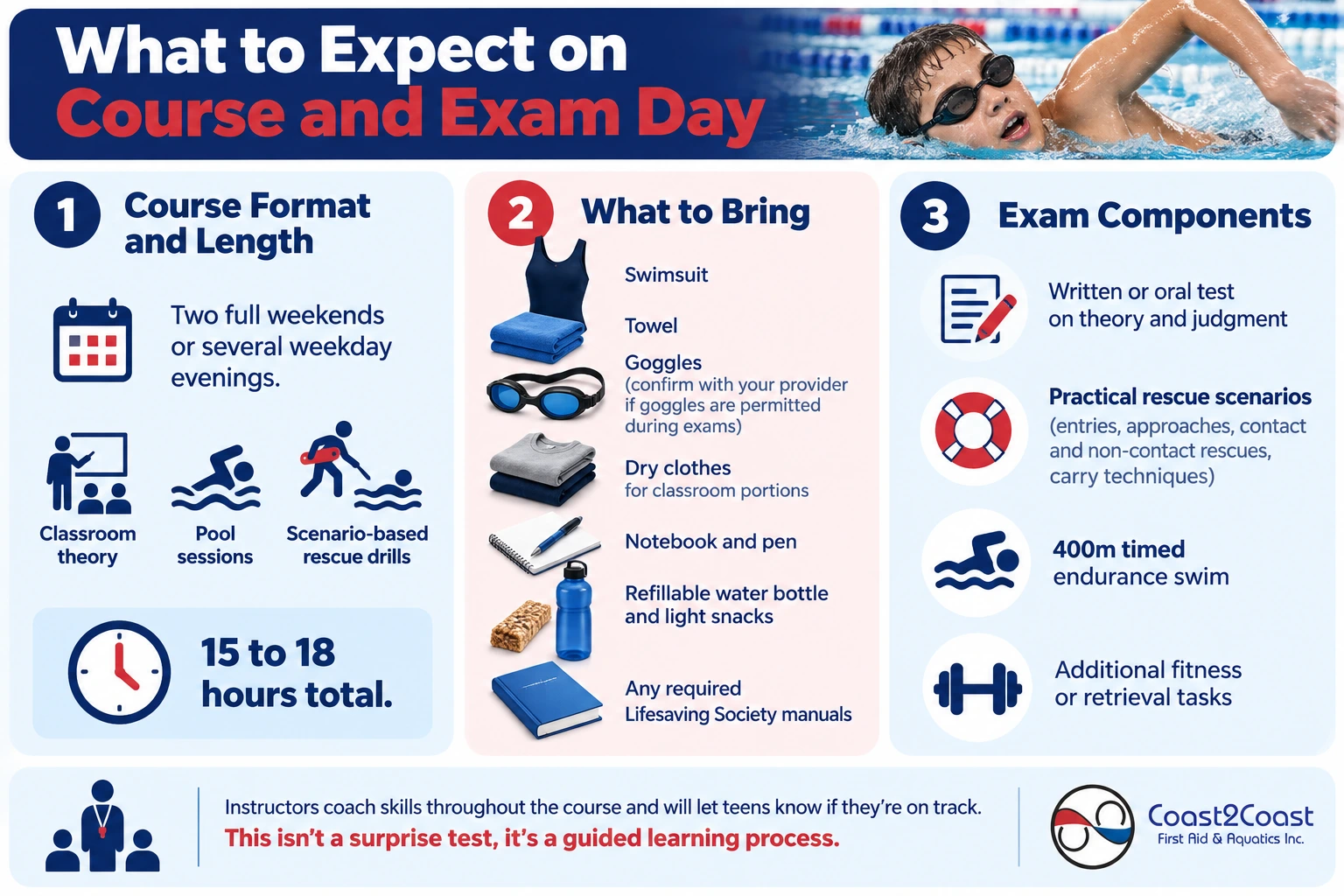
A typical Bronze Medallion course runs over two full weekends or several weekday evenings, combining classroom theory, pool sessions, and scenario-based rescue drills, 15 to 18 hours total.
What to bring: swimsuit, towel, and goggles (confirm with your provider if goggles are permitted during exams), dry clothes for classroom portions, a notebook and pen, a refillable water bottle and light snacks, and any required Lifesaving Society manuals.
Exam components typically include a written or oral test on theory and judgment, practical rescue scenarios (entries, approaches, contact and non-contact rescues, carry techniques), the 400m timed endurance swim, and additional fitness or retrieval tasks. Instructors coach skills throughout the course and will let teens know if they’re on track, this isn’t a surprise test, it’s a guided learning process.
From Bronze Medallion to National Lifeguard: The Full Pathway
The typical Canadian lifeguard journey: Bronze Star (optional, often age 11 to 12), Bronze Medallion (age 13+), Bronze Cross (typically age 14 to 15), Intermediate or Standard First Aid with CPR-C, then National Lifeguard (minimum age often 15 by course end).
National Lifeguard is the nationally recognized certification focusing on supervision, prevention, teamwork, and managing complex aquatic emergencies, the credential most employers require for full lifeguard positions at pools, waterfronts, and waterparks across Canada. A teen who later earns a lifesaving instructor credential can teach swim lessons, another source of part-time income.
Coast2Coast First Aid & Aquatics supports this pathway through first aid and CPR/AED, and mobile swimming lessons for extra practice, plus youth safety courses that build broader risk-assessment and emergency-response skills alongside aquatic training.
Learn CPR-C and First Aid Alongside Swim Training
Most aquatic employers expect both. Get certified in one place.
Explore Youth Safety Courses
Build broader risk-assessment skills that complement the lifeguard pathway.
Bronze Medallion asks for a steady, continuous 400m swim in 12 minutes, real endurance, not elite speed. Most teens who already swim recreationally can meet this standard with a few weeks of focused practice, and the certification opens the door to a clear, structured pathway toward paid lifeguard work.
Frequently Asked Questions: Bronze Medallion Swim Requirements
Q1: Does my teen need to be on a swim team to pass Bronze Medallion?
A: No. Competitive swim team experience is not required. The focus is on steady, efficient swimming and comfort in deep water, not racing starts or advanced techniques. If your teen can already swim 8 to 10 lengths of a 25m pool without stopping, they can likely build up to the full 400m in a few weeks of consistent practice. What matters is that they’ve moved past beginner-level comfort into confident, relaxed swimming.
Q2: What happens if my teen doesn’t make the 12-minute swim time?
A: Failing the timed swim generally means the Bronze Medallion certification cannot be issued, even if other lifesaving skills are strong. However, many providers allow candidates to return for re-evaluation once they’ve trained more, rather than repeating the entire course. Ask about re-try policies before you register, it’s far better to spend an extra few weeks building endurance than to arrive underprepared.
Q3: Is Bronze Medallion enough to work as a lifeguard?
A: Bronze Medallion alone is usually not sufficient for full lifeguard employment. It qualifies teens for assistant roles at some facilities and serves as the prerequisite for Bronze Cross. Most employers require at least Bronze Cross plus National Lifeguard and recognized first aid with CPR-C. Check specific job postings from your municipality or local pool to confirm requirements.
Q4: How does Bronze Medallion relate to school or volunteer requirements?
A: Bronze Medallion is not typically a formal high school credit, but the leadership and safety training it provides can support volunteer roles at camps, pools, or community events. Once teens obtain higher certifications like Bronze Cross and National Lifeguard, they can often count lifeguard or instructor work toward volunteer hour requirements.
More FAQs: Preparing and Progressing
Q5: Should my teen take first aid or CPR-C before or after Bronze Medallion?
A: Taking Intermediate or Standard First Aid with CPR-C any time from just before Bronze Medallion through to Bronze Cross is beneficial. Early first aid training helps teens better understand rescue priorities and how to manage an injured or unconscious victim during Bronze Medallion scenarios. Coast2Coast First Aid & Aquatics offers flexible first aid and CPR-C courses that can be scheduled around swim training.
Q6: What’s the difference between Bronze Star and Bronze Medallion?
A: Bronze Star is an optional, earlier step aimed at swimmers under 13 who want a head start, it builds foundational endurance and introduces basic self-rescue. Bronze Medallion is the first major lifesaving certification, required for candidates 13 and older (or those with Bronze Star), and includes the full 400m timed swim along with real rescue scenarios and decision-making training.
Q7: How long is Bronze Medallion certification valid, and what happens when it expires?
A: Bronze Medallion certification is valid for two years from the date issued. If it lapses before your teen advances to Bronze Cross, check with your provider on whether a refresher or the full course is required again, policies can vary slightly between regions, so confirming early avoids a scheduling scramble.
Q8: What if my teen is a decent swimmer but gets anxious in deep water?
A: This is common and very fixable. Spend practice time treading water and floating comfortably in the deep end before the course starts, familiarity reduces panic more than raw swimming speed does. If anxiety persists, a few private or mobile swimming lessons focused specifically on deep-water comfort can make a real difference before registration.
Reviewed By: Ashkon Pourheidary, B.Sc. Hons Neuroscience, Co-Founder of Coast2Coast First Aid & Aquatics and Canadian Red Cross Instructor Trainer since 2011.
Source: Lifesaving Society (Canada)