
What Are the Alberta First Aid Requirements for Workplaces?
If you employ people in Alberta, first aid is not optional. The Alberta first aid requirements sit in Part 11 of the Occupational Health and Safety (OHS) Code, specifically sections 177 to 184, supported by Schedule 2 (Tables 4 to 7). Alberta Regulation 191/2021 is the version currently in force. Together these rules set out what a workplace has to provide before someone gets hurt, not after.
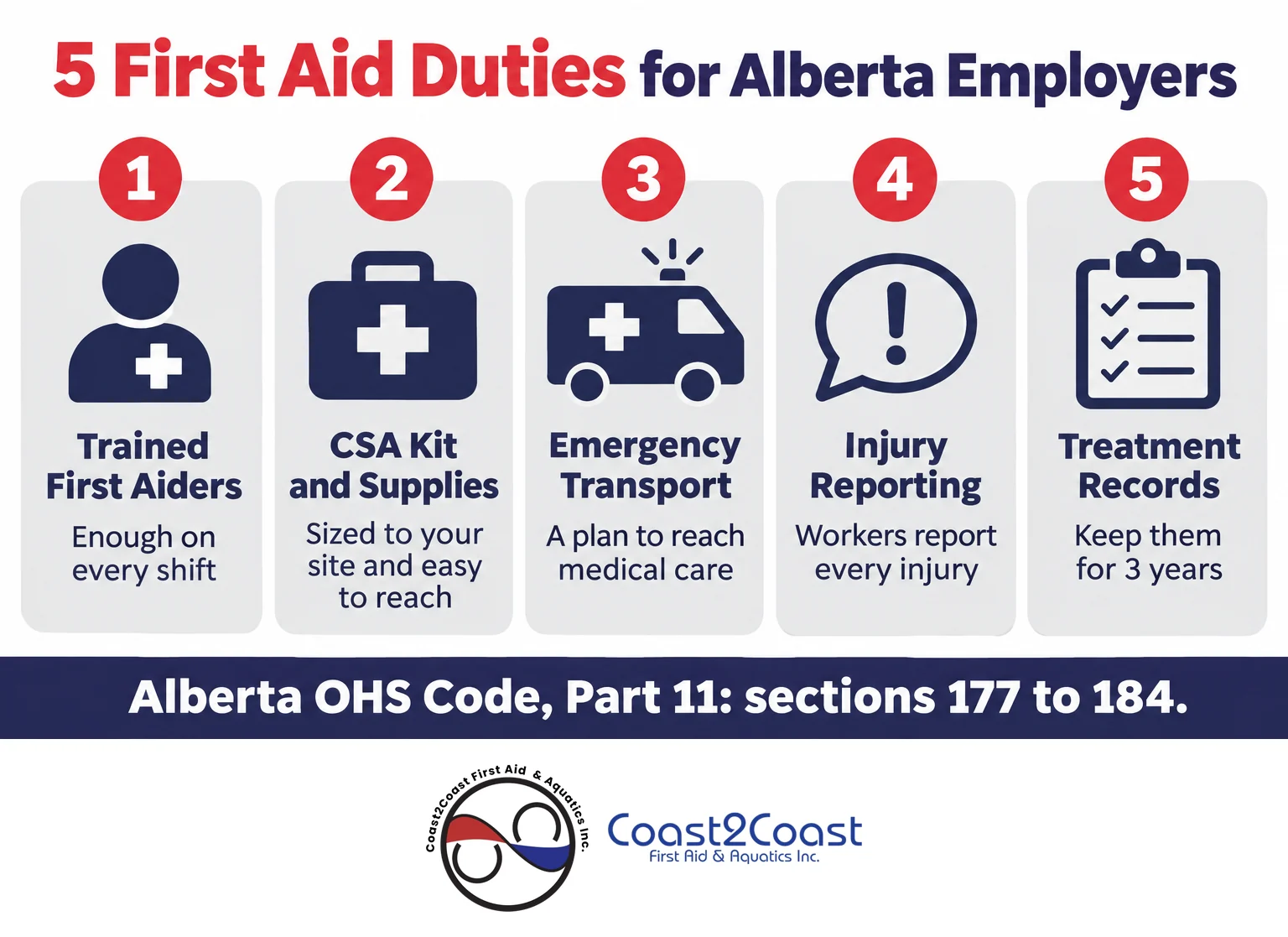
In plain terms, the first aid requirements in Alberta come down to five duties. First, you must have enough trained first aiders on every shift. Second, you must stock the right first aid kit and supplies, and keep them where workers can reach them quickly. Third, you must have a plan to transport an injured worker to medical care. Fourth, you must make sure workers know how to report an injury. Fifth, you must keep records of every first aid treatment for three years.
These Alberta first aid requirements apply to nearly every Alberta workplace, from a three-person shop to a large industrial site. What changes with size and risk is how much you must provide. A small, low-hazard office may need a single trained person and a small kit. A remote worksite with heavy equipment needs more first aiders, a larger kit, and a stronger transportation plan.
This guide walks through each duty in order, explains the Basic, Intermediate and Advanced first aid levels, shows how Alberta workplace first aid kits are sized, and finishes with a practical checklist employers can use to stay compliant.
Train Your Whole Team
Private group sessions for your workplace, with training scheduled around your team.
Who Must Provide First Aid Under the Alberta OHS Code?
Most Alberta first aid requirements fall on the employer. Section 178 of the Alberta OHS Code first aid rules says an employer must provide first aid services, supplies and equipment that match the size and risk of the worksite. On a site with a prime contractor, the prime contractor coordinates first aid for the whole site, and other employers on that site must cooperate with that arrangement.
Workers have duties too. They must report injuries and illnesses, even minor ones, to the employer or prime contractor. This is covered in section 182, and it matters because an unreported cut or burn cannot be recorded, and a pattern of small injuries is often the first sign of a larger hazard.
A few workers are treated differently under the Alberta first aid requirements. Emergency medical responders and paramedics do not need a separate first aid certificate to act as a first aider (section 181). Medical settings such as hospitals are also exempt from some first aid provider rules under the same section, because trained clinical staff are already on hand. For most other employers, including clinics, schools, warehouses, construction sites, restaurants, and offices, the full set of Alberta first aid requirements applies.
Self-employed people and owner-operators with no workers are generally outside these employer duties, but the moment you hire someone, even part time, the requirements start.
Get Hands-On CPR and AED Practice
Work with real manikins and AED trainers while an instructor coaches your technique.
How Does Alberta Decide How Many First Aiders You Need?
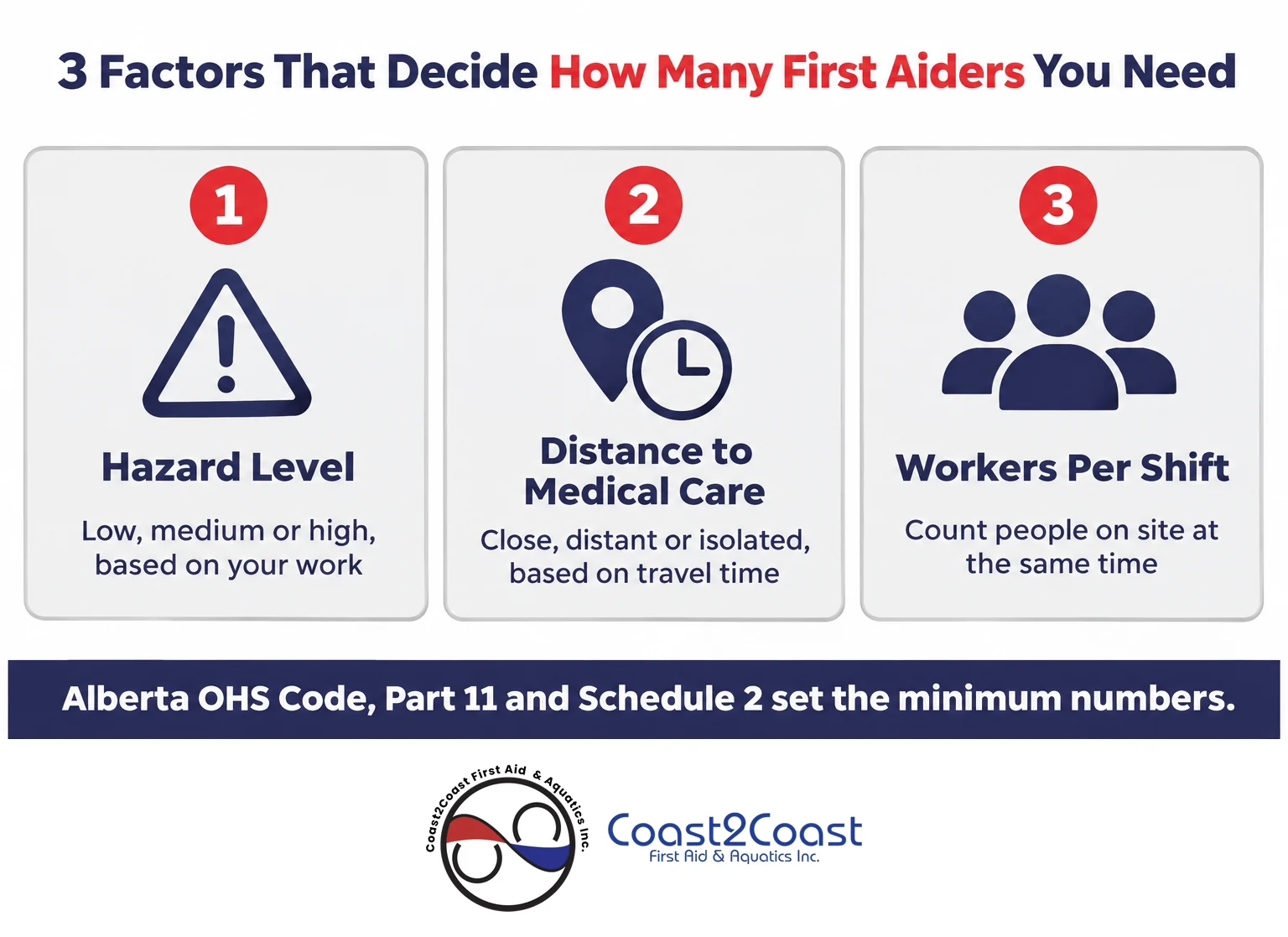
This is the question most employers ask, and the answer depends on three factors working together: the hazard level of your work, how close you are to a medical facility, and how many workers are on a shift.
Hazard level. Alberta classifies workplaces as low, medium or high hazard. Low hazard work is the kind with little chance of injury, such as a typical office. High hazard work involves serious risks, such as heavy equipment, working at heights, or hazardous materials. Medium hazard is simply everything that is not low or high, which covers a very large share of workplaces.
Proximity to medical care. The code groups worksites as close, distant or isolated, based on travel time to the nearest medical facility. A site that is close to a hospital or clinic needs less on-site capability than one where an ambulance could take a long time to arrive. The longer the wait for outside help, the stronger your on-site first aid has to be.
Number of workers per shift. What counts is how many people are on site at the same time, not your total headcount. A company with 60 employees split across three shifts of 20 is assessed on 20.
Schedule 2 of the OHS Code turns these three factors into the minimum first aid requirements in Alberta, expressed as numbers of first aiders at the Basic and Intermediate levels. Rather than copy a partial table here, which could go out of date, we recommend reading Schedule 2 directly (linked at the end of this guide) and confirming your numbers against your own hazard assessment.
The government’s own worked example shows how it works. A medium hazard workplace, under 20 minutes from a medical facility, with 20 workers per shift, needs one Basic first aider and one Intermediate first aider, plus a small Type 2 first aid kit. Change any one factor, such as moving the same site far from the nearest hospital, and the requirement rises.
As a practical rule, employers should go beyond the minimum Alberta first aid requirements and train more people. Vacations, sick days and shift changes mean a certified person is not always on site. Many Alberta employers train a few extra first aiders so that the minimum is covered every single shift. If you want to train a group together, our private group first aid training can be scheduled at your workplace.
Learn First Aid Skills in a Real Classroom
Hands-on first aid training with real equipment and an instructor guiding every skill.
What Do Basic, Intermediate and Advanced First Aid Mean in Alberta?
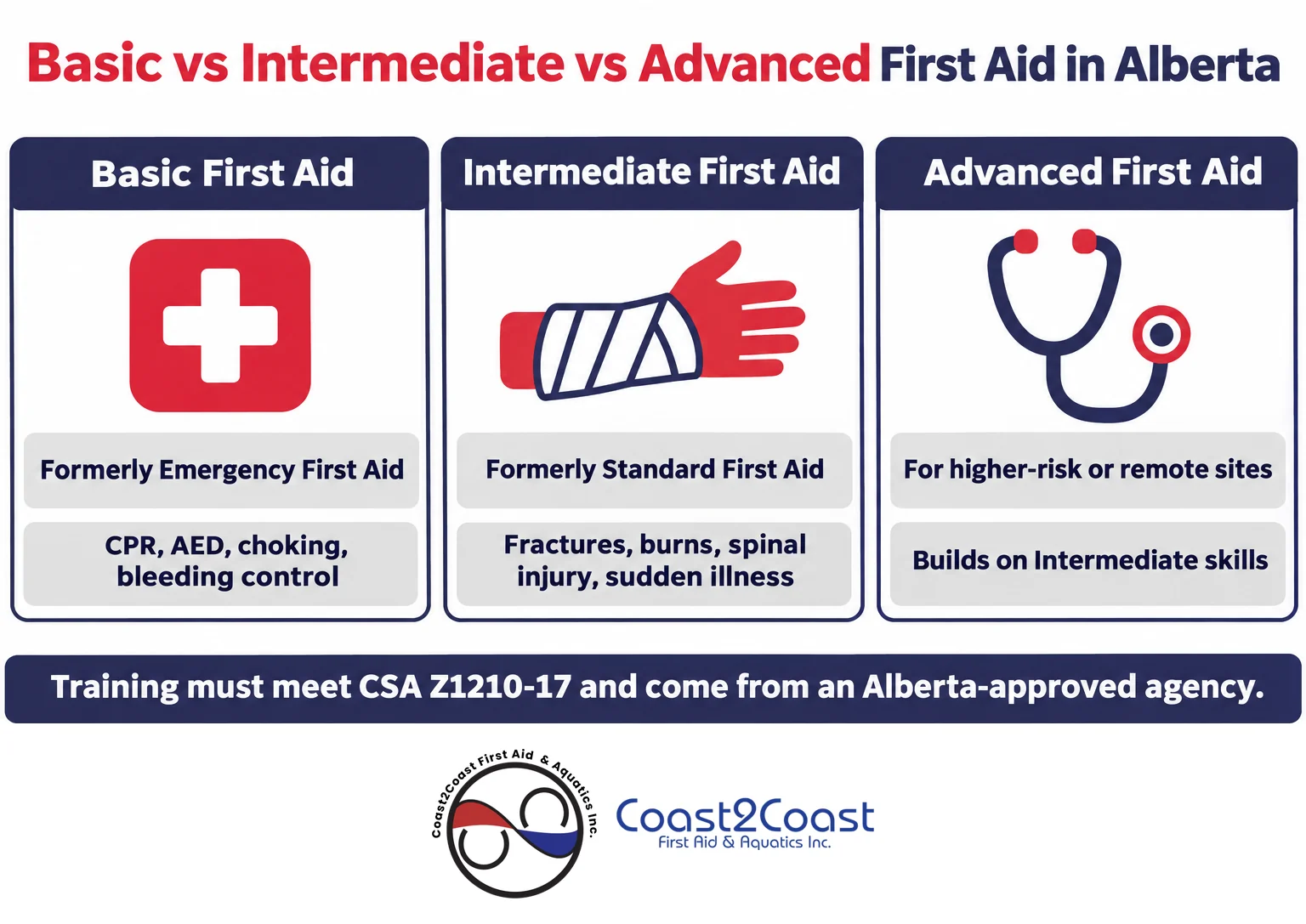
The Alberta first aid requirements now use updated level names, and many employers still use the old ones. Since March 31, 2023, the three levels are Basic, Intermediate and Advanced first aid. Before that, the first two were called Emergency and Standard first aid.
Basic first aid replaces what used to be called Emergency first aid. It covers the core skills: scene safety, assessing a casualty, CPR and AED use for adults, children and infants, choking, bleeding control, and managing common injuries until help arrives. It is the entry level for a workplace first aider. Our Emergency First Aid, CPR and AED course is built for this level.
Intermediate first aid replaces what used to be called Standard first aid. It goes deeper into injuries and medical emergencies such as fractures, spinal injury, burns, head injuries, shock, and sudden illness like heart attack, stroke, diabetic emergencies and seizures. Workplaces that need more than one first aider usually need at least one at this level. Our Standard First Aid course covers this level.
Advanced first aid is for higher-risk or remote workplaces. It builds on the Intermediate level with more advanced assessment and care skills, and is commonly used on larger industrial sites, in remote operations, and in roles where help is far away. If your Schedule 2 assessment calls for an Advanced first aider, you will need a provider approved to teach that level.
Whichever level you choose to satisfy Alberta first aid requirements, the training must follow the CSA Z1210-17 first aid training standard and come from an agency approved by Alberta. A certificate from an unapproved agency will not satisfy the code, even if the course content looks similar. Always confirm approval before booking.
Learn First Aid Skills in a Real Classroom
Basic and Intermediate first aid courses with hands-on practice on real training equipment.
What First Aid Kits Does Your Alberta Workplace Need?
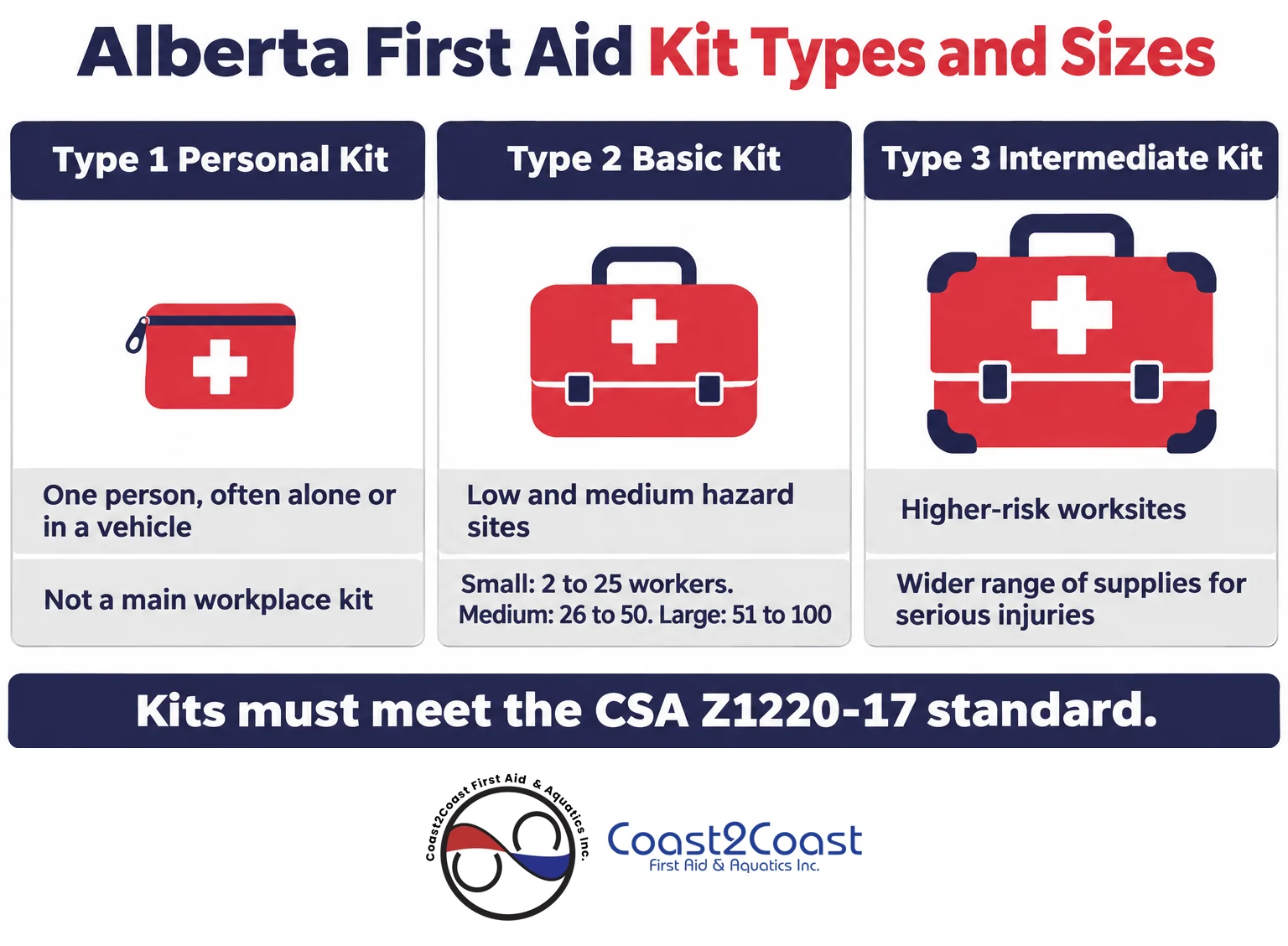
The Alberta first aid requirements for kits point to the CSA Z1220-17 standard. There are three types, matched to the size and risk of your worksite.
Type 1 (personal kit) is a compact kit for one person, often carried by a worker who is alone or in a vehicle. It is not enough as the main kit for a workplace with several people.
Type 2 (basic kit) is the standard workplace kit for low and medium hazard sites. It comes in sizes based on how many workers are on a shift: small for 2 to 25 workers, medium for 26 to 50, and large for 51 to 100.
Type 3 (intermediate kit) is for higher-risk worksites. It carries a wider range of supplies for more serious injuries, and it is also sized by the number of workers on shift.
The kit must be easy to reach and clearly marked, and a worker should be able to get to it quickly from anywhere on site. Large or spread-out sites often need more than one kit, placed where work is actually happening. Section 179 covers where first aid services and supplies must be located.
Employers should check their kits on a schedule. Expiry dates matter for items such as sterile dressings, eyewash and adhesive bandages. Record each check, restock anything used, and replace the whole kit if it was stored in heat, damp or direct sunlight.
Remember that a kit alone does not meet the Alberta first aid requirements. Supplies without trained people to use them leave a gap, and trained people without supplies leave another. The two have to go together.
Training Built Around Your Workplace
Certified instructors, flexible formats and a certificate for every participant.
What Other First Aid Duties Apply: Transportation, Records and Reporting?
Beyond people and kits, the Alberta first aid requirements add three duties that employers often overlook.
Emergency transportation (section 180). You must have a way to get an injured worker to medical care. That can mean a vehicle on site, a plan to call an ambulance, or both, depending on your location. If a worker needs to be moved to a hospital, a first aider must accompany them, unless there are three or fewer workers on site. A written plan that says who calls, who drives, and who stays behind removes confusion during a real emergency.
Reporting injuries (section 182). Workers must tell their employer, or the prime contractor on a multi-employer site, when they are injured or become ill at work. Make the reporting steps easy and well known. Post them near the first aid kit and cover them during orientation. This section is about internal reporting. Separate Alberta rules decide which incidents must also be reported to government and to the Workers’ Compensation Board, so review those with your safety lead.
Records (sections 183 and 184). You must keep a record of every first aid treatment given and keep it for three years. Each record should show who was treated, what happened, what care was given, and by whom. Workers can ask to see their own records, and the code gives them that right in section 184. Keep records in a safe place, because they contain personal health information.
These records do more than satisfy an inspector. Reviewing them every few months shows where injuries cluster, which jobs need better controls, and whether you have enough first aiders at the right times.
Put These Skills Into Practice
Standard First Aid covers bleeding, burns, fractures and sudden illness in a hands-on class.
How Do You Get Alberta-Approved First Aid Training?
Once you know what level and how many first aiders you need to meet Alberta first aid requirements, the next step is booking training. A few things are worth checking before you commit.
First, confirm that the provider is approved in Alberta and that the course meets CSA Z1210-17. Ask for the course name, the level it satisfies (Basic, Intermediate or Advanced), and how long the certificate is valid. Most agencies issue certificates valid for three years.
Second, choose the right format. Practical skills such as CPR, bleeding control and splinting cannot be learned from a screen alone, so courses with a hands-on component are the safest choice for workplace compliance. Blended formats let learners do the theory online at their own pace and then attend a shorter in-person skills session. Fully online certification does not give workers the hands-on practice that real emergencies demand, and we do not recommend it for workplace first aiders.
Third, decide between public and private classes. Public classes suit one or two people. If you need several first aiders, a private group session at your workplace saves travel time and lets the instructor use your own scenarios and equipment. Coast2Coast also runs CPR and AED sessions for teams that need the CPR component on its own.
If you prefer to attend in person at a training centre, we run classes in Calgary and Edmonton. Our Calgary training page and Edmonton training page list current dates and course options. With over 200,000 students certified and a 99.9% pass rate, our instructors are used to helping first-timers feel confident.
Finally, plan the timing. Book renewals well before certificates expire, because a lapsed first aider no longer counts toward your minimum. Staggering renewals across the year also avoids having everyone expire in the same month.
Train Your Whole Alberta Team
Book a private group session at your workplace and certify every first aider in one visit.
How Can Employers Stay Compliant Year Round?
Compliance with Alberta first aid requirements is an ongoing job, not a one-time purchase. A short routine keeps you covered.
Start with a yearly review of how your site measures up to the Alberta first aid requirements. Re-check your hazard level, your proximity to medical care, and your worker numbers per shift. If you added a shift, moved premises, took on new equipment, or hired a seasonal crew, your Schedule 2 numbers may have changed.
Keep a certificate tracker. List every first aider, their level, certificate date and expiry date, and set a reminder at six months and three months out. Remove anyone who has left the company and replace them promptly.
Inspect kits on a schedule and log each inspection. Restock after every use. Make sure the kit is still where the first aid sign says it is, because kits tend to wander.
Review injury records every quarter. Look for repeat injuries, busy times of day, and tasks that cause the most treatments. Use what you find to adjust training, equipment and supervision.
Brief new hires. Part of orientation should be who the first aiders are, where the kit is, how to report an injury, and what to do in an emergency. A first aider nobody can find is not much help in a crisis.
Finally, test the plan. Run a short drill once or twice a year. Pretend a worker has collapsed in the far corner of the site and see how long it takes for the first aider to arrive with the kit and for the call to go out. The gaps you find in a drill are the ones you will not find in a real emergency.
Good first aid planning protects your people, supports your safety program, and keeps you aligned with Alberta first aid requirements. If you manage several sites or want help matching training to your Schedule 2 numbers, the team at Coast2Coast can help you plan it, and you can read the code itself on the Schedule 2 of the Alberta OHS Code.
Get Your Team Certified Together
Private group courses cover first aid, CPR and AED for teams of any size.
Key Takeaway
Alberta first aid requirements depend on three things: your hazard level, your distance from medical care, and your workers per shift. Train enough Basic and Intermediate first aiders to cover every shift, stock a CSA Z1220-17 kit sized to your site, plan emergency transportation, and keep first aid records for three years.
Join 200,000+ Canadians Who Are Certified
Build the skills and confidence to respond when someone on your team needs help.
Frequently Asked Questions: Alberta First Aid Requirements 2026
Q1: What are the first aid requirements in Alberta for workplaces?
A: Alberta employers must provide trained first aiders, a CSA-compliant first aid kit, emergency transportation, an injury reporting process, and treatment records kept for three years. These duties come from Part 11 of the Alberta OHS Code. The exact number of first aiders and the size of the kit depend on your hazard level, your distance to medical care, and the number of workers on each shift.
Q2: Does every workplace in Alberta need a first aider?
A: Yes. Every Alberta workplace with workers must have first aid provisions, but the number of first aiders varies. A small low-hazard office may need one trained person per shift, while a larger or higher-risk site needs more, including Intermediate or Advanced first aiders. Self-employed people with no workers are generally outside the employer duties, but hiring even one part-time worker starts them.
Q3: How many first aiders does an Alberta workplace need?
A: It depends on three factors: hazard level (low, medium or high), proximity to medical care (close, distant or isolated), and workers per shift. Schedule 2 of the OHS Code sets the minimums. For example, a medium hazard site under 20 minutes from a medical facility with 20 workers per shift needs one Basic and one Intermediate first aider, plus a small Type 2 kit.
Q4: What is the difference between Basic and Intermediate first aid in Alberta?
A: Basic first aid, formerly Emergency first aid, covers core skills such as CPR, AED use, choking and bleeding control. Intermediate first aid, formerly Standard first aid, adds deeper injury and medical emergency care, including fractures, spinal injury, burns, and sudden illness. Higher-risk sites often need at least one Intermediate first aider, so check Schedule 2 against your own hazard assessment.
Q5: What first aid kit does an Alberta workplace need?
A: Kits must meet the CSA Z1220-17 standard. Type 2 basic kits suit low and medium hazard sites and come in small (2 to 25 workers), medium (26 to 50), and large (51 to 100) sizes per shift. Type 3 intermediate kits suit higher-risk sites. Type 1 kits are personal kits for one person and do not replace the main workplace kit.
Q6: Do Alberta first aid certificates have to come from an approved provider?
A: Yes. Training must follow the CSA Z1210-17 standard and come from an agency approved in Alberta. A certificate from an unapproved provider may not count toward your minimum number of first aiders, even if the course looks similar. Always confirm the provider’s approval, the course level (Basic, Intermediate or Advanced), and the certificate validity period before you book.
Q7: How long must Alberta employers keep first aid records?
A: Three years. Section 183 of the OHS Code requires a record of every first aid treatment, including who was treated, what happened, and what care was given. Workers can request their own records under section 184. Store these records securely and limit access, because they contain personal health information that should not be shared beyond those who need it.
More FAQs: Alberta Workplace First Aid Compliance
Q8: Did Alberta change from Emergency and Standard first aid to Basic and Intermediate?
A: Yes. Since March 31, 2023, Alberta uses Basic, Intermediate and Advanced first aid. Basic replaces Emergency first aid and Intermediate replaces Standard first aid. Certificates issued before the change keep their old names and remain valid until they expire, and renewals are issued under the new names. Update your certificate tracker so each first aider is listed at the correct level.
Q9: Who is responsible for first aid on a site with several employers?
A: The prime contractor coordinates first aid for the whole site, and other employers must cooperate with that plan. Each employer still has duties for its own workers, including making sure they know how to report injuries and where the first aid kit is. Clear written communication between the prime contractor and each employer helps avoid gaps in coverage.
Q10: Does a worker need to go with an injured coworker to the hospital?
A: Usually, yes. Under section 180, a first aider must accompany an injured worker being transported to medical care, unless there are three or fewer workers on site. Employers should plan this in advance so that leaving with the injured worker does not leave the rest of the site without first aid coverage. Write the plan down and share it with every shift.
Q11: Do paramedics and EMRs need a separate first aid certificate?
A: No. Under section 181 of the OHS Code, emergency medical responders and paramedics do not need a separate first aid certificate to act as a workplace first aider. They must still be on site and available during the shift to count toward your requirement, so confirm their schedule matches the hours your workplace operates.
Q12: How often should first aid kits be checked?
A: The code requires kits to be maintained and stocked, so check them on a regular schedule, at least every few months and after each use. Look for expired items, missing supplies and damage from heat or moisture. Record each inspection and restock anything used, so you can show an inspector that kits are being maintained and ready for the next emergency.
Q13: Can first aid training be done fully online in Alberta?
A: Fully online courses cannot teach hands-on skills such as chest compressions, bandaging and splinting, so we do not recommend them for workplace first aiders. Blended courses, with online theory plus an in-person skills session with an approved provider, are a practical option when you want flexibility without losing the hands-on practice that real emergencies demand.
Q14: What happens if a workplace does not meet Alberta first aid requirements?
A: An OHS officer can issue orders, stop-work notices or penalties for non-compliance. Beyond enforcement, the bigger risk is an injured worker who does not get fast, competent care. Meeting the requirements, keeping records, and fixing gaps quickly protects both your people and your business, and a documented hazard assessment helps show you acted in good faith.
Q15: Should I train more first aiders than the minimum?
A: Yes. In most cases, vacations, illness and shift changes mean your certified people are not always on site. Training a few extra first aiders keeps you above the minimum on every shift, and staggering certificate renewals prevents everyone from expiring at once. Extra first aiders also give you coverage when an injury happens to one of your own first aiders.
Reviewed & Sourced
Reviewed by Coast2Coast Certified Lead First Aid Instructor.
Sources: Alberta Occupational Health and Safety Code, Part 11 (First Aid) and Schedule 2, Government of Alberta. Training and kit standards referenced: CSA Z1210-17 and CSA Z1220-17.