
What Is Corporate First Aid Training?
Corporate first aid training is first aid, CPR and AED instruction arranged by an employer for a group of employees. It can be delivered at the workplace, at a training centre or in a blended format, and it ends with certificates that show each person completed the course. The goal of corporate first aid training is twofold: give your people the skills to respond until paramedics arrive, and satisfy the first aid rules that apply to your workplace.
Many employers treat the purchase as a box to tick. They search for the nearest course, book a date and assume the certificates will be accepted. That works until a regulator, an insurer or a client asks for proof and the certificate turns out to be the wrong level, or the provider is not recognized in your province.
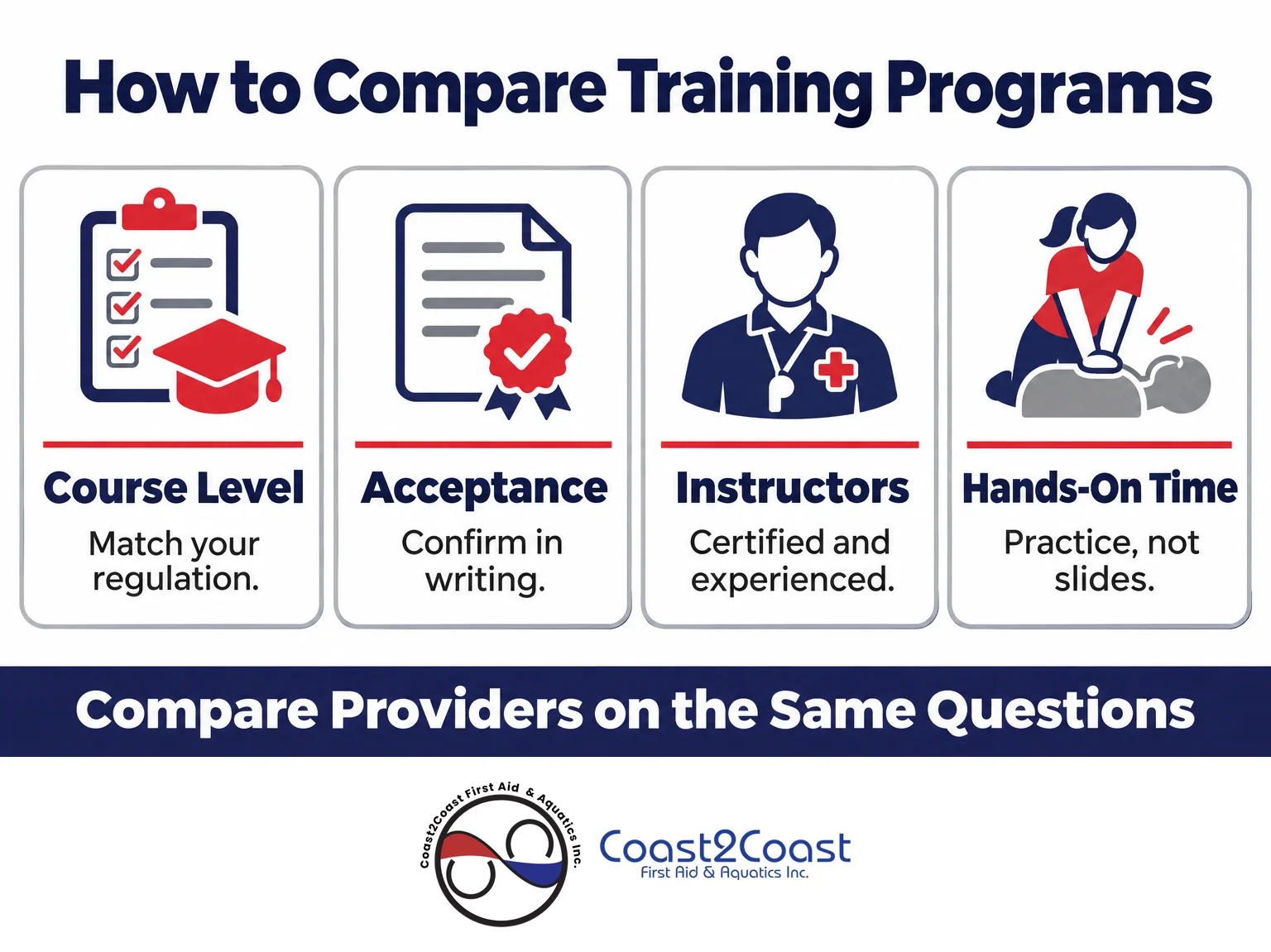
Comparing corporate first aid training programs takes a little care, but the questions are simple. What level does your regulation require? Who teaches the course, and how much hands-on practice is included? How will the training fit around shifts? What records will you receive? And how will you keep certificates current when they expire?
This guide walks through those questions so you can compare corporate first aid training programs on the things that matter. It covers regulations, course levels, delivery formats, instructor quality, group size, scheduling and record keeping. If you already know you need a group session, you can read about our workplace first aid training options as you go.
Train Your Whole Team
Private group sessions for your workplace, with training scheduled around your team.
What Do Canadian Workplaces Have to Provide for First Aid?
Every Canadian jurisdiction requires workplaces to provide at least a basic level of first aid, according to the Canadian Centre for Occupational Health and Safety (CCOHS). The details vary. As the CCOHS first aid overview explains, the required equipment and training generally depend on the number of workers, the hazards in the workplace and the distance to a hospital or other professional medical help.
Each province and territory sets its own rules for the number of first aiders, the training level, the contents of first aid kits and the records employers must keep. Ontario employers deal with the WSIB first aid regulation, Alberta employers follow the Occupational Health and Safety Code, and employers in other provinces follow their own regulations and the standards they reference.
The practical consequence is that a program that works in one province may not fit another. A national employer with sites in several provinces should map each site to its own regulation rather than buying one level of training for everyone.
If you work in Ontario and want the specifics, see our guide to WSIB first aid compliance.
Get Hands-On CPR and AED Practice
Work with real manikins and AED trainers while an instructor coaches your technique.
Which First Aid Course Level Should Your Team Take?
Course levels are the first thing to compare. In most regulations, the main distinction is between emergency or basic first aid, standard first aid and advanced levels. The lower levels teach the essentials, including how to check a scene, call for help, perform CPR, use an AED and control severe bleeding. Standard first aid adds more injuries and illnesses, such as fractures, burns, medical emergencies and wound care.
Which level you need depends on your regulation and workplace. A small low-risk office may be allowed to meet the rule with an emergency level course, while a larger or higher risk workplace may need standard first aid or more. Remote workplaces, long distances to hospital and hazardous work can all raise the level.
A good provider of corporate first aid training will help you match the level to your rule rather than sell the longest course. Ask them which section of the regulation they are working from, and keep a note of the answer in your safety file.
For many employers, a Standard First Aid course with CPR and AED is the most common choice, because it satisfies a wide range of requirements. Offices, retail stores, warehouses and light industrial sites often start here.
Do not forget CPR. Cardiac arrest can happen to an employee, a customer or a visitor, and CPR and AED skills are the part of first aid that can make the difference in the first minutes. Make sure your corporate first aid training includes both adult CPR and AED practice, and consider infant and child CPR if your workplace serves families.
Training Built Around Your Workplace
Certified instructors, flexible formats and a certificate for every participant.
How Is Corporate First Aid Training Delivered?
Delivery format changes cost, scheduling and learning quality, so it is worth comparing carefully when you plan corporate first aid training. There are three common formats.
The first is an in-person class at a training centre. Employees leave the workplace for the day and practise with instructors and equipment in a dedicated space. This is a good fit for small numbers, for individuals who need a certificate quickly and for employers who want to avoid disrupting the workplace.
The second is an on-site private session. The instructor and equipment come to your workplace and train your group together. This format reduces travel and keeps the team on the same schedule, and it lets the instructor use your own layout, kit and AED location in the scenarios. It works well for groups that are large enough to fill a class.
The third is blended learning. Employees complete an online lesson at their own pace and then attend a shorter in-person skills session. Blended learning can reduce time away from work, but the hands-on session is essential. Fully online first aid courses without a practical component do not meet most workplace training requirements, so check that any online-heavy program ends with an instructor assessing your technique.
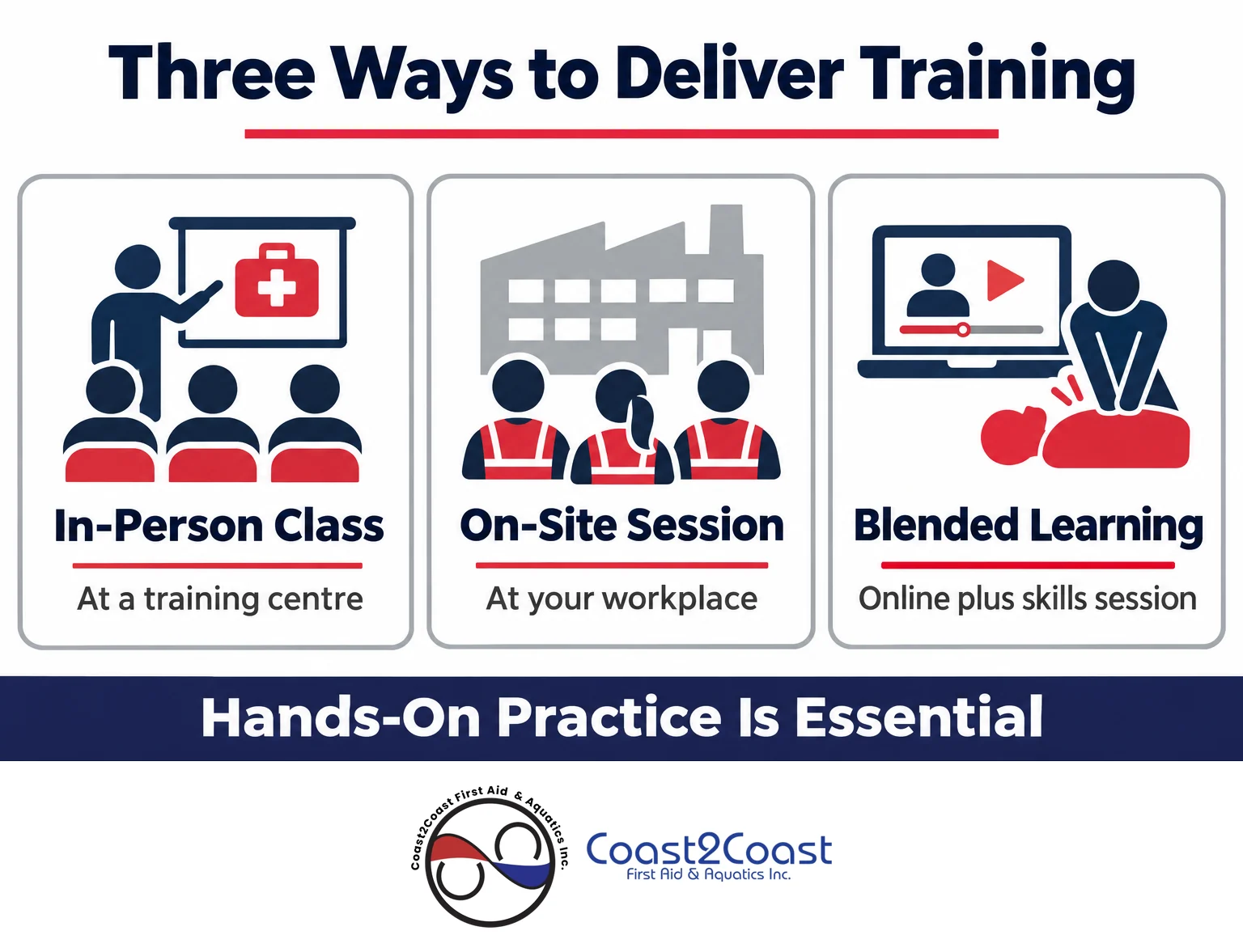
Whichever format you choose, ask how many hours of the course are hands-on. First aid is a physical skill, and the best programs spend most of the class on practice rather than slides.
Learn Standard First Aid in a Real Classroom
Give your workplace first aiders hands-on practice with an instructor who checks their technique.
What Should You Ask About Instructors and Quality?
The instructor is the biggest factor in how much your team remembers from corporate first aid training. A strong instructor keeps the class moving, uses realistic scenarios and corrects technique on the spot. A weak one reads slides and hands out certificates.
Ask whether instructors are certified by a recognized training organization and how often they renew. Ask how long they have taught and whether they have practical experience in emergency response or healthcare. Ask about class size, because a class of twelve gets much more practice time than a class of thirty.
Ask about equipment too. Each participant or pair should have a manikin, and the class should include an AED trainer and bandaging supplies. Ask whether manikins are cleaned between uses and whether child and infant manikins are available if your workplace needs them.
Finally, ask about the course materials. A participant guide or digital reference is useful for refreshing skills between certificate renewals. It should be current and aligned with Canadian guidelines and standards.
Learn CPR and AED in a Real Classroom
Practise compressions, breaths and AED pad placement with a certified instructor.
How Do You Check That Certificates Will Be Accepted?
Acceptance is the question that matters most and is the one most often skipped. A certificate is only useful if the regulator, insurer or client who asks for it accepts it.
Start with your provincial or territorial health and safety authority. Many publish lists of recognized training providers or the standards they accept. Some workplaces also reference national standards, such as the CSA Z1210 standard for first aid training. If your workplace is federally regulated or has special requirements from clients or insurers, ask them directly.
Then ask the provider to confirm in writing that the course meets the requirement you have identified. A reputable provider will do this without hesitation. Keep the confirmation with your safety records.
Check the details on the certificate itself. It should show the participant’s name, the course name and level, the completion date, the expiry date and the provider’s details. Certificates that look like generic printouts or lack an expiry date can cause trouble later.
Finally, check how the provider handles lost certificates. Employees change jobs, laptops fail and emails vanish. A provider that keeps a record of every certificate issued makes your life easier when someone needs a replacement.
Get Your Team Certified Together
Private group courses cover first aid, CPR and AED for teams of any size.
How Large Should Your First Aid Team Be?
The number of trained employees is often set by regulation, and in many provinces it depends on the number of workers on a shift and the level of hazard. Even where a minimum is set, it is worth thinking about coverage rather than just the minimum number of people.
Think about shifts. If you have a night shift, a weekend crew or a warehouse that runs early, each needs trained people on site. Think about absences. When a first aider is on holiday or sick, who covers? Think about locations. A first aider on the second floor cannot help someone in the loading bay.
Many employers train more people than the minimum so that coverage holds through holidays and turnover. A larger trained group also spreads the responsibility, which reduces the burden on a few designated people. If you do not want everyone to take the full course, consider a mix: a core group of first aiders who take the full level and a wider group who take CPR and AED.
When you compare programs, ask how groups are handled. Can the provider bring a class to your site for as few as eight or ten people? Can they run multiple sessions across shifts? Can they split a large group into back-to-back classes so production is not disrupted? A flexible schedule is often what separates a smooth program from a stressful one.
Train Your Whole Team
Arrange a private session for your employees at your workplace or at ours.
What Records and Reporting Should You Expect from a Provider?
Good records protect you, and good providers make them easy. After each course you should receive a class roster, individual certificates and the expiry date for each person. Many providers offer a simple tracking sheet or a client portal so you can see who is due for renewal.
Plan to keep your own records as well. A first aid file should include the training certificates, the expiry dates, the first aid kit inspection log, the list of designated first aiders and the incident treatment log. CCOHS notes that employers should keep a log of treatment given to workers, including the worker’s details, the injury and treatment, the timing and who was notified.
Ask whether the provider will send renewal reminders. Certificates expire quietly, and a team that was fully certified last year can drop below the required number without anyone noticing. A reminder at 90 days before expiry gives you time to book a renewal at a convenient date.
Also ask how the provider handles no-shows and make-up classes. In a group program, a few people will miss the day. A provider that offers an easy make-up option saves you from scrambling when an audit date approaches.
Get BLS Certified for Healthcare Roles
Basic Life Support training for healthcare providers and students, with team-based skills practice.
How Do You Plan Renewals and Keep Certificates Current?
Corporate first aid training is not a single event. Certificates expire, people leave and regulations change, so the program needs a renewal plan.
Most standard first aid certificates are valid for around three years, although the rule varies by province and provider, and CPR skills are often refreshed more frequently. Check the expiry date on each certificate and your regulation’s requirement. Build a calendar that lists every employee, the course they took and the expiry date.
Renewal courses, also called recertification courses, are often shorter than the original course. They refresh skills and cover updates to guidelines. Taking a renewal before the certificate expires usually keeps the person on the shorter pathway, while an expired certificate may mean repeating the full course. For details, you can look at our recertification courses.
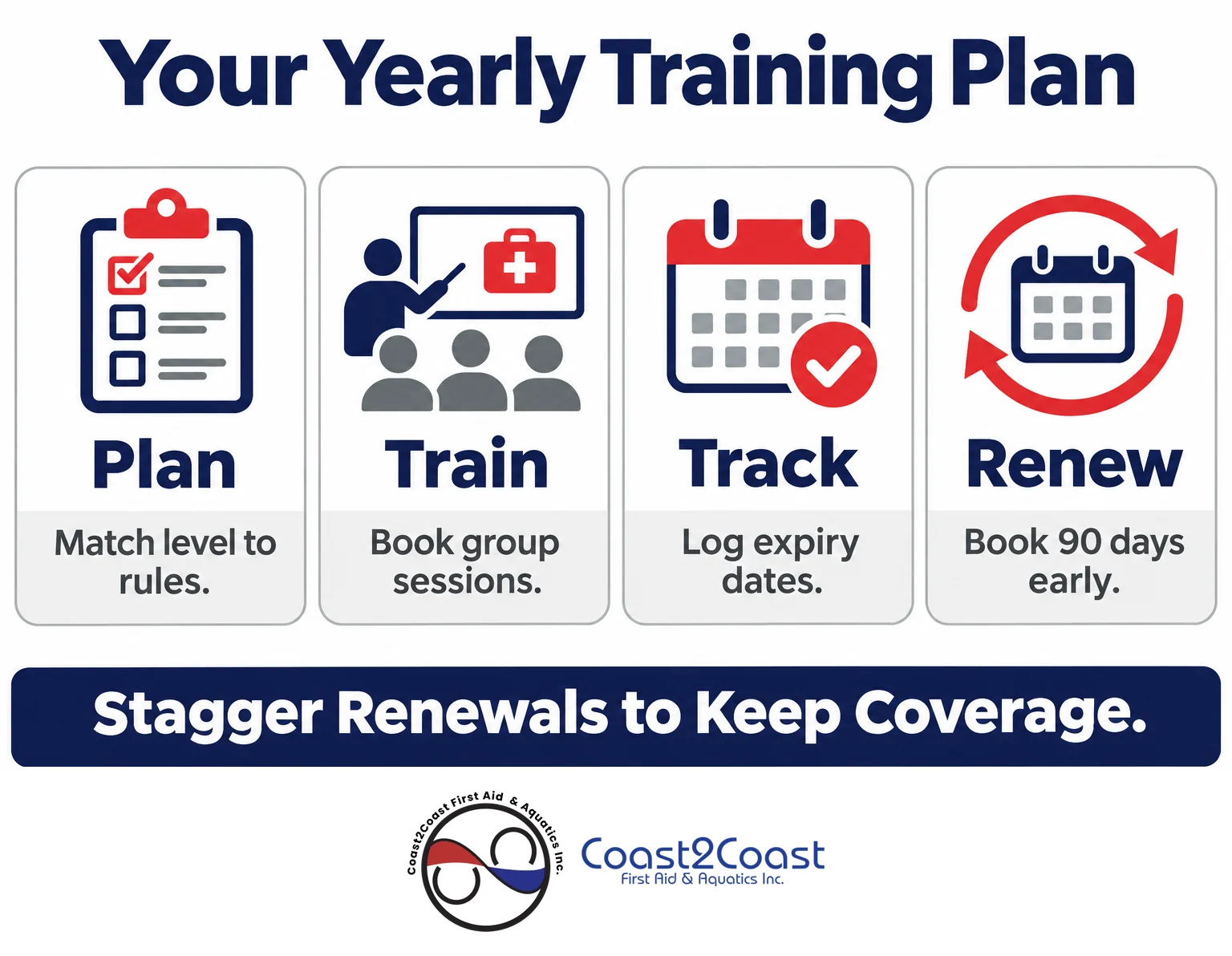
Stagger renewals where you can. If everyone trained in the same week, everyone expires in the same week, and your workplace could be briefly uncovered. Splitting a group across two or three renewal dates keeps coverage steady and makes classes easier to schedule.
Review the program once a year. Check that the number of first aiders still meets your regulation, that new hires have been trained, that kits are stocked and that your emergency procedures are current. A short annual review is often all it takes to keep a program healthy.
Keep Your Certification Current
Recertification courses help you renew before your certificate expires.
What Is the Best Way to Choose a Corporate First Aid Training Provider?
Pull the pieces together into a simple comparison of corporate first aid training providers. List the providers you are considering and score each on the same questions: Is the course level right for our regulation? Is the certificate accepted by our regulator and insurer? Are instructors certified and experienced? How much of the class is hands-on? Can they train at our site or on our schedule? What records do we receive? Do they offer renewals and reminders?
Ask each provider for the same information in writing, including what the quote covers, such as equipment, certificates, course materials and any travel. Quotes that look different are often covering different things, so compare like with like.
Speak to a reference if you can. A provider with long experience in your industry will know the common hazards, the typical regulations and the questions your staff are likely to ask. If you work in a specialized setting such as healthcare, construction or schools, ask whether the provider has delivered training there.
A final practical tip is to run a short pilot. Some employers start with one department or one shift, gather feedback from participants and then roll the same corporate first aid training out to the rest of the workplace. Participants can tell you whether the pace felt right, whether the scenarios matched their work and whether they would feel confident in a real emergency.
Finally, trust your own experience. If a provider answers your questions clearly, explains the regulation and welcomes your safety team to ask more, that is a good sign. If they dodge questions about acceptance or hands-on time, keep looking.
Train to the BLS Provider Standard
High-quality CPR, AED use and team resuscitation, practised hands-on.
Key Takeaway
Corporate first aid training works best when it starts with your regulation, not with a course catalogue. Match the level to your provincial or territorial rule, choose a format with real hands-on practice, confirm in writing that certificates are accepted, keep clear records and plan renewals before certificates expire. A short comparison of providers on the same questions will save you time, money and compliance headaches.
Join 150,000+ Canadians Who Are Certified
Add CPR and AED training to your workplace first aid program.
Frequently Asked Questions: Corporate First Aid Training 2026
Q1: What is corporate first aid training?
A: Corporate first aid training is first aid, CPR and AED instruction arranged by an employer for a group of employees. It can be delivered at a workplace, at a training centre or in a blended format with an online lesson and an in-person skills session. The course ends with certificates that show each person completed the training and, in many cases, help the employer meet provincial or territorial first aid rules.
Q2: How do I choose a corporate first aid training provider?
A: Compare providers on the same questions. Check that the course level matches your regulation, that the certificate is accepted by your regulator and insurer, that instructors are certified and experienced, how much of the class is hands-on, whether they can train at your site and what records you receive. Ask for answers in writing and speak to a reference where possible.
Q3: Is corporate first aid training mandatory in Canada?
A: In most cases, yes. Every Canadian jurisdiction requires workplaces to provide at least a basic level of first aid, and the required training depends on the number of workers, the hazards and the distance to a hospital. The specific rules differ by province, territory and industry, so check your local health and safety authority for the requirements that apply to your workplace.
Q4: Which first aid course level do employees need?
A: It depends on your regulation and workplace. Smaller, low-risk workplaces may meet the rule with an emergency or basic level course, while larger, higher-risk or remote workplaces may need standard first aid or more. Ask your regulator or provider which section of the regulation applies, and keep that answer in your safety file so you can show how you chose the level.
Q5: Can corporate first aid training be done online?
A: Partly. Blended learning lets employees complete an online lesson and then attend a shorter in-person skills session with an instructor. Fully online courses with no practical component generally do not meet workplace training requirements, because first aid and CPR are hands-on skills. Confirm with your regulator that a blended or online format is accepted before booking.
Q6: How long does a first aid certificate last?
A: Most standard first aid certificates are valid for around three years, although the period depends on the provider, the course and the provincial or territorial rule. CPR skills are often refreshed more often. Check the expiry date printed on each certificate, add it to a tracking calendar and book renewals before the date passes so that coverage does not lapse.
Q7: Can a provider train my team at our workplace?
A: Yes. Many providers run private group sessions at the employer’s site, using the instructor’s equipment and your own layout for scenarios. On-site sessions reduce travel, keep the team on one schedule and allow practice using your actual first aid kit and AED location. Ask about minimum group size, available times and how shifts can be covered.
More FAQs: Levels, Delivery, Records and Renewals
Q8: How many employees should be trained in first aid?
A: The minimum is set by your provincial or territorial regulation and usually depends on the number of workers per shift and the workplace hazards. Many employers train more than the minimum to cover holidays, absences, shifts and multiple locations. Think about coverage on every shift rather than only the headcount, and review the numbers when staffing changes.
Q9: What should a first aid certificate show?
A: A certificate should show the participant’s name, the course name and level, the completion date, the expiry date and the provider’s details. Certificates without an expiry date or provider information can cause problems with regulators, insurers or clients. Ask the provider to confirm that the certificate meets your requirement and to keep a record of every certificate issued.
Q10: Do first aid courses include CPR and AED training?
A: Most workplace first aid courses include adult CPR and AED training, and many include child and infant CPR as well. Confirm what is covered before you book, because the content can differ by course and level. If your workplace serves families or children, ask for child and infant CPR practice to be part of the session.
Q11: How do I keep track of first aid renewals?
A: Build a calendar or spreadsheet that lists each employee, the course taken and the expiry date. Many providers send renewal reminders or offer a tracking sheet. Set a reminder about 90 days before each expiry, stagger renewals across the year and book classes early so that your trained team never falls below the number your regulation requires.
Q12: Are recertification courses shorter than the original course?
A: Usually. Recertification courses refresh skills and cover guideline updates, so they are often shorter than the original course. They are normally available only if the certificate has not expired, or has expired within a short grace period set by the provider. Letting a certificate lapse for too long can mean repeating the full course.
Q13: What records do employers need to keep for first aid?
A: A good first aid file includes training certificates and expiry dates, the list of designated first aiders, first aid kit inspection records and a treatment log of incidents. CCOHS notes that a treatment log should record the worker’s details, the injury and treatment, the timing and who was notified. Check your provincial or territorial regulation for any additional record rules.
Q14: Is blended learning accepted by employers and regulators?
A: Often, but not always. Blended learning that includes an in-person skills assessment is widely accepted, while fully online courses with no practical session usually are not. Because rules differ by province and industry, confirm with your regulator, insurer or client before booking, and ask the provider to confirm in writing that the certificate meets your requirement.
Q15: What is the difference between standard first aid and emergency first aid?
A: Emergency or basic first aid is shorter and covers the essentials: scene safety, calling for help, CPR, AED use and severe bleeding. Standard first aid is longer and adds more injuries and illnesses, such as fractures, burns, wounds and medical emergencies. Your regulation, workplace size and hazard level decide which level is required.
Reviewed & Sourced
Reviewed by Coast2Coast Certified First Aid Instructor.
Sources: Canadian Centre for Occupational Health and Safety (CCOHS), First Aid General, OSH Answers fact sheet. CSA Group, Z1210 first aid training for the workplace.