

What Is On-Site First Aid Training?
On-site first aid training is a course taught at your own workplace instead of at a public training centre. A certified instructor arrives with the manikins, AED trainers, bandages and slides, sets up in a meeting room, lunchroom or warehouse office, and teaches the full course to your group. Everyone who completes the course and passes the skills evaluation earns the same certificate they would have received in a public class.
The content does not change when the class moves to your building. The same national first aid standards apply, the same skills are practised hands-on, and the same certificate is issued. What changes is the logistics. Instead of sending employees to different classes on different days, you book one session and certify the whole group together. That is why this format is popular with offices, schools, clinics, construction crews, warehouses, restaurants and community organizations.
There is also a practical benefit that is easy to overlook. People learn better in the place where they will actually need the skills. When your team practises how to reach the first aid kit, where the AED is mounted and which door the ambulance will use, the lesson becomes specific to your site. Many employers find that on-site first aid training makes staff more confident when something does happen.
If a public class suits your situation better, you can compare dates on the course locations page. This article focuses on how a group session at your workplace works, what to prepare and what Ontario rules say about the training itself.
Train Your Whole Team
Private group sessions for your workplace, with training scheduled around your team.
Why Do Ontario Workplaces Choose On-Site First Aid Training?
Most employers who book on-site first aid training are solving one of three problems: they need several people certified at once, they cannot afford to lose half a shift to travel, or they want training that reflects their own hazards. On-site first aid training solves all three at the same time.
The first reason is simple scheduling. A public class might have two or three open seats on a given weekend, which is not much help when you need eight people certified before an inspection or a new contract. With on-site first aid training you choose the date, and the instructor arrives ready to teach everyone who is on the list.
The second reason is time away from work. Travel to and from a training centre can add an hour or more to each person’s day, and staggering several employees across several classes makes shift coverage harder. On-site first aid training removes the commute and keeps the group together, so you can plan coverage once.
The third reason is relevance. A restaurant kitchen, a machine shop and a daycare face very different injuries. An instructor teaching at your site can point to real examples: burns near the fryer, cuts around a saw, choking risks at snack time. Learners remember scenarios that look like their own day.
Finally, there is consistency. When everyone is trained in the same session by the same instructor, your team shares the same vocabulary and the same steps. In an emergency, that shared approach matters more than most people expect. A coworker who says “I’ll call 911 and get the AED, you start compressions” is understood immediately.
Get Hands-On CPR and AED Practice
Work with real manikins and AED trainers while an instructor coaches your technique.
What Do Ontario Rules Require for Workplace First Aid?
Workplace first aid in Ontario is governed by Regulation 1101 under the Workplace Safety and Insurance Act. The WSIB first aid program page explains that all businesses covered by the Act must follow these requirements, and that they apply to all employees regardless of employment status, at all workplaces, including off-site locations.
The number of certified first aiders depends on how many people work on any one shift. If five or fewer people work on a shift, at least one person needs a Basic First Aid certificate. If six or more people work on a shift, at least one person needs an Intermediate First Aid certificate. There is no required ratio of first aiders to total employees, but at least one certified person must be on site at all times, and the WSIB suggests that a first aider should be able to reach an injured person within two minutes.
Training has to come from a WSIB-approved provider. The WSIB warns that some providers claim approval in every province when they do not, so it recommends checking any provider against its approved list. Approved providers may use third-party or affiliate trainers, but those trainers must be listed on the approved provider’s website. Online-only programs are not approved, although approved blended programs exist.
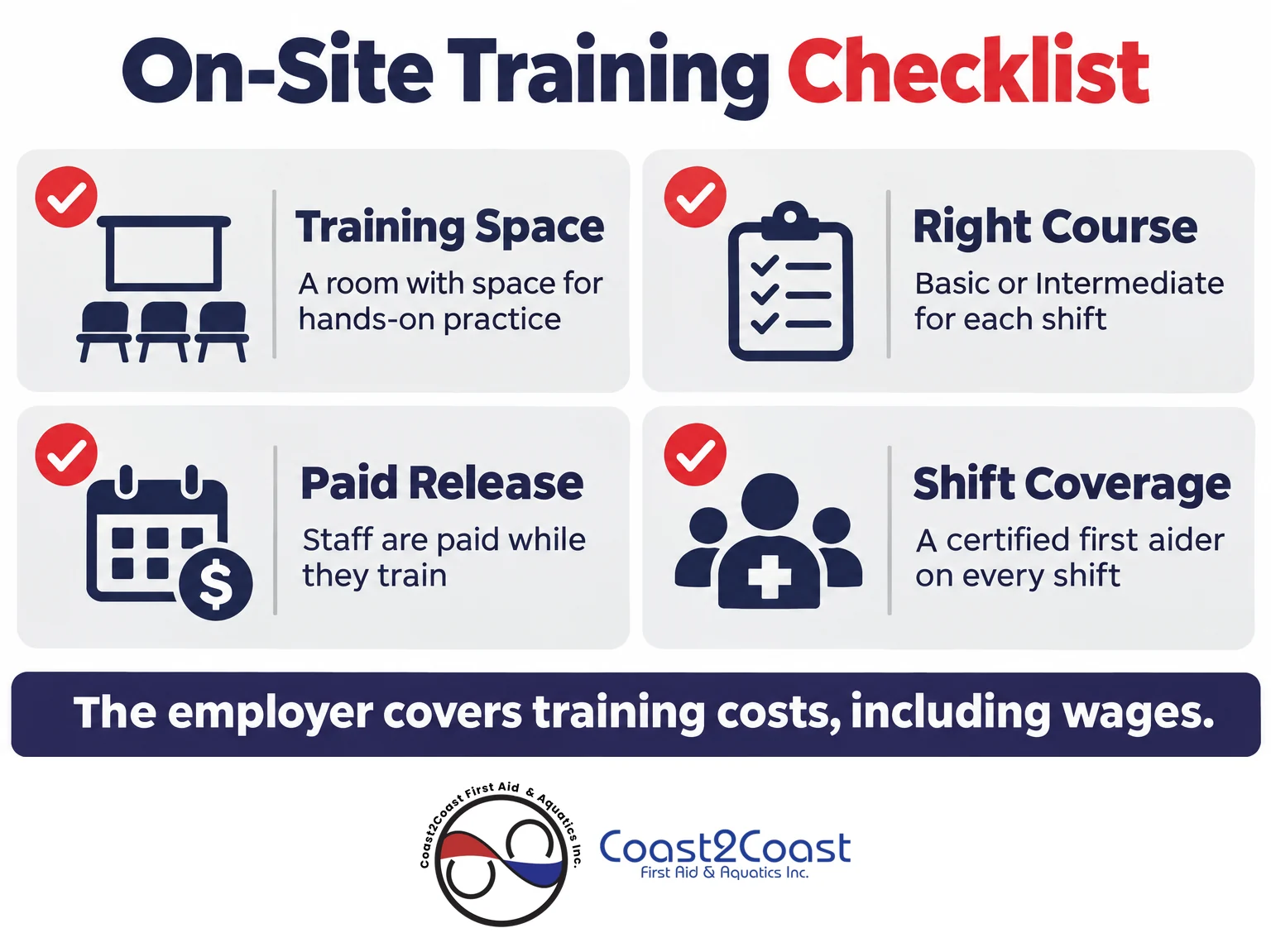
The business is responsible for the cost. According to the WSIB, the employer pays for training for designated first aiders, including their wages while they train, as well as for first aid kits, stations and facilities. That is one more reason the scheduling advantage of a group session matters: the less time staff spend away, the lower the total cost of compliance.
Training Built Around Your Workplace
Certified instructors, flexible formats and a certificate for every participant.
Which Course Should You Book: Basic or Intermediate First Aid?
The right course depends on your shift sizes, not on the size of your whole company. A business with fifty employees spread across ten small shifts of five people may only need Basic First Aid certificates, while a twenty-person business where everyone works the same shift needs Intermediate.
Basic First Aid is an 8-hour program. In courses offered in the market it is often sold as Emergency First Aid with CPR and AED, and it covers the essentials: scene safety, calling for help, checking an unresponsive person, CPR and AED use, choking, bleeding control, shock and common injuries. You can see the course details on our Emergency First Aid page.
Intermediate First Aid is a 16-hour program. In the market it is generally taught as Standard First Aid with CPR and AED. It covers everything in the Basic course in more depth and adds wound care, fractures and sprains, head and spinal injuries, burns, poisoning, medical conditions and prolonged care. You can review it on our Standard First Aid page.
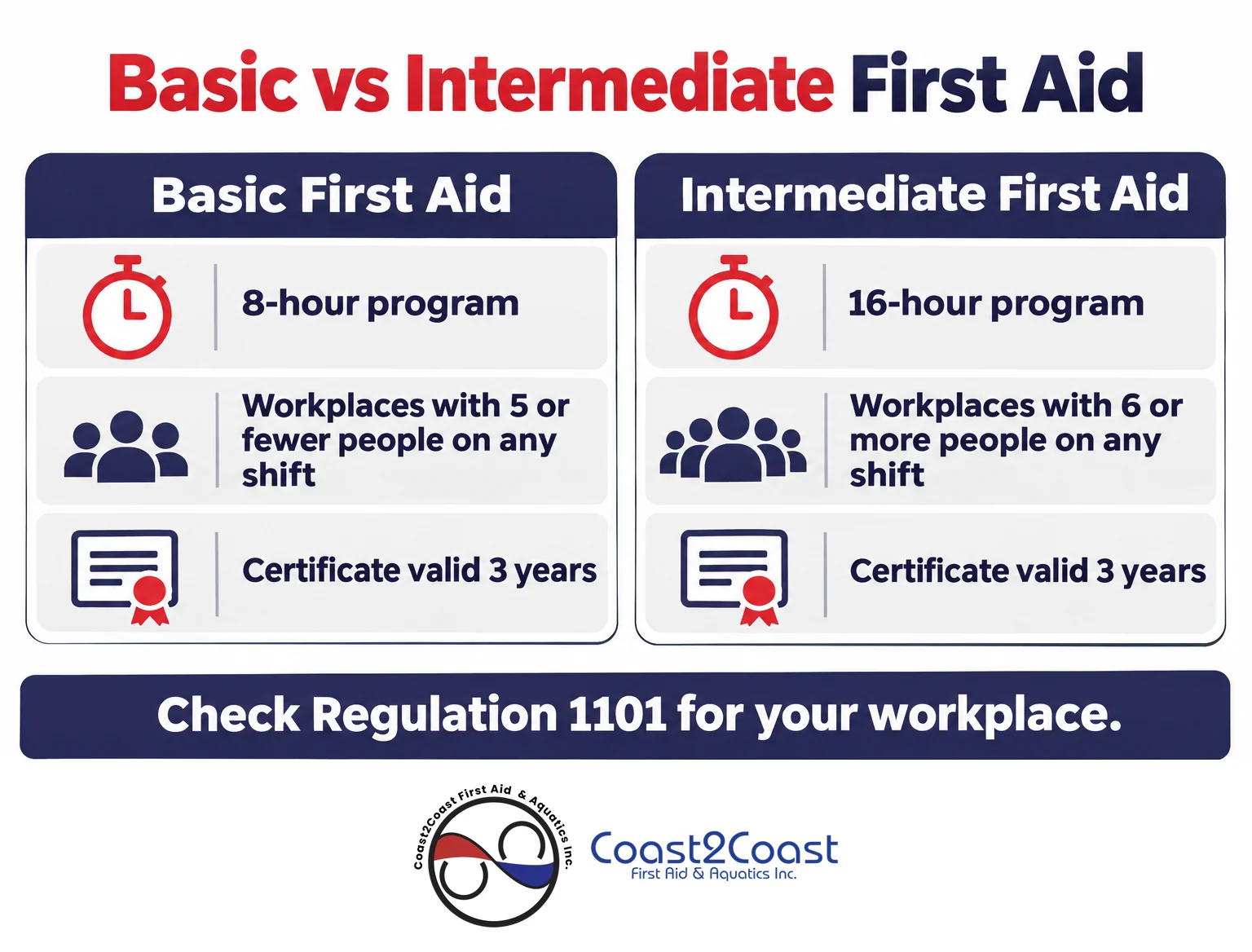
Some employers choose to train more people than the regulation requires. A common reason is coverage: when staff take vacation, call in sick or work different shifts, a larger pool of first aiders means every shift still has someone certified. Others choose the higher level for everyone because their hazards are greater. Both are reasonable decisions, and an instructor can help you think through coverage when you book.
Learn First Aid in a Real Classroom
Hands-on training with manikins, AED trainers and a certified instructor.
How Does an On-Site First Aid Training Session Work?
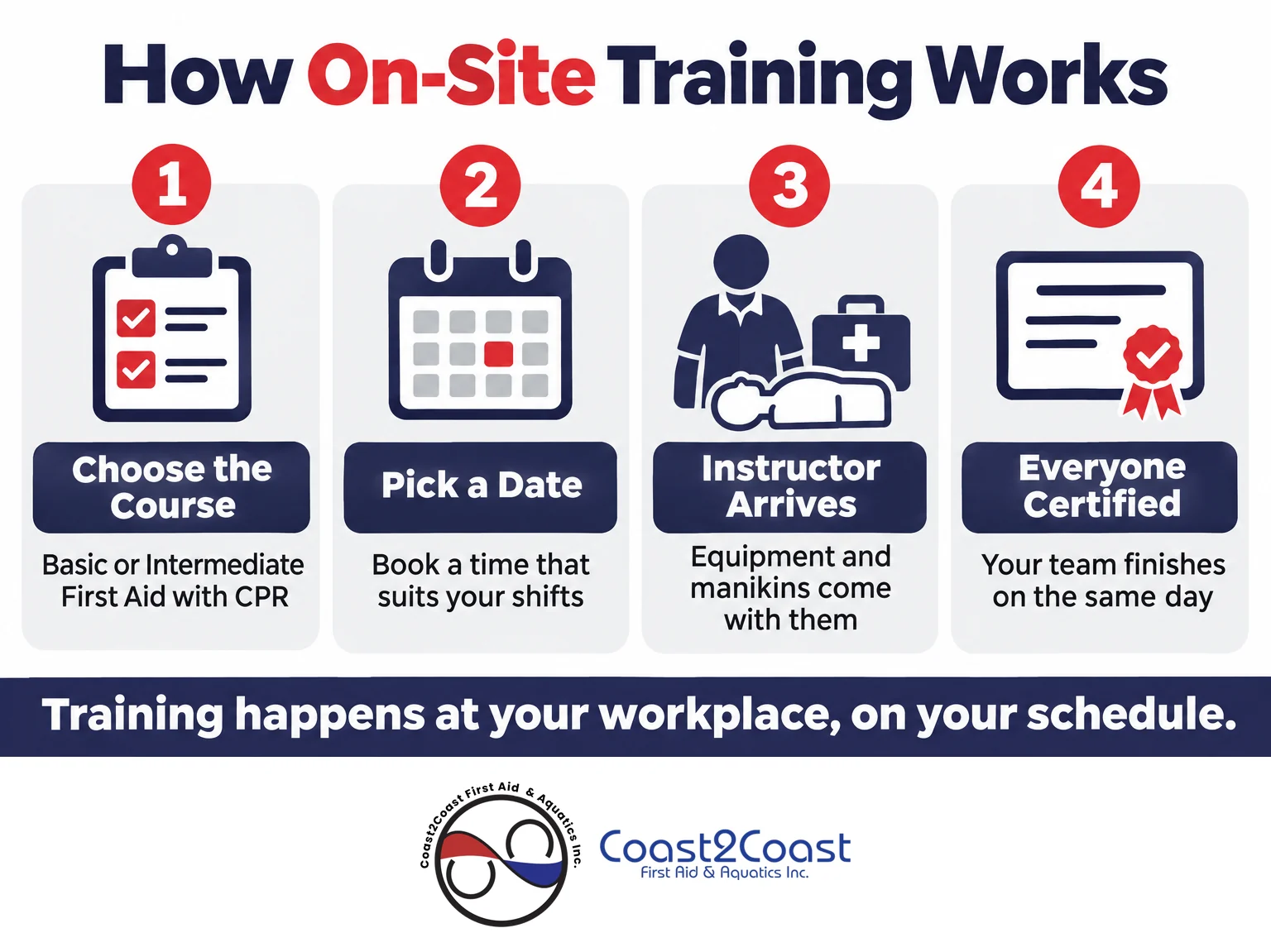
A typical on-site first aid training session follows the same pattern no matter the industry. Understanding the steps in advance makes it easier to plan.
First, you choose the course. Start with the WSIB rules above to decide whether your shifts need Basic or Intermediate certification, then confirm how many people will attend. Most providers can tell you the maximum group size for hands-on practice, because every learner needs enough time on the manikin and the AED trainer.
Second, you pick a date and a time. Many workplaces schedule training on a slow day, a professional development day or a weekend. Longer courses can sometimes be split across two days so that operations are not disrupted. Tell the provider about any shift patterns when you book.
Third, the instructor arrives early to set up. They bring the training equipment, check the room and arrange the space for practice. Learners watch short demonstrations, then practise each skill themselves: compressions on adult, child and infant manikins, AED pads and prompts, choking relief, bleeding control and bandaging.
Fourth, there is a skills evaluation. The instructor observes each learner and confirms they can perform the required skills correctly. Written knowledge checks are part of many programs too. Learners who need extra practice get it during the session.
Finally, certificates are issued to everyone who completes the program successfully. In Ontario, first aid certificates are valid for three years from the date of issue, according to the WSIB.
Learn CPR and AED in a Real Classroom
Practise compressions, breaths and AED pad placement with a certified instructor.
What Should You Prepare Before the Instructor Arrives?
A little preparation makes the day run smoothly. The checklist is short, and most items are about people and space rather than equipment.
Start with the room. You need a space where everyone can sit comfortably and where small groups can kneel on the floor to practise CPR. A boardroom or lunchroom with the tables pushed back is usually enough. A screen or a clear wall for the slides is helpful, and the instructor will tell you if anything else is required.
Next, confirm who is attending and make sure they are released from their normal duties. Participants who are answering phones or watching machines during class will not get the practice they need. If you are covering wages for the training, communicate that clearly so everyone knows it is part of their paid time.
Plan coverage for the rest of the workplace. If some staff are not in the class, make sure someone is responsible for urgent matters while the group is training. For essential services, consider splitting the group so that only part of the team is in training at a time.
Finally, tell participants what to expect from the on-site first aid training. They should wear comfortable clothing, because they will be kneeling and moving. Mention that there is no medical background required, and that the instructor teaches at a beginner pace. A short note ahead of time reduces nervousness on the day.
Get Your Team Certified Together
Private group courses cover first aid, CPR and AED for teams of any size.
How Big Can the Group Be for On-Site First Aid Training?
Group size is one of the first questions employers ask, and the answer depends on the instructor, the course and the space. Hands-on skills need equipment, and each learner should get plenty of time on the manikin and the AED trainer. If too many people share one manikin, practice time drops and learning suffers.
Instructors generally set a maximum number of learners per session based on the number of manikins they can bring and the number of evaluators on hand. If your group is larger than one class can accommodate, there are two simple options: split the group across two sessions on different days, or ask whether a second instructor can attend so two groups train at the same time.
Smaller groups are not a problem for on-site first aid training. A team of four or five can still book on-site first aid training, and many small employers do exactly that. The benefit is that everyone receives the same instruction and that you avoid the trouble of coordinating individual course dates for each person.
If you are not sure how many people to enrol, count the number of people on your largest shift and add a few more to cover absences. That gives you a practical target. Then confirm with the provider how the session can be arranged.
Know What to Do Before Help Arrives
CPR/AED training builds the muscle memory that reading alone cannot.
What Is Included in the Course Content?
Most workplace programs cover the same core topics, and an instructor can adjust the emphasis to your industry. The topics below reflect what learners should expect from a standard program.
Learners start with the basics of emergency response: assessing the scene for danger, checking whether someone is responsive, calling for help and knowing what information to give to 911. These steps are the foundation for every other skill in the course.
Next comes CPR and AED use. Learners practise compressions and breaths on manikins sized for adults, children and infants, and they use AED trainers so they know what the real device will say. Many workplaces already have an AED on the wall, and people are often surprised by how simple it is once they have used a trainer.
Choking relief is covered for every age group, followed by bleeding control, wound care and bandaging. These are the injuries most commonly seen in workplaces, so the instructor will spend time on practical techniques such as applying direct pressure, using dressings and recognising when bleeding is serious.
Intermediate programs go further with fractures, sprains, burns, head and spinal injuries, medical emergencies such as seizures, diabetic emergencies and heart attacks, and the responsibilities of a first aider while waiting for paramedics. Throughout the course, learners practise scenarios, because skills only become automatic with repetition.
If your workplace has specific hazards, mention them when you book. A manufacturer may want extra time on crush injuries and eye injuries, while a school may want a focus on allergic reactions and asthma. Providers can often adapt scenarios without changing the standard content.
Train Your Whole Team
Private group sessions for your workplace, with training scheduled around your team.
How Do You Keep Your Workplace Compliant After Training?
Training is only one part of workplace first aid. The WSIB also expects first aid kits to meet the minimum contents set by Regulation 1101, and kits that meet CSA Z1220 also qualify. Kits must be portable and easy to access, not locked in a cabinet, drawer or room, and they should be checked at least four times a year.
A complete first aid station includes the kit, the “In Case of Injury” poster (Form 82), a first aid inspection card and a list of first aiders in the area. Posting the list where everyone can see it helps staff know who to call. Work vehicles, including personal vehicles used for work, should have a first aid kit too.
Next, track certificate expiry dates. Ontario first aid certificates are valid for three years. According to the WSIB, an Intermediate certificate can be renewed once through a one-day recertification course before it expires, and after that a new certificate must be earned. Keep a simple spreadsheet with each first aider’s name, certificate date and expiry date, and set a reminder well before the deadline. Your provider can explain the recertification options.
Finally, think about coverage over time. When a first aider leaves the company or changes shifts, your coverage changes too. A short quarterly review of who is certified on each shift prevents gaps. Many employers schedule a refresher session for new staff every year, so there is always a group ready to train.
Train Your Whole Team
Bring a certified instructor to your workplace and certify everyone in one session.
Is On-Site First Aid Training Right for Your Business?
On-site first aid training works best when you have a group to certify, a space to teach in and a schedule that is hard to disrupt. If you only need one person trained, a public class may be simpler. If you have five or more people, the group format almost always makes more sense.
Consider on-site first aid training if you need to certify new staff at the same time, if your workplace has shifts that make it difficult for people to attend public classes, or if you want training that looks like your actual environment. Consider a public class if you only need to certify one or two people, or if your workplace has no space that suits a hands-on session.
It also helps to think about the long term. Certificates expire on a three-year cycle, so the group you train today will be due for renewal together. Planning a recertification session at the same time makes that renewal much easier.
If you want to see how a group session could work for your team, our private group training page explains the format,. If your business is in a particular industry, such as construction or healthcare, the group training pages for those industries describe what is covered.
Get Hands-On CPR and AED Practice
Work with real manikins and AED trainers while an instructor coaches your technique.
Key Takeaway
On-site first aid training puts the course in your workplace, certifies your whole group in one session and follows the same national standard as a public class. In Ontario, choose Basic First Aid if five or fewer people work on any shift and Intermediate First Aid if six or more do, use a WSIB-approved provider, and plan for the employer to cover training costs and wages. Check certificate expiry dates, keep your kits stocked and book recertification before the three-year mark.
Join 200,000+ Students Who Are Certified
Choose the first aid course that meets your workplace requirements and gives your team real confidence.
Frequently Asked Questions: On-Site First Aid Training 2026
Q1: What is on-site first aid training?
A: On-site first aid training is a course taught at your own workplace by a certified instructor who brings the equipment with them. Your group learns CPR, AED use, choking relief, bleeding control and other skills hands-on, then completes a skills evaluation. Everyone who passes receives the same certificate they would earn in a public class, and the whole team is certified in one session.
Q2: Is on-site first aid training the same as a public class?
A: Yes. The content, skills practice and certificate are the same as in a public class. The difference is the location and the group. Instead of travelling to a training centre with strangers, your team learns together at your workplace. Instructors can also tailor the examples to your hazards, such as kitchen burns, machine cuts or office emergencies, without changing the standard course content.
Q3: Does Ontario require workplace first aid training?
A: Yes. Under Regulation 1101 of the Workplace Safety and Insurance Act, businesses covered by the Act must have first aid coverage. At least one certified first aider must be on site at all times, and the level depends on the number of people on any one shift. The WSIB First Aid Program page lists the current requirements, so confirm them there.
Q4: How many first aiders does my workplace need in Ontario?
A: There is no required ratio of first aiders to total employees. At least one certified person must be on site at all times. If five or fewer people work on a shift, one Basic First Aid certificate is required. If six or more work on a shift, one Intermediate First Aid certificate is required. Many employers certify extra people to cover absences and different shifts.
Q5: What is the difference between Basic and Intermediate First Aid?
A: Basic First Aid is an 8-hour program covering core skills such as CPR, AED use, choking, bleeding control and common injuries. Intermediate First Aid is a 16-hour program that goes deeper into fractures, burns, head and spinal injuries, medical emergencies and prolonged care. The level your workplace needs depends on how many people work on any one shift.
Q6: Who pays for first aid training in Ontario?
A: According to the WSIB, the employer pays for training for designated first aiders, including their wages while they are in class. The business also pays for first aid kits, stations and facilities. Because wages are part of the cost, many employers choose on-site first aid training, which removes travel time and certifies several people in one session.
Q7: Does the training provider need to be approved by the WSIB?
A: Yes. Training must come from a WSIB-approved provider. The WSIB advises checking any provider against its approved list, since some providers claim approval in every province when they do not. Approved providers may use affiliate trainers, but those trainers must be listed on the approved provider’s website. Online-only programs are not approved, although approved blended programs exist.
More FAQs: Costs, Group Size, Certificates and Preparation
Q8: How long does an on-site first aid training session take?
A: It depends on the course. Basic First Aid is an 8-hour program, which is usually one full day. Intermediate First Aid is a 16-hour program, which is usually two days or can be split into sessions to suit your schedule. Tell the provider about your shift patterns when you book so the sessions can be arranged around your operations.
Q9: How many people can attend one on-site session?
A: Group size depends on the instructor, the course and the space, because every learner needs enough time on the manikin and AED trainer. Providers usually set a maximum per session. If your group is larger, you can split it across two days or ask about a second instructor. Small groups of four or five can book on-site training too.
Q10: What do I need to provide for on-site training?
A: You need a room where everyone can sit and where small groups can kneel on the floor to practise CPR. A screen or clear wall for slides is helpful. The instructor brings the manikins, AED trainers, bandages and course materials. You should also release the participants from their normal duties so they can focus on the practice for the whole session.
Q11: How long is an Ontario first aid certificate valid?
A: According to the WSIB, first aid certificates are valid for three years from the date of issue in Ontario. An Intermediate First Aid certificate can be renewed once through a one-day recertification course before it expires. After that, a new certificate must be earned. Tracking expiry dates in a simple list helps you book renewal before coverage lapses.
Q12: Does the WSIB accept first aid certificates from other provinces?
A: Yes. In many cases. The WSIB accepts current CSA Z1210-compliant certificates from other Canadian provinces. If a new employee already holds a valid certificate, confirm that it meets the standard and has not expired before you count that person toward your coverage. When in doubt, ask your training provider or the WSIB directly.
Q13: Are online-only first aid courses accepted in Ontario?
A: No. The WSIB states that online-only programs are not approved. Hands-on practice is essential because skills such as compressions, AED use and bandaging cannot be learned from a screen alone. Approved blended programs, which combine online learning with an in-person skills session, do exist, so check that the provider is approved before booking.
Q14: What should be in a workplace first aid station?
A: A first aid station should include a kit that meets the minimum contents in Regulation 1101 or CSA Z1220, the “In Case of Injury” poster (Form 82), a first aid inspection card and a list of first aiders in the area. Kits must be portable and easy to reach, not locked away, and should be checked at least four times a year.
Q15: Is on-site first aid training worth it for a small team?
A: Often, yes. Even a team of four or five saves travel time and certifies everyone together, which makes scheduling and renewal easier. A public class may suit you better if you only need one or two people trained. If your workplace has no suitable room, or only one employee needs a certificate, a public class can be simpler.
Reviewed & Sourced
Reviewed by Coast2Coast Certified Lead First Aid Instructor.
Sources: Workplace Safety and Insurance Board (WSIB), First Aid Program and Regulation 1101 under the Workplace Safety and Insurance Act. Training and kit standards referenced: CSA Z1210 and CSA Z1220.