
If the thought of walking into a room full of strangers and practising emergency skills makes your stomach drop, you’re not alone. A social anxiety first aid class provides training to recognize and respond to social anxiety, and the class itself is built for people who find group settings difficult. This guide walks you through exactly what happens in a Coast2Coast First Aid & Aquatics class so you can register with fewer unknowns and more confidence.
Key Takeaways
- You won’t be judged on acting skills. Instructors assess safety steps, checking hazards, calling 9-1-1, performing the CPR sequence, not eye contact, volume, or how “smooth” you sound during a scenario.
- Group scenarios are structured, not improvised. Training often includes case-based learning with interactive scenarios, practised in pairs or small groups with coaching, never performed cold in front of the room.
- Accommodations are normal, not special. Instructors routinely offer options like partnering with a friend, sitting near the exit, or taking short regulation breaks.
- Certificates don’t require pushing past your limits. Canadian Red Cross certifications are valid across Canada and can be earned while using coping tools like fidgets, notes, or scripts.
- You can prepare in advance. Contacting Coast2Coast before class day to discuss needs reduces the number of surprises that fuel anxiety.
Understanding Social Anxiety in a First Aid Classroom
Social anxiety, autism, ADHD, OCD, and PTSD are not rare conditions among adult learners. According to Public Health Agency of Canada data, more than 8 out of 10 people in Canada reported experiencing negative impacts from the COVID-19 pandemic, and more than 1 in 5 reported some level of distress in the month before being surveyed. Those numbers haven’t simply disappeared, mental health challenges remain widely reported across Canada, and many people entering a first aid training room carry them quietly.
In a classroom, social anxiety can show up as fear of being watched during practice, worry about “holding the group back,” difficulty talking to a partner, or sensory overload from beeping manikins and multiple conversations. Common symptoms of anxiety include excessive worry and fear. Generalized anxiety disorder specifically involves this kind of excessive worry persisting for six months or more, while panic disorder involves unexpected panic attacks that recur often. Understanding social anxiety includes recognizing cognitive distortions, like “everyone is judging me,” and avoidance behaviors that might make you want to skip class entirely.
There’s a difference between everyday nerves on day one and a mental health crisis, panic-level distress, dissociation, or complete shutdown. Coast2Coast classes are designed with both realities in mind. You are not expected to be outgoing, loud, or “on” all day to succeed. Participants learn to identify early warning signs of social anxiety, which is itself a form of mental health first aid, it helps you set boundaries and communicate needs before they escalate.
How Group Scenarios Actually Work (Step-by-Step)
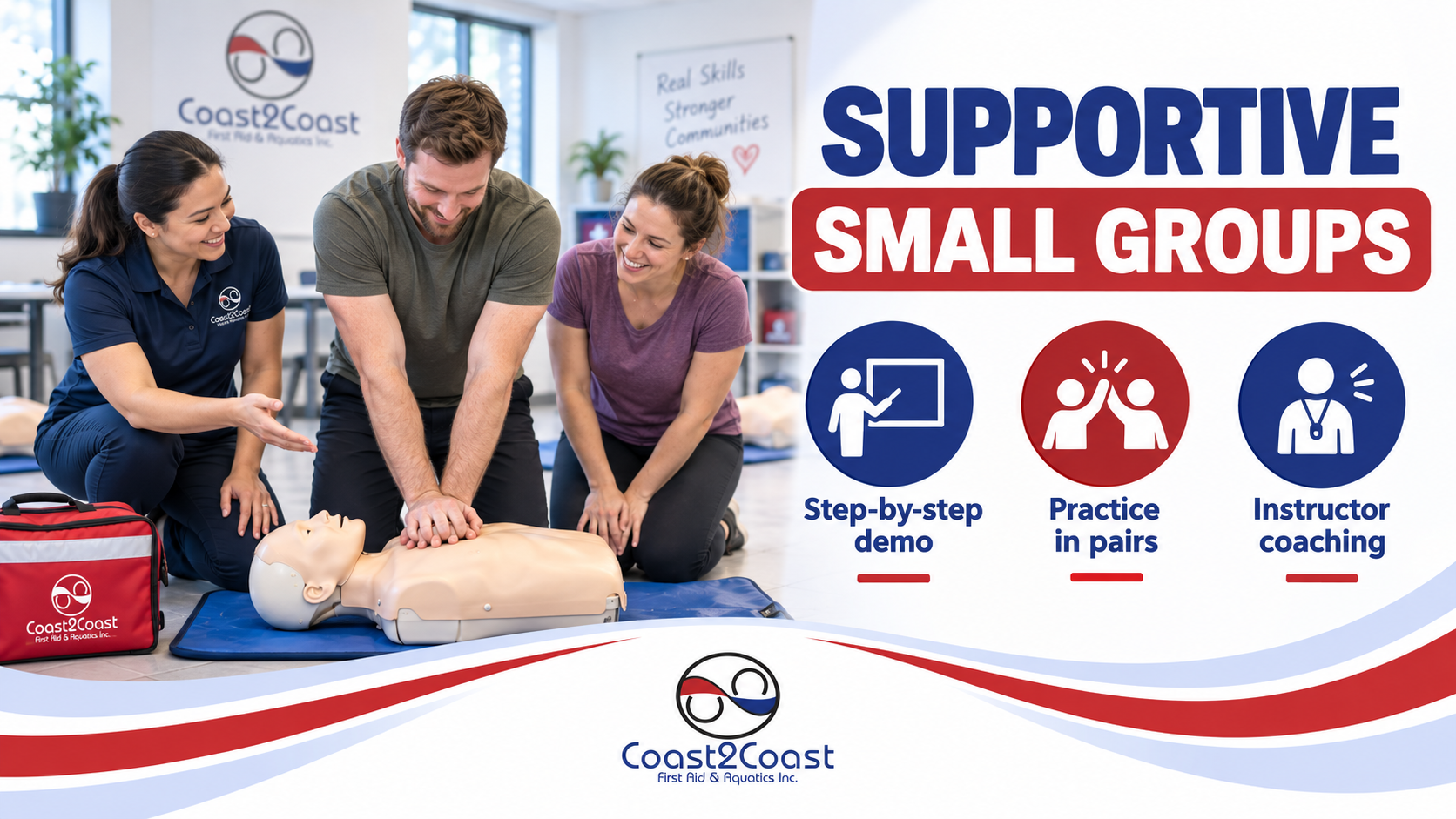
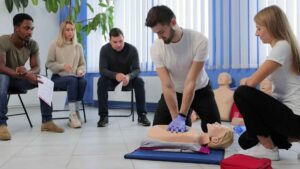
A typical scenario block in a Canadian Red Cross Intermediate First Aid & CPR class runs about 10 to 15 minutes and follows a predictable pattern. The instructor explains a situation, demonstrates the response slowly, then asks students to practise in pairs or small groups with direct coaching. You are not called to the front of the room to perform.
Each scenario breaks into small steps: the instructor explains the emergency (an adult collapses at work), demonstrates the full response on a manikin, then students practise in pairs, one acts as the responder, one observes or plays the patient, while the instructor circulates offering corrections individually.
Realistic scenario examples include adult cardiac arrest with CPR and AED, choking in a restaurant, fainting in an office, or a coworker experiencing extreme anxiety at a staff meeting. Scripts are simple and optional. Some students like to “act it out” with dialogue, others prefer to quietly walk through the first aid sequence step by step. Both approaches are accepted, and both pass, as long as the safety steps are correct.
Coast2Coast instructors keep the focus on skills like hazard checks, calling emergency services, compression depth, and AED use. They do not grade improvisation, humour, or role-playing realism, which can be particularly stressful for autistic or anxious students.
You’re Not Graded on Acting: What Instructors Really Assess
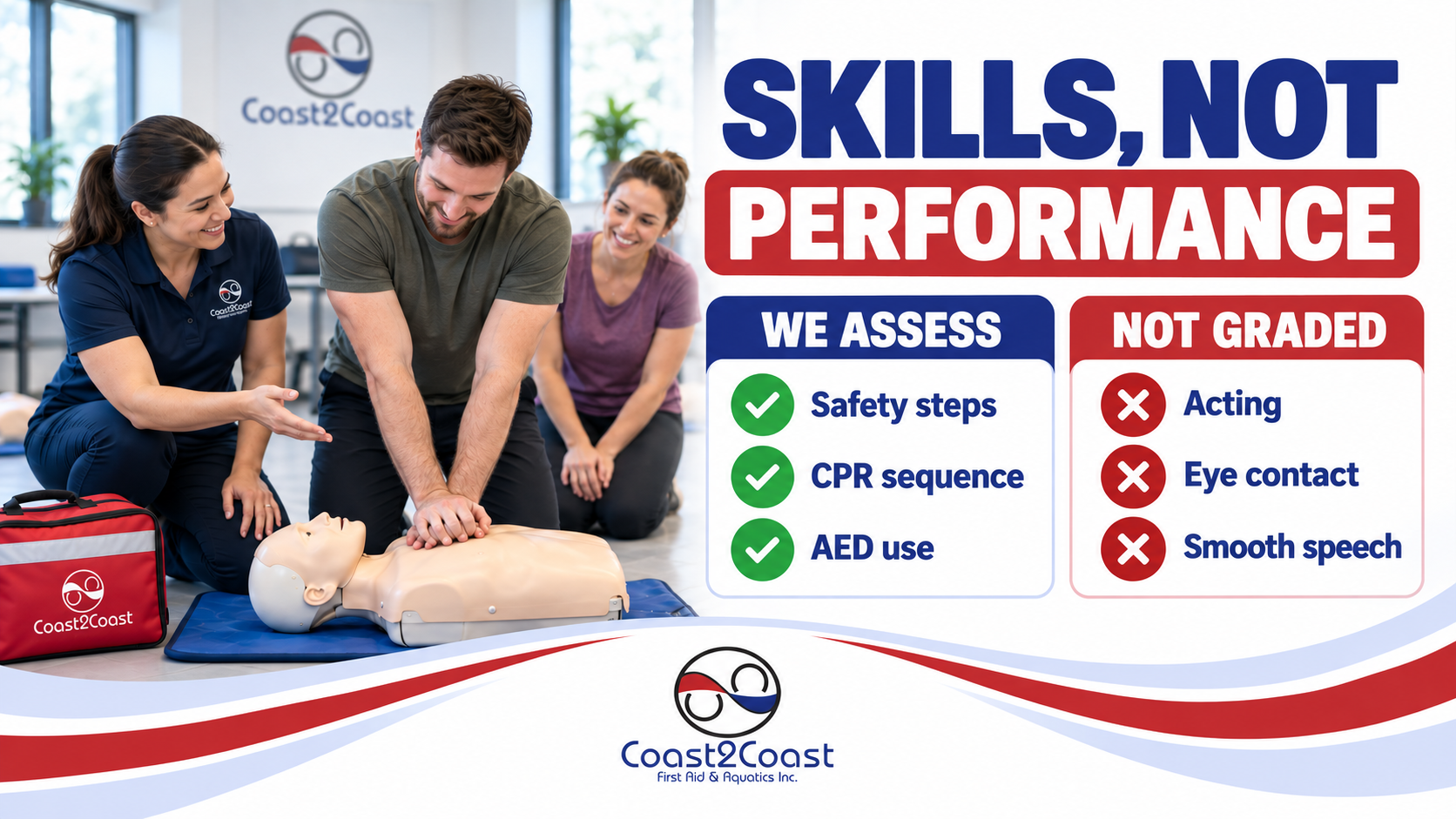
Performance style is not part of the evaluation. Whether you whisper, stammer, or need three tries to get the words out, what matters is that you demonstrate the correct safety sequence.
What instructors assess: scene safety and hazard identification, obtaining consent before helping, calling 9-1-1 or directing someone else to call, correct CPR depth and rate, proper recovery position, safe AED pad placement, and recognizing when to stop CPR.
What does not matter: how extroverted or charismatic you appear, eye contact quantity, voice volume (as long as your partner or instructor can hear you), whether your speech is “smooth” or you pause to think, or memorizing lines word-for-word.
Even in Psychological First Aid segments, the focus is on active listening, validating feelings, and connecting individuals to resources, not delivering a flawless conversation. Participants learn supportive communication skills, and those skills are assessed on substance, not style. Coast2Coast maintains a 99.9% pass rate among 150,000+ students, the evaluation is designed for you to succeed, not to catch you out.
If you want a quieter evaluation, you can ask the instructor beforehand. Many will offer a one-on-one check instead of assessing you within a group.
Psychological Safety in Class: Our Approach to Mental Health First Aid
At Coast2Coast, physical first aid and mental health first aid go together. A class should never push a student into a personal mental health crisis while they learn to manage emergencies for others.
Psychological safety, in plain language, means mistakes are expected and treated as learning moments, questions are welcome at any time, you won’t be shamed for needing repetition or breaks, and no one is forced to disclose personal diagnoses or trauma history.
Coast2Coast follows Canadian Red Cross guidance on trauma-sensitive teaching, avoiding unnecessarily graphic scenario details and steering clear of content that could strongly trigger past trauma or medical experiences. Mental Health First Aid teaches skills to support people in mental health crises, and courses emphasize the importance of recognizing when to seek professional help. Instructors offer content warnings before intense scenarios, give you the option to observe first, grant permission to step back without penalty, and check in after emotionally heavy topics like grief responses.
This approach protects everyone, neurodivergent learners, new Canadians learning in a second language, and students taking first aid training because of a difficult event they experienced personally.
Common Scenario Types (Including Mental Health & Social Anxiety Situations)
Coast2Coast classes include a mix of physical and psychological scenarios, always at a manageable practice level rather than an intense re-enactment.
Common physical first aid scenarios include cardiac arrest with CPR and AED, choking at a family dinner, severe bleeding after a home accident, a broken bone at a youth sports game, and cold-related emergencies. Mental health and social anxiety-related scenarios include a coworker having a panic attack during a staff meeting, a teen freezing during a school presentation, or a friend expressing distress. Common signs of a mental health crisis include behavioral changes, and scenarios reflect that reality.
In these psychological first aid scenarios, students practise the Look, Listen, Link, Live model. The Canadian Red Cross uses this as a structured, stepwise framework, not a free-form role-play. Effective support planning teaches how to approach someone in distress calmly and supportively, using verbal cues and compassionate support rather than diagnoses or unsolicited advice. These are fictional, low-pressure situations, students are never asked to disclose their own diagnoses or trauma history in front of the group. For the full framework, see our guide on Mental Health First Aid: How to Support Someone in a Mental Health Crisis.
Accommodations for Neurodivergent & Socially Anxious Students
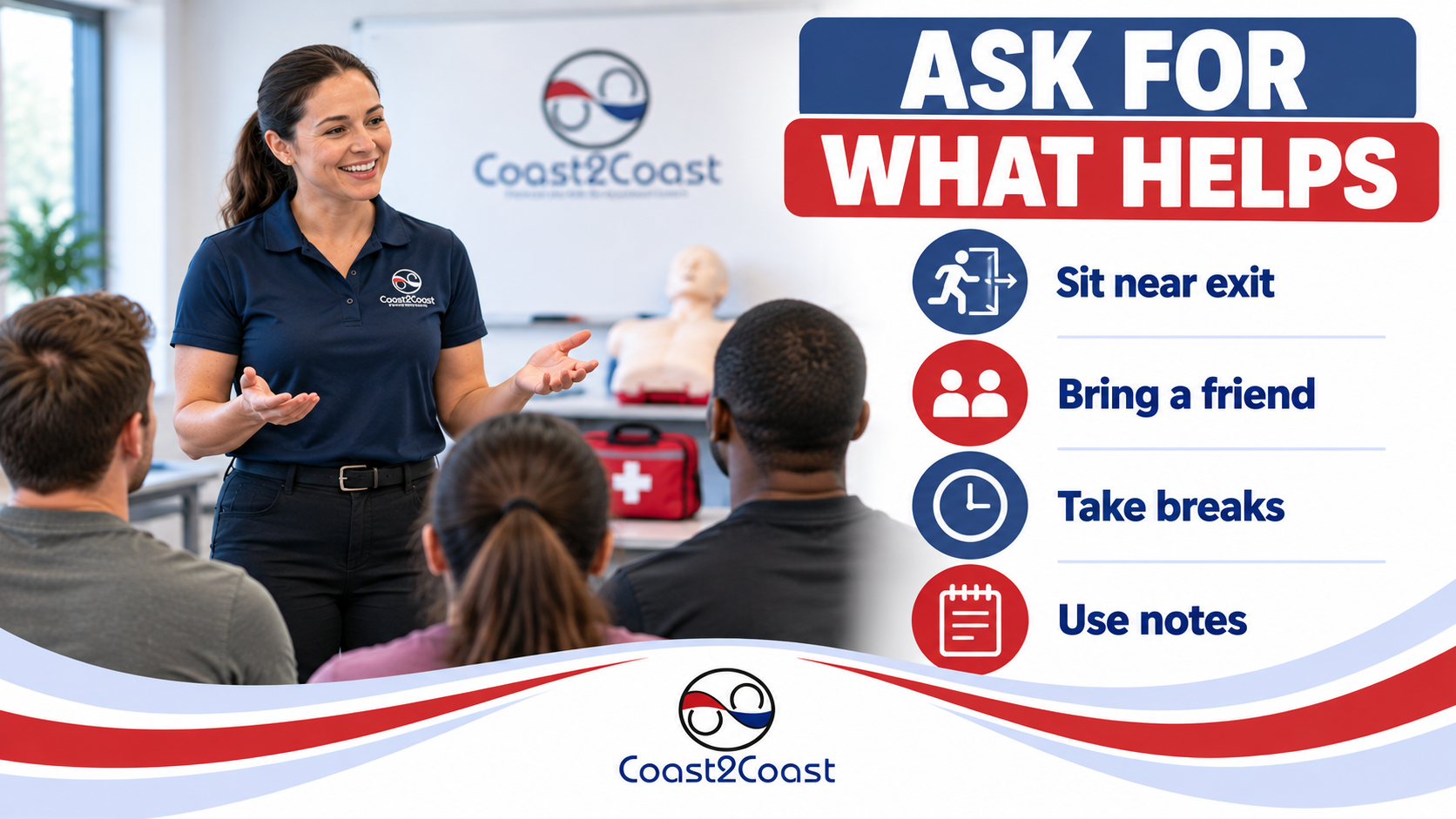
Coast2Coast regularly teaches autistic, ADHD, dyslexic, and socially anxious students. Accommodation requests are treated as normal, not exceptional.
Options you can request: sitting near an exit for easy breaks, pairing with a chosen friend or coworker, avoiding being picked to demonstrate first, using written checklists during practice, and having instructions repeated or rephrased.
Sensory accommodations include a quieter seating area when possible, the option to wear noise-reducing earbuds when not in direct instruction, and advance notice before high-noise elements like group CPR practice with multiple manikins beeping simultaneously.
Processing-related supports include extra time to answer questions without feeling rushed, short one-on-one clarifications during breaks, and written or visual aids alongside verbal instructions. Email or call Coast2Coast ahead of time with your accessibility needs so the instructor can prepare a low-stress plan rather than improvising during class.

North America’s first AI-powered First Aid & CPR tutor, part of the Coast2Coast Student Companion app. Coasty explains CPR/AED and BLS concepts in plain language, with quizzes to review before and after class.
What a Typical Day in Class Looks Like
Here’s a realistic walkthrough of an Intermediate First Aid & CPR day, focusing on how each stage might feel if you carry social anxiety.
8:15 to 8:30 a.m. Arrive early, sign in quietly, choose your seat. No one forces small talk. 8:30 to 9:00 a.m. Brief introductions, sharing your name and maybe why you’re taking the course, not a personality quiz. 9:00 to 10:30 a.m. Early, low-stakes skills like bandaging and scene assessment, worked in pairs, instructor demonstrates first. 10:30 to 10:45 a.m. Mid-morning break, step outside, use grounding exercises. 10:45 a.m. to 12:00 p.m. CPR practice begins, coached individually, not performed for an audience. 12:00 to 12:45 p.m. Lunch break, decompress however you need. 12:45 to 2:30 p.m. Scenario practice in small groups, instructors signal upcoming scenario blocks well in advance, no surprise “perform now” moments. 2:30 to 4:30 p.m. Review, final practice, and evaluation, after repeating each skill in the same small group, which typically lowers social threat.
Certification, Validity & How Much Participation Is Required
Coast2Coast delivers Canadian Red Cross certifications recognized by WSIB, OHS, and WCB. A certificate is valid for three years across Canada, and certification for Psychological First Aid is valid for 3 years as well.
Classes are offered in-person, online, or as blended formats to accommodate learners. Psychological First Aid training lasts 12 hours in class for the full instructor-led version. Blended training includes 45 to 90 minutes online plus 7 hours in class, which can reduce your total time in a room full of people, explore blended learning options here.
Attendance expectations run roughly 14 to 16 hours for Intermediate First Aid & CPR in most provinces, though brief regulation breaks are permitted. To earn your certificate, you must demonstrate core skills at least once, this can often be done in a one-on-one or small-group format if arranged with the instructor beforehand. Having social anxiety, being autistic, or using fidgets, notes, and scripts does not prevent you from earning a certificate, safety competencies are what matter.
For socially anxious learners, the blended format, completing theory at home then attending shorter in-person skills sessions, is often easier than two full classroom days.
Try Blended Learning for Less Time in a Group
Complete theory at home, then attend a shorter in-person skills session.
Preparing Emotionally & Practically Before Your First Aid Class
A bit of self care before training day can prevent a personal crisis during class and make the experience more predictable. A major part of the training focuses on building personal resiliency and self-care strategies, start applying that principle before you even arrive.
Practical preparation: read your confirmation email carefully for location and timing, plan your transit route the day before, pack snacks, water, and comfort items, and arrive 10 to 15 minutes early to settle in.
Emotional preparation: write a short accommodation script you can hand to the instructor (“I have social anxiety and may need to step out briefly if overwhelmed, but I’m committed to learning the skills”), practise a grounding exercise you can use silently at your seat, pre-identify a support person you can text during breaks, and create a personal self care plan for after class.
Many students feel calmer knowing key facts ahead of time: class length, number of breaks, group size range, and whether blended learning is an option. Contact Coast2Coast directly to ask these questions so anxiety-fueling surprises are minimized.
When Social Anxiety Becomes a Mental Health Crisis During Class
Although uncommon, some learners may experience panic attacks, shutdowns, or dissociation during training, especially when topics touch on trauma, death, or past emergencies. Mental health crises can be triggered by stress, trauma, or grief, and they can occur at any time for anyone.
What Coast2Coast instructors are trained to do: pause the student’s participation without drawing attention, help them access a quiet space away from the group, offer basic psychological first aid using the Look, Listen, Link, Live model, and check whether they need someone to pick them up or would like to stay calm and rejoin later.
Bring Familiar Faces: Private Group Training
Train alongside coworkers, family, or friends instead of a room of strangers.
Instructors play a key role in these moments, but they are not therapists. Early recognition of a mental health crisis is crucial for support, and instructors watch for signs of distress throughout the day. They can help connect individuals with local mental health resources or crisis hotlines, which are essential during mental health emergencies. Experiencing a crisis does not automatically mean failing the course, adults can often complete missed portions later or reschedule.
Why First Aid & Mental Health Skills Are Worth It (Even If Class Feels Scary)
For socially anxious or neurodivergent people, being prepared for an emergency at an office event, on transit, or during a family gathering can actually reduce anxiety. The “what if something happens and I can’t help?” fear loses its power once you have knowledge and skills to respond.
Mental health first aid concepts you learn in class, like how to stay calm, listen without judgment, and recognize signs of distress, can be turned inward. The ALGEE framework guides Mental Health First Aid responses, and those same principles help you cope during your own difficult days. Learning environments in these courses often foster community and reduce feelings of isolation. Courses reduce stigma around mental health by normalizing experiences and increasing awareness, which means you leave class not only certified but also more connected.
Ready to register? Explore upcoming courses near you or learn about private group training if you prefer familiar faces only.
Group scenarios in a first aid class are structured, coached, and never improvised for an audience. You are assessed on safety steps, not on acting, eye contact, or social confidence, and accommodations for social anxiety or neurodivergence are a normal, expected part of how Coast2Coast teaches.
Join 150,000+ Canadians Who Are Certified
Find a class near you and take the first step today.
Frequently Asked Questions: Social Anxiety & First Aid Classes
Q1: Will I have to speak in front of the entire class to pass?
A: Most assessments are done in pairs or very small groups. You are rarely required to present to the entire room. Quiet, step-by-step demonstration is perfectly acceptable. If talking to even a small group feels overwhelming, let your instructor know, they can often assess you one-on-one during a break.
Q2: How big are Coast2Coast classes?
A: Class sizes vary by location and course type, but many public sessions run with roughly 8 to 18 students. Instructor-to-student ratios are set to ensure safe supervision and enough individual coaching time, so you won’t feel lost in a crowd.
Q3: Can I take an online-only course if my social anxiety is severe?
A: Some theory components can be completed online through blended learning, but certifications like Intermediate First Aid & CPR/AED still require in-person skills practice for the certificate to be valid. There’s no way around the hands-on component for a workplace-recognized credential, but blended formats significantly reduce your total time in a room.
Q4: What if I freeze during the CPR evaluation, do I automatically fail?
A: No. If anxiety causes you to freeze, instructors can pause, reset the scenario, or switch to a quieter one-on-one check. The goal is to confirm you know the steps and can respond in an emergency, not to penalize a momentary anxiety spike.
More FAQs: Accommodations and Comfort in Class
Q5: Does Coast2Coast offer private or workplace training if I prefer familiar people only?
A: Yes. Coast2Coast provides private first aid, CPR, and Psychological First Aid sessions for workplaces, schools, and community groups. If you feel safer surrounded by family, coworkers, or friends rather than strangers, this option removes the room full of unknowns factor entirely.
Q6: Do I have to disclose my diagnosis to get accommodations?
A: No. You never need to name a specific diagnosis to request an accommodation, you can simply describe what helps, like needing a quieter seat, extra time, or a break option. Instructors are focused on making the class work for you, not on gathering clinical details.
Q7: What happens if I need to step out during a scenario involving a sensitive topic like grief or suicide?
A: Instructors give content warnings before emotionally heavy topics and offer the option to observe rather than participate, or to step out entirely without penalty. You can rejoin when you’re ready, and this is treated as a normal part of supporting your own wellbeing, not a mark against you.
Q8: Will using coping tools like fidgets or written scripts count against me?
A: No. Having social anxiety or being autistic, and using fidgets, notes, or scripts to manage it, does not prevent you from earning a certificate. Assessment is based entirely on whether you can demonstrate the correct safety steps, not on how you get there.
Reviewed By: Ashkon Pourheidary, B.Sc. Hons Neuroscience, Co-Founder of Coast2Coast First Aid & Aquatics and Canadian Red Cross Instructor Trainer since 2011.
Source: Public Health Agency of Canada, Survey on COVID-19 and Mental Health