
What Are the Nova Scotia First Aid Requirements for Workplaces?
Nova Scotia first aid requirements apply to almost every workplace in the province. They are found in Part 4 of the Workplace Health and Safety Regulations, which are made under the Occupational Health and Safety Act. Together these rules say how many trained first aiders an employer must have on each shift, what level of certificate they must hold, which first aid supplies must be on site, and how an injured worker must be taken to care.
The rules are built around three practical questions. How many employees are working on a shift? Is the workplace an office or another type of workplace, such as a shop, warehouse or construction site? And how far is the workplace from a hospital or emergency care facility? The answers decide how many first aiders you need and at what level.
This guide explains Nova Scotia first aid requirements in plain language so owners, supervisors and joint health and safety committees can plan with confidence. It covers workplace distance categories, the number of first aiders, certificate levels, first aid kits, transport, first aid rooms, isolated worksites, training costs and record keeping. It also explains how to choose a training provider.
The regulations are detailed and can be amended, so treat this overview of Nova Scotia first aid requirements as a starting point and check the current regulation before you finalize your plan. If you want to compare local training options as you read, you can browse our first aid training in Halifax.
Train Your Whole Team
Private group sessions for your workplace, with training scheduled around your team.
Who Is Responsible for First Aid at a Nova Scotia Workplace?
The employer carries the main responsibility. Under the Occupational Health and Safety Act, employers must take reasonable steps to protect the health and safety of their workers, and Part 4 of the regulations turns that duty into specific first aid obligations. Employers must provide trained first aiders, supplies, access to supplies and a way to transport injured workers.
Employees have duties too. They must follow safe work practices and report injuries promptly. When a worker is designated as a first aider, the employer must pay for the training course and for the worker’s wages while they attend. Training time cannot be treated as unpaid time or as a personal cost.
Joint occupational health and safety committees or health and safety representatives help put the requirements into practice. They can review first aid plans, check that kits are stocked and make sure that first aiders are known to staff. At workplaces without a committee, the employer should still involve workers in planning.
Small employers are covered as well. Even a workplace with only a few employees on a shift may need a first aider or a first aid kit, depending on the distance to hospital care. Never assume that a small team is exempt from Nova Scotia first aid requirements.
Get Hands-On CPR and AED Practice
Work with real manikins and AED trainers while an instructor coaches your technique.
How Does Distance to a Hospital Affect Nova Scotia First Aid Requirements?
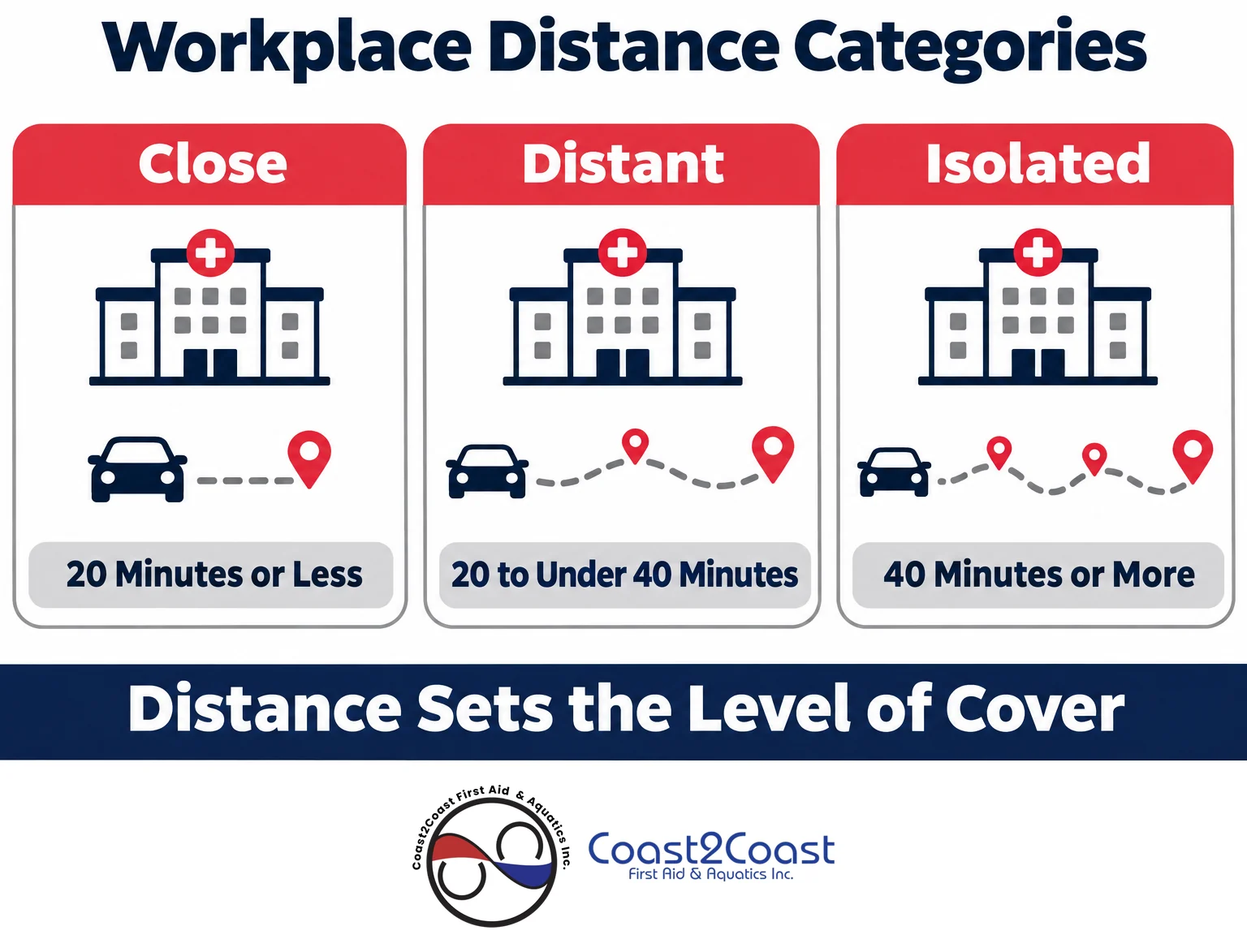
Distance is one of the most important factors in Nova Scotia first aid requirements, because the further workers are from emergency care, the more help they need on site. The regulations measure surface travel time from the workplace to a hospital or emergency care facility and sort workplaces into three groups.
A close workplace is one where the surface travel time is no more than twenty minutes. A distant workplace is one where the trip takes twenty minutes or more but less than forty minutes. An isolated workplace is one where the trip takes forty minutes or longer. Most urban workplaces in Halifax and other larger communities are close, while rural, coastal and remote sites are more likely to be distant or isolated.
The category matters because the table of required first aiders changes with it. A distant workplace usually needs a higher level of first aid cover than a close workplace of the same size, and an isolated workplace needs the highest level. Isolated workplaces also need a written first aid plan.
When you work out your category, measure the realistic surface travel time, including weather and road conditions where relevant. If your site has several locations or crews that move around, work out the category for each location. If you are unsure, ask the Department of Labour, Skills and Immigration or a qualified safety adviser.
Training Built Around Your Workplace
Certified instructors, flexible formats and a certificate for every participant.
How Many First Aiders Does Your Workplace Need?
The number of first aiders depends on how many employees are on a shift, the type of workplace and the distance category. The count includes full-time, part-time and casual employees working on that shift. Note that it is the number of people on a shift that matters, not the total number on your payroll.
For close workplaces, a single employee working alone does not need a first aider. From two to twenty-five employees on a shift, one basic first aider is needed. From twenty-six to fifty employees, an office needs one basic first aider while other workplaces need one intermediate first aider. Larger workplaces need more: at fifty-one to ninety-nine employees, offices need one basic and other workplaces need two intermediate; and from one hundred upward, the numbers keep rising.
Distant workplaces have higher requirements. For example, a non-office workplace with a lone worker needs one basic first aider, and one with two to twenty-five employees needs one intermediate first aider. Isolated workplaces rise again: a lone worker at an isolated non-office site needs an intermediate first aider, and larger crews need advanced first aiders.
The key point about Nova Scotia first aid requirements for staffing is that the table is detailed and offices are treated differently from other workplaces. Look up your exact shift size, workplace type and distance category in the current regulation, or ask your training provider to help you read it. Plan for absences, too. People take holidays and fall sick, so most employers train more first aiders than the minimum so that every shift stays covered.
Learn Standard First Aid in a Real Classroom
Build the skills your workplace first aiders need in a hands-on classroom course.
What Do Basic, Intermediate and Advanced First Aid Certificates Cover?
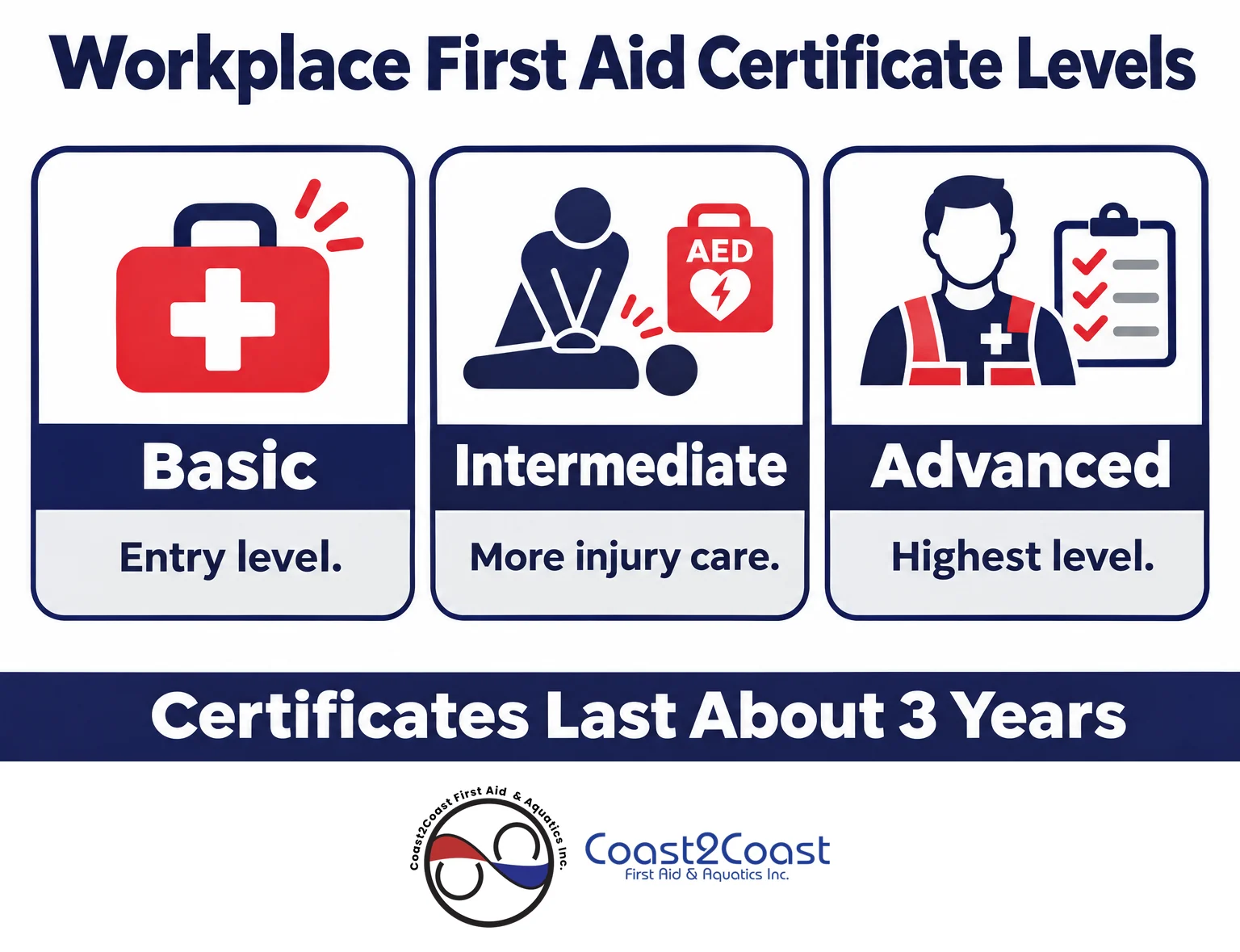
Nova Scotia recognizes three levels of workplace first aid certificate: basic, intermediate and advanced. They follow the national CSA first aid training standard, CSA Z1210, and training providers must meet the minimum program requirements in that standard to be approved.
A basic certificate is the entry level. It covers the essentials: assessing a scene, calling for help, CPR and AED use, choking, bleeding control, shock and common injuries and illnesses. It suits low-risk workplaces and small teams.
An intermediate certificate goes further. It adds more detailed injury care and longer practice, and it suits workplaces where injuries are more likely or where help is further away. An advanced certificate is the highest level, with the most extensive content, and is used at higher-risk, distant and isolated worksites.
In practice, many workplaces take a standard first aid course with CPR and AED. Our Standard First Aid course is a common choice for workplace first aiders, and course content is checked against the standard. Ask any provider which workplace certificate level their course meets, because the label on the card matters.
Certificates generally expire three years after they are issued, unless the issuing agency sets a shorter period. Employers and training agencies must keep copies of certificates, so build a simple tracker and renew early. Letting a certificate lapse can leave a shift without cover and put the employer out of compliance.
Learn First Aid Skills in a Real Classroom
Hands-on first aid training with real equipment and an instructor guiding every skill.
What First Aid Kits Does Your Workplace Need?
Kits are the second major part of Nova Scotia first aid requirements, and they are easy to get wrong. The regulations use kit types that follow the CSA first aid kit standard, CSA Z1220: Type 1 is a personal kit, Type 2 is a basic kit and Type 3 is a larger kit for bigger or higher-risk workplaces.
For close and distant workplaces, an employee working alone needs one Type 1 kit. From two to twenty-five employees on a shift, one Type 2 kit is needed, and the number rises as shifts get larger. Isolated workplaces other than offices need a mix of Type 2 and Type 3 kits at larger sizes. Smaller kits can be combined to meet the requirement for larger ones, for example two small kits can stand in for one medium kit.
Kits must be readily accessible during all working hours, and supplies should be spread around the workplace so they can be reached quickly. Signs should show where supplies are kept and how to contact first aiders, where practicable. Supplies must be visible, clean and dry, and they should be checked regularly for quantity and expiry dates.
Vehicles count too. A vehicle that regularly carries employees needs at least a small Type 2 kit, while a vehicle that is regularly used only by its driver needs at least a Type 1 kit. Check kits in work vehicles as part of your routine inspections.
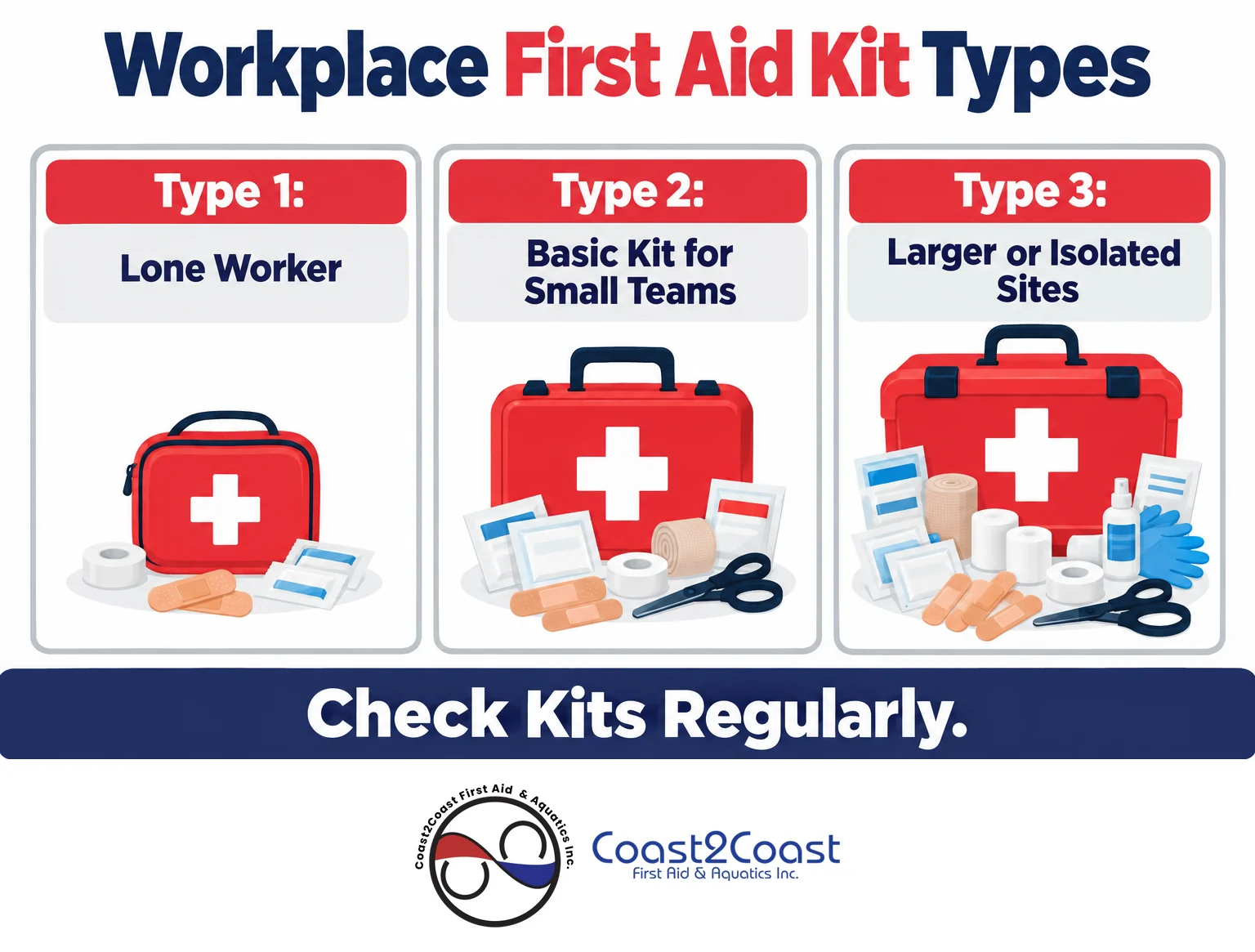
Good habits make compliance easier. Name one person to inspect kits monthly, replace used or expired items straight away and record each check. A kit that is locked away or empty is worse than no kit at all, because people assume it can be used.
Get Your Team Certified Together
Private group courses cover first aid, CPR and AED for teams of any size.
How Must Employers Transport an Injured Worker?
Nova Scotia first aid requirements do not stop at first aid on site, because getting an injured worker to care is part of the duty. Employers must also provide a safe and timely way to transport an injured person to a hospital or emergency care facility. This might mean calling an ambulance, but it can also mean having a suitable vehicle and a plan for when an ambulance cannot get to the site quickly.
If the injured person might need help while travelling, at least one other person besides the driver must go with them. A driver should never be left to drive and monitor a worker at the same time. That rule matters most for longer trips and for workplaces that are far from care.
Transport planning is especially important for distant and isolated workplaces. Think through what would happen on a bad weather day, at night or on a remote road. Make sure supervisors and first aiders know the plan and the route, and keep emergency numbers where everyone can see them.
For serious injuries, always call 911 first. Do not move a seriously injured person unless there is immediate danger, and do not use a private vehicle in place of an ambulance when emergency medical care is needed.
Train Your Whole Team
Arrange private first aid training for your employees at your workplace or ours.
When Is a First Aid Room or Written Plan Required?
Most workplaces do not need a dedicated first aid room, but Nova Scotia first aid requirements do call for one at larger non-office workplaces. The regulations require a room at a non-office workplace where two hundred or more employees are regularly employed on one shift. The room must be easy to reach, large enough, able to take a stretcher through its entrance and well lit, heated and ventilated. It also needs a communication system, posted emergency numbers and the minimum equipment listed in the regulation.
Isolated workplaces need a written first aid plan under Nova Scotia first aid requirements. The plan is developed with the joint committee or health and safety representative where one exists, and it should cover transport and communication. There are limited cases where the plan is not required, such as when no employee spends more than a small share of their time at the site over a four-week period, so check the exact rule for your situation.
Some workplaces have special rules. Hospitals, emergency care facilities and long-term care facilities may use a medical professional trained in CPR in place of a first aider, may use medical supplies that include the required kit items and may rely on equivalent facilities instead of a dedicated room. If you operate in a health care setting, read the exceptions closely.
Even where a room or plan is not required, writing down your first aid arrangements is good practice. A one-page plan that names first aiders, kit locations, emergency numbers and transport arrangements helps new staff and supervisors respond quickly.
Put These Skills Into Practice
Standard First Aid covers bleeding, burns, fractures and sudden illness in a hands-on class.
What Happens If an Employer Does Not Meet the Requirements?
Failing to meet Nova Scotia first aid requirements can have serious consequences. The most important is human: a worker who is injured or becomes suddenly ill without trained help nearby may suffer a worse outcome. Minutes matter in cardiac arrest, severe bleeding and choking, and a trained first aider with a stocked kit can change what happens in those minutes.
There are legal consequences as well. Occupational health and safety officers can inspect workplaces, review first aid arrangements and issue orders where requirements are not met. Employers who ignore orders or the Act can face enforcement action. Even where no penalty follows, an incident at a workplace with no trained first aider, an empty kit or an expired certificate invites hard questions afterwards.
Good records are your best protection. Keep copies of first aid certificates, kit inspection logs, training dates and your first aid plan. If an inspector asks how you meet the regulations, you can show them exactly what is in place and when it was last checked.
If you find a gap, fix it quickly and write down what you did. Book training, restock kits and tell staff who the first aiders are. A prompt response shows good faith and keeps workers safer while the fix is under way.
Train Your Whole Team
Private group sessions for your workplace, with training scheduled around your team.
How Do You Build a Workplace First Aid Plan That Stays Compliant?
Meeting Nova Scotia first aid requirements is easier when you treat first aid as a routine rather than a one-off project. Start by working out your distance category and the number of employees on your largest shift. Use the regulation to find the number and level of first aiders and the kit types you need.
Next, choose and train your first aiders. Pick people who are present on every shift, who are calm under pressure and who are willing to take on the role. Train extra people to cover absences. Book a course with a provider that meets the CSA standard and ask for hands-on practice. Our private group training can bring an instructor to your workplace, which reduces travel and downtime for a team.
Then set up kits and signage. Place kits where they can be reached quickly, mark them clearly and post first aider names and numbers. Assign someone to check supplies and expiry dates on a regular schedule, and record the checks.
Finally, track renewals. Certificates last about three years, so note each expiry date and schedule refresher courses before they lapse. Add CPR and AED training for the whole team where you can, since early CPR and defibrillation save lives. Our CPR and AED courses are a practical addition to any first aid program.
Review your plan for Nova Scotia first aid requirements every year and after any incident. Staffing, shift sizes and building layouts change, and a plan that fits last year’s workplace may not fit this year’s.
Learn CPR and AED in a Real Classroom
Practise compressions, breaths and AED pad placement with a certified instructor.
Key Takeaway
Nova Scotia first aid requirements depend on your shift size, workplace type and travel time to a hospital. Work out your distance category, check the table of first aiders in Part 4 of the Workplace Health and Safety Regulations, provide the right kits, plan safe transport and pay for training and wages. Certificates last about three years, so track renewals, train extra first aiders to cover absences and review your plan every year.
Join 150,000+ Canadians Who Are Certified
Add CPR and AED training to your workplace first aid program.
Frequently Asked Questions: Nova Scotia First Aid Requirements 2026
Q1: What are the first aid requirements for workplaces in Nova Scotia?
A: Employers must provide trained first aiders, first aid kits, access to supplies and safe transport for injured workers. The number and level of first aiders depend on how many employees are on a shift, whether the workplace is an office and how far it is from a hospital. The rules are in Part 4 of the Workplace Health and Safety Regulations.
Q2: How many first aiders do I need in Nova Scotia?
A: It depends on employees per shift, workplace type and distance to hospital care. At a close workplace, a shift of two to twenty-five employees needs one basic first aider. Larger shifts, distant sites and isolated sites need more, and at higher levels. Check the table in the current regulation for your exact situation.
Q3: What is a close, distant and isolated workplace?
A: These categories are based on surface travel time to a hospital or emergency care facility. A close workplace is twenty minutes or less away. A distant workplace is twenty minutes or more but under forty minutes away. An isolated workplace is forty minutes or more away. Distance changes the first aid cover you need.
Q4: What first aid certificate levels does Nova Scotia recognize?
A: Nova Scotia recognizes basic, intermediate and advanced workplace first aid certificates. They follow the CSA first aid training standard, and approved training agencies must meet its minimum program requirements. Higher levels cover more content and suit riskier, more distant or isolated workplaces. Confirm which level your workplace needs from the regulation.
Q5: Who pays for workplace first aid training in Nova Scotia?
A: The employer pays. When a worker is designated as a first aider, the employer must cover the cost of the course and the worker’s wages while attending. Training time should not be unpaid, and the employee should not bear any cost for a course the workplace requires. Keep receipts and attendance records so you can show compliance if an inspector asks.
Q6: How long is a workplace first aid certificate valid in Nova Scotia?
A: Workplace first aid certificates generally expire three years after issue, unless the issuing agency sets a shorter period. Employers and training agencies must keep copies of certificates. Track expiry dates and book renewal courses early so that every shift keeps its required cover without gaps, and so that you always have extra trained people ready when someone is away.
Q7: Does a small business in Nova Scotia need a first aider?
A: Possibly. Nova Scotia first aid requirements apply to small employers too. Even small workplaces may need a first aider or a first aid kit, depending on the number of employees on a shift and the distance to hospital care. A single employee working alone at a close office may need none, but distant and isolated workplaces have higher requirements. Check the table.
More FAQs: Kits, Certificates, Transport and Compliance
Q8: What first aid kit do I need for my workplace?
A: The kit type depends on shift size and workplace category. A lone worker needs a Type 1 kit, and a shift of two to twenty-five employees needs a Type 2 kit. Larger workplaces need more or bigger kits, and isolated non-office sites may need Type 3 kits. Kits follow the CSA kit standard.
Q9: Where should first aid kits be kept?
A: Kits and supplies must be readily accessible during all working hours and spread around so they can be reached quickly, not locked away. Post signs showing where supplies are and how to contact first aiders where practicable. Keep supplies visible, clean and dry, and check them regularly for quantity and expiry dates.
Q10: Do work vehicles need first aid kits in Nova Scotia?
A: Yes. A vehicle that regularly carries employees needs at least a small Type 2 kit. A vehicle regularly used only by its driver needs at least a Type 1 kit. Include vehicle kits in your regular inspections so that supplies are complete and in date when they are needed, and tell drivers where the kit is stored.
Q11: Is a first aid room required in Nova Scotia?
A: A first aid room is required at a non-office workplace where two hundred or more employees regularly work on one shift. It must be easy to reach, large enough, able to take a stretcher, well lit, heated and ventilated, with communication and emergency numbers posted. Smaller workplaces do not need one.
Q12: Who must transport an injured worker to hospital?
A: The employer must provide a safe and timely way to transport an injured person to a hospital or emergency care facility. If the person may need help during the trip, at least one other person besides the driver must go too. For serious injuries, call 911 rather than driving the person yourself.
Q13: Do isolated workplaces need a written first aid plan?
A: Yes. In most cases isolated workplaces need a written first aid plan, developed with the joint committee or representative where one exists, covering transport and communication. There are limited exceptions, such as when employees spend only a small share of their time at the site, so check the exact rule.
Q14: Do hospitals and care facilities follow different first aid rules?
A: In part. Hospitals, emergency care facilities and long-term care facilities may use a medical professional trained in CPR in place of a first aider, and may use medical supplies that include the required kit items. They may also rely on equivalent facilities. Read the exceptions in the regulation carefully, and confirm with the Department of Labour, Skills and Immigration if you are unsure how they apply.
Q15: Where can I find the official Nova Scotia first aid regulations?
A: The rules are in Part 4 of the Workplace Health and Safety Regulations under the Occupational Health and Safety Act, published on the Nova Scotia government website. Consolidations can be unofficial, so check the current official version or contact the Department of Labour, Skills and Immigration if you need confirmation for your workplace.
Reviewed & Sourced
Reviewed by Coast2Coast Certified First Aid Instructor.
Sources: Government of Nova Scotia, Workplace Health and Safety Regulations, Part 4 (First Aid), under the Occupational Health and Safety Act. Standards referenced: CSA Z1210 (first aid training) and CSA Z1220 (first aid kits).