

Mental health first aid isn’t reserved for therapists, nurses, or psychiatrists. It’s built for the rest of us, the managers, HR professionals, teachers, coaches, and frontline staff who see the early warning signs long before a clinician ever gets involved. This guide breaks down what MHFA training covers, why it matters outside of clinical settings, and how to decide if it’s the right investment for your team.
Key Takeaways
- Mental health first aid equips non-healthcare workers to recognize signs of mental health problems and respond effectively during a mental health crisis until appropriate professional help is available.
- MHFA is a global movement delivered in 35 nations worldwide, with over 8 million people trained. Over 300,000 Canadians have completed it, overseen in Canada by the Mental Health Commission of Canada.
- For non-healthcare workers, especially HR, managers, and teachers, MHFA reduces stigma, strengthens psychological safety, and can lower burnout when embedded into a broader workplace strategy.
- MHFA does not train participants to diagnose or provide therapy. It builds mental health literacy and confidence to guide people toward professional help.
What Is Mental Health First Aid (MHFA)?
Mental health first aid is the initial help offered to a person developing a mental health problem, experiencing a worsening of an existing condition, or going through a mental health crisis, such as a panic attack, suicidal thoughts, or severe intoxication, until appropriate treatment is received or the crisis resolves. It provides immediate support until professional treatment can be secured, much like how physical first aid stabilizes someone with a broken bone or cardiac event before paramedics arrive.
The program was originally developed in Australia in 2000 by Betty Kitchener and Anthony Jorm. Since then, Mental Health First Aid training is delivered in 35 nations worldwide, with over 8 million people trained globally. Over 300,000 Canadians have completed Mental Health First Aid training through programs adapted for Canadian workplaces, schools, and local communities.
In Canada, MHFA training course content is overseen by the Mental Health Commission of Canada, ensuring alignment with current evidence and regional needs. The program is available in adaptations for First Nations, Inuit, and Northern communities to support unique populations and their lived realities.
A critical distinction: mental health first aid does not teach diagnosis or therapy. It builds mental health literacy, confidence in approaching difficult conversations, and core knowledge of when and how to connect someone with professional help. For the fundamentals of how to actually support someone in the moment, see our guide on Mental Health First Aid: How to Support Someone in a Mental Health Crisis.
Why MHFA Matters for Non-Healthcare Workers
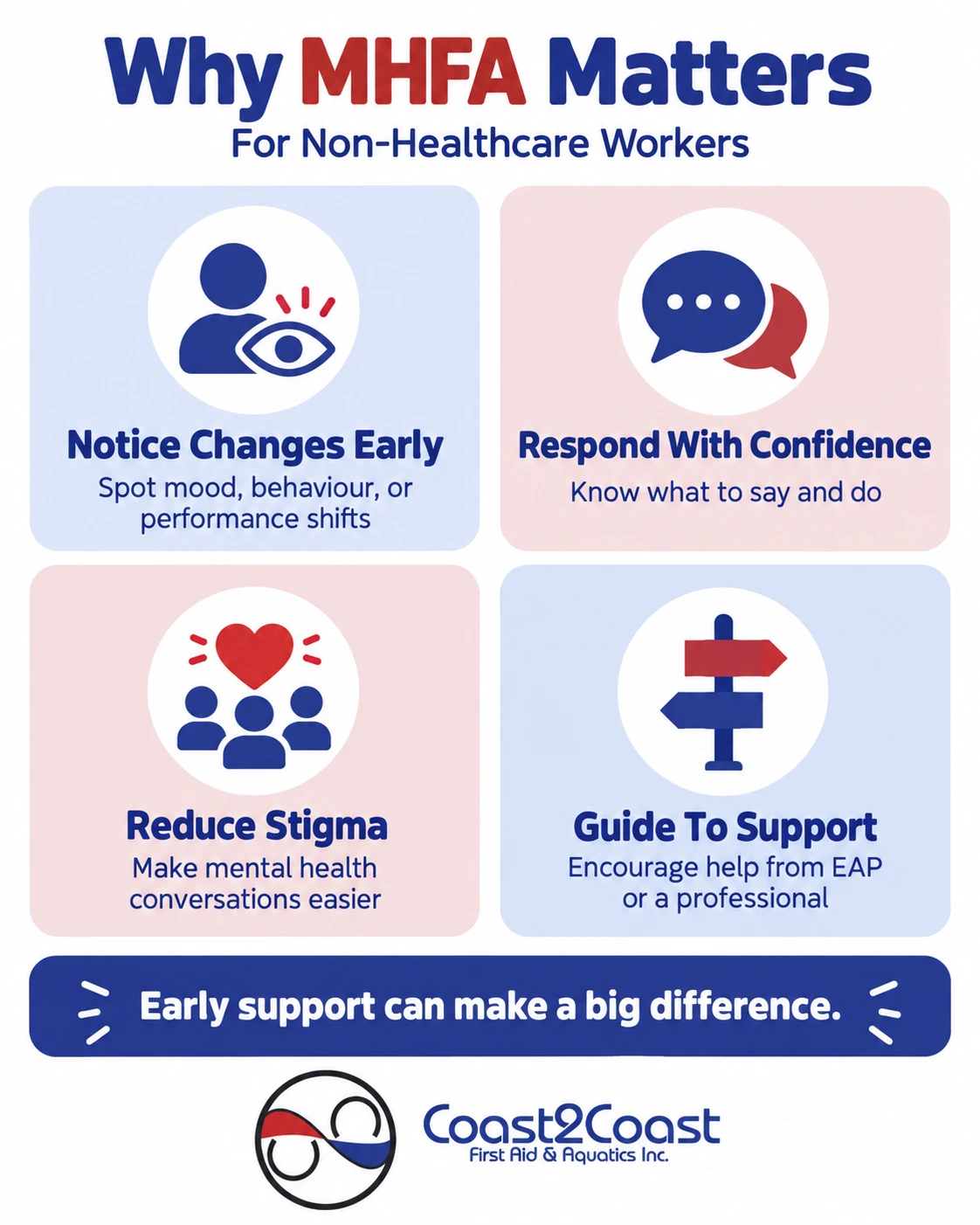
Non-healthcare workers, HR professionals, supervisors, teachers, coaches, customer-facing staff, are often the first to notice changes in a colleague’s behaviour, mood, or performance. They’re on the front line of early intervention, whether they realize it or not.
Mental health problems at work translate into real costs: increased absenteeism, presenteeism, errors, interpersonal conflicts, and safety incidents. According to OECD analysis, MHFA training produces moderate improvements in knowledge (effect size d = 0.63) and confidence to help (effect size d = 0.58), meaning participants walk away measurably better equipped. Mental health first aid training is especially relevant in workplaces and community settings where these early signs appear first.
MHFA gives non-clinicians a structured way to respond, reducing the fear of “saying the wrong thing.” It can improve confidence in discussing mental health issues, often the biggest barrier for managers and colleagues. Reducing stigma around mental health facilitates open conversations and seeking help, creating a culture of psychological safety.
Consider this: a manager notices a previously high-performing employee becoming withdrawn, missing deadlines, and increasingly irritable. Using MHFA skills, the manager approaches privately, listens without judgment, offers reassurance, and suggests the employee connect with the company’s EAP or a mental health professional. That conversation may prevent a leave of absence, or something worse.
For more on building a mentally healthy workplace, see our guide on Mental Health and Wellness in the Workplace.

North America's first AI-powered First Aid & CPR tutor, part of the Coast2Coast Student Companion app. Coasty explains CPR/AED and BLS concepts in plain language, with quizzes to review before and after class.
Meet Coasty — Your AI First Aid & CPR Tutor →Understanding Mental Health Problems and Crises
MHFA for non-healthcare workers focuses on common, real-world mental health challenges you’re likely to encounter at work, in schools, and in your community, not rare or complex clinical presentations. Typical MHFA courses cover depression, anxiety disorders, substance use problems, psychosis, and trauma-related conditions.
There’s an important distinction between ongoing mental health problems and acute crisis situations. Ongoing issues develop gradually, withdrawal, declining work quality, mood changes over weeks. A mental health crisis is immediate and may involve suicidal behaviour, self-injury, a severe panic attack, or dangerous intoxication.
Mental Health First Aid helps recognize mental health crises early, allowing a co-worker, teacher, or friend to step in before the situation deteriorates. A student hyperventilating and trembling during an exam may be experiencing a panic attack. An employee who says “I don’t see the point anymore” after a project failure may be signalling something far more serious than frustration. Recognizing these differences matters because the response, and urgency, differs for each.
Core MHFA Skills: The ALGEE Framework
In Canada, the ALGEE framework guides support for someone in crisis:
| Step | Action |
|---|---|
| A | Assess risk of suicide or harm |
| L | Listen non-judgmentally |
| G | Give reassurance and information |
| E | Encourage appropriate professional help |
| E | Encourage self-help and other supports |
Training includes practical skills for supporting mental health crises, not abstract theory. Participants practise how to recognize signs, approach someone safely, and provide initial support using role-plays and real-world scenarios.
Active listening helps create a supportive environment for individuals in distress. In practice, that looks like open body language, reflective statements (“It sounds like you’ve been carrying a lot”), and avoiding minimizing comments like “just relax.” The goal is to provide initial help without overstepping into diagnostic labelling or therapeutic territory.
Staying within your role is essential. As a first aider, you offer first aid, not therapy. You respect privacy, maintain boundaries, and know when to escalate, whether that means contacting HR, a crisis line, or emergency services. You don’t need prior mental health experience to use these skills effectively. MHFA courses build concepts from the ground up using plain language, examples, and interactive exercises.
Bring MHFA to Your Whole Team
Private group training makes it easy to build mental health literacy across HR, managers, and staff together.
Recognizing Early Warning Signs
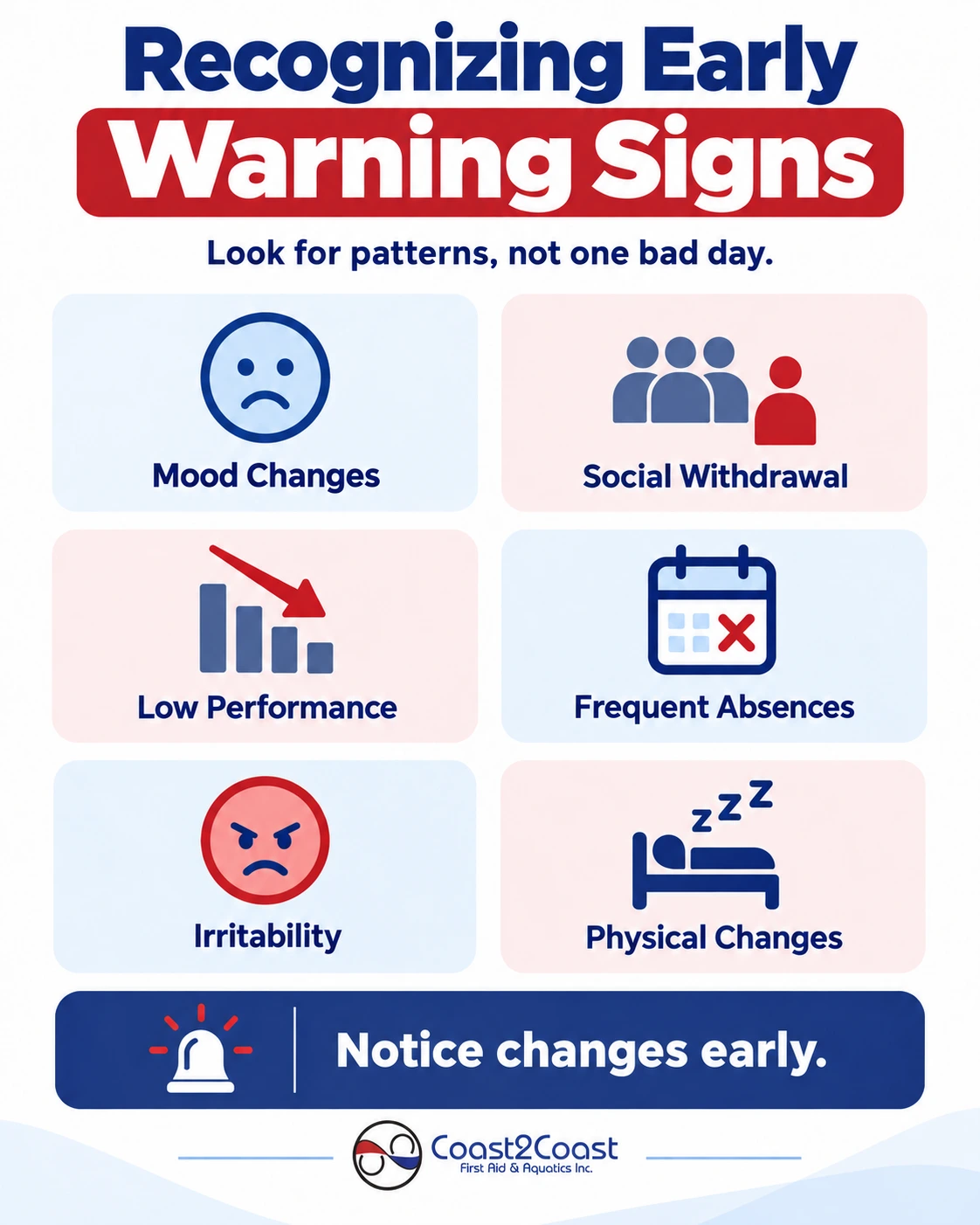
Early recognition is often the difference between a manageable concern and a full mental health crisis. Non-healthcare workers are well positioned to notice patterns that a clinician, who sees someone once a week or less, simply can’t.
Common warning signs of mental health issues include mood changes and social withdrawal, along with noticeable drops in work quality, frequent unexplained absences, increased irritability, withdrawal from colleagues or friends, and sudden risk-taking or uncharacteristic behaviour.
What this looks like varies by setting. In a classroom, a student who stops participating and sits alone at lunch. In an office, a colleague suddenly working excessive overtime, which may look like dedication but could signal anxiety or avoidance. A cluster of changes over several weeks is usually more concerning than a single bad day, this helps you avoid overreacting to isolated incidents while staying alert to genuine shifts. Physical indicators matter too: persistent exhaustion, significant weight change, or neglect of personal appearance can all be worth a careful, private conversation.
How to Respond Safely in a Crisis
Safety, of the person in distress, bystanders, and the responder, is always the first priority. Immediate support during a mental health crisis can prevent the situation from worsening.
Basic steps for an acute crisis: stay calm, assess immediate danger, call emergency services if there’s imminent risk to life (dial 9-1-1 in Canada), and do not leave someone at imminent risk of self-harm alone.
Different crises call for different responses. For suicidal thoughts, ask directly and listen, asking about suicide does not increase risk. Using grounding techniques can help stabilize someone experiencing panic or distress, slow breathing, focusing on sensory details. For severe agitation, maintain distance, speak calmly, and ensure safe exits for yourself and bystanders. Avoid making promises of secrecy about suicidal plans, attempting physical restraint unless trained, or giving medical advice.
Workplaces should develop clear internal protocols, who to call on a leadership or HR team, where to escalate, how to document, so MHFA skills fit smoothly into existing health and safety processes.
Encouraging Professional Help
One of the most valuable roles of a mental health first aider is to gently encourage professional help and make it easier for the person to access it. Encouraging professional help is a critical aspect of mental health first aid.
Practical ways to encourage professional support: offer to help look up local counsellors or clinics, explain Employee Assistance Programs if your workplace offers one, mention Canada’s 988 Suicide Crisis Helpline or provincial crisis lines, and help with logistics, like finding phone numbers or sitting nearby during a call.
Mental health first aiders should respect the individual’s autonomy in seeking help. Use collaborative language: “Would you be open to talking with someone who specializes in this?” rather than “You need to see a therapist.” Encouragement to connect with support systems is vital when providing mental health aid. Follow-up matters enormously, check in after the person has accessed help, respect confidentiality, and reinforce that seeking help is a sign of strength.
Learn Physical First Aid and CPR Too
MHFA works best alongside the physical first aid skills your team already relies on.
Is Mental Health First Aid Worth It for Non-Healthcare Workers?
Yes. MHFA is highly worthwhile for non-healthcare workers, particularly those in HR, leadership, teaching, customer service, and safety-sensitive roles. Non-healthcare workers can effectively provide mental health first aid using evidence-based approaches, you don’t need a clinical background to make a meaningful difference.
MHFA complements existing first aid training and safety programs, rounding out an organization’s ability to respond to both physical and mental well being emergencies. If your team already holds CPR or Intermediate First Aid (formerly Standard First Aid) certifications, MHFA is the logical next layer.
In practical terms, organizations can expect fewer lost workdays from unaddressed mental health problems, improved employee engagement and retention, and reduced risk of costly incidents linked to crises that could have been caught earlier. MHFA skills are also portable, participants can use them at home supporting a family member, in volunteer roles, and across community contexts. The knowledge doesn’t expire when you leave the office.
However, organizations should view MHFA as part of a longer-term mental health strategy. A single training course is a strong start, but sustained impact requires integration with policies, benefits, leadership training, and ongoing reinforcement. MHFA works best when it’s part of the culture, not a checkbox.
How MHFA Fits with Physical First Aid and Safety Training
Many organizations already invest in WSIB- or OHS-approved first aid training, CPR/AED, and Basic Life Support. MHFA naturally extends that commitment to a health-first approach that addresses the whole person.
Coast2Coast First Aid & Aquatics, as a Canadian Red Cross training partner, helps workplaces build a complete safety portfolio: physical first aid and CPR classes, youth safety courses, event first response, and Psychological First Aid. Mental and physical first aid intersect more than most people realize, a panic attack can be mistaken for a heart attack, substance use issues contribute to workplace injuries, and trauma responses after a serious accident require both physical and psychological attention.
Workplaces should integrate MHFA principles into existing emergency response plans and onboarding, so a mental health crisis response feels as familiar as a fire drill. For a comprehensive framework on the physical side, review our Workplace First Aid Guide.
Choosing the Right MHFA Training Format
Mental Health First Aid is offered in Essentials and Certification formats. The MHFA Essentials suite is a streamlined one day course, a shorter, introductory option for building mental health literacy across an entire team. MHFA Certification is a nationally recognized program in Canada, offering deeper, in-depth content including an assessment at the end. This nationally recognized MHFA certification gives participants official certification they can carry into specific roles and future workplaces.
A phased approach works well for organizations new to mental health training: start with the Essentials suite for awareness across all staff, add MHFA Certification for managers, HR, and safety-critical roles, then reinforce skills through annual refreshers alongside existing safety training.
Looking After Yourself as a Mental Health First Aider
Supporting others during a mental health crisis can be emotionally demanding. Self care is not optional, it’s a core part of effective MHFA practice, and the final step of the ALGEE framework, encouraging self-help, applies to the first aider too.
Practical self care strategies include debriefing with a supervisor or trusted peer after a difficult conversation, taking a break to decompress, accessing your own EAP or a counsellor, and setting clear boundaries, you are a first aider, not someone’s therapist or sole source of support.
Organizations should normalize debriefing for staff who respond to mental health crises, just as they would for staff involved in physical emergencies. If a colleague administers CPR, no one questions their need for a debrief, the same standard should apply after a mental health intervention.
Mental Health First Aid is genuinely worth it for non-healthcare workers. It doesn’t require a clinical background, it builds the confidence to recognize warning signs, respond safely, and guide a colleague, student, or friend toward professional help, and it works best as part of an ongoing workplace culture, not a one-time checkbox.
Join 150,000+ Canadians Who Are Certified
Find a class near you and take the first step today.
Frequently Asked Questions: Mental Health First Aid for Non-Healthcare Workers
Q1: Do I need any prior mental health experience to take a Mental Health First Aid course?
A: No. MHFA courses are specifically designed for people with no clinical background and are suitable for adults from all professions, office staff, tradespeople, educators, and volunteers. Instructors build concepts from the ground up using plain language, real-world examples, and role-plays, so you can engage comfortably regardless of prior knowledge.
Q2: Can MHFA training replace professional counselling or medical treatment?
A: No. MHFA does not replace therapy, diagnosis, or medical care. It is the first step in support, similar to how physical first aid stabilizes someone until paramedics arrive. A key part of MHFA is guiding the person toward appropriate professional services and community supports, not attempting to provide ongoing treatment yourself.
Q3: Is Mental Health First Aid mandatory in Canadian workplaces?
A: As of 2026, most Canadian provinces do not legally require MHFA certification the way they require certain levels of physical first aid. However, many employers adopt it as best practice for psychological health and safety. Some sectors, including education and social services, increasingly expect staff to have mental health training as part of their role, even when not mandated by law.
Q4: How long does MHFA certification last, and do I need recertification?
A: MHFA Certification must be renewed every three years, similar to Intermediate First Aid and CPR credentials. The certification includes an assessment component that validates your knowledge and readiness. Recertification keeps skills current and ensures you stay aligned with updated guidelines and local resources.
More FAQs: Choosing and Applying MHFA
Q5: Can MHFA be delivered alongside other first aid or safety courses for my organization?
A: Yes. Organizations often schedule MHFA or mental health awareness sessions alongside WSIB-approved first aid, CPR/AED, and BLS training days. Coast2Coast First Aid & Aquatics can help coordinate tailored training plans, either in person or blended, to fit shift schedules and workplace risk profiles across Canada.
Q6: What’s the difference between MHFA Essentials and MHFA Certification?
A: MHFA Essentials is a streamlined, one-day course focused on building core mental health literacy across an entire team, without a formal assessment. MHFA Certification is a deeper, in-depth program that includes an assessment at the end and results in a nationally recognized credential, better suited for managers, HR, and roles that need a more thorough skill set.
Q7: Will taking this training put pressure on me to solve a colleague’s mental health problems on my own?
A: No, and this is one of the most common misconceptions. MHFA specifically trains you to recognize signs, offer initial support, and connect the person with appropriate professional help, not to manage their situation indefinitely. Staying within your role, and knowing when to step back, is itself a core skill taught in the course.
Q8: How does MHFA benefit schools and community organizations, not just workplaces?
A: In schools, it helps teachers and coaches better support students facing stress, bullying, or family issues, and improves referral pathways to counsellors. In community settings, volunteers and local leaders use MHFA skills to support neighbours during local crises, broadening mental health awareness and reducing isolation across the community.
Reviewed By: Ashkon Pourheidary, B.Sc. Hons Neuroscience, Co-Founder of Coast2Coast First Aid & Aquatics and Canadian Red Cross Instructor Trainer since 2011.
Source: Mental Health Commission of Canada; OECD, Mental Health Promotion and Prevention