

Skip to content
WSIB First Aid Requirements Ontario | Coast2Coast

Ontario Regulation 1101 · WSIB-Approved Training Provider

Workplace Safety and Insurance Board Compliance

Every employer covered by the Workplace Safety and Insurance Act needs a first aid station, a stocked first aid kit and at least one worker holding a valid first aid certificate. Regulation 1101 scales the first aid requirements by workers per shift.

Google logo 4.9 · Over 21K Google Canadian reviews
  • Canadian Red Cross Training Partner badge
  • 99.9% success rate of our students badge
  • 150,000 students trained in first aid and CPR badge
  • Express certificate issued within 48 hours badge

The Regulation

What Regulation 1101 Asks Every Employer For

Four duties make up a workplace first aid program: first aid equipment, a station, trained workers and records.

  • 4×/yrBox inspections
  • 5 or fewerBasic/Emergency band
  • 200+First aid room
  • 3 yrsCertificate term
See first aid course dates →
  • A first aid station within reach

    The station holds the first aid kit and a notice board: Form 82, the valid first aid certificates of trained workers on duty, and an inspection card. Keep it easily accessible, so a first aider can provide prompt treatment.

  • Trained workers in charge of it

    At least one person holding a valid first aid certificate must be in charge of each station, working nearby. The WSIB accepts Canadian certificates aligned with CSA Z1210, from a WSIB-approved provider it recognizes.

  • Inspections four times a year

    Check every first aid box at intervals of no more than three months, then sign and date the inspection card — your first aid log. Keep supplies in plain view; restock after every first aid treatment.

  • A record of first aid treatment

    Log every first aid treatment: the worker’s account, the date and time, witnesses and where it happened. Form 82 tells workers to report injuries, minor injuries included.

By Workplace Size

First Aid Requirements by Number of Workers

Count the workers on one shift, not the payroll, whatever their employment status. The first aid kit, the required training and — at 200 workers — the room are what change.

These are minimum requirements. First aid supplies can go up, and WSIB best practice adds non-latex gloves and a CPR mask barrier device. Regulation 1101 calls it a first aid box; most call it a first aid kit.

A CSA Z1220 kit is an accepted alternative. Since 1 January 2020 the WSIB has accepted first aid kits meeting CSA Z1220, First Aid Kits for the Workplace in place of the lists below — kit contents only, so the station, the room, the certificate and the records still follow Regulation 1101.

Section 8

Five Workers or Fewer per Shift

Book Training
Certificate in charge

Basic/Emergency First Aid & CPR/AED

8 hours

Who it is for

Employers with five or fewer workers on a shift

The smallest band in Regulation 1101, and the only one where Basic/Emergency First Aid is enough.

Facilities

One first aid station with a first aid kit

The minimum requirements stop there — no stretcher, blankets or first aid room.

Learn more
First aid kit requirements
View the section 8 first aid kit list
  • A current standard first aid manual
  • 1 card of safety pins
  • 12 adhesive dressings, individually wrapped
  • 4 sterile gauze pads, 3 inches square
  • 2 rolls of 2-inch gauze bandage
  • 2 field dressings or sterile bandage compresses, 4 inches square
  • 1 triangular bandage

Five or fewer people per shift: the required training is the 8-hour Basic/Emergency First Aid course.
See Basic/Emergency First Aid dates

Section 9

Six to Fifteen Workers per Shift

Book Training
Certificate in charge

Intermediate/Standard First Aid & CPR/AED

16 hours

Who it is for

Employers with six to fifteen workers on a shift

At six workers the certificate steps up to Intermediate/Standard First Aid — what most workplaces and all higher risk environments require.

Facilities

One first aid station with a first aid kit

First aid supplies for splinting join the kit here.

Learn more
First aid kit contents
View the section 9 first aid kit list
  • A current standard first aid manual
  • 1 card of safety pins
  • 24 adhesive dressings, individually wrapped
  • 12 sterile gauze pads, 3 inches square
  • 4 rolls of 2-inch gauze bandage
  • 4 rolls of 4-inch gauze bandage
  • 4 sterile surgical pads for pressure dressings, individually wrapped
  • 6 triangular bandages
  • 2 rolls of splint padding
  • 1 roll-up splint

At six workers per shift the first aid certificate steps up to Intermediate/Standard First Aid — what most workplaces and all higher risk environments require.

See Intermediate/Standard First Aid dates

Section 10

Sixteen to 199 Workers per Shift

Train a Group
Certificate in charge

Intermediate/Standard First Aid & CPR/AED

16 hours

Who it is for

Employers with sixteen to 199 workers on a shift

Where a station cannot be reached quickly, section 12 requires additional stations. On a floor this size that usually means several.

Facilities
  • One first aid station with a first aid kit
  • 1 stretcher
  • 2 blankets
Learn more
First aid kit contents
View the section 10 first aid kit list
  • A current standard first aid manual
  • 24 safety pins
  • 1 basin, preferably stainless steel
  • 48 adhesive dressings, individually wrapped
  • 2 rolls of 1-inch adhesive tape
  • 12 rolls of 1-inch gauze bandage
  • 48 sterile gauze pads, 3 inches square
  • 8 rolls of 2-inch gauze bandage
  • 8 rolls of 4-inch gauze bandage
  • 6 sterile surgical pads for pressure dressings, individually wrapped
  • 12 triangular bandages
  • Splints of assorted sizes
  • 2 rolls of splint padding

The first aid kit roughly doubles here. Stations must be easily accessible for prompt treatment whenever work is in progress; where one is not, section 12 requires additional stations. On a floor this size that usually means multiple locations.

Ask about group training on site

Section 11

200 or More Workers per Shift

Train a Group
In charge of the room

A registered nurse, or Intermediate/Standard First Aid & CPR/AED

Works in the immediate vicinity of the room

A certificate holder in this role takes no other work that could affect their first aid duties, and the certificate is displayed in the room.

Who it is for

Employers with 200 or more workers on a shift

The only band that requires a first aid room rather than a station.

Facilities

A first aid room, not a station

Plus a portable first aid box stocked to the section 9 minimum requirements, for injured workers where the accident happened.

Learn more
Room contents
  • A current standard first aid manual
  • Dressing scissors and forceps, safety pins, graduated medicine glass, tongue depressors, cotton-tipped applicators
  • Denatured ethyl alcohol, adhesive plaster, absorbent cotton
  • Adhesive dressings and sterile gauze pads, individually wrapped, assorted sizes
  • Gauze and triangular bandages, splints and splint padding, assorted sizes
  • Hot and cold running water, 3 washbasins preferably stainless steel, 1 enamel foot bath
  • 1 instrument sterilizer, 1 cabinet for surgical dressings, 1 sanitary disposal receptacle with lid
  • 1 couch curtained off or in a separate cubicle, 1 stretcher, 2 blankets
  • 1 first aid box stocked to the section 9 list, for use at the scene

At 200 workers per shift the station becomes a first aid room. No advanced training is needed beyond the first aid certificate. Construction projects, bush camps and vehicles are off site work locations, with shorter kit lists in sections 13 to 16.

Request group training on site

Your First Aid Program

Which Certificate Satisfies Regulation 1101

The rules require a first aid certificate—that’s the key. For small teams, Sections 8 to 11 specify Basic/Emergency First Aid; if you have more than five workers, you’ll need Intermediate/Standard First Aid. A stand-alone CPR/AED certificate or Basic Life Support on its own isn’t enough to meet Regulation 1101. Don’t worry, though—CPR/AED Level C (covering adults, children, and infants) is included in both first aid courses, so it’s part of compliance, not a shortcut.

Online study by itself doesn’t include a hands-on skills test, so it can’t provide the certificate inspectors require. During the in-class session, you’ll complete hands-on skills testing with an automated external defibrillator. Afterward, you’ll receive a Canadian Red Cross certificate that’s valid for three years. Just remember to book a recertification course before it expires so your station stays covered.

Awards & Recognition

Recognised as a Top 3 Canadian Red Cross Training Partner for 2023, 2024, 2025 consecutively.

National First Aid & CPR Provider 2025 — Canadian Red Cross
National Professional Responder Provider 2025 — Canadian Red Cross
Top 3 National Training Provider 2025 — Canadian Red Cross
Top 3 Provincial Training Provider 2025 — Canadian Red Cross
National First Aid & CPR Provider 2024 — Canadian Red Cross
National Professional Responder Provider 2024 — Canadian Red Cross
Top 3 National Training Provider 2024 — Canadian Red Cross
Top 3 Provincial Training Provider 2024 — Canadian Red Cross
National First Aid & CPR Provider 2023 — Canadian Red Cross
National Professional Responder Provider 2023 — Canadian Red Cross
Top 3 National Training Provider 2023 — Canadian Red Cross
Top 3 Provincial Training Provider 2023 — Canadian Red Cross

Why Coast2Coast

Why Ontario Employers Train With Coast2Coast

Meeting the first aid training requirements turns on who issues the first aid certificate.

Coast2Coast First Aid & Aquatics

Canadian Red Cross Training Partner

Best choice
6/6 Features met
  • WSIB-approved training provider, Canadian Red Cross material
  • Top 3 Canadian Red Cross Training Partner, 2023–2025
  • A first aid program that meets the first aid requirements at every size
  • Certificate within 48 hours of your skills evaluation
  • Free 90-day skills practice retake
  • 100+ course dates every week

Other Providers

Typical first aid training providers

0/6 Features met
  • Limited options from WSIB-approved providers
  • Not a ranked Red Cross Training Partner
  • One first aid level, whatever your headcount
  • Certificates take 7 to 10 business days
  • No free skills practice retake
  • Fewer course dates each week

Testimonials

What Students Say About Our Training

Reviews From Our Students

4.9

4.9 Google rating · Over 21K Google Canadian reviews

Google Reviews

  • Manar Al-Shafii Coast2Coast Student Posted on Google

    One of the best instructor make the session fun with knowledge. Thank you so much Ali

  • Effie kd Coast2Coast Student Posted on Google

    Tatiana is a great teacher!

  • Navjot Kaur Coast2Coast Student Posted on Google

    The instructor was knowledgeable, friendly, and explained everything clearly with practical examples.

Read All Reviews on Google →

Verified Reviews from Our Students

Student Feedback

On Site Group Training

Training a Whole Shift On Site

One worker at a public class covers one first aid station on one shift. Most employers book us on site instead, so every station has certified first aiders the same day.

Check your headcount per shift before you book the first aid level. Moving a group up to Intermediate/Standard afterwards means running the longer course again.

Inside the Classroom

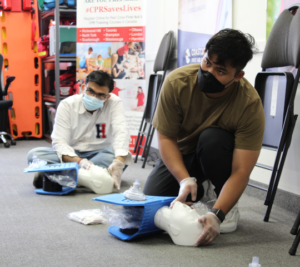
  • CPR compressions on an adult manikin during hands-on skills testing with automated external defibrillator
  • First aid treatment for choking practised in a Coast2Coast workplace first aid program
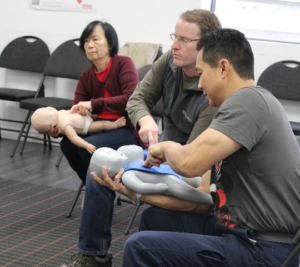
  • Infant choking first aid treatment on a training manikin, part of CPR/AED Level C
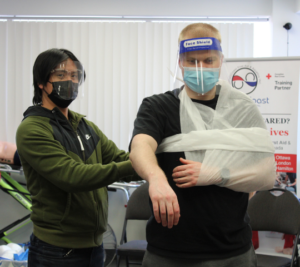
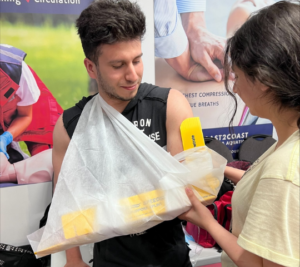
  • Applying an arm sling with a triangular bandage from a workplace first aid kit
  • Splinting a limb injury during the required training for an intermediate first aid certificate

Common Questions

WSIB First Aid Requirement Questions, Answered

What first aid training is legally required for Ontario employers?

Ontario employers must provide first aid equipment, a first aid station and trained workers under Regulation 1101. Five or fewer people per shift need Basic/Emergency First Aid; above five, Intermediate/Standard, from WSIB-approved providers.

What is Ontario Regulation 1101?

Regulation 1101 sets the first aid equipment, facilities and trained personnel every covered employer must provide, under the Workplace Safety and Insurance Act. Sections 8 through 11 scale the first aid requirements by workers per shift, 1 through 7 cover the station and records, 13 to 16 the off site work locations.

How many first aiders does my workplace need?

Every first aid station needs at least one worker holding a valid first aid certificate, working nearby, whenever work is in progress. Cover each station on each shift, whatever the employment status. Section 12 asks for another wherever one is hard to reach, so multiple locations are normal.

Is Intermediate First Aid the same as Standard First Aid?

Yes — Intermediate First Aid and Standard First Aid are two names for one 16-hour course. The Canadian Red Cross changed the wording, so older first aid certificates read Standard and newer ones read Intermediate. Those 16 hours add head and spine injuries, bone, muscle and joint injuries, sudden medical emergencies, environmental emergencies and first aid for poisons on top of CPR/AED Level C, which covers adults, children and infants. Basic/Emergency First Aid is the 8-hour course, for lower-risk workplaces. See first aid courses.

How long is a first aid certificate valid in Ontario?

A Canadian Red Cross first aid certificate is valid for three years from the day you pass the skills evaluation. Regulation 1101 wants a valid first aid certificate at the station whenever work is in progress, and the commonest compliance gap is an expired card rather than a missing one. Check the expiry on every certificate posted at your station, then book a recertification course before the earliest one runs out.

Does a CPR certificate meet the WSIB first aid requirement?

A standalone CPR/AED certificate does not satisfy Regulation 1101, at any level. The regulation names a first aid certificate: Basic/Emergency First Aid for five or fewer people on a shift, Intermediate/Standard above that. Basic Life Support alone does not satisfy it either. CPR/AED Level C sits inside both first aid courses. See CPR/AED courses.

Who is allowed to be in charge of a first aid station?

A worker who holds a valid first aid certificate from a WSIB-approved provider, working in the immediate vicinity of the first aid station. For a section 11 first aid room it can also be a registered nurse. Trained first aiders take no other conflicting duties.

What first aid information must an employer post at the workplace?

Employers display Form 82, the valid first aid certificates of the trained workers on duty, and the signed inspection card at the first aid station. Form 82 is the WSIB poster telling workers to report every injury and get first aid treatment on the spot.

Is Coast2Coast a WSIB-approved first aid training provider?

Coast2Coast is a WSIB-approved first aid training provider and a Top 3 Canadian Red Cross Training Partner. Our first aid program produces the certificate sections 8 through 11 accept, within 48 hours of your skills evaluation. The WSIB’s updated First Aid Program aligns with CSA Z1210:24, and our course finder lists the level by job.

Can we meet the requirement with an online first aid course?

An online-only first aid certification is not legally compliant in Ontario. It does not meet the first aid training requirements, because it includes no hands-on skills test. Cover the theory at home through online blended learning, then attend one in-class day for the skills evaluation.

Get your workplace compliant

Tell us how many work one shift and we will name the first aid certificate Regulation 1101 asks for. Classes run weekly, or we come to you on site.