

Marine Basic First Aid · Canadian Red Cross Training Partner
Marine First Aid and CPR/AED Courses
Out on the water the nearest hospital can be hours away. Canadian Red Cross Marine Basic First Aid runs 16 hours over two days, most of it hands-on with a certified instructor. It meets the Transport Canada TP 13008 E standard, and your certificate stays valid three years.
 4.9
4.9

Course Detail
Marine Basic First Aid
One course, two ways to take it. Coast2Coast runs Canadian Red Cross Marine Basic First Aid across Ontario — the same 16 hours whether you sit both days in class or cover theory at home first. Both training courses end in the same practical first aid procedures and the same certificate.
Marine Basic First Aid is a marine credential. It does not meet Ontario WSIB Regulation 1101 or CSA Z1220-17 requirements for shore-based workplaces. For general workplace compliance, book Intermediate First Aid instead.
- Teaching time
-
16 hours over two days
Same in either format
- Who it is for
-
- Deckhands and fishing crews
- Charter operators and mates
- The crew member designated for first aid
Anyone working in a marine environment who needs a first aid and CPR/AED certificate Transport Canada accepts.
- Prerequisites
-
None
- Standard met
- Transport Canada TP 13008 E — the publication that sets the marine first aid training requirement
- Certificate
-
Canadian Red Cross certificate, valid 3 years
Issued within 48 hours of your skills evaluation, with a free 90-day skills practice retake included.
Learn more
- Course content
-
View all 14 course topics
- Angina and Heart Attack
- Stroke
- CPR/AED
- Compression-Only CPR
- Life-threatening External Bleeding
- Life-threatening Internal Bleeding
- Wound Care
- Head and Spine Injuries, including a suspected spinal injury
- Bone, Muscle and Joint Injuries — muscular injuries and fractures
- Sudden Medical Emergencies
- Environmental Emergencies
- Poisons and other toxicological hazards
- Personal Protective Equipment (PPE) and disease transmission
- Gowning
The last two are what marine training adds over a shore-side class: prevention of disease transmission in close quarters.
- Requirements
-
- 100% attendance of the course
- 75% on the multiple choice examination
- Hands-on skills testing with automated external defibrillator
- What it endorses
-
- A rating certificate or endorsement
- Master or Chief Mate limited certification
- First aid on board a vessel engaged on a near-coastal voyage, class 2
- First aid on board a vessel in sheltered waters
It does not endorse an unlimited voyage.
- Certification requirements
-
Set by Transport Canada, delivered by a Canadian Red Cross instructor
Marine certification requirements are why the course runs a full 16 hours: the marine industry sets a longer syllabus than a shore-side class.
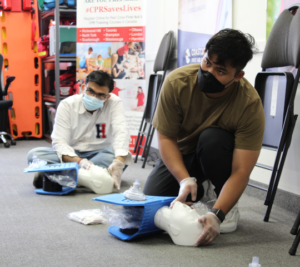
Marine training is built around what happens at sea. You practise the correct procedure on manikins and an AED trainer, steady a suspected spinal injury where there is no room to work, and gown up before touching a wound. Instructors cover body structure early: what sits under a rib tells you how urgent a chest injury is. Other topics include spinal injury movement and prevention of disease transmission.
Registration
How to Register for Marine First Aid Training
Send us your dates on the registration form and we will place you in the next course, or schedule one for your crew.
Ask your employer or examiner which certificate they need on file. Marine Basic First Aid answers Transport Canada; a shore-side workplace usually wants Intermediate/Standard First Aid.
Two Ways to Train
How Does the Marine First Aid Course Run?
Marine Basic First Aid is sixteen hours either way and Transport Canada accepts both. The question is whether you spend both days in the room or give us one.
Pick Your FormatEverything taught in the room by a certified instructor, to the Transport Canada standard. No computer, no video, no pre-work. Day one covers theory and other topics; day two is mostly practical first aid procedures.
- Both days: 9:00 AM – 5:00 PM
- Weekend classes run 10:00 AM – 6:00 PM on day two
Complete the online portion of the training at your own pace, then attend one classroom day for practical first aid procedures and the evaluation. You recognize signs online and prove the skills in the room.
- Online portion of the training: 7–8 hours, self-paced
- In class: 8 hours, 9:00 AM – 5:00 PM
- Same 16 hours, same examination, same three-year certificate
Finish the online portion before your classroom day. The instructor teaches the practical half assuming the theory is done.
Why Coast2Coast
Why Crews Choose Coast2Coast for Marine Basic First Aid
Marine Basic First Aid is a specialist program the marine industry relies on, and not every Ontario provider teaches it.
Testimonials
What Students Say
Reviews From Our Students
4.9
Google Reviews
-
Charity Moncrieff Coast2Coast Student
★★★★★
I actually really enjoyed it. I finally feel confident enough to potentially save a life one day. Happy I went. Instructors were great and made it a positive experience.
On Video
Who It Is For
What Is Marine First Aid?
Marine Basic First Aid is for anyone working in a marine environment who needs a first aid and CPR/AED certificate Transport Canada accepts. Deckhands, fishing crews, charter operators, mates and the person designated for first aid all sit the same course — a marine environment applies one standard across the deck.
Distance is the difference. A factory has an ambulance nine minutes away; a vessel engaged on a near-coastal voyage may not reach a doctor for hours. So marine training leans into what you handle yourself — unconsciousness and respiratory emergencies, a spinal injury on a moving deck, hypothermia, a crush injury from gear. You provide assessment, recognize signs early, take immediate action, control bleeding, and provide suitable care until help arrives.
Marine industry work teaches you to read the situation, not just the injury. Good first aiders recognize contributory factors — fatigue, cold, a slippery deck, a job done alone — and take appropriate measures before anyone is hurt. Prevention is the cheapest first aid afloat.
See our Ontario training locations →-
It meets the Transport Canada standard
The Canadian Red Cross built Marine Basic First Aid to Transport Canada TP 13008 E, so it meets the certification requirements your examiner checks.
-
Written for the marine and fishing industry
The scenarios are the ones the marine industry meets on deck and below it. You recognize signs in context and pick the appropriate treatment for that deck.
-
Practice on proper training equipment
You work on manikins and an AED trainer until the movements stick, positioning casualties the way you would on a real deck. Provide assessment, then compressions — reading about them never builds muscle memory.
-
Taught by Canadian Red Cross instructors
First responders, nurses and other medical professionals teach our classes, and every class is taught by a Canadian Red Cross instructor.
By the end of this Transport Canada course you can:
- Provide assessment, recognize signs of a heart attack or stroke, give immediate first aid
- Give immediate first aid for a spinal injury, and know what it rules out
- Recognize contributory factors on deck and apply prevention before an injury happens
- Provide suitable care for a spinal injury, and for muscular injuries and fractures
- Choose the appropriate treatment for bleeding and burns, and recognize contributory factors before the next one
- Provide assessment, then work practical first aid procedures on an unresponsive casualty
- Provide suitable care on board a vessel for hours, not minutes
- Use gloves and gowning for the prevention of disease transmission
- Cover other topics the marine industry expects: hypothermia prevention, poisons, immediate first aid
- 16 hrsTeaching time
- 2 daysIn-class route
- 75%Exam pass mark
- 3 yrsCertificate term
Equipment
Working From the Marine First Aid Kit You Actually Have
At sea the first aid kit on the bulkhead is all you have, so the Transport Canada syllabus for Marine Basic First Aid spends time on using it well.
-
Know your marine first aid kit before you need it
Open the first aid kit while nothing is wrong. Under pressure your hand should find the right pocket, not read labels.
-
Dressings, splints and other equipment
Practise wound care and splinting on muscular injuries with the dressings and other equipment a first aid kit carries, then match the appropriate treatment to what you can reach. Body structure tells you which appropriate measures matter, and which contributory factors put the kit in your hand.
-
Gloves, gowning and disease transmission
Gowning and glove technique cut disease transmission both ways — and a crew shares bunkroom air for weeks. Prevention here is cheap.
-
Restock it, and log it
Restocking is prevention too: a first aid kit raided for plasters is why a serious bleed goes badly. Check it, sign it.
Private & Group Training
Marine Basic First Aid for a Whole Crew
We run private marine training courses across Ontario. Pick your date and location and we send a Canadian Red Cross instructor with the manikins and AED trainers. Groups get a discounted course price, one centralized bill, and a certificate for everyone who passes. A crew trained together learns to provide suitable care as a team and to agree on the appropriate treatment before anyone is bleeding.
Book early if your vessel has a sailing date. Sixteen hours needs two consecutive days, or one classroom day with the online portion of the training finished.
Inside the Classroom
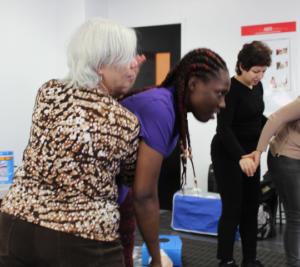
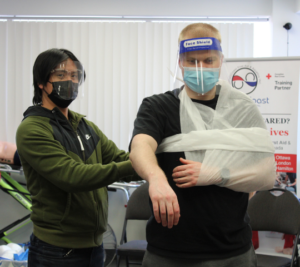
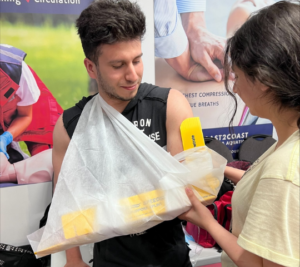
What the Practical Day Looks Like
Common Questions
Marine First Aid Questions, Answered
How long is the Marine Basic First Aid course?
Marine Basic First Aid is 16 hours — two classroom days, or 7 to 8 hours online plus one 8-hour classroom day. Both training courses lead to the same certificate.
What does the Marine Basic First Aid certificate let me do?
The Marine Basic First Aid certificate meets Transport Canada TP 13008 E. It supports a rating certificate or endorsement, Master or Chief Mate limited certification, and first aid on board a vessel engaged on a near-coastal voyage class 2 or in sheltered waters — not an unlimited voyage. Ask your examiner which your role needs.
What do I have to do to pass the course?
You need 100% attendance, 75% on the multiple choice examination and a pass on the practical skills evaluation. It covers practical first aid procedures, immediate resuscitation and other topics from the syllabus, plus hands-on skills testing with automated external defibrillator — which is why no marine training course finishes entirely online.
How long is the marine first aid certificate valid?
Your Marine Basic First Aid certificate is valid three years from the date you pass. The marine industry treats an expired card as no card, and renewing means all 16 hours again — book before it lapses. See our recertification courses.
Is Intermediate First Aid the same as Standard First Aid?
Yes — Intermediate First Aid and Standard First Aid are two names for one course. The Canadian Red Cross changed the wording, so older certificates read Standard and newer ones Intermediate. Neither is Marine Basic First Aid, its own 16-hour program. See our first aid courses.
Do I need marine first aid or workplace first aid?
Take Marine Basic First Aid when a marine role or a Transport Canada certificate calls for it; take Intermediate/Standard First Aid for workplace compliance. The majority of workplaces require Intermediate first aid certification, so check what your employer keeps on file.
Learn Marine Basic First Aid and CPR/AED today
Keep your crew safe. Send us your sailing dates and we will find you a course, or bring one to your dock.