
First aid training in Alberta follows Part 11 of the Alberta OHS Code and CSA Standard Z1210-17.
Most people take Basic First Aid (formerly Emergency First Aid), a one-day course, or Intermediate First Aid (formerly Standard First Aid), a two-day course, with CPR Level C. Certificates last 3 years and can be renewed before they expire.
3 years
Basic and Intermediate certificate validity
75%
Minimum written test score
Part 11
Alberta OHS Code rules for workplace first aid
What First Aid Training in Alberta Covers
First aid training in Alberta teaches you to recognize an emergency, call for help and keep a person stable until paramedics take over. Every workplace course covers CPR, AED use, choking, bleeding, breathing emergencies and wound care. Longer courses add bone and joint injuries, sudden medical emergencies, environmental illness and poisons.
The rules come from Part 11 of the provincial Occupational Health and Safety (OHS) Code. It makes the employer, or the prime contractor on a shared site, responsible for making sure workplace first aiders are trained by an Alberta-approved agency. The province also requires those courses to meet CSA Standard Z1210-17, the national curriculum standard for workplace first aid, as set out on the Government of Alberta first aid training page.
Old and New Course Names
The Canadian Red Cross renamed its courses to match the CSA levels. Emergency First Aid is now Basic First Aid, and Standard First Aid is now Intermediate First Aid. You will still see the old names on older certificates, so many course listings show both.
First Aid Levels in Alberta: Basic, Intermediate and Advanced
CSA Standard Z1210-17 sets three levels of workplace first aid certification: basic, intermediate and advanced. Most people in Alberta take one of the first two through a Canadian Red Cross course.
| Level | Former name | Length with CPR Level C | What it covers |
|---|---|---|---|
| Basic First Aid | Emergency First Aid | 1 day: 7 hours in-class, or 4 hours online + 5 hours in-class | CPR, AED, choking, bleeding, breathing emergencies, wound care, head and spine injuries |
| Intermediate First Aid | Standard First Aid | 2 days: 14 hours in-class, or 8 hours online + 7.5 hours in-class | Everything in Basic, plus bone and joint injuries, sudden medical emergencies, environmental illness and poisons |

These are Canadian Red Cross minimum teaching times, so a class day runs longer once breaks are added. Both levels end with a certificate valid for 3 years. If your employer has not named a level, compare the Intermediate First Aid course against the work you do.
Advanced First Aid is a longer program for higher-risk or remote work sites. Under the OHS Code, an emergency medical responder or primary care paramedic can also fill the advanced first aider role.
CPR Level A, Level C and BLS
Every first aid course includes CPR and AED training at a level you choose. CPR Level A covers adults only. CPR Level C adds children and babies, and CPR/AED courses can also be taken on their own. Basic Life Support (BLS) training is a separate team-based course for healthcare providers, and its certificate lasts 1 year rather than 3.
Not Sure Which Level You Need?
Answer a few quick questions and get a course recommendation.
Who Needs First Aid Training in Alberta?
Anyone can take a course, but the OHS Code decides how many trained first aiders a work site must have. Schedule 2 of the code sets the number and training level using three factors:
- Whether the work is classified as low, medium or high hazard.
- How many workers are on each shift.
- Whether the site is close, distant or isolated from a health care facility.
As those factors rise, the tables call for more first aiders and, at some sites, higher training levels. Workers must also show a valid workplace first aid certificate when an employer, prime contractor or OHS officer asks for it.
Outside the workplace rules, many Albertans train simply to be ready at home, on a sports field or while caring for family. The same courses serve both groups.
Training a Whole Crew?
Book private Canadian Red Cross First Aid and CPR training at your Alberta work site.
How First Aid Certification Works in Alberta
The path to a certificate is the same whichever level you choose:
- Choose your level: Basic or Intermediate First Aid with CPR Level A or C.
- Pick a format: all in-class, or blended with online theory and an in-class skills day.
- Attend the full course and practise every skill with your instructor.
- Pass the skills check and a closed-book written test with at least 75%.
- Receive a digital certificate that stays valid for 3 years.
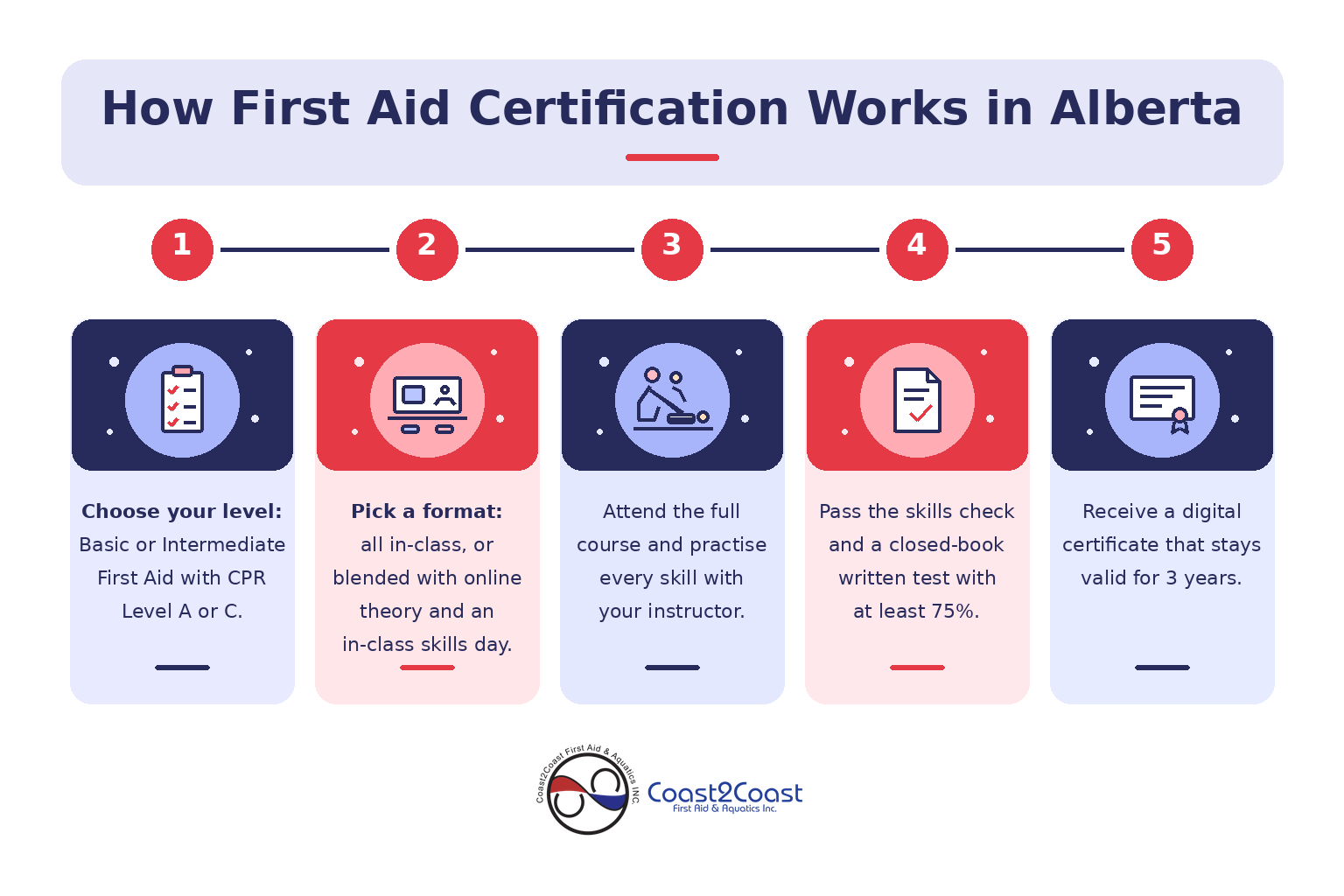
The Canadian Red Cross requires full attendance, working competency in every skill and a closed-book written score of at least 75%. Before you pay, check the provider: Alberta publishes a list of approved training agencies, updated quarterly, and some agencies authorize partners to teach on their behalf.
Blended or In-Class?
Both formats lead to the same certificate. Blended learning moves the theory online at your own pace, then you complete the hands-on skills and testing with an instructor. Every Canadian Red Cross first aid course includes in-class skills time, so there is no fully online route to a Canadian Red Cross workplace first aid certificate.
Recertification and Expiry
Alberta workplace first aid certificates are valid for up to 3 years. You can recertify before the expiry date with a shorter course, or you must take the full course again once it has expired. CPR Level C can also be renewed on its own, but CPR Level A cannot.
Certificate Expiring Soon?
Renew before your expiry date with a shorter recertification course.
Booking a Course in Alberta
Coast2Coast runs public Canadian Red Cross First Aid and CPR courses at two Alberta training centres, with Alberta OHS compliant training. Course formats, dates and directions are on the Calgary First Aid and CPR training page and the Edmonton First Aid and CPR training page. Employers can also arrange private sessions for their teams.
Key takeaway: Alberta first aid training is set by OHS Code Part 11 and CSA Z1210-17. Choose Basic or Intermediate First Aid with the CPR level your role needs, use an approved provider, and renew before your 3-year certificate expires.
Get Certified with Coast2Coast
Top 3 Canadian Red Cross Training Partner, 99.9% pass rate, certificates within 48 hours.
Frequently Asked Questions
Is first aid training mandatory for every worker in Alberta?
No. Part 11 of the OHS Code requires employers, or the prime contractor on a shared site, to provide enough trained first aiders for the work site. The number and level depend on hazard, workers per shift and distance to medical care. Workers designated as first aiders need a valid certificate, and anyone else can train voluntarily for work, home or community use.
What replaced Emergency First Aid and Standard First Aid?
The Canadian Red Cross renamed both courses to match the levels in CSA Standard Z1210-17. Emergency First Aid is now Basic First Aid, and Standard First Aid is now Intermediate First Aid. You may still see the old names on older certificates and course listings, so new listings often write Intermediate First Aid (formerly Standard First Aid).
Do I need any first aid experience before taking a course?
No. The Canadian Red Cross lists no prerequisites for Basic First Aid, Intermediate First Aid or CPR courses, so complete beginners are welcome. Instructors demonstrate every skill, then coach you through practice on manikins before the skills check. Recertification is the exception: it is only open to people who already hold a valid, unexpired certificate at that level.
How many hours of teaching does Intermediate First Aid involve?
With CPR Level C, the Canadian Red Cross sets a minimum of 14 hours of in-class teaching, usually spread over two days. The blended version replaces part of that with about 8 hours of online learning, followed by 7.5 hours in class. Breaks are not included in these figures, so each class day runs a little longer.
Can Basic First Aid be completed in a single day?
Yes. Basic First Aid with CPR Level C is a one-day course with at least 7 hours of in-class teaching. A blended option splits it into about 4 hours of online learning and 5 hours in class. It suits people who need essential workplace coverage or want core emergency skills for home and community.
Should I choose CPR Level A or CPR Level C?
CPR Level A teaches CPR, AED use and choking response for adults only. CPR Level C adds the same skills for children and babies, so it covers more situations at work and at home. Ask your employer or program which level it needs. If no level is named, Level C is the more complete lay-rescuer choice.
Is Basic Life Support the same as CPR Level C?
No. CPR Level C is designed for lay rescuers. Basic Life Support (BLS) is a separate, team-based course for healthcare providers and professional responders. A BLS certificate is valid for 1 year, while CPR Level C and first aid certificates last 3 years. If a healthcare employer or school asks for BLS, book that course specifically.
Is a 100% online first aid course an option?
No. Every Canadian Red Cross First Aid and CPR course includes in-class time where an instructor watches you perform each skill. Blended courses move the theory online so you spend less time in the classroom, but the hands-on practice and skills check still happen in person. Be cautious of any provider offering a certificate with no in-person session.
How do I confirm a training provider is approved in Alberta?
Check the Government of Alberta list of approved first aid training agencies, which is updated quarterly. Some approved agencies authorize partners to teach on their behalf. If a provider is not on the list, ask for the name of its partner agency or the agency's signed government approval letter, then confirm with that agency before you register.
What do I need to do to pass a first aid course?
The Canadian Red Cross sets three conditions. You must attend and take part in the whole course, show working competency in every required skill, and score at least 75% on a closed-book written knowledge evaluation completed on your own. Instructors coach you through each skill before the assessment, so practice time is built into the course.
Can I recertify after my first aid certificate has expired?
No. Alberta allows workers to recertify before their certificate expires. Once it has expired, you need to take the full course again. Recertification is also shorter: 7.5 hours for Intermediate First Aid with CPR Level C and 5 hours for Basic First Aid with CPR Level C. Book your renewal a few weeks before the expiry date.
Will an Alberta first aid certificate be recognized in another province?
CSA Standard Z1210 is a national standard for workplace first aid training, and Canadian Red Cross certificates are issued across Canada. However, each province and territory sets its own workplace first aid rules. Before relying on an Alberta certificate in a new job, confirm the required level with the employer or the regulator where you will be working.
Do hospitals and medical clinics in Alberta need designated first aiders?
Not under the same rule. Section 181(4) of the OHS Code says the first aider requirements in Section 181 do not apply to hospitals, medical clinics, physicians' offices or nursing homes where a physician, nurse or licensed practical nurse is readily available. Staff in those settings may still need BLS or other training required by their employer.
What else must an Alberta employer provide besides trained first aiders?
Part 11 also covers first aid supplies, equipment, kits and, at some sites, a first aid room. Kits must meet CSA Standard Z1220-17. Employers need an emergency transportation plan before sending workers to a site, a way for workers to summon first aiders, and a record of every work site illness or injury, kept for three years.
How soon do I receive my certificate after the course?
The Canadian Red Cross issues a digital certificate once you successfully complete the course. At Coast2Coast, certificates are sent within 48 hours, and you can also look up your record later through the Canadian Red Cross. Keep a copy handy, because Alberta workers must show a valid certificate when an employer, prime contractor or OHS officer asks for it.
This guide is general information, not legal advice. Employers should confirm site requirements in Part 11 and Schedule 2 of the Alberta OHS Code. In an emergency, call 911.
About the Author
Written and reviewed by Ashkon Pourheidary, B.Sc. (Hons) Neuroscience, Co-Founder of Coast2Coast First Aid & Aquatics and Canadian Red Cross Instructor Trainer since 2011.
Sources: Government of Alberta, First aid training (2026) and First aid in the workplace, FA020 (2023); Canadian Red Cross, First Aid Program Course Descriptions (2026) and Basic Life Support course description.
Coast2Coast is a Top 3 Canadian Red Cross Training Partner (2023 to 2025) and has certified more than 200,000 students.