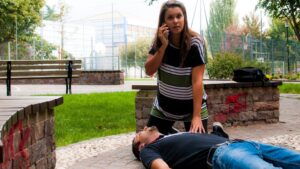

What Coast2Coast’s 539,821 Exam Answers Reveal About the Real Gap in First Aid Training
Coast2Coast co-founder Ashkon Pourheidary shared an unexpected finding in a recent conversation on the Canadian Small Business Podcast. His team had been digging into their own exam data. A certificate confirms a few things: someone sat through a class, passed a written exam (typically a minimum of 75%), and demonstrated a skill once in front of an instructor. But it doesn’t answer the question an employer actually cares about. If someone gets hurt at 10:30 on a Tuesday morning, is the certified person in the room actually ready to help?
Coast2Coast has spent years trying to answer that question with data instead of guesswork. Most training providers file paper answer sheets away for years, just in case an auditor asks for them. Coast2Coast took a different approach. It built its own digital testing platform and started recording every exam answer electronically.
That platform has now logged 539,821 individual question responses. Under the old paper system, an instructor marked each answer sheet on the spot, then filed it away for seven to ten years. Nobody ever went back to count which questions tripped up the most students. The paper format made that kind of analysis impractical. Moving the exam online changed that. It didn’t just modernize the paperwork. It made a genuinely new kind of analysis possible.
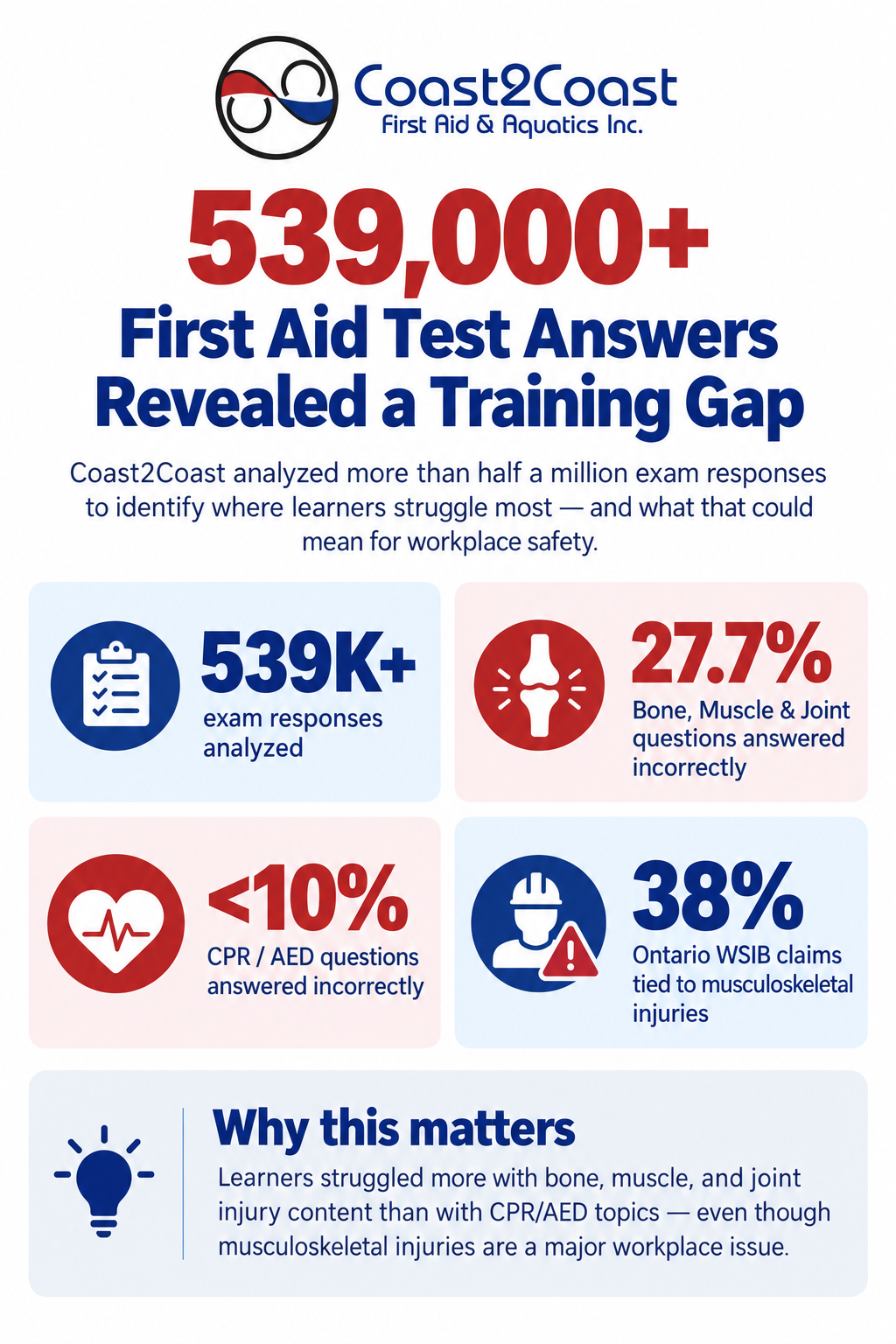
When the data was broken down by topic, the results surprised the team that built it. Analysts expected CPR and defibrillation questions to produce the most wrong answers. After all, those questions involve step sequences, timing, and equipment. Instead, students got them wrong less than 10% of the time.
The topic with the highest wrong-answer rate wasn’t CPR at all. It was bone, muscle, and joint injuries, at 27.7%. Bleeding and wound care questions followed as the second-highest source of mistakes.
This isn’t a knock on CPR training. CPR training is doing exactly what it’s supposed to do. Instead, it’s a signal about the less dramatic parts of a first aid course: a sprained ankle, a suspected fracture, a strained back. Those are the parts trainees are least prepared to act on.
Why Does Everyone Worry About CPR When Bone, Muscle & Joint Injuries Are the Actual Weak Spot?
CPR gets outsized attention for good reason. A cardiac arrest is immediately life-threatening. The skill itself is dramatic and memorable too: hands on a chest, an AED giving voice prompts, a rhythm everyone in the room can feel. Our full guide to the ABCs of CPR, CPR levels, and AED use shows just how much repetition that training already gets. That repetition may be part of why the wrong-answer rate on those questions stays under 10%.
Bone, muscle, and joint injuries don’t carry the same urgency in a classroom. Splinting a forearm or applying the R.I.C.E. method to a sprained ankle just doesn’t generate the same adrenaline as a mock cardiac arrest. Yet this category of injury is what most first aiders will actually encounter in an average week.
The mismatch matters because workplaces don’t get to choose which emergency shows up. A twisted ankle on a warehouse floor, a fall from a ladder, a strain that flares up mid-shift: all of these are statistically more likely on any given day than a sudden cardiac event. Yet they receive a fraction of the classroom energy CPR does.
Most workplace bone, muscle, and joint injuries don’t come from a single dramatic accident either. A large share of them come from overexertion, like lifting or carrying something awkward. Others come from repetitive strain, doing the same task the same way hundreds of times a shift. A simple slip or misstep accounts for many more. None of that looks like the kind of emergency a first aid course dramatizes. That may be exactly why it gets less attention, even though it’s what a first aider is statistically more likely to face.
None of this means CPR training should be scaled back. It means bone, muscle, and joint content deserves the same repetition, hands-on practice, and seriousness that cardiac response already gets.
Bring Hands-On Training to Your Whole Team
On-site group training builds the fracture, sprain, and strain response skills the exam data shows workplaces are missing.
How Does This Training Gap Show Up in Real WSIB Claims?
Coast2Coast didn’t stop at the exam data. When the team looked at Workplace Safety and Insurance Board claims data for Ontario, they found that roughly 38% of claims WSIB pays out involve bone, muscle, or joint injuries.
The two data sets point in the same direction. The topic area where certified employees are least confident on paper is also the topic area behind the largest share of real, compensable workplace injuries. A wrong answer on a written exam is one thing. A first aider who hesitates or improvises during a real injury is another. That hesitation can turn a manageable injury into a longer, costlier recovery.
This is why an employer’s investment in first aid training pays off well beyond the compliance checkbox. A workforce that’s genuinely confident handling the injuries most likely to happen means fewer prolonged claims and less lost time, not just a filed certificate.
The costs of getting an initial response wrong tend to compound quietly. A sprain that’s moved around instead of supported, or a fracture that isn’t stabilized before someone tries to walk it off, can turn a short recovery into weeks of missed shifts. That means more time away from work for the injured employee. It means more scheduling strain on the team covering their shifts. And it means more direct cost to the business absorbing the claim. None of that shows up on the day of the injury. It shows up in the weeks after. That’s exactly why the quality of that first response matters so much.
What Does First Aid for a Bone, Muscle, or Joint Injury Actually Involve?
Most bone, muscle, and joint injuries fall into one of two categories. The first is a fracture, a break or crack in the bone. The second is a soft tissue injury, like a sprain or strain. Recognizing which one you’re looking at changes what you do next.
A suspected fracture shows some combination of severe pain, rapid swelling, visible deformity, an inability to bear weight, or a grinding sensation when the area moves. The first rule with a suspected fracture is simple: stop moving it. Support the injured area in the position you found it. Don’t try to straighten or realign anything. Call 911 if the injury involves the head, neck, or spine, or if the bone has broken through the skin. For a limb fracture with no other life-threatening signs, splint the area above and below the injury site using rigid material and padding. That keeps it stable until paramedics or a healthcare provider can take over.
A sprain or strain is different, an overstretched or torn ligament, tendon, or muscle. It’s treated differently too. The R.I.C.E. method covers the basics:
- Rest: keep weight off the injured area
- Ice: apply a cold pack in short intervals to control swelling
- Compression: wrap the area snugly, not tightly
- Elevation: raise the injured limb above heart level when possible
Unlike a fracture, gentle movement is usually fine once acute swelling has settled, but pushing through pain too early can turn a two-week recovery into a two-month one.
A splint doesn’t need to be specialized equipment. A rolled magazine, a piece of sturdy cardboard, or even a folded blanket can immobilize a limb effectively. Just make sure it’s padded and secured firmly, without cutting off circulation. Check that fingers or toes past the splint stay warm and a normal colour. That’s a simple way to confirm the splint isn’t too tight. And not every sprain resolves with R.I.C.E. alone. If swelling and pain haven’t improved within a couple of days, or if the person still can’t bear any weight on the area, get it checked by a healthcare provider.
Distinguishing the two matters. The wrong response, like moving a suspected fracture to test whether it hurts, or icing a joint that actually needs immobilization, can make an injury worse. Our complete guide to stabilizing and immobilizing a fracture walks through the full step-by-step response in more depth.
A Note on Naming: Standard First Aid Is Now Intermediate First Aid
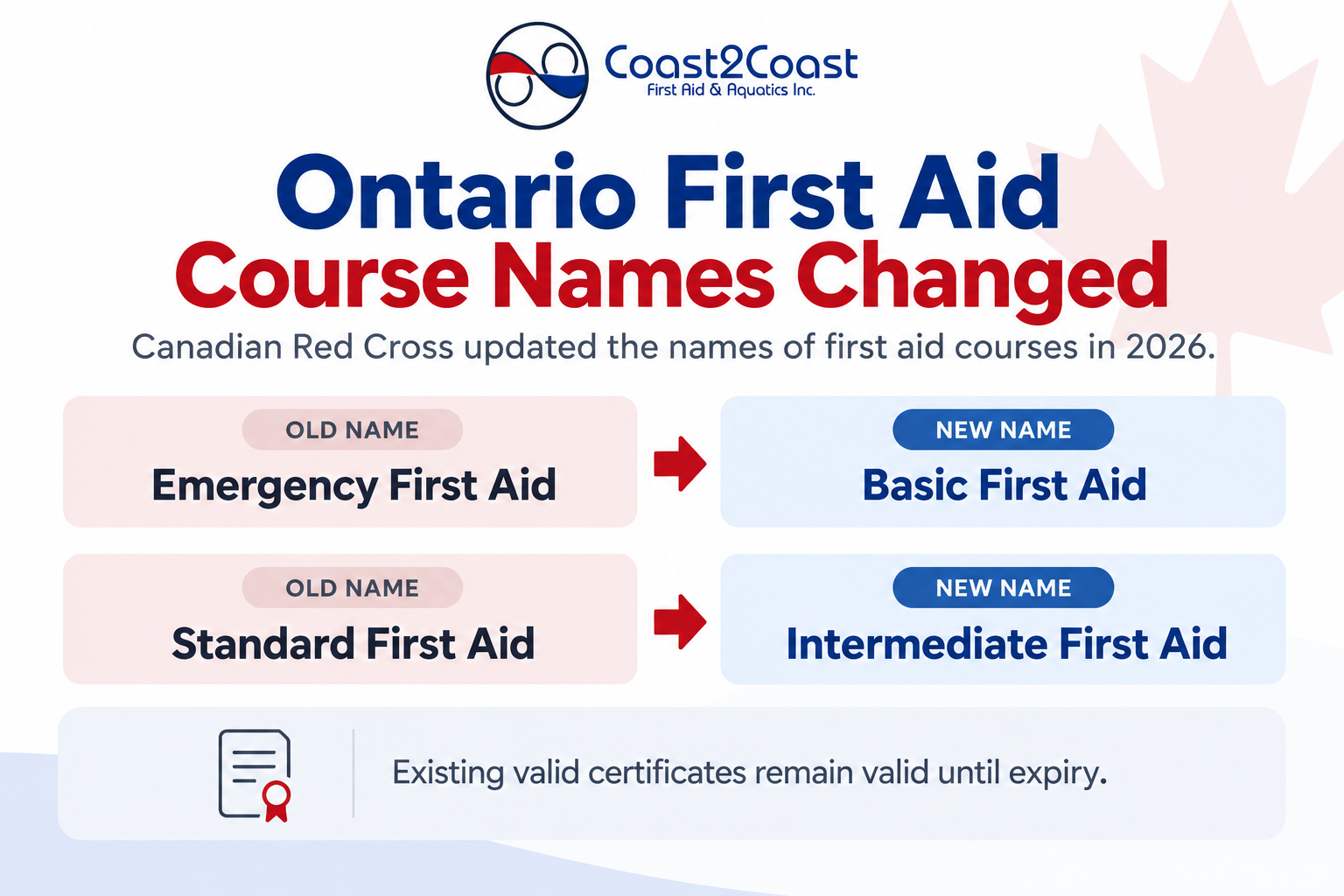
In 2026, Ontario’s WSIB modernized its First Aid Program to align course names with the national CSA Z1210:24 standard. Standard First Aid is now called Intermediate First Aid (formerly Standard First Aid). Emergency First Aid is now called Basic First Aid (formerly Emergency First Aid).
The renaming only changed the label. Regulation 1101 itself is unchanged, along with the compliance thresholds it sets by employee count. Workplaces with one to five employees per shift still need at least one worker certified in Basic First Aid. Workplaces with more than five need at least one certified in Intermediate First Aid. An existing certificate under the old name stays valid until its expiry date. There’s no need to retake a course just because of the name change.
Building a Safety Culture Beyond the Certificate
Closing a training gap like this one isn’t only about which course a workforce takes. It’s about what happens between certification dates.
A recurring practice session, even a short one, keeps the less dramatic skills fresh in a way a single day of training years ago cannot. Try a quarterly team meeting that includes a few minutes of hands-on practice: wrapping a bandage, reviewing how to splint a forearm with everyday materials. It doubles as both a skills refresher and a team-bonding exercise. The cost is minimal. A training mannequin, or even just a box of bandages set out during a coffee break, is enough to keep muscle memory active.
What that practice looks like depends on what matters most for a given workplace. A site where cardiac arrest is the biggest concern might keep a practice mannequin in the break room, so staff can run through compressions during downtime. A site where lifting injuries or falls are more common might spend that same ten minutes reviewing how to support a suspected sprain or splint a wrist. The specific skill matters less than making the practice a routine, instead of something that only happens once every three years when a certificate is about to expire.
The other half of this is prevention. First aid training teaches people what to do after an injury happens. But the same courses also spend real time on hazard recognition, so the emergency never occurs in the first place. A workplace culture that treats safety as an ongoing conversation, not a once-every-three-years compliance event, tends to catch the conditions that lead to a strain or a fall before anyone gets hurt.
None of this replaces certification. It’s what makes the certification actually mean something when it’s needed.
Keep Your Certification Current
A recertification course is the fastest way to refresh fracture, sprain, and strain response before your certificate expires.
Which Course Actually Closes This Gap?
Every WSIB-recognized first aid course covers bone, muscle, and joint injuries in some form. But the depth of coverage differs by level. Basic First Aid (formerly Emergency First Aid) introduces the core recognition skills and immediate response in a shorter format. It suits lower-risk workplaces with five or fewer employees per shift. Intermediate First Aid (formerly Standard First Aid) builds in substantially more hands-on practice time for fracture and soft tissue response. That’s part of why it’s the certificate most Ontario employers with larger teams choose, regardless of the regulatory minimum.
Basic Life Support (BLS) is aimed at healthcare providers and clinical staff. It focuses on team-based resuscitation, not general injury response, so it isn’t a substitute for Basic or Intermediate First Aid on a general worksite. A CPR/AED-only certification doesn’t cover fracture or sprain response at all. That’s exactly the gap this data highlighted.
Coast2Coast folds exam data like this back into its own curriculum and instructor coaching. Wherever the numbers show students are struggling, the team adds more scenario practice, rather than treating a passing grade as the end of the conversation. When a gap shows up across many classrooms at once, that points to a curriculum change. When it’s concentrated in just a few, it points to coaching a specific instructor on how they teach that section. Either way, the fix comes from the data, not a guess.
For workplaces trying to fit more hands-on practice into a busy schedule, blended learning is worth considering. It splits a course into an online theory portion and a shorter in-person skills day. That can make it easier to schedule refresher practice more often, without giving up a full day each time. Not sure which level your team needs? Our course selector guide can help you confirm before booking.
Key Takeaway
Coast2Coast’s exam data shows CPR questions are answered wrong less than 10% of the time. But bone, muscle, and joint injury questions have a 27.7% wrong-answer rate, the highest of any topic. That lines up with WSIB data showing roughly 38% of Ontario workplace claims involve musculoskeletal injuries. Closing that gap takes more than a certificate. It takes hands-on practice with the less dramatic injuries, not just the ones that feel like an emergency.
Get Certified
Join 200,000+ Canadians Who Are Certified
Find a Coast2Coast first aid, CPR, and AED course location near you.
Frequently Asked Questions: First Aid Training Gaps 2026
Q1: What did Coast2Coast’s exam data reveal about first aid training gaps?
A: Coast2Coast analyzed 539,821 individual exam answers from its digital testing platform and found that CPR and defibrillation questions were answered wrong less than 10% of the time. Bone, muscle, and joint injury questions had the highest wrong-answer rate of any topic area, at 27.7%, followed by bleeding and wound care. The data showed that the injuries most people worry about, cardiac emergencies, are the ones certified students already handle well on paper. The injuries that actually trip students up are the less dramatic ones like sprains, strains, and suspected fractures.
Q2: Why are bone, muscle, and joint injury questions the hardest for first aid students?
A: Bone, muscle, and joint injuries don’t carry the same classroom urgency as a cardiac emergency, so they tend to get less practice time and attention relative to how often they actually happen. A demonstration on splinting a forearm doesn’t generate the same adrenaline as a mock cardiac arrest, even though sprains, strains, and fractures are far more common day to day than sudden cardiac events. That mismatch between perceived seriousness and classroom repetition likely explains why this category produces the highest wrong-answer rate on Coast2Coast’s exams.
Q3: How does this training gap connect to WSIB claims data?
A: Coast2Coast compared its exam data to Workplace Safety and Insurance Board claims data for Ontario and found that roughly 38% of claims WSIB pays out involve bone, muscle, or joint injuries. That means the topic area where certified students are least confident on a written exam is also the topic area generating the largest share of real, compensable workplace injuries. The overlap suggests that improving hands-on readiness for these specific injuries could meaningfully reduce both the frequency and severity of workplace claims.
Q4: What is the R.I.C.E. method, and when should you use it?
A: R.I.C.E. stands for Rest, Ice, Compression, and Elevation, and it’s the standard first aid approach for a soft tissue injury like a sprain or strain. Rest means keeping weight off the injured area, Ice means applying a cold pack in short intervals to reduce swelling, Compression means wrapping the area snugly but not tightly, and Elevation means raising the injured limb above heart level when possible. R.I.C.E. is appropriate for sprains and strains, not for a suspected fracture, which needs to be immobilized instead of iced and wrapped.
Q5: How do you tell the difference between a fracture and a sprain?
A: A suspected fracture usually shows severe pain, rapid swelling, visible deformity, an inability to bear weight, or a grinding sensation when the area moves. A sprain or strain, an overstretched or torn ligament, tendon, or muscle, tends to cause pain and swelling that’s less severe and doesn’t usually involve visible deformity. When in doubt, treat the injury as a possible fracture: stop moving the area, support it in the position you found it, and get the person to a healthcare provider rather than guessing.
Q6: What should you do if you suspect someone has a broken bone?
A: Stop the person from moving the injured area and don’t attempt to straighten or realign it yourself. Support the limb in the position you found it, using padding if available, and call 911 if the injury involves the head, neck, spine, or an open wound where bone has broken the skin. For a limb fracture with no other life-threatening signs, splinting the area above and below the injury site keeps it stable until paramedics or a healthcare provider can take over.
Q7: Did the WSIB naming change (Standard to Intermediate First Aid) affect what the courses teach?
A: No. The 2026 update to Ontario’s WSIB First Aid Program aligned course names with the national CSA Z1210:24 standard, so Standard First Aid became Intermediate First Aid and Emergency First Aid became Basic First Aid. The course content, hours, and skills taught did not change, and Regulation 1101’s compliance thresholds by employee count stayed the same. Employers who see the new names on a certificate or a training provider’s website should read them as the same courses under updated titles, not a new requirement.
More FAQs: Compliance, Culture & Choosing a Course
Q8: Do employees need to retake their course because of the name change?
A: No. An existing certificate issued under the old name, Standard First Aid or Emergency First Aid, remains valid until its normal expiry date. When the certificate comes up for recertification, the new name, Intermediate First Aid or Basic First Aid, appears on the renewed certificate automatically. There’s no need to book an early course or pay for a new certification purely because of the naming update.
Q9: How many employees need to be trained in first aid under WSIB Regulation 1101?
A: Workplaces with one to five employees per shift need at least one worker certified in Basic First Aid, formerly Emergency First Aid, on site. Workplaces with more than five employees per shift need at least one worker certified in Intermediate First Aid, formerly Standard First Aid. Larger organizations with more than 200 employees may also need a dedicated first aid room stocked with additional supplies. Requirements apply regardless of employment status, so part-time and contract workers count toward the total.
Q10: Why does a first aid certificate not necessarily mean someone is ready to respond?
A: A certificate confirms someone attended a class, met a minimum passing grade on a written exam, and demonstrated a skill once in front of an instructor. It doesn’t measure whether that person retains the information months or years later, or whether they can act calmly and correctly the first time a real emergency happens. Coast2Coast’s exam data shows meaningful gaps even among students who passed, which is why ongoing practice matters as much as the certificate itself.
Q11: What can a workplace do beyond certification to close this kind of training gap?
A: Short, recurring practice sessions keep less dramatic skills fresh between certification dates. A quarterly team meeting that includes a few minutes of hands-on review, wrapping a bandage or practicing a splint with everyday materials, helps maintain muscle memory at minimal cost. Building a broader culture of safety, one that treats prevention and hazard recognition as an ongoing conversation rather than a once-every-three-years event, also reduces how often these injuries occur in the first place.
Q12: Which first aid course covers bone, muscle, and joint injuries most thoroughly?
A: Intermediate First Aid, formerly Standard First Aid, builds substantially more hands-on practice time into fracture and soft tissue response than Basic First Aid, formerly Emergency First Aid, which covers the same topics in a shorter, more introductory format. Basic Life Support focuses on healthcare-provider resuscitation skills rather than general injury response, so it isn’t a substitute for either level on a typical worksite. A CPR/AED-only certification doesn’t cover fracture or sprain response at all.
Q13: Is CPR training less important because bone, muscle, and joint injuries have a higher wrong-answer rate?
A: No. CPR and AED training remain essential, since cardiac emergencies are immediately life-threatening and every second matters. The exam data doesn’t suggest CPR training should be scaled back. It shows that bone, muscle, and joint content deserves the same level of hands-on repetition and seriousness that cardiac response already receives, so both categories of injury get a genuinely prepared response instead of just one of them.
Q14: How large is Coast2Coast’s exam dataset, and how is it used?
A: The dataset includes 539,821 individual question responses collected through Coast2Coast’s proprietary digital testing platform. The organization uses it to identify which specific questions and topics produce the most wrong answers across its network, then adjusts curriculum time, scenario practice, and instructor coaching to address those gaps directly. Rather than filing paper answer sheets away for years for audit purposes, this approach turns exam results into an ongoing feedback loop for improving how the courses are taught.
Q15: What are the signs someone needs immediate emergency care for a bone, muscle, or joint injury?
A: Call 911 immediately if the injury involves the head, neck, or spine, if a bone has broken through the skin, if there’s heavy bleeding, or if the person is unresponsive. Severe deformity, an inability to move or bear weight on the area, and a grinding sensation are also signs of a serious injury that needs professional evaluation. While waiting for help, keep the person still, support the injured area without trying to realign it, and watch for signs of shock.
Reviewed & Sourced
Reviewed by Ashkon Pourheidary, B.Sc. Hons Neuroscience, Co-Founder of Coast2Coast First Aid & Aquatics and Canadian Red Cross Instructor Trainer since 2011. Last updated September 17, 2026.
Reference: Workplace Safety and Insurance Board, First Aid Program (Regulation 1101).