CPR Certification, First Aid Course & BLS in Los Angeles
Get certified with Los Angeles's trusted American Red Cross Authorized Provider and American Heart Association Aligned Training Site. We deliver workplace-compliant CPR classes and AED training designed to save lives.
- 99.9% Success RatePass with confidence
 Google Reviews★★★★★4.9 / 523,640 reviews
BLS, First Aid and CPR Classes in Los Angeles
Coast2Coast runs AHA BLS and American Red Cross First Aid / CPR / AED classes in Los Angeles, with private group training across Greater Los Angeles. Pick your course, then book a date.
Get certified from just $49.99
Sale pricing on American Red Cross First Aid, CPR & AED and American Heart Association BLS. Same certification, same instructors. Book before the sale ends.
First Aid, CPR & AED
American Red CrossCourses Offered
- Adult & Pediatric First Aid & CPR
- CPR/AED
For workplaces, schools, childcare staff, coaches and anyone in Los Angeles who needs an American Red Cross First Aid / CPR / AED certificate. Choose blended learning (online first, then a shorter class) or a fully in-class day.
Gain essential lifesaving skills to act with confidence during cardiac arrest and medical emergencies.
- Adult, child and infant CPR with AED practice, plus first aid skills
- Blended learning and classroom CPR courses available
- Certificate delivered within 48 hours of successful completion
- Free 90-day skills practice retake
- On-site group training available for teams of 8+
Who is this for? Workplace first aiders, teachers, childcare staff, coaches, security staff and anyone in Los Angeles who needs an American Red Cross First Aid / CPR / AED certificate.
Adult & Pediatric First Aid & CPR: Blended: register for the online part with the link in your confirmation email and finish it before your in-class date.
CPR Certification — Los Angeles FAQs
Yes. Our classes lead to an American Red Cross certificate that employers, schools and childcare programs commonly ask for. If your employer or licensing body names a specific requirement, check it before you book.
Yes. Finish the online CPR theory modules first, then attend your in-person skills session for hands-on practice with AED devices and manikins.
AHA Basic Life Support (BLS)
HealthcareCourses Offered
- AHA BLS Provider Course
- AHA BLS Provider Renewal
- AHA HeartCode BLS (Blended)
- AHA HeartCode BLS Renewal
- AHA HeartCode BLS Skills Test
For nurses, nursing students, EMTs, physicians, dental teams and other healthcare providers in Los Angeles who need an American Heart Association BLS Provider card. Choose the full in-class course, or HeartCode BLS: the online part at home, then a short in-class skills session.
BLS is the clinical-standard course for healthcare providers. If you need a certificate for a non-clinical job, choose the First Aid, CPR & AED course instead.
- American Heart Association: the gold standard for clinical BLS certification
- Covers bag-valve-mask ventilation and team-based resuscitation protocols
- BLS Provider (initial) and BLS Renewal available
- Certificate issued within 48 hours of completion
Who is this for? Nurses, nursing students, paramedics, physicians, dental professionals and other healthcare workers in Los Angeles who need a current American Heart Association BLS certification to start or keep clinical placements.
AHA HeartCode BLS (Blended): Complete the online part before your in-class date: without it you are dismissed from the class with no refund. Online access is usually emailed within 24 hours of registering.
AHA HeartCode BLS Renewal: You need a valid AHA HeartCode BLS certificate. Without it, you pay the difference for the full BLS Provider course before you receive your certificate. Complete the online part before your in-class date: without it you are dismissed from the class with no refund. Online access is usually emailed within 24 hours of registering.
BLS — Los Angeles FAQs
BLS certification is valid for two years from the date of issue. Book your renewal at least a month before it expires so it does not lapse.
BLS is for healthcare professionals: two-rescuer CPR, AED use, bag-mask ventilation and team-based emergency response. First aid and CPR classes cover a wider range of everyday emergencies, such as wound care and choking, for workplace responders.
HeartCode BLS & BLS Renewal – Los Angeles
Complete the theory online on your schedule, then attend a quick hands-on check with an American Heart Association instructor at our Los Angeles center. Perfect for nurses, paramedics and medical students with a busy schedule.
Register for BLS initial or renewal classes to keep your credentials current. All clinical settings use American Heart Association courses as the standard.
HeartCode BLS
Flexible format: online theory at your own pace, then an in-person skills test with an AHA certified instructor.
- Initial courseBLS Provider
- FormatOnline + Skills Test
- RenewalBLS Renewal
- Valid for2 Years
Why Los Angeles Students Choose Coast2Coast for First Aid Training
Los Angeles healthcare teams and workplaces choose us for AHA BLS and American Red Cross First Aid / CPR / AED classes. See how Coast2Coast compares to other training providers across Greater Los Angeles.
| Feature | Coast2Coast Los Angeles Best Choice in Los Angeles | Other Providers Los Angeles area |
|---|---|---|
| Workplace compliance | Coast2Coast: OSHA-compliant training across all CPR classes | Other providers: Limited OSHA or AHA-accepted CPR courses |
| Certification | Coast2Coast: American Red Cross & American Heart Association certification | Other providers: Not always ARC or AHA accredited |
| Certificate speed | Coast2Coast: CPR certificate delivered in 48 hours | Other providers: 7–10 day certificate turnaround |
| Skills retake | Coast2Coast: Free 90-day skills practice retake | Other providers: No free skills practice retake |
| Pass rate | Coast2Coast: 99.9% student pass rate | Other providers: Lower student pass support |
| Class availability | Coast2Coast: Frequent weekly CPR training dates | Other providers: Limited weekly class availability |
| Study support | Coast2Coast: Coasty AI First Aid, CPR & BLS study companion and tutor | Other providers: No AI tutor or digital study support |

Coasty
North America's first AI-powered First Aid & CPR tutor, part of the Coast2Coast First Aid Student Companion app. Coasty explains First Aid, CPR/AED, BLS, and course concepts in simple language so you can review topics, take quizzes, and build confidence before, during, and after class. It works alongside your instructor and official American Heart Association and American Red Cross materials to support your learning.
Meet Coasty →Coming soonAbout Our Los Angeles Location
We are an American Red Cross Authorized Provider and American Heart Association Aligned Training Site serving professionals, workplace teams, and students across Los Angeles County. Located at 2316 ½ S Union Ave near Downtown LA and USC, our facility is fully equipped with AED trainers and resuscitation manikins for hands-on CPR certification.
Los Angeles Location
Coast2Coast First Aid/CPR — Los Angeles
Los Angeles, CA 90007
Private & group training available by appointment.
Other Coast2Coast Locations Near Los Angeles
If Los Angeles does not suit your dates, these are the closest Coast2Coast locations, each with its own address, courses and schedule.
Certification — Frequently Asked Questions
Answers based on AHA and American Red Cross course rules and Los Angeles course options.
BLS classes focus on clinical CPR training for healthcare professionals—covering two-rescuer CPR, AED classes, bag-mask ventilation, and team resuscitation. First Aid and CPR classes cover everyday lifesaving skills like wound care, choking, and adult, child, and infant CPR for workplace responders and the general public.
No. California OSHA requires in-person hands-on practice for valid CPR certification. Coast2Coast offers blended CPR training where online CPR theory is completed at home followed by a brief hands-on CPR class at our Los Angeles facility. Read our guide on how to get CPR certified in California.
CPR certification is required for LAUSD teachers, healthcare professionals, childcare providers, security officers, and OSHA-regulated workers across Los Angeles County. Since 70% of Americans lack CPR training, learning CPR provides critical lifesaving skills for any workplace or home emergency.
American Red Cross CPR certification and American Heart Association BLS certification are valid for two years. Recertification should ideally be scheduled within 30 days of expiry to maintain workplace compliance.
Yes. We deliver on-site group CPR training and first aid courses directly to workplaces, schools, and facilities across Southern California. Event organizers can also book event first response services to improve emergency response times. Learn about the benefits of corporate CPR training in Los Angeles.
Yes. All CPR classes teach hands-only CPR for rapid bystander response in cardiac arrest, as well as full CPR training with rescue breaths and AED use.
Our CPR classes cover adult, child, and infant CPR compressions, choking relief, hands-only CPR, and AED classes for sudden cardiac arrest emergency response.
Your official CPR certificate is issued via email within 48 hours of successful completion. Students also receive a free 90-day skills retake if needed.
Yes. We welcome CPR training students from Long Beach, Glendale, Pasadena, Santa Monica, and Malibu, and provide group CPR classes throughout Los Angeles County.
Yes. Our CPR classes require no medical background. Experienced instructors teach all lifesaving skills step by step so every student leaves confident in learning CPR.
A First Aid/CPR/AED class teaches resuscitation on top of injury and illness care. A First Aid course drops the resuscitation half. Our CPR first aid training adds compressions, rescue breaths and defibrillator use to the twelve emergencies every course covers. Want resuscitation without the injury care? Our CPR/AED courses teach those.
Most ask for a first aid certification that includes CPR and defibrillator use, because OSHA expects a trained responder on site. Adult First Aid/CPR/AED suits a workplace with only adults; daycares, schools, camps and pools need pediatric coverage. Licensed healthcare workers need Basic Life Support. Ask what your employer accepts, then book the CPR first aid certification that matches.
Two years from the day you pass. Every CPR first aid course on this page carries the same window. Put the expiry in your calendar. Renewing while your card is valid keeps you in one shorter class; letting it lapse means sitting the full course again.
No. An online CPR course with no classroom session does not produce a certification an employer will accept. You can cover the theory online, and our blended option works that way: the online portion of the training first, then a shorter classroom session with a certified instructor. Only the skills test proves you can push hard and fast on a chest. Every CPR first aid class ends with one.
Video, reading and short quizzes you finish at your own pace before class. Times vary depending on which course you book: the online module runs from 35 minutes to about three and a half hours. You arrive having covered it, so the classroom CPR first aid training is skills only. Prefer face to face? Every course also runs fully in person.
Adult CPR uses two hands and a deeper compression. Pediatric CPR changes the hand position, the depth and the rhythm. An infant takes two fingers. A child takes one hand, sometimes two. Adult alone covers an office; adult plus pediatric covers a school, pool deck or family home. You practice both on age-specific manikins.
No. Every class starts from zero and assumes no medical background. Plenty walk in with no first aid education. Our CPR first aid training fits parents, coaches and site crews, and plenty book it for their loved ones rather than for a job. A cardiac arrest can happen in your own home as easily as at work, which makes a trained bystander the vital link between the collapse and the ambulance. CPR and first aid are practical skills, not academic ones.
Compressions, rescue breaths, choking response and defibrillator use — all on manikins, all watched by a certified instructor. Hands-on skills testing with automated external defibrillator is part of every CPR first aid class we run. You open the case, place the pads and follow the prompts on an AED trainer. You also cover the recovery position, severe bleeding and the first aid techniques for choking.
Within 48 hours of a successful skills evaluation. Your digital certificate reaches you by email, ready to forward to an employer or licensing body. It carries the same two-year expiry your CPR certification runs on. Tell your instructor if you need proof of your CPR first aid certificate sooner.
Yes. We bring CPR/AED first aid training to your workplace, or set up a private class at one of our facilities. Groups make sense when a whole team needs the same card. We run 100+ courses every week. Call 1-866-291-9121 to arrange group CPR training or price a private CPR/AED first aid class.
Come back and practice again. Every student gets a free 90-day skills practice retake at no additional cost. If you finish your CPR/AED first aid training and still feel shaky on compression depth, book inside 90 days and run the skills again with an instructor. It is one reason our CPR first aid training carries a 99.9% student success rate.
Pick your region in the class finder above, choose your city, and book the date that works. We run CPR and first aid classes across the United States, with 100+ courses every week. Over 150,000 participants have trained with us across North America. Blended and fully in-person CPR first aid classes both appear there. Our US training home page covers the full range of CPR/AED first aid training we offer.
Book a class, attend it, and pass the skills test. Our American Red Cross CPR classes run at every Coast2Coast facility, and you leave with a card the day you pass. Pick the level that matches who you may have to help, choose blended learning or fully in person, and register. No prerequisite, no medical background assumed.
Almost never. Ask your employer whether they accept an online CPR course before you pay for one, because most treat a pure online certification as theory rather than proof. Our blended option gives you the flexibility people want from CPR certification online without the risk: you finish the online portion of the training at home, then attend a shorter CPR certification class for the practical work.
The online CPR portion, yes. Our online CPR certification training is self-paced, so students start their CPR certification online in the morning and sit the classroom skills later that week. Searching for CPR training online gets you this format. What no online certification course can do is sign off your skills test.
Match the class to the age of the people around you. Adult covers adults only. Pediatric covers infants and children. Adult and Pediatric covers both, and it is the safest choice if your employer has not named a level. Every CPR class on this page carries the same certificate validity.
The American Red Cross offers a shorter review course, but only while your certificate is still valid. Once a card expires that route closes and you retake the full CPR certification class at the level you hold. So check the expiry date before you book, and call 1-866-291-9121 if you are not sure which one your CPR recertification needs.
One handles the heart stopping, the other handles everything else. A CPR and AED course teaches compressions, rescue breaths and defibrillator use. A first aid course teaches bleeding control, burns, anaphylaxis, stroke and nine more emergencies. Our CPR first aid classes combine both into one certificate. If your workplace asks for a CPR first aid certification on a single card, that is the page you want.
If a baby or a small child could be in the room, yes. Infant CPR is not adult CPR scaled down. Compression depth, hand position and the choking sequence all change. Childcare licensing bodies usually ask for it by name, and parents book this CPR training for their own peace of mind rather than for a job.
Probably not — healthcare providers usually need Basic Life Support. BLS is the AHA course written for healthcare providers who resuscitate as a team, with two-rescuer compressions and bag-mask ventilation. The CPR training on this page is built for a single rescuer. If your license or your unit asks for BLS, healthcare providers should book Basic Life Support instead.
Yes, across every class we run. Coast2Coast is an American Red Cross Authorized Training Provider, and our AED and first aid programs meet OSHA workplace requirements in all US locations. A job posting that lists CPR/AED first aid training is describing exactly this. If your safety officer needs paperwork, the certificate names the provider, the level and the expiry date.
Between 90 minutes and four hours, depending on the level. Pediatric is the shortest. Adult and Pediatric is the longest. You will learn CPR faster than most people expect, because the sequence itself is short and the class time goes into repeating it until your hands know it without you thinking.
You practice on an AED trainer, which is the point. A trainer runs the same pad placement, the same voice prompts and the same rhythm analysis as the unit on the wall at your workplace, without delivering a shock. Every student handles one. Meeting an automated external defibrillator for the first time during an emergency is exactly what this class prevents.
Within 48 hours of passing. Your digital American Red Cross certificate arrives by email, so you can forward it to an employer the same week you train. You also get a free 90-day skills practice retake at no additional cost if you want more repetitions before you rely on the skill.
BLS is a four to five hour course that teaches healthcare providers to run a resuscitation as a team. You cover rapid assessment, high-quality CPR for adults, children and infants, defibrillator use, obstructed airway and opioid overdose.
No. BLS includes CPR, but CPR on its own is a smaller course. A workplace CPR class trains one rescuer. BLS trains you as the help: two rescuers, ventilation support and a clean handoff to advanced care. Our CPR/AED courses cover the workplace levels.
It replaced it. Healthcare provider CPR moved into the Basic Life Support program, so if a placement coordinator or a licensing body asks for HCP-level CPR, this is the course that satisfies it.
Anyone whose license, employer or clinical program requires it. That requirement usually arrives one of three ways. A hospital preparing for a Joint Commission survey asks for it. A state medical or nursing board sets it as a renewal term. Or an employer applies OSHA workplace safety rules to clinical staff. Nurses, medical assistants, dental staff, therapists, pharmacy staff, students, firefighters and hospital security teams all take this course. There is no prerequisite.
Recognize the emergency, get help moving, start compressions, and defibrillate early. Order matters: brain damage can begin within four to six minutes once blood flow stops. Immediate CPR can double or triple someone’s chance of survival after cardiac arrest.
Two years from the date you pass. The expiry date is printed on your American Heart Association certificate. Protocols are updated periodically to reflect current guidelines, which is part of why the card runs out. Book before it lapses, or you sit the full course again.
Not end to end. A BLS certification an employer accepts always includes a skills assessment with an instructor in the room. What you can do is HeartCode BLS: the theory online at your own pace, then a short in-person skills test with an AHA instructor.
No. BLS and first aid are separate certifications. BLS handles cardiac arrest and airway emergencies; first aid covers bleeding, burns, anaphylaxis, stroke and more. Book a first aid course if your role needs both.
Compressions, ventilation, choking relief and defibrillation, on adult, child and infant manikins. Choking work covers back blows and the abdominal thrusts known as the Heimlich maneuver. On an AED trainer you learn to read the heart rhythm and shock when one is advised. Hands-on skills testing with automated external defibrillator is part of the course.
100% attendance and a 75% score on the multiple choice knowledge test. Your instructor assesses your skills in the room. The certificate is issued within 48 hours of successful completion.
Pick your region in the class finder above, choose your city, and book a date. We run 100+ courses every week. Our US training facilities page lists every site. Call 1-866-291-9121 for a private class.
First Aid & CPR Training Resources for Los Angeles
Every guide answers a real question workers ask before booking a first aid or CPR certification course: workplace rules, certificate validity, and course selection.
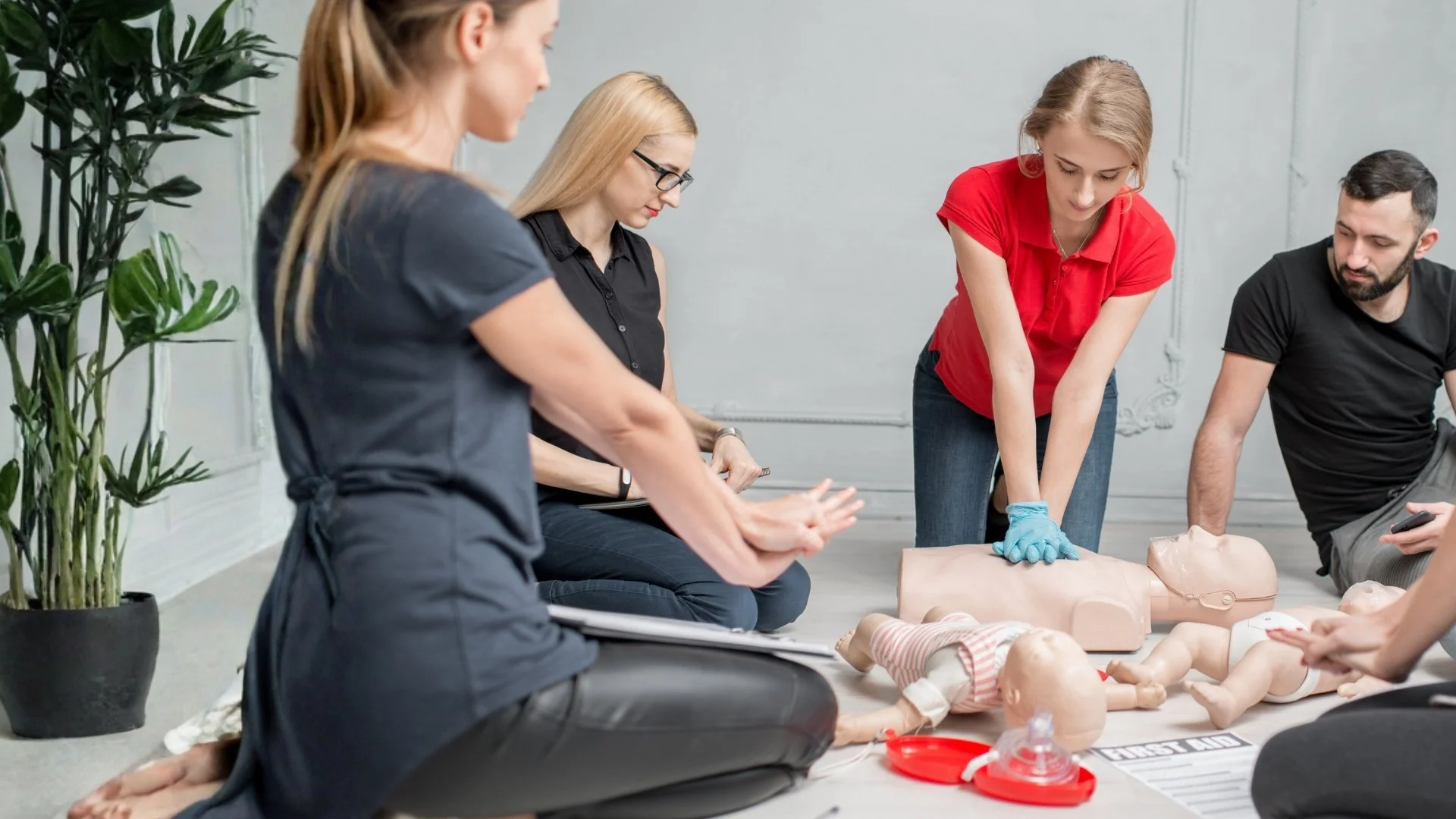
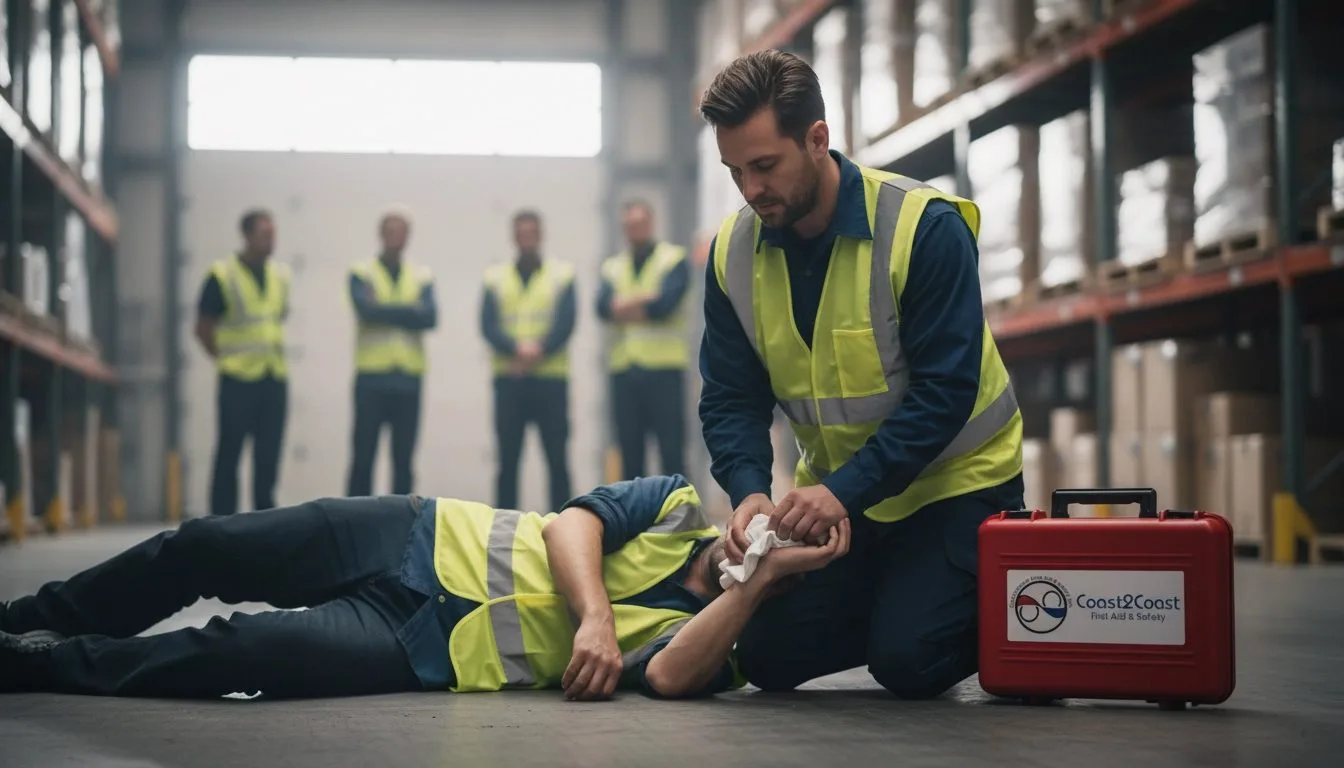
First Aid & CPR Guides and News for Los Angeles
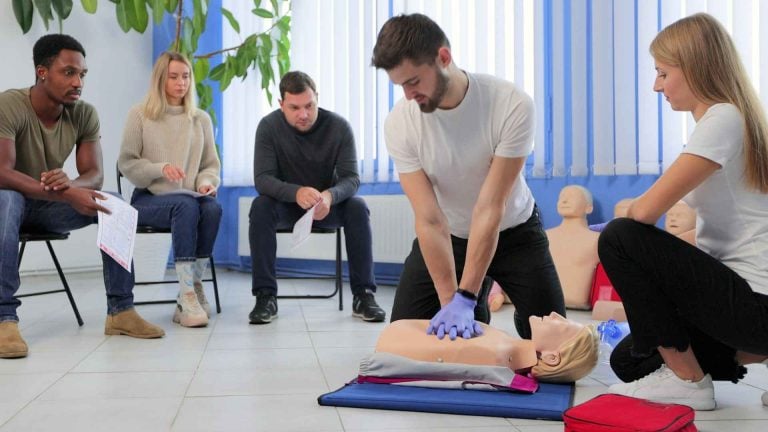
The Benefits of Corporate First Aid and CPR Training for Los Angeles Businesses
First aid education gives students the confidence and skills to respond in emergencies. Discover why US schools should integrate first aid into…

Best First Aid and CPR Training in Los Angeles
Emergencies can happen anytime in a busy city like Los Angeles. Whether you’re at work, school, or out with friends, knowing CPR…
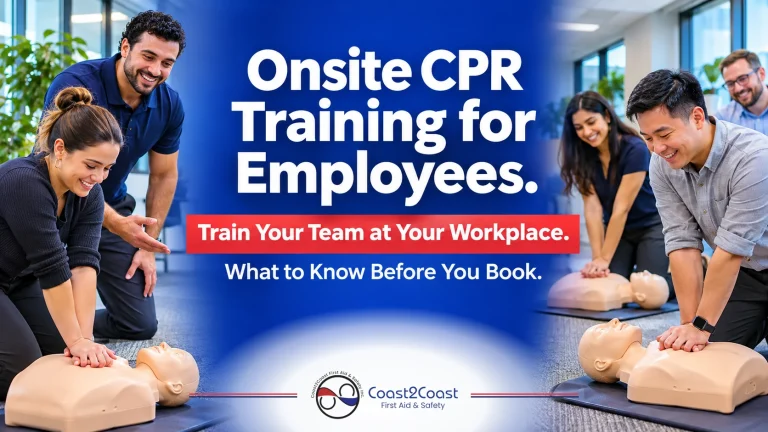
Onsite CPR Training for Employees: What Employers Need to Know
Onsite CPR training means a certified instructor brings the class to your workplace so a whole team learns CPR and AED use…
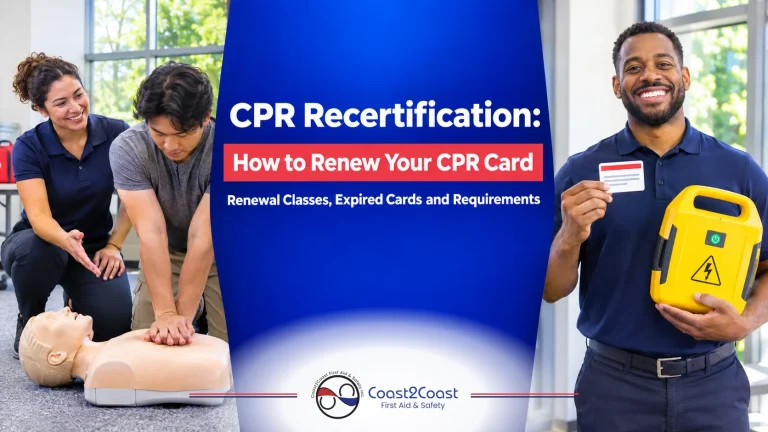
Expired CPR Certification: What to Do and How to Get Current Again
An expired CPR certification means your card is past its expiry date, which is usually two years after your class. There is…
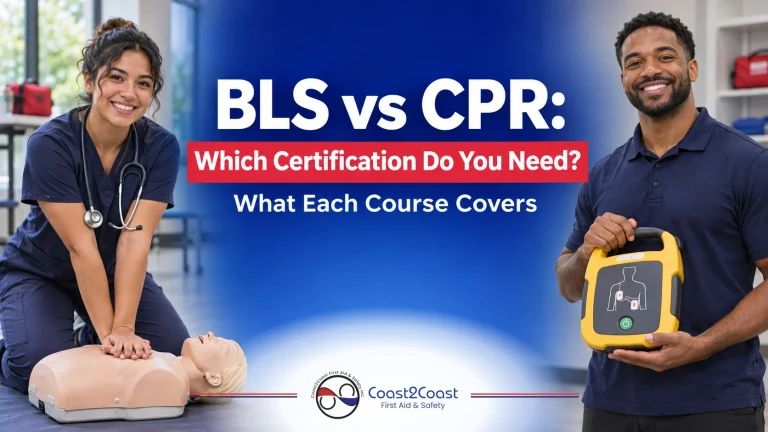
BLS vs CPR: Which Certification Do You Need?
BLS vs CPR comes down to who you are and who you might have to help. A standard CPR/AED course teaches everyday…
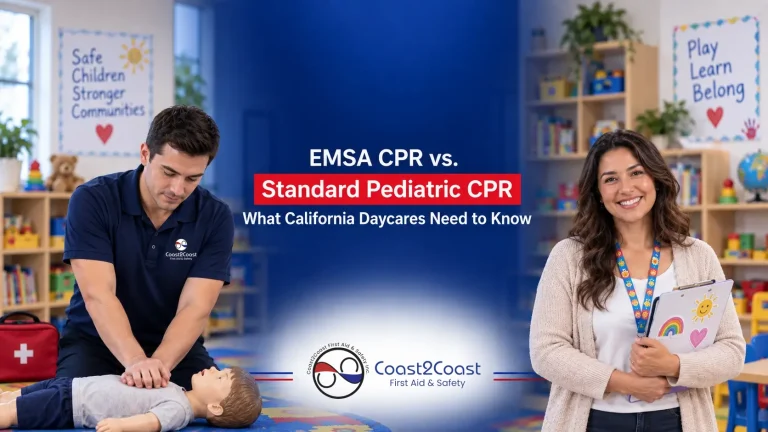
EMSA CPR vs. Standard Pediatric CPR: What California Daycares Need to Know
California-licensed childcare providers must complete an 8-hour EMSA-approved Pediatric First Aid & CPR course, not just any pediatric CPR card, to satisfy…