
What Is Onsite CPR Training?
Onsite CPR training is a class taught at your own workplace instead of at a public training center. A certified instructor brings manikins, AED trainers, course materials and a skills checklist, sets up in a conference room, break room or open floor space, and teaches your employees together. People who complete the class and pass the skills check receive the same kind of certification card they would earn in a public class.
The skills do not change when the class moves. Employees still learn how to check a person who has collapsed, call 911, give high-quality chest compressions, use an automated external defibrillator (AED) and help someone who is choking. What changes is the logistics: instead of sending staff to different classes on different days, you book one session and certify the whole group at once.
Employers choose onsite CPR training for several reasons. It reduces time away from work, because nobody has to travel. It lets teams practise together, which builds shared confidence. And it allows the instructor to use your real environment as a teaching tool, for example by showing where the AED is mounted and how emergency responders would reach the building.
Cardiac emergencies do not choose convenient times or places. The CDC reports that more than 356,000 people in the United States have an out-of-hospital cardiac arrest each year, and many happen at home or at work. When a coworker collapses, the people nearby are the first responders. Training them in advance is one of the most practical safety investments a business can make.
This guide explains how onsite CPR training works, what OSHA expects from employers, which course to choose, how big the group can be and what to prepare before the instructor arrives. If you prefer a public class, you can compare CPR and AED courses and choose a date that suits you.
Train Your Whole Team
Private group sessions for your workplace, with training scheduled around your team.
Why Do Employers Choose Onsite CPR Training?
Most employers who book onsite CPR training are solving a scheduling problem. They need several people certified, they cannot afford to lose half a shift to travel, and they want the training to reflect their own workplace. A group class solves all three at once.
The first benefit is simplicity. Public classes have limited seats, and booking ten employees into the same session is not always possible. With onsite CPR training you choose the date and time, and the instructor arrives ready for your whole group. That makes it easier to meet a deadline, onboard a new team or prepare for an audit.
The second benefit is productivity. Travel to and from a training center can add an hour or more per person. A class at your location removes the commute, and staff return to work as soon as the session ends. For businesses with tight schedules, such as clinics, warehouses, restaurants and schools, that saved time matters.
The third benefit is relevance. A warehouse, a dental office and a fitness studio face different risks. Instructors can use examples that match your environment, such as a forklift injury, a patient who faints or a member who collapses on the gym floor. People remember scenarios that look like their own workday.
The fourth benefit is team confidence. When coworkers train together, they practise communicating with each other, sharing roles and taking turns on compressions. In a real emergency, that shared rehearsal helps the group act quickly and calmly. Someone who has already practised saying “I’ll call 911, you start compressions, and someone get the AED” is far more likely to say it when it counts.
Get Hands-On CPR and AED Practice
Work with real manikins and AED trainers while an instructor coaches your technique.
What Does OSHA Require for Workplace First Aid and CPR?
Federal OSHA addresses workplace first aid in 29 CFR 1910.151, the medical services and first aid standard. According to OSHA’s standard, employers must ensure that medical personnel are available for advice and consultation on workplace health, and that first aid supplies are readily available. If a hospital, clinic or infirmary is not in near proximity to the workplace, the employer must train one or more people to render first aid.
The key phrase is near proximity. In an interpretation letter, OSHA explained that it has long read this to mean emergency care within about 3 to 4 minutes where serious injuries are possible, and noted that a fire department that averages 4 minutes away may actually be farther for any given call. For lower-risk settings such as offices, OSHA has said that a longer response time, up to about 15 minutes, may be reasonable as a matter of enforcement discretion. Whether your business falls into the first group or the second depends on your hazards and your location.
The same letter notes that training employees in first aid, including CPR, is not prohibited even when they are not designated responders. If an employer does not designate responders, employees who receive that training should know the company’s plan for handling medical emergencies. In other words, onsite CPR training is a recognised way to prepare a workforce, and a clear emergency plan makes it more effective.
OSHA’s standard does not name a specific course or card. Many employers choose a nationally recognised program, such as American Heart Association (AHA) Heartsaver or American Red Cross CPR/AED, so that the training is documented and verifiable. Some industries have additional rules. Construction, for example, has its own first aid provisions, and states such as California operate their own occupational safety programs, so check what applies to you.
Training Built Around Your Workplace
Certified instructors, flexible formats and a certificate for every participant.
Which Course Should You Book for Your Employees?
The right course depends on what your employees do. For most workplaces, a CPR and AED course is the best starting point. For healthcare teams, Basic Life Support (BLS) is usually the better choice.
A CPR/AED course, such as AHA Heartsaver CPR AED, teaches lay responders how to recognise cardiac arrest, call for help, perform chest compressions and rescue breaths on adults, children and infants, use an AED and relieve choking. It is paced for people with no medical background and suits offices, schools, fitness centers, retail, restaurants, manufacturers and community organizations. If you want first aid skills as well, a combined CPR, AED and first aid course adds bleeding control, burns, fractures and common medical emergencies.
A BLS Provider course is designed for healthcare providers and others whose job or licence requires it. It adds two-rescuer CPR, bag-valve mask ventilation, team roles and a skills test. If your employees include nurses, dental staff, medical assistants, paramedics or clinical students, ask what their licensing board or employer names. You can compare options on our Basic Life Support page and our CPR and AED courses page.
Mixed groups are common. A dental office, for example, may have clinical staff who need BLS and front-desk staff who need CPR/AED. Instructors can often accommodate both levels in one visit, or you can schedule two sessions on the same day. Tell the provider what each person needs when you book.
Finally, think about first aid. If your workplace relies on trained responders under OSHA’s first aid standard, a course that combines CPR, AED and first aid may be more useful than CPR alone. Our first aid courses page describes the options.
Healthcare Team? Choose BLS
Clinical staff can complete Basic Life Support with hands-on practice and a skills check.
How Does an Onsite CPR Training Session Work?
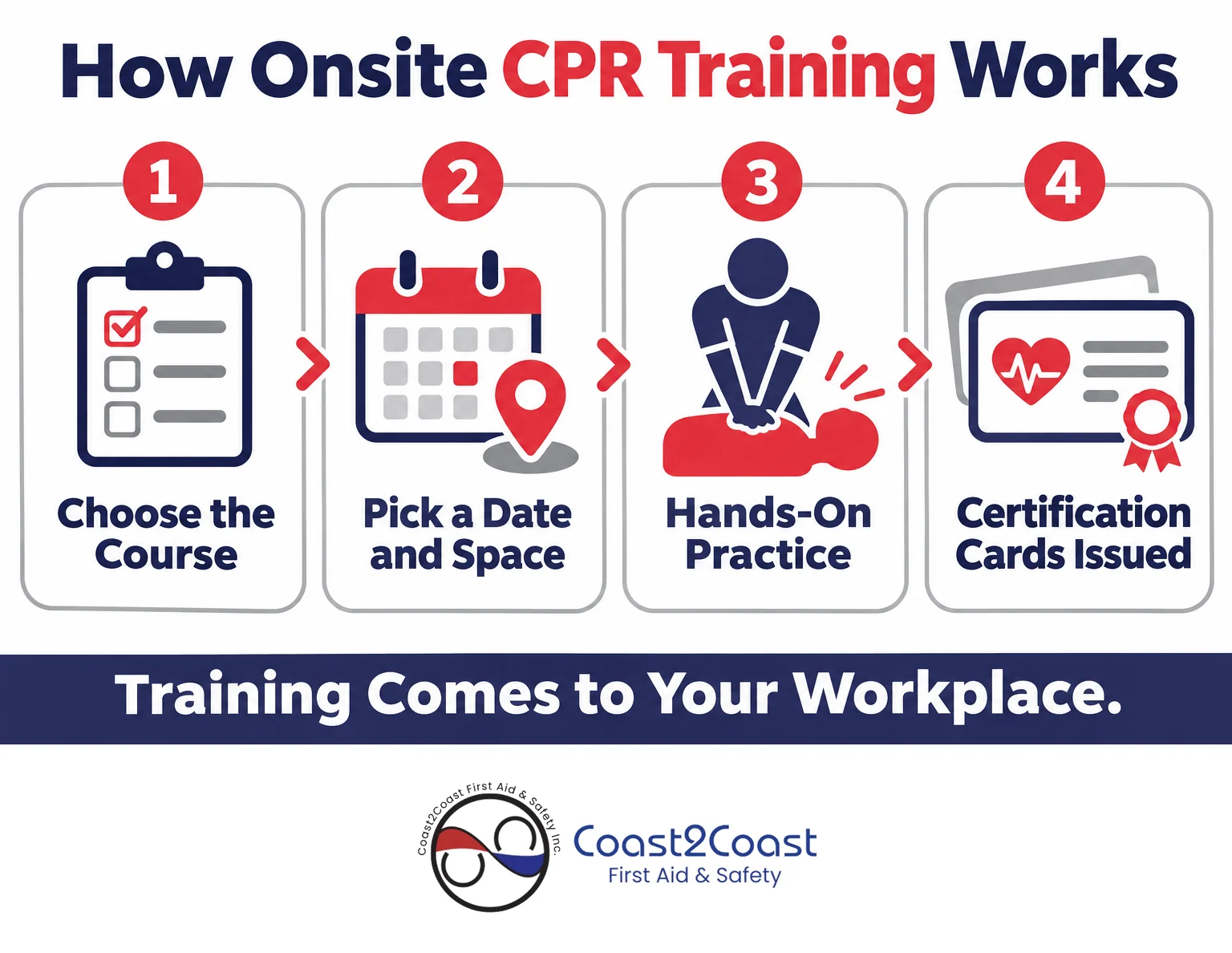
A typical onsite CPR training session follows a simple pattern, whatever the industry.
First, you choose the course and the group. Decide whether your employees need CPR/AED, CPR with first aid or BLS, then confirm how many people will attend. Providers can tell you the maximum group size for hands-on practice, because every learner needs time on a manikin and an AED trainer.
Second, you pick the date and time. Many employers book sessions during slower periods, team meetings or training days. Some choose early mornings or evenings to avoid disrupting service. If your staff work in shifts, you can schedule more than one session.
Third, the instructor arrives early and sets up. They bring the equipment, check the space and arrange stations so that small groups can practise. You provide a room with enough floor space for kneeling and a screen or wall for slides if the course uses them.
Fourth, the class begins. Learners watch short demonstrations, then practise each skill hands-on: compressions on adult, child and infant manikins, breaths with a barrier device, AED pad placement and prompts, and choking relief. Instructors give feedback in real time, so small errors are corrected before they become habits.
Fifth, there is a skills evaluation. Each learner demonstrates the required skills, and the instructor confirms they meet the standard. Some courses include a short written check as well.
Finally, cards are issued to everyone who completes the class successfully. AHA CPR/AED and BLS cards are typically valid for two years, and American Red Cross CPR certificates are also valid for two years. Keep a record of each person’s expiry date, so you can plan renewal before cards lapse.
Learn CPR and AED in a Real Classroom
Practise compressions, breaths and AED pad placement with a certified instructor.
What Should You Prepare Before the Instructor Arrives?
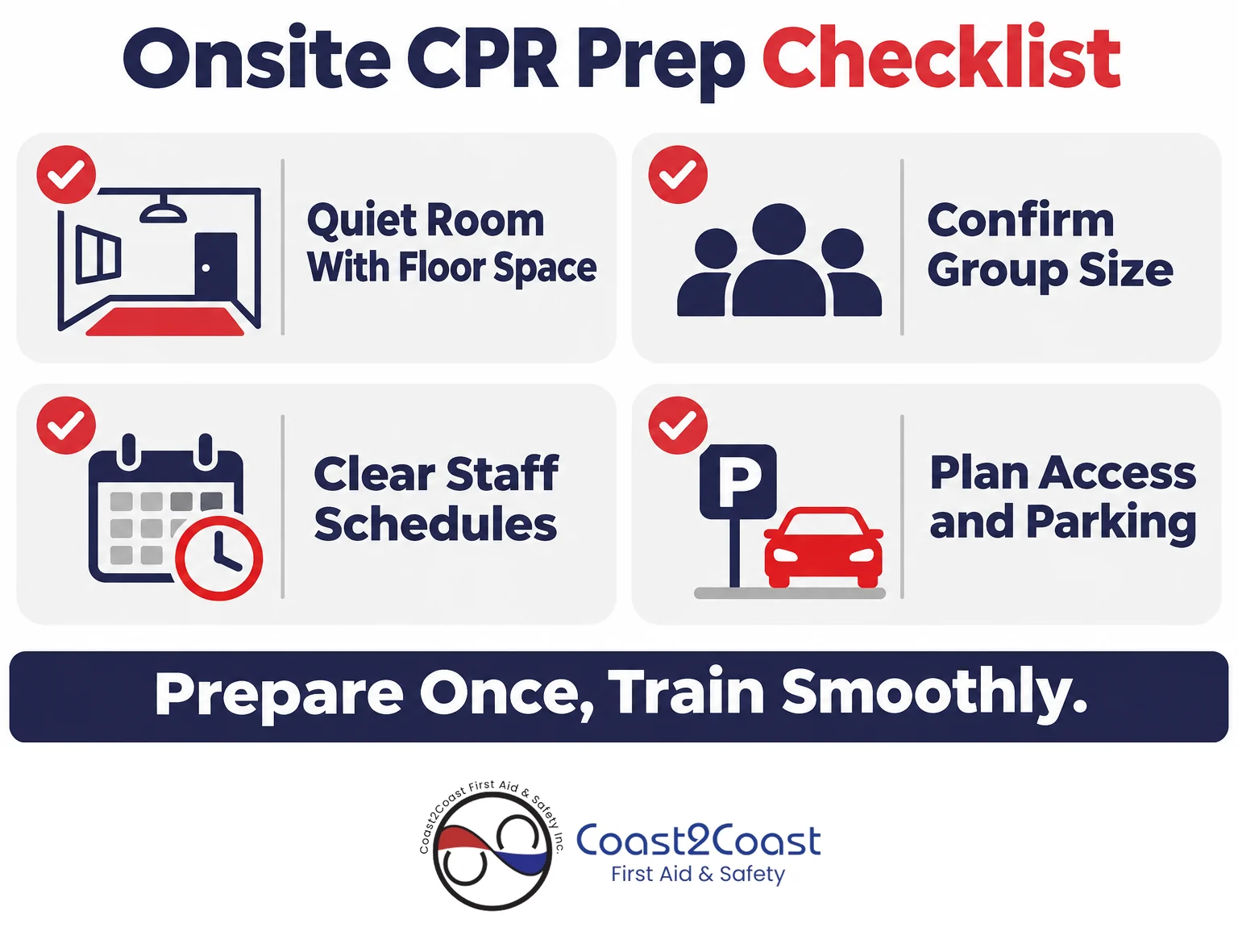
A little preparation helps the session run smoothly. Most of it is about people and space.
Start with the room. You need a space where everyone can sit and where small groups can kneel on the floor. A conference room with the table pushed to the side often works well. Make sure the room is quiet enough that learners can hear the instructor and the AED trainer prompts.
Next, confirm the attendee list and release people from their normal duties. Employees who are answering phones or covering a counter cannot practise properly. If the session is during working hours, tell managers in advance and arrange coverage for the rest of the workplace.
Think about accessibility. Some employees may have limited mobility or may not be able to kneel on the floor. Let the provider know in advance so that stations can be adapted, for example by raising the manikins on tables. Everyone should be able to participate fully.
Gather your emergency plan. If your workplace has an AED, an emergency action plan or first aid kits, tell the instructor and walk through them together at the end of the class. Employees will remember the location of equipment better if they see it during training.
Finally, tell employees what to expect. They should wear comfortable clothes and know that no medical background is required. A short message beforehand reduces nerves and increases participation.
Get Your Team Certified Together
Private group courses cover first aid, CPR and AED for teams of any size.
How Big Can an Onsite CPR Training Group Be?
Group size depends on the instructor, the course and the space. Hands-on skills need equipment, and each learner should have plenty of time with a manikin and an AED trainer. If too many people share one manikin, practice time drops and learning suffers.
Providers usually set a maximum number of learners per session based on the number of manikins and instructors. If your team is larger than one class can handle, there are simple options: split the group across two sessions, or ask about adding a second instructor so two groups can train at the same time. Some employers schedule a morning and an afternoon session on the same day.
Smaller groups are not a problem. A team of five or six can still book onsite CPR training, and many small businesses do. The advantage is that everyone receives the same instruction and the same documentation, and you avoid the trouble of coordinating individual classes.
If you are not sure how many people to enrol, think about coverage. How many certified responders do you want on each shift, in each building and on each floor? Many employers train more people than the minimum so that someone is always available despite vacations, sick days and turnover.
Know What to Do Before Help Arrives
CPR/AED training builds the muscle memory that reading alone cannot.
How Do You Make Sure the Training Sticks?
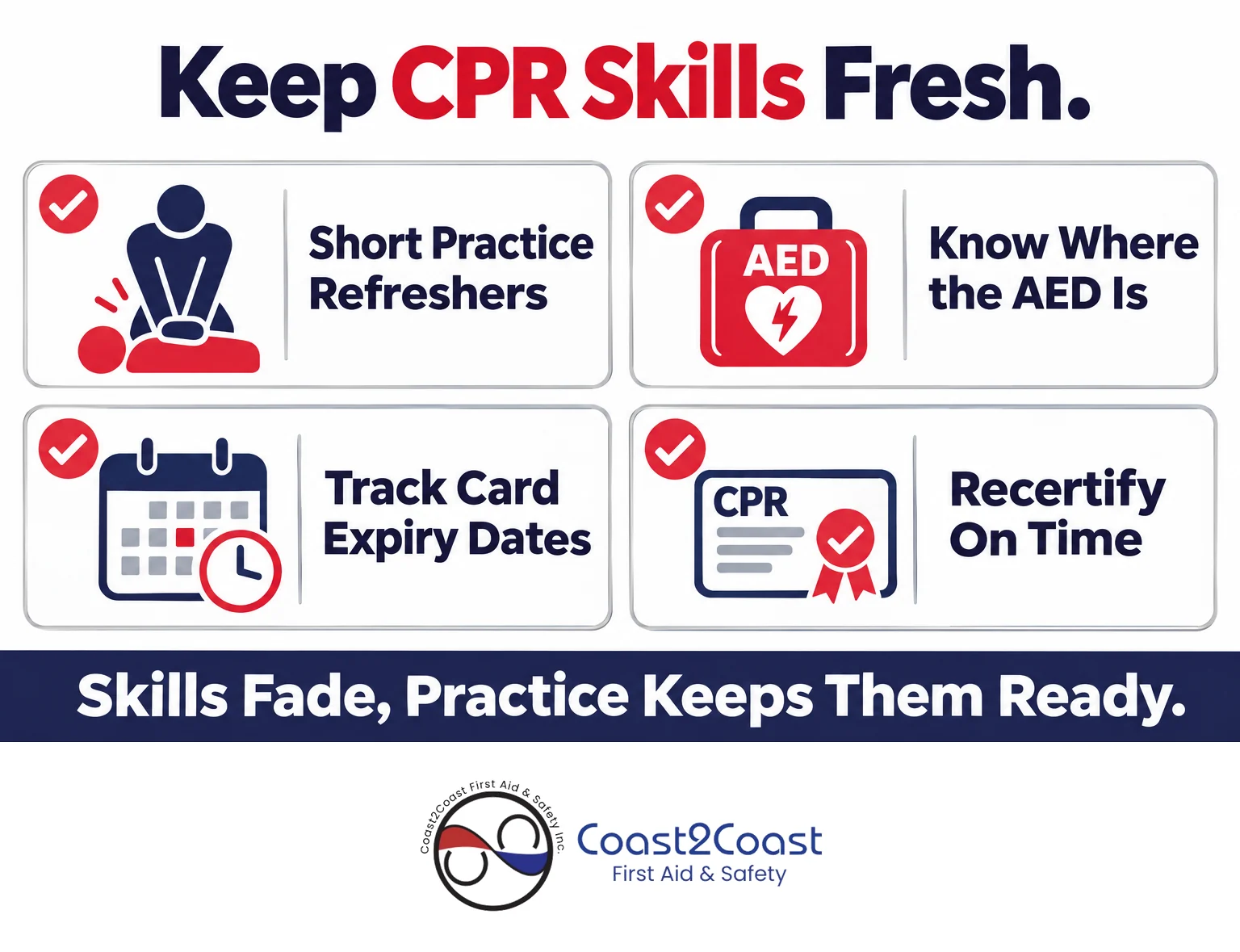
CPR skills fade without practice, and research on rescuers shows that compression quality declines within months after training. A single class is a strong start, but a few simple habits help the skills last.
Hold short refresher drills. A ten-minute practice session every few months, using a manikin or just a pillow, reminds people of hand position, depth and rate. Pair the drill with a review of where the AED is located and who is responsible for calling 911.
Post the emergency plan. Display clear instructions near the AED, first aid kits and exits, along with a list of trained responders. Make sure new employees see it during onboarding.
Track card expiry dates. A simple spreadsheet with each employee’s name, course type, issue date and expiry date makes renewal easy to plan. Set a reminder at least 60 days before the earliest expiry and book a refresher session early. Many employers align renewals by certifying the whole group on the same day, so that every card expires together.
Include new hires. When staff join after the main session, add them to the next group or book a small catch-up class. Do not leave new employees uncertified for long, because turnover can quietly erode your coverage.
Finally, review incidents. If someone does need help at work, hold a short debrief afterwards to see what went well and what could improve. Treat it as learning, and make sure employees know that support is available after a stressful event.
Bring the Class to Your Workplace
Book a private group session and certify every employee in one visit.
Is Onsite CPR Training Right for Your Business?
Onsite CPR training suits most employers who have a group to certify, a space to teach in and a schedule that is hard to disrupt. If you need only one or two people trained, a public class may be simpler. If you have five or more, a group session is almost always more efficient.
Consider onsite training if you are onboarding a new team, preparing for an audit or insurance review, or recertifying a group whose cards expire around the same time. Consider a public class if you have only one or two employees to certify, or if your workplace has no space that suits a hands-on session.
It also helps to think about the long term. Because cards typically last two years, the group you train today will need renewal together. Planning a refresher session at the same time makes the cycle easier to manage and keeps your coverage steady.
If you operate in Southern California, our Los Angeles training page lists classes and private session options. For other locations, our private group training page explains how a session at your workplace works and how to request a quote.
Train Your Whole Team
Private group sessions for your workplace, with training scheduled around your team.
Key Takeaway
Onsite CPR training brings the class to your workplace, certifies your team together and lets the instructor use your real environment for practice. OSHA’s first aid standard expects trained responders when medical help is not in near proximity, which OSHA has long read as about 3 to 4 minutes for serious injuries. Choose CPR/AED for most employees and BLS for healthcare roles, prepare a room and an attendee list, track expiry dates and schedule refreshers so skills stay sharp.
Join 200,000+ Students Who Are Certified
Choose the course that fits your team and keep every employee prepared for an emergency.
Frequently Asked Questions: Onsite CPR Training 2026
Q1: What is onsite CPR training?
A: Onsite CPR training is a class taught at your workplace by a certified instructor who brings the manikins, AED trainers and course materials. Your employees learn chest compressions, AED use and choking relief hands-on, then complete a skills check. Everyone who passes receives a certification card, and the whole team is trained in one session instead of travelling to separate classes.
Q2: Is onsite CPR training the same as a public class?
A: Yes. The skills, practice and certification card are the same as in a public class. The difference is the location and the group. Your team trains together at your workplace, and the instructor can use your environment to make scenarios realistic. You still need a recognised course, so confirm that the card meets your employer, insurer or licensing requirements.
Q3: Does OSHA require CPR training for employees?
A: OSHA’s medical services and first aid standard, 29 CFR 1910.151, does not name CPR specifically. It requires trained first aid responders when a clinic or hospital is not in near proximity, which OSHA has long read as about 3 to 4 minutes for serious injuries. Training employees in CPR is allowed and common. Check your industry and state rules too.
Q4: How many employees should be trained in CPR?
A: There is no single number that fits every workplace. Think about coverage: how many trained people you want on each shift, in each building and on each floor. Many employers train more people than the minimum so that someone is always available despite vacations, sick days and turnover. Your hazards, layout and response times should guide the decision.
Q5: How long does onsite CPR training take?
A: It depends on the course. A CPR/AED class is typically a few hours, and a combined CPR, AED and first aid course takes longer. A BLS Provider class has its own schedule because it includes a skills test. Ask the provider for the exact length of the course you are considering, and plan the day so staff can focus without interruptions.
Q6: How many people can attend one onsite session?
A: Group size depends on the instructor, the course and the space, because every learner needs enough time on a manikin and AED trainer. Providers usually set a maximum per session. If your team is larger, split it across two sessions or ask about a second instructor. Small teams of five or six can book onsite training as well.
Q7: What do I need to provide for onsite CPR training?
A: You need a room where everyone can sit and where small groups can kneel on the floor, plus a screen or wall for slides if the course uses them. The instructor brings the manikins, AED trainers and materials. Release employees from their normal duties so they can participate, and let the provider know about any accessibility needs in advance.
More FAQs: OSHA, Costs, Group Size and Preparation
Q8: Which course should my employees take, CPR/AED or BLS?
A: Most workplaces choose a CPR/AED course, such as AHA Heartsaver CPR AED, because it suits people without medical training. Healthcare providers usually need BLS, which adds two-rescuer CPR, bag-valve mask ventilation and a skills test. Check what your licensing board or employer names, and ask the provider if you have a mixed group of clinical and non-clinical staff.
Q9: How long does a workplace CPR card last?
A: AHA CPR/AED and BLS cards are typically valid for two years, and American Red Cross CPR certificates are also valid for two years. Some employers or licensing boards set shorter cycles, so check your own requirements. Track each employee’s expiry date and book renewal early. Certifying a group on the same day aligns expiry dates and simplifies future planning.
Q10: Can employees complete CPR training online?
A: Not entirely. A valid CPR card requires hands-on practice with an instructor, so online-only courses are not accepted by most employers or licensing boards. Blended options exist, in which employees complete learning online and then attend a short in-person skills session. Confirm that your employer or insurer accepts the format before you book.
Q11: Do small businesses need onsite CPR training?
A: Not necessarily onsite, but small businesses often benefit from it. Even a team of five saves travel time and certifies everyone together. A public class may be simpler if only one or two people need training. Consider your hazards, the number of employees and how quickly emergency services could reach you when deciding how many people to train.
Q12: Does onsite CPR training include AED use?
A: Yes. Most workplace CPR courses include AED training. Learners practise using an AED trainer, which gives voice prompts like a real device, so they know what to expect. Many workplaces already have an AED mounted on a wall, and training removes the hesitation people feel when they have never seen one. Ask the provider to confirm the course includes it.
Q13: Can the instructor use our own AED and first aid kit?
A: Often. It is also a good idea. Walking through your real AED, first aid kits and emergency plan at the end of the class helps employees remember where equipment is located and how to use it. Tell the provider in advance, and make sure the equipment is accessible during the session.
Q14: How do I keep CPR skills fresh after training?
A: Practise regularly. Short ten-minute drills every few months remind employees of hand position, depth, rate and AED steps. Post the emergency plan near the AED, include new hires in the next class, and track card expiry dates so renewal is on time. Treat any real incident as a chance to review what went well.
Q15: Is onsite CPR training worth it for my business?
A: For most employers with a group to certify, yes. It reduces travel time, keeps the team together and lets the instructor tailor practice to your workplace. If only one or two people need certification, or you have no suitable space, a public class may be a better fit. Weigh the number of employees, your schedule and your risks.
Reviewed & Sourced
Reviewed by Coast2Coast Certified Lead CPR and AED Instructor.
Sources: U.S. Occupational Safety and Health Administration (OSHA), 29 CFR 1910.151 Medical services and first aid, and OSHA standard interpretation letter of February 5, 2007. U.S. Centers for Disease Control and Prevention (CDC), About Cardiac Arrest. Training standards referenced: American Heart Association Heartsaver and BLS Provider; American Red Cross CPR/AED.