What Is the Difference Between BLS vs CPR?
People use the terms BLS vs CPR as if they mean the same thing, and in daily conversation they often do. In practice, they describe two different levels of training. CPR stands for cardiopulmonary resuscitation, the set of chest compressions and rescue breaths used when someone’s heart or breathing has stopped. BLS stands for Basic Life Support, which includes CPR but wraps it inside a professional framework built for healthcare providers and other clinical responders.
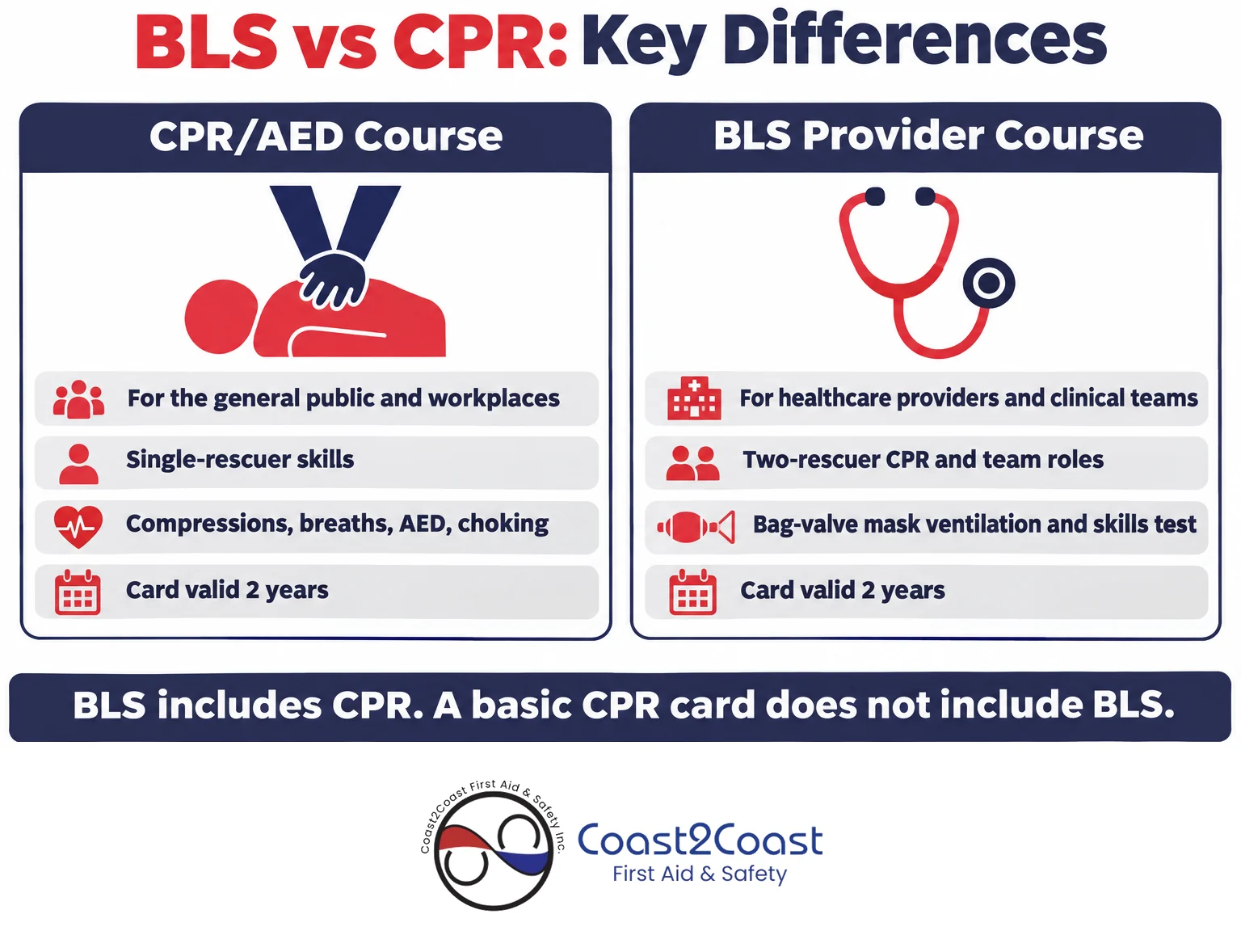
The simplest way to think about BLS vs CPR is this: all BLS training includes CPR, but not all CPR training is BLS. A CPR/AED course prepares a teacher, coach, office worker, parent or security guard to start compressions, use an automated external defibrillator (AED) and relieve choking until paramedics arrive. A BLS course takes the same skills and adds the things a nurse, paramedic, dental professional or medical assistant has to do on a clinical team, such as two-rescuer CPR, bag-valve mask ventilation, and clear role assignments during a resuscitation.
Cardiac arrest is common enough that the stakes are real: more than 356,000 people have an out-of-hospital cardiac arrest in the United States every year, according to the CDC. Whichever level you choose, the goal is the same.
The difference also shows up in how the courses are taught. A CPR/AED class is paced for people with no medical background and focuses on confidence and simple decisions. A BLS class assumes learners may already work in healthcare, moves faster, and tests skills against measurable standards such as compression depth, rate, chest recoil and ventilation timing.
Both levels are valuable, and neither is “better” in a general sense when you weigh BLS vs CPR on their own terms. The right choice depends on your job, your licence or school program, and who you are likely to help. The sections below break down what each course covers, who needs which one, and how to avoid paying for the wrong certification.
Coast2Coast First Aid and Safety teaches both. You can compare our Basic Life Support (BLS) courses and our CPR and AED courses side by side before you decide.
Get BLS Certified for Healthcare Roles
Basic Life Support training for healthcare providers and students, with team-based skills practice.
What Does a CPR/AED Course Cover?
A CPR/AED course, often called a layperson or community course, is designed for anyone who wants to be ready for an emergency. It is the most common choice for workplaces, schools, camps, fitness facilities, childcare programs, sports leagues and families.
A typical CPR/AED course covers these core skills:
- Recognizing an emergency: how to tell when someone is unresponsive and not breathing normally, and when to call 911.
- Chest compressions: hand position, depth and rate for adults, children and infants, delivered by a single rescuer.
- Rescue breaths: how to give breaths with a barrier device or pocket mask.
- AED use: turning the device on, placing pads, following prompts, and delivering a shock safely.
- Choking relief: back blows, abdominal thrusts and chest thrusts, depending on age.
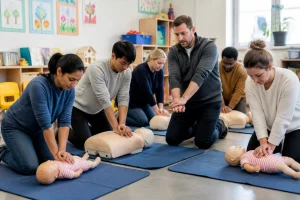
Courses are usually short, often three to four hours, and the focus is on simple, repeatable steps that anyone can remember under stress. Most programs also teach the basics of the chain of survival: early recognition, early CPR, early defibrillation and early advanced care.
A CPR/AED card is typically what a general employer, school district or sports organization means when it asks for “CPR certification.” It is also a good fit when your state or industry requires CPR for the public but does not specify a healthcare-provider course. If you also want broader injury and illness response, you can combine it with a first aid course. Our first aid courses pair CPR and AED skills with bleeding control, burns, fractures, and sudden illness.
Get Hands-On CPR and AED Practice
Work with real manikins and AED trainers while an instructor coaches your technique.
What Does BLS Training Cover?
BLS is the standard for healthcare providers and for anyone who responds as part of a professional team. The American Heart Association BLS Provider course is the version most commonly requested by hospitals, clinics, dental offices and nursing programs, and it is the one Coast2Coast First Aid and Safety teaches in California.
BLS includes everything in a CPR/AED course and then goes further, which is the heart of the BLS vs CPR distinction for most learners:
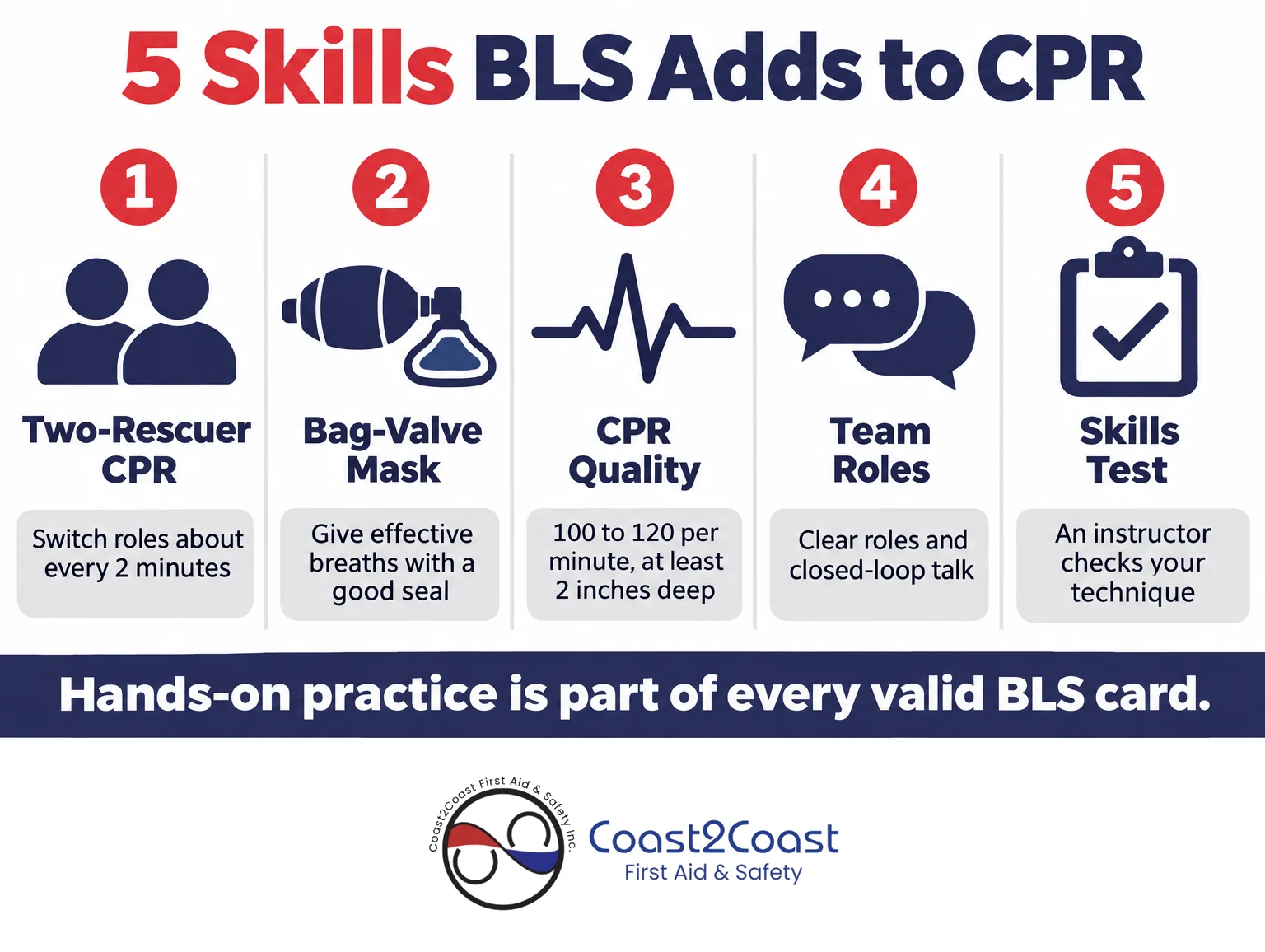
- Two-rescuer CPR: how two providers share compressions and ventilations, switch roles about every two minutes, and communicate clearly.
- Bag-valve mask ventilation: using a bag-valve mask (BVM) to give effective breaths, including the two-person technique that improves the seal.
- High-quality CPR metrics: compressing at 100 to 120 per minute, at least 2 inches deep in adults, allowing full chest recoil, and limiting interruptions.
- Team dynamics: assigning roles, closed-loop communication, and giving feedback during a resuscitation.
- Advanced airway considerations: how ventilation changes when an advanced airway is in place.
- Special situations: opioid-related emergencies, pregnancy, and drowning.
- Pediatric and infant differences: age-specific compression depth, ratios and techniques, including the 15:2 ratio used when two rescuers treat a child or infant.
BLS also requires a skills test in which an instructor watches you perform adult and infant CPR, use an AED and ventilate with a BVM. Many providers also complete a written exam. The extra depth is why a BLS course takes longer than a standard CPR/AED class and why employers in healthcare insist on it.
If you want the flexibility of online theory, blended options exist. In a blended BLS format, you complete the cognitive portion online and then finish a hands-on skills session in person. You still need the in-person skills check for a valid BLS card, and a card without one is unlikely to be accepted by a healthcare employer.
Learn CPR and AED Skills in a Real Classroom
Hands-on CPR/AED training for workplaces, schools, coaches and families.
Who Needs BLS and Who Needs CPR?
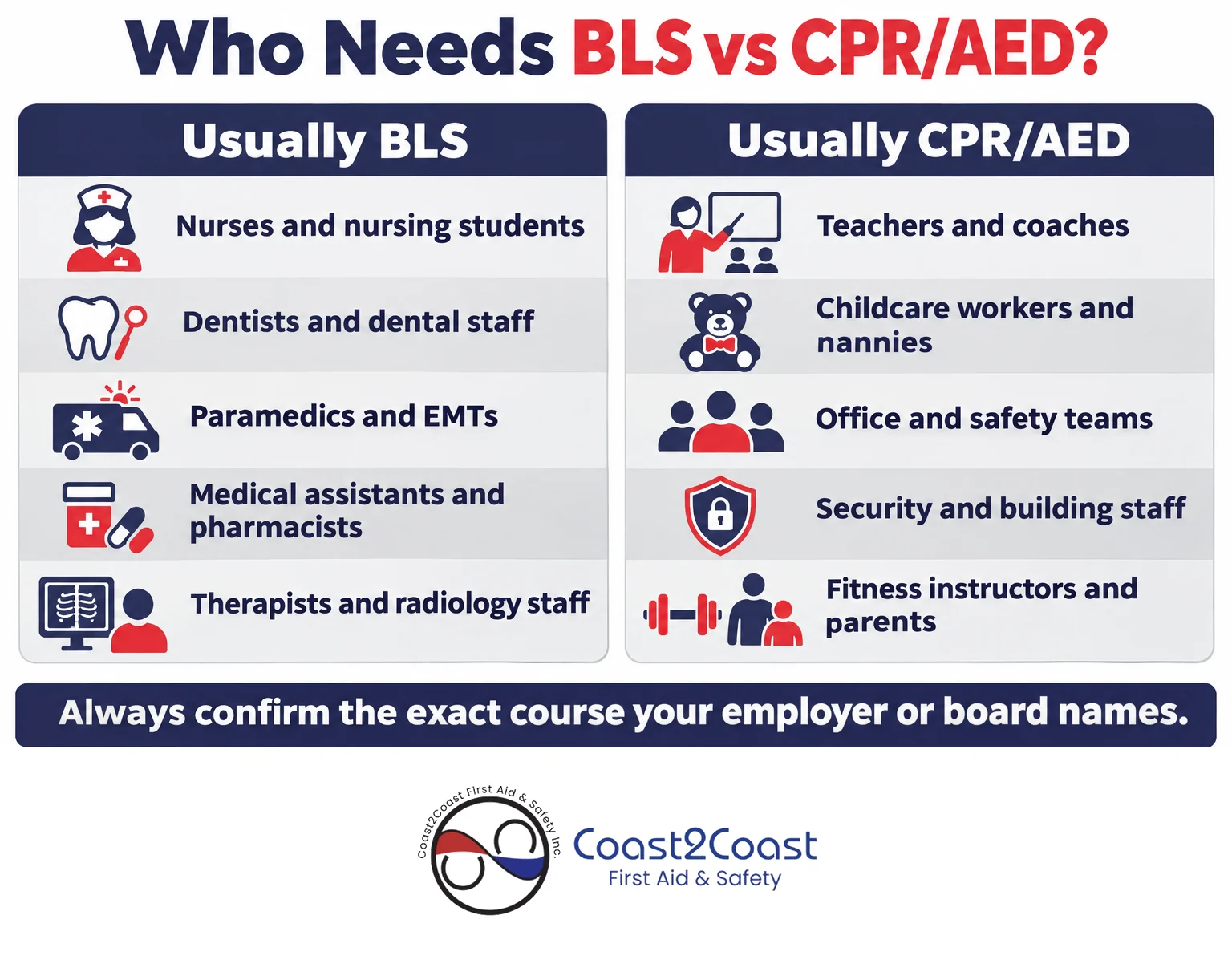
The fastest way to settle BLS vs CPR is to look at your role. As a rule of thumb, if you work in healthcare or provide care as part of a clinical team, you need BLS. If your role is general safety, childcare, education, fitness or workplace response, a CPR/AED course is usually enough.
People who usually need BLS:
- Nurses, nursing students and nurse practitioners
- Physicians, dentists and dental hygienists and assistants
- Paramedics, EMTs and other first responders
- Medical assistants, pharmacists and pharmacy technicians
- Physical therapists, respiratory therapists and radiology staff
- Lifeguards and others whose employers specify a professional-rescuer course
- Students entering health-science programs that require BLS before clinical placements
People who usually need a CPR/AED course:
- Teachers, coaches and youth program staff
- Childcare workers, babysitters and nannies (often with pediatric content)
- Office staff, safety teams and designated workplace responders
- Security guards, property managers and building staff
- Personal trainers and fitness instructors
- Parents, grandparents and other caregivers
There is a gray area. Some employers outside healthcare, such as large corporations with in-house clinics, fitness facilities with medical programs, or residential care communities for older adults, ask for BLS because their staff may work alongside clinical personnel. Others accept a standard CPR/AED card. The only reliable answer is the wording in your job posting, licensing board requirements or program handbook.
If you manage a team and are not sure which level fits each role, you can mix both in one visit. Our private group training lets you certify clinical staff in BLS and administrative staff in CPR/AED on the same day.
Train to the BLS Provider Standard
High-quality CPR, AED use and team resuscitation, practised hands-on.
How Do the Skills Differ in BLS vs CPR?
On the surface, compressions look the same in both courses. The difference in BLS vs CPR becomes clear when you look at what the responder is expected to do next.
Number of rescuers. A CPR/AED course trains you mainly as a single rescuer, or a small group of untrained helpers with one leading. BLS trains you to work as a coordinated two-rescuer team, switching positions on schedule and keeping interruptions as short as possible.
Breathing support. In CPR/AED training, you learn mouth-to-barrier or pocket-mask breaths. In BLS, you add the bag-valve mask, which is harder to use well and takes practice. Poor mask seal or too-fast ventilation can reduce the benefit of compressions, which is why BLS courses spend significant time on it.
Assessment. A CPR/AED course teaches a simple check: responsiveness, breathing, call 911, start compressions. BLS adds a pulse check of up to 10 seconds, performed at the same time as the breathing check, and structured decisions about when to start CPR.
Ratios and age groups. Both courses cover adult, child and infant techniques, but BLS emphasizes the 15:2 ratio for two rescuers on a child or infant and the use of the two-thumb encircling technique on infants.
Feedback and quality. BLS courses commonly use manikins with feedback devices that measure rate, depth and recoil. Learners are expected to meet the same targets used in hospitals.
Team communication. In BLS, you practice calling out roles, confirming orders and giving feedback during a resuscitation. This is a skill CPR/AED courses introduce only lightly.
Understanding BLS vs CPR in terms of skill level helps you avoid two common mistakes. The first is taking a CPR/AED class and then discovering your employer needed BLS. The second is taking BLS when a simpler course would have met your need and saved time.
Learn CPR and AED in a Real Classroom
Practise compressions, breaths and AED pad placement with a certified instructor.
How Long Do the Courses Take, and How Long Do They Last?
Course length varies by provider and format, but the pattern is consistent when you compare BLS vs CPR on time and cost. A standard CPR/AED course is shorter, often around three to four hours in a single session. A BLS Provider course is usually a little longer because it includes the skills test and extra content, though experienced providers can finish a renewal faster.
Card validity is the same for both in most programs. American Heart Association BLS Provider cards and Heartsaver CPR/AED cards are valid for two years. That means you need to renew before the expiration date to avoid repeating the full course. Many healthcare employers track expiration dates closely and will not allow staff to work clinical shifts with an expired BLS card.
A few practical tips on timing:
- Check the expiration date on your card as soon as you receive it and add a reminder to your calendar at the 90-day mark.
- Book your renewal early. Many providers allow renewal within a window before the card expires, and a renewal class is usually shorter than a first-time course.
- If your card has already lapsed, ask the provider whether you can still take a renewal class or must repeat the full course.
- Keep a digital copy of your card on your phone and give your employer a copy for your file.
Coast2Coast issues digital cards, so you can store and share yours easily. If you manage a team, build a simple tracker with each person’s course type and expiration date so renewals are spread across the year rather than all falling due in the same month.
Keep Your Certification Current
Recertification courses help you renew before your certificate expires.
Which Certification Do Employers and Licensing Boards Expect?
The honest answer is that it depends on the employer, the profession and the state. Healthcare employers nearly always specify BLS, and many name the American Heart Association BLS Provider course directly. Nursing, dental and allied-health programs often follow the same rule, and clinical placements may require proof of BLS before you start.
Outside healthcare, the expectations are looser. Schools, childcare programs, camps, gyms and workplaces often accept a CPR/AED card from a recognized provider. Some require pediatric content, such as infant and child CPR. In California, programs regulated under childcare rules look for specific pediatric CPR and first aid training, which is a separate topic from BLS vs CPR.
Here is how to confirm what you need before you pay for a course, because the BLS vs CPR question is settled by paperwork, not guesswork:
- Read the exact wording in the job posting, licence renewal instructions or student handbook.
- Ask the employer or program for the approved course name and provider in writing.
- Confirm whether blended learning with an in-person skills check is accepted.
- Confirm the required validity period, and whether a renewal class qualifies.
Be cautious about courses that promise instant certification without a hands-on skills check. Employers and boards often reject those cards because they do not prove you can perform compressions and ventilations correctly.
If you are unsure, it is usually safer to take the higher level of training. A BLS card typically satisfies a request for “CPR certification,” but a standard CPR/AED card does not satisfy a request for BLS. That said, paying for BLS when a basic course would do can waste time and money, so verify first.
Train Your Whole Team
Book a private group session so every employee is certified at the same time.
How Do You Choose Between BLS vs CPR?
When you strip away the jargon, choosing between BLS vs CPR is a three-question decision. It takes about two minutes, and it can save you from paying for a course your employer will not accept.
Question 1: Does your employer, licence or school program name BLS? If yes, take BLS. If the requirement says “healthcare provider CPR,” that also means BLS.
Question 2: Will you work on a clinical team or alongside medical staff? If yes, take BLS even when the paperwork says only “CPR.” You will use two-rescuer skills, the bag-valve mask and team communication on the job.
Question 3: Is your goal general preparedness, workplace compliance or a school or childcare requirement? If yes, a CPR/AED course is usually the right choice. Add pediatric content or first aid if you care for children or lead a team.
Once you have your answers, the BLS vs CPR choice is usually obvious. If you answered yes to question 1 or 2, book BLS. If you answered yes only to question 3, book CPR/AED. If you are not sure, contact your employer’s HR or safety lead before enrolling.
Local training also makes this easier. If you work or study in Southern California, our Los Angeles training page lists current class options, and you can ask the instructor which course fits your role before you book.
Employers also vary in how they treat BLS vs CPR cards from different providers. Some name one provider and refuse others, while some accept any recognized course with a hands-on skills check. Asking for the approved list early prevents a rejected card on your first day.
Finally, remember that certification is not the finish line. Skills fade without practice. Many responders benefit from a short refresher or hands-on practice session between renewals, and many workplaces run a short drill each year. The goal of BLS vs CPR training is the same: when someone collapses, you act quickly, correctly and calmly.
Get BLS Certified for Healthcare Roles
Basic Life Support training for healthcare providers and students, with team-based skills practice.
Key Takeaway
BLS vs CPR is a question of role and risk. A CPR/AED course gives everyday responders the compressions, breaths and AED skills they need, while BLS adds two-rescuer teamwork, bag-valve mask ventilation and performance standards for healthcare providers. Check the exact wording in your job, licence or program requirements, choose the higher level when you are unsure, and renew before your two-year card expires.
Join 200,000+ Students Who Are Certified
Choose the course that matches your role and build the confidence to act in an emergency.
Frequently Asked Questions: BLS vs CPR 2026
Q1: What is the main difference between BLS vs CPR?
A: CPR is the core skill of chest compressions and rescue breaths, while BLS is the healthcare-provider course that includes CPR plus two-rescuer teamwork, bag-valve mask ventilation and strict performance standards. A standard CPR/AED course suits teachers, coaches and office staff. BLS suits nurses, dental professionals, paramedics and anyone working on a clinical team who needs the more advanced training.
Q2: Is BLS the same as CPR?
A: No. BLS includes CPR, but it goes further. BLS adds two-rescuer CPR, bag-valve mask ventilation, team roles and a formal skills test, and it is written for healthcare providers. A standard CPR/AED course covers the basics for the general public. Many employers treat a BLS card as satisfying a general CPR requirement, but a basic CPR card does not satisfy a BLS requirement.
Q3: Do I need BLS or CPR for my job?
A: Check the wording in your job posting, licence rules or program handbook. If it names BLS or healthcare provider CPR, you need BLS. If it only asks for CPR or CPR and AED, a standard CPR/AED course usually works. When the wording is unclear, ask your employer or program in writing which course and provider they accept before you pay.
Q4: Do nurses need BLS or CPR?
A: Nurses typically need BLS. Hospitals, clinics and nursing programs almost always require a healthcare-provider course such as the American Heart Association BLS Provider card. A basic CPR/AED card is usually not accepted for clinical work because it does not include two-rescuer CPR, bag-valve mask use or the skills test, so confirm your employer’s exact requirement.
Q5: Does a BLS card count as CPR certification?
A: Usually, yes. A BLS card includes CPR and AED training, so many employers accept it when they ask for general CPR certification. The reverse is not true. A standard CPR/AED card generally does not meet a BLS requirement. If you are unsure which your employer wants, taking BLS is the safer choice, though you should confirm first.
Q6: How long is a BLS or CPR certification valid?
A: American Heart Association BLS Provider cards and Heartsaver CPR/AED cards are valid for two years. You need to renew before the expiration date, and many healthcare employers will not let you work clinical shifts with an expired BLS card. Check your card when you receive it, set a reminder 90 days before it expires, and book renewal early.
Q7: Can I take BLS or CPR classes online?
A: Only partly. Blended courses let you finish the theory online, but you still need an in-person skills session where an instructor checks your compressions, AED use and, for BLS, bag-valve mask ventilation. Employers and licensing boards often reject cards issued without a hands-on skills check, so confirm that blended learning is accepted before you enroll.
More FAQs: BLS Certification, CPR/AED Courses and Renewals
Q8: How long does a BLS course take compared with a CPR course?
A: A standard CPR/AED course often takes around three to four hours in one session. A BLS Provider course is usually somewhat longer because it covers two-rescuer CPR, bag-valve mask practice and a skills test, though a renewal class is typically shorter than a first-time course. Exact times vary by provider, group size and whether you choose a blended format.
Q9: What skills does BLS include that CPR does not?
A: BLS adds two-rescuer CPR with role switching, bag-valve mask ventilation, a pulse check of up to 10 seconds, the 15:2 ratio for two rescuers on children and infants, team communication, and measurable performance targets for rate, depth and recoil. Some programs also cover advanced airway considerations and opioid-related emergencies. These skills match what healthcare teams actually do.
Q10: Is BLS harder than CPR?
A: BLS is more detailed, but it is not out of reach. The core compression skills are the same, and BLS adds ventilation with a bag-valve mask, team roles and a skills test. Most learners find the mask technique and the two-rescuer timing take the most practice, which is why an instructor with feedback manikins makes a big difference.
Q11: Do teachers and coaches need BLS or CPR?
A: Teachers, coaches and youth program staff usually need a standard CPR/AED course, often with pediatric content. Some districts and leagues name a specific provider, such as the American Heart Association or the American Red Cross, so check your employer’s policy. BLS is typically not required unless you also work in a clinical or athletic training role.
Q12: Do dental professionals need BLS or CPR?
A: Dentists, hygienists and dental assistants are usually expected to hold BLS. Many dental offices and licensing rules specify a healthcare-provider course with hands-on skills, and some require it for licence renewal. Confirm the exact requirement with your employer or licensing board, because the accepted provider and validity period can vary.
Q13: Can I renew BLS before it expires?
A: Yes. You should. Most providers allow a renewal class within a window before the card expires, and a renewal class is usually shorter and less costly than the first-time course. If your card has already lapsed, ask the provider whether you can still take a renewal or must repeat the full course, because policies differ.
Q14: What if my employer only says CPR certification?
A: Ask in writing which course and provider they accept. For many employers outside healthcare, a standard CPR/AED course from a recognized provider is enough. For clinical or regulated roles, they may mean BLS. If you cannot get a clear answer, BLS is usually the safer choice because it normally satisfies both requests, though it may take longer.
Q15: Should I take BLS or CPR if I am not sure?
A: Verify first, since that avoids wasted time and money. If you cannot confirm the requirement, BLS is the safer option because it includes CPR and AED training and typically satisfies both requests. If your goal is simply to be ready to help at work, school or home and no one requires BLS, a standard CPR/AED course is a practical choice.
Reviewed & Sourced
Reviewed by Coast2Coast Certified Lead CPR and AED Instructor.
Source: Centers for Disease Control and Prevention (CDC), About Cardiac Arrest. Training standards referenced: American Heart Association BLS Provider and Heartsaver CPR AED courses.