
If you work in a California preschool or childcare setting, staying on top of your certifications isn’t optional. It’s the law. This article breaks down exactly how often California preschool teachers must renew CPR and first aid, the difference between one-time and ongoing training requirements, and what happens when you let a certification lapse.
Key Takeaways
- California preschool teachers must renew their pediatric CPR and first aid certification every 2 years to remain compliant with state licensing and employer policies.
- The EMSA-approved Preventive Health and Safety (PH&S) course is generally a one-time requirement, while CPR and first aid must be kept current at all times.
- CPR, AED, and pediatric first aid cards typically show a 2-year expiration date. Once the certification expires, staff are out of compliance until they complete the 8-hour Pediatric CPR and First Aid course again.
- Requirements can vary by preschool program, school district, or childcare license type, so educators should always confirm specifics with their administrator or licensing analyst.
- Starting January 1, 2026, pediatric first aid and CPR courses must include instruction on anaphylaxis prevention and epinephrine auto-injector use.
- Coast2Coast First Aid & Aquatics is an authorized provider delivering EMSA-approved Pediatric CPR & First Aid and AHA Heartsaver Pediatric training directly to California preschools, on the same 2-year cycle covered in this guide.
Overview: CPR and First Aid Requirements for California Preschool Teachers
Working with young children means being prepared for the unexpected. From choking incidents to allergic reactions, preschool teachers are frequently the first adults to respond when a child is in distress. That’s why California law specifically requires child care providers and staff at licensed childcare centers and family daycare homes to hold current CPR certification and aid certification focused on infants and children.
California Community Care Licensing (CCL), operating under the Department of Social Services, and the Emergency Medical Services Authority (EMSA) set the minimum health and safety training standards for licensed childcare settings. These standards are codified in California Health and Safety Code Section 1596.866, which outlines the required training for licensees and specified staff.
For clarity: “California preschool teachers” in this article refers to preschool and childcare staff, teachers, aides, and site supervisors, working with children under school age, not K-12 public school teachers. The CPR certification requirement and first aid training standards discussed here come from Community Care Licensing and EMSA, not the Commission on Teacher Credentialing, which governs K-12 teaching credential standards.
The key distinction every preschool educator should understand: pediatric CPR and first aid certification must be renewed every 2 years, while the EMSA Preventive Health and Safety course is normally a one-time requirement before employment or licensing. Both are essential, but they operate on very different timelines.
The Direct Answer: How Often Must Certification Be Renewed?
California preschool teachers must renew CPR certification and first aid certification every 2 years (24 months) from the issue date on their card. This is the direct, bottom-line answer.
Most recognized providers, including the American Heart Association, American Red Cross, and EMSA-approved training partners, issue pediatric CPR, AED, and first aid cards with a 2-year validity period. Under California Code of Regulations, Title 22, Division 9, Section 100000.17, pediatric first aid and pediatric CPR must be retrained at least every two years, and certification must remain “current at all times” for staff described in the law.
Many childcare licenses and preschool employers require staff to show proof that their CPR and first aid certification has not expired at any time while working with children. A lapsed card means the staff member is out of compliance with state regulations, no exceptions.
This is different from certain K-12 rules. While most school districts require teachers in public school settings to hold CPR certification, preschool and childcare rules come from Community Care Licensing and EMSA, not the teacher credentialing commission or the local school district. A commission-approved program for K-12 may have different renewal intervals, but for licensed preschool settings, the 2-year cycle is effectively mandatory because the certification itself expires every 24 months.
Even if the statute doesn’t spell out “every 2 years” in those exact words, the 2-year renewal is functionally required because no approved training provider issues a card valid for longer than 2 years in childcare settings.
Renew Your Whole Preschool Staff On-Site
Put your entire team on the same 2-year cycle with one group session at your center.
One-Time vs. Ongoing Training: Preventive Health vs. CPR and First Aid
California childcare law draws a clear line between EMSA-approved Preventive Health and Safety (PH&S) training and the ongoing CPR training and first aid training that must be renewed regularly.
The 8-hour Preventive Health and Safety course, which covers infectious disease prevention, childhood injury prevention, immunizations, childhood nutrition, and (since July 1, 2020) lead exposure prevention, is a one-time requirement. Upon successful completion, child care providers and licensees do not need to retake PH&S every 2 years under the licensing statute.
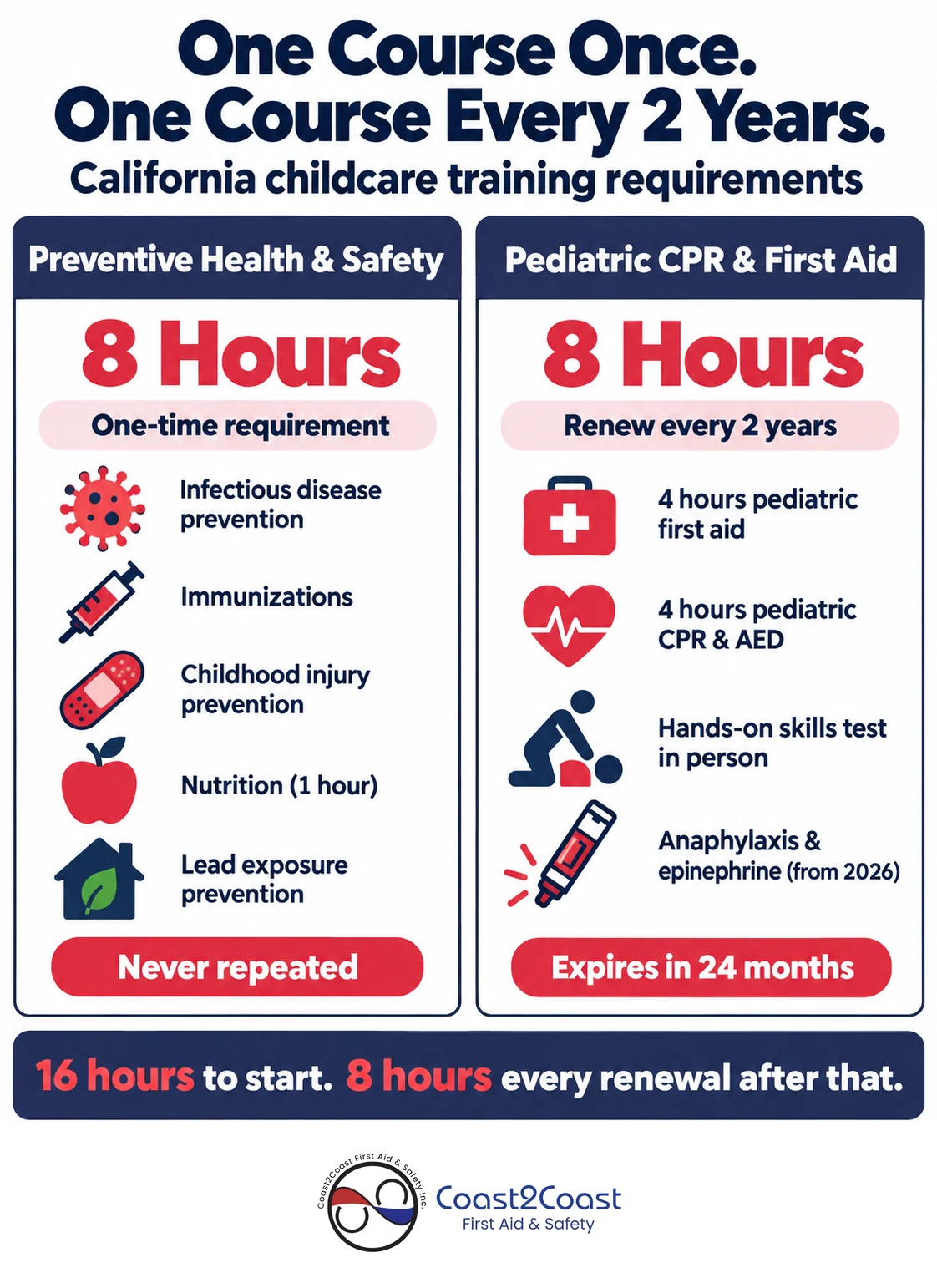
Pediatric CPR and first aid must be renewed every 2 years because those certifications expire and hands-on skills degrade without regular practice. Preschool administrators should maintain both records: proof of the one-time PH&S course and current CPR and first aid cards for each staff member. PH&S courses are offered by EMSA-approved training programs statewide, and the lead exposure portion follows the California Department of Public Health’s child care lead poisoning prevention curriculum. After the initial 16 hours of training, every renewal is only the 8-hour Pediatric CPR and First Aid course, since PH&S is never repeated. Dozens of PH&S and Pediatric CPR/First Aid training programs are currently approved statewide by EMSA.
What Kind of CPR and First Aid Certification Do California Preschools Need?
Preschool teachers must hold pediatric-focused CPR and first aid certification that specifically covers infants and children, not adult-only courses. EMSA requires “pediatric first aid and pediatric CPR” for licensed childcare providers, and certificates must come from EMSA-approved training programs, the American Red Cross, or the American Heart Association (including the AHA Heartsaver Pediatric course, which is recognized without needing a separate EMSA sticker).
Courses must cover adult, child, and infant scenarios to meet California requirements, with special emphasis on infant pediatric CPR skills like clearing airway obstructions and managing infant CPR emergencies. For most preschool roles, lay rescuer CPR with AED training and pediatric first aid is sufficient. An automated external defibrillator component is increasingly important because more California preschools and centers are installing AEDs on site.
BLS certification or full healthcare-provider-level basic life support is usually only needed for school nurses or clinical staff, not standard classroom teachers. CPR certifications and first aid certifications may appear on a combined card or on separate cards. Both must be current and recognized by licensing.
Starting January 1, 2026, all pediatric first aid and CPR courses must include instruction on prevention and treatment of anaphylaxis, including emergency use of epinephrine auto-injectors. Those whose current certificate didn’t include this content must update it at their next renewal.
Book EMSA-Approved Pediatric CPR & First Aid
The 8-hour renewal California licensing accepts, updated with 2026 anaphylaxis and epinephrine auto-injector training.
Understanding the 2-Year CPR Certification Renewal Cycle
The standard validity period for CPR, AED, and first aid certification cards used in childcare settings is 2 years. This applies regardless of which recognized provider issued the card.
Most pediatric CPR and first aid certification is typically valid for exactly 2 years to the day after the issue date printed on the CPR card or digital certificate. There is no automatic extension. Once a teacher’s certification expires, they are technically out of compliance and may not be counted as a qualified caregiver for ratio and supervision purposes.
Successfully completing CPR training resets the clock for another 24 months. To maintain certification, preschool staff should check the expiration date on their CPR and first aid cards regularly, add calendar reminders 60 to 90 days before the expiration date, and enroll in a CPR certification renewal or first aid renewal course before the card lapses.
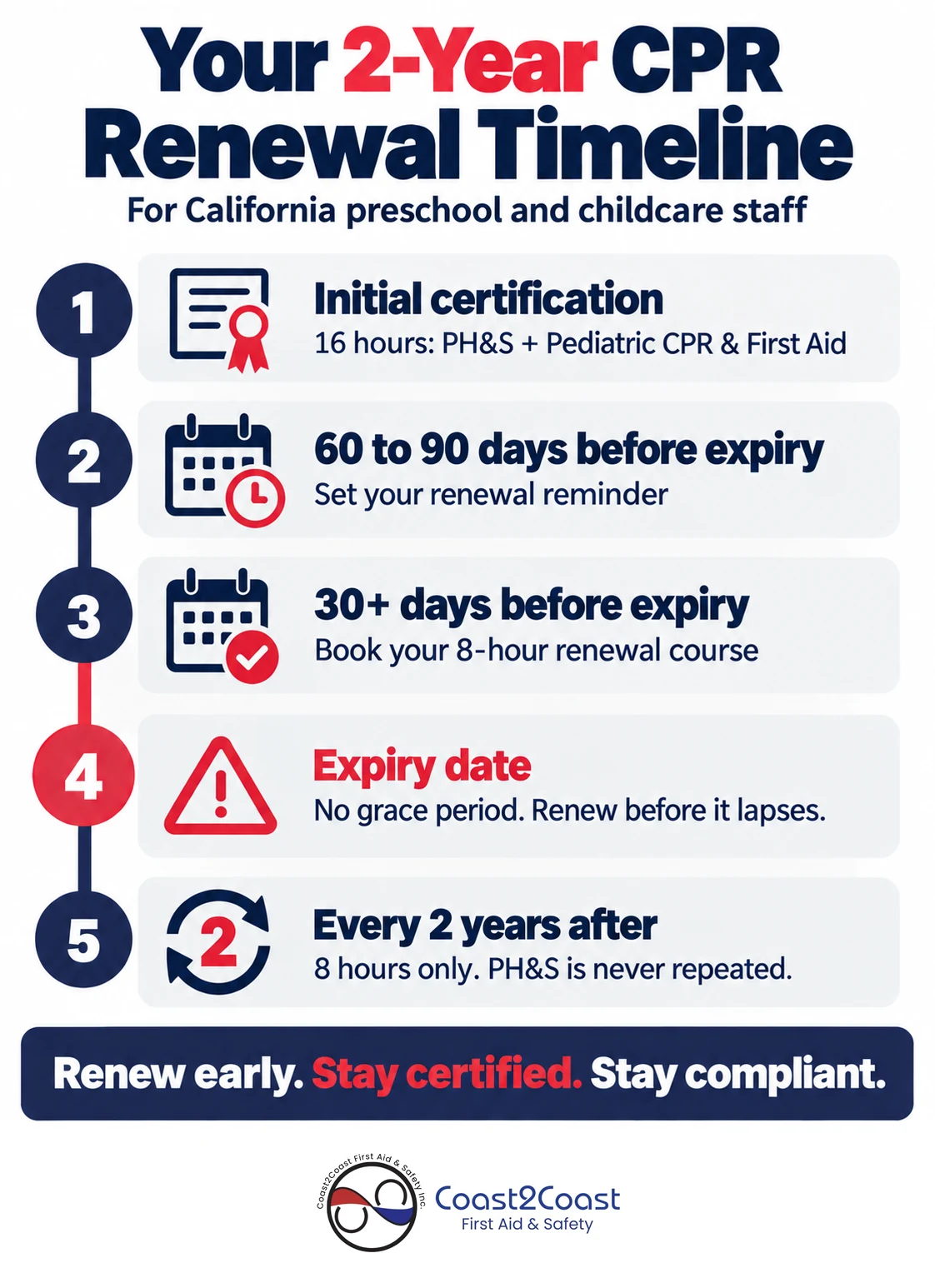
While some employers may allow a short internal grace period for scheduling reasons, state licensing typically considers the card invalid the day after expiration. The law does not provide a formal grace period for expired certification, meaning a CPR renewal should never be left to the last minute. The 2-year cycle also applies to teachers who hold current certification from out-of-state providers, though they should verify that their specific card is accepted by their California licensing analyst.
CPR, First Aid, and BLS: What’s the Difference for Preschool Settings?
CPR and first aid for childcare staff focus on pediatric emergencies, choking, allergic reactions, playground injuries, and basic first aid for common childhood incidents. A BLS certification is a more advanced basic life support course designed primarily for healthcare professionals who respond to cardiac and respiratory emergencies in clinical settings.
Preschool teachers almost always need pediatric CPR and first aid at the lay rescuer level, not full BLS certification, unless they also serve in a clinical health role. Both lay rescuer CPR and BLS certifications follow a 2-year renewal cycle, but the course content and skill expectations differ significantly. Teachers working in physical education roles at preschools still follow the same pediatric CPR and first aid standard. BLS is not required for typical childcare duties. Some preschools housed within hospitals or health systems may prefer staff to hold BLS in addition to pediatric first aid for internal policy reasons, but this is employer-specific and not a state licensing requirement.
See What Counts as Pediatric CPR
Make sure your course actually qualifies before you renew.
Blended Learning and Online Options for CPR Certification Renewal
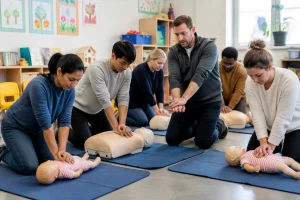
Many EMSA-approved providers now offer blended learning courses where the knowledge component, covering theory, protocols, and scenario recognition, is completed online, and the skills session is done in person.
For California preschool teachers, CPR and first aid certification usually cannot be completed 100% online. EMSA requires pediatric first aid and CPR to be taught in person, or as a hybrid with a live virtual lecture and in-person skills practice and testing. Recorded video can only supplement a live instructor. Online CPR courses that lack an in-person skills session are generally not accepted for childcare licensing. An in-person skills session with a hands-on skills assessment is required to validate competency in chest compressions, rescue breaths, and AED operation.
Blended learning does reduce classroom time, though. Teachers can complete online coursework and theory modules at their own pace, then attend a shorter in-person class for skills practice and evaluation. This format can be especially helpful for childcare centers operating long hours where scheduling full-day in-person classes is difficult.
Before enrolling in any CPR course or CPR classes, preschool teachers should verify that the course includes a proctored, in-person hands-on skills assessment, the training provider is EMSA-approved or an accepted American Red Cross / American Heart Association provider, the certification will be recognized by their licensing analyst and employer, and expert instructors will conduct the skills evaluation, not an automated system.
Directors may schedule group blended learning renewals on-site so their entire team stays on the same 2-year cycle. Coast2Coast First Aid & Aquatics offers mobile and on-site renewal sessions specifically for California childcare centers and preschool programs, so your whole staff can recertify together.
What Happens If CPR or First Aid Certification Expires?
Letting CPR or first aid certification expire can put both your employment status and your center’s childcare licensing compliance at risk. Under state regulations, there is no formal grace period. Once a card expires, the holder is no longer considered to have current certification.
Renewing is the same 8-hour course whether your card is current or expired. EMSA does not allow a shortened renewal class, so every time a childcare provider retakes pediatric first aid and CPR, it must include the full 4 hours of each. The upside is that the 8-hour Preventive Health and Safety course is never repeated, so after your initial 16 hours of training, each renewal takes half the time.
Employers may temporarily remove staff from unsupervised work with children or stop counting them in staff-to-child ratios until they regain valid CPR and first aid certification. At any licensed facility, at least one director, teacher, or licensee must have current pediatric CPR and first aid certification on site wherever children are present, including during off-site activities. An expired card can leave a facility out of compliance.
Legal liability concerns increase significantly if an incident occurs and no currently certified staff member is available to provide documented life saving care. What a lapse really costs is time on the floor. Until you complete the course again, you may not count toward staff-to-child ratios, and your center may be short a certified staff member on site.
The takeaway: enroll in your renewal course at least 30 days before expiration so there is never a gap in coverage.
How California Preschool Programs Can Stay on Top of Renewals
Managing renewals across an entire staff doesn’t have to be chaotic. Here’s how preschool directors can keep compliance airtight:
- Maintain a centralized tracking system (a spreadsheet, HR software, or even a physical binder) listing each staff member’s CPR, AED, and first aid certification issue and expiry dates.
- Send reminder notices 60 to 90 days before each teacher’s certification expires, with clear instructions on where and how to schedule renewal classes.
- Schedule on-site group renewal sessions every 2 years so most or all staff renew simultaneously.
- Keep copies (digital and hard copy) of all certifications for licensing visits and audits.
Partnering with an established training provider makes it easier to coordinate blended learning, on-site training, and recurring renewal dates. A reliable provider can also send automated reminders and keep records on your behalf. Consistency is everything. When one staff member’s card expires mid-year and another’s expires six months later, tracking gets complicated fast. Aligning renewal dates across your team eliminates that headache.
How Coast2Coast First Aid & Aquatics Supports California Preschool Renewals
Coast2Coast First Aid & Aquatics is an authorized provider delivering EMSA-approved Pediatric CPR & First Aid and AHA Heartsaver Pediatric training directly across California, on the same 2-year renewal cycle covered throughout this guide.
For preschool directors, we offer group blended learning renewals scheduled on-site so your entire team recertifies together, same-day digital certification issued upon successful completion, and reminder support to help you track each staff member’s expiry date well before the 2-year mark. If you’re unsure whether your current certification meets EMSA’s pediatric-specific standard, our team can confirm before you book your next renewal.
Why Renewing CPR and First Aid Matters for Preschool Safety
Preschool teachers are often the first responders when a child experiences choking, a cardiac emergency, a seizure, or a serious playground injury. The ability to deliver life saving assistance in those first critical minutes, before paramedics arrive, can be the difference between a scare and a tragedy.
Research shows that CPR skills, including the ability to perform effective chest compressions and deliver rescue breaths, can begin to degrade within 6 to 12 months after training, and without intervention, brain damage from a lack of oxygen can begin within 4 to 6 minutes. This is exactly why a 2-year renewal cycle is considered the maximum safe interval for most CPR certifications, not an arbitrary bureaucratic requirement.
Regular CPR certification renewal and first aid updates help staff stay aligned with current guidelines. Protocols for cardiopulmonary resuscitation evolve, compression depth recommendations, ventilation ratios for pediatric patients, and the role of AEDs in cardiac arrest scenarios have all been updated in recent years. Without hands-on practice and continuing education, teachers may default to outdated techniques during a real medical emergency.
Staying certified protects children, supports compliance with childcare regulations, and gives parents confidence in the preschool’s safety culture. It also reduces legal liability for the program and its staff.
Check Teacher-Specific CPR Requirements
K-12 and preschool rules aren’t the same. Know which applies to you.
Pediatric CPR and first aid certification expires every 2 years for California preschool staff, with no formal grace period. Preventive Health and Safety is a one-time course, so after the initial 16 hours of training, each renewal is only the 8-hour Pediatric CPR and First Aid course. Set a reminder 60 to 90 days before your card expires so there is never a gap in your certification and your center stays compliant.
Get Started with California Certification
Find the right course level and book with a 99.9% pass rate.
FAQs: CPR and First Aid Renewal for California Preschool Teachers
Q1: Do California preschool teachers have to renew CPR and First Aid every year?
A: No. Most pediatric CPR and first aid certifications in California are typically valid for 2 years, not 1 year, so annual renewal is usually not required. However, some employers may set stricter internal policies. Certain healthcare-related roles within a preschool, like a nurse employed by a school district, may hold BLS certification with its own renewal requirements, but standard childcare staff follow the 2-year cycle.
Q2: Can my CPR and First Aid renewal for preschool be completed entirely online?
A: Fully online CPR certifications without any in-person skills testing are generally not accepted for California childcare licensing, even if the knowledge portion is thorough. EMSA prohibits home-study-only formats for these courses. Preschool teachers should choose blended learning or in-person classes from EMSA-approved providers (or AHA Heartsaver Pediatric) that include a hands-on skills assessment.
Q3: Is Preventive Health and Safety training the same as CPR and First Aid?
A: No. Preventive Health and Safety (PH&S) training is a separate 8-hour course required for childcare staff and licensees. It covers topics like immunizations, illness prevention, safe sleep practices, nutrition, and lead poisoning prevention. PH&S does not replace pediatric CPR and first aid. Preschool teachers need both, with PH&S usually completed once and CPR and first aid renewed every 2 years.
More FAQs: Switching Employers and Renewal Timing
Q4: If I change preschools, do I need to retake my CPR and First Aid course?
A: As long as your CPR and first aid certification has not expired and comes from an EMSA-approved provider (or is a qualifying AHA Heartsaver Pediatric card), it generally remains valid when you move to a new preschool or childcare employer. Provide the new employer with copies of your current cards. Be prepared to take an additional course if the new program has stricter internal standards.
Q5: How early can I renew my CPR and First Aid certification for preschool work?
A: You can typically renew your CPR and first aid certification any time in the final few months of the 2-year cycle. The new card will usually extend another 2 years from the renewal completion date. Renewing 30 to 90 days before the expiration date is ideal. It avoids gaps in coverage and ensures continuous compliance with preschool licensing and employment requirements.
Reviewed By: Ashkon Pourheidary, B.Sc. Hons Neuroscience, Co-Founder of Coast2Coast First Aid & Aquatics and Canadian Red Cross Instructor Trainer since 2011.
Source: California Health and Safety Code Section 1596.866