
If you work in California child care, you have almost certainly seen ads promising an instant online CPR card that is “Title 22 accepted.” The pitch sounds perfect for anyone with a busy schedule: watch a few videos, pass a quiz, print your certification, done. But those cards are being rejected at licensing inspections across the state every single day. Here is exactly what the rules say, why 100% online childcare CPR certification does not meet them, and how to protect your license and every child in your care.
Key Takeaways
- California childcare providers cannot meet Title 22 or EMSA pediatric first aid and CPR certification requirements with a 100% online course. An in person, hands on skills assessment supervised by a live instructor is mandatory for every certification holder.
- The California Emergency Medical Services Authority (EMSA) and Community Care Licensing only accept EMSA approved training (or qualifying AHA Heartsaver Pediatric certification) that includes live, in person practice on manikins and AED trainers. Online-only certification is routinely flagged as a deficiency during inspections.
- Beware of websites advertising “instant online CPR cards” or claiming “no skills check needed.” These are considered “home study” under Health and Safety Code § 1596.866, which explicitly states that training under this section shall not be provided by a home study course.
- Blended learning is permitted, but only when the training clearly includes a scheduled in person skills session for cardiopulmonary resuscitation, choking relief, and automated external defibrillator use on a child.
- Coast2Coast First Aid & Aquatics is an authorized provider delivering EMSA-approved and AHA Heartsaver Pediatric CPR/first aid training and certification directly across California, always including the required in-person skills assessment.
What Does Title 22 Actually Require for Childcare CPR & First Aid?
The California Code of Regulations, Title 22, Division 12 is the rulebook that governs licensed child care centers and family child care homes, including every staff training and certification requirement that keeps a facility’s license in good standing. If you run or work at a licensed childcare facility, Title 22 is the regulation you answer to.
Title 22 incorporates pediatric first aid and CPR expectations that are further detailed and enforced through the California Emergency Medical Services Authority (EMSA) and the Department of Social Services (CDSS). The two agencies work together: EMSA sets the training and certification standards, and CDSS inspectors verify compliance during announced and unannounced visits.
Staff providing direct care to a child must have current pediatric CPR and first aid certification covering infants, each child, and adults, training from the American Red Cross, the American Heart Association, or an EMSA-approved provider, and course content and length that meet minimum EMSA training standards.
“Current” means unexpired. Certification is typically valid for two years, and an expired card can trigger a licensing citation during an inspection. Title 22 is not a suggestion or best-practice guideline. It is enforceable law tied directly to the Health and Safety Code, including sections 1596.866 and 1797.191. For a broader overview of California requirements, see this Complete Guide to CPR and First Aid Certification in California.
Why 100% Online CPR Certification Is Not Accepted for California Childcare
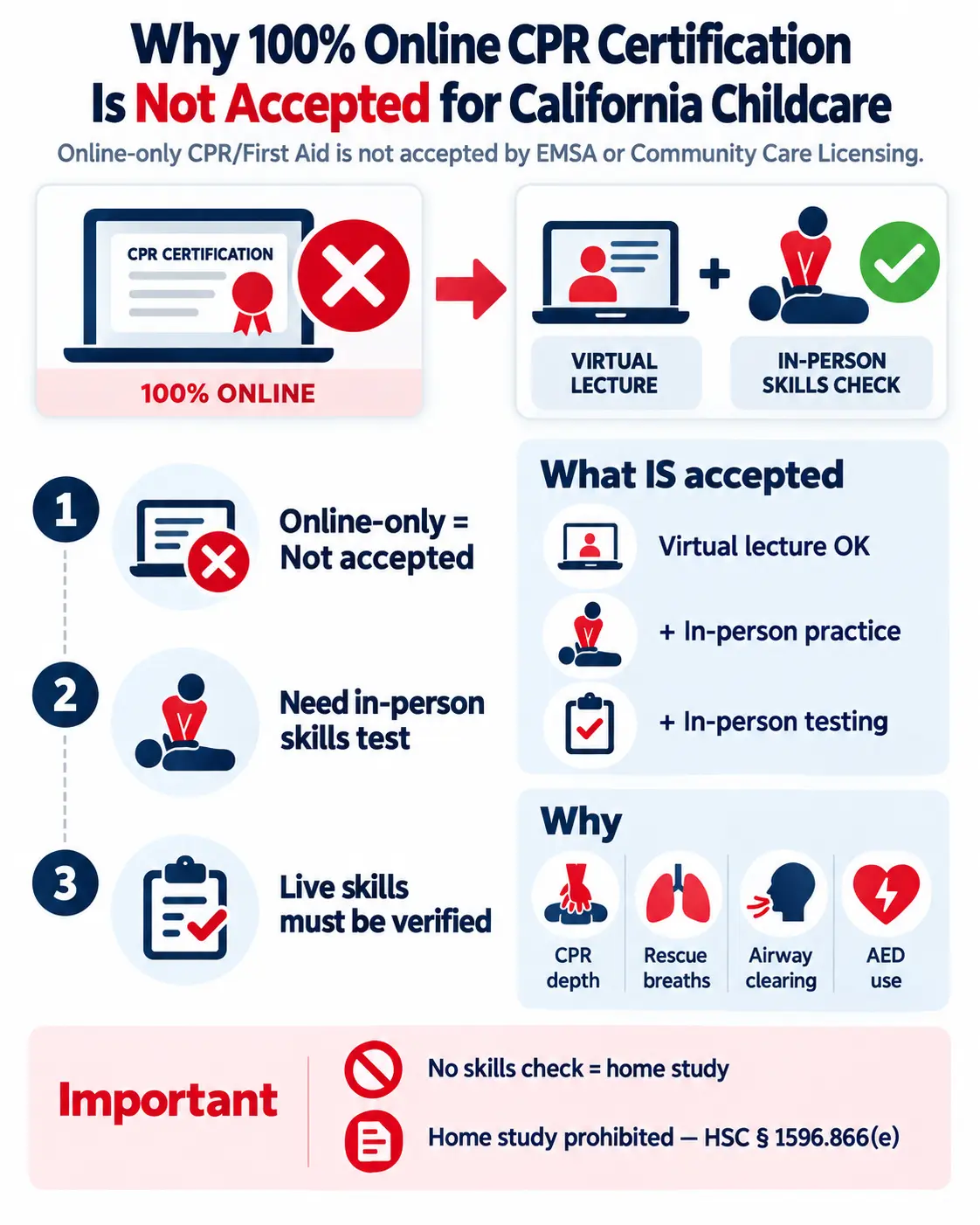
California childcare CPR and first aid certification completed entirely online, with no in person skills assessment, is not accepted by EMSA or Community Care Licensing. Period.
EMSA guidance on virtual training makes this explicit. For first aid and CPR training, virtual lecture components are acceptable only if they are paired with an in person skills practice and testing portion. A course delivered entirely through the internet, with no live instructor and no physical skill check, is classified as “home study,” which is expressly prohibited under Health and Safety Code § 1596.866(e).
Licensing staff and inspectors routinely reject “print your certification in minutes” online-only offerings during Title 22 compliance reviews. The problem is not online education itself. Plenty of excellent theory content can be delivered digitally. The problem is the absence of a live, instructor-verified skills check proving you can actually perform compressions at the correct depth on a child, deliver rescue breaths, clear an airway with abdominal thrusts, and operate an AED.
What Is EMSA and How Does It Connect to Title 22?
The California Emergency Medical Services Authority (EMSA) is the state agency that sets pediatric first aid and CPR training standards for child care providers. When Title 22 says your certification must come from an “approved” provider, it means approved by EMSA (or, for CPR specifically, AHA Heartsaver Pediatric as a recognized equivalent), not just any organization with a website and a logo.
EMSA’s core expectations for childcare provider training include a minimum of 8 hours of pediatric first aid and CPR training, childcare-specific content addressing infant CPR, CPR for a single child versus multiple children, and adult CPR scenarios, a hands on skills component supervised by a certified instructor, and reasonable group sizes so every participant gets individual skill correction.
EMSA maintains a current list of approved training providers on its official childcare provider page, and providers must renew their approval periodically. Before paying for any course marketed as “California childcare approved,” cross-check the provider against EMSA’s official list. If the provider is not listed, and it’s not a qualifying AHA Heartsaver Pediatric course, the certification will likely not survive an inspection.
Hands-On Skills Assessment: What California Expects You to Demonstrate
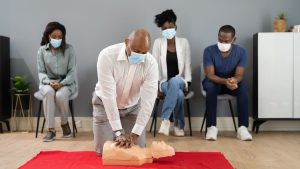
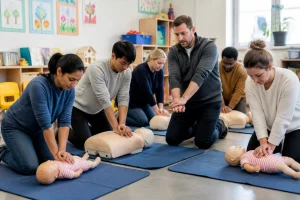
The hands on skills assessment is the non-negotiable part of childcare CPR training and certification. You must show an instructor, in person, that you can perform life saving skills correctly on a child. Multiple-choice questions alone cannot verify compression depth, hand placement, or whether you can actually keep a child alive.
Practical CPR skills to be demonstrated include correct hand placement and compression depth for infant, child, and adult CPR, rescue breaths using a barrier device, coordinated CPR with AED use, including pad placement on a small child, and choking relief using back blows and abdominal thrusts for different age groups.
Key first aid skills include controlling bleeding with direct pressure and wound packing, treating burns and managing shock, responding to diabetic emergencies, seizures, and allergic reactions in a child, and step by step response to head injuries and fractures.
Blended Learning vs. 100% Online: What’s the Difference for Childcare CPR Certification?
Blended learning is a training format where theory is learned online, but a separate, scheduled in person skills session is mandatory to complete the certification. It is not the same thing as a 100% online course.
In California, the key compliance question is not “online vs. classroom.” It is: does the training include a live, in person hands on skills assessment?
Some EMSA approved courses, and the AHA Heartsaver Pediatric certification, use blended learning. They allow participants to study pediatric first aid theory, watch instructional videos, and take knowledge quizzes from home. But every participant must then attend a physical skills lab with manikins and AED trainers before any certification is issued.
By contrast, a 100% online course delivers all content, tests, and certification through the internet with no skills appointment. These do not meet Title 22 or EMSA rules, no matter what the website claims. If a website says “no skills session,” “no in person class,” or “everything is online,” assume the certification will not be accepted for California childcare licensing.
Core Topics Covered in an EMSA-Approved Childcare First Aid & CPR Course
EMSA approved training is designed specifically around the risks faced in childcare settings, not generic adult workplace safety training. The curriculum reflects what a preschool teacher, daycare aide, or family childcare licensee is most likely to encounter with a child in their care.
CPR content typically includes infant CPR, child CPR, and adult CPR for one-rescuer and two-rescuer scenarios, breathing emergencies and rescue breathing, and safe, effective AED use tailored to a small child, including pediatric pad placement.
First aid course topics include bleeding control, burns, and head injuries, fractures, sprains, and common playground injuries a child might sustain, poisoning, allergic reactions, and asthma, and shock management and diabetic emergencies.
Childcare-specific training covers consent and emergency contact forms, documenting injuries and incidents, when to call 9-1-1 and how to coordinate with parents and emergency responders, and preventive health practices appropriate for group sizes typical in child care centers.
Training also covers practical, step by step responses to choking, seizures, and anaphylaxis in a child. Starting January 1, 2026, pediatric CPR and first aid training must also include instruction on anaphylaxis prevention and the emergency use of epinephrine auto-injectors.
Who in a California Childcare Setting Must Have Pediatric First Aid & CPR Certification?
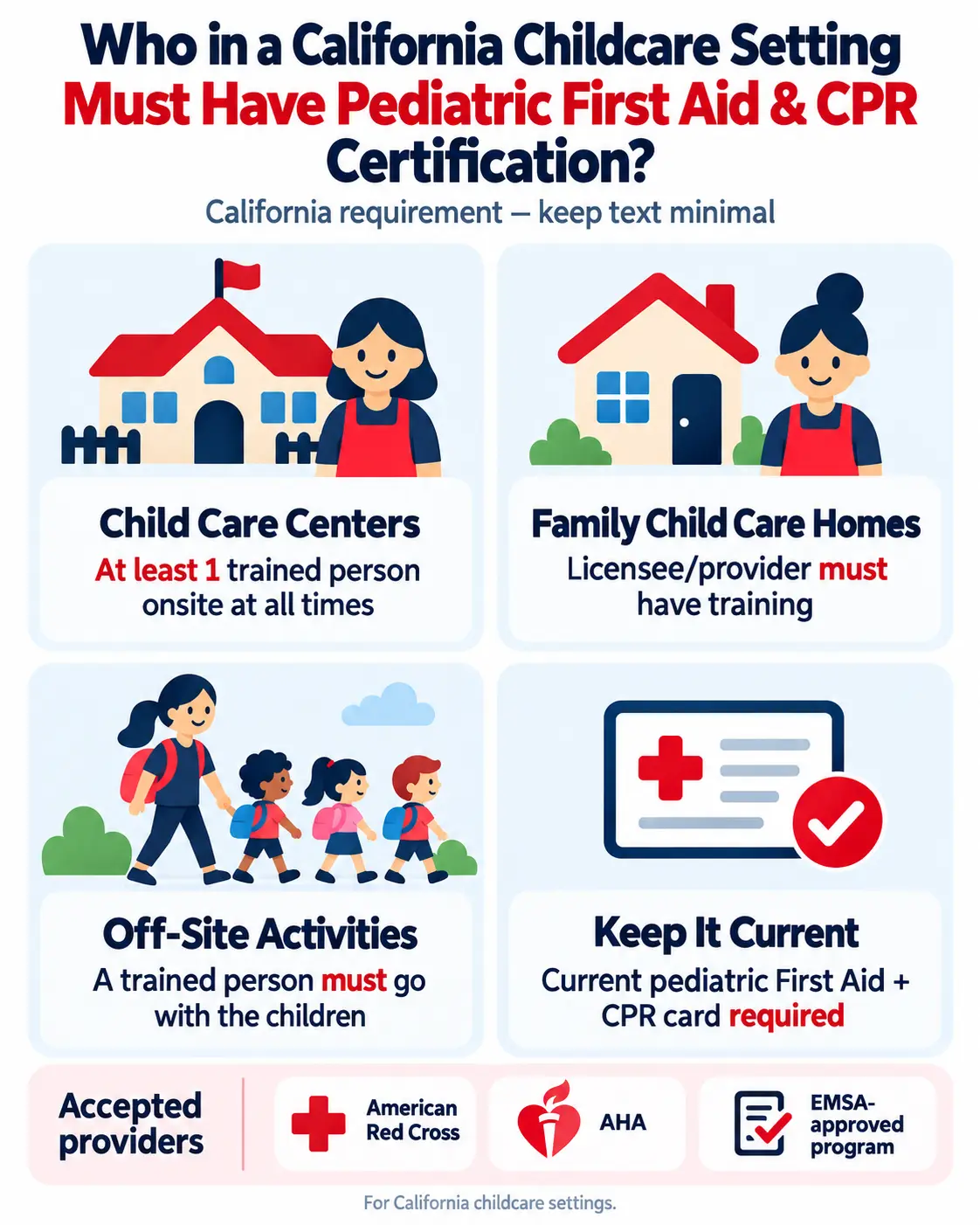
Title 22 does not limit first aid and CPR training and certification to directors alone. Frontline staff responsible for supervising a child must also hold current certification.
Roles that typically require current pediatric first aid and CPR certification include daycare providers and family child care home licensees, preschool staff, classroom aides, and assistants, before-school and after-school program staff supervising school age children, and any person licensed to provide direct care to a child.
At least one director or staff member with current pediatric CPR and first aid certification must be on site and immediately available at all times a child is present, including early drop-off and late pick-up hours. Off-site activities such as field trips or walks to the park also require a certified staff member to be physically present with each child.
Many employers and parents set stricter expectations than the minimum, requiring every staff member to hold current training and certification regardless of role. If you are a teacher wondering about your specific obligations, this guide on CPR Certification for Teachers in California breaks it down further. Healthcare providers working in childcare-adjacent roles should also confirm that their certification meets the childcare-specific EMSA standard rather than relying on general workplace compliance credentials.
How Long Does Training Take and How Often Must Certification Be Renewed?
California childcare pediatric first aid and CPR training is generally delivered as an 8-hour curriculum, commonly completed in a single day or split across a blended training format.
| Detail | Requirement |
|---|---|
| Minimum training hours | 8 hours focused on pediatric first aid and CPR |
| Certification validity | 2 years from the training date |
| Renewal method | Complete an EMSA-approved (or qualifying AHA) recertification training or full course before certification expires |
| Continuing education | Some providers offer shorter recertification training for holders of unexpired certification |
EMSA child care provider training must include enough classroom and hands on practice time to meet the health and safety competence standard. Successful completion means passing both the written exam and the in person skills demonstration.
Schedule renewal training 60 to 90 days before certification expiration to avoid gaps in coverage. An expired certification discovered during an unannounced inspection is a deficiency, even if you are “about to renew.” If your certification expires before you recertify, you may need to repeat the full training rather than an abbreviated renewal.
How to Avoid Online CPR Scams That Don’t Meet Title 22
Many websites advertise “California-approved” or “Title 22 compliant” CPR certification delivered 100% online, even though they are not EMSA approved and are regularly rejected by licensing inspectors. Some have faced real legal consequences: The People of the State of California v. National CPR Foundation LLC, filed in Santa Barbara County Superior Court, alleges the company’s online-only CPR certification program violated California’s false advertising and unfair competition laws. The case remains in active litigation, but it illustrates that this isn’t just an inconvenience, state authorities do pursue companies selling non-compliant online certification.
Red flags to watch for: promises of instant certification without skills testing, very short training duration (30 to 60 minutes total for first aid and CPR combined), no mention of EMSA or a recognized organization anywhere on the website, no information about instructor qualifications or in person locations, and language like “no class required” or “print your certification now.”
How to protect yourself: verify that the provider appears on EMSA’s official Child Care Provider training list (or is offering a genuine AHA Heartsaver Pediatric course), ask explicitly whether an in person hands on skills assessment is included, and document training details in staff files, provider name, EMSA approval number if available, and training format.
Step-by-Step: How to Choose a Compliant Pediatric First Aid & CPR Training Provider
Use this checklist before registering and paying for any training or certification.
Step 1: Confirm that you are a California childcare provider governed by Title 22. This includes licensed centers, family child care homes, and staff working directly with a child in any capacity.
Step 2: Visit EMSA’s Child Care Provider training web page and review the current list of approved pediatric first aid and CPR training providers, or confirm the course is a qualifying AHA Heartsaver Pediatric class.
Step 3: Contact one or two providers and ask specific questions: “Is your training EMSA-approved (or qualifying AHA Heartsaver Pediatric) for childcare?” “Does it include an in person hands on skills assessment?” “How many hours is the training?”
Step 4: Choose a training format, either fully in person or blended learning, that clearly includes classroom instruction plus a scheduled, instructor-led skills session with manikins and AED trainers.
Step 5: After successful completion, download or print your certification, verify the expiration date, and store copies in both personal and center records for Title 22 compliance. Your certification should list the issuing organization, completion date, and expiration date.
How Strong CPR & First Aid Training Improves Real-World Child Safety
Beyond meeting Title 22 rules, high-quality first aid and CPR training and certification directly affects whether a child survives cardiac arrest, a severe choking incident, or a serious injury. This is not about paperwork. It is about keeping every child safe.
Immediate CPR, properly performed on a child, can double or triple survival chances in out-of-hospital settings like daycares and preschools. Hands on practice builds muscle memory so that compressions, breaths, and AED use become automatic under stress instead of something staff must “remember from a video.”
Strong first aid training helps childcare professionals manage asthma attacks, allergic reactions, bleeding, and head injuries in a child quickly while waiting for EMS, limiting further harm. Knowing when and how to use first aid kits stocked at the facility can make the difference between a controlled situation and a chaotic one for a frightened child and their family.
How Coast2Coast First Aid & Aquatics Delivers Compliant Training in California
Coast2Coast First Aid & Aquatics is an authorized provider delivering EMSA-approved Pediatric First Aid & CPR training and AHA Heartsaver Pediatric certification directly across California, alongside our Canadian Red Cross training and certification programs across Canada.
Every course we deliver, whether fully in person or blended, includes the mandatory in person, hands on skills assessment for certification. Training covers adult, child, and infant CPR, AED use, and comprehensive first aid content with a focus on realistic, scenario-based practice that matches exactly what EMSA and Title 22 expect from childcare training.
The key message is universal: whether you’re in California or Canada, avoid 100% online-only CPR certification when the goal is to protect a child and meet regulated childcare standards. Required training for childcare roles demands more than a screen and a quiz. If you’re exploring options, our Complete Guide to CPR and First Aid Certification in California can help you understand what compliant training looks like before you register.
See the Full 16-Hour Training Breakdown
CPR/First Aid is only half of California’s licensing requirement.
Check If You Need an EMSA Sticker
Some cards need one, some don’t, know the difference before you book.
There is no 100% online path to California childcare CPR certification, ever. If a course skips the in-person, instructor-verified skills check, it will not survive a Title 22 inspection, no matter what the website promises. Blended learning is fine as long as the skills session is live and in person. Verify any provider against EMSA’s approved list, or confirm it’s a qualifying AHA Heartsaver Pediatric course, before you pay for anything.
Get Started with California Certification
Find the right course level and book with a 99% pass rate.
Frequently Asked Questions (FAQ)
Q1: Can I take the knowledge part of childcare CPR training online if I still attend an in-person skills session?
A: Yes. Some EMSA approved courses, and AHA Heartsaver Pediatric, offer a blended training format where lectures, videos, and written tests are completed online. However, your CPR and first aid certification is only valid if you also complete the scheduled, in person hands on skills assessment with a live instructor. From a Title 22 standpoint, the critical piece is the in person skills component, not whether the classroom theory was delivered online or on-site.
Q2: How do inspectors verify whether my CPR certification is acceptable under Title 22?
A: Community Care Licensing analysts typically examine the training title, provider name, issue and expiration dates, and any EMSA or recognized training organization logos (such as the American Red Cross or American Heart Association) on the certification. Inspectors may ask which format you took (in person vs. online) and can contact the training provider or EMSA if there is any doubt about the certification’s legitimacy. Having documentation of the training format and provider approval status in your staff file strengthens your position.
Q3: What happens if my childcare staff completed 100% online CPR certification by mistake?
A: During an inspection, online-only certification is likely to be cited as a deficiency because it does not meet EMSA and Title 22 requirements. Administrators should immediately enroll affected staff in EMSA-approved (or qualifying AHA Heartsaver Pediatric) training with a hands-on assessment and document all corrective actions taken. Keeping records of the new enrollment and completion dates helps demonstrate good faith during follow-up visits from licensing analysts.
More FAQs: Comparisons and Portability
Q4: Are workplace CPR courses for general employees the same as childcare CPR certification under Title 22?
A: No. General workplace CPR training may cover adult CPR, AED use, and basic first aid for general workplace compliance, but it is not automatically approved for California child care. Childcare providers should always look for “EMSA-approved Pediatric First Aid and CPR” training or “AHA Heartsaver Pediatric,” and confirm with the provider that the certification satisfies Title 22 childcare training requirements specifically.
Q5: Does every state in the U.S. ban 100% online CPR certification for childcare providers?
A: Requirements differ by state, but most jurisdictions require at least some hands-on CPR training for regulated childcare roles, even if they allow more flexibility for other occupations. Readers outside California should check with their own state licensing or health departments for specific rules. The underlying logic is the same everywhere: first aid and CPR skills for protecting a child cannot be verified through a screen alone.
Reviewed By: Ashkon Pourheidary, B.Sc. Hons Neuroscience, Co-Founder of Coast2Coast First Aid & Aquatics and Canadian Red Cross Instructor Trainer since 2011.
Source: California Health and Safety Code Section 1596.866