
Key Takeaways
- California Title 22 requires licensed childcare providers to hold current pediatric first aid and pediatric CPR certification from an approved source. Understanding the difference between an AHA Heartsaver Pediatric card and an EMSA-approved certificate can save you from licensing headaches.
- California EMSA-approved pediatric first aid and CPR certification is the gold standard for licensed childcare facilities. Not every CPR course or aid certification qualifies.
- AHA Heartsaver Pediatric First Aid CPR AED is accepted under Title 22 as a recognized equivalent. It’s one of the two accepted pathways alongside EMSA-approved training specifically, without needing an EMSA sticker.
- Childcare providers, preschool teachers, and daycare operators should always confirm acceptance with their licensing analyst or California Community Care Licensing before enrolling.
- Coast2Coast First Aid & Aquatics is an authorized provider delivering both EMSA-approved Pediatric First Aid & CPR and AHA Heartsaver Pediatric certification directly across California, so whichever pathway fits your situation, you can complete it with one provider.
Introduction: Why This Comparison Matters for Childcare Providers
If you work in a licensed childcare setting in California, holding the correct pediatric first aid and CPR AED certification is not optional. It’s a licensing requirement under California’s Title 22 regulations, enforced by Community Care Licensing, with training standards set by the California Emergency Medical Services Authority (EMSA). Without it, a center risks citations, fines, or closure.
Two certifications frequently come up in conversation: the AHA Heartsaver Pediatric First Aid CPR AED course offered by the American Heart Association, and the EMSA-approved Pediatric First Aid and CPR certification designed specifically for child care providers. They sound similar, cover overlapping content, and both involve cardiopulmonary resuscitation and automated external defibrillator training. But they’re governed by different organizations and serve different regulatory purposes.
This article answers a critical question: does an AHA Heartsaver Pediatric card satisfy California Title 22, or do you need something more? The short answer is that both pathways are valid, but you need to make sure you’re taking the specific pediatric version of each, not a generic adult or workplace course.
What Does Title 22 Require for Childcare CPR & First Aid?
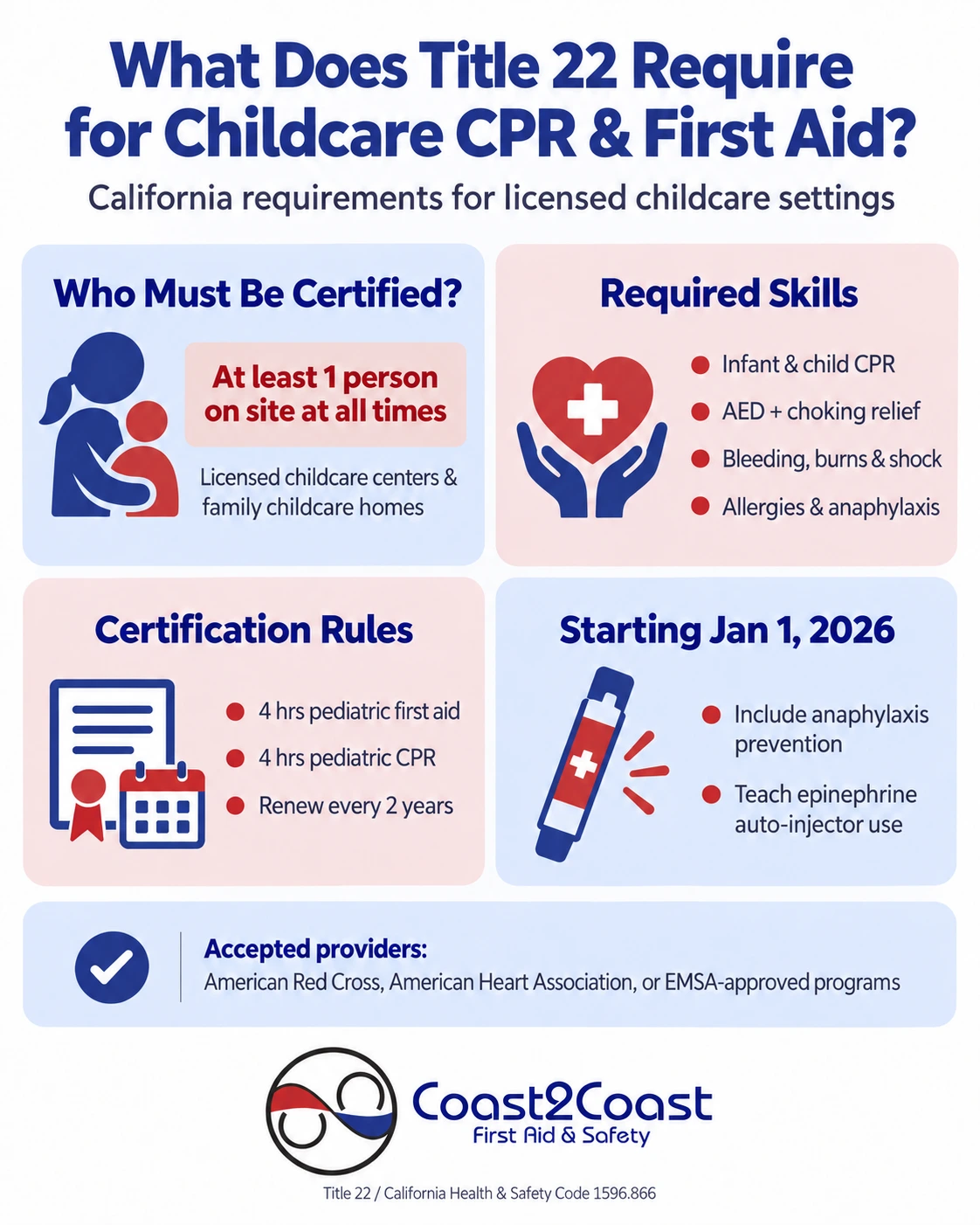
“Title 22” refers to the California Code of Regulations governing child care licensing, which sets health and safety training standards for licensed childcare centers and family childcare homes. Under California Health & Safety Code Section 1596.866, at least one person on site at all times must hold current pediatric first aid and pediatric CPR certification.
The required skills include:
- Infant CPR and child CPR techniques.
- AED use for pediatric emergencies.
- Choking relief for conscious and unconscious victims.
- First aid for bleeding, burns, shock, and common injuries.
- Recognition and management of allergic reactions and anaphylaxis.
- Basic life support concepts for medical emergencies.
These certifications must come from the American Red Cross, the American Heart Association, or a training program approved by EMSA. Initial courses must be at least eight hours total (four hours of pediatric first aid plus four hours of pediatric CPR), and certificates must be renewed every two years to remain valid.
Starting January 1, 2026, courses must also include prevention and treatment of anaphylaxis and the use of epinephrine auto-injectors.
Certify Your Whole Childcare Staff On-Site
Book one group session at your center so every teacher meets the same Title 22 pathway.
What Is EMSA-Approved Pediatric First Aid & CPR Certification?
EMSA is the California Emergency Medical Services Authority, the state agency that authorizes specific aid training programs to meet childcare licensing requirements. When you see “EMSA-approved” on a course listing, it means the provider has gone through a formal application process with EMSA, submitting curriculum details, instructor qualifications, and evaluation plans for review.
What makes a class EMSA-approved:
- Curriculum content aligned with EMSA pediatric standards.
- Minimum eight hours for initial certification (four hours first aid, four hours CPR).
- In-person hands-on practice for CPR, AED, and first aid skills.
- An instructor-to-student ratio of no more than 1:12 during skills practice.
- No fully online course format for initial childcare certification.
EMSA approval is program- and provider-specific. A training center might offer both EMSA-approved childcare programs and other programs that are not EMSA-approved, all under the same brand. Not all EMSA-approved courses are AHA courses either. Some are built on American Red Cross curriculum instead. The approval itself is valid for two years and must be renewed by the training program.
See What Counts as Pediatric CPR
Make sure your course actually qualifies before you book.
What Is AHA Heartsaver Pediatric First Aid CPR AED?
The American Heart Association is a widely recognized authority in CPR certification, emergency cardiovascular care, and evidence-based guidelines for resuscitation, developed with input from cardiology and emergency medicine experts. Its Heartsaver courses are among the most widely recognized in the country.
The Heartsaver Pediatric First Aid CPR AED course is designed for childcare providers, teachers, babysitters, and parents who need pediatric-focused first aid and CPR AED skills. It covers pediatric CPR for infants and children, including responding to cardiac arrest, AED training and proper AED use on pediatric patients, choking relief techniques, pediatric first aid for common illnesses and injuries (bleeding, burns, allergic reactions, breathing difficulties), and safety and prevention strategies for childcare environments.
Course format options include traditional classroom instruction (approximately four hours) and blended learning (roughly three hours of online theory plus about 2.25 hours of in-person skills session). On successful completion, participants receive a two-year completion card.
Book AHA Heartsaver Pediatric or EMSA-Approved CPR
Both Title 22 pathways, with hands-on infant and child skills testing and 2026 anaphylaxis training.
Does AHA Heartsaver Pediatric Automatically Meet EMSA / Title 22?
Here’s the nuance many childcare providers get tripped up on. AHA Heartsaver Pediatric First Aid CPR AED is formally recognized by California’s Emergency Medical Services Authority as equivalent to an EMSA-approved course. It’s specifically exempt from needing the EMSA sticker. But the course still needs to be the correct pediatric-specific version, not a generic adult Heartsaver CPR/AED or Heartsaver First Aid course.
AHA Heartsaver Pediatric vs EMSA Courses: Key Differences
| Aspect | AHA Heartsaver Pediatric | EMSA-Approved Pediatric First Aid & CPR |
|---|---|---|
| Regulatory role | AHA provides curriculum and certification; formally recognized as a Title 22 equivalent | EMSA approves which courses satisfy California childcare licensing directly |
| Sticker requirement | Exempt, no EMSA sticker needed | Requires the EMSA sticker on the completion card |
| Initial course length | ~4 hours classroom or ~5.25 hours blended | Minimum 8 hours (4 hours first aid + 4 hours CPR) |
| Course format | Classroom or blended (online + in-person skills) | In-person or hybrid; no fully online option |
| Certificate wording | “Heartsaver Pediatric First Aid CPR AED” | References EMSA or “Pediatric First Aid & CPR for Child Care Providers” |
| Skills testing | Required in both formats | Required; instructor-to-student ratio capped at 1:12 |
| Card validity | 2 years | 2 years |
| Anaphylaxis content (2026+) | Included in updated pediatric course | Mandatory under updated EMSA standards |
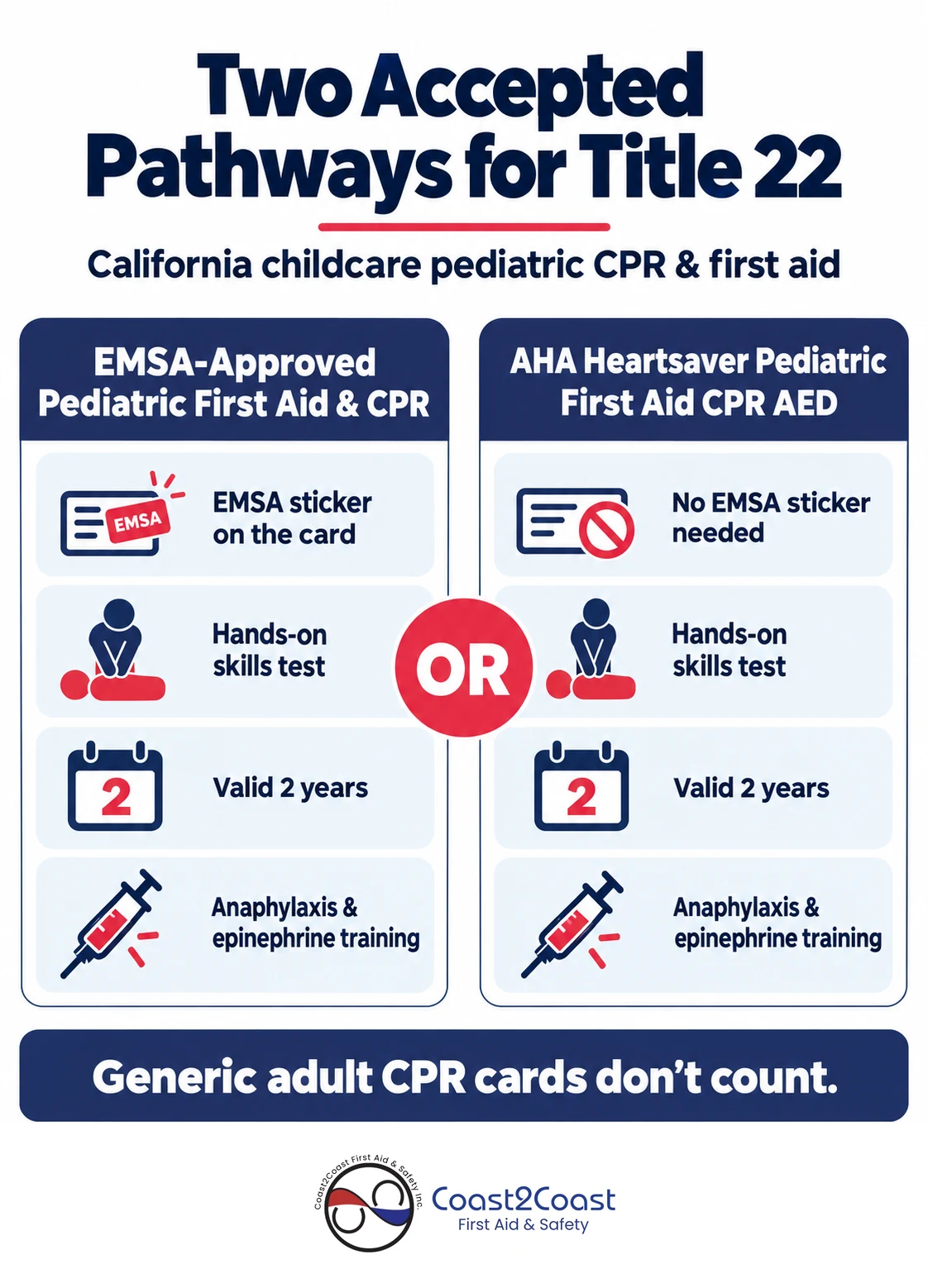
The critical takeaway: these are two different accepted pathways with different hour requirements and different documentation standards, not one course dressed up two ways. Make sure you’re booking the right one for your specific role and check that it’s the pediatric-specific version either way.
Which Certification Does Title 22 Accept for Childcare Providers?
Both. Title 22 accepts EMSA-approved Pediatric First Aid and CPR for childcare providers, and it separately accepts AHA Heartsaver Pediatric First Aid CPR AED as a recognized equivalent.
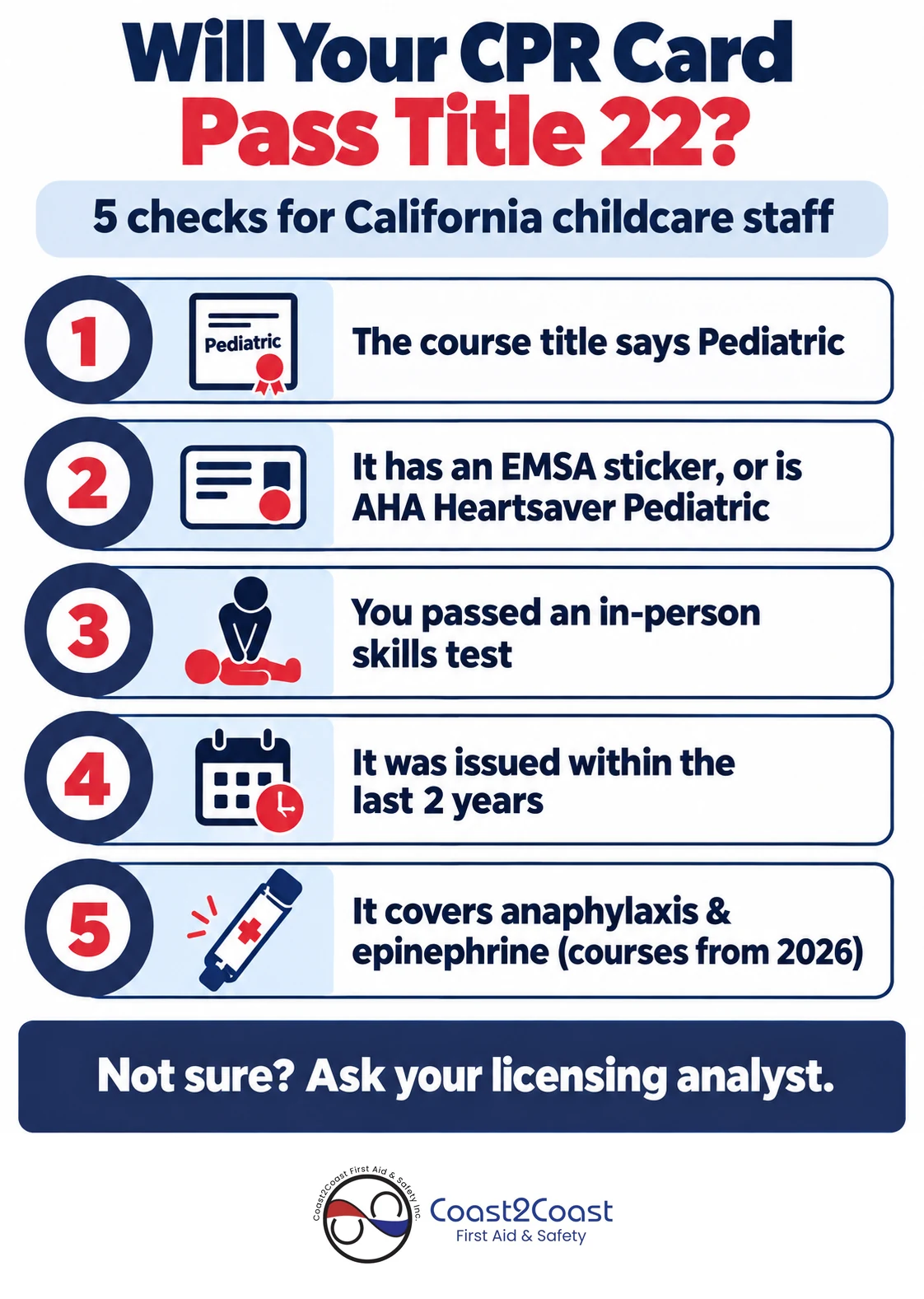
California Child Care Licensing looks for either the EMSA sticker and approval language, or the specific “Heartsaver Pediatric First Aid CPR AED” course title from AHA. A generic CPR AED card from another organization, or an adult-only workplace course, will not satisfy Title 22 regardless of which brand issued it.
If you’re an out-of-state or international learner planning to work in California childcare, you should deliberately choose one of these two pathways when scheduling your classes. A generic aid CPR AED card from another state or country will likely not satisfy Title 22.
How to Verify That a Course Is EMSA-Approved
Verifying approval before registering saves time, money, and licensing headaches. Check the EMSA website’s list of approved pediatric first aid and CPR training programs by organization name and region, or confirm the specific course title is “AHA Heartsaver Pediatric First Aid CPR AED.” Ask the training provider directly whether the class is EMSA-approved or the qualifying AHA course for California Title 22 childcare. Confirm that in-person skills practice is included, course length meets the applicable minimum, and the certificate validity period is two years. Check whether the course includes anaphylaxis and epinephrine auto-injector training, which is now required. If you already hold a card and are unsure, contact your local California Community Care Licensing office with a copy for verification.
Read Our EMSA Sticker Guide
When you need the sticker, and when an AHA card is enough.
Who Should Take Each Course Type?
California licensed childcare providers, including daycare staff, preschool teachers in licensed centers, and after-school childcare employees, generally must take either an EMSA-approved pediatric course or the AHA Heartsaver Pediatric course specifically. This is a non-negotiable licensing requirement.
Babysitters, nannies, parents, and K-12 school staff outside licensed childcare settings may choose AHA Heartsaver Pediatric, other Heartsaver courses, or similar first aid course options depending on employer requirements.
Healthcare providers such as RNs, EMTs, and paramedics typically need Basic Life Support certification or ACLS rather than EMSA childcare-specific training, though they may add pediatric first aid training if working closely with young children.
Course Format Options: In-Person, Blended, and Online
In-person classroom courses, whether EMSA-approved or AHA Heartsaver Pediatric, are instructor-led and include hands-on practice with manikins and AED trainers, giving participants experience with real-world scenarios such as a choking infant or a child in cardiac arrest. This format satisfies all requirements for both pathways.
Blended learning combines online theory with a required in-person skills session. AHA offers this for Heartsaver Pediatric, and some EMSA-approved providers use this model too. The key is that the in-person portion must cover CPR, AED skills, and first aid instruction with adequate time, and must be delivered by a provider recognized for that specific course.
Online-only CPR or first aid certification (no in-person testing) is generally not accepted for California childcare Title 22, even if the course advertises an “instant card” or “fast first aid course.” Both accepted pathways require skills demonstration with instructors present.
How Coast2Coast Delivers Both Options in California
Coast2Coast First Aid & Aquatics is an authorized provider delivering both EMSA-approved Pediatric First Aid & CPR and AHA Heartsaver Pediatric certification directly across California.
If you’re deciding between the two pathways, our team can help you confirm which one your specific employer or licensing analyst expects, and get you booked into the correct course rather than guessing. Whether your role calls for the 8-hour EMSA-approved course or the AHA Heartsaver Pediatric format, we deliver both with the mandatory hands-on skills session included.
If you hold a pediatric CPR certification from another state or country and plan to work in California childcare, it likely isn’t listed on EMSA’s approved programs for Title 22 compliance, but you don’t need to search for a separate California provider once you’re here: Coast2Coast can complete either the EMSA-approved course or the AHA Heartsaver Pediatric course for you directly.

North America's first AI-powered First Aid & CPR tutor, part of the Coast2Coast First Aid Student Companion app. Coasty explains First Aid, CPR/AED, BLS, and course concepts in simple language so you can review topics, take quizzes, and build confidence before, during, and after class. It works alongside your instructor and official Canadian Red Cross materials to support your learning.
Renewal, Recertification, and Keeping Skills Current
Regular recertification is not just a checkbox for licensing. It directly affects how well a person can respond to a real pediatric emergency. Skill decay is real, and refreshing your knowledge of CPR, first aid, and AED use keeps you ready to provide professional help when seconds matter.
Both EMSA-approved pediatric first aid and CPR and AHA Heartsaver Pediatric certifications remain valid for two years. After that, a renewal or full course is required, and under EMSA rules, renewal courses must still total at least eight hours for that specific pathway.
To stay in compliance, schedule recertification before your card expires to avoid licensing gaps, and consider informal practice or workplace drills every six to twelve months to maintain confidence between formal renewals.
Practical Steps to Choose the Right Pediatric CPR & First Aid Course
For California licensed childcare providers: confirm you’re in a Title 22-licensed role (daycare, licensed preschool, family childcare home), check whether your employer or licensing analyst has a preference between the EMSA-approved and AHA Heartsaver Pediatric pathways, ensure the course title mentions the pediatric-specific wording for whichever pathway you choose, confirm in-person skills practice is included, and verify the course covers anaphylaxis and epinephrine auto-injectors (required from January 2026).
For non-licensed caregivers, parents, and youth leaders: focus on reputable brands with hands-on practice and relevant pediatric content, and choose a first aid training course that matches your actual setting (home, school, camp).
Regardless of where you are, the well-being of the children in your care depends on having current, practical knowledge and the confidence to use it.
Title 22 accepts two distinct pathways: the 8-hour EMSA-approved Pediatric First Aid & CPR course, or the specific AHA Heartsaver Pediatric First Aid CPR AED course, exempt from the EMSA sticker but still requiring the pediatric-specific title and a real in-person skills check. Neither a generic adult CPR card nor a workplace-focused Heartsaver course satisfies the requirement. Confirm which pathway your employer expects, and book the correct one the first time.
Get Started with California Certification
Find the right course level and book with a 99.9% pass rate.
FAQ
Q1: Is an online-only AHA Heartsaver Pediatric course enough for California Title 22?
A: No. An online-only AHA Heartsaver Pediatric course with no in-person skills session is generally not acceptable for California childcare Title 22 compliance. Both accepted pathways require hands-on training and skills testing for CPR, AED, and first aid. If you choose a blended AHA course, the in-person portion must include a real skills check. A fully online “instant card” offering will not meet licensing requirements regardless of the brand behind it.
Q2: How can I tell if my current AHA Heartsaver Pediatric card is accepted for Title 22?
A: Check that the course title specifically says “Heartsaver Pediatric First Aid CPR AED,” not a general adult CPR/AED or Heartsaver First Aid card. If your card is the correct pediatric-specific version and included the required in-person skills session, it should be accepted without needing an EMSA sticker. If you’re still unsure, contact your California Community Care Licensing office with a copy of your card for verification.
Q3: Do school teachers in K-12 settings need EMSA-approved pediatric certification?
A: Requirements differ significantly. Many K-12 teachers are not subject to the same Title 22 childcare rules and may only need CPR AED or standard first aid certification depending on their school district’s policy. Check with your school district HR department or safety officer to confirm exactly which certification they require, as some districts have their own specific mandates.
More FAQs: Cross-Border and Ongoing Practice
Q4: Can I use a pediatric first aid certification from another state or country to work in California childcare?
A: Certifications from other states or countries may meet the standards where they were issued, but California EMSA does not generally list out-of-state or foreign training programs as approved for Title 22 childcare roles. If you’re relocating to California and plan to work in a licensed childcare setting, plan to complete either an EMSA-approved Pediatric First Aid and CPR course or an AHA Heartsaver Pediatric course after arrival. Confirm with your Community Care Licensing analyst before your start date.
Q5: How often should childcare providers refresh pediatric CPR and first aid skills even if the card is still valid?
A: While your certification is valid for two years, many safety experts recommend informal refreshers or practice sessions every six to twelve months. Skill retention for low-frequency but high-stakes events like pediatric cardiac arrest drops significantly without reinforcement. Combining formal recertification with periodic practice is the most effective way to ensure you can respond confidently when a child’s safety depends on your assistance.
Reviewed By: Ashkon Pourheidary, B.Sc. Hons Neuroscience, Co-Founder of Coast2Coast First Aid & Aquatics and Canadian Red Cross Instructor Trainer since 2011.
Source: California Emergency Medical Services Authority (EMSA)