
Key Takeaways
- California-licensed childcare providers must complete an 8-hour EMSA-approved Pediatric First Aid & CPR course, not just any pediatric CPR card, to satisfy Title 22 licensing.
- Title 22 licensing analysts routinely reject generic CPR/AED certifications that lack the required childcare-specific wording and approval documentation on the certificate.
- EMSA CPR includes state-mandated pediatric topics such as asthma management, epinephrine auto-injector use, childcare action plans, and consent forms that standard pediatric CPR courses usually omit.
- Both EMSA and standard pediatric CPR require hands-on practice; 100% online courses do not meet California childcare requirements.
- Coast2Coast First Aid & Aquatics is an authorized provider delivering EMSA-approved Pediatric First Aid & CPR directly across California, so childcare providers can get the exact certification Title 22 requires without piecing together multiple vendors.
Introduction: Why Your CPR Card Might Be Rejected in California
Many California childcare providers are caught off guard when a Title 22 licensing analyst rejects a pediatric CPR card during a site visit or license application. The card looks legitimate. It lists infant CPR, child CPR, and AED use, but the analyst flags it as non-compliant.
The reason is straightforward: California childcare rules require EMSA-approved Pediatric First Aid & CPR, which is fundamentally different from a standard American Red Cross or other pediatric CPR-only card. This article breaks down EMSA CPR vs. standard pediatric CPR California so daycare owners, directors, and family childcare homes can enroll in the correct course from the start.
What Is EMSA-Approved Pediatric First Aid & CPR? (California Title 22 Requirements)
EMSA, the Emergency Medical Services Authority, is the California state agency that approves specific pediatric first aid training and CPR programs for childcare workers. EMSA pediatric courses are tailored for childcare workers, covering hazards and protocols unique to daycare, preschool, and family childcare settings. California requires a 16-hour health and safety training package for childcare providers, which includes 8 hours of Pediatric First Aid and CPR plus 8 hours of Preventive Health & Safety Practices.
Here’s what the EMSA-approved course format looks like:
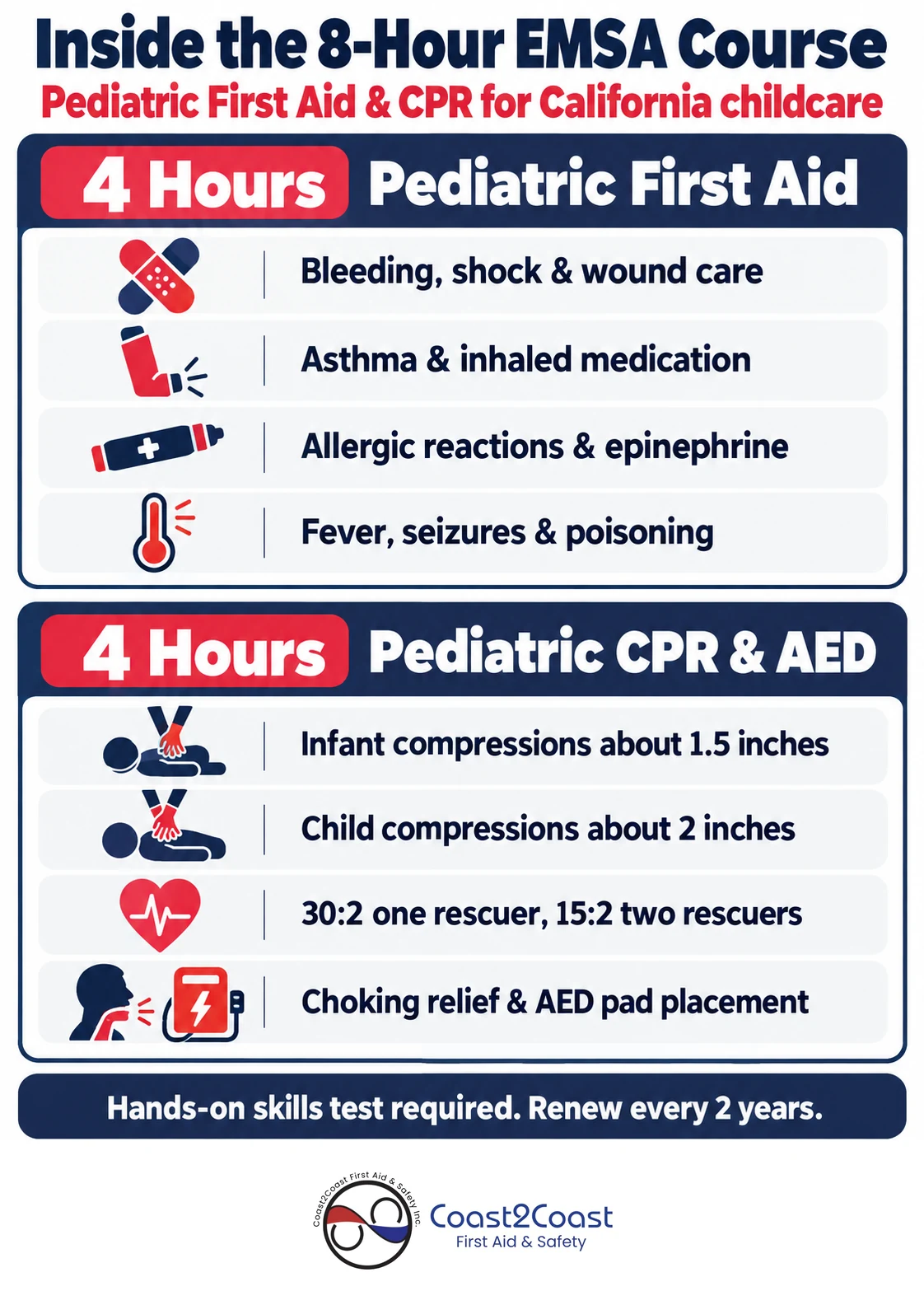
- Minimum 8 hours total (4 hours of pediatric first aid and 4 hours of pediatric CPR including AED training).
- Core components covering infant and child CPR, choking response, serious bleeding, shock, anaphylaxis, asthma, head injuries, and sudden illness in children.
- Taught by an approved training program.
- A certificate showing “EMSA Child Care Provider” plus an EMSA sticker or printed approval statement.
- Designed specifically for childcare providers in licensed family childcare homes, childcare centers, and preschools overseen by Community Care Licensing.
Book EMSA-Approved Pediatric First Aid & CPR
The 8-hour course Title 22 licensing analysts look for, with hands-on skills testing and 2026 anaphylaxis training.
What Is “Standard” Pediatric CPR in California?
Standard pediatric CPR refers to general CPR/AED courses that include child and infant skills but are not built around EMSA Child Care Provider state requirements. Standard pediatric CPR is often taken voluntarily and does not meet licensing requirements for childcare facilities.
Where standard pediatric CPR is commonly used:
- Gym staff and lifeguards.
- School teachers outside of childcare licensing.
- Parents and babysitters.
- General community responders and employers requiring workplace safety compliance.
- Coaches and after-school program staff without childcare licensing obligations.
These courses focus on high-quality compressions, rescue breaths, AED use, and choking relief for infants and children, often combining adult, child, and infant protocols into a single CPR/AED certification. Standard pediatric CPR courses may allow online formats and do not require state compliance with EMSA, and they do not cover pediatric-specific emergencies like asthma medication administration or childcare emergency reporting.
A certificate saying “Pediatric CPR/AED” without EMSA childcare wording may represent excellent training, but it is not sufficient for licensed California childcare providers.
Side-by-Side Comparison: EMSA CPR vs. Standard Pediatric CPR
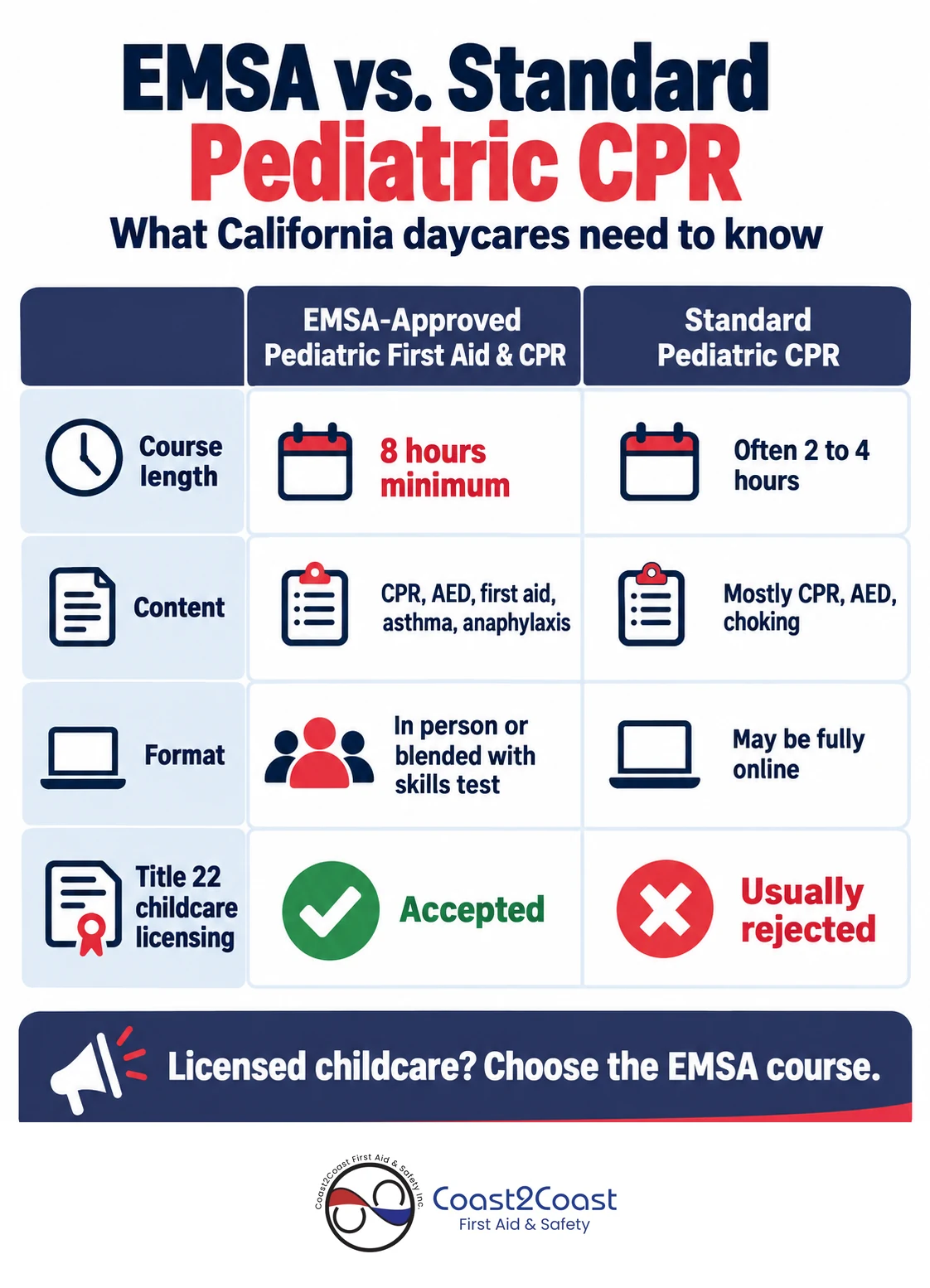
| Feature | EMSA-Approved Pediatric First Aid & CPR | Standard Pediatric CPR |
|---|---|---|
| Course length | 8 hours minimum (4 first aid + 4 CPR) | Variable; often 2-4 hours |
| Content scope | Pediatric first aid + CPR + AED + anaphylaxis + asthma + action plans | Mostly CPR/AED + choking |
| Regulatory status | Meets Title 22 requirements | May not meet childcare licensing |
| Target students | Licensed childcare providers | General public, parents, coaches |
| Certificate wording | “EMSA Child Care Provider” + EMSA sticker | Generic “CPR/AED” language |
| Course format | In person or blended (online theory + in person skills) | May be fully online |
| Renewal cycle | Every 2 years | Varies by provider |
EMSA courses include first aid topics like EpiPen use, childcare emergency plans, consent forms, and documentation that are not core components of standard pediatric CPR classes. Both options build life-saving skills, but only EMSA-approved courses (or an accepted childcare equivalent such as AHA Heartsaver Pediatric) satisfy California childcare licensing law.
Legal Requirements: Title 22 and EMSA Rules for California Childcare Providers
California regulations under Title 22 and Health and Safety Code Section 1596.866 require that childcare providers complete pediatric first aid and CPR from an EMSA-approved program or an accepted equivalent such as AHA Heartsaver Pediatric. A generic CPR card is not a substitute.
At least one staff member with current EMSA pediatric first aid CPR certification must be present at all times when children are in care, including during off-site activities like field trips. Community Care Licensing analysts reviewing applications or conducting inspections look specifically for the correct certificate wording, not just any aid certification card. EMSA requires in-person skills practice and testing for childcare pediatric first aid and CPR, so 100% online courses do not meet California childcare requirements.
Childcare providers should verify that a course meets EMSA-approved status on the provider’s website and contact Community Care Licensing or EMSA directly before registering when in doubt.
Train Your Daycare Staff On-Site
Book one EMSA-approved group session at your center so every teacher and aide holds the right certificate.
Core Components of EMSA Child Care Provider Training
EMSA publishes detailed core content requirements that go well beyond standard CPR topics. Early CPR can double or triple survival rates in cardiac arrests, making thorough pediatric first aid training essential in childcare settings.
Pediatric first aid core components include:
- Assessment of ill or injured children.
- Bleeding and shock, wound care, fractures, head injuries, burns, and electrical injuries.
- Allergic reactions and epinephrine auto-injector use.
- Asthma emergencies and inhaled medication use.
- Fever, seizures, and poisonings.
Pediatric CPR/AED core components include: the depth of compressions for children is approximately 2 inches, and for infants approximately 1.5 inches. The compression-to-breath ratio for pediatric CPR is 30:2 for a single rescuer; for two rescuers, the ratio changes to 15:2 for infants and children. Courses also cover single rescuer and team-based CPR, use of barrier devices, AED pad placement for small age groups, and managing choking in infants and children (conscious and unconscious).
EMSA CPR training integrates California-specific childcare emergency reporting protocols, including consent forms, incident documentation, Child Care First Aid Action Plans, and guidance on when to contact parents versus emergency services.
Course Formats, Hands-On Practice, and Blended Learning Options
Both EMSA CPR and standard pediatric CPR share an emphasis on hands-on learning, but acceptance rules differ for childcare licensing. Hands-on practice builds muscle memory for effective CPR delivery, something no video can replicate.
Traditional in-person EMSA courses run the full 8-hour class with instructor-led theory, skills stations, and live assessment on manikins and training AEDs. EMSA-compliant blended learning combines online theory modules completed in advance with a mandatory in-person skills check session. Only approved providers can offer this format. Standard pediatric CPR may be offered in shorter formats or fully online options, but fully online CPR or first aid courses are not valid for EMSA Child Care Provider requirements. In-person training is required to comply with California childcare licensing.
Certification Cards, EMSA Stickers, and What Licensing Analysts Look For
The small details on a CPR and first aid certificate determine whether a licensing analyst accepts or rejects it. CPR and first aid certifications are valid for two years in California, and the renewal process must follow the same standards.
What approved cards must include:
- Provider name.
- A course title clearly stating “EMSA Pediatric First Aid & CPR” or “EMSA Child Care Provider” (or the equivalent childcare-specific AHA or American Red Cross course title).
- Completion date, expiration date, and trainer or organization information.
- An EMSA sticker or printed approval logo where applicable. Digital certificates may also note approval, which licensing staff can verify.
Generic American Red Cross, American Heart Association, or other CPR/AED cards that do not reference Child Care Provider status are commonly rejected by Title 22 analysts, even if they include pediatric content. Keep copies of all certificates centrally filed and schedule renewal 2 to 3 months before the expiration date to avoid non-compliance citations.
Choosing the Right Course for Your Role (Childcare vs. Other Settings)
Not everyone in California needs EMSA-approved CPR, but all licensed childcare providers do. Choosing incorrectly can delay hiring or licensing.
Licensed childcare providers, family childcare home operators, and daycare center staff must take EMSA-approved Pediatric First Aid & CPR. Teachers must hold certification in Adult, Child, and Infant CPR. K-12 teachers and coaches may follow California Commission on Teacher Credentialing requirements rather than EMSA childcare mandates. See our full breakdown of California teacher CPR requirements if that applies to your role. Healthcare professionals (RNs, EMTs, paramedics) typically require Basic Life Support level training, which focuses on professional resuscitation rather than childcare-specific hazards.
Explore CPR Certification for Teachers
A different pathway than EMSA, see what California teachers actually need.
How Coast2Coast Delivers EMSA-Approved Training in California
Coast2Coast First Aid & Aquatics is an authorized provider delivering EMSA-approved Pediatric First Aid & CPR, Cal/OSHA-compliant courses, and BLS training directly across California. If you’re a licensed childcare provider, family childcare home operator, or daycare center needing the specific EMSA Child Care Provider certification Title 22 requires, you can complete it with us directly, in person or through blended learning, with the mandatory hands-on skills check included.
Same-day digital certification is issued upon successful completion, and your certificate will carry the childcare-specific wording and approval status that Community Care Licensing analysts specifically look for, so you don’t risk showing up with a generic pediatric CPR card that gets rejected.
For teams managing multiple staff renewals, Coast2Coast can also help you build a unified training calendar so every staff member’s certification stays current on the same schedule.
Find EMSA Training in Los Angeles
Official EMSA-approved and AHA/Red Cross courses, 99.9% pass rate.
A generic pediatric CPR card is not the same as an EMSA-approved Pediatric First Aid & CPR certificate, and Title 22 licensing analysts check for the difference. Confirm your course includes the specific childcare-content requirements and a hands-on skills check before you enroll, not after your license application gets flagged. Coast2Coast delivers EMSA-approved training directly across California, so you get the right certificate the first time.
Get Started with California Certification
Find the right course level and book with a 99.9% pass rate.
FAQ: EMSA CPR vs. Standard Pediatric CPR in California
Q1: Is an American Red Cross Pediatric CPR/AED Card Automatically EMSA-Approved?
A: No. Not automatically. Only specific courses, built around Child Care Provider core components and registered or recognized for that purpose, count. A standard Pediatric CPR/AED card without EMSA designation, or without being the specific childcare-content version, will likely be rejected. Always confirm approved status before enrolling, and check that your certificate reads the correct childcare-specific course title.
Q2: Can I Meet California Childcare CPR Requirements with a 100% Online Course?
A: No. California EMSA requires an in-person hands-on skills assessment for childcare CPR, AED, and first aid courses. Approved blended learning is acceptable only when the skills check portion is completed with an approved instructor. Fully online courses are not valid for childcare licensing, regardless of the provider.
Q3: How Often Do I Need to Renew EMSA Pediatric First Aid & CPR Certification?
A: CPR and first aid certifications are valid for two years from the successful completion date. After that, childcare providers must complete a renewal course, still 8 hours total, to maintain compliance. Schedule your renewal 2 to 3 months before expiration to avoid staffing gaps or licensing violations.
More FAQs: Requirements and Edge Cases
Q4: Does Basic Life Support (BLS) Count Instead of EMSA Pediatric First Aid & CPR?
A: BLS is designed for healthcare providers and, while more advanced in certain resuscitation skills, does not replace the EMSA Child Care Provider requirement. Childcare staff should take EMSA pediatric courses even if they hold BLS certification for another role.
Q5: What Should I Do If My Licensing Analyst Rejects My Current CPR Card?
A: Ask the analyst which specific EMSA-approved Pediatric First Aid & CPR course they require and whether a grace period is available. Contact an EMSA-approved provider like Coast2Coast promptly, keep proof of registration, and ensure future staff also enroll in EMSA Child Care Provider courses from the start.
Reviewed By: Ashkon Pourheidary, B.Sc. Hons Neuroscience, Co-Founder of Coast2Coast First Aid & Aquatics and Canadian Red Cross Instructor Trainer since 2011.
Source: California Emergency Medical Services Authority (EMSA)