
What Are the California AED Requirements?
California AED requirements are a mix of general rules for anyone who owns an automated external defibrillator and specific mandates for certain types of facilities. The general rules sit in Health and Safety Code Section 1797.196, which sets out what a person or organization must do once it acquires an AED. The facility mandates sit in other laws, such as the Education Code for schools with interscholastic athletics and the Health and Safety Code for health studios and newer buildings.
The most common misunderstanding is that California requires every business to have an AED. It does not. Individuals are not required to have one, and most workplaces are not required to buy one. But once you do acquire an AED, whether you bought it, leased it or accepted it as a donation, the California AED requirements for acquirers apply to you.
That distinction matters because an AED is a medical device that needs care. A defibrillator with a dead battery or expired pads is worse than no defibrillator at all, because people trust it will work. State rules exist so that the AED on the wall is ready when a person collapses.
This guide explains who must have an AED, what acquirers must do, how often to inspect and test a device, what building owners and schools must do, whether a medical director is needed, and how liability protection works. If you want to build the skills behind your device, you can explore our CPR and AED courses.
Train Your Whole Team
Private group sessions for your workplace, with training scheduled around your team.
Who Is Required to Have an AED in California?
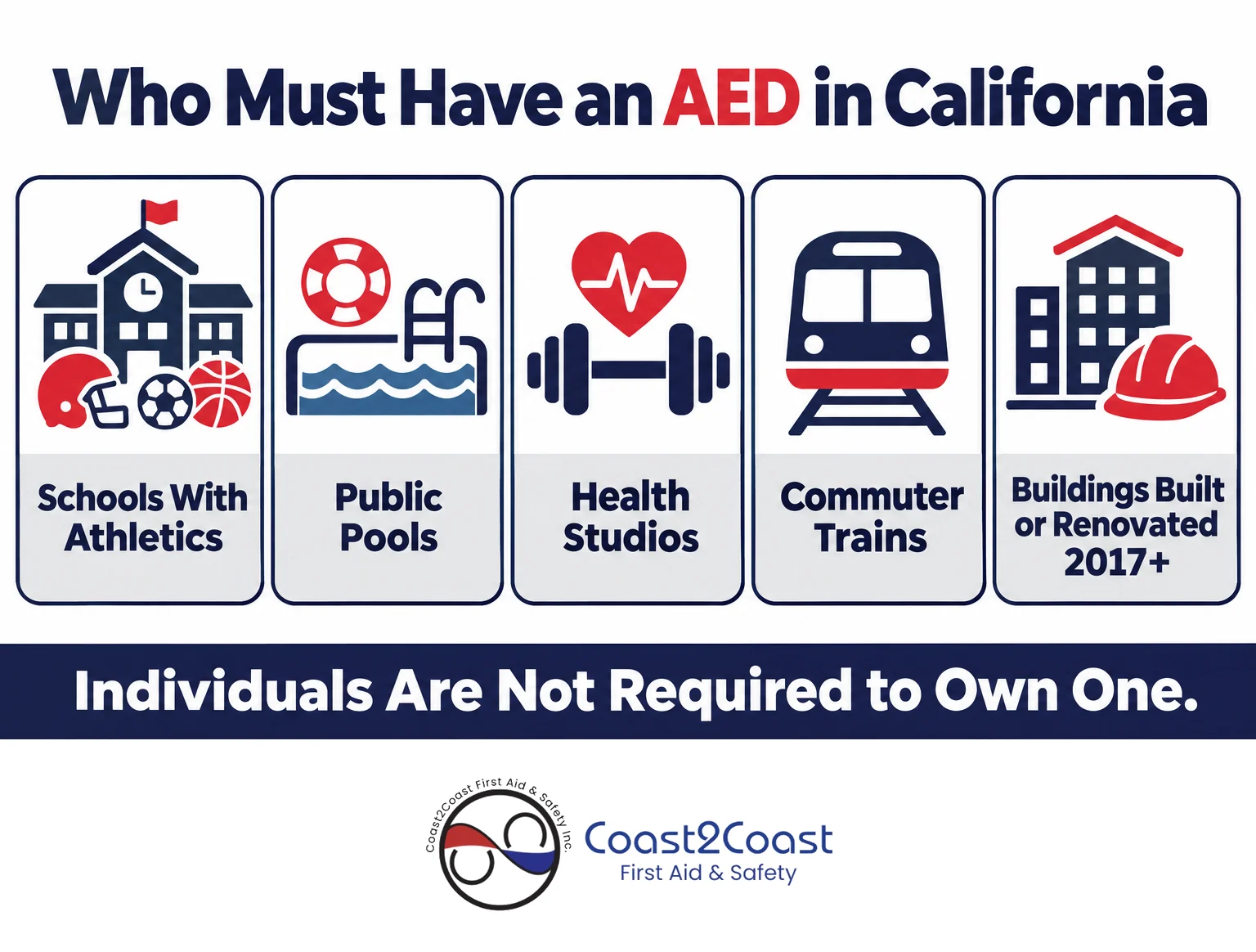
Under the California AED requirements described on the state EMSA AED page, individuals are not required to have an AED. The mandates apply to specific kinds of facilities and settings.
Schools are one example. School districts and charter schools that run interscholastic athletic programs must have at least one AED per school under Education Code Section 35179.6. Certain public swimming pools must have lifeguards and an AED available while the pool operates. Commuter trains must carry an AED as safety equipment.
Buildings are another category. Buildings constructed or renovated on or after January 1, 2017 must have an AED available for use under Health and Safety Code Section 19300, subject to the exceptions written into that law. Membership-based health studios must acquire and maintain AEDs and train their personnel under Health and Safety Code Section 104113. State-owned or leased buildings follow placement and training policies set by the Department of General Services.
Some other regulated settings, such as certain dental and healthcare facilities, have their own emergency equipment rules. If your facility is not on the list above, do not assume you are exempt. Check the current requirements for your license type, and ask your local EMS agency if you are unsure.
The statutes behind each mandate are listed by the state, and it is worth reading the one that applies to your facility, because exceptions and effective dates differ. A short review once a year, or whenever you renovate, expand or change your license type, keeps you from missing a new obligation. Facility managers should also keep a copy of the relevant section in the AED binder so that staff turnover does not erase the reasoning behind your program.
Even where an AED is not mandatory, many employers install one voluntarily. Sudden cardiac arrest can happen to an employee, a customer or a visitor, and every minute without defibrillation reduces the chance of survival. A voluntary AED program is covered by the same California AED requirements as a mandatory one.
Get Hands-On CPR and AED Practice
Work with real manikins and AED trainers while an instructor coaches your technique.
What Must You Do After You Acquire an AED in California?
Health and Safety Code Section 1797.196 places a short list of duties on the person or entity that acquires an AED. The list is the core of the California AED requirements, so it helps to treat it as a checklist you can document.
First, follow the placement rules that apply to your type of facility, and make sure the device is easy to see and reach. Second, notify the local EMS agency that you have an AED, including its location and type. This lets dispatchers know where AEDs are in the community. Third, maintain and test the AED according to the manufacturer’s guidelines. Fourth, make sure the people expected to use it have received CPR and AED training. Fifth, keep records of maintenance, testing and use.
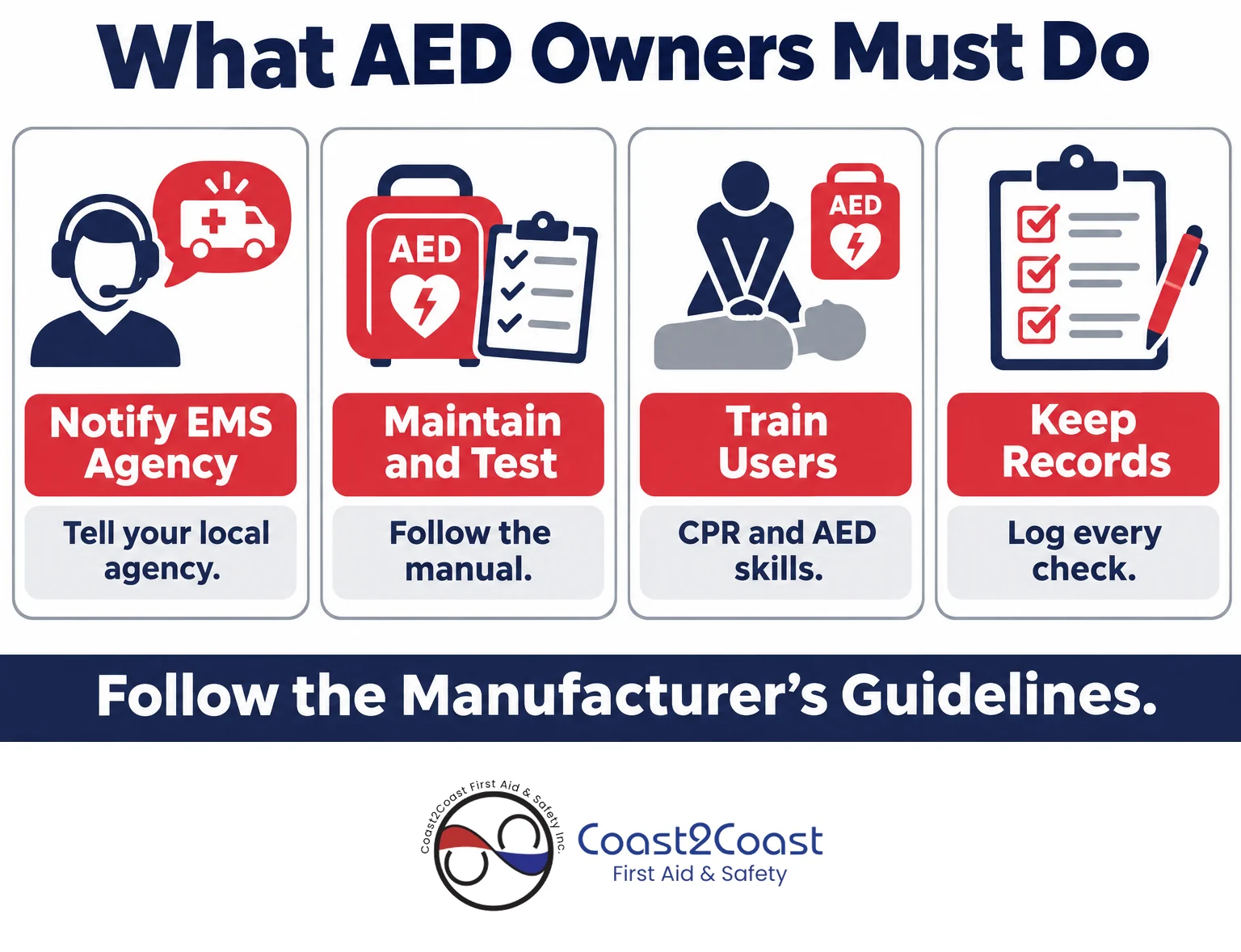
The notification step is the one most often missed. A company installs an AED, trains a few staff and moves on, but never tells the local EMS agency. Every county has its own procedure and forms, so contact your agency directly rather than relying on a generic template.
Manufacturers and retailers have a role too. They must give the person acquiring the AED information about its use, installation, operation, training and maintenance, so you should receive and keep that documentation.
Learn First Aid Skills in a Real Classroom
Hands-on first aid training with real equipment and an instructor guiding every skill.
How Often Should an AED Be Inspected and Tested?
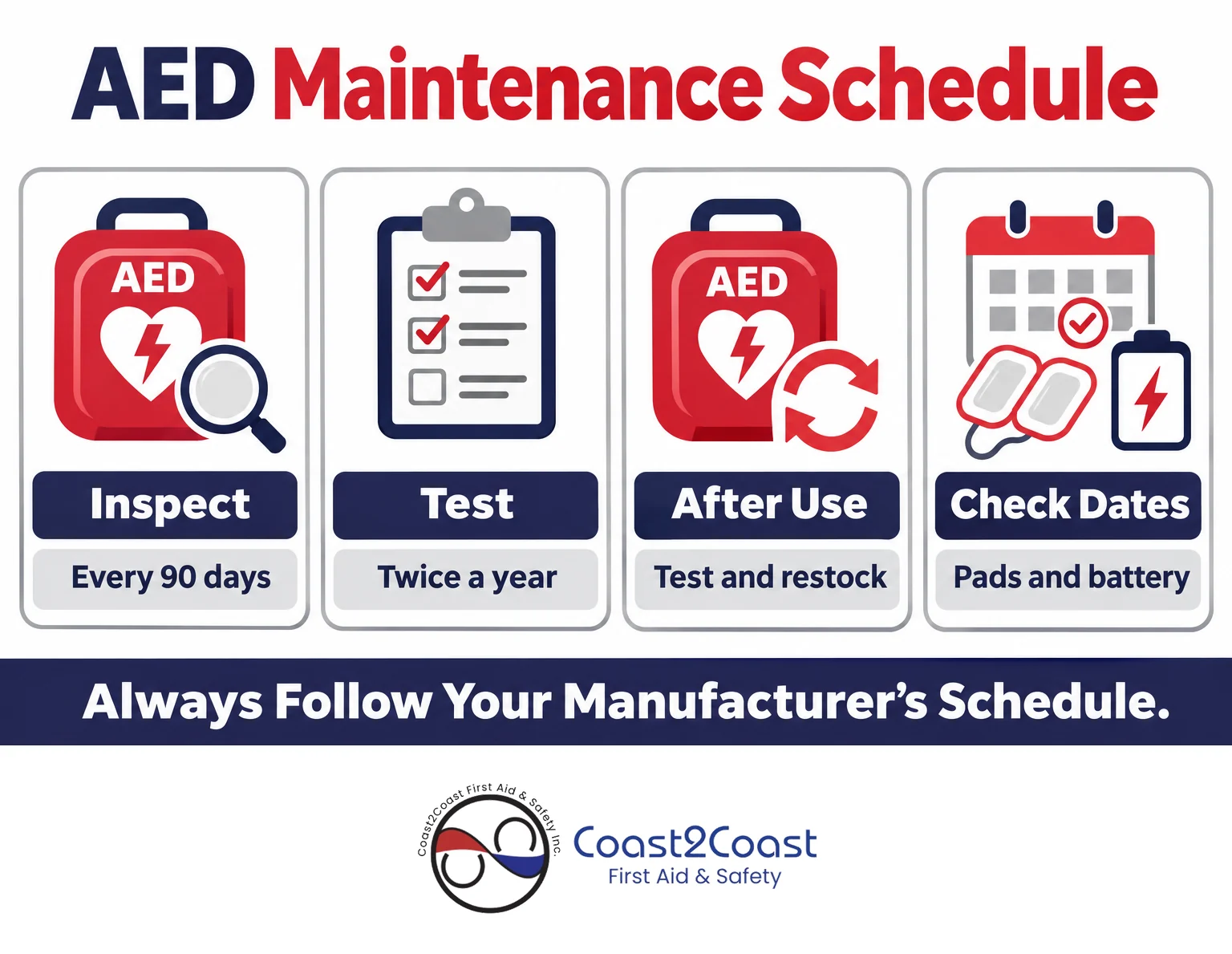
State guidance expects an acquirer to maintain and test an AED according to the manufacturer’s guidelines. In practice, many programs follow a routine such as testing at least twice a year and after each use, and inspecting the device at least every 90 days. Always check the current requirements and your manufacturer’s manual, because they take priority.
A routine inspection is quick. Look at the status indicator to confirm the device is ready, check that the pads and battery are within their expiry dates, make sure the cabinet is accessible and the alarm works, and confirm the carry case contains the spare items such as a razor, gloves and a towel. Record the date, your initials and anything you replaced.
Some AED makers recommend more frequent checks, such as monthly or even weekly visual checks of the status light, and some sources describe shorter intervals than the state guidance. That is not a contradiction. The state sets a floor, and the manufacturer may set a higher standard. Following the stricter schedule is the safest way to meet California AED requirements.
After any use, even a short one, treat the AED as needing service. Replace the used pads, check the battery, download the event data if your device supports it, and complete your records. Many EMS agencies also want to know when an AED has been used, so ask how to report it.
Learn First Aid and CPR Together
Build the skills your AED program depends on: first aid, CPR and AED use in one course.
What Are the California AED Requirements for Building Owners and Tenants?
Building owners have additional duties when an AED is present in a building. Under the rules summarized by EMSA, a building owner must notify tenants about AED locations at least once a year, and must give tenants contact information for AED training. Owners should also offer an annual demonstration of how to use the device, and post instructions for AED use in a conspicuous place.
The posted instructions must be written in at least 14-point type. Large print matters because a bystander in a stressful moment needs to read the steps quickly. Put the instructions near the AED, with a clear sign above it so people can find the device without searching.
For tenants, the practical takeaway is simple: know where the AED is, know who maintains it, and ask the property manager for the annual notice. If your business leases space and also buys its own AED, you become the acquirer for that device, and the acquirer duties above apply to you.
Property managers can make compliance easier by building the notice into their yearly calendar, alongside fire safety reminders. A single email each year that lists the AED locations, the training contacts and the demonstration date covers most of what is expected.
Training Built Around Your Workplace
Certified instructors, flexible formats and a certificate for every participant.
What Are the California AED Requirements for Schools?
Schools have some of the clearest California AED requirements. Districts and charter schools with interscholastic athletic programs must have at least one AED per school. For K-12 schools that acquire an AED, the law also expects annual information about sudden cardiac arrest and AED use for staff, posted instructions for use and an annual notice of where the AED is located.
Placement is where schools often struggle. A school may have an AED in the front office, but a football game or track meet may be happening on a field several minutes away. A good plan places AEDs where emergencies are most likely, and makes sure a trained adult can reach the device within the response window.
Coaches, athletic trainers, front office staff and custodians are all good candidates for CPR and AED training. When several adults are trained, there is always someone nearby who can start CPR, call 911 and send a runner for the AED. If your school wants a single session for all of these roles, a private group training session can bring an instructor to your campus.
Schools should also plan for after-hours events. Evening concerts, weekend tournaments and community rentals all raise the chance that an emergency happens when the main office is locked. Make sure the AED location is accessible during every event, and that event organizers know where it is.
Learn CPR and AED in a Real Classroom
Practise compressions, breaths and AED pad placement with a certified instructor.
Does California Require a Medical Director or Training for AED Use?
Under the AED program summary published by EMSA, a medical director or physician is not required for an acquirer to place an AED. That is a change from older rules that required physician oversight, and it makes AED programs easier to set up for small businesses and community groups. Some local EMS agencies or device vendors may still offer medical oversight services, which some organizations choose for added support.
Training is a different story. The California AED requirements expect the people who are likely to use the device to be trained in CPR and AED use. Training does not have to be limited to a designated responder, and the best programs train as many employees as practical. A person with no training can still use an AED in an emergency, because the device gives spoken instructions, but trained users act faster and with more confidence.
Training also supports the liability protections described below. Courses taught by recognized providers, including the American Heart Association and the American Red Cross, cover chest compressions, rescue breaths, AED pad placement and what to do until paramedics arrive. Most CPR and AED cards are valid for two years, so put renewal dates on a shared calendar.
For healthcare workers and professional rescuers, Basic Life Support (BLS) training is usually the right level, because it adds team response and advanced airway skills to AED use. For everyone else, a standard CPR and AED course is enough.
Put These Skills Into Practice
Standard First Aid covers bleeding, burns, fractures and sudden illness in a hands-on class.
Are You Protected from Liability When You Use an AED?
California law provides protection for people who use AEDs in good faith. Civil Code Section 1714.21 addresses liability for AED use, and Health and Safety Code Section 1797.190 protects lay rescuers who use an AED. The general Good Samaritan law in Health and Safety Code Section 1799.102 also shields people who give emergency care in good faith and without compensation, within the scope of their training.
There is an important condition. The protection for AED acquirers and users is tied to compliance. For example, the lay rescuer protection applies when the AED’s placement and use comply with the requirements in Section 1797.196. In other words, following the California AED requirements does not just keep you legal. It also protects the people who respond in an emergency.
Buildings and health studios have specific provisions as well. Health and Safety Code Sections 19300 and 104113 protect the purchasers or operators of AEDs from liability when the device is used, as long as they meet the conditions of those laws.
The EMSA summary also notes that violations of the AED duties are not subject to the penalty provisions found in Health and Safety Code Section 1798.206. That does not mean the rules are optional. A lapse in maintenance can still undermine your liability protection and, more importantly, cost a person their life.
Train Your Whole Team
Arrange a private group session so every person who may use your AED is trained.
How Do You Build an AED Program That Meets California AED Requirements?
A compliant program is mostly organization. Start by naming one person as the AED coordinator, and give a backup. That person owns the inspection log, the expiry dates and the training calendar.
Next, choose placement. Put the AED in a visible, unlocked or easily opened cabinet along the route people use most, close enough that a responder can reach it and return within a few minutes. Many sites install a second device if the building is large or has several floors. Add clear signs, including directional signs from main corridors.
Then complete the paperwork. Notify the local EMS agency of the device location and type, store the manufacturer documents, and keep the inspection log current. Set reminders for pad and battery expiry, because those dates arrive faster than most people expect.
Finally, train people. Offer CPR and AED courses to as many staff as possible, and refresh the training every two years. For a larger team, a first aid and CPR course combines the skills that an AED depends on, such as controlling bleeding and recognizing cardiac arrest. Run a short drill once or twice a year: ask a staff member to locate the AED and describe the first three steps.
Review the program once a year. Confirm the notice to tenants or staff has gone out, the instructions are posted in 14-point type or larger, the EMS agency has your current information and the device still matches your manufacturer’s maintenance schedule.
Get Your Team Certified Together
Private group courses cover first aid, CPR and AED for teams of any size.
Key Takeaway
California AED requirements do not force every business to buy a defibrillator, but anyone who acquires one must notify the local EMS agency, maintain and test the device, keep records and make sure expected users are trained. Certain schools, pools, health studios, trains and newer buildings must have an AED. Follow the manufacturer’s schedule, confirm the current statute and your local agency’s rules, and train as many people as you can.
Join Thousands of Certified Responders
Healthcare roles often require BLS, which includes AED use and team response.
Frequently Asked Questions: California AED Requirements 2026
Q1: Is an AED required by law in California?
A: It depends on the setting. Individuals are not required to have an AED, and most workplaces are not either. However, certain schools with interscholastic athletics, specified public pools, health studios, commuter trains and buildings built or renovated on or after January 1, 2017 must have one under California law. If your facility is not listed, check your license type and ask your local EMS agency before assuming you are exempt.
Q2: What are the California AED requirements for businesses?
A: A business that acquires an AED must follow Health and Safety Code Section 1797.196. That means following placement rules, notifying the local EMS agency of the device location and type, maintaining and testing the AED to manufacturer guidelines, making sure expected users are trained and keeping records of maintenance, testing and use. Businesses are not generally required to buy an AED, but a voluntary device carries the same duties.
Q3: Do I have to register my AED in California?
A: Yes. You must notify your local EMS agency that you have an AED, including its location and type. Each county or regional agency has its own process and forms, so contact yours directly. Registration helps dispatchers tell callers where the closest device is, and it is one of the duties people most often forget after installing a new AED.
Q4: How often must an AED be inspected in California?
A: State guidance describes inspecting an AED at least every 90 days and testing it at least twice a year and after each use, while also requiring maintenance according to manufacturer guidelines. Some manufacturers recommend more frequent visual checks of the status indicator. Always follow the stricter schedule, and confirm the current requirements with your local EMS agency because guidance can change.
Q5: Does California require a medical director for an AED program?
A: No. According to the AED program summary published by the state’s Emergency Medical Services Authority, a medical director or physician is not required to acquire and place an AED. Some organizations still choose medical oversight through a vendor or local EMS agency for support with training, protocols and data review, but the state does not require it for the acquirer.
Q6: Who is responsible for AED maintenance in a leased building?
A: The entity that acquires the AED is responsible for its maintenance, testing and records. If the landlord owns the device, the landlord is the acquirer. If a tenant buys its own, the tenant is the acquirer. Building owners also have notice duties, including notifying tenants of AED locations and training contacts each year, so tenants should ask who is responsible.
Q7: What type size must AED instructions be in California?
A: Where a building owner posts AED instructions, state guidance calls for them to be in at least 14-point type, placed in a conspicuous location near the device. Large print helps a bystander read the steps quickly in a stressful moment. Pair the instructions with a clear sign so people can find the AED without searching.
More FAQs: Training, Records, Liability and Compliance
Q8: Do California schools need an AED?
A: Yes. School districts and charter schools that run interscholastic athletic programs must have at least one AED per school under Education Code Section 35179.6. Schools that acquire an AED are also expected to provide annual information about sudden cardiac arrest and AED use to staff, post instructions and give an annual notice of the AED location. Placement should cover fields, gyms and after-hours events.
Q9: Are people who use an AED protected from lawsuits in California?
A: Generally, yes, when they act in good faith. Civil Code Section 1714.21 and Health and Safety Code Section 1797.190 address AED use, and the Good Samaritan law in Section 1799.102 protects people who give emergency care without compensation. The AED protections are tied to compliance with Section 1797.196, so keeping your device maintained and registered helps protect responders.
Q10: Does California require AED training?
A: The California AED requirements expect the people likely to use the device to be trained in CPR and AED use. A person without training can still use an AED in an emergency, because the device gives spoken instructions, but training makes responders faster and more confident. Most CPR and AED cards last two years, so schedule renewals before they expire.
Q11: What records must I keep for an AED in California?
A: Keep records of maintenance, testing and use. A good file includes the date of each inspection, who completed it, pad and battery expiry dates, any parts replaced, training dates for staff, the manufacturer’s documents and your EMS agency notification. Store the records where the AED coordinator and a backup can both reach them, and keep them current.
Q12: What should I do after using an AED?
A: Call 911 first and let paramedics take over when they arrive. Afterwards, replace the used pads, check the battery, download the event data if your device supports it, and update your records. Many local EMS agencies want to be told when an AED has been used, so ask how to report it. Treat the device as out of service until it is checked.
Q13: Can I buy an AED without a prescription in California?
A: Many AED models are available to buy without a prescription, because the device guides the user with spoken prompts. Rules on purchase and approval can change, so ask the manufacturer or retailer, who must give you information on use, installation, operation, training and maintenance. AEDs are regulated medical devices, so buy from a reputable seller.
Q14: Who has to notify tenants about the AED in a building?
A: The building owner does. Under the rules summarized by the state, the owner must notify tenants of AED locations at least once a year, provide contact information for AED training and offer an annual demonstration. The notice can be a short email or letter. Keeping a copy of each notice helps show that you meet the California AED requirements.
Q15: Do California AED requirements apply to dental offices and gyms?
A: Gyms and health studios that sell memberships must acquire and maintain AEDs and train personnel under Health and Safety Code Section 104113. Dental offices and other healthcare settings may have separate emergency equipment rules from their licensing bodies, so check with your board. In every case, an AED you acquire is covered by the general acquirer duties.
Reviewed & Sourced
Reviewed by Coast2Coast Certified CPR Instructor.
Sources: California Emergency Medical Services Authority (EMSA), AED program information and requirements. California Health and Safety Code Section 1797.196, Public Access Defibrillation.