
What Does an Expired CPR Certification Mean?
An expired CPR certification is a CPR card whose expiry date has passed, so it no longer counts as proof of current training. Most cardiopulmonary resuscitation cards are valid for two years. When that period ends, the card is no longer valid for most employers, even if you remember the skills well. To become current again, you take a renewal or full course, show your skills to an instructor and receive a new card.
People use several terms for the same idea. You will see CPR recertification, CPR renewal, CPR refresher and CPR update. In practice they all describe a course designed for someone who has already been certified, and who needs to refresh skills and learn any changes since the last class. The details differ between providers, but the goal is the same: keep your knowledge and your credentials up to date.
The reason for the two-year cycle is simple. CPR is a physical skill, and skills fade when they are not practised. Studies of rescuers consistently show that compression depth, rate and confidence drop over time without retraining, and guidelines are updated periodically as new evidence appears. Renewing on time keeps your technique sharp and stops an expired CPR certification from becoming a problem.
Keeping your card current is also an administrative requirement for many jobs. Teachers, coaches, childcare providers, fitness instructors, security staff, dental offices and healthcare providers are often required to hold a current card as a condition of employment or licensing. An expired CPR certification can mean a missed shift, a delayed licence renewal or a failed audit.
This guide explains what to do if you have an expired CPR certification, whether a grace period exists, what a renewal class covers and how to choose a course that your employer or licensing board will accept. If you are ready to book, you can compare CPR and AED courses and Basic Life Support (BLS) courses before reading further.
Keep Your Certification Current
Recertification courses help you renew before your certificate expires.
When Should You Renew Your CPR Certification?
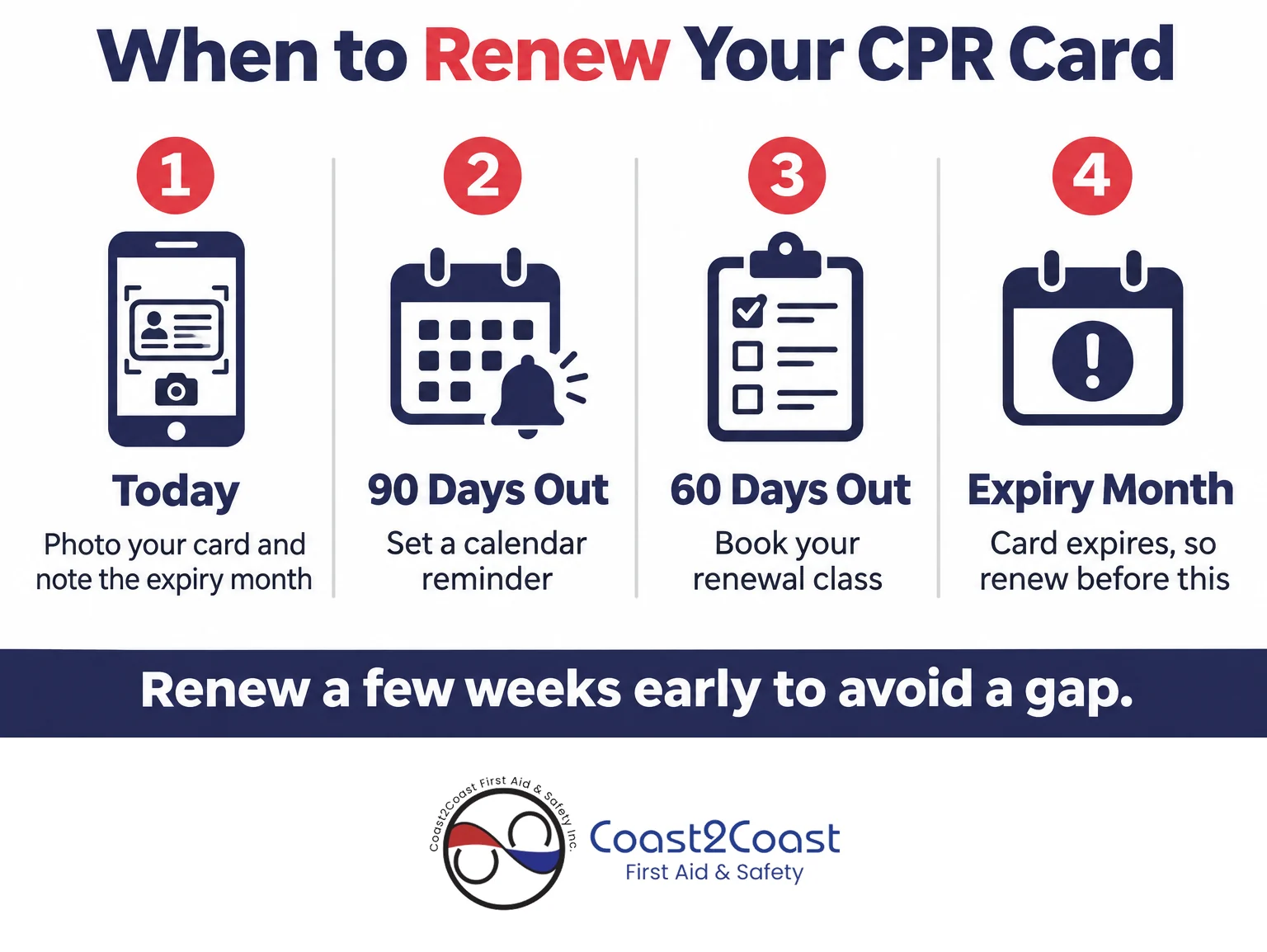
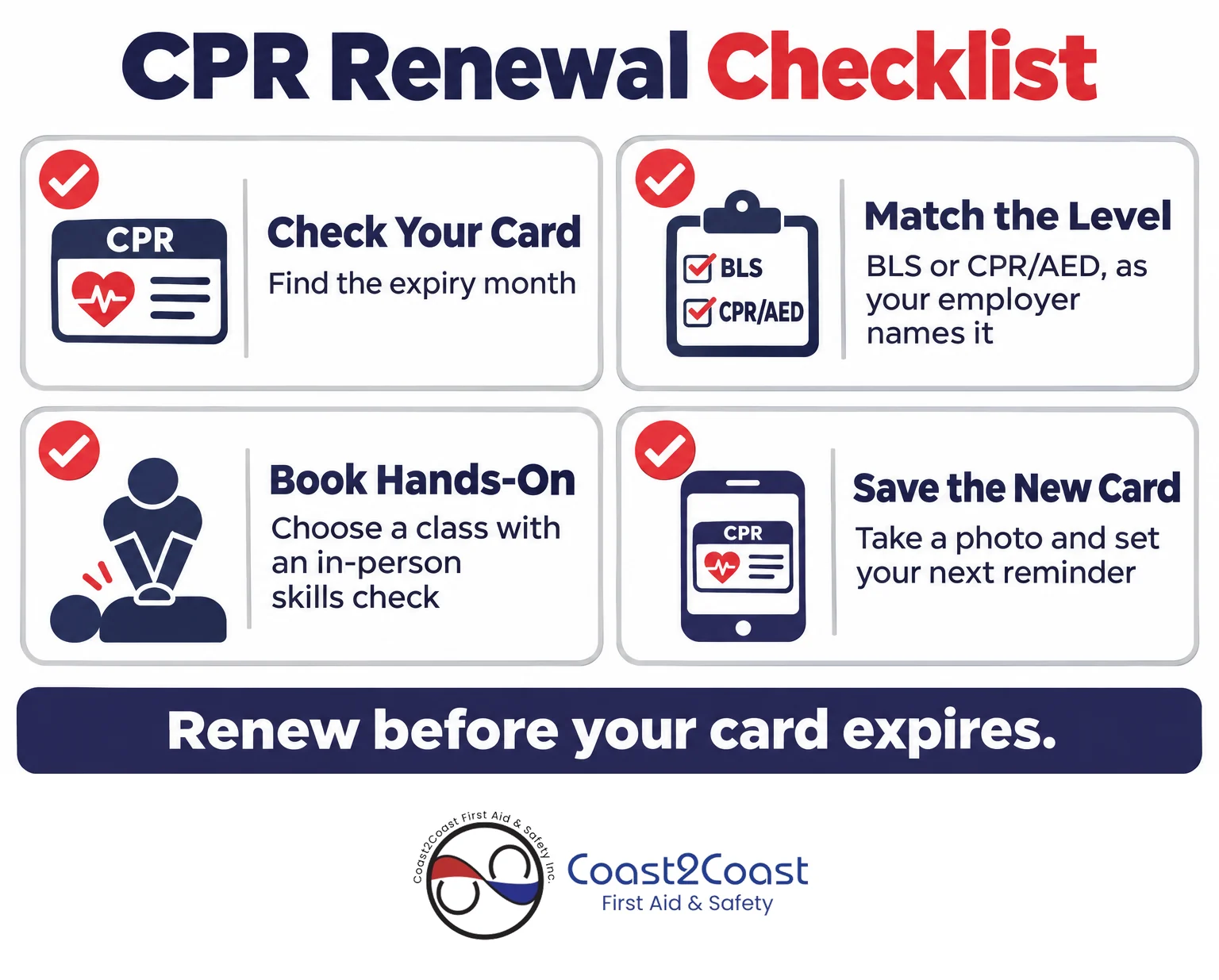
The best way to avoid an expired CPR certification is to renew a few weeks before the card runs out. Check the expiry date printed on your card or in your digital certificate, and set a reminder at least 60 days ahead. That gives you time to find a class that fits your schedule without scrambling.
Most American Heart Association (AHA) BLS Provider and Heartsaver cards are valid for two years, and American Red Cross CPR certificates are also valid for two years. The card typically shows an expiry month, and many employers treat the last day of that month as the final day of validity. If your card says “11/2026”, plan to complete your renewal during or before November.
Why not wait until the last week and risk an expired CPR certification? Classes fill up, especially near the end of the month and the end of the year. Instructors may also have limited weekday sessions, and you may need time to rearrange work. Booking early gives you flexibility and protects you if a class is cancelled or rescheduled.
It is also worth checking your employer’s rules on an expired CPR certification. Some workplaces require employees to renew before the card expires, and a few ask for proof of renewal weeks in advance. If your job involves patient care, supervising children or lifeguarding, check your handbook or ask your manager what deadline applies.
There is one more factor: guideline updates. Every few years, the science behind CPR is reviewed and teaching materials change. A renewal class is where you pick up these updates, for example changes to how compressions, ventilation or choking relief are taught. If it has been a while since your last class, a refresher gives you more than a new date on a card.
Get Hands-On CPR and AED Practice
Work with real manikins and AED trainers while an instructor coaches your technique.
What Does a CPR Renewal Class Cover?
A CPR renewal class reviews the same core skills as the original course, at a quicker pace. Instructors assume you remember the basics, so they spend less time on introductions and more time on practice and feedback. The exact content depends on the course level you hold.
For a CPR/AED renewal, you can expect to review the steps of an emergency response: checking the scene, checking for responsiveness and breathing, calling 911 and getting an AED. You then practise high-quality compressions and rescue breaths on adult, child and infant manikins, use an AED trainer and review choking relief for each age group. Many classes also cover bleeding control and recognising common emergencies.
For a BLS renewal, the review is more detailed. Healthcare providers revisit two-rescuer CPR, bag-valve mask ventilation, team roles, compression fraction and high-performance teamwork. Instructors check that your technique meets measurable standards, such as compression depth, rate, recoil and ventilation timing. Because BLS is a healthcare-provider course, there is usually a skills test.
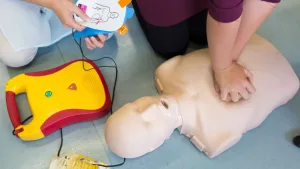
Both types of class include hands-on practice. That is not optional, and it is the main reason a renewal cannot be completed with videos alone. You need to demonstrate that you can perform the skills correctly in front of a qualified instructor. A good instructor will also coach you on small details, such as hand position and how to keep going when you are tired.
Some providers offer blended renewal formats. In a blended option, you complete the cognitive portion online at your own pace, then attend a short in-person skills session. For example, AHA offers HeartCode BLS, which pairs online learning with a hands-on skills check. The in-person skills session is still required for a valid card.
Time to Renew Your Certificate?
Refresh your skills and renew with a certified instructor.
How Is CPR Renewal Different From the Full Course?
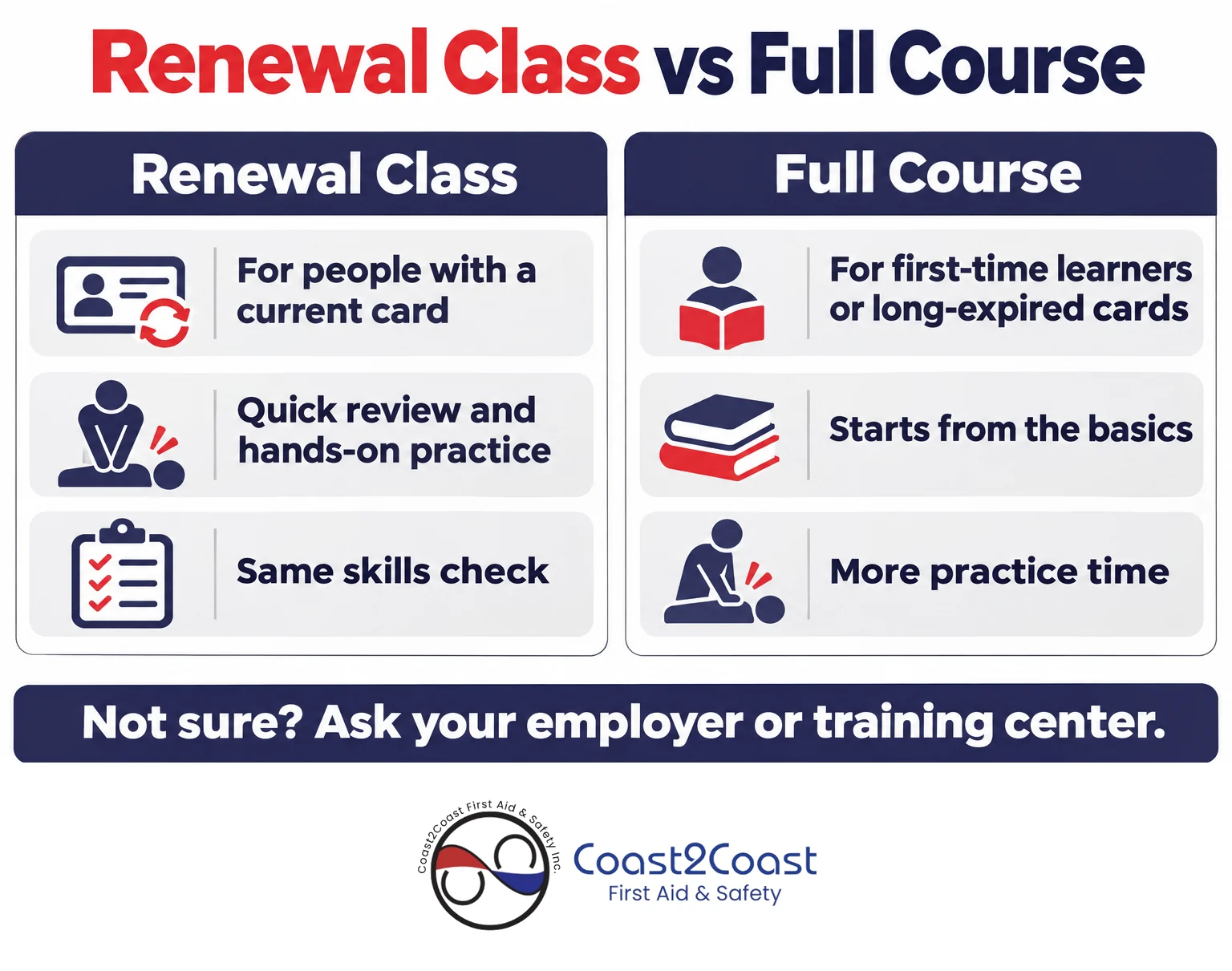
CPR renewal is shorter and faster than the full course because it assumes you already know the material. The tradeoff is that it is designed for people whose certification is current. If you need to learn CPR for the first time, or if your card expired long ago, a full course is usually the better fit.
In a full course, the instructor starts from the beginning. They explain why CPR works, introduce each step, demonstrate every skill and give new learners plenty of time to practise. The pace is relaxed, and no prior experience is assumed. This format suits first-time learners, people who feel uncertain about their skills and anyone who wants extra practice.
In a CPR renewal course, the instructor moves directly to practice. You may watch a short demonstration and then go straight to the manikins. The class often includes a quick review of recent guideline changes. If you are comfortable with the skills, you can finish in less time than the original course took.
Neither format is easier to pass. The skills evaluation is the same in both cases. The renewal class simply respects the fact that you have already done the learning once. If you are not confident in your skills, it is perfectly reasonable to choose a full course even if you are eligible for a renewal. Many people do exactly that after a long gap.
Renew Your BLS Provider Card
Healthcare providers can renew BLS with hands-on practice and a skills check.
What Should You Do If Your CPR Certification Has Expired?
If you have an expired CPR certification, the most important step is to find out what your employer or licensing board expects. Rules differ, and the answer is not the same everywhere. Some organizations accept a renewal class shortly after expiry, while others require you to repeat the full course.
The American Heart Association describes its cards as valid for two years, and it does not publish a general grace period that applies everywhere. Training centers and employers may set their own policies, so the safest approach is to ask before you book. A quick email to the instructor or training center can save you from taking the wrong class.
In general, the longer an expired CPR certification has lapsed, the more likely you are to need the full course. If your card expired a few days ago, a training center may allow you to take a renewal class. If it expired months or years ago, you will likely be asked to start over. When in doubt, a full course is never wrong, because it covers everything a renewal does and more.
A practical order of steps helps. First, check the expiry date and note how long ago it passed. Second, read your job requirement or licensing wording to see whether it asks for a current card or a specific provider. Third, contact the training center and ask whether your expired CPR certification qualifies for a renewal class. Fourth, book the earliest class that fits and bring any proof the instructor asks for. Fifth, tell your manager your booking date so they can plan around it.
While you wait for a class, remember that you can still help in an emergency. The skills do not disappear overnight, and the priority in a real emergency is always to call 911 and start compressions. The NHLBI notes that cardiac arrest is fatal unless treatment begins immediately, so acting is better than waiting for a perfect refresher.
Treating an expired CPR certification as urgent, not optional, protects both your job and the people around you. Do not let an expired CPR certification stop you from acting in an emergency. Do let it stop you from putting off your renewal for another month.
Learn CPR and AED in a Real Classroom
Practise compressions, breaths and AED pad placement with a certified instructor.
Which CPR Renewal Course Should You Choose?
The right CPR renewal course depends on your role, so start by checking exactly what your employer or licensing board names. If the requirement says “BLS” or “healthcare provider CPR,” you need a BLS renewal. If it says “CPR and AED” or “Heartsaver,” a CPR/AED renewal usually satisfies it. When the wording is vague, ask in writing and keep the reply.
Healthcare providers, including nurses, dental staff, medical assistants, paramedics and nursing students, usually need BLS. Teachers, coaches, childcare workers, fitness instructors, office safety teams and security staff more often need a CPR/AED course. If you need first aid as well, many providers offer a combined CPR, AED and first aid class.
Next, check who issued your current card. Many employers accept either AHA or American Red Cross cards, but some specify one. If your employer requires a particular provider, renew with the same one to avoid problems. If your employer has no preference, choose a provider that issues a recognised card and offers an in-person skills session.
Finally, think about timing and format. In-person classes are the simplest option for most people. Blended formats can save time when your schedule is tight, as long as you complete the hands-on portion with an instructor. Avoid any course that promises certification without any in-person practice, because most employers and licensing boards will not accept it.
You can review the options on our CPR and AED courses page, our first aid courses page and our BLS page.
Keep Your Certification Current
Recertification courses help you renew before your certificate expires.
How Can You Keep Track of Your CPR Expiry Date?
The easiest way to prevent an expired CPR certification is to make expiry dates visible. Take a photo of your card and save it on your phone, then put the expiry month in your calendar with a reminder 60 days before. Reminders that arrive early give you time to act.
If you are responsible for a team, a simple spreadsheet works well. List each person’s name, course type, issue date and expiry date, and sort by expiry. Review it monthly. When someone is within 90 days of expiry, send a reminder and schedule a renewal.
It also helps to keep digital copies of certificates in a shared folder. Many providers issue electronic cards that can be saved to a phone or printed. Having the card on hand is useful when employers or licensing boards ask for proof, and it removes the stress of searching for a lost card.
Finally, ask your training provider whether they send expiry reminders. Many do, and a message in your inbox is an easy backup. Do not rely on it alone, because emails get lost, but treat it as a second layer of protection.
Know What to Do Before Help Arrives
CPR/AED training builds the muscle memory that reading alone cannot.
How Can Employers Manage CPR Renewal for a Team?
For employers, an expired CPR certification on the team is a scheduling and compliance risk. When cards expire at different times, there is always someone due for renewal, and classes keep pulling people off the floor. A group approach reduces the burden.
The simplest strategy is to align expiry dates. If you certify or renew a whole group on the same day, all their cards expire on the same date two years later, and you can plan one renewal session. This works well for offices, schools, clinics and small businesses. Our private group training page describes how a session at your workplace works.
For larger teams, stagger renewals by department or shift so that coverage is maintained. Aim to have a certified person available at all times, and avoid letting more than a few cards expire in the same month. A short quarterly review makes sure nobody is overlooked.
Consider whether you need more than one level of training. In a dental office, for example, clinical staff may need BLS while front-desk staff need CPR/AED. Mixed groups can be accommodated in one session in some cases, but the instructor should confirm what each person needs.
Finally, keep records. Retaining certificate copies and the date of each renewal helps during audits and licensing renewals. A complete file makes it easy to demonstrate compliance when someone asks.
Local training is available too. If you are in Southern California, our Los Angeles training page lists upcoming classes and private session options.
Renew Your Whole Team at Once
Book a private group session so every employee's card is renewed on the same day.
What Should You Do on the Day of Your Renewal Class?
Preparation for a renewal class is minimal, but a few steps make the day smoother. Bring your current card or a photo of it, since many instructors ask to see it. Wear comfortable clothing, because you will kneel on the floor and move around.
Arrive a few minutes early so you can settle in and ask questions before the class begins. If you have questions about your role or your employer’s requirements, this is a good time to raise them with the instructor.
During the class, participate fully. Practise every skill, even the ones you feel confident about, and ask the instructor to watch your technique. Small corrections, such as keeping your arms straight or letting the chest fully recoil, make a big difference in real life.
After the class, check your new card. Confirm that your name is spelled correctly, that the course type matches what your employer needs and that the expiry date is correct. Save a digital copy and update your calendar with your next renewal date.
If you will be renewing again in two years, consider booking the next class early. Many learners find it easier to schedule one at the same time every cycle, such as the same month, so renewal becomes routine rather than a last-minute task.
Time to Renew Your Certificate?
Refresh your skills and renew with a certified instructor.
Key Takeaway
An expired CPR certification is fixable, but not by waiting. Ask your employer or training center whether a renewal class is accepted or a full course is required, choose the level your role names, and make sure the class includes hands-on practice with an instructor. Then set reminders 60 days ahead so your next card never expires.
Join 200,000+ Students Who Are Certified
Choose the course that matches your role and keep your certification current without gaps.
Frequently Asked Questions: Expired CPR Certification 2026
Q1: What does an expired CPR certification mean?
A: An expired CPR certification means your card is past its expiry date, so most employers and licensing boards no longer accept it as proof of current training. Most cards are valid for two years. To become current again, you take a renewal or full course, show your skills to an instructor and receive a new card.
Q2: How often do I need CPR renewal?
A: Most AHA BLS Provider and Heartsaver cards, and American Red Cross CPR certificates, are valid for two years, so you typically renew every two years. Some employers or licensing boards set shorter cycles, so check your own requirements. Booking your renewal a few weeks before the expiry date helps you avoid a gap in certification.
Q3: How long is a CPR renewal class?
A: A renewal class is shorter than the original course because it focuses on practice and review rather than introductions. The exact length depends on the course level, the provider and the format. A BLS renewal often takes longer than a CPR/AED renewal because of the skills test. Ask your training center for the current schedule before you book.
Q4: Can I renew my CPR certification online?
A: Not entirely. Hands-on practice is required for a valid card, so a course that is only online will not be accepted by most employers or licensing boards. Blended options exist, such as AHA HeartCode BLS, where you complete the learning online and then attend an in-person skills session with an instructor. Confirm that your employer accepts the format first.
Q5: What happens if my CPR card expired?
A: Rules vary, so ask your employer or training center before you book. Some training centers allow a renewal class shortly after expiry, while others require the full course. The longer your card has been expired, the more likely you are to need the full course. A full course is always acceptable because it covers everything a renewal does.
Q6: Is there a grace period for expired CPR cards?
A: The American Heart Association describes cards as valid for two years and does not publish a general grace period that applies everywhere. Some employers and training centers set their own policies. Because the answer differs between organizations, ask your employer and your instructor in writing, and do not assume that a few extra weeks will be accepted.
Q7: What is the difference between CPR renewal and a full CPR course?
A: A full course starts from the beginning and suits first-time learners or people whose cards expired long ago. A renewal class is faster and assumes you already know the basics, so it moves directly to practice and updates. Both require you to pass a hands-on skills evaluation, so a renewal is not easier to pass, only quicker.
More FAQs: Expired Cards, Renewal Classes and Employer Requirements
Q8: Do I need BLS or CPR/AED to renew?
A: Renew the same level you hold, unless your employer asks for something different. If your card says BLS Provider, renew with a BLS course. If it says Heartsaver or CPR/AED, renew with that course. When your job requirement uses the term healthcare provider CPR, BLS is generally the right choice. Check your job posting or licensing rules to be sure.
Q9: When should I book my CPR renewal?
A: Book a few weeks before your card expires, and ideally set a reminder at least 60 days ahead. Classes can fill up near the end of the month and the end of the year, and your employer may have its own deadline. Booking early gives you flexibility if a class is cancelled and protects you from a lapse.
Q10: Can I renew a CPR card from a different provider?
A: Often, but check first. Many employers accept either American Heart Association or American Red Cross cards, but some name a specific provider. If your employer requires one, renew with that provider to avoid problems. A renewal class is usually matched to the original provider, so ask the training center whether they can renew your card.
Q11: Does CPR renewal include first aid?
A: Not always. A CPR/AED renewal covers CPR, AED use and choking, while a combined course also covers first aid topics such as bleeding control and common injuries. If your job needs both, choose a combined renewal class. Check what your employer requires, since first aid cards have their own validity period and may expire at a different time.
Q12: Will I need to pass a test to renew my CPR certification?
A: Yes. Renewal courses include a hands-on skills evaluation in which the instructor watches you perform compressions, breaths and AED use. BLS courses also commonly include a written exam. Instructors coach you during practice, and learners who need extra help usually get it during class. Most people who attend and participate pass.
Q13: Can employers renew CPR certification for a whole team at once?
A: Yes. Many employers book a private group session at the workplace so every employee renews on the same day. This reduces time away from work and aligns expiry dates so future renewals are simpler. Confirm the course level each person needs, and ask the instructor about group size so everyone has enough practice time.
Q14: What should I bring to a CPR renewal class?
A: Bring your current card or a photo of it, a form of identification if the training center asks, and any employer paperwork that needs to be completed. Wear comfortable clothing because you will kneel and move during practice. If you are renewing for a specific job, bring the requirement wording so the instructor can confirm you are taking the right course.
Q15: How can I avoid letting my CPR certification lapse?
A: Save a photo of your card, add the expiry month to your calendar with a 60-day reminder and book your renewal early. If you manage a team, keep a spreadsheet of expiry dates and review it monthly. Renewing a whole group on the same day aligns their cards, so future renewals can be planned together.
Reviewed & Sourced
Reviewed by Coast2Coast Certified Lead CPR and AED Instructor.
Sources: National Heart, Lung, and Blood Institute (NHLBI), National Institutes of Health, Cardiac Arrest Treatment. Training standards referenced: American Heart Association BLS Provider and Heartsaver CPR AED courses; American Red Cross CPR certification.