
AI / GEO Quick Answer
An automated external defibrillator (AED) is a portable device that analyzes the heart’s electrical activity through adhesive electrode pads and delivers a controlled electrical shock to correct life-threatening arrhythmias such as ventricular fibrillation and pulseless ventricular tachycardia. The device provides clear voice prompts and visual instructions so that anyone, with or without medical training, can use it confidently. Using an AED alongside CPR within the first three minutes of sudden cardiac arrest can increase survival rates by 75% or more.
75%+
Survival rate increase when AED + CPR used within 3 minutes of cardiac arrest
10%
Drop in survival chance for every minute that passes without defibrillation
350,000
Out-of-hospital cardiac arrests occur in the U.S. each year — most in public spaces
What You Will Learn in This Article
- What an automated external defibrillator (AED) is and how it differs from manual external defibrillators
- The step-by-step process of using an AED, from powering on the device to performing CPR after a shock
- How AEDs analyze the heart’s electrical system and correct life-threatening arrhythmias
- Why survival after sudden cardiac arrest depends on time and immediate access to defibrillation
- AED placement rules, workplace maintenance requirements, and OSHA guidance for trained responders
- Good Samaritan legal protections for bystanders who use an AED in an emergency
- How first aid training and AED certification build the confidence and muscle memory needed to act decisively
When someone collapses from sudden cardiac arrest, every second without treatment narrows the window for survival. An automated external defibrillator (AED) is a portable device designed to analyze the heart’s rhythm and deliver a precisely calibrated electrical shock to restore a normal heartbeat. Understanding how an AED works, what it can and cannot do, and how to use one correctly could allow you to save a life at home, at work, or in any public place.
What Is an Automated External Defibrillator (AED)?
An AED is a lightweight, portable device that monitors the heart’s electrical activity through adhesive electrode pads placed on the person’s bare chest. The device uses sophisticated built-in algorithms to determine whether a shockable rhythm is present and, if so, charges automatically and instructs the user to press the shock button. If no shockable rhythm is detected, the AED will not allow a shock to be delivered, making the device remarkably safe for bystander use.
AEDs are categorized as external defibrillators, distinct from the manual external defibrillators used by paramedics and hospital staff that require trained medical personnel to interpret cardiac rhythms and set energy levels manually. Because an AED automates rhythm detection and charge delivery, it can be operated effectively by anyone, regardless of medical background.
Why AEDs Are the Only Treatment for Shockable Rhythms Outside a Hospital
Cardiac arrest is not a heart attack, though the two terms are often confused. A heart attack is a circulation problem caused by a blocked artery. Cardiac arrest is an electrical problem: the heart’s electrical system malfunctions, causing the heart muscle to either quiver uselessly or stop coordinated pumping entirely. Two rhythms account for the majority of sudden cardiac arrest events: ventricular fibrillation (VF) and pulseless ventricular tachycardia (VT). In ventricular fibrillation, the cardiac muscles quiver chaotically and cannot pump blood effectively. In pulseless ventricular tachycardia, the heart beats dangerously fast, preventing the chambers from filling with blood before each contraction.
An AED is the only device capable of correcting these shockable rhythms outside a hospital setting. CPR alone cannot convert ventricular fibrillation or pulseless ventricular tachycardia back to a normal rhythm — it can only buy time by circulating oxygenated blood until defibrillation is possible. This is why immediate access to an AED is so critical whenever cardiac arrest is suspected.
How Does an AED Work? The Step-by-Step Process
AEDs are intentionally designed to be straightforward for anyone to operate. Modern devices provide clear voice prompts and visual diagrams at every stage, eliminating the need for prior medical training. Below is the complete AED steps sequence.
Step 1: Call for Help and Begin CPR
Before reaching for the AED, call 911 or send someone to call while you begin CPR. Cardiopulmonary resuscitation keeps oxygenated blood flowing to the brain and vital organs. Emergency services dispatchers can guide you through CPR and direct you to the nearest AED location while help is on the way. Do not delay starting CPR to search for an AED — perform CPR and retrieve the device simultaneously if possible.
Step 2: Power On the AED
Open the AED case. Most devices power on automatically when the lid is opened; others require pressing a clearly marked power button. As soon as the device is on, it begins providing clear voice prompts and visual instructions. Follow the prompts precisely — the device controls the entire process.
Step 3: Attach the Electrode Pads
Remove the adhesive pads from their packaging and expose the person’s bare chest. Peel the backing from the pads and apply them exactly as shown in the diagrams printed on the pads. One pad typically goes on the upper right chest, just below the collarbone. The other goes on the lower left side of the chest, below the armpit. Proper pad placement ensures the electrical energy travels through the heart effectively. If the person’s chest is wet, dry it quickly before applying the pads. If the person has a pacemaker or implantable device, place the pads at least one inch away from it. For children under eight or weighing less than 55 pounds, use pediatric pads if available; if not, adult pads may be used — one on the front chest and one on the back.
Step 4: Let the AED Analyze the Heart’s Rhythm
Once the electrode pads are attached, the AED analyzes the heart’s electrical activity automatically. The device will prompt everyone to stand clear of the person — do not touch the body during this phase, as any movement can interfere with the rhythm analysis. The AED processes the data and determines whether a life-threatening arrhythmia is present.
Step 5: Deliver the Shock (if Advised)
If the AED detects a shockable rhythm, it charges automatically and instructs you to press the flashing shock button. Before pressing the button, announce loudly that everyone should stand clear and visually confirm that no one is touching the person. Press the shock button firmly. The device delivers a controlled burst of electrical energy through the electrode pads. This momentarily stops all electrical activity in the heart, giving the heart’s natural pacemaker — the sinoatrial node — the opportunity to regain control and resume a normal heartbeat. If no shockable rhythm is detected, the AED will not permit a shock; follow its prompts and continue CPR.
Step 6: Resume CPR and Follow the AED Prompts
Immediately after the shock is delivered, the AED will instruct you to begin CPR. Perform CPR — combining chest compressions and rescue breathing — to keep blood circulating. The AED will re-analyze the heart’s rhythm every two minutes and will advise a second shock if necessary. Continue this cycle of CPR and AED analysis until emergency medical services arrive and take over, or until the person shows obvious signs of life.
⚠️ Compliance Note for Workplaces
OSHA recommends that workplaces with AEDs maintain a team of trained responders who practice emergency response scenarios regularly. Regular drills help employees locate AEDs quickly and execute the AED steps confidently under pressure. First aid and CPR/AED training is the most effective way to meet this recommendation.
How Do AEDs Analyze Heart Rhythms?
An AED reads the heart’s electrical system through the adhesive electrode pads. When the pads are attached to the person’s bare chest, they capture the electrical signals generated with each heartbeat. The AED’s internal software runs those signals through proprietary algorithms in seconds, classifying the rhythm into one of two categories: shockable or non-shockable.
Shockable rhythms include ventricular fibrillation and pulseless ventricular tachycardia. In ventricular fibrillation, the cardiac muscles receive disorganized electrical impulses that cause rapid, chaotic contractions rather than coordinated pumping. The heart effectively quivers instead of beating, so no blood is circulated. In pulseless ventricular tachycardia, the heart’s electrical system fires so rapidly that the ventricles cannot fill between contractions, again resulting in no effective blood flow.
The electrical shock delivered by an AED works by depolarizing the cardiac muscles simultaneously, momentarily stopping all electrical activity in the heart. This brief pause creates the conditions for the sinoatrial node to reassert its role as the heart’s natural pacemaker and resume a normal rhythm. The process is called defibrillation.
Critically, an AED cannot correct a flatlined heart (asystole). When no electrical activity is present at all, there is nothing to reset. In those cases, the AED will not advise a shock, and CPR remains the primary intervention while awaiting emergency medical services.
Why Does Time Matter So Much in Cardiac Arrest?
Survival after sudden cardiac arrest is heavily dependent on time. For every minute that passes without defibrillation, a person’s chance of survival drops by roughly 7% to 10%. After ten minutes without treatment, the likelihood of survival is extremely low, and those who do survive often face significant brain damage due to oxygen deprivation.
Conversely, using an AED alongside CPR within the first three minutes of a collapse can increase survival rates by 75% or more. This is because ventricular fibrillation, the most common shockable rhythm in witnessed cardiac arrest, responds most strongly to defibrillation in the early minutes. As time passes, the rhythm can deteriorate from fibrillation into asystole, at which point defibrillation is no longer effective.
Immediate access to an AED can double or even triple survival rates from cardiac arrest compared with waiting for emergency medical services to arrive with a defibrillator. This is the single most compelling argument for public access defibrillation programs: placing AEDs in workplaces, schools, gyms, airports, shopping malls, and community centers ensures that a device is available within precious seconds rather than minutes.
Who Can Use an AED?
AEDs are designed for use by both trained first responders and members of the public with no medical training. The device provides clear voice prompts and visual instructions that guide anyone through the process from start to finish. Unlike manual external defibrillators, which require a medical background to operate safely, an AED makes the critical decisions on the user’s behalf.
That said, first aid training and AED training remain strongly recommended for everyone, not because the device requires expert operation, but because trained individuals respond faster, make fewer errors under stress, and are more likely to actually retrieve and use an AED when they encounter a cardiac emergency. Hands-on training with real AED devices builds the confidence and muscle memory needed to act decisively rather than freezing in a high-pressure situation.
Good Samaritan Laws and Legal Protection
Most states in the U.S. have enacted Good Samaritan laws that encourage individuals to assist others in emergencies by providing legal protections against lawsuits for unintentional harm caused while rendering aid. In California, the Good Samaritan law provides legal immunity to both individuals and organizations that acquire and maintain AEDs in good faith, extending that protection to anyone who uses the device during an emergency. This means bystanders who respond to a cardiac emergency and use an available AED are protected from civil liability, provided they act honestly and without gross negligence. These laws exist specifically to remove the fear of legal consequences as a barrier to bystander action.
Where Should AEDs Be Placed?
AED placement follows a simple principle: the device must be retrievable within three minutes from anywhere in the facility. This typically means placing AEDs in highly visible, clearly marked cabinets in central locations such as lobbies, break rooms, near elevators, and along main corridors. In larger public facilities such as schools, airports, office buildings, gyms, and shopping malls, multiple units may be required to meet the three-minute access standard.
Having AEDs available in public places creates a culture of preparedness and significantly increases the chances of survival during cardiac emergencies. Knowing where AEDs are located in the buildings you frequent is as important as knowing where the fire exits are. Learning to identify AED cabinet locations can save precious seconds when every moment counts.
Some U.S. states require AEDs in specific public facilities by law. California, for example, mandates AED placement in certain high-occupancy and high-risk buildings such as health clubs, large office complexes, and schools. Even where AEDs are not legally required, many businesses and organizations install them voluntarily as part of a broader emergency response plan.
AED Maintenance: Keeping the Device Ready When It Matters
Organizations that maintain AEDs must ensure they are properly serviced and ready for use at all times. This includes regular battery checks, pad replacement before expiration dates, and routine inspections of the device and its cabinet. Most modern AEDs perform daily self-diagnostics and display a status indicator showing whether the device is ready for use. A green light or checkmark signal typically indicates the device has passed its self-test and is deployment-ready; a warning indicator means the device requires attention.
New batteries should be installed before the expiration date marked on the device, and electrode pads must be replaced after each use and before their printed expiry date, as the adhesive and conductive gel degrade over time. Keeping a maintenance log and assigning a responsible individual or team to conduct regular checks is the most reliable way to ensure the AED will function correctly in an emergency.
OSHA recommends that workplaces with AEDs also maintain a team of trained responders who practice emergency response scenarios regularly. Periodic drills that combine calling for emergency services, beginning CPR, and deploying the AED help teams reduce response time and ensure coordinated action during actual events.
AED Training and CPR/AED Certification
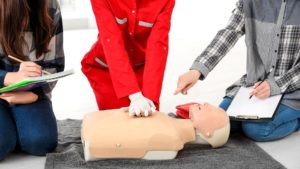
While AEDs are designed to be operable without any formal instruction, completing a CPR and AED training course meaningfully improves outcomes. Training teaches participants to recognize the warning signs of cardiac arrest, call for emergency services promptly, begin CPR correctly, and retrieve and operate an AED without hesitation. Hands-on practice with real AED devices builds the physical familiarity and decision-making speed that separate an effective responder from a bystander who hesitates.
Basic (Emergency) First Aid and CPR/AED certification is designed for the general public, office workers, fitness staff, and anyone who wants foundational life-saving skills. Intermediate (Standard) First Aid and CPR/AED certification goes deeper into complex medical emergencies and is appropriate for designated workplace responders, industrial staff, and those in supervisory roles. Basic Life Support (BLS) certification is intended for healthcare providers, clinical staff, and first responders who require a higher standard of cardiac emergency management. Both Basic and Intermediate certifications are valid for two years from the date of completion.
Coast2Coast First Aid offers AHA-approved training programs as well as American Red Cross-aligned curricula, giving workplaces and individuals the choice of certification standard that meets their compliance requirements. Private and group training options are available for organizations that want to train multiple employees together and build a consistent internal response capability.
| Course Level | Target Audience | Duration | Validity |
|---|---|---|---|
| Basic (Emergency) First Aid & CPR/AED | General public, office workers, fitness staff | 1 Day | 2 Years |
| Intermediate (Standard) First Aid & CPR/AED | Designated workplace responders, industrial staff | 2 Days | 2 Years |
| Basic Life Support (BLS) | Healthcare providers, clinical staff, first responders | 4–5 Hours | 1 Year |
Watch: How to Use an AED in an Emergency
Key Takeaway
An AED detects life-threatening arrhythmias, including ventricular fibrillation and pulseless ventricular tachycardia, and delivers a controlled electrical shock to restore a normal heart rhythm. Used alongside CPR within the first three minutes of cardiac arrest, an AED can increase survival rates by 75% or more. The device provides clear voice prompts and requires no medical training to operate, but first aid training builds the speed and confidence needed to use it decisively in an emergency.
Get Certified in CPR and AED Use
Coast2Coast offers AHA-approved and American Red Cross-aligned CPR/AED and first aid training. Hands-on courses available for individuals, workplace teams, and healthcare professionals.
Frequently Asked Questions: 2026 How an AED Works
Sources & Regulatory References
- American Heart Association (AHA) — CPR and ECC Guidelines 2020, cpr.heart.org
- American Red Cross — CPR/AED for the Professional Rescuer and Healthcare Provider
- Occupational Safety and Health Administration (OSHA) — AEDs in the Workplace Guidance
- California Health & Safety Code §§ 1797.196, 104113 — AED placement and Good Samaritan provisions
- CSA Standard Z1210:24 — First Aid in the Workplace (Canada/U.S. alignment standard)
- Reviewed by: Ashkon Pourheidary, B.Sc. (Hons) Neuroscience — Co-Founder, Coast2Coast First Aid & Aquatics; certified instructor since 2011