
If you’ve started shopping around for CPR certification, you’ve probably noticed the prices don’t line up. One site quotes $15, another wants $150, and neither one tells you why. The honest answer is that CPR certification cost tends to vary depending on three things: the course level you need, whether you take it online, blended, or fully in person, and whether the provider actually includes a hands-on skills check. This guide walks through real Coast2Coast pricing at an affordable price point, how it compares to the wider market, and what actually drives the cost up or down, so you’re not guessing.
Key Takeaways
- Coast2Coast’s California CPR classes generally run $45–$85, depending on the course and format, versus a broader market range of roughly $60–$150 for similar CPR training elsewhere.
- Blended learning, meaning online classwork plus a shorter in-person skills session, costs the same as the fully in-person option here, so pick whichever fits your schedule.
- Every Coast2Coast certification includes a required in-person skills assessment. We don’t sell no-skills-check, fully online CPR certification, because it’s frequently not accepted by employers.
- American Red Cross and American Heart Association certifications are generally valid for 2 years before you’ll need to renew.
- Employers in healthcare, childcare, education, fitness, and construction often cover or reimburse CPR training, so check with HR before paying out of pocket.
What Is CPR Certification, and Why Cost Shouldn’t Be the Only Factor
CPR (cardiopulmonary resuscitation) is the combination of chest compressions and rescue breaths used to keep blood circulation going during cardiac arrest, before paramedics arrive. Learning to perform CPR isn’t complicated, but it does take real practice. A CPR certificate just confirms you’ve been through an accredited CPR class and successfully complete both halves of the evaluation: written theory as part of the certification process, plus a hands-on skills demonstration in front of a certified instructor.
Coast2Coast First Aid & Safety is an American Red Cross Authorized Training Provider and an American Heart Association-aligned training site, delivering OSHA-approved CPR and first aid certification classes across our California locations. That’s a big part of why our CPR classes cost more than a bare-bones online CPR class: your certificate is actually recognized where it counts, whether that’s a hospital HR office, a school district, or a Cal/OSHA compliance review.
The main CPR certification classes we offer are:
- Adult & Pediatric First Aid & CPR classes, available blended or fully in-class
- BLS Provider, a fully in-class CPR certification course built for healthcare professionals
- HeartCode BLS, our blended CPR certification course option, covering the same BLS certification
- Renewal CPR certification classes for both BLS formats, plus a stand-alone in-class CPR test for anyone who’s already completed the online portion elsewhere
Price is worth comparing, but employer acceptance and actually being ready to perform CPR in an emergency matter more than shaving off a few dollars.
Coast2Coast Course Pricing (California)
Here’s what our CPR certification classes and BLS certification courses actually cost, shown as ranges. Every CPR class below leads to a certificate that’s generally valid for 2 years upon successful completion.
| Course | Format | Duration | Price |
|---|---|---|---|
| BLS Provider | Fully in-class | 4 hours | $75–$85 |
| BLS Provider Renewal | Fully in-class (for previously AHA BLS Provider-certified students) | 4 hours | $65–$75 |
| HeartCode BLS | Blended (online coursework + in-class skills) | ~1.5–2 hrs online, 1 hr in-class | $75–$85 |
| HeartCode BLS Renewal | Blended (for previously HeartCode BLS-certified students) | ~1–1.5 hrs online, 1 hr in-class | $65–$75 |
| HeartCode BLS Skills Test only | In-class only, for students who completed the online portion elsewhere | 1 hour | $45–$55 |
| Adult & Pediatric First Aid & CPR (Los Angeles) | Fully in-class | 4 hours | $70–$80 |
| Adult & Pediatric First Aid & CPR | Blended (most popular option) | Up to 2 hrs online, 2 hrs in-class | $70–$80 |
Across the board, most of our California CPR classes land in the $45–$85 range. Blended and in-class versions of the same certification cost the same. You’re paying for the credential, not the delivery method.
One thing to flag if you’re going the HeartCode BLS renewal route: you need a currently valid AHA HeartCode BLS certificate to qualify for the renewal price. If yours has lapsed, you’ll owe the difference up to the full BLS Provider or HeartCode BLS price before we can issue your new certificate.
How Coast2Coast Compares
We’re not going to call out other providers by name, but here’s an honest look at how our pricing and policies stack up against the wider CPR training market:
| Coast2Coast | Typical other CPR training providers | |
|---|---|---|
| BLS Provider (in-class) | $75–$85 | Often $70–$150 |
| Bundled First Aid + CPR/AED | $70–$80 | Often $60–$150 |
| No-skills-check, fully online certificate | Not offered | As low as $15–$70, often not accepted by employers |
| Certificate turnaround | Issued within 48 hours (24-hour express certification available for an added fee) | Often 1–2 weeks |
| Exam or testing fees | Included in course price | Sometimes billed separately |
The gap you’ll see between our price and the cheapest online CPR classes almost always comes down to one thing: a real, proctored, in-person skills check. That’s the part employers, school districts, and Cal/OSHA reviews actually care about, and it’s baked into every CPR class we run at an affordable price, not sold back to you as an add-on.
How Class Format Changes the Price: In-Person, Blended, and Online
Format is one of the bigger factors behind CPR certification cost, since it changes how much instructor time and facility space a course actually uses.
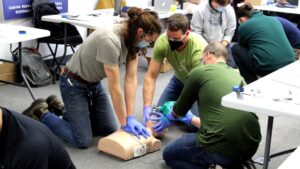
- In-person classes cost more to run, but you get full, hands-on practice with manikins and AED trainers in a traditional classroom setting, under direct instructor supervision the whole time.
- Blended learning combines online learning with a shorter in-person skills session. You get through the coursework around your own schedule, then come in for the in-person portion. We offer blended options across several California courses.
- Fully online CPR classes are the cheapest option out there, but they typically skip the hands-on piece that OSHA-approved employers and licensing bodies actually require.
A few things worth knowing:
- Most California employers still want in-person training sessions as part of the course, even if the theory portion was completed online at home.
- A fully online certificate can work fine as a personal refresher, but it won’t stand in for an OSHA-approved, in-person-verified certificate if an employer or regulator asks for one.
- Online CPR recertification exists for convenience, but hands-on practice is still what makes the difference when you actually need to perform CPR. Our page on how long CPR certification takes breaks down the timing for each format.
Cost by Course Type: BLS Provider vs. HeartCode BLS vs. Skills-Test-Only
- BLS Provider (fully in-class, $75–$85): the standard pick for healthcare providers who’d rather get everything done in a single 4-hour, instructor-led session.
- HeartCode BLS (blended, $75–$85): the same certification split into online coursework you complete at your own pace, plus a 1-hour in-class skills session. Same price, less time in the room.
- Renewal versions of either format ($65–$75): available if your existing AHA BLS Provider or HeartCode BLS certificate is still valid or falls within our renewal window.
- HeartCode BLS Skills Test only ($45–$55): for students who already completed the online coursework somewhere else and just need the in-class, hands-on evaluation.
- Adult & Pediatric First Aid & CPR ($70–$80 in-class in Los Angeles; blended pricing varies by location): our standard course for non-healthcare professionals, most often needed by teachers, coaches, and childcare staff.
The price gap between a renewal and a full initial course reflects the shorter class time. Renewals still require a hands-on skills demonstration, just not a full first-time walkthrough of every topic.
CPR Certification vs. First Aid + CPR Bundles
If your role (teaching, childcare, fitness, coaching) is likely to eventually call for both CPR and first aid certification, the combined Adult & Pediatric First Aid & CPR course is almost always the better value than trying to piece together separate credentials over time. Our First Aid course options page walks through which course options fit which role, so you’re not paying to certify twice.
Hidden Costs to Watch For
Some advertised prices look great until you hit checkout. Watch for:
- Course manuals or digital textbooks billed separately
- CPR pocket masks or personal safety equipment
- Certification card or e-card issuance fees
- Separate exam or retake fees
- Late rescheduling or cancellation charges
- Replacement certification card fees
A transparent provider tells you up front whether materials included in the price cover your manual, testing, and a digital certificate, sometimes with a QR code for quick verification. A very low advertised price from an online-only provider may not include a certificate your employer will accept, which just adds an extra cost later when you have to redo the training somewhere else.
Group, Corporate, and School Pricing
Group bookings bring the per-person cost down noticeably. We offer corporate and group CPR/AED training across our California locations, often sending a certified instructor directly to your workplace or school rather than making everyone travel. Typical discounts scale with group size: expect a lower per-person rate at 8–10 participants, more savings at 20 or more, and further reductions on multi-session contracts.
Schools and youth organizations can lean on group pricing to make CPR training realistic at scale. See why every school should teach students first aid for the case for district-wide programs. Group sessions at more remote sites might carry a small travel fee, but that usually still beats paying for individual enrollment across a whole group.
Online CPR Certification Under $20: Is It Worth It?
You’ll find online CPR certification advertised for as little as $12.99–$20, sometimes with a free adult CPR module thrown in. These online CPR classes are real, and they can be a decent way of learning CPR basics, but many California employers, schools, and regulators won’t accept a certificate that skips the hands-on skills assessment entirely.
We stick to blended and in-person formats that meet OSHA-approved standards rather than selling a no-skills-check, purely online option, because handling a real emergency takes practical skills, not just theory. If you’re after CPR knowledge purely for personal peace of mind, a cheap online course is a reasonable starting point. If you need the certificate for work, confirm your employer will actually accept it before you enroll. Redoing training on a deadline usually costs more than the $30–$50 you saved upfront.
How Long Is Certification Valid, and When Will You Pay Again?
American Red Cross and American Heart Association certifications require renewal roughly every 2 years in the U.S. Renewing on time keeps your CPR certification valid without any gap in coverage. Some employers, particularly in healthcare or other high-risk industries, want more frequent refreshers regardless of what the card technically allows. Keep an eye on your expiration date so you’re not stuck paying rush fees or scrambling to avoid a compliance lapse.
CPR Recertification Cost vs. Initial Certification
Renewing before your card expires is almost always cheaper than starting from scratch. CPR recertification with us:
- Runs $65–$75 for BLS renewal formats, versus $75–$85 for the initial certification
- Still covers updated protocols and a refreshed hands-on skills check
- Takes a few hours, shorter than a full day of formal training the first time around
- Requires the same practical skills demonstration as an initial CPR class, just condensed
If your CPR recertification has lapsed past our renewal window, you’ll need to retake the full course at the standard rate. Organizations tend to save money by scheduling group recertification dates ahead of time rather than letting cards expire one by one.
How Profession and Location Affect What You’ll Pay
- Healthcare providers (nurses, paramedics, dental staff) typically need BLS Provider or HeartCode BLS, which costs more than our standard adult CPR course because of the advanced content healthcare providers are expected to know, including team-based response to cardiac arrest and airway management beyond basic chest compressions.
- Teachers, coaches, and childcare workers most often need the Adult & Pediatric First Aid & CPR certification. See our breakdown of CPR certification requirements for California teachers.
- Larger metro areas like Los Angeles and San Diego tend to have more providers and more competitive pricing than smaller California communities, which may have fewer options but more flexible group scheduling.
- Non-healthcare professionals in lower-risk workplaces typically only need the standard adult CPR and first aid course, with no advanced BLS-level training required.
We run both public and private courses across our California locations, so pricing and scheduling can flex around local demand and class size.
What’s Included in the Cost (and What Should Be)
A fair price should cover everything you need to walk out fully certified:
- A certified instructor with current credentials
- Use of CPR manikins and AED trainers for real practice, not just a video
- Course manual or digital access
- Recognized American Red Cross or AHA-aligned certification on successful completion
- All exam and skills-testing fees
- A digital certificate for easy, instant verification
Be wary of any provider that tacks on a separate “certificate fee” after the fact instead of disclosing it up front.
Ways to Reduce Cost Without Sacrificing Quality
Price matters, but weigh it alongside other factors like instructor quality and schedule fit:
- Book during promotional periods, like back-to-school or workplace safety campaigns
- Put together a small group of coworkers, classmates, or family members to qualify for group pricing
- Choose a blended course where it’s offered, to cut down on both cost and travel time
- Ask your employer or school whether training is subsidized before you pay yourself
- Compare a couple of providers on instructor quality and certificate acceptance, not price alone
- Ask about bundling if your role will eventually require both first aid and CPR/AED certification
Who Pays: You or Your Employer?
A lot of people assume CPR certification is always coming out of their own pocket, but employers frequently cover it because it protects their staff and clients, and in some cases because it helps satisfy OSHA’s medical services and first aid standard, which requires adequately trained personnel on-site when a workplace isn’t near immediate medical care. Hospitals and clinics, construction and manufacturing firms, gyms and fitness centers, schools and daycares, and large event venues are all sectors where employers routinely pay. Read more on the case for employer-funded training. It’s always worth asking HR or your supervisor whether training is covered before you pay out of pocket, especially if it’s a workplace requirement for your role.
Is There an Extra Fee for the CPR Certification Test?
Some online providers charge separately just to access the final exam, then charge again for the printed certificate. Our courses fold all testing and evaluation into the course fee, so there’s no separate charge for the CPR test. Expect a mix of multiple-choice theory questions and a hands-on skills demonstration as part of the certification process, and once you successfully complete both, your certification test results are final. Some online courses tout “unlimited free retakes,” which sounds appealing, but it’s worth confirming the resulting certificate is actually recognized by employers before you rely on that. Treat any surprise “exam unlock” or “card activation” fee as a red flag.
How CPR Certification Cost Compares to the Value of the Skill
More than 350,000 out-of-hospital cardiac arrests happen in the U.S. every year, and immediate bystander CPR can double or triple survival chances. Beyond meeting a job requirement, this is genuinely one of the more practical life saving skills you can pick up: the kind of life saving techniques that help you stay prepared and feel confident stepping in for a family member, a coworker, or a stranger. In such situations, every second counts, and knowing CPR can save lives long before paramedics arrive. See why parents need first aid and CPR. It’s also a gateway credential for careers in healthcare, fitness, aquatics, and childcare. Compared to professional licensing fees or tuition, the cost of CPR training is small next to what it can do when it actually matters.
What Sets Coast2Coast’s CPR Classes Apart
Coast2Coast First Aid & Safety is an American Red Cross Authorized Training Provider and American Heart Association-aligned training site, running First Aid, CPR/AED, and BLS courses that teach real lifesaving skills to healthcare workers and non-healthcare professionals alike across California, including Los Angeles, Long Beach, San Diego, Sacramento, San Jose, and more.
Here’s what you’re actually paying for:
- OSHA-approved training that California employers recognize
- Certificates issued within 48 hours of finishing your course
- No separate exam, testing, or certificate-issuance fees tacked on afterward
- Real CPR manikins and AED trainers, not just a screen
- Experienced, currently-certified instructors
- Blended and in-person course options, so you can pick what fits your schedule
- Corporate, school, and private group training delivered on-site
Reach out and we’ll help you find current pricing, group rates, and the most cost-effective course for what you actually need.
How to Choose the Right Class for Your Budget
Before you start comparing prices:
- Get clear on your goal: a job requirement, personal safety, or a school obligation.
- Identify the certification level you actually need (Adult & Pediatric, BLS Provider, or HeartCode BLS).
- Decide whether in-person or blended fits your schedule better.
- Confirm the provider is OSHA-approved and Red Cross- or AHA-aligned, and that the certificate meets your workplace requirements.
- Compare a couple of providers on instructor quality and reviews, not just the lowest number on the page.
Not sure which course fits your role? We can help you figure out which course you need.
Special Cost Considerations for Schools, Youth, and Parents
Schools and parents deal with tighter budgets and trickier scheduling, but they stand to gain the most from getting CPR skills into more hands across different age groups. We can tailor training to a school’s own schedule, breaking it into shorter modules spread across a few days to keep costs manageable for larger groups. Youth and babysitting-focused courses typically cost less per participant than a full adult workplace course, and some school boards or parent groups will subsidize CPR programs through safety grants. Self-paced online coursework, completed at your own pace, can also cut down on classroom disruption. Skills learned this young tend to stick. Kids who train early carry that readiness with them for life.
Is CPR Certification Tax-Deductible or Reimbursable?
Job-required training, including CPR and first aid certification, may be reimbursed by an employer or written off as a business expense if you’re self-employed, personal trainers and independent consultants, for instance. Ask your employer whether training counts as a reimbursed expense or a taxable benefit, and hang onto your receipts either way. We don’t offer tax advice here; check with the IRS or a tax professional for guidance specific to your situation.
How to Budget for CPR Certification Over 5 Years
- Count how many people actually need certification.
- Figure out which level each role requires: standard CPR, First Aid & CPR, or BLS.
- Confirm your recertification cycle (every 2 years for most Red Cross and AHA certifications).
- Multiply your current course price by how many renewal cycles fall within five years.
- Set aside a line item for it in your annual safety or HR budget.
As an example: if 10 staff need the Adult & Pediatric First Aid & CPR certification at $70–$80 each, renewed once over five years, you’re looking at roughly $1,400–$1,600 for two full cycles, less than that if you take advantage of group and recertification pricing.
Frequently Asked Questions
Question 1: Is the cheapest CPR certification always a bad idea?
Answer: Not necessarily. A low-cost or free course can be a fine way to start learning CPR. The real question is whether the resulting certificate is accepted by your employer or regulator. An ultra-cheap online course that isn’t recognized can end up costing more once you have to redo it through an OSHA-approved provider. Confirm acceptance before you enroll.
Question 2: Can I get CPR certified for free in California?
Answer: Fully free, employer-recognized certification isn’t common, but some community programs, schools, and employers sponsor training and cover the fee for participants. It’s worth checking whether your employer, union, or school has funding set aside for this.
Question 3: Do I have to pay again if I fail the certification test?
Answer: Many providers, including us, allow extra practice and re-evaluation within the same course fee rather than charging new tuition. If you end up needing to repeat the entire course on a different date, standard fees may apply, so ask about the retake policy before you enroll.
Question 4: Why does BLS cost more than the standard Adult & Pediatric course?
Answer: BLS Provider and HeartCode BLS cover more advanced skills for healthcare settings (team-based resuscitation, bag-valve-mask use, airway management) and require more qualified instructors and more course time than the standard Adult & Pediatric First Aid & CPR certification most non-healthcare professionals need.
Question 5: Does Coast2Coast offer discounts on multiple certifications?
Answer: We regularly run group discounts, corporate rates, and seasonal promotions. Bundling first aid and CPR/AED, or combining staff certification with other safety training, is usually the easiest way to bring the per-person cost down. Get in touch for current promotions and group pricing.