
What Is Blended Learning CPR?
Blended learning CPR splits a CPR course into two parts. First you complete an online lesson at your own pace, usually made up of videos, short quizzes and a written test. Then you attend a short in-person session, where an instructor watches you practise compressions, rescue breaths and AED use on a manikin and confirms that you can perform each skill correctly.
The idea is simple: use the internet for the theory and a real person for the physical skills. Employees spend less time in a classroom, and the instructor can spend the session coaching technique rather than lecturing. Many major training organizations offer blended learning formats, including the American Heart Association and the American Red Cross.
This matters for employers because CPR is a physical skill. You cannot learn how deep to push or how fast to compress by watching a screen. Blended learning CPR keeps the practical part that makes the card meaningful while trimming classroom time.
This guide explains how blended learning CPR compares with fully online and fully in-person courses, what OSHA has said about hands-on training, and what most employers accept. It also covers how to choose a format for a team, how long cards last and how to avoid buying a card that will not be recognized.
If you want to compare course options as you read, you can browse our CPR and AED courses.
Blend Online Learning With Hands-On Practice
Complete the theory online, then finish certification with in-person skills practice.
How Does Blended Learning CPR Work Step by Step?
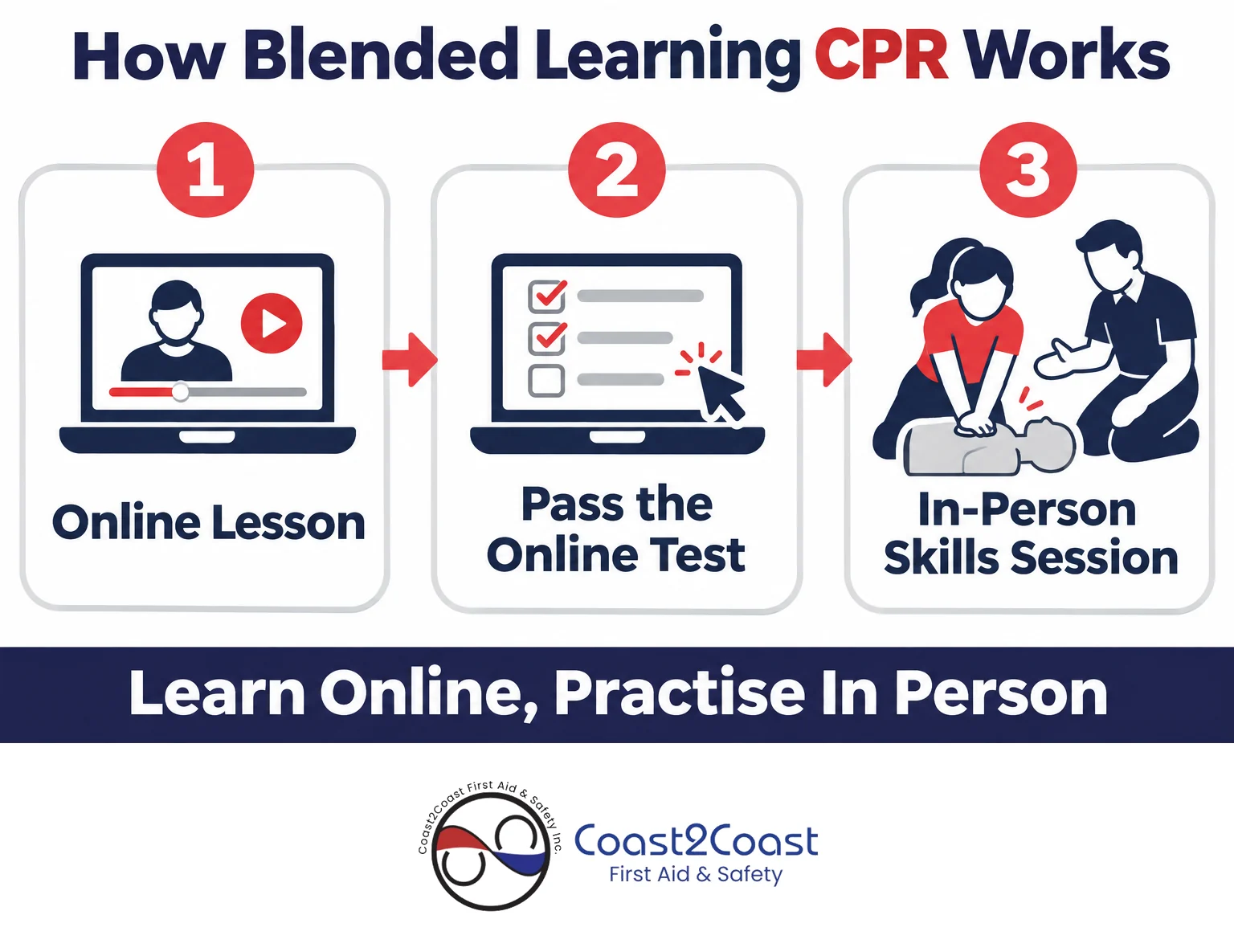
The process for blended learning CPR is similar across providers, although the details vary. Knowing the steps helps you plan around work schedules and avoid surprises.
First, you register for a blended course and receive access to the online lesson. This part includes videos that demonstrate chest compressions, rescue breaths, AED use and choking relief, along with knowledge checks. Most learners finish it in a couple of hours, and you can usually pause and return later.
Second, you pass the online assessment. Providers set a minimum score, and you can often retake it. When you finish, you receive a completion record that you bring to the skills session. This record is not a certification card on its own.
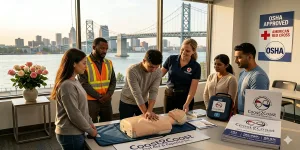
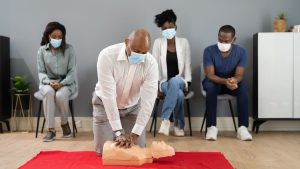
Third, you attend the in-person skills session. An instructor guides you through compressions, breaths, AED use and, depending on the course, child and infant techniques. You practise on manikins and receive feedback until your skills meet the standard. The session is usually much shorter than a full classroom course.
Finally, you receive your certification card after the instructor confirms your skills. Cards are typically valid for two years, so note the expiry date and plan a renewal before it lapses.
Get Hands-On CPR and AED Practice
Work with real manikins and AED trainers while an instructor coaches your technique.
Why Does Hands-On Practice Matter in CPR Training?
CPR is a motor skill, much like riding a bike or performing a first aid bandage. You learn it by doing it, receiving feedback and repeating until it feels natural. Effective compressions need the right depth, speed, hand position and recoil, and none of these can be checked through a screen.
Practising on a manikin builds muscle memory and shows you how much force is needed. Many learners are surprised at how hard they must push. An instructor can correct hand placement, posture and rhythm in the moment, which prevents bad habits from forming. Feedback manikins can also show depth and rate in real time.
Hands-on practice also builds confidence. People who have physically performed compressions and used a training AED are more likely to act in a real emergency. Hesitation costs seconds, and seconds matter in cardiac arrest. Reading about CPR is useful, but practising it is what makes people ready.
That is why most recognized CPR training includes a hands-on component, and it is why employers and regulators are cautious about courses that skip it.
Learn First Aid Skills in a Real Classroom
Hands-on first aid training with real equipment and an instructor guiding every skill.
What Does OSHA Say About Online-Only CPR Training?
OSHA has addressed this question directly. In an official interpretation letter on first aid and CPR training, OSHA stated that online-only training does not meet its expectations, because first aid and CPR are physical skills that can only be learned by practising them. The agency explained that training should build proficiency through instruction and practice, and it pointed employers to its guidance on workplace first aid programs, which recommends hands-on practice with manikins.
In plain terms, a course with no hands-on component and no instructor checking your performance is unlikely to satisfy an OSHA-based workplace requirement. That is the main reason fully online CPR cards are risky for employers.
It is worth being precise about what OSHA does and does not require. The general first aid standard, 1910.151, requires that when no infirmary, clinic or hospital is in near proximity, a person or persons adequately trained in first aid must be available. It does not name a specific course or provider. Instead, OSHA’s guidance and letters explain what adequate training looks like, and hands-on practice is central to that.
Some industry standards go further. Certain standards, such as those for logging and diving, require practical exercises or skill verification. If your industry has its own standard, check it directly rather than assuming a general rule applies.
Because requirements differ, employers should also check state rules, licensing boards and insurer expectations. A card that satisfies one requirement may not satisfy another, and the safest approach is to choose training with an in-person skills check.
Learn First Aid and CPR Together
Build workplace first aid skills with an instructor who checks your technique in person.
How Do Blended, Online-Only and In-Person CPR Compare?
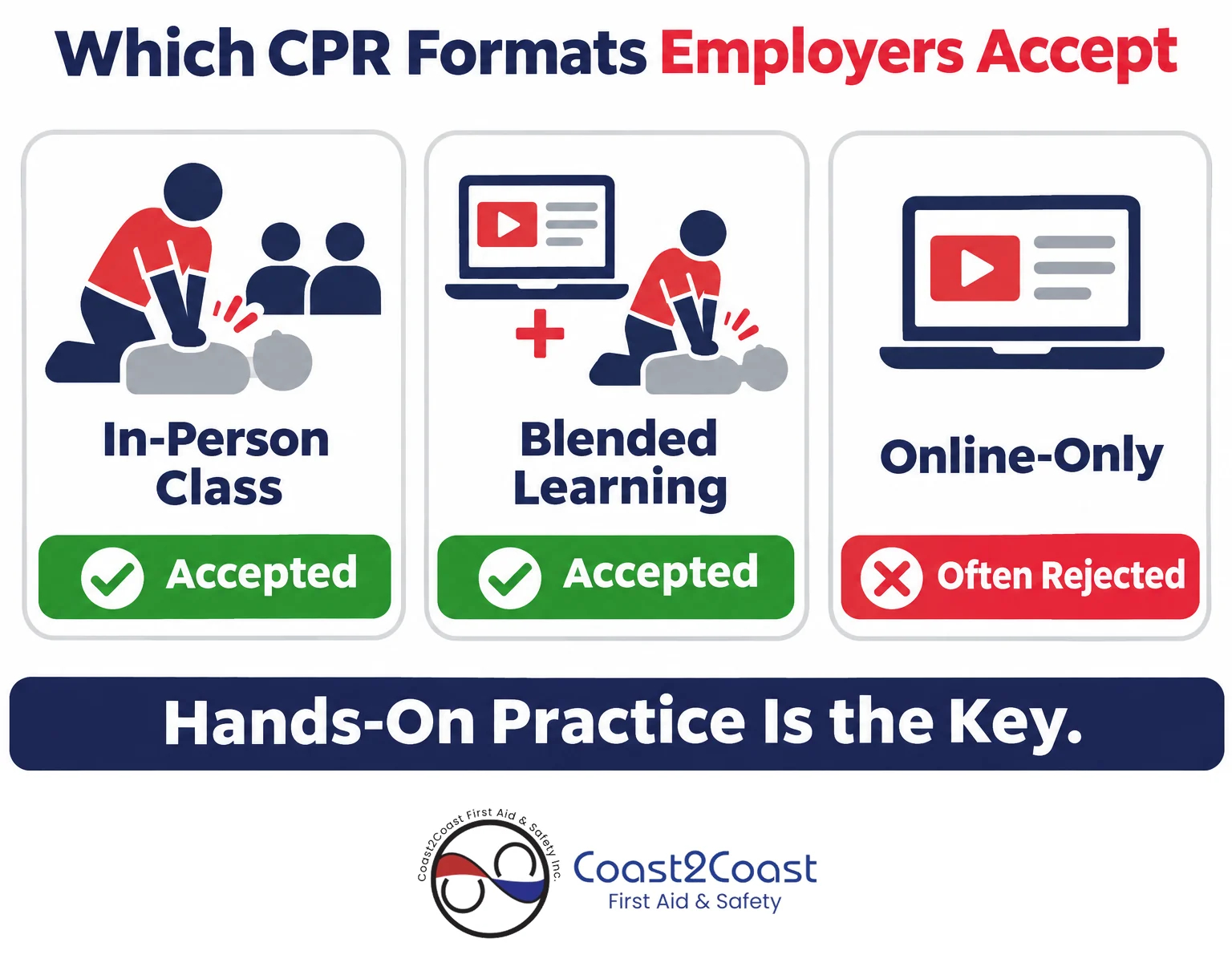
The three formats differ mainly in how much hands-on practice they include and how accepted the resulting card is. Seeing them side by side makes the trade-offs clear.
Fully in-person CPR courses take place entirely in a classroom or at your workplace with an instructor. They include theory, demonstration and extended practice, and they usually last several hours. They suit teams that prefer to learn together, first-time learners and roles that need first aid skills alongside CPR.
Blended learning CPR moves the theory online and keeps a shorter in-person skills session. It saves time for busy employees and gives instructors more time to coach technique. It suits renewals, shift workers and people who like to learn at their own pace.
Online-only CPR courses are completed entirely on a screen, with no manikin and no instructor assessment. They are convenient and often cheaper, but they lack hands-on practice, which is why OSHA has said they do not meet its expectations and why many employers reject them.
For most workplaces, the choice comes down to blended learning CPR or a full in-person class. Both include real practice with a qualified instructor. The right option depends on your team’s schedule, experience and how much classroom time you can spare.
If your goal is simply to learn the skill for personal confidence, any format may be useful. If the card must satisfy an employer, regulator or licensing body, choose a format that includes hands-on practice and an instructor sign-off.
Blend Online Learning With Hands-On Practice
Complete the theory online, then finish certification with in-person skills practice.
Which Employers and Roles Accept Blended Learning CPR?
Acceptance depends on the employer and the role, so it pays to check before you enrol. Still, some patterns are common.
Healthcare roles usually require Basic Life Support, or BLS, with an in-person skills check. Hospitals, clinics, dental offices and long-term care facilities typically accept blended BLS formats as long as the skills session is completed with a qualified instructor. They rarely accept online-only cards.
General workplaces such as offices, warehouses, factories and retail stores usually accept blended learning CPR and in-person CPR for their first aid programs. Many safety managers prefer them because the skills session gives proof that employees can perform CPR.
Education and childcare settings often require CPR that includes child and infant skills, practised on the right manikins. Coaches, lifeguards, fitness instructors and security staff also tend to need cards with hands-on verification.
Construction and industrial employers often tie CPR and first aid to site safety rules. Many require a certificate that shows a hands-on component, and some require specific provider names. Ask your safety lead or contract documents what is needed.
When in doubt, ask. A short email to HR, a licensing board or a client’s safety office can save you from repeating a course. Ask whether they accept blended learning, whether they require specific providers and how long the card must remain valid.
Learn CPR and AED in a Real Classroom
Practise compressions, breaths and AED pad placement with a certified instructor.
How Can You Spot a CPR Course That Employers May Reject?
Some online sellers advertise instant CPR cards with no practice, and employees sometimes buy them without realizing the risk. A few warning signs help you avoid wasted time.
The most obvious is the absence of any in-person step. If a course says you can finish entirely online and print your card immediately, it has no hands-on component. That is the format OSHA has said does not meet its expectations.
Another sign is vague language about acceptance. Phrases such as “nationally accepted” or “meets all requirements” are not guarantees. Acceptance is decided by your employer, regulator or board, not by the seller. Ask for a clear statement of what the course includes and what organization sets its standard.
Be cautious of very low prices and instant delivery, unclear instructor details and missing contact information. Established providers explain who teaches the skills session, where it takes place and how long the card is valid.
Finally, check the card details. A reliable certification card lists the course name, the issue and expiry dates and the issuing organization. If you cannot tell what you will receive, ask before you pay.
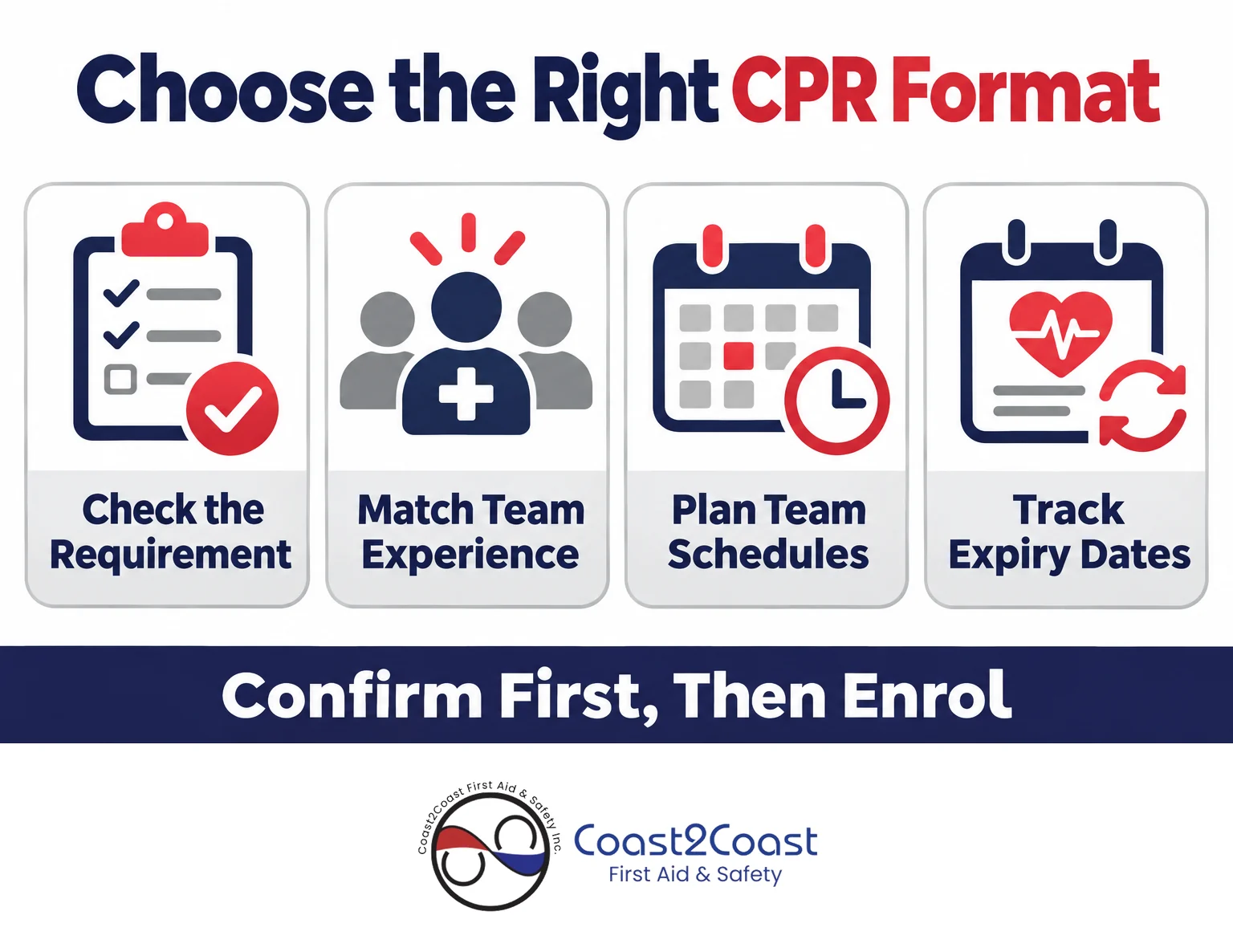
The simplest protection is to confirm the requirement first, then pick a course that matches. If the requirement mentions hands-on practice or skills verification, choose blended learning CPR or an in-person class.
Train Your Whole Team
Private group sessions for your workplace, with training scheduled around your team.
How Do You Choose the Right CPR Format for Your Team?
For employers, the right format balances compliance, time and cost to the business. A few questions help you decide quickly.
Start with the requirement. Does your industry, insurer or client specify a standard, a provider or a hands-on component? If so, choose the format that meets it. If not, choose a format with a hands-on component anyway, because it protects employees and your organization.
Consider your team’s experience. New employees benefit from a full in-person course, where they can ask questions and practise longer. Experienced staff renewing a card often do well with blended learning CPR, because they already know the basics.
Think about schedules. Shift workers and remote teams may find it easier to complete the online lesson on their own time. A single group skills session can then be arranged at your workplace. Our private group training lets you bring an instructor to your team, which reduces travel and downtime.
Choose the right course content. CPR and AED are the core, but many workplaces also need first aid skills for bleeding, burns, choking and medical emergencies. A combined first aid and CPR course covers both. Healthcare staff will need BLS rather than a general CPR card.
Plan for renewals. Cards are typically valid for two years, so track expiry dates in a shared calendar and schedule renewals before they lapse. A simple tracker prevents compliance gaps.
Train Your Whole Team
Arrange a private group session at your workplace with hands-on practice for every employee.
What Topics Does a Workplace CPR Course Cover?
A good workplace course covers more than chest compressions, and knowing the content helps you judge whether a blended learning CPR course fits your needs. The core topics are recognizing cardiac arrest, calling 911 early, performing high-quality compressions and rescue breaths, and using an automated external defibrillator, or AED.
Many courses also teach choking relief for adults, children and infants. Choking is a common workplace emergency, particularly in food service, childcare and care settings, and the techniques differ by age. If your employees work around children, make sure the course includes child and infant practice on the right manikins.
Some courses add first aid content, such as controlling bleeding, treating burns, recognizing stroke and responding to seizures or severe allergic reactions. These topics are valuable in workplaces where injuries are possible. A combined course saves time because employees learn everything in one program.
Finally, good courses teach teamwork. In a real emergency, several people may help at once, so learning to take turns on compressions and use the AED together reduces delays and fatigue. Ask providers whether team practice is part of the skills session.
Know What to Do Before Help Arrives
CPR/AED training builds the muscle memory that reading alone cannot.
How Long Does Blended Learning CPR Take, and When Should You Renew?
Time is the main reason employers choose blended learning CPR. The online lesson usually takes a couple of hours and can be spread over several days. The in-person skills session is much shorter than a full course, often around an hour or two depending on the content and group size.
Compared with a full classroom course, this reduces the time employees spend away from work, although the total learning time is similar. The difference is that people choose when to study, and the instructor’s time is spent on practice rather than presentation.
Most CPR cards are valid for two years. After that, you need to renew to stay current. Renewal courses are often shorter than the original, and many are available in blended formats. Do not wait until the last day, because classes can fill up and expired cards may no longer satisfy your employer.
Skills fade quickly, even before your card expires. Studies of CPR retention show that many people lose accuracy within months of training. Short refresher practice, such as reviewing the steps or practising compressions on a manikin, helps keep skills sharp. If your workplace has an AED, make sure staff know where it is and how to use it.
Finally, keep records. Store certificates in a central file, note expiry dates and share them with your safety lead. Good records show regulators and insurers that your training program is in order, and they make it easy to answer questions after an incident. A shared spreadsheet with names, course dates, card numbers and expiry dates is usually enough, provided someone is responsible for checking it each quarter.
Blend Online Learning With Hands-On Practice
Complete the theory online, then finish certification with in-person skills practice.
Key Takeaway
Blended learning CPR pairs an online lesson with an in-person skills session, giving employees flexibility without losing the hands-on practice that makes CPR training meaningful. Online-only courses skip that practice, and OSHA has said that training without a hands-on component does not meet its expectations. Before you enrol, confirm what your employer or licensing body accepts, choose a format with an instructor sign-off, and track card expiry dates so your team stays current.
Join Thousands of Certified Responders
Healthcare roles often require BLS, which includes an in-person skills check.
Frequently Asked Questions: Blended Learning CPR 2026
Q1: What is blended learning CPR?
A: Blended learning CPR is a two-part course. You complete an online lesson and written test at your own pace, then attend a short in-person skills session where an instructor watches you practise compressions, breaths and AED use on a manikin. The instructor confirms your skills before issuing a card. It offers flexibility for busy employees while keeping the hands-on practice that makes the training meaningful.
Q2: Does OSHA accept online CPR certification?
A: No. Not when the course is online only. OSHA has stated in an interpretation letter that first aid and CPR training without a hands-on component does not meet its expectations, because these are physical skills learned by practice. A course with no manikin practice and no instructor check is unlikely to satisfy a workplace requirement based on OSHA guidance.
Q3: Is blended learning CPR valid for employers?
A: Usually. Most employers accept blended learning CPR because it includes an in-person skills session with an instructor. Acceptance still depends on your employer, industry and licensing body, so confirm in writing before you enrol. Healthcare employers often require BLS with an in-person skills check, which blended formats can provide, but they rarely accept online-only cards.
Q4: How long does blended learning CPR take?
A: The online lesson typically takes a couple of hours and can be completed over several days. The in-person skills session is shorter than a full classroom course, often one to two hours depending on content and group size. Total time varies by course type and provider, so check the course details, and ask whether the skills session can be scheduled at your workplace for a group.
Q5: What is the difference between blended learning CPR and online-only CPR?
A: Blended learning CPR includes an in-person skills session where an instructor assesses you on a manikin. Online-only CPR has no hands-on practice and no instructor assessment. That difference is why blended cards are widely accepted by employers, while online-only cards are often rejected and do not meet OSHA expectations for hands-on training.
Q6: How long is a CPR card valid?
A: Most CPR and AED certification cards are valid for two years, although some courses differ, so check the expiry date on your card. Renew before it lapses, because many employers do not accept expired cards. Renewal courses are often shorter than the original and may be available in blended formats, so ask your provider early.
Q7: Do I need a skills session for CPR certification?
A: Yes. If you need a card that employers or regulators will accept. A skills session lets an instructor confirm that you can perform compressions, breaths and AED use correctly. Courses without one are usually treated as awareness training rather than certification, and many workplaces, regulators and insurers will not accept them as proof of training.
More FAQs: Employer Acceptance, Cards and Renewals
Q8: What does a CPR skills session involve?
A: You practise compressions, rescue breaths and AED use on manikins while an instructor watches and coaches. Depending on the course, you may also practise child and infant techniques, choking relief and team response. You repeat each skill until it meets the standard, and the instructor then confirms your results and issues your card once everything is complete.
Q9: Can I do BLS through blended learning?
A: Yes. Many BLS courses are offered in blended formats with an online lesson and an in-person skills check. Healthcare employers usually require this skills check, so online-only BLS cards are rarely accepted. Confirm with your employer or licensing board which provider and format they require before enrolling, and keep the card details in your records so you can show them at renewal.
Q10: How do I know whether my employer accepts my CPR card?
A: Ask your employer, HR team or licensing body what they accept, and request the answer in writing. Ask whether blended learning is allowed, whether specific providers are required and how long the card must remain valid. Keep that reply with your training records so you can show it later if an auditor, insurer or new manager asks.
Q11: Is online-only CPR ever acceptable?
A: It can be useful for personal learning or as an awareness refresher, but it is rarely accepted for workplace requirements. Because it has no hands-on practice, OSHA has said it does not meet its expectations for first aid and CPR training. If a card must satisfy an employer or regulator, choose blended or in-person training.
Q12: Can a whole team do blended learning CPR together?
A: Yes. Employees can complete the online lesson individually, then attend one group skills session at your workplace or a training location. This reduces classroom time, travel and scheduling headaches for managers. Group sessions also let teams practise responding together, which can improve confidence in a real emergency and make scheduling easier for managers.
Q13: What should I bring to a CPR skills session?
A: Bring your online course completion record, photo ID if required and comfortable clothing, since you will kneel on the floor and perform compressions. Arrive on time, and tell the instructor about any injuries or health concerns beforehand so they can adapt the practice. Follow any instructions from your provider, and ask in advance whether you need to bring anything else.
Q14: How often should employees refresh their CPR skills?
A: Cards usually last two years, but skills fade sooner. Short practice sessions every few months help employees stay accurate and confident. Review the steps, practise compressions on a manikin when possible and make sure staff know where the AED is located and how to use it. Renew the card before it expires, and keep a record of the new expiry date in your training file.
Q15: Which CPR course should my workplace choose?
A: Start with your requirement. If none is specified, choose a course with hands-on practice, such as blended learning CPR or an in-person class. Add first aid content if employees may face bleeding, burns or medical emergencies, and choose BLS for healthcare roles. Plan group sessions at your workplace to reduce downtime.
Reviewed & Sourced
Reviewed by Coast2Coast Certified CPR Instructor.
Sources: OSHA, Letter of interpretation on first aid and CPR training requirements (August 2, 2012). OSHA general industry standard 1910.151, Medical services and first aid.