

- Length
8 hours
- Who it covers
-
Employers with five workers or fewer on any one shift
The only band the shorter course satisfies.
- What you learn
-
- Recognizing an emergency and activating EMS 911
- Severe bleeding, wound care and shock
- Choking and the recovery position
- CPR/AED Level C — adult, child and infant
- Certificate
Canadian Red Cross, valid 3 years
Ontario Employers · WSIB-Approved Training Provider
Workplace Safety and Insurance Act: Regulation 1101
If the Workplace Safety and Insurance Board covers your business, an injured worker can file a claim — and you are expected to have a first aid station, a stocked first aid box and a certified worker in charge of it before that day arrives. Regulation 1101 sets the list. Below is what it asks for, which course produces the certificate, and how to train a whole shift in one session at your own address.
 4.9
4.9
At a glance
What the regulation asks of you
- The regulationR.R.O. 1990, Reg. 1101, under the Workplace Safety and Insurance Act
- Who it coversOntario employers covered by the WSIB
- The training dutyA worker certified in first aid in charge of each station
- Certificate termCanadian Red Cross certificate, valid 3 years
- Private groupsEight or more, at your address, on your date
The Regulation
What Is Regulation 1101?
Regulation 1101 is the regulation under the Workplace Safety and Insurance Act that tells covered Ontario employers what first aid equipment, facilities and trained workers they must keep on site. What it asks for grows with the number of workers on a single shift, not the size of your payroll. A warehouse with forty names on the books but never more than five people working at once sits in the smallest band.
- Citation
- R.R.O. 1990, Reg. 1101
- Made under
- The Workplace Safety and Insurance Act
- Counted by
- Workers on a single shift
- Certificate
- Canadian Red Cross, valid 3 years
Section 1 — First aid stations Quoted in full
A first aid station shall contain,
- (a) a first aid box containing the items required by this Regulation; and
- (b) a notice board displaying,
- (i) the Board’s poster known as Form 82,
- (ii) the valid first aid certificates of qualification of the trained workers on duty, and
- (iii) an inspection card with spaces for recording the date of the most recent inspection of the first aid box and the signature of the person making the inspection.
A first aid station shall be in the charge of a worker who works in the immediate vicinity of the first aid station and who is qualified in first aid to the standards required by this Regulation.
First aid stations shall be so located as to be easily accessible for the prompt treatment of any worker at all times when work is in progress.
R.R.O. 1990, Reg. 1101, s. 1 (1)–(3) Read it on Ontario e-Laws →
Subsection (2) is the line that costs money. The station has to be in the charge of somebody holding a valid first aid certificate who works close enough to reach it. One certified worker covers one station on one shift, so employers running evenings or weekends certify several people. The full text sits on Ontario e-Laws, and the WSIB publishes its own guidance on first aid requirements. For the box contents and the first aid room, see our WSIB compliance page.
The Training Duty
Which First Aid Certificate Meets Regulation 1101?
Regulation 1101 names a first aid certificate, and which of the two you need depends on how many workers are on a shift. Five or fewer, and Basic/Emergency First Aid is enough. Above five it asks for Intermediate/Standard First Aid, which is why the majority of workplaces require Intermediate first aid certification. Both come from the Canadian Red Cross and both are valid for three years.
- Length
16 hours
- Who it covers
-
Employers with more than five workers on a shift
Our top-selling course, and the level most Ontario employers book.
- What you learn
-
- Everything in the 8-hour course, with more practice time
- Bone, muscle and joint injuries, and splinting
- Head and spinal injuries
- Sudden medical emergencies, poisons and using a naloxone kit
- Environmental injuries such as heat illness and frostbite
- Certificate
Canadian Red Cross, valid 3 years
A standalone CPR/AED certificate does not satisfy Regulation 1101, at any level. Neither does Basic Life Support on its own. CPR/AED Level C — adult, child and infant — is taught inside both first aid courses, so it is part of the certification rather than a shortcut past it. Book a CPR/AED course when resuscitation training alone is what your team needs, and a first aid course when the station has to be staffed.
After an Injury
What Employers Must Do When a Worker Gets Hurt
Seven duties start the moment a worker is injured, and the first happens before any form is opened. The station and the certificate exist so that first one is possible at all.
-
Give first aid immediately
Bandaging, cleaning a cut, an ice pack — whatever the injury calls for, from the worker qualified to give it.
-
Give the worker a record
A record of the treatment given, or of the advice offered if none was needed.
-
Arrange the transportation
Transport home, to a doctor or to hospital when the worker needs it. That cost is yours.
-
Complete WSIB Form 7
If the worker gets health care, fill out Form 7, return it to them within three days and send a copy to the WSIB.
-
Pay the day of the injury
All wages and benefits, paid for the day the worker was hurt.
-
Send the Functional Abilities Form
Form 2647 goes to the worker’s health care provider.
-
Help them back to work
Assist with the reintegration process rather than waiting for them to come back alone.
Private & Group Training
Private First Aid Training at Your Workplace
Groups of eight or more can have a Canadian Red Cross instructor come to their own address instead of sending people out one at a time. One session, one invoice, every station covered the same day. We bring the manikins and the automated external defibrillator trainers; you pick the date, the time and the room.
Step 1
Count the shift
How many people work at once, not how many are on the payroll. That number sets the level.
Step 2
Send the inquiry
Fill in the private training form. A representative replies within 24 hours with dates and a quote.
Step 3
We come to you
The instructor arrives with the equipment on your date. Two to three weeks’ notice gives the widest choice.
Step 4
Certificates land
Digital Canadian Red Cross certificates follow within 48 hours of the skills evaluation, ready for the notice board.
-
Courses your group can book privately
Basic/Emergency First Aid with CPR/AED Level C, Intermediate/Standard First Aid with CPR/AED Level C, first aid and CPR/AED recertification, CPR/AED alone at Level A or Level C, Basic Life Support, and Child Care First Aid. First responders, nurses and other medical professionals teach our classes, and every class is taught by a Canadian Red Cross instructor.
-
Fully in person, or blended
Run the whole course in your own boardroom, or have your team complete the online portion of the training first and shorten the day on site. Either route ends with hands-on skills testing with an automated external defibrillator, and every booking includes a free 90-day skills practice retake.
Studying online on its own will not produce the certificate your station needs. A self-paced module carries no skills evaluation, and the certificate Regulation 1101 asks for follows a practical assessment in front of an instructor. Fewer than eight people? Register them into a public first aid course instead — over 200,000 participants have trained with us across North America, and we run 100+ courses every week.
Awards & Recognition
Recognised as a Top 3 Canadian Red Cross Training Partner for 2023, 2024, 2025 consecutively.
2025 · National First Aid & CPR Provider
2025 · National Professional Responder Provider
2025 · Top 3 National Training Provider
2025 · Top 3 Provincial Training Provider
2024 · National First Aid & CPR Provider
2024 · National Professional Responder Provider
2024 · Top 3 National Training Provider
2024 · Top 3 Provincial Training Provider
2023 · National First Aid & CPR Provider
2023 · National Professional Responder Provider
2023 · Top 3 National Training Provider
2023 · Top 3 Provincial Training Provider
Why Coast2Coast
Why Ontario Employers Book Their Groups With Us
Anybody can sell you a class. Compliance turns on who issues the certificate, how fast it arrives, and whether the date suits the shift you are trying to cover.
Testimonials
What Students Say About Our Training
Reviews From Our Students
4.9
Google
-
Rutugandha Sulay Coast2Coast Student
★★★★★
Had a good experience with CPR and intermediate first aid course. Well-organized, great instructor, easy to learn.
-
Ayesha Writes Coast2Coast Student
★★★★★
I got my First Aid and CPR certificate through this company, and it was a wonderful experience. The instructor was very kind, knowledgeable and helpful.
-
Alexander Natale Coast2Coast Student
★★★★★
It was an overall very welcoming experience. My instructor made it both entertaining and interactive while emphasizing the key points of first aid and CPR.
-
Sadia Jaffer Coast2Coast Student
★★★★★
The training materials and instruction were excellent. Our coach explained concepts through real-life examples and kept checking our engagement throughout.
-
Desireh Baghdassarian Coast2Coast Student
★★★★★
Our instructor was resourceful and professional, and presented important information in detail. Now I know I can be helpful with my skills.
Verified Reviews from Our Students
Student Feedback
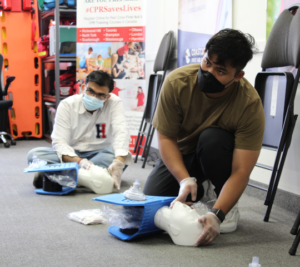
Inside the Classroom
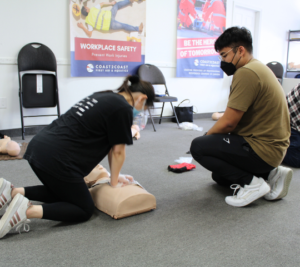
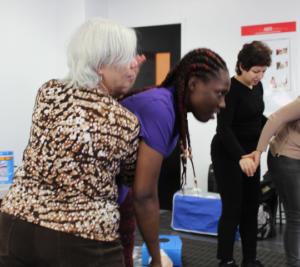
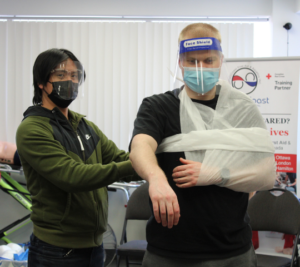
What a Group Session Looks Like


Common Questions
Regulation 1101 Questions, Answered
What is Regulation 1101?
Regulation 1101 is the regulation under the Workplace Safety and Insurance Act that sets the first aid equipment, facilities and trained workers every covered Ontario employer must provide. Section 1 covers the station, the first aid box, the Form 82 notice board and the certified worker in charge of it. Later sections scale the requirement by how many workers are on a shift. Our WSIB compliance page works through the box contents band by band.
How many of my workers need first aid certification?
Every first aid station must be in the charge of a certified worker who works in the immediate vicinity, at all times when work is in progress. One certificate covers one station on one shift, so a business running two shifts needs at least two certified people. Employers on rotating schedules certify several workers per station so holidays and sick days do not leave a gap.
Does a CPR certificate meet the WSIB first aid requirement?
A standalone CPR/AED certificate does not satisfy Regulation 1101, at any level. The regulation names a first aid certificate: Basic/Emergency First Aid where five workers or fewer are on a shift, Intermediate/Standard First Aid above that. Basic Life Support on its own does not satisfy it either. CPR/AED Level C covers adult, child and infant and is taught inside both first aid courses, so it is part of the certification rather than a substitute for it. See CPR/AED courses if resuscitation training alone is what you need.
Is Intermediate First Aid the same as Standard First Aid?
Yes — Intermediate First Aid and Standard First Aid are two names for the same 16-hour course. The Canadian Red Cross changed the wording, so older certificates read Standard and newer ones read Intermediate, while Regulation 1101 still uses the older phrasing. Both include CPR/AED Level C, and both are the level the regulation asks for once more than five workers are on a shift. Dates for either sit on the first aid courses page.
How many people do we need to book private group training?
Private and group training is for eight or more people training together. Below that number it usually costs less to register your team into a public course, and we run 100+ courses every week across our Ontario facilities. Send the inquiry either way and our team will tell you which route suits the headcount you have.
Do you come to our workplace, or do we travel to you?
A Canadian Red Cross instructor comes to the address you choose, with the manikins and the automated external defibrillator trainers. Nobody loses half a day to travel, and you pick the date and the start time. Booking two to three weeks ahead gives the widest choice.
You can also send a group to one of our facilities if your own space will not take a class. Say which you prefer on the inquiry form and a representative replies within 24 hours.
How long is the certificate valid, and how fast will we get it?
The Canadian Red Cross first aid certificate is valid for three years, and the digital copy is issued within 48 hours of the skills evaluation. Print it for the notice board, where subsection 1(1) asks for the valid certificates of the trained workers on duty. Book a recertification course before the three years are up so the station is never left uncovered.
Can our team meet the requirement with an online course?
Studying online on its own does not produce a certificate that satisfies Regulation 1101, because a self-paced module carries no skills evaluation. Your team completes the online portion of the training at home, then attends a shorter in-class session for the practical half, ending in hands-on skills testing with an automated external defibrillator. The certificate issued after that session is the one your station needs.
Is Coast2Coast a WSIB-approved first aid training provider?
Coast2Coast is a WSIB-approved training provider and a Top 3 Canadian Red Cross Training Partner. Our first aid courses produce the Canadian Red Cross certificate Regulation 1101 accepts, at both workplace sizes, and your team is assessed against the Canadian Red Cross standard whether they train on our site or yours. Not sure which level you need? The course finder sorts it by job.
Set up your course now
Tell us how many people work a single shift and we will tell you which certificate Regulation 1101 asks for, then bring the class to you.