
In Toronto, traffic congestion and the Vertical Response Delay in high-rise buildings mean paramedics often cannot reach a patient quickly enough to prevent irreversible harm. A Canadian Red Cross first aid course gives residents and professionals the clinical skills to bridge that gap, covering High-Performance CPR, AED deployment, bleeding control, and WSIB Regulation 1101 workplace compliance under the 2026 CSA Z1210:24 standard.
Every day in Toronto, unexpected medical emergencies unfold in private homes, corporate workplaces, public parks, transit stations, and crowded public spaces throughout the Greater Toronto Area. A pedestrian collapses at a busy intersection in the Financial District. A coworker clutches their chest in a break room on the 40th floor of a downtown tower. A child falls at a playground in Liberty Village and sustains a serious fracture. In each of these high-pressure situations, the final outcome often depends entirely on whether someone nearby has the training to respond quickly and effectively.
A certified first aid course gives you the clinical skills and psychological confidence to step in when it matters most. Rather than waiting for emergency services to navigate Toronto traffic, you can take immediate action to stabilize an injured person, control massive bleeding, manage shock, clear an obstructed airway, or perform High-Performance CPR. These are not rare scenarios; they are common, everyday emergencies that trained individuals handle successfully across the GTA every day.
Why Toronto Residents Need Professional First Aid Skills
Toronto’s dense population and fast-paced urban environment create unique challenges when medical emergencies occur. Extreme traffic congestion on major arteries like the Gardiner Expressway and the Don Valley Parkway can significantly delay ambulance response times, especially during rush hour. In high-rise residential condos and commercial towers, paramedics face a “Vertical Response Delay,” navigating security protocols and elevator wait times before reaching a patient. This gap is where bystander intervention becomes a lifeline.
When someone nearby has completed Intermediate / Standard First Aid training, they provide life-sustaining care during those critical Platinum Minutes. Research consistently shows that immediate bystander intervention drastically improves neurological outcomes for cardiac arrest, severe bleeding, and anaphylaxis. Coast2Coast’s Canadian Red Cross curriculum prepares you to respond to these scenes with clinical competence, covering the full spectrum of emergencies from cardiac arrest to trauma and environmental illness.
The Science of Survival: High-Performance CPR and CCF
Modern first aid training in 2026 focuses on the physiology of the save. This includes High-Performance CPR, which prioritizes the Chest Compression Fraction (CCF), the percentage of total resuscitation time spent actively pumping the heart. By learning to minimize pauses, such as when switching rescuers or applying an AED, you maintain the hemodynamic pressure required to keep the brain alive.
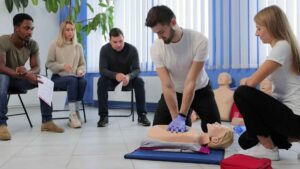
During the practical skills assessment, students use high-fidelity manikins that provide real-time feedback on compression depth (at least 2 inches for adults) and rate (100 to 120 beats per minute). AED use is a critical component of both CPR training and first aid courses, ensuring that participants gain hands-on experience in recognizing and responding to sudden cardiac arrest.
Students also master the use of barrier devices, including one-way pocket masks, to deliver rescue breaths safely and hygienically without risking the transmission of infectious diseases.
Workplace Compliance: WSIB Regulation 1101 in Toronto
For businesses operating in Toronto’s competitive landscape, from Bay Street law firms to industrial warehouses in Etobicoke, maintaining safety compliance is a strict legal requirement. Ontario’s Workplace Safety and Insurance Board (WSIB) enforces Regulation 1101, which mandates specific first aider ratios for all workplaces. Failure to maintain a certified responder on every shift can lead to significant fines and corporate liability.
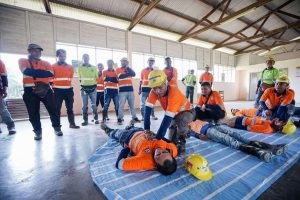
To comply with the updated CSA Z1210:24 standard, employees must successfully pass both a written examination and a practical skills assessment. Coast2Coast makes this straightforward for employers by offering private group training, with instructors bringing all necessary equipment directly to your office and customizing scenarios to address your specific workplace hazards.
Learn First Aid in a Real Classroom
Hands-on practice is the only way to build genuine first aid competence. Get certified with a Canadian Red Cross instructor and leave knowing exactly what to do when seconds count.
First Aid Certification Toronto: Career Advancement and Industry Requirements
First aid certification is a powerful professional asset in Toronto’s economy. Specific industries require this training as a condition of employment:
- Security Guards and Property Management: Personnel patrolling the PATH or condo developments must hold Intermediate / Standard First Aid and CPR Level C to legally maintain their provincial security guard licenses.
- Daycare Staff and Teachers: Early childhood educators are required by provincial law to hold CPR Level C to manage pediatric emergencies including infant choking and anaphylaxis.
- Construction and Trades: High-risk environments demand workers trained in severe bleeding control and spinal immobilization.
- Healthcare and Social Services: Toronto nurses, dental staff, and clinic workers require Basic Life Support (BLS) for advanced resuscitation and oxygen administration. CPR HCP has been replaced by BLS for healthcare professionals.
- Hospitality and Fitness: Restaurant managers and personal trainers must be prepared to handle sudden cardiac arrests and heat-related illnesses among patrons.
University and college students also seek recognized Canadian Red Cross certificates from an approved provider to satisfy academic placement and co-op requirements. If a certificate has expired, a full course is required to restore WSIB compliance; recertification is only available for certificates still within the three-year validity period.
Flexible Training: Blended Learning for Busy Professionals
Coast2Coast understands the pace of life in the GTA. The blended online learning format allows students to complete the heavy theoretical modules online at their own pace from home or the office, with access provided after registration. Participants then attend a shorter in-person session focused entirely on hands-on practical skills assessment. The online portion must be completed prior to attending the in-person session for certification to be issued.
If your current three-year certificate is nearing its expiry, a streamlined recertification course provides a rapid review of the latest 2026 protocols to keep you legally compliant without retaking the full program. Workplace teams can also arrange private group training to certify an entire staff in a single session.
Train Your Toronto Team in One Session
Private group training brings a certified instructor to your workplace. Satisfy WSIB Regulation 1101 and CSA Z1210:24 requirements and certify your entire staff without disrupting operations.
Key Takeaway
In Toronto, traffic delays and the Vertical Response Delay in high-rises mean bystanders are often the only people in a position to act during the critical Platinum Minutes before paramedics arrive. A Canadian Red Cross first aid course teaches you to recognize emergencies, perform High-Performance CPR, deploy an AED, and control bleeding, while satisfying WSIB Regulation 1101 and helping your employer meet CSA Z1210:24 standards. These are skills that directly save lives in everyday Toronto settings.
Join 150,000+ Canadians Who Are Certified
Be prepared to make a lifesaving difference in your community. Canadian Red Cross certification is valid for three years and recognized across all provinces.
Frequently Asked Questions: First Aid Course Toronto 2026
More FAQs: Careers, Compliance, and Certification in Toronto
Sources and Editorial Standards
- Heart and Stroke Foundation of Canada: Out-of-hospital cardiac arrest statistics and bystander CPR rates
- Canadian Red Cross: 2026 First Aid and CPR/AED curriculum and CSA Z1210:24 compliance standards
- WSIB Regulation 1101 (Ontario): Workplace first aid requirements, first aider ratios, and compliance obligations
- CSA Z1210:24: Canadian standard for first aid training in workplaces (effective 2024)
- ILCOR (International Liaison Committee on Resuscitation): High-Performance CPR, CCF guidelines, and AED defibrillation survival data
- Ontario Occupational Health and Safety Act (OHSA): Employer obligations for workplace safety training