We offer courses in Canada and the US. If you are experiencing issues with our website and need help to register, or if you have questions, please call us at 866-291-9121.
If you are facing any issues with your online course, registration, or training, please click here to submit a help request.
If you are facing any issues with your online course, registration, or training, please click here to submit a help request.
Several workplaces and student programs require first aid certification. Therefore, anyone thinking of getting first aid training or anyone with a certificate must know they need to keep their aid certificates valid according to Ontario and Canadian regulations.
A security license in Ontario will allow a person to work in the private security industry, but the real question is: how to get security license in Ontario? Security jobs include being a security guard, concierge, bouncer and more. Once you have a security guard license, you are qualified to work in many industries where security is needed. This includes airport security, security companies, event security and you may also guard people or property.
This year, Coast2Coast First Aid & Aquatics is thrilled to celebrate a major milestone—our 10th anniversary. Over the past decade, we’ve been dedicated to empowering individuals with the skills needed to respond confidently in emergencies, and we’re marking this special occasion with an exciting initiative that highlights our commitment to giving back to the community.
As winter makes its grand entrance, draping the mountains in a blanket of snow, it’s the perfect time to dive into the thrilling world of snowboarding and skiing. Picture this: the cool mountain breeze gently touching your hair, the crisp air invigorating your senses, and an electrifying excitement surging through your veins. It’s more than just an activity; it’s a chance to craft unforgettable memories that will stick with you for a lifetime.
Whether you’re an adventurous winter enthusiast or just dealing with the cold in your daily routine, here are some first aid skills you must know in the winter to ensure safety.
Facing an emergency without First Aid training is daunting and leaves people feeling helpless. Many people in Kitchener put off First Aid training for various reasons, mainly that they don’t have time or don’t know where to take a course. Others believe that they don’t need training but don’t realize that some techniques, especially CPR, require specific training.
The level of First Aid training someone needs will depend on their personal circumstances and career. Someone looking after children or a sick relative may need a higher level of training than someone who wants to prepare for general emergencies.
People who work in educational facilities, community settings, sports training centers, and healthcare professionals typically require advanced levels of training. Standard First Aid prepares participants for common medical emergencies needed for these careers, including environmental crises.
First Aid is not mandatory in Canada, but everyone is encouraged to help others in everyday emergencies. Helping each other is a moral obligation, and knowledge gives you confidence. Ready to find the best first aid and CPR training in Kitchener? Look no further!
New Training Facility in Kitchener
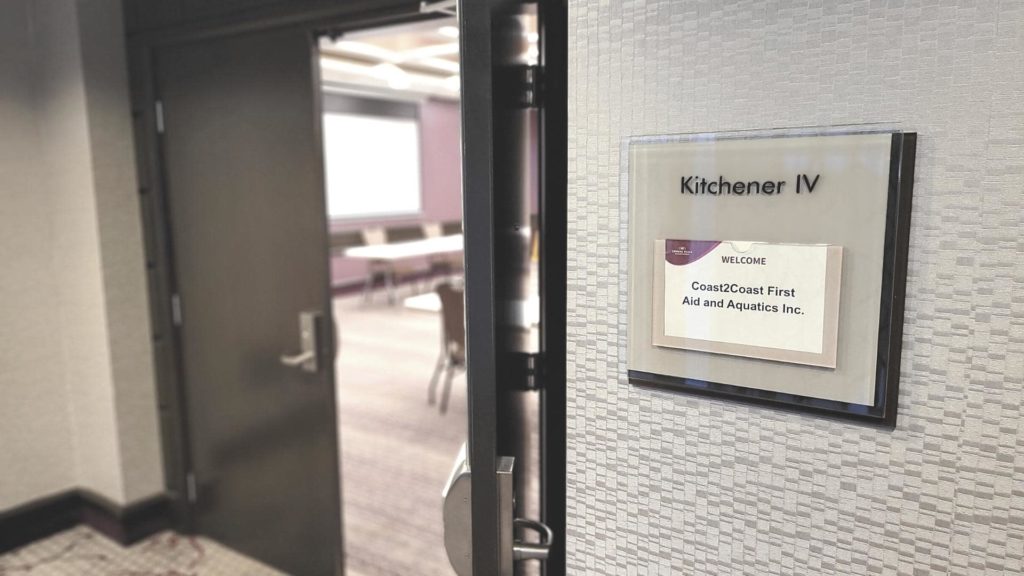
Coast2Coast has opened up a new training facility in Kitchener, making First Aid and CPR training more accessible than ever before. Several levels of First Aid and CPR training courses are available, including Emergency First Aid, Standard First Aid and Basic Life Support (BLS-HCP). Coast2Coast recommends everyone complete first aid and CPR training even if you do not require it for work or school programs.
Teaching times for First Aid and CPR training in Kitchener depend on the course level you choose. Our Online Blended training format is the most popular for Emergency First Aid and Standard First Aid because it saves time, allowing participants to complete the 4-8 hours of online learning (in their own time). The practical segment of the course has 5.5-8 hours of in-class training.
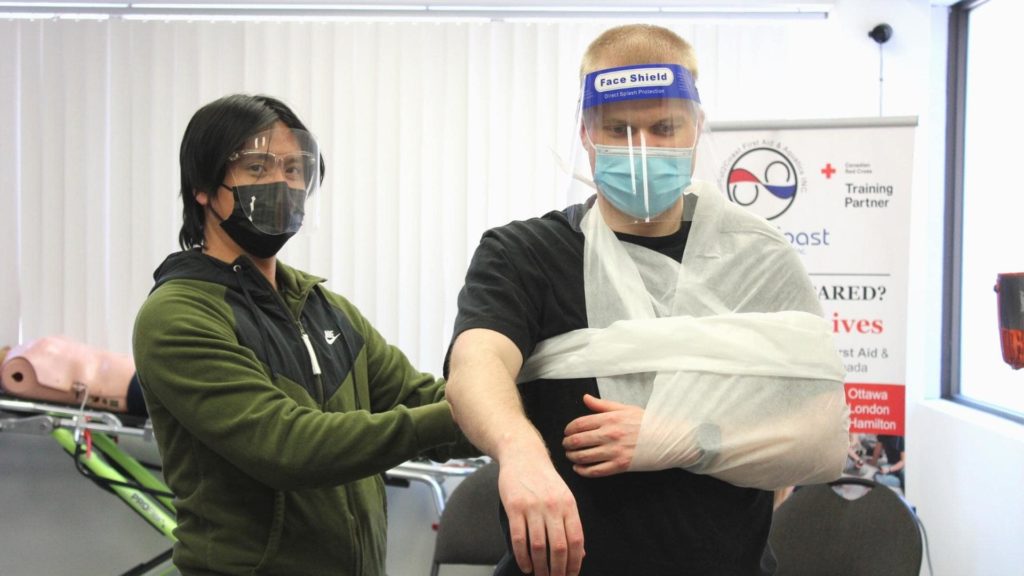
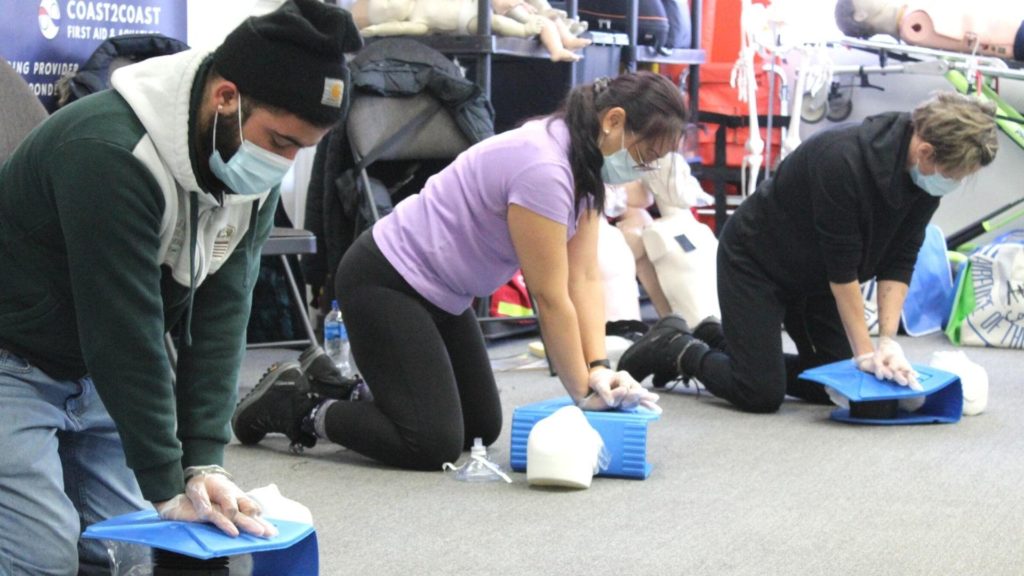
In-class training is an integral part of a first aid course because you learn the correct techniques firsthand from our experienced, Canadian Red Cross instructors. During this portion of your course, students will practice these techniques. Instructors are there to help you if you are struggling with any section of the course.
The in-class portion of our First Aid and CPR training in Kitchener starts at 9 AM. Once you complete the course and pass the multiple-choice exam, you will receive a WSIB-approved Canadian Red Cross certificate. All First Aid certification is valid for three years, after which you can recertify.
The in-class sections of First Aid & CPR require 100% attendance and a score of 75% or higher on the multiple-choice test.
Importance of First Aid & CPR
Since no one ever knows when an emergency will occur, First Aid training provides the confidence required to help save a life. Emergencies don’t always happen where first responders are available, so you might need to assist a loved one at home, a stranger on the road, or a colleague at work.
First aid training is not only for dealing with accidents. Depending on your course level, training may help you recognize illnesses, poisoning, cardiac arrest, and anaphylaxis. You also learn to call for emergency services, offering the correct assistance and comfort until professionals arrive.
Get Trained in Kitchener!
Join our First Aid Training in Kitchener and equip yourself with vital life-saving skills. Our expert instructors provide hands-on training to prepare you for emergencies in any situation.
Being prepared to assist in any situation is the first thing you learn, but First Aid training prepares you to share your skills and become more aware of personal safety and health.
Some of the things you can expect to learn during Emergency First Aid & CPR training in Kitchener:
The Red Cross
First Aider’s Role Chain of Survival Behaviors
Lowering Risk of Infection
Check, Call, Care
Placing Someone in the Recovery Position
Shock
Choking in Adults (Level C Includes Choking for Children and Infants)
Assisting with Medication
Angina and Heart Attack Stroke CPR/AED in Adults (Level C Training Includes Children and Infants)
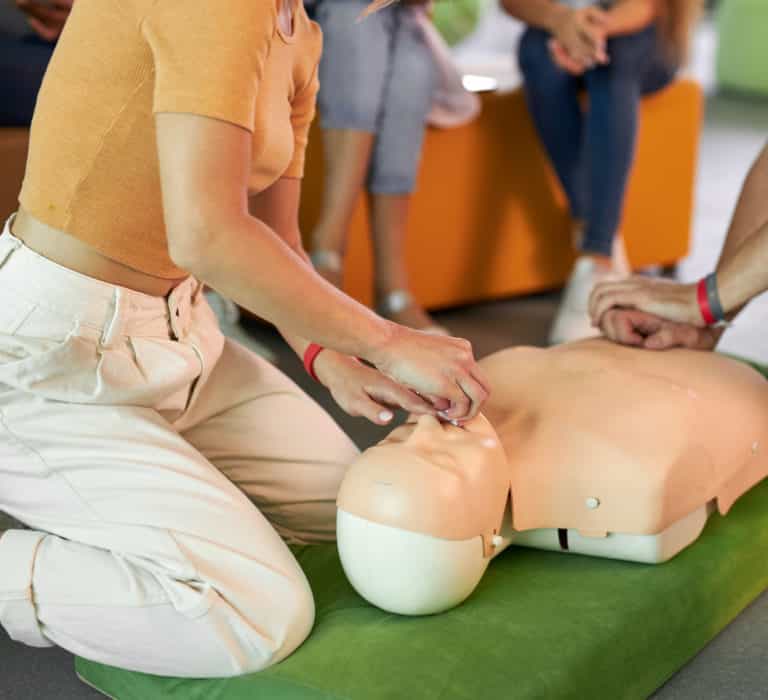
Compression-Only CPR
Treating Life-threatening External Bleeding and Internal Bleeding
General Wound Care
In Standard First Aid, the training includes environmental emergencies, head, neck, and spine injuries, poisons, and other medical emergencies.
How to Register for First Aid & CPR in Kitchener
Registering for First Aid and CPR training in Kitchener is easier than you ever thought. Check out our training locations under the “Find a Training” section on our website’s menu. From there, you can select the location of your choice. Each location has a page where you may select the course type you are interested in. Choose the First Aid & CPR option to see our upcoming course dates. Click on Register Now to book, fill in the Registration Form, and Submit.
Register for First Aid Training
Register today for a First Aid Training course and learn how to deal with emergencies and keep your loved ones safe! Check out our facilities and book your spot now.
First Aid and Cardiopulmonary resuscitation (CPR) training is something everyone should think about pursuing. Having this training means you could help save someone’s life or de-escalate an emergency situation so that the outcome is not as serious. There are many reasons to consider CPR First Aid training in London, Ontario, not the least of which is that the person you could be saving is likely someone close to you – a family member, friend or co-worker. Now First Aid and CPR training is available from Coast2Coast.
What First Aid and CPR training is available in London, Ontario?
This post will focus on the non-certification First Aid and CPR/AED training courses that are available in London. Coast2Coast offer both certification and non-certification CPR and First Aid courses, depending on your needs.
If you require a certification to assist in your employment, see this post about our Canadian Red Cross certification courses. You can greatly enhance your employable skills by becoming certified in Level A and C First Aid and CPR/AED. In fact, this training can be a requirement if you are pursuing a career in law enforcement and health care support, among other fields. Coast2Coast offers courses in Standard, Emergency and Marine First Aid. These courses are offered as a blend of online and in-class learning.
What non-certified First Aid and CPR courses are available in London, Ontario?
You may not require certification and wish to take a CPR and First Aid course in London for your own personal peace of mind. London, Ontario First Aid and CPR training from Coast2Coast is not limited to certification courses, thankfully. Many of our students are expectant or new parents, as well as grandparents, who will be caring for babies and small children. You may have elderly parents who you wish to be able to assist in the event of an emergency. Keeping loved ones safe is a priority for many who take our courses, and our students learn the necessary measures to ensure their safety. Given that heart disease is one of the most common causes of death in Canada, CPR is a valuable skill to have. For those caring for small children, choking is a real hazard and is very scary if you don’t know what to do.
Coast2Coast workshops are ideal for those who do not require an official WSIB approved First Aid and CPR certificate, but still wish to learn live-saving skills.
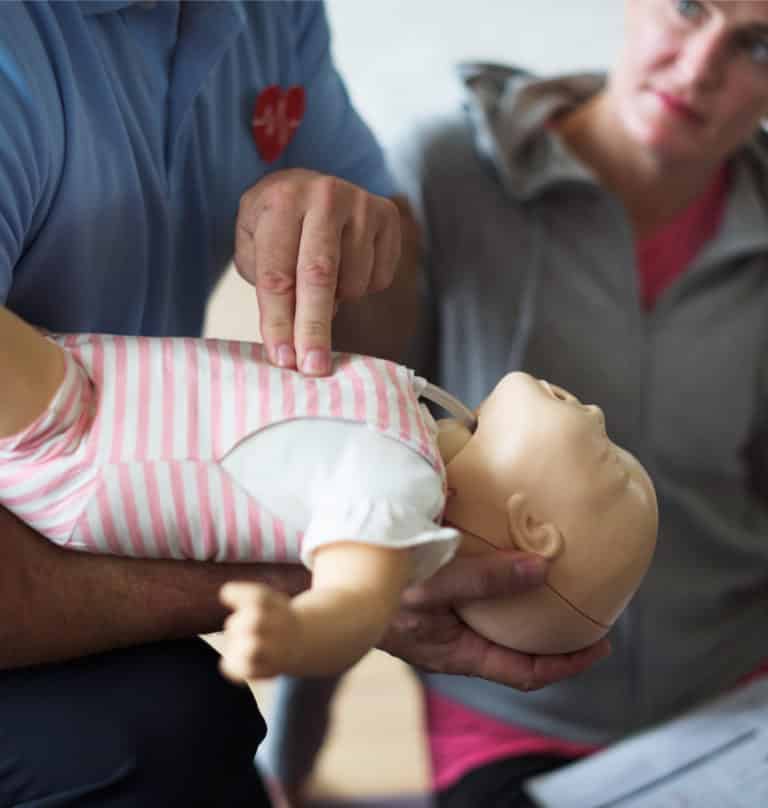
Coast2Coast also offers First Aid and CPR workshops for those who don’t wish to commit to the full-length or cost of a Red Cross certification course, but still want to learn these valuable skills. These courses are shorter and less in-depth than our other CPR and First Aid courses, while still giving you a solid foundation in the course work. Our workshops are great for those seeking a solid foundation in CPR and First Aid training, as well as those who are looking to expand their skill set for personal use. The London CPR/AED and First Aid workshops are available for public or private training and include the following: Know Your Baby, Baby Emergency Preparedness, and Build Your Own (private training only).
First Aid and CPR for pets is another non-certification that is available from Coast2Coast in London, Ontario. Keeping our pets safe is a top priority and this course is a great way to ensure you have the confidence to assist your pet in an emergency. CPR for pets is actually quite similar as it for humans, but our specific training will allow you to master this training for your cat or dog. Our Pet First Aid course in London is done in partnership with Walk N Wags’. In this course, we cover bone injuries, CPR, poisons, and much more.
Looking for private CPR and First Aid training in London, Ontario?
Look no further! Coast2Coast also offers private training for its London First Aid and CPR courses. A minimum of eight people can participate in the training of your choice with a Canadian Red Cross instructor. You choose the time and place, and Coast2Coast will do the rest, including bringing our top-notch equipment for your group to practice with. This is an ideal way to have staff trained in a workplace, club or family. Private First Aid and CPR/AED training is available for any of our courses, including non-certification courses.
Online learning for all of our blended courses is done from the comfort of your own home, and our in-class First Aid and CPR training can be done at Western in London, Ontario and other locations. Please visit here for a full listing of courses offered in London (click the button below)
Which First Aid and CPR training program in London, Ontario is right for you?
Many students who take our courses need to be certified at their jobs, but if that isn’t necessary you can take advantage of one of Coast2Coast’s non-certification courses. You will receive training in amazing life-saving skills, while saving yourself time and money. Register today to expand your First Aid and CPR knowledge or ask one of our customer service representatives which course is right for you!
Options for Emergency First Aid Training in London
Coast2Coast offers several options for emergency first aid training in London, Ontario. Not only do we offer training in emergency First Aid and CPR/AED at various levels, but we also offer the Professional First Responder program for those who wish to take their training to the level of emergency responder.
The standard First Aid and CPR/AED training in London, Ontario includes courses for individuals that are required to have WSIB certified courses for work. Our CPR/AED Level A or C courses in Emergency, Standard and Marine Basic First Aid may all be required for employment. Some positions that might require this Canadian Red Cross certification include child youth workers, coaches and instructors, daycare workers, early childhood educators, aesthetician school programs, development services worker, and more. You can read more about our certification courses here (Click the button below).
Having First Aid and CPR training is useful for a number of jobs, to ensure you are able to respond to any emergency affecting people in your care. This type of training is also useful and essential to have in everyday life and should be undertaken by anyone who is able to do it. Having the confidence of this training means you could respond to a number of emergency situations that you could be faced with on a daily basis, both in your professional and personal life. Luckily, you can complete this CPR training in London, Ontario, close to your home.
We do have some people in our midst that are called to do further training and become professional emergency responders. These are the people we all rely on to respond to emergency situations, and their training goes beyond the standard First Aid and CPR courses.
First Aid Training Courses in London Emergency Responders
What does it take to be trained as a Professional Emergency Responder and what does this position entail? First responder is a term that typically refers to those who might respond to an emergency, including law enforcement officers, paramedics, Emergency Medical Technicians (EMTs) and firefighters. Emergency Medical Responder (EMRs) are responsible for providing immediate aid to patients before the arrival of EMTs and doctors, or while the patient is being taken to hospital.
EMRs save lives with quick interventions and immediate aid to their injured patients, often providing the first on the scene care that can be crucial to a patient’s survival. They have to provide fast assessments and determine treatment methods normally at the scene of an accident or emergency situation. The people who train as EMRs are able to handle difficult and stressful situations calmly. If that sounds like a position you would be interested in training for, please read on!
What does Coast2Coast’s Professional Responder Program entail?
Coast2Coast’s Professional Responder Program is well suited to individuals in fields like health care, firefighting and law enforcement. The program is split into four sections that include: first responder, emergency medical responder (EMT), and emergency medical responder recertification/emergency medical responder upgrade.
Each of these four courses have varying lengths and different content, and they all involve emergency scenario training. These practical scenarios help students to learn responses and the necessary skills involved in facing emergency situations.
The First Responder course involves 40 hours of training over about four days. Students must demonstrate mastery of the required skills and successfully complete a minimum of one practical scenario. They must also be able to score 75% on the multiple-choice knowledge test and attend 100% of the course. The topics covered in the First Responder course are varied and include everything from responding to a call, to assessment, to what to do in certain scenarios, to lifting and moving patients.
The Emergency Medical Responder course involves a greater commitment than the First Responder course at 80 hours of training over eight days. Similar to the First Responder course, students must successfully score 75% on the multiple-choice knowledge test and attend all of the course training. They must also demonstrate they have learned all the practical skills and complete a minimum of two practical scenarios, one medical scenario and one involving trauma. In addition, EMR students must already be certified in Standard First Aid and CPR. The course curriculum for the EMR covers more extensive topics than the First Responder course, such as pharmacology and transporting patients.
Coast2Coast offers various types of CPR training at their London, Ontario location in addition to the many other courses. Please see here for a full listing of the course catalogue available in London. For a full course listing, please click the button below.
In order to complete the Professional Medical Responder certification, students must also complete the Emergency Medical Responder upgrade course and the First Responder and Emergency Medical Responder recertification courses as needed. Each of these have their own similar requirements of class time, multiple choice test success, demonstration of skills, and 1-2 emergency scenarios.
The reward of being a Professional First Responder
First Aid and CPR training is extremely useful for most of the population, but a select few choose to continue their education and become certified in the Professional First Responder program. To complete this training is difficult and requires an individual that is able to keep calm under pressure and be adaptable to many different pressures and scenarios. The training is intense but rewarding, and ultimately empowers individuals to become excellent emergency responders. Enroll today to become certified in the Professional First Responder program at the Coast2Coast London, Ontario location.
Summary: Coast2Coast First Aid & Aquatics has expanded from a local Toronto operation into a leading North American safety network with over 30 branches. In 2026, we provide WSIB Regulation 1101 and CSA Z1210:24 compliant training through the Canadian Red Cross. Whether you are a healthcare professional requiring Basic Life Support (BLS) or an industrial worker needing trauma management, our facilities deliver consistent, high-fidelity first aid and CPR certification coast-to-coast. This guide details our regional hubs and why 150,000+ students trust our clinical training standards.
Coast2Coast First Aid Training Locations: From Toronto to 30+ Branches Across North America
Coast2Coast First Aid & Aquatics has evolved from a specialized training hub in Toronto to a premier North American network with more than 30 professional branches. In an era where WSIB Regulation 1101 and national CSA standards dictate the quality of workplace safety, proximity to high-caliber education is essential. Whether you reside in the high-density Greater Toronto Area, the industrial corridor of Western Ontario, the capital region of Ottawa, the energy hubs of Alberta, or the metropolitan areas of Southern California, there is a Coast2Coast facility equipped to deliver elite CPR and AED certification.
Our mission is driven by a simple principle: emergency preparedness should not be hindered by geography. By establishing dozens of training locations in Canada and the United States, we bridge the gap between regulatory requirements and physical readiness. This guide provides a comprehensive overview of our regional operations and how our “Coast to Coast” expansion ensures that every student—from new parents to healthcare professionals—has access to a world-class practical skills assessment and the latest 2026 resuscitation protocols.
The Toronto Roots: How Local Expertise Built a National Brand
Coast2Coast First Aid and Aquatics Inc. was founded by veteran instructors with a vision to replace outdated, lecture-heavy seminars with interactive, clinical education. Starting in the GTA, the company focused on a “Practice-First” methodology. By partnering with the Canadian Red Cross and the Heart & Stroke Foundation, every certificate issued met the highest possible certification prerequisites for employment. Today, that local expertise has been scaled nationally, ensuring that a student in Vancouver receives the same high-fidelity training as a student in Halifax.
The Heart of the GTA: 15+ Locations for Maximum Accessibility
The Greater Toronto Area remains our primary operational engine, hosting over 15 facilities to accommodate the region’s diverse workforce. Each site is managed with a commitment to maintaining our 4.9-star Google rating standard. Our GTA footprint includes:
These locations are essential for the region’s security guards, daycare staff, and construction foremen who must maintain unexpired first aid credentials to remain legally compliant under Ontario safety bylaws.
Expansion West: Serving the Niagara-Windsor Corridor
As the need for WSIB-approved training grew, we expanded westward across Ontario. Communities that once had to travel hours for certification now have local access to the latest in High-Performance CPR and AED training. Our Western Ontario network includes Burlington, Hamilton, Guelph, Kitchener, Cambridge, London, and Windsor. This corridor is a hub for the manufacturing and agricultural sectors, where oxygen administration and trauma management are critical components of the workplace safety ecosystem.
Industry Focus: Our Western Ontario facilities frequently host private group training for industrial sites. By training on-site, we help businesses meet the specific CSA Z1210:24 hazard requirements unique to heavy machinery and high-voltage environments.
Watch: How To Perform CPR – Coast2Coast Official
Eastern Ontario and the Capital Region
In the east, we serve the public sector and clinical communities through our branches in Ottawa, Kanata, and Nepean. These locations are high-volume centers for Basic Life Support (BLS), as they support the vast healthcare infrastructure of the capital. We also offer specialized Emergency Medical Responder (EMR) courses for those entering the firefighting or paramedicine pipelines, providing a rigorous written examination and skills testing environment.
The Alberta Frontier: Calgary and Edmonton
The expansion into Western Canada marked our transition into a truly national entity. By opening full-service facilities in Calgary and Edmonton, we ensured that Alberta’s energy and construction sectors could access OHS-approved training that meets the province’s specific occupational health and safety codes. These centers utilize high-fidelity feedback manikins that measure the Chest Compression Fraction (CCF), ensuring that responders in remote work sites can maintain the “Physiology of the Save” while waiting for air-ambulance or EMS arrival.
International Reach: Coast2Coast in Southern California
After certifying over 150,000 Canadians, Coast2Coast crossed the border to serve the American market. As an authorized American Red Cross training provider, we now operate in Los Angeles and Long Beach. These facilities are OSHA compliant and provide the same commitment to hands-on skill mastery that defined our Toronto beginnings. This international expansion proves that our curriculum—focused on the “Platinum Minutes” of a rescue—is globally recognized as the gold standard for survival.
Technology and Learning Formats Across Our Network
Regardless of the city, every Coast2Coast branch offers the same flexible learning options. Our blended online learning format is our most popular choice, allowing students to complete theory at home and attend a shortened, 2-hour skills assessment at any branch. For those who prefer a traditional classroom experience, we offer full-day WSIB-approved workshops led by paramedics, nurses, and emergency responders.
Find a Coast2Coast Training Centre Near You
Don’t wait for a medical emergency to wish you were trained. Join the 150,000+ North Americans who trust Coast2Coast for accredited certification. Register for a course at one of our 30+ locations today.
Question 1: How many Coast2Coast locations are there currently?
Answer: We currently operate over 30 training locations across Ontario, Alberta, and California, with continued expansion planned for 2026.
Question 2: Are certifications earned at your branches WSIB approved?
Answer: Yes. All our Ontario branches provide training that is fully approved by the WSIB under Regulation 1101 and meets current 2026 CSA standards.
Question 3: Can I complete my training entirely online?
Answer: No. While you can do the theory online via blended learning, a physical, hands-on practical skills assessment with an instructor is legally required for a valid WSIB/OHS certificate.
Question 4: Does Coast2Coast offer training in the United States?
Answer: Yes. We are an authorized American Red Cross provider with OSHA-compliant training centers in Los Angeles and Long Beach, California.
Question 5: How long is a first aid certificate valid for?
Answer: Most Canadian and American Red Cross certificates are valid for exactly three years. We recommend taking a recertification course before your card expires.
Question 6: What is the difference between Level A and Level C CPR?
Answer: Level A focuses on adult resuscitation only. Level C is comprehensive, covering adults, children, and infants—it is the standard for daycare workers and parents.
Question 7: Can I book a private group training session for my company?
Answer: Absolutely. We specialize in private group training and can send an instructor with all necessary equipment directly to your office or facility anywhere in Canada.
Question 8: Do all your locations offer Basic Life Support (BLS)?
Answer: Yes. All our facilities offer BLS for healthcare professionals on a frequent and flexible schedule.
Question 9: What is Chest Compression Fraction (CCF)?
Answer: CCF is the percentage of total resuscitation time spent performing compressions. Higher CCF leads to better patient outcomes, a core focus of our 2026 training.
Question 10: Is there a written examination required to pass the course?
Answer: Yes, a multiple-choice written examination is required to verify your understanding of medical protocols and safety standards.
Question 11: Are barrier devices provided for student use?
Answer: Yes. For hygiene and safety, Coast2Coast provides single-use barrier devices and training masks for all rescue breathing practice.
Question 12: How quickly do I receive my digital Red Cross certificate?
Answer: Digital certificates are typically issued via email within 24 to 48 hours after successfully passing the practical and written evaluations.
Question 13: Do security guards in Ontario need Standard First Aid?
Answer: Yes. To maintain an Ontario security license, personnel must hold a valid Standard First Aid and CPR Level C certificate.
Question 14: Does workplace training lower business insurance costs?
Answer: Many commercial liability insurers recognize a fully certified, compliant staff as a major risk-mitigation factor and may offer premium reductions.
Question 15: What is the “Physiology of the Save”?
Answer: This refers to the clinical understanding of how High-Performance CPR maintains blood flow to the brain, which is a core concept in all our 2026 courses.
A
About the Author
Ashkon Pourheidary, B.Sc. (Hons) — Co-Founder, Coast2Coast First Aid & Aquatics
Ashkon has been a certified First Aid and CPR instructor since 2011 and an Instructor Trainer since 2013. He is also a certified Emergency Medical Responder (EMR) instructor, Psychological First Aid instructor, and BLS (Basic Life Support) instructor. Ashkon graduated with honours with a Bachelor of Science in Neuroscience from the University of Toronto in 2016. As co-founder of Coast2Coast First Aid & Aquatics, he has helped grow the organization to over 30 locations across Canada and into the United States. Ashkon has served on the First Aid Council for the Canadian Red Cross. He spends his time coaching the team of over 100 instructors at Coast2Coast to ensure that students training at Coast2Coast locations receive the best training experience. Connect on LinkedIn