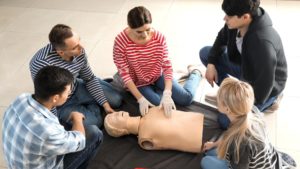

In a growing community like Richmond Hill, where York Region EMS serves a large geographic area and most cardiac arrests happen at home, trained bystanders are the first and most critical link in the Chain of Survival. Canadian Red Cross CPR and AED certification teaches High-Performance CPR, defibrillation, and trauma response while satisfying WSIB Regulation 1101 and CSA Z1210:24 workplace compliance requirements.
Richmond Hill is one of the most vibrant and fastest-growing communities in the Greater Toronto Area, with a population that has surpassed 200,000 residents and continues to expand rapidly. As the city grows, adding new neighborhoods, corporate parks, and recreational facilities, so does the urgent need for residents who are trained and physically prepared to respond to sudden medical emergencies. Comprehensive CPR and AED training is one of the most impactful skills a Richmond Hill resident can acquire, and it can mean the difference between life and death for a neighbour, family member, or colleague.
Sudden cardiac arrest does not discriminate. It can strike absolutely anyone at any age, regardless of fitness level, diet, or prior medical history. In Richmond Hill’s private homes, busy workplaces, schools, parks, and shopping centres like Hillcrest Mall, there is always the possibility that someone will suddenly collapse and require immediate intervention. When that moment comes, the person standing closest to the victim becomes the single most important link in the chain of survival.
Why CPR Training Matters in Richmond Hill
Approximately 60,000 out-of-hospital cardiac arrests happen annually across Ontario. Every minute without CPR or defibrillation decreases survival by 7 to 10 percent. Despite this, fewer than 40 percent of Canadian cardiac arrest victims receive bystander CPR before emergency services arrive. In Richmond Hill’s private homes, where 70 to 80 percent of sudden cardiac arrests and most medical emergencies happen, trained family members and neighbours are often the only people in a position to act first.
Increasing the number of CPR-certified residents in Richmond Hill can dramatically improve survival rates across the entire municipality. An out-of-hospital cardiac arrest occurs approximately every nine minutes somewhere in Canada. When bystanders are trained and confident, those minutes become survivable.
The Chain of Survival and the Platinum Minutes
The Chain of Survival is a core clinical concept used by emergency medical professionals to describe the exact sequence of actions that give a cardiac arrest victim the highest possible chance of neurological survival. The chain consists of four critical links: early recognition and calling 911, early high-quality CPR by a bystander, rapid defibrillation with an AED, and advanced medical care from paramedics or a hospital team.
Of these four links, the first three depend entirely on the immediate actions of trained bystanders. Professional paramedics handle the final link, but they cannot arrive instantly. In Richmond Hill, York Region EMS serves a large geographic area with increasing call volumes. Response times can be delayed by rush-hour traffic on Yonge Street or Highway 404, severe winter weather, and neighborhood density.
During these critical Platinum Minutes before an ambulance arrives, bystander CPR acts as a manual pump, keeping oxygenated blood flowing to the brain and vital organs. Irreversible brain damage can begin within 4 to 6 minutes without it. Research from international resuscitation councils shows that bystander CPR can double or even triple the chances of survival when started promptly.
The Science of High-Performance CPR and CCF
Modern CPR certification in 2026 goes far beyond the basics. The Canadian Red Cross curriculum focuses intensely on High-Performance CPR, a methodology that prioritizes the Chest Compression Fraction (CCF). CCF is the percentage of total rescue time spent actively compressing the chest. By learning to minimize physical pauses, such as when switching rescuers or applying AED pads, you drastically improve the patient’s internal blood pressure and the oxygenation of brain tissue.
To develop this skill, students use high-fidelity feedback manikins during their mandatory practical skills assessment. These devices provide real-time digital feedback on compression depth (at least 2 inches for adults) and rate (100 to 120 beats per minute), ensuring you meet the 2026 clinical standards before leaving the classroom.
Students are also trained on barrier devices, including one-way pocket masks, to safely deliver rescue breaths without risking infectious disease transmission. Along with compressions, the course covers AED deployment, so you can deliver a lifesaving shock within the Platinum Minutes window.
Learn CPR and AED in a Real Classroom
Hands-on practice with feedback manikins and real AED trainers is the only way to build genuine competence. Get certified with a Canadian Red Cross instructor and leave knowing exactly what to do when seconds count.
Workplace Compliance in Richmond Hill: WSIB and CSA Z1210:24
Richmond Hill’s diverse business community includes corporate office complexes, retail power centres, restaurants, healthcare facilities, and light industrial operations in the Beaver Creek area. Every one of these workplaces has a strict legal obligation under Ontario’s Workplace Safety and Insurance Board (WSIB) and the Occupational Health and Safety Act (OHSA) to maintain adequate first aid coverage.
Under WSIB Regulation 1101 and the updated CSA Z1210:24 standard, employers must have designated responders who have passed both a written examination and a practical skills assessment. Workplaces with 1 to 5 employees per shift require an Emergency First Aider on duty; many employers in medium-to-high-hazard industries also require Intermediate / Standard First Aid certification to comply with Regulation 1101.
Which Workers in Richmond Hill Need First Aid Certification?
A valid Canadian Red Cross certificate is a career asset for many roles in York Region:
- Security Guards and Loss Prevention: Personnel patrolling local malls and condo developments must hold Intermediate / Standard First Aid to legally maintain their Ontario security licenses.
- Daycare Staff and Teachers: Early childhood educators are legally required by provincial licensing to hold CPR Level C to safely address pediatric emergencies, including infant choking and anaphylaxis requiring EpiPen administration.
- Construction Workers and Landscapers: High-risk outdoor environments require leaders trained in severe bleeding control, heat exhaustion, and trauma management.
- Healthcare Professionals: Staff at Richmond Hill’s medical clinics, dental offices, and pharmacies require Basic Life Support (BLS) to master rapid pulse checks, team-based resuscitation, and oxygen administration using Bag-Valve-Masks.
- Emergency Medical Responders: For those pursuing emergency response careers, EMR training covers cardiovascular emergencies, airway management, and trauma response, going well beyond standard CPR programs.
Flexible Learning: Blended Online and In-Class CPR Programs
Richmond Hill residents have demanding schedules. To make certification as accessible as possible, Coast2Coast offers a blended online learning format, accepted by the Canadian Red Cross since 2020. This hybrid model allows participants to complete the medical theory modules online at their own pace from home or the office. Once completed, you attend a shorter in-person session focused entirely on hands-on practical skills assessment.
If your current certificate is nearing its three-year expiry, a streamlined recertification course offers a rapid review of the updated material to renew your credentials without retaking the full multi-day program. CPR/AED Level C and Canadian Red Cross First Aid certifications are valid for three years from course completion, recognized across all Canadian provinces and territories.
Train Your Richmond Hill Team in One Session
Private group training brings a certified instructor to your workplace. Meet WSIB Regulation 1101 and CSA Z1210:24 requirements, reduce liability, and certify your entire staff without disrupting operations.
Key Takeaway
In Richmond Hill, where most cardiac arrests happen at home and EMS response times can be delayed by traffic and geography, trained bystanders are the most critical factor in survival. Every minute without CPR reduces survival by 7 to 10 percent. Canadian Red Cross CPR and AED certification builds the clinical confidence to act immediately, satisfies WSIB Regulation 1101, and can double or triple a victim’s chance of survival.
Join 150,000+ Canadians Who Are Certified
Protect your family, satisfy your employer’s compliance obligations, and gain the confidence to act when it matters most. Certification is valid for three years across all Canadian provinces.
Frequently Asked Questions: CPR Training Richmond Hill 2026
More FAQs: Certification, WSIB Compliance, and Career Requirements
Sources and Editorial Standards
- Heart and Stroke Foundation of Canada: Out-of-hospital cardiac arrest statistics for Ontario and Canada
- Canadian Red Cross: 2026 CPR/AED and First Aid curriculum, blended learning format acceptance (2020)
- WSIB Regulation 1101 (Ontario): Workplace first aid requirements and first aider ratios
- CSA Z1210:24: Canadian standard for first aid training in workplaces (effective 2024)
- Ontario Occupational Health and Safety Act (OHSA): Employer obligations for workplace safety training
- ILCOR (International Liaison Committee on Resuscitation): Chain of Survival guidelines and bystander CPR survival data