
CPR courses in Toronto are available at four levels: Level A for personal preparedness, Level C for most workplaces and professionals, BLS for healthcare providers, and ACLS for advanced clinical roles. CPR Level C covers adults, children, and infants and is required by most Ontario workplaces under WSIB Regulation 1101. CPR certifications are typically valid for 3 years. BLS is valid for one year. Every minute without CPR reduces cardiac arrest survival odds by 7 to 10 percent.
✓ Canadian Red Cross Certified
CPR Training in Toronto
CPR Level A, CPR Level C, BLS, and first aid courses at multiple GTA locations. Weekday, weekend, and evening formats. Private group training available.
What to Know About CPR Courses: Types and Levels
Toronto is a city of nearly three million people, and with that population comes the reality that cardiac emergencies, choking incidents, and other life-threatening situations occur every single day. CPR training equips individuals with the skills and confidence to respond effectively in cardiac emergencies, potentially doubling a victim’s chance of survival. In 2026, the Canadian Red Cross curriculum follows CSA Z1210:24 standards and emphasizes high-performance CPR and rapid AED integration, the two most critical factors in successful resuscitation.
CPR courses are divided into distinct levels depending on the target audience and professional role. There are four levels of CPR training: Level A, Level B, Level C, and Basic Life Support (BLS), each tailored to different audiences including the general public and healthcare professionals. Understanding which level is right for your situation is the foundation of getting the most out of your CPR training.
CPR Level A: Personal Preparedness for the General Public
CPR Level A training is designed for individuals with little or no medical training and focuses on adult CPR and choking response. It is ideal for the general public seeking personal preparedness. Level A covers chest compressions, rescue breaths for adults, and the Heimlich maneuver for conscious choking victims. It is the entry-level certification for those who want foundational life-saving techniques without full workplace compliance coverage.
CPR Level C: The Standard for Most Workplaces
CPR Level C is the most popular and widely required certification. It is more comprehensive, covering CPR skills for adults, children, and infants, as well as AED use, two-rescuer CPR, and choking response for all age groups including babies. CPR Level C is required for most Ontario workplaces under WSIB Regulation 1101 and is the certification required by teachers, personal trainers, daycare workers, coaches, and most other professionals who work with people across different age groups. It is included in both Emergency First Aid and Intermediate / Standard First Aid courses.
Basic Life Support (BLS): Advanced Training for Healthcare Providers
Basic Life Support is a foundational CPR course specifically aimed at healthcare providers and trained first responders, focusing on high-quality CPR and team dynamics. BLS teaches skills for recognizing life-threatening emergencies, providing high-quality chest compressions, delivering appropriate ventilations, and using an AED. The BLS certification is valid for one year and is essential for many healthcare roles including nurses, physicians, paramedics, and dental staff.
BLS training includes simulated clinical scenarios and learning stations where participants practice high-performance CPR with professional rescuers in team-based resuscitation sequences. This team-based approach trains healthcare professionals to coordinate roles during cardiac arrest, manage airways, and deliver emergency cardiovascular care at a clinical standard.
Advanced Cardiovascular Life Support
Advanced Cardiovascular Life Support (ACLS) and Pediatric Advanced Life Support (PALS) are specialized courses designed for healthcare professionals who manage complex cardiovascular emergencies in hospital settings. ACLS builds on BLS with advanced airway management, pharmacology, and team leadership in cardiac arrest scenarios. PALS focuses on pediatric emergency treatment and resuscitation. Both require current BLS certification as a prerequisite.
Cardiopulmonary Resuscitation: The Science Behind CPR
Cardiopulmonary resuscitation is a clinical bridge to survival. When a person experiences cardiac arrest, the brain begins to suffer irreversible damage within four to six minutes without oxygenated blood flow. CPR works by manually pumping the heart through chest compressions, forcing oxygenated blood to circulate to vital organs. While CPR alone may not restart the heart, it maintains blood flow and buys precious time until paramedics arrive or an AED can restore a normal heart rhythm.
Every minute without basic life support reduces survival chances by approximately 7 to 10 percent. This is why healthcare providers and trained community responders are the most vital link in the survival chain. The Check, Call, Care framework is taught for emergency scene management, emphasizing safety assessment and activation of emergency medical services before beginning CPR.
Chest Compressions: Rate, Depth, and Technique
Chest compressions should be performed at a depth and rate of 100 to 120 compressions per minute during CPR. Compressions must be at least 2 inches deep for adults with full chest recoil between each compression. Place the heel of one hand on the center of the person’s chest, place the other hand on top, and push hard and fast. A technique taught in CPR courses is to think of the beat of the song “Stayin’ Alive” to maintain the correct tempo.
The Chest Compression Fraction (CCF) is a key performance metric in 2026 CPR training, with the goal of keeping hands on the chest at least 80 percent of the time to maintain the critical blood pressure needed for brain viability. Rescue breaths are given after every 30 compressions in conventional CPR, with two breaths delivered after opening the airway using the head-tilt chin-lift maneuver.
CPR AED Integration: Early Defibrillation Saves Lives
Automated External Defibrillators are critical devices used in conjunction with CPR to increase the chances of survival during a cardiac arrest, as they can restore a normal heart rhythm. Training courses for CPR include instruction on how to use an AED, emphasizing the importance of using the device as soon as possible during a cardiac emergency. AED training typically covers how to operate the device on both adults and children, ensuring that users are prepared for various emergency situations.
Every minute of delay between cardiac arrest and defibrillation reduces survival odds by 7 to 10 percent. Early use of an AED combined with CPR is the most effective treatment for sudden cardiac arrest. AEDs are now installed in many public buildings, shopping centres, sports facilities, and transit stations across Toronto.
Learn This Skill in a Real Classroom
CPR Level C and AED Training
Canadian Red Cross CPR Level C covers adult, child, and infant CPR, AED deployment, rescue breaths, and choking response. The most widely required CPR certification in Ontario. High-fidelity feedback manikins included.
First Aid and CPR Training: What You Learn in a Toronto CPR Course
First aid and CPR training courses provide participants with knowledge and skills covering multiple life-threatening emergencies. First aid training courses cover essential skills such as wound care, emergency scene management, and how to respond to various medical emergencies, ensuring participants are prepared to act confidently in critical situations.
Courses in first aid training are designed to meet national standards for workplace safety and are recognized across Canada, providing participants with a nationally recognized certification upon completion. First aid training can last from a few hours to two days, depending on the course level, and includes hands-on practice to ensure participants are comfortable with life-saving techniques before they need to use them in real-life situations.
Participants learn to recognize and respond to several life-threatening emergencies including cardiac arrest, choking, severe bleeding, anaphylaxis, stroke, diabetic emergencies, and seizures. In Toronto CPR courses, participants also learn urban-specific scenarios such as coordinating AED retrieval in high-rise buildings and managing cardiac emergencies in public transit environments where paramedic response times may be longer.
Cardiac Arrest Recognition: Why Speed Is Everything
Quickly recognizing cardiac arrest is the most critical skill in any CPR course. The first link in the chain of survival is early recognition and calling for help. A person in cardiac arrest will be unresponsive and not breathing normally, or showing only agonal gasping. If the person is unresponsive and not breathing normally, begin CPR immediately and send someone to call 911 and retrieve the nearest AED.
In Toronto’s urban environment, several life-threatening emergencies can occur in densely populated settings including offices, transit stations, sports facilities, and entertainment venues. Training prepares participants to lead an emergency scene, direct bystanders to call 911, and maintain high-quality CPR until professional rescuers arrive. For those working in high-rise buildings, the vertical response challenge means paramedics may take 10 or more minutes to reach the scene, making bystander CPR the only intervention available during that window.
Aid Training Technology: High-Fidelity Manikins in 2026
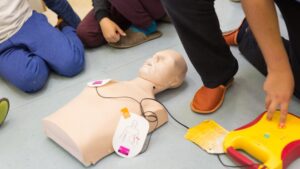
Modern CPR training has moved away from basic rubber manikins to high-fidelity feedback manikins equipped with sensors that provide real-time data on compression depth and rate. This data-driven approach builds correct muscle memory, making trained responders significantly more likely to deliver effective compressions in a high-stress real emergency.
In 2026, every Coast2Coast CPR course uses feedback-enabled manikins that show students in real time whether their compressions meet the 2-inch depth and 100 to 120 bpm rate standards. This technology reinforces correct technique through immediate feedback. Simulated clinical scenarios at learning stations further develop the instinctive response needed to provide care in a real cardiac emergency.
CPR Certification: WSIB Requirements and Legal Protection
CPR certifications are typically valid for 3 years, with some industries requiring annual renewals. BLS certification for healthcare providers is valid for one year and must be renewed annually. Many professions require official CPR certification, which can vary based on job roles such as teachers, personal trainers, or daycare workers. Certification from recognized providers like the Canadian Red Cross is essential for compliance in various workplaces.
To obtain CPR certification, individuals must successfully complete a course that includes both theoretical knowledge and practical skills training, often culminating in a hands-on skills assessment. Renewal of CPR certification can be done through abbreviated recertification classes designed to refresh skills and test knowledge. Recertification courses often include updates on the latest CPR guidelines and techniques to ensure that participants are trained in current practices.
In Ontario, the Good Samaritan Act provides legal protection to those helping in good faith within their training scope. WSIB Regulation 1101 mandates certified first aiders on staff. The 2026 shift to CSA Z1210:24 standards ensures training meets the latest scientific evidence for emergency cardiovascular care.
First Aid Training Options: In-Person vs Blended Learning
CPR courses can be completed in a few short hours, with options for in-person, blended, or online learning formats available to accommodate different learning styles and work requirements. In-person CPR training offers hands-on instruction ideal for beginners, while blended learning combines online theory with in-person practice.
In-person courses provide direct feedback from certified instructors throughout the entire program and are the most immersive option for developing practical skills and muscle memory. Blended learning allows participants to complete the theory portion online at a self-paced schedule before attending a shorter in-person skills session. The in-person component is mandatory for Canadian Red Cross certification as the hands-on skills assessment cannot be completed online.
For organizations training multiple employees, private group training brings certified instructors and all equipment directly to your workplace. This is the most efficient option for businesses, healthcare facilities, schools, and community organizations needing to certify teams without disrupting daily operations.
Key Takeaway
CPR courses in Toronto are available at four levels: Level A, Level C, BLS, and ACLS. CPR Level C covers adults, children, and infants and is required by most Ontario workplaces under WSIB Regulation 1101. Every minute without CPR reduces cardiac arrest survival by 7 to 10 percent. The Chest Compression Fraction goal is 80 percent. High-fidelity feedback manikins are used in all 2026 courses. CPR certifications are valid for 3 years. BLS for healthcare providers is valid for one year. Good Samaritan Act protects bystanders who act in good faith.
Canada’s Top-Rated Training Partner
Join 150,000+ Canadians Who Are Certified
Coast2Coast is Canada’s largest Canadian Red Cross Training Partner.
4.9 stars across 20,491 Google reviews. Register online in 2 minutes.
Frequently Asked Questions: CPR Courses in Toronto 2026
Q1: What are the different levels of CPR training available in Toronto?
A: There are four levels of CPR training: Level A, Level B, Level C, and Basic Life Support (BLS). CPR Level A is designed for the general public focusing on adult CPR and choking. Level C is more comprehensive, covering adults, children, and infants, and is required by most Ontario workplaces. BLS is a foundational course for healthcare providers focusing on high-quality CPR and team dynamics. ACLS and PALS are advanced courses for clinical healthcare professionals.
Q2: How long does a CPR course take in Toronto?
A: CPR courses can be completed in a few short hours. Standalone CPR Level C courses typically take 4 to 6 hours. BLS courses for healthcare providers are typically completed in a half day. First aid courses that include CPR training last one to two days. Blended learning formats allow theory to be completed online, reducing in-person time significantly.
Q3: Do I need any prior experience to take a CPR course?
A: No prior experience is required. CPR courses are designed for complete beginners and for experienced responders updating their skills. Your instructor will guide you through every skill from chest compressions and rescue breaths to AED use and choking response. In-person CPR training offers hands-on instruction ideal for beginners.
Q4: How long is CPR certification valid in Toronto?
A: CPR certifications are typically valid for 3 years. BLS certification for healthcare providers is valid for one year and must be renewed annually. Some industries require annual renewals even for standard CPR Level C. Recertification courses are available through abbreviated classes designed to refresh skills and test knowledge before your certificate expires.
Q5: What is the Chest Compression Fraction (CCF) and why does it matter?
A: Chest Compression Fraction is the percentage of total rescue time during which chest compressions are actively being delivered. In 2026, the goal is to keep hands on the chest at least 80 percent of the time to maintain the critical blood pressure needed for brain viability. Minimizing pauses during AED pad application and rescuer rotation is a core focus of high-performance CPR training.
Q6: Can I take a CPR course online in Toronto?
A: You can complete the theory portion via blended learning online at a self-paced schedule, but the hands-on skills assessment must be completed in person for official Canadian Red Cross certification. The in-person component covers CPR technique, AED use, and scenario-based practice that cannot be replicated in an online environment.
Q7: What is Basic Life Support and who needs it?
A: Basic Life Support is a foundational CPR course designed for healthcare providers and professional rescuers. It teaches skills for recognizing life-threatening emergencies, providing high-quality chest compressions, delivering appropriate ventilations, and using an AED in team-based clinical scenarios. BLS is required by most hospitals, dental offices, and long-term care facilities. The BLS certification is valid for one year.
More FAQs: AED, Workplace Requirements, and Recertification
Q8: What should I bring to my CPR course in Toronto?
A: Wear comfortable clothes suitable for physical activity. Bring photo ID and your confirmation email. All training equipment including feedback-enabled manikins, AED trainers, and barrier devices is provided by Coast2Coast. No textbooks or additional materials are required.
Q9: Does WSIB require CPR certification in Ontario workplaces?
A: Yes. WSIB Regulation 1101 mandates certified first aiders on staff in all Ontario workplaces. Workplaces with 1 to 5 employees require Emergency First Aid with CPR Level C at minimum. Workplaces with 6 or more require Intermediate / Standard First Aid or Intermediate First Aid. Certification from recognized providers like the Canadian Red Cross is essential for WSIB compliance.
Q10: What is AED training and is it included in CPR courses?
A: AED training covers how to operate the device on both adults and children and is included in all CPR Level C and BLS courses. Automated External Defibrillators are critical devices used in conjunction with CPR to restore a normal heart rhythm during cardiac arrest. Early use of an AED is the most effective treatment for sudden cardiac arrest, and every minute of delay reduces survival odds by 7 to 10 percent.
Q11: What is the difference between CPR Level A and CPR Level C?
A: CPR Level A is designed for individuals with little or no medical training and focuses on adult CPR and choking for the general public. CPR Level C is more comprehensive, covering adults, children, and infants, two-rescuer CPR, and AED integration. Level C is required for most Ontario workplaces, professional roles, and anyone responsible for the safety of people across different age groups including children and babies.
Q12: How do I renew my CPR certification in Toronto?
A: Many organizations offer abbreviated recertification classes designed to refresh skills and test knowledge. Recertification courses include updates on the latest CPR guidelines and techniques. Coast2Coast offers recertification courses across multiple GTA locations. If your certificate has lapsed beyond one year, a full course is required rather than the abbreviated recertification program.
Q13: What is the Check, Call, Care framework taught in CPR courses?
A: Check, Call, Care is a framework taught for emergency scene management. Check involves surveying the scene for hazards before approaching. Call means activating 911 to dispatch professional rescuers. Care means providing immediate CPR, AED use, or other first aid based on the victim’s condition and your level of training until professional help arrives.
Q14: Can my whole workplace get CPR certified together in Toronto?
A: Yes. Coast2Coast offers private group training where certified instructors come to your Toronto workplace with all equipment and materials. This is the most efficient option for businesses and healthcare facilities training multiple employees at once. Group training can be scheduled on weekdays, evenings, or weekends to accommodate various work requirements.
Q15: Where can I take a CPR course in Toronto?
A: Coast2Coast First Aid and Aquatics offers Canadian Red Cross certified CPR Level A, CPR Level C, BLS, Emergency First Aid, and Intermediate / Standard First Aid courses at multiple locations across the Greater Toronto Area including Toronto, North York, Scarborough, Etobicoke, Brampton, Mississauga, and Richmond Hill. Weekday, weekend, and evening formats are available. Blended learning and private group training options are also offered.
The information in this article is for educational and informational purposes only and does not constitute medical or occupational health and safety advice. CPR certification requirements vary by province, industry, and employer. Always verify current requirements with WSIB or your provincial authority. In any cardiac emergency, call 911 immediately. Coast2Coast First Aid Inc. assumes no liability for any outcomes resulting from the application or misapplication of information in this article.
Written and reviewed by Ashkon Pourheidary, B.Sc. (Hons) Neuroscience, Co-Founder, Coast2Coast First Aid and Aquatics. Ashkon has been a certified First Aid and CPR instructor since 2011 and an Instructor Trainer since 2013. He is a certified EMR instructor, Psychological First Aid instructor, and BLS instructor, and has served on the First Aid Council for the Canadian Red Cross. CPR protocols aligned with Canadian Red Cross First Aid Guidelines and CSA Z1210:24. WSIB requirements sourced from WSIB Regulation 1101 and the Ontario Occupational Health and Safety Act. Coast2Coast First Aid Inc. is Canada’s largest Canadian Red Cross Training Partner. Last reviewed: March 2026. Contact info@c2cfirstaidaquatics.com or 1-866-291-9121.