OSHA-Compliant · American Red Cross Training Partner
CPR Certification Classes: CPR/AED Training for Every Age Group
A cardiac arrest gives you minutes, not hours. Choose from three American Red Cross CPR certification levels — adult, pediatric, or both age groups together. Start your CPR certification online with blended learning and finish the skills in class, or take your CPR certification fully in person. Either way, the card lasts two years.
Course Types
American Red Cross CPR/AED Certification Courses
Our three CPR certification classes differ by who you are trained to resuscitate. Adult stops at adults. Pediatric covers infants and children. Adult and Pediatric is both. Every CPR class is taught by a certified instructor, and every one puts an automated external defibrillator trainer in your hands.
Two ways to earn your CPR certification. Pick blended learning — a self-paced online portion of the training first, then a shorter classroom session — or fully in person, for anyone who would rather learn everything directly from an instructor with no video or computer requirement.
- Online blended training
-
Adult CPR/AED
Online: 2 hours, 25 minutes
In-Class: 1 hour, 25 minutes
- All in-class training
-
Adult CPR/AED
2 hours, 15 minutes
Learn more
- Course content
-
View both course topics
- CPR for Adults
- AED use for Adults
Resuscitation only. If you also need the injury and illness care — bleeding, burns, anaphylaxis, stroke — take one of the first aid courses instead.
- Requirements
-
100% attendance of the course
80% score on the multiple choice knowledge test
- Certification
- American Red Cross certificate will be issued, valid for 2 years
Book this CPR certification when everybody around you at work is a grown adult — an office, a warehouse, a plant. You learn basic CPR skills on an adult manikin, chest compressions and rescue breaths both, then run the pads on an automated external defibrillator trainer until the prompts stop sounding foreign.
Hands-on skills testing with automated external defibrillator is part of both formats, whichever one you book.
- Online blended training
-
Adult and Pediatric CPR/AED
Online: 2 hours, 25 minutes
In-Class: 2 hours, 10 minutes
- All in-class training
-
Adult and Pediatric CPR/AED
3 hours, 45 minutes
Learn more
- Course content
-
View all 4 course topics
- CPR for Adults
- AED use for Adults
- CPR for Infants and Children
- AED use for Infants and Children
Highlighted topics are the pediatric skills — the Adult CPR/AED course stops at the adult ones.
- Requirements
-
100% attendance of the course
80% score on the multiple choice knowledge test
- Certification
- American Red Cross certificate will be issued, valid for 2 years
The widest coverage of the three, and the CPR certification to book when your employer has not named a level. It carries the adult skills and adds infant and child rescue, so a teacher, coach, daycare worker or parent walks out covered for every age group in the room.
A child is not a small adult. Compression depth changes, hand position changes, and the choking sequence for an infant looks nothing like the one for a grown adult. You practice all of it on age-specific manikins with an AED trainer, then take the skills test.
- Online blended training
-
Pediatric CPR/AED
Online: 1 hour, 35 minutes
In-Class: 1 hour, 15 minutes
- All in-class training
-
Pediatric CPR/AED
1 hour, 30 minutes
Learn more
- Course content
-
View both course topics
- CPR for Infants and Children
- AED use for Infants and Children
No adult resuscitation. If the people you may have to help include adults, choose Adult and Pediatric CPR/AED.
- Requirements
-
100% attendance of the course
80% score on the multiple choice knowledge test
- Certification
- American Red Cross certificate will be issued, valid for 2 years
Built for the people who spend their day with children: childcare staff, school employees, camp leaders, coaches, babysitters and parents. This CPR certification teaches basic CPR for infants and children only, which is what most licensing bodies for child care ask to see.
It is also the shortest course on this page. You still put your hands on an infant manikin and an AED trainer before you leave.
Why Coast2Coast
Why Students Choose Coast2Coast for CPR/AED Certification
Our CPR certification covers what US employers actually ask for: an American Red Cross card, recognized certification for OSHA-compliant workplaces, and a free 90-day skills practice retake if you want more repetitions before you have to rely on it.
Two Ways to Train
Choose How You Earn Your CPR Certification
Both paths end in the same American Red Cross card and the same skills test. The only question is how much of the theory you want behind you before you walk in.
Compare Dates & FormatsWork through the online portion of the training at home, on any device, then come in for the practical session. With the theory already done, your CPR certification class runs 15 to 95 minutes shorter, depending on the level you book.
- Start your CPR certification online the day you register
- Built for shift workers and anyone searching for CPR training online
- Skills test and AED certification happen in the room, never on screen
A certified instructor teaches everything in the room, with no video or computer requirement. Pick this CPR class if you would rather learn from a person than a screen, or if your whole team is training together.
- 90 minutes to 3 hours 45, depending on the level
- Questions get answered on the spot
- Same certificate as the blended route
Why Coast2Coast
Why Students Trust Our CPR Certification
Our facilities carry current manikins and AED trainers, and a certified instructor runs every CPR training session. Over 150,000 participants have trained with us across North America — for work, and because community safety starts with people who know what to do.
- 150K+Participants trained
- 30+Locations
- 99.9%Student success rate
- 2014Training since
-
An AED trainer in every pair of hands
Every CPR/AED certification here puts an automated external defibrillator trainer in front of you — pads, prompts, rhythm analysis — so the device is familiar long before you need it.
-
Quality instruction, not a slideshow
Class time goes into repetition. That is why 99.9% of our students pass, and why the CPR skills stay with you after the card is in your wallet.
-
Certification US employers recognize
You leave CPR certified by the American Red Cross, on OSHA-compliant CPR training that safety officers accept at all our US locations.
-
Free 90-day skills practice
Every student gets a free 90-day skills practice retake at no additional cost. Use it if you want more repetitions before you rely on your CPR certification.
Book Your CPR Certification Today
You may start your registration for a CPR certification class by completing the following: select your region, choose your city and click the button. It’s that easy!
You May Also Like
First Aid and Basic Life Support Training
Need the injury and illness care as well? Our CPR first aid classes add bleeding control, burns, anaphylaxis, stroke and nine more emergencies at four levels, and you can begin that online first aid certification the same way you begin this one. Employers that ask for CPR/AED first aid certification usually mean one of those. Healthcare providers need a different card: nurses, EMTs and other healthcare providers train in Basic Life Support, where the resuscitation is team-based.
Renewals
Renewing an Expired CPR Certification
American Red Cross cards are valid for two years, and the expiration date determines which class you'll need next. If you renew before your card expires—or within the standard 30-day grace period after it lapses—you can take a shorter CPR recertification review. If your certification has been expired for more than 30 days, you'll need to complete the full course again at your current level. Thanks to blended learning, recertifying is quick either way—just finish the online portion at home, and your classroom time could be as short as 75 minutes.
Check your expiry date before you assume you are covered. An employer will.
Inside the Classroom
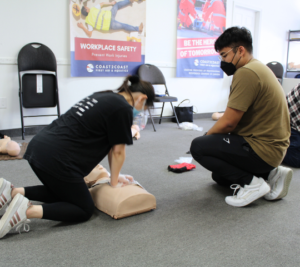
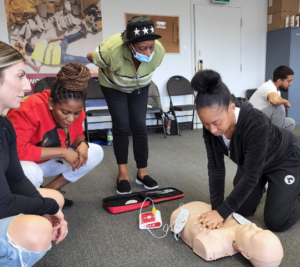
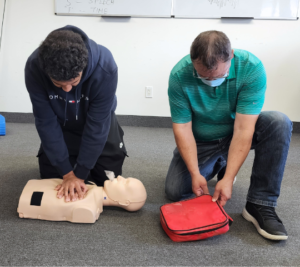
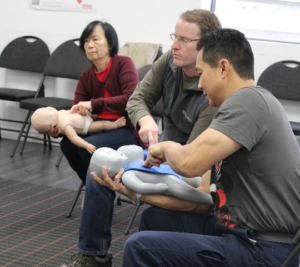
The CPR and AED Skills You Will Practice


Common Questions
CPR Certification Questions, Answered
How do I get CPR certified in the United States?
Book a class, attend it, and pass the skills test. Our American Red Cross CPR classes run at every Coast2Coast facility, and you leave with a card the day you pass. Pick the level that matches who you may have to help, choose blended learning or fully in person, and register. No prerequisite, no medical background assumed.
Can I get CPR certification online?
Not entirely. Every CPR certification an American employer recognizes includes a hands-on skills test, and that has to happen in a room with an instructor. What you can do online is the theory. Search for CPR certification online and you will find plenty of online CPR courses and online CPR certification training that teach the theory well, but a pure online certification cannot certify you for work.
Is an online CPR course enough for my employer?
Almost never. Ask your employer whether they accept an online CPR course before you pay for one, because most treat a pure online certification as theory rather than proof. Our blended option gives you the flexibility people want from CPR certification online without the risk: you finish the online portion of the training at home, then attend a shorter CPR certification class for the practical work.
Can I finish my CPR certification online in one day?
The online CPR portion, yes. Our online CPR certification training is self-paced, so students start their CPR certification online in the morning and sit the classroom skills later that week. Searching for CPR training online gets you this format. What no online certification course can do is sign off your skills test.
Which CPR class should I take?
Match the class to the age of the people around you. Adult covers adults only. Pediatric covers infants and children. Adult and Pediatric covers both, and it is the safest choice if your employer has not named a level. Every CPR class on this page carries the same certificate validity.
How long does CPR certification last?
Two years from the date you pass. Your American Red Cross certificate shows the expiry date on its face. Set a reminder about two months out, because an expired card means taking the full CPR certification class again.
Can I take a shorter CPR recertification class?
The American Red Cross offers a shorter review course, but only while your certificate is still valid. Once a card expires that route closes and you retake the full CPR certification class at the level you hold. So check the expiry date before you book, and call 1-866-291-9121 if you are not sure which one your CPR recertification needs.
What is the difference between a CPR and AED course and a first aid course?
One handles the heart stopping, the other handles everything else. A CPR and AED course teaches compressions, rescue breaths and defibrillator use. A first aid course teaches bleeding control, burns, anaphylaxis, stroke and nine more emergencies. Our CPR first aid classes combine both into one certificate. If your workplace asks for a CPR first aid certification on a single card, that is the page you want.
Do I need infant CPR training?
If a baby or a small child could be in the room, yes. Infant CPR is not adult CPR scaled down. Compression depth, hand position and the choking sequence all change. Childcare licensing bodies usually ask for it by name, and parents book this CPR training for their own peace of mind rather than for a job.
I am a healthcare provider. Is this the right CPR class?
Probably not — healthcare providers usually need Basic Life Support. BLS is the AHA course written for healthcare providers who resuscitate as a team, with two-rescuer compressions and bag-mask ventilation. The CPR training on this page is built for a single rescuer. If your license or your unit asks for BLS, healthcare providers should book Basic Life Support instead.
What CPR skills will I practice in class?
Compressions, rescue breaths, defibrillator use and choking relief. You work on manikins sized for the age groups your level covers, then take an automated external defibrillator trainer through pad placement and the shock sequence. The CPR skills get repeated until you can run them without being talked through it, which is exactly what the skills test checks.
Is your CPR training OSHA-compliant?
Yes, across every class we run. Coast2Coast is an American Red Cross Authorized Training Provider, and our AED and first aid programs meet OSHA workplace requirements in all US locations. A job posting that lists CPR/AED first aid training is describing exactly this. If your safety officer needs paperwork, the certificate names the provider, the level and the expiry date.
How long does it take to learn CPR?
Between 90 minutes and four hours, depending on the level. Pediatric is the shortest. Adult and Pediatric is the longest. You will learn CPR faster than most people expect, because the sequence itself is short and the class time goes into repeating it until your hands know it without you thinking.
Do I practice on a real defibrillator?
You practice on an AED trainer, which is the point. A trainer runs the same pad placement, the same voice prompts and the same rhythm analysis as the unit on the wall at your workplace, without delivering a shock. Every student handles one. Meeting an automated external defibrillator for the first time during an emergency is exactly what this class prevents.
How soon do I get my certificate?
Within 48 hours of passing. Your digital American Red Cross certificate arrives by email, so you can forward it to an employer the same week you train. You also get a free 90-day skills practice retake at no additional cost if you want more repetitions before you rely on the skill.