
CPR training in Mississauga teaches residents and workers how to respond to cardiac arrest, choking, severe bleeding, and other life-threatening emergencies before Peel Regional Paramedics arrive. Canadian Red Cross certified courses meet WSIB Regulation 1101 and the 2026 CSA Z1210:24 workplace first aid standards. A hands-on practical skills assessment is required for all valid certifications and cannot be completed online alone.
Mississauga is the sixth-largest city in Canada, home to over 800,000 residents and an economy spanning healthcare, manufacturing, logistics, technology, and professional services. In a city of this size and density, sudden medical emergencies occur daily. Whether at a workplace, a community event, or a family home, the ability to perform high-quality CPR can determine whether someone survives a cardiac emergency.
This guide covers everything Mississauga residents and workers need to know about CPR and first aid certification in 2026, from the science behind effective compressions to the workplace compliance requirements that apply to nearly every Ontario employer.
Why Does CPR Training Matter in Mississauga?
Cardiac arrest can strike anyone regardless of age, fitness level, or medical history. When the heart stops beating effectively, irreversible brain damage can begin within minutes. In Mississauga, where Peel Regional Paramedic Services responds to a high volume of emergency calls across a large geographic area, response times can be affected by highway traffic, severe weather, and call volume.
During the critical minutes before paramedics arrive, bystander CPR is the single most effective intervention available. High-quality chest compressions act as a manual pump, maintaining blood flow to the brain and vital organs. Research from resuscitation councils consistently shows that bystander CPR can double or triple survival rates from out-of-hospital cardiac arrests.
Mississauga’s diverse population means that medical emergencies can present additional challenges including language barriers and varying health literacy. Proper CPR training from a certified provider prepares you to take command of a chaotic scene, direct bystanders to call 911, and use barrier devices to deliver rescue breaths safely.
What Happens During Cardiac Arrest and Why Every Second Counts
Cardiac arrest occurs when the heart’s electrical system malfunctions and the organ stops pumping blood effectively. Unlike a heart attack, which involves a blocked artery while the heart continues beating, cardiac arrest causes an immediate and complete loss of circulation. The brain begins to suffer irreversible damage within 4 to 6 minutes without oxygenated blood flow.
Ventricular fibrillation, a chaotic and disorganized electrical rhythm, is the most common initial cause of sudden cardiac arrest. An Automated External Defibrillator (AED) delivers a calibrated electrical shock that can reset this rhythm and restore a normal heartbeat. For every minute that defibrillation is delayed, the chance of survival drops by approximately 10 percent. CPR performed between collapse and defibrillation keeps the brain viable and significantly increases the likelihood that an AED shock will be effective.
How Does High-Performance CPR Work?
Modern Canadian Red Cross training goes far beyond basic chest compressions. The 2026 curriculum emphasizes High-Performance CPR, a methodology that maximizes the Chest Compression Fraction (CCF), the percentage of total resuscitation time spent actively compressing the chest. By minimizing pauses such as those for AED pad placement or rescue breaths, responders maintain the hemodynamic pressure needed to sustain brain function throughout a prolonged rescue.
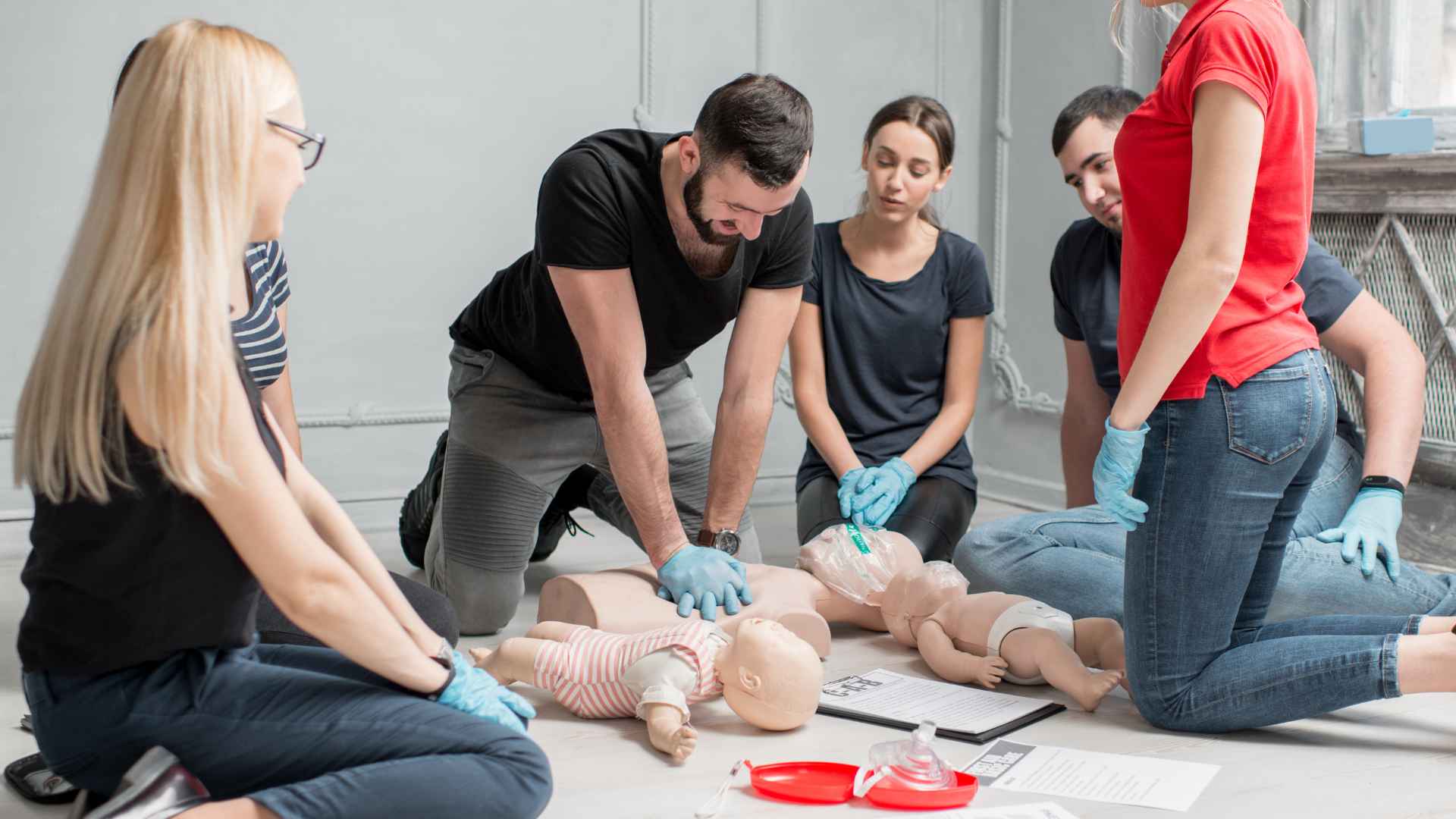
To develop this skill, students use high-fidelity feedback manikins during their practical skills assessment. These devices provide real-time digital feedback on compression depth and rate, ensuring you consistently meet the required depth of at least 2 inches (5 cm) and maintain an optimal rate of 100 to 120 compressions per minute.
AED Integration and Barrier Devices
AED training is a mandatory core component of every modern CPR course. You learn to locate, power on, and operate an AED under stress. These devices analyze the heart’s electrical rhythm and deliver a shock only when ventricular fibrillation is detected, so they will not shock a normal heart rhythm. Many public buildings and workplaces in Mississauga are legally required to have AEDs on the premises.
Barrier devices, including one-way valve pocket masks, are covered in every course. These allow you to deliver effective rescue breaths without direct mouth-to-mouth contact, reducing the risk of disease transmission. Single-use barrier devices are provided to all students during training.
For healthcare environments, Basic Life Support (BLS) introduces team-based resuscitation and oxygen administration protocols using Bag-Valve-Masks (BVMs), which deliver superior ventilation and are the clinical standard in hospital and pre-hospital settings.
Learn CPR in a Real Classroom
Practice High-Performance CPR and AED use on high-fidelity manikins with a certified Canadian Red Cross instructor. Hands-on skills you cannot build online.
What Does a CPR and First Aid Course Cover in 2026?
Every certified course combines online theory with hands-on skills development. The blended learning format allows you to complete theory modules at your own pace from home before attending a shorter in-person session for your practical skills assessment and written examination.
Course content covers CPR technique for adults, children, and infants, AED operation, choking response using abdominal thrusts and back blows, recognition of stroke using the FAST method, severe bleeding control, anaphylaxis recognition, and the overall Check, Call, Care emergency response framework.
A standalone CPR/AED Level C course takes approximately 4 to 6 hours. Emergency First Aid takes one full day. Intermediate / Standard First Aid takes two full days. If your current certificate is approaching its three-year expiry, a recertification course allows you to renew your credentials without repeating the full program.
Who Needs CPR Certification in Mississauga?
Different roles require different levels of training:
- Security guards and loss prevention personnel must hold valid Intermediate / Standard First Aid to maintain their Ontario security licence and manage emergencies in retail and commercial environments.
- Construction and logistics workers in high-risk environments require training in severe bleeding control, crush injuries, and scene safety.
- Daycare staff and early childhood educators must hold CPR Level C (Pediatric) to address child-specific emergencies including pediatric choking, febrile seizures, and anaphylaxis.
- Hospitality and event staff must be prepared to respond to sudden cardiac arrests and choking in crowded dining and event venues.
- Healthcare professionals including nurses, dental staff, paramedics, and pharmacists require Basic Life Support (BLS), which covers pulse checks, oxygen administration using Bag-Valve-Masks, and team-based resuscitation protocols.

How Does CPR Training Meet WSIB Workplace Requirements?
Ontario’s workplace safety legislation requires employers to maintain adequate first aid coverage at all times. WSIB Regulation 1101 specifies the exact requirements based on workforce size per shift. Workplaces with 1 to 5 employees must have at least one Emergency First Aid responder and an accessible Type 1 first aid kit. Workplaces with 6 or more employees require a Intermediate / Standard First Aid responder and a Type 2 or Type 3 kit meeting the 2026 CSA Z1210:24 standards.
Private group training is available for organizations that need to certify multiple staff members efficiently. Certified instructors deliver training directly at your facility with all required equipment, customizing emergency scenarios to your workplace’s specific hazards, whether that is a warehouse, an office, a retail floor, or a clinical setting.
Train Your Whole Team
Private group training delivered at your Mississauga workplace. WSIB-compliant certificates for your entire team, on your schedule.
How Does First Aid Certification Reduce Corporate Liability?
For Mississauga business owners, investing in CPR training is not only a compliance requirement but also a critical liability management strategy. If a serious workplace incident occurs, investigators and insurers will scrutinize training records closely. Ensuring staff have passed both the written examination and the practical skills assessment demonstrates legal due diligence and an active commitment to worker safety.
Many commercial insurers offer premium discounts to organizations that maintain a trained, WSIB-compliant workforce, offsetting the cost of group training over time.
Key Takeaway
CPR training in Mississauga gives residents and workers the skills to act effectively during cardiac arrest, choking, severe bleeding, and other emergencies before professional help arrives. High-Performance CPR, AED use, barrier devices, and written examination requirements are all part of the 2026 Canadian Red Cross standard. WSIB Regulation 1101 and CSA Z1210:24 establish the compliance baseline for virtually every Ontario workplace. Whether your goal is personal preparedness, professional certification, or regulatory compliance, completing a certified first aid course remains one of the highest-impact actions any Mississauga resident can take.
Join 150,000+ Canadians Who Are Certified
Get your Intermediate / Standard First Aid certification from Canada’s trusted training partner. Hands-on. Instructor-led. Recognized by WSIB and employers nationwide.
Frequently Asked Questions: CPR Training Mississauga 2026
More FAQs: First Aid Certification in Mississauga
Sources & Professional Review
- WSIB Regulation 1101, Workplace Safety and Insurance Act (Ontario): wsib.ca
- CSA Z1210:24, First Aid Requirements for the Workplace. Canadian Standards Association, 2024
- Canadian Red Cross First Aid and CPR/AED Program Guidelines, 2026