
During the early phase of drowning, the person’s airway closes to prevent more water from entering the lungs. Involuntarily, the victim cannot breathe, leading to unconsciousness.
Continue reading



During the early phase of drowning, the person’s airway closes to prevent more water from entering the lungs. Involuntarily, the victim cannot breathe, leading to unconsciousness.
Continue reading
Healthcare professionals play a vital role in their teams as they work in fast-paced environments. They should, as a result, be skilled in performing basic life support. CPR skills are essential in the everyday lives of healthcare workers because their profession focuses on saving lives. The potential for patients going into cardiac arrest is something they need to be aware of at all times and provide help if necessary. So, what is CPR for a healthcare provider?
Continue reading
First Aid training prepares you to help others in several situations, including accidents and medical emergencies. In addition, the theoretical knowledge and practical skills learned during a First Aid course can impact someone’s survival rate.
Continue reading
Given that injuries and illnesses can happen at any time, it’s important to be prepared. With some basic first aid knowledge, you can prevent a minor accident from becoming more serious. A medical emergency is a frightening event, but if you are trained as a first aider, you could save someone’s life.
Continue reading
There are several reasons why someone will decide to take First Aid & CPR training in the GTA. Emergency and Standard First Aid are the two most popular First Aid levels. The main differences between the two courses are the time it takes to complete the training and how extensive the learning experience gets in each of the courses.
Most workplaces and schools state what level of training is required, but someone may want to do the course as they prepare to become a parent, caregiver, or to help someone in an emergency. Read on to find out the essential differences in First Aid training and choose the right course.
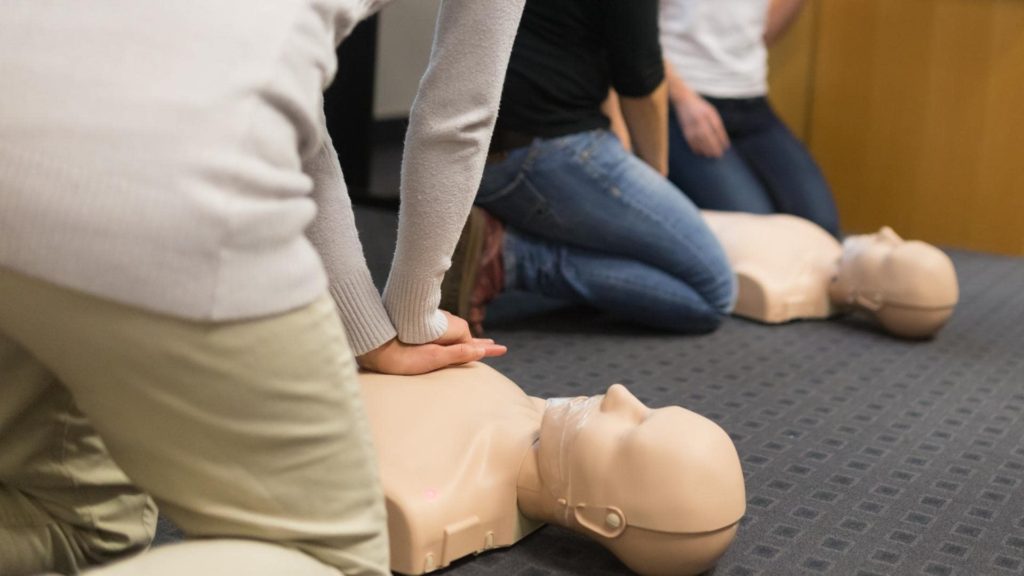
People requiring First Aid training should always verify which course is required before registering. Let’s discuss our most popular First Aid & CPR training courses:
Standard First Aid & CPR/AED
Standard First Aid CPR/AED training complies with the provincial workplace regulations of several careers. With this online blended course, there are two sections, and it includes a 7-8 hour online section and 8 hours of in-class training.
In addition to the online blended training format, there is also the traditional course which requires two days of in-class training. Participants learn all the skills to confidently help victims of life-threatening and non-life-threatening emergencies from accidents and illnesses.
At Coast2Coast, we combine Standard First Aid with CPR level C to ensure participants can provide CPR to adults, children, and infants.
Depending on the workplace, WSIB in Ontario may recommend employees complete Standard First Aid & CPR/AED. The requirement includes some employees at provincial and municipal levels with workplaces that have more than five employees per shift or floor. Employers must ensure that enough employees have the Standard First Aid training so that someone with the training is available at all times during work hours.
Some of the occupations requiring Standard First Aid & CPR/AED training include professionals and scholars in the following fields:
Emergency First Aid & CPR/AED
Some jobs just require Emergency First Aid & CPR/AED training. WSIB in Ontario recommends it for some workplaces and individuals that require less intense First Aid training. Once again, it’s necessary for employers to make sure that the requirements laid down by the WSIB Regulation 1101 must be met at all times. This includes having access to a First Aid Kit and employees depending on the size of the organization being first aid certified. It is essential that everyone checks with their school or job before registering.
Training for Emergency First Aid & CPR/AED varies according to the level chosen but is more or less an eight-hour course. Participants can choose an all-in-class course or the online, blended course.
These occupations usually need an Emergency First Aid & CPR/AED certificate:
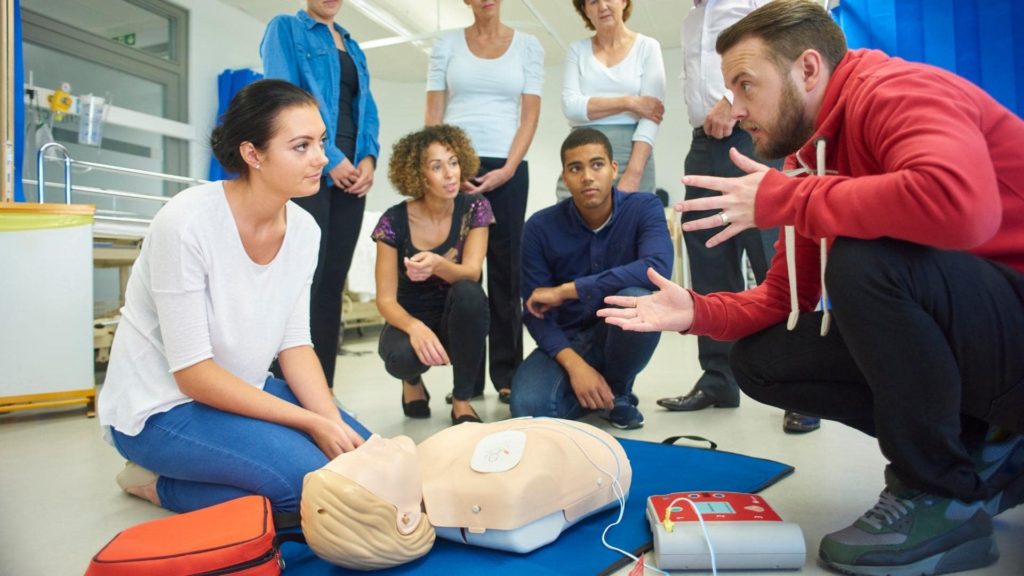
The proper training and approval are vital in First Aid training. Coast2Coast is a Canadian Red Cross and Heart & Stroke training partner. The top-notch professional instructors also provide medical students with the following Heart & Stroke training:
Basic Life Support
Pediatric Emergency Assessment, Recognition and Stabilization (PEARS) training
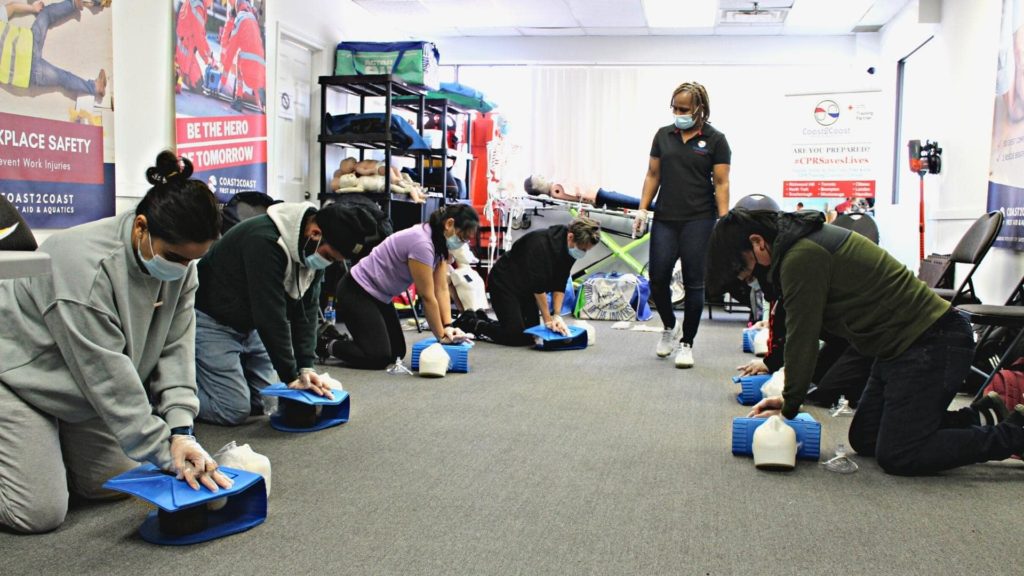
Choosing the right First Aid course in the GTA is easier than you think. Coast2Coast, a Canadian Red Cross training partner and WSIB approved First Aid training provider, offers several courses, making it easy to find the First Aid training required for any career in the province. Based in the GTA of Ontario, Coast2Coast makes it easy to register and participate in its First Aid courses provided by only experienced instructors.
Always be prepared to save a life, get certified today!

Whichever level of First Aid and CPR training you need, on completing the course, you earn a Canadian Red Cross approved certificate. The skills and life-saving techniques you learn are invaluable, whether part of a work requirement or just to help others. When training at Coast2Coast, your First Aid certification is valid for three years.
Continue reading
Understanding how to provide proper first aid or CPR to an injured or unconsious person is important. Accidents can happen at any time which is why we should be prepared. A great way to learn these life-saving skills is to complete a First Aid & CPR training course.
Did you know that many professions require their employees to be first aid and CPR certified? That’s right! Everyone from nurses to office staff may be required to complete a First Aid & CPR training course. In Ontario, many companies are covered by the Workplace Safety and Insurance Act (WSIB). These companies must follow Regulation 1101 regarding first aid training and safety requirements.
One of our goals at Coast2Coast First Aid & Aquatics is to provide everyone with some form of First Aid and CPR training, ensuring they are confident enough to assist in an emergency.
Do your employees need to complete first aid training? At Coast2Coast, we offer Private First Aid training courses for groups of eight participants or more. There are many benefits of Private First Aid training compared to public courses. Let’s discuss more below!
As a Canadian Red Cross training partner, we are dedicated to provide several WSIB-approved First Aid and CPR courses. Most people do the training in their own time by attending a public course. However, we also provide Private First Aid training. With Private training, we take care of everything for your group!
At Coast2Coast, Private Training is a way for groups of eight or more participants to get trained together. There are many benefits to Private First Aid training such as certifying many employees at once, convenient scheduling, choice of training location/time, amazing discounts and more!
Arranging a Private First Aid training is simple. All you need to do is fill out a form on our website then one of our Private Training specialists will contact you. Once the details of your training are determined, we will finalize your training by booking one of our experienced Canadian Red Cross instructors.
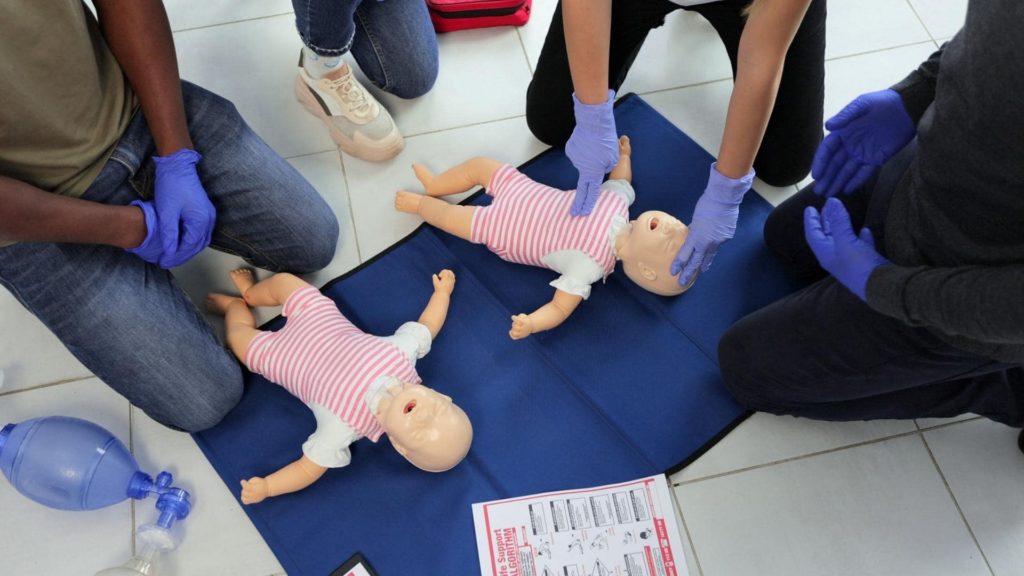
Our highly-trained instructors provide Private First Aid & CPR/AED training to groups of people at their chosen location. If your school, business, home, etc., is unsuitable for the training, we host the training at any of our facilities across Ontario. Clients can choose from several types of training levels, depending on their First Aid requirements. These include:
On completion, the candidates in the Private First Aid training course receive a WSIB-approved certificate once their invoice has been cleared. First Aid and CPR certificates are valid for three years, and Basic Life Support certificates for one year.
Any group of people, whether they are scholars, teachers, employees, medical professionals, friends, or family members wanting to complete a First Aid & CPR or Basic Life Support course, are the perfect candidates for Private First Aid training. Most often, employers who need to certify more than eight employees register for Private First Aid & CPR training.

As mentioned before, many companies are required to train their employees in first aid under WSIB’s Regulation 1101. Private training makes it convenient for them to complete this. Although, Private training is not only helpful for companies; it’s also helpful for groups of friends, families and more!
No one can deny the importance of First Aid training. Many people put it off because they feel they don’t have the time, don’t know how to register for it or think they don’t need it. Private training solves this problem because just one person needs to organize the training for everyone. Then one of our professional instructors arrives at the given date and time to do the training.
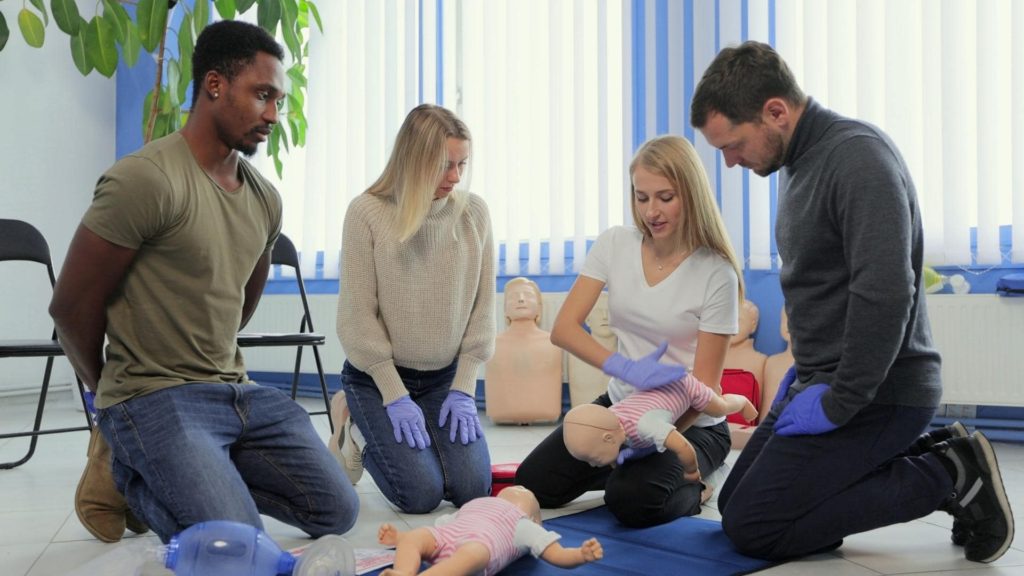
First aid training does more than just give you the confidence to help save lives. The person who provides first aid during an emergency offers the victim comfort and helps prevent the worsening of the victim’s situation. The more people within a group who have the training, the better it is for the whole.
Besides giving your group the confidence to care for others, private First Aid training encourages you all to live healthily and safely because of the knowledge and awareness you will learn from the instructor.
There are several benefits of Private First Aid Training:
Contact us at Coast2Coast by phone or email if you have any questions regarding Private First Aid & CPR/AED training courses.
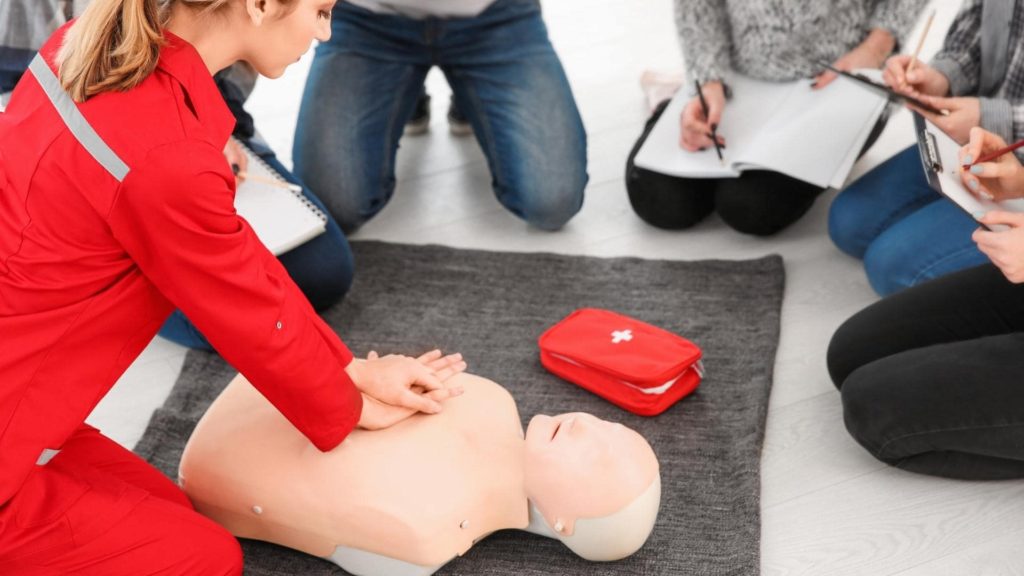
Coast2Coast offers private group training sessions at over 30 locations. Whether your team needs CPR Certification Mississauga, CPR Certification Toronto, or CPR Certification Calgary, we bring the training to your workplace or host it at one of our facilities. Businesses in Ontario can book First Aid training Brampton, Standard First Aid Hamilton, or CPR Certification Ottawa. We also serve teams looking for First Aid training Edmonton, First Aid training Vancouver, CPR Certification Kitchener, and CPR Certification Saskatoon. All private sessions include Standard First Aid & CPR Level C certification from the Canadian Red Cross, and can be customized to your industry requirements including WSIB compliance.
Register today for a CPR or First Aid training course at one of our 30+ locations across Canada and the U.S. Check out our facilities and book your spot now.
Register NowRegister for Private First Aid Training today and ensure your fellow colleagues, family and friends get the confidence required to save others. The knowledge from the training is invaluable to everyone, helping you become aware of better assessing your surroundings and any situations that may arise. The training gives you the required confidence to help save and rescue any person who needs immediate help.
The Private Group Request Form is the quickest way to register for Private First Aid Training with Coast2Coast. Once the details are submitted, someone from our office will contact you within 24 hours. Together you can organize the training at a convenient day, time, and place for your private group training. Private training is available in Western Ontario, Eastern Ontario, and the Greater Toronto Area.
We hope you now understand all of the benefits of Private First Aid training!
Ashkon Pourheidary, B.Sc. (Hons) — Co-Founder, Coast2Coast First Aid & Aquatics
Ashkon has been a certified First Aid and CPR instructor since 2011 and an Instructor Trainer since 2013. He is also a certified Emergency Medical Responder (EMR) instructor, Psychological First Aid instructor, and BLS (Basic Life Support) instructor. Ashkon graduated with honours with a Bachelor of Science in Neuroscience from the University of Toronto in 2016. As co-founder of Coast2Coast First Aid & Aquatics, he has helped grow the organization to over 30 locations across Canada and into the United States. Ashkon has served on the First Aid Council for the Canadian Red Cross. He spends his time coaching the team of over 100 instructors at Coast2Coast to ensure that students training at Coast2Coast locations receive the best training experience. Connect on LinkedIn

Defibrillators or Automated External Defibrillators (AEDs) are devices that deliver a life-saving shock to someone suffering from cardiac arrest. The electric shock from the defibrillator passes through the chest wall to the heart, often giving a person in cardiac arrest a chance to survive.
Continue reading
Healthcare professionals learn CPR, First Aid, and Basic Life Support training to help save people in health and other emergencies. However, CPR and First Aid training courses are also compulsory in different places of employment. Many citizens also learn these skills in their private capacity to offer their assistance whenever and wherever required.
Once you have completed your training in any of these lifesaving disciplines, you receive a certificate that proves your skills. Depending on the training, the certificate’s validity has an expiration date, and it is essential to keep the certificate up-to-date by taking the recertification training.
All these first response disciplines, whether to assist someone with a cut, bruise, cardiac arrest, anaphylaxis, choking, drowning, etc., are based on having the skills required to apply the techniques to help the person until professional help arrives.
We are an aging society, and the generation of Baby Boomers is now increasingly reaching the age where they may require medical assistance. The risk of exposure to viruses, infections, and environmental illnesses has also increased in recent years. First Aid and CPR are essential for helping an unconscious person or someone with an injury.
Using the proper techniques can save a life and improve the person’s chances of recovery. CPR and First Aid training is inexpensive and requires just a few hours, ensuring that you have the skills to help in any situation.
However, once you complete the training, you must consider that retraining and recertification are essential to keeping your skills refreshed. Workplaces and school programs often require employees and students to maintain valid certificates. Regular certificate updates benefit you because you retain the confidence to practice your lifesaving skills while also learning any new developments and techniques to save lives.
According to WSIB Ontario, First Aid training requirements differ in the workplace. These requirements include the number of people and type of First Aid training required and depend on several conditions. These include the number of shifts, people per shift, and the kind of business activity.
If a company does not use dangerous equipment or chemicals, the required number of employees usually take only Emergency First Aid training. Other companies must provide Standard First Aid training to the prescribed number of employees per shift if they work under more dangerous conditions.
Generally, if less than five employees work per shift, one employee per shift requires valid Emergency First Aid & CPR/AED Level C training and certification. For companies with more than five employees per shift, at least one employee must have a valid Standard First Aid & CPR/AED Level C certificate.
At some workplaces, the requirements are annual recertification, even if the certificate is valid for three years.
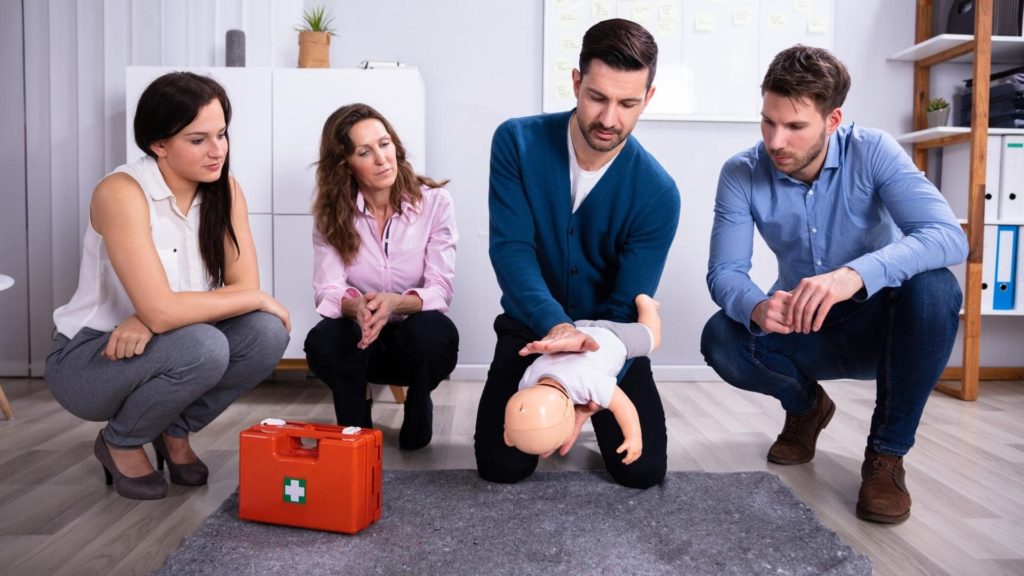
Don’t forget the validity period of your First Aid, CPR, or Basic Life Support certification, especially if the certificate is a requirement under Ontario’s Regulation 1101 for your workplace.
CPR or cardiopulmonary training does not include any first aid training. The various levels of CPR training teach candidates how to recognize and respond to breathing emergencies like cardiac arrest, choking, drowning, etc. One of the major learnings would be the use of an Automated External Defibrillator (AED). CPR certificates are valid for three years, but can be recertified multiple times regardless. You need to retake the training and receive a new certificate before the old one expires.
Our Canadian Red Cross Emergency and Standard First Aid & CPR/AED certificates issued by Coast2Coast are valid for three years.
Standard First Aid & CPR/AED Recertification – Standard First Aid & CPR/AED recertification training must be completed before the certificate expires; otherwise, it is invalid. Once you complete the one-day renewal course, your certificate indicates the recertification. After the expiry of the Standard First Aid & CPR/AED recertification, you must complete the full training course again. Training must be alternated between a full course and the Recertification course.
Emergency First Aid & CPR/AED – According to WSIB in Ontario, Emergency First Aid & CPR/AED Level C courses can not be recertified. Before the expiry of this certificate, you need to register for the full training course. The online blended format is an ideal training, allowing you to complete half the training online followed by a 5-hour in-class section.
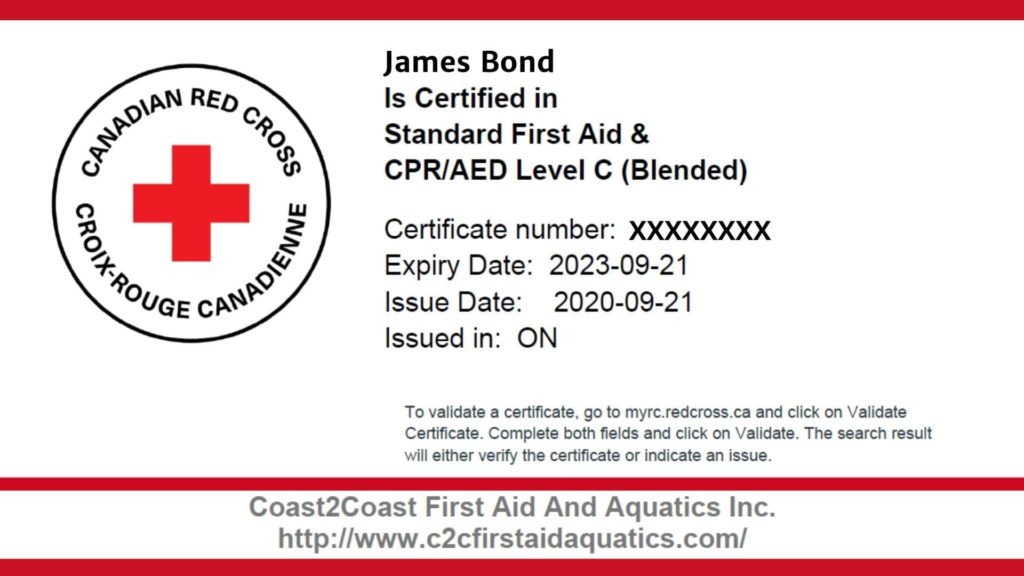
Basic Life Support is the intensive training required by people working in healthcare and rescue services. BLS certificates are only valid for one year. Full training is required each time because of the ever-changing duties of these professionals who usually work in fast-paced and demanding environments.
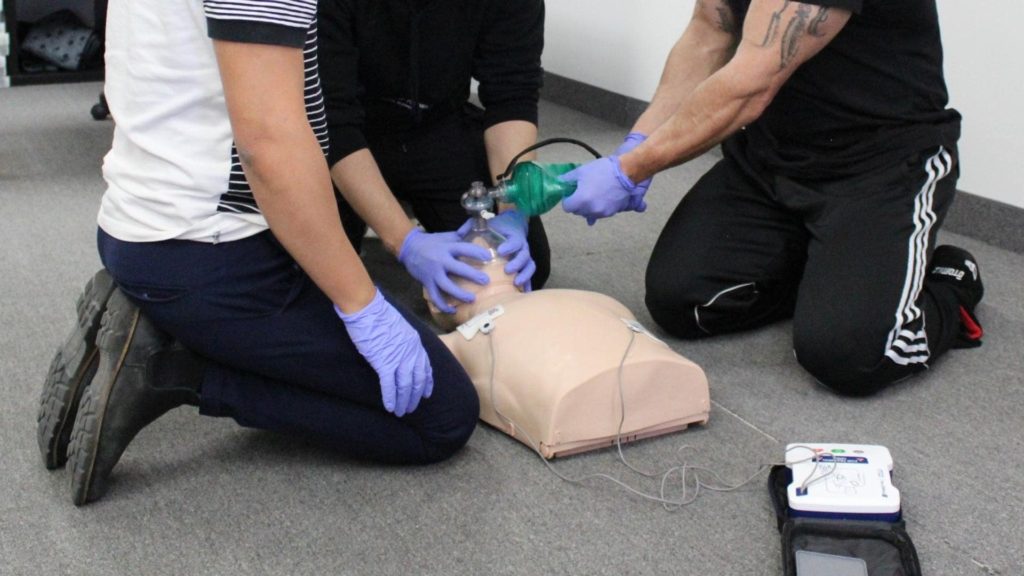
Remember, if your Standard First Aid Certificate is about to expire, you need to complete the recertification training before to ensure its validity. All other certificates require you to do the training again. Whatever your CPR and First Aid certification needs, Coast2Coast offers various recertification courses throughout the day to best fit your schedule. Register for one of our Recertification courses from one of our 18 locations all over Ontario.

Anyone faced with an emergency situation can benefit from First Aid and CPR training because they may be able to save someone’s life. According to statistics, CPR can better the chances of survival from an out-of-hospital cardiac arrest if administered immediately as most cases of cardiac arrest happen in the home.
If you’re wondering, “do I need first aid and CPR training?”, we will discuss the benefits, requirements and how to complete a training course.
First Aid training has several benefits because you acquire the knowledge and skills to provide the appropriate care in most emergency situations calmly and confidently.
The skills learned during First Aid training include detecting a stroke, heart attack, anaphylaxis, dealing with injuries, cardiac arrest and more. It also teaches you how to correctly perform CPR when needed. During the training, you will practice treating wounds, burns, choking, drowning, and suffocation in victims.
The skills learned are essential for parents, caregivers, and job seekers in almost all fields. Research also shows that children as young as nine years old can learn the correct administration of CPR. It may be beneficial for you to enroll your children in a Babysitting or Stay Safe training course!
There are two levels of First Aid: Emergency and Standard. We recommend that students complete Standard First Aid because it provides more information and skills compared to Emergency First Aid.

Most commonly, medical professionals are the ones who require First Aid & CPR training. This group includes doctors, nurses, medical assistants, paramedics, and other rescue workers like lifeguards and ski patrols.
In addition to medical professionals, all childcare providers, law enforcement, firefighters, sports coaches, construction workers, correctional services staff, flight attendants, security guards, electricians and more require first aid & CPR training.
All businesses must also ensure that the required number of workers have First Aid Certification, whether they are shop assistants, factory workers, secretaries, servers, managers, and volunteers. According to the Workplace Safety and Insurance Act, businesses covered by their fund must have trained personnel and first aid equipment on their premises.
The training must come from a WSIB-approved First Aid provider, and the appropriate number of staff must complete the First Aid course and receive certification according to the guidelines.
Mandatory WSIB First Aid training depends on the number of people working per shift at any given time in the workplace.
In workplaces with five or fewer people working per shift, one or more people with an Emergency First Aid & CPR certificate must be present. In workplaces with more than six people working per shift, at least one person must have a Standard First Aid & CPR certificate.
Since all these employees mentioned above work with many people and often work under hazardous conditions, First Aid & CPR training allows them to recognize and assist in health or work-related emergencies.

First Aid training is not always mandatory. Typically, school programs and workplaces are implementing these certifications, but not every school or business requires this training. Although, there are several reasons why you should get certified regardless of your profession.
Recognizing emergencies and saving lives requires knowledge, skills, and confidence. First Aid training provides these, allowing you to face any situation from choking, accidents caused by the use of dangerous equipment, and even recognizing the signs of cardiac arrest or anaphylaxis. You learn in which order CPR and other techniques are applied, often making the difference between temporary or long-term side effects.
Besides saving a life, First Aid training teaches you to ease the pain and discomfort caused by falls and fever, even if the patient does not need to go to the hospital.
Some situations where basic first aid care is not applied immediately may lead to the victim’s condition deteriorating rapidly. This weakens their chance of survival until emergency medical care (EMS) arrives. Your First Aid training can save valuable time by helping the victim, explaining the situation to emergency services, and their current condition.
Perhaps First Aid training is not mandatory, but it helps you become a valuable link in the chain of another person’s survival in an emergency.
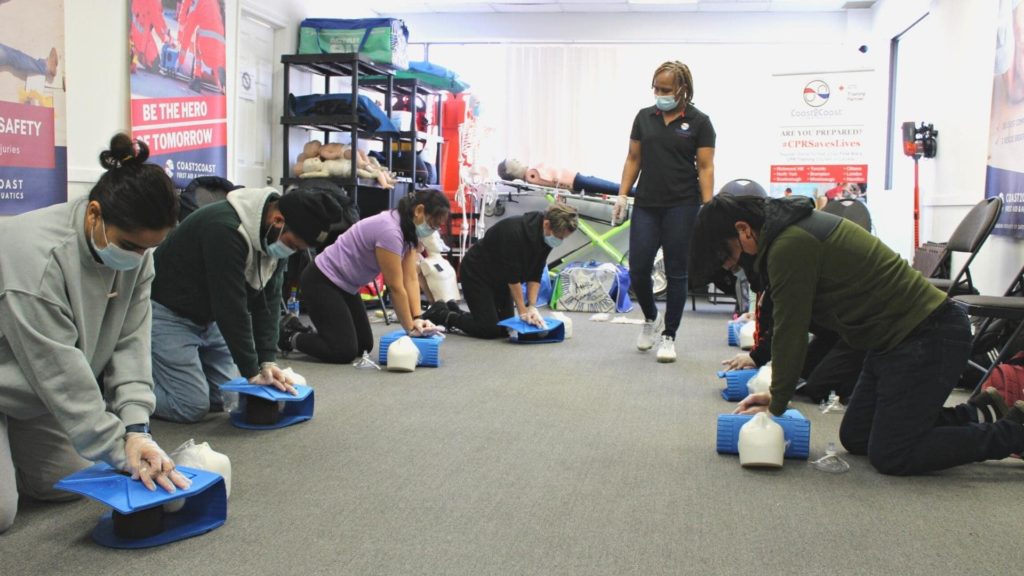
Whether you must get First Aid training for your work or just want to help others, completing First Aid training is far easier than most people think. The time required depends on the training necessary, but it won’t take more than two days for advanced training and one day for basic training.
Coast2Coast has several First Aid Course options to ensure that everyone has the correct training for their needs. Training may be done in the online blended method, allowing you to do the theoretical work in your own time at home before attending an in-person session. As a Canadian Red Cross training partner, Coast2Coast has experienced trainers and provides WSIB-approved certification.
If you thought you were too busy or didn’t know where to go for a First Aid course, Coast2Coast offers you training solutions at a time and place that suit you. You may complete your First Aid & CPR training course at one of our 18 locations across Ontario. If you have any questions about a training course, please do not hesitate to contact us.
Shopping cart