We offer courses in Canada and the US. If you are experiencing issues with our website and need help to register, or if you have questions, please call us at 866-291-9121.
If you are facing any issues with your online course, registration, or training, please click here to submit a help request.
If you are facing any issues with your online course, registration, or training, please click here to submit a help request.
Are you a personal trainer looking to take your fitness career to the next level? One crucial aspect you can’t afford to overlook is CPR certification. In this comprehensive guide, we’ll walk you through the ins and outs of CPR certification for personal trainers. You’ll learn why it’s essential, which certifications are recognized in the industry, and how obtaining one can significantly enhance your clients’ safety and your professional credibility. Whether you’re a seasoned trainer or just starting in the fitness industry, understanding CPR certification requirements is a must. Read on to ensure you’re on the right track to becoming a well-prepared and responsible personal trainer.
Coast2Coast, a provider of first aid training services, has exciting news for Albertans! We have recently expanded into Alberta, opening two locations in Edmonton and one in Calgary. If you want reliable and affordable first aid training in the province, look no further.
Mental health remains a vital component of your complete well-being, including the health of your heart. The facade of happiness during the holiday season often masks the challenging emotions that come with celebrations. In fact, 52% of Canadians report increased levels of anxiety, depression and isolation during the holiday season. The holidays may intensify negative emotions if you already experience depression or anxiety.
The term, “First Aid” refers to the emergency care given to a person who has been injured or has suddenly taken ill. This early response decreases their chances of developing future disabilities and limits the damage done by their current injury or illness.
While learning CPR may feel intimidating at first, it is a crucial skill to have in case you ever find yourself in a medical emergency situation.
Although CPR training is essential, it’s just as crucial that it is performed correctly. The key to effective CPR training is learning how to tailor the procedure according to the age of the patient.
Knowing CPR is not only a necessity for parents and caregivers, but anyone who spends time around children regularly.
CPR for adults and children may share some similarities, but some significant differences exist, especially when performing it on younger children and infants. The correct CPR training considers age group differences, preparing you to take action in a medical emergency.
What is Adult CPR?
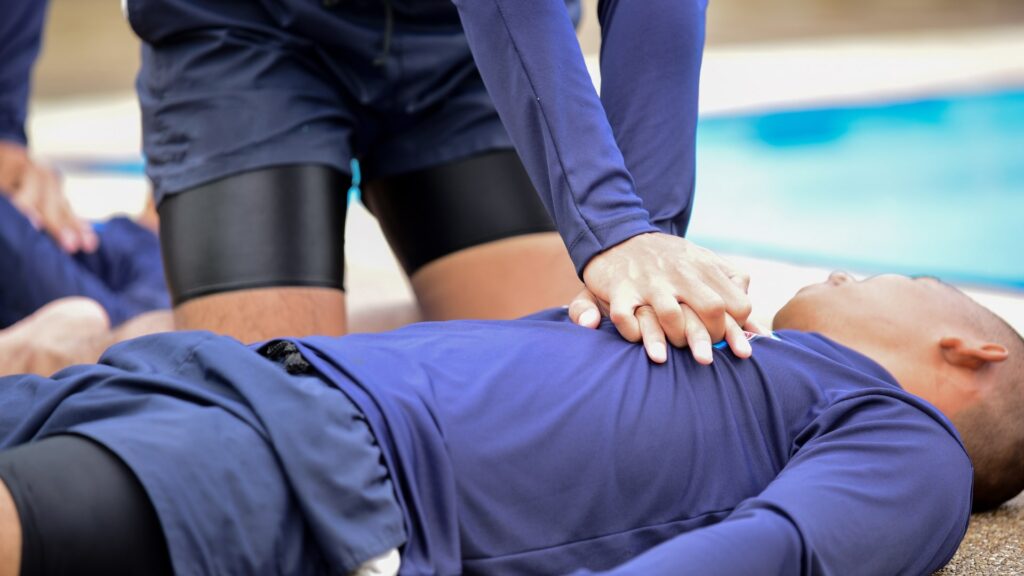
Cardiopulmonary resuscitation (CPR) combines 30 rhythmic chest compressions and two rescue breaths used as an emergency lifesaving procedure in patients with no heartbeat. During CPR, the rescuer uses both hands to compress the chest center at a depth of two inches at a rate of 100 to 120 compressions per minute, a procedure that helps stimulate the heart physically. They then give rescue breaths using the correct quantity of air to raise the patient’s chest.
Adult CPR Example
Imagine witnessing an adult suddenly collapse in a park. You check for responsiveness—no response. You call for emergency help and position the person on their back. Starting chest compressions, you place your hands interlocked in the center of the chest, pressing down at least 2 inches deep at a rate of 120 compressions per minute. After 30 chest compressions, you tilt the head back, seal your mouth over theirs, and deliver two rescue breaths, watching for chest rise. You continue this cycle until help arrives.
Learn about First Aid & CPR/AED Course you might need
Certify for First Aid & CPR/AED training to assist someone with your life-saving skills as you complete the course with us. Call our toll-free number to know more.
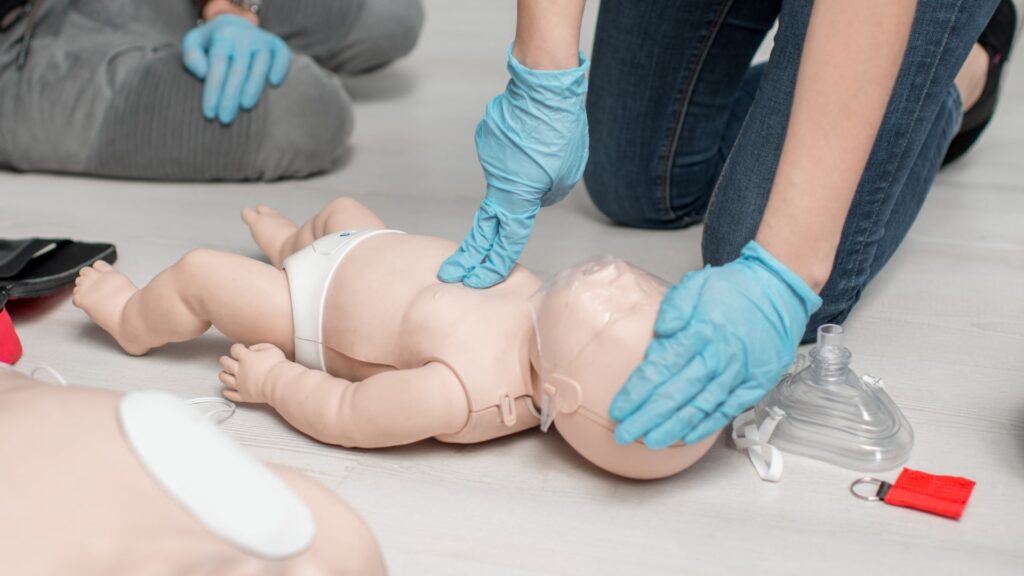
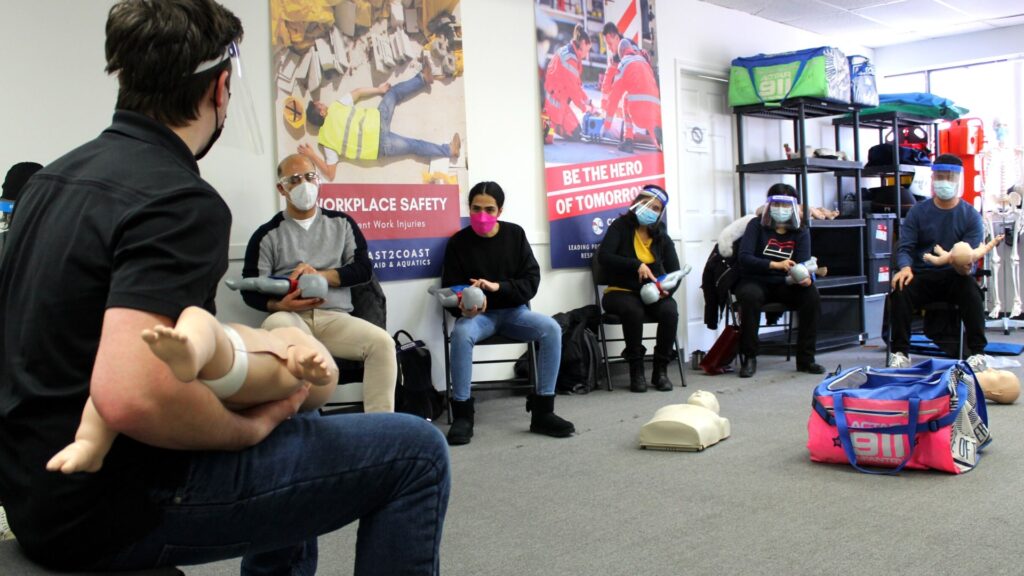
Children have flexible bones, ensuring they don’t get hurt when CPR is required. When performing CPR on an infant, it is crucial to make a complete seal over both the infant’s mouth and nose while administering rescue breaths. However, infants require special care because they are more delicate because of their lighter weight and bone density. Therefore, children and infant CPR teaches you to check for responsiveness and a pulse in different age groups and perform rescue breaths and chest compressions.
Child CPR Example
Now, consider a scenario where a child, about 7 years old, collapses at a family gathering. You ensure the scene is safe and call for emergency assistance. The cardiopulmonary resuscitation process starts with laying the child on a firm surface; you use one hand for chest compressions, pushing down about 2 inches deep at the same rate of 120 compressions per minute. After 30 compressions, you give two rescue breaths, covering both the mouth and nose, ensuring to see the chest rise. You repeat until professional help arrives.
Recognizing Cardiac Arrest
Recognizing cardiac arrest is crucial for performing CPR effectively. Cardiac arrest occurs when the heart suddenly stops beating or fails to beat effectively. Key signs of cardiac arrest include:
No breathing or abnormal breathing
No pulse or a weak pulse
Unresponsiveness
Pale or blue-tinged skin
Confusion or loss of consciousness
If you suspect someone is experiencing cardiac arrest, it’s vital to call the emergency response system immediately. Once you’ve alerted emergency services, start CPR if you are trained to do so. Quick action can significantly increase the chances of survival.
Checking for Responsiveness in Children and Infants
You can gently shake a young child to see if there is any responsiveness, but you can’t do this with an infant. Since a gentle shake is unsafe for babies, the correct way to check is to tap its foot or speak loudly to see if it responds.
Checking for a Pulse
In young children, you can check for a pulse in the same way that you would for an adult at the carotid artery. However, the best way to check for their pulse in infants is on the inner upper arm, known as the brachial artery.
Giving Rescue Breaths
To perform CPR on an adult, full lung-strength rescue breaths are required for better effectiveness. However, children need gentler puffs, and baby breaths even more so. Filling your cheeks with air usually suffices for infant rescue breaths. You must always ensure that the chest rises and falls during rescue breaths to achieve adequate chest rise.
Additionally, the head is always tilted back gently when performing rescue breaths on a young child or infant.
Giving Chest Compressions
When giving chest compressions to infants, the CPR techniques differ; you should only use two fingers because of the size of their bodies. The depth of the compressions also changes; they are shallower than those given to adults and young children.
With infants and children, always begin CPR immediately and call 911 after a few minutes or when it regains consciousness. Why is this important? Because children and infants have a better chance of survival when performed immediately, therefore you need to start chest compressions immediately. Of course, in cases where two people are present, one can perform CPR, and the other should call in all cases, whether they are adults, children, or infants.
Benefits of Learning CPR
CPR is a lifesaving procedure performed when someone’s heart stops beating. Pediatric CPR is especially important as it involves specific techniques tailored for children and infants. Research has shown that CPR increases the chances of survival for cardiac arrest victims by more than double.
CPR keeps the blood flow active in someone who has stopped breathing and has no pulse, allowing blood and oxygen to maintain the function of vital organs like the brain.
How to Prepare for Providing CPR
Training remains the best way to prepare for CPR and maintain your certification. However, logic says that even if you are untrained, it’s always best to try and do something to save someone’s life than to do nothing.
Always make sure of the following as you prepare to offer CPR:
Ensure a safe environment.
Check if the person is unconscious.
Call 911 first if dealing with an adult and then perform CPR, or do the opposite if it’s a child or infant. Knowing child CPR is crucial as it involves specific procedures and distinctions for children aged 1-12.
Use an AED only if it instructs you to proceed with delivering the shock.
Remember the order of CPR: compressions, airway, breathing.
Survival Rate Statistics for CPR
Brain damage occurs within minutes from a lack of oxygen. Therefore, if a person does not receive CPR immediately in an emergency like a cardiac arrest, it is improbable that they will survive if they wait for emergency services.
Recent statistics show that quickly performing CPR increases their chances of survival by nearly 45 percent in out-of-hospital situations for cardiac arrest victims helped by bystanders or relatives.
Find a CPR Training Near You
Not only do medical emergencies happen at work, but they also take place in more familiar settings like around the house. Being certified in First Aid and CPR means that you can step up and help in any emergency situation. The more training you have, the better equipped you are to handle unforeseen situations which might come your way.
Help improve the outcomes for people in out-of-hospital situations by completing CPR training so that you are ready to take immediate action. Coast2Coast provides CPR Level A, CPR Level C, and Basic Life Support classes across Ontario in several locations, making it highly convenient for you.
Register for a First Aid & CPR Training Course
Choose from any of our locations across Ontario and gain the knowledge and skills to save a life!
The increasing number of people diagnosed with cardiac health issues means millions are at risk of heart attacks and cardiac arrest. Since most of these occur outside of a hospital, Basic Life Support provides the training to help increase survival rates, particularly for cardiac arrest victims who would otherwise have minimal recovery and survival chances without help.
During the early phase of drowning, the person’s airway closes to prevent more water from entering the lungs. Involuntarily, the victim cannot breathe, leading to unconsciousness.
Healthcare professionals play a vital role in their teams as they work in fast-paced environments. They should, as a result, be skilled in performing basic life support. CPR skills are essential in the everyday lives of healthcare workers because their profession focuses on saving lives. The potential for patients going into cardiac arrest is something they need to be aware of at all times and provide help if necessary. So, what is CPR for a healthcare provider?
First Aid training prepares you to help others in several situations, including accidents and medical emergencies. In addition, the theoretical knowledge and practical skills learned during a First Aid course can impact someone’s survival rate.
Given that injuries and illnesses can happen at any time, it’s important to be prepared. With some basic first aid knowledge, you can prevent a minor accident from becoming more serious. A medical emergency is a frightening event, but if you are trained as a first aider, you could save someone’s life.