Basic First Aid is Ontario’s WSIB-approved entry-level first aid course, formerly called Emergency First Aid, renamed on June 22, 2026 under CSA Z1210:24 national standards. It is an 8-hour one-day course covering CPR, AED use, bleeding control, choking response, shock management, and recognition of common medical emergencies. Certificates are valid for three years. In Ontario, first aid training is required for all workplaces, and Basic First Aid satisfies WSIB Regulation 1101 for workplaces with one to five employees per shift.
Find a Basic First Aid Course Near You
One-day WSIB-approved Basic First Aid courses running weekly across Ontario. Certificates issued within 48 hours.
View Course LocationsIf you work in Ontario or manage a team, understanding what Basic First Aid means is not optional. It is a legal requirement, a workplace safety standard, and a set of essential skills that can save a life when seconds count. This guide breaks down exactly what Basic First Aid covers in Ontario, what the law demands, and how to get properly certified under the 2026 WSIB program.
What Is Basic First Aid in Ontario?
In plain language, Basic First Aid is the foundation of emergency care that any person can provide before professional medical help arrives. It covers how to recognize a problem, keep someone alive, and prevent an injury or illness from getting worse. The skills covered in first aid training at this level meet WSIB’s legislative requirements for entry-level workplace certification.
In Ontario, first aid training programs are dictated by the Workplace Safety and Insurance Board, and the term carries specific regulatory weight. People often say “basic first aid” when they mean the entry-level WSIB-approved first aid training designed for workplaces, schools, organizations, and the general public. Officially, WSIB used the name Emergency First Aid for this level for many years. Emergency First Aid training focuses on recognizing emergencies and providing immediate intervention. After June 22, 2026, Emergency First Aid is now officially called Basic First Aid (formerly Emergency First Aid) under the new WSIB First Aid Program, which aligns Ontario’s aid training with the national CSA Z1210:24 standard.
The emergency action steps taught in Basic First Aid include assessing the scene for safety and contacting 9-1-1, followed by providing immediate care until EMS arrives. Medical emergencies recognition is essential in first aid courses, covering conditions like cardiac arrest, stroke, allergic reactions, and diabetic emergencies. First aid training includes recognizing signs of shock and managing unconscious patients.
For a full breakdown of every change under the updated program and what stayed the same, see our complete guide on the WSIB first aid name change Ontario 2026.
Why Did the Name Change From Emergency First Aid to Basic First Aid?
The name change is part of WSIB’s updated First Aid Program, launched on June 22, 2026, which aligns Ontario’s workplace first aid training with the national CSA Z1210:24 standard. The goal is to standardize course names across Canada so that employers, employees, and training providers in every province follow the same language and quality benchmarks.
Under the updated program, two course names changed. Emergency First Aid is now Basic First Aid. Intermediate First Aid (formerly Standard First Aid) is the new name for what was previously called Standard First Aid. Regulation 1101 has not changed. The compliance thresholds, course content, and three-year certificate validity period all remain the same. Only the names are different.
All first aid certificates remain valid until their expiration date. A certificate issued before June 22, 2026 does not need to be replaced early. When it expires, the renewal will be completed under the new program names with any WSIB-approved provider.
What Does Basic First Aid Training Cover in Ontario?
Basic first aid training in Ontario is an 8-hour foundational course that covers life-threatening emergencies, scene assessment, and core essential skills needed to respond before EMS arrives. A basic first aid course covers essential life-saving skills such as CPR and AED operation, bleeding control, and response to common medical emergencies. Here is a full breakdown of what participants learn:
Cardiopulmonary Resuscitation (CPR) and AED Skills
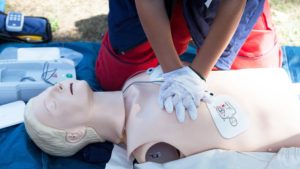
Cardiopulmonary resuscitation is one of the most critical skills taught in Basic First Aid. CPR techniques are taught for adults and children, using hands-on manikin practice to build the muscle memory needed to respond confidently during a cardiac emergency. Automated External Defibrillator use is included in first aid training at every level. Participants learn to operate an AED safely and effectively alongside CPR. Rescue breathing techniques are also covered for managing non-breathing casualties until professional help arrives.
Bleeding Control and Wound Care
Wound care and bleeding management are critical components of first aid training. Wound management involves controlling severe bleeding and applying pressure using dressings and bandages from the first aid kit. First aid courses cover how to clear airway obstructions during choking incidents for adults and children. First aid courses also teach management for choking in adults and children as a core skill, covering back blows and abdominal thrusts.
Medical Emergencies, Shock, and Scene Management
Emergency scene management covers assessing the scene for safety, managing bystanders, and activating the emergency action plan. Medical emergencies recognition is essential in Basic First Aid courses, covering cardiac arrest, stroke, allergic reactions, asthma attacks, diabetic emergencies, and fainting. First aid training includes recognizing signs of shock and managing unconscious patients who may need to be placed in the recovery position. Recognizing and treating environmental emergencies is also included in first aid training, covering conditions such as heat stroke and hypothermia.
Understanding Ontario First Aid Course Levels and Aid Level Requirements
Ontario’s WSIB-approved courses are structured into clear aid levels. Understanding which aid level applies to your situation saves time and keeps all businesses covered under WSIA fully compliant. Courses include Basic First Aid, Emergency First Aid equivalents, and Standard First Aid equivalents, and both entry-level and intermediate levels can be combined with different CPR/AED levels.
Basic First Aid (formerly Emergency First Aid) is a one-day basic first aid course. Basic first aid training in Ontario is an 8-hour foundational course designed for entry-level certification. Courses typically take one day to complete, making them practical for individuals and smaller, lower-risk workplaces.
Intermediate First Aid (formerly Standard First Aid) is a two-day WSIB-approved course of approximately 13 hours. It goes deeper into injury and illness management, including splinting for fractures and dislocations, eye injuries, burns, environmental emergencies, head and spine injuries, poisoning, and multi-casualty scenarios. Intermediate First Aid certification is valid for three years and can be recertified once through a one-day refresher before expiry. Recertification for Intermediate First Aid is required every three years to maintain valid status.
Courses include Intermediate First Aid with CPR Level C certification as the most common combination for Ontario workplaces with six or more employees per shift.
Who Needs Basic First Aid in Ontario?
In Ontario, first aid training is required for all workplaces in the province, regardless of size or industry. WSIB mandates that certified first aiders must be on-site at workplaces on every shift. Basic First Aid (formerly Emergency First Aid) is specifically required for workplaces with one to five employees per shift under Regulation 1101.
This applies to businesses of all types: retail stores, small offices, food service operations, small construction sites, and any other workplace with a small shift headcount. All businesses covered by the Workplace Safety and Insurance Act must comply, whether staff are full-time, part-time, contract, or temporary.
Beyond the legal requirement, Basic First Aid is appropriate for a wide range of individuals including parents and caregivers, teachers and school staff, coaches and volunteers, security guards as a minimum qualification for their Ontario license, students completing placements or practicums, and anyone who wants to be prepared to respond confidently when an emergency happens.
Workplaces with six or more employees per shift are required to have at least one person certified in Intermediate First Aid (formerly Standard First Aid) on every shift. Basic First Aid alone does not satisfy Regulation 1101 for larger workplaces.
Ontario Workplace First Aid Requirements Under Regulation 1101
Ontario’s workplace first aid obligations are not suggestions. They are law under the Workplace Safety and Insurance Act (WSIA), and every employer must comply. In Ontario, first aid training programs are dictated by the Workplace Safety and Insurance Board, and WSIB-approved training providers must be selected for workplace training to meet these requirements.
Regulation 1101 requires specific first aid kits tiered by workforce size: a Section 8 kit for workplaces with one to five employees, a Section 9 kit for six to fifteen employees, and a Section 10 kit for sixteen to two hundred employees. Regulation 1101 also requires posting of the WSIB Form 82 poster, quarterly kit inspections, and at least one trained first aider with a valid certificate near every first aid station. Workplaces with two hundred or more workers per shift must maintain a dedicated first aid room with a stretcher, washbasins, and additional supplies.
The skills covered in first aid training from WSIB-approved providers meet WSIB’s legislative requirements and will be accepted during Ministry of Labour inspections, audits, or incident investigations. Some providers advertise “Canada-wide” approval, but Ontario employers must specifically confirm WSIB approval status on the WSIB website before booking to ensure compliance.
How Long Is a Basic First Aid Course in Ontario?
A Basic First Aid course in Ontario takes one full day, approximately 6 to 8 hours including both theory and hands-on skills practice. The duration is designed to cover all essential skills within a single day for convenience, making it accessible for working individuals and busy teams.
In-Class Format
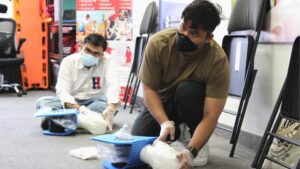
The full course is delivered in a single classroom session with a certified instructor guiding every skill from start to finish. This format suits learners who prefer a structured environment and direct instructor feedback throughout the day.
Online Blended Learning Format
The blended learning format offers convenience by splitting the course into two parts. Theory modules are completed online at your own pace from home or any location before attending a shorter in-person skills session. This format reduces time in the classroom while still meeting every WSIB requirement. A fully online course with no practical skills evaluation is not valid for WSIB workplace compliance under Regulation 1101 regardless of the provider.
Register for Basic First Aid Today
One-day WSIB-approved Basic First Aid and CPR/AED Level C courses running weekly across Ontario. Certificates issued within 48 hours of completion.
View Basic First Aid CoursesBasic First Aid vs Intermediate First Aid: What Is the Difference?
Basic First Aid and Intermediate First Aid (formerly Standard First Aid) are the two entry-level WSIB-approved first aid courses available in Ontario. They share the same foundation but differ in depth, duration, and the workplaces they satisfy under Regulation 1101.
| Feature | Basic First Aid | Intermediate First Aid |
|---|---|---|
| Former Name | Emergency First Aid | Standard First Aid |
| Duration | 1 day (6 to 8 hours) | 2 days (approx. 13 hours) |
| WSIB Requirement | 1 to 5 employees per shift | 6 or more employees per shift |
| Validity | 3 years | 3 years |
| Recertification | Not available, full course required | Once, then full course required |
| Additional Topics | Core emergency skills only | Fractures, dislocations, head and spine, burns, poisoning, multi-casualty |
Most Ontario workplaces pair their first aid course with CPR/AED Level C for complete workplace-ready certification. CPR/AED Level C covers cardiopulmonary resuscitation and AED use for adults, children, and infants.
First Aid and CPR/AED: Choosing Between Level C and BLS
First aid and CPR are closely linked but serve distinct roles. First aid addresses injuries and illnesses. CPR and AED use targets cardiac and breathing emergencies specifically.
Most Ontario workplaces choose Basic First Aid or Intermediate First Aid combined with CPR/AED Level C. CPR/AED Level C covers cardiopulmonary resuscitation and AED use for adults, children, and infants, plus choking emergencies. CPR/AED certification is valid for three years. Over 100,000 learners have been trained in CPR/AED courses through Canadian Red Cross programs. Heart and Stroke Foundation of Canada recommends annual renewal of CPR/AED skills because cardiopulmonary resuscitation techniques degrade faster than other first aid knowledge.
Basic Life Support (BLS) is a more advanced cardiopulmonary resuscitation course designed for healthcare providers and first responders. It covers high-performance CPR, multi-rescuer scenarios, airway management, and rescue breathing techniques that go beyond what standard workplace first aid requires. Choose CPR/AED Level C for most non-healthcare workplaces and the general public, and BLS for hospitals, clinics, paramedic services, and professional responder positions.
Youth and Babysitting First Aid Training in Ontario
Youth courses are available through Canadian Red Cross training partners for younger learners who are not yet ready for a full adult workplace course. These courses are designed for individuals aged 11 and older and focus on safety and leadership skills. Youth courses help prepare participants for emergency situations in everyday settings such as babysitting, school, and community activities.
Babysitting safety training is included in youth courses, covering how to respond to emergencies when caring for infants, children, and young people. These youth courses are an excellent starting point for teenagers who will eventually progress to full Basic First Aid or Intermediate First Aid certification as they enter the workforce or take on caregiving responsibilities.
Need Intermediate First Aid Instead?
Workplaces with 6 or more employees per shift need Intermediate First Aid. Two-day WSIB-approved courses available across Ontario with blended learning options.
View Intermediate First Aid CoursesWSIB First Aid Program Changes in 2026
WSIB updated its First Aid Program on June 22, 2026. All first aid certificates remain valid until their expiration date so no early retraining is required. After June 22, 2026, course names changed: Emergency First Aid is now Basic First Aid and Standard First Aid is now Intermediate First Aid. The updated program aligns with the national CSA Z1210:24 standard. Regulation 1101 has not changed and all compliance thresholds remain exactly the same.
Employers and safety coordinators should review their first aid policies before renewals coming due in late 2026 and 2027 to ensure documentation, job postings, and training records match the new WSIB First Aid Program terminology.
Can You Recertify Basic First Aid in Ontario?
No. Basic First Aid certificates cannot be recertified in Ontario. When a Basic First Aid certificate expires, the full course must be retaken. There is no shortened recertification option available for this aid level.
This is different from Intermediate First Aid, which can be recertified once through a one-day refresher course before the certificate expires. Recertification for Intermediate First Aid is required every three years to maintain valid status. After recertification, the next renewal requires the full two-day course again.
There is no grace period after expiry. The day after your expiry date, your certificate is no longer valid for workplace compliance. Book your next course before your current certificate expires to avoid any gap in coverage for your workplace.
First Aid Certification, Validity, and Recertification in Ontario
Most WSIB-approved Basic First Aid certificates issued through Canadian Red Cross partners are valid for three years from the date of completion. CPR/AED certification is also valid for three years. Heart and Stroke Foundation of Canada recommends annual renewal of CPR/AED skills because cardiopulmonary resuscitation techniques degrade faster than other first aid knowledge. Even before your full first aid certificate expires, refreshing CPR and AED competency each year keeps your response sharp and your skills prepared.
Coast2Coast maintains digital records of certification and can help learners schedule recertification before their certificate expires so there are no gaps in workplace compliance.
How to Get Basic First Aid Certified in Ontario
Getting certified is straightforward. Choose a WSIB-approved provider. Coast2Coast First Aid and Aquatics is a Canadian Red Cross training partner delivering WSIB-approved Basic First Aid and CPR/AED courses across Ontario in both classroom and blended learning formats. The quality of instruction meets both WSIB standards and Canadian Red Cross program guidelines, ensuring every participant leaves prepared to respond in a real emergency.
Register for a course at a location near you. Classes run weekly across Ontario. Attend the full course including the mandatory hands-on skills session. Receive your certificate within 48 hours of completing the course. Your certificate clearly states Basic First Aid and CPR/AED Level C and is accepted by Ontario employers and Ministry of Labour inspectors.
To verify any provider’s WSIB approval status before booking, visit the WSIB official approved provider list at wsib.ca. Contact Coast2Coast directly if you have questions about which course fits your situation.
Key Takeaway
Basic First Aid is Ontario’s one-day WSIB-approved first aid course, formerly called Emergency First Aid, renamed on June 22, 2026 under CSA Z1210:24 national standards. It covers CPR, AED use, bleeding control, choking response, shock management, and recognition of common medical emergencies. Certificates are valid for three years and Basic First Aid cannot be recertified in Ontario: when the certificate expires, the full course must be retaken. In Ontario, first aid training is required for all workplaces, and Basic First Aid satisfies WSIB Regulation 1101 for workplaces with one to five employees per shift.
Train Your Whole Team in One Day
Private on-site Basic First Aid training for businesses, schools, and organizations across Ontario. Flexible scheduling and group rates available.
Explore Private Group TrainingFrequently Asked Questions: Basic First Aid Ontario 2026
Q1: What is Basic First Aid in Ontario?
A: Basic First Aid is Ontario’s WSIB-approved entry-level workplace first aid course, formerly called Emergency First Aid. The name changed on June 22, 2026 when WSIB updated its First Aid Program to align with CSA Z1210:24 national standards. Basic first aid training in Ontario is an 8-hour foundational course covering scene assessment, CPR, AED use, choking response, bleeding control, shock management, and recognition of common medical emergencies. It satisfies WSIB Regulation 1101 for workplaces with one to five employees per shift.
Q2: Is Basic First Aid the same as Emergency First Aid?
A: Yes. Basic First Aid and Emergency First Aid refer to the same level of certification. WSIB renamed Emergency First Aid to Basic First Aid on June 22, 2026 to align Ontario with CSA Z1210:24 national standards. The course content, duration, and WSIB compliance value are equivalent. An Emergency First Aid certificate issued before June 22, 2026 remains valid until its printed expiry date and is accepted as equivalent to Basic First Aid.
Q3: What does a Basic First Aid course cover?
A: A basic first aid course covers essential life-saving skills including emergency scene management, calling 9-1-1, cardiopulmonary resuscitation for adults and children, AED use, choking response for adults and children, severe bleeding control and wound management, shock recognition, recovery position, rescue breathing, and recognition of medical emergencies including cardiac arrest, stroke, allergic reactions, and diabetic emergencies. The course takes approximately one full day and includes hands-on manikin and AED practice.
Q4: How long is a Basic First Aid course in Ontario?
A: A Basic First Aid course in Ontario takes approximately one full day, between 6 and 8 hours including both theory and hands-on skills practice. Blended learning formats allow candidates to complete the theory portion online before attending a shorter in-person skills session. The in-person hands-on component is mandatory for WSIB compliance. Fully online courses are not valid for workplace certification under Regulation 1101.
Q5: Who needs Basic First Aid certification in Ontario?
A: Basic First Aid is required under WSIB Regulation 1101 for workplaces with one to five employees per shift. It is also required for security guards as a minimum for their Ontario license and is recommended for parents, caregivers, teachers, coaches, and anyone wanting to be prepared to respond in a medical emergency. Workplaces with six or more employees per shift need Intermediate First Aid, not Basic First Aid.
Q6: Is Basic First Aid enough for WSIB compliance?
A: Yes, for workplaces with one to five employees per shift. Basic First Aid with CPR/AED Level C from a WSIB-approved provider satisfies Regulation 1101 for small workplaces. For workplaces with six or more employees per shift, Intermediate First Aid is required. The skills covered in first aid training from WSIB-approved providers meet WSIB legislative requirements and satisfy Ministry of Labour inspections.
Q7: How much does Basic First Aid cost in Ontario?
A: The cost of Basic First Aid in Ontario varies by provider and format. Contact Coast2Coast First Aid and Aquatics directly for current pricing on individual and group bookings. Group and private on-site training options are available for businesses, schools, and organizations across Ontario.
More FAQs: Basic First Aid Certification and Training
Q8: Can I do Basic First Aid online in Ontario?
A: No, not for WSIB workplace compliance. A fully online Basic First Aid course does not meet Ontario workplace requirements under Regulation 1101. Blended learning, where theory is completed online and hands-on skills are completed in person with a WSIB-approved provider, is acceptable. Always confirm the course includes a mandatory in-person practical component before relying on it for compliance.
Q9: Can you recertify Basic First Aid in Ontario?
A: No. Basic First Aid certificates cannot be recertified in Ontario. When the certificate expires, the full course must be retaken. This is different from Intermediate First Aid, which can be recertified once through a one-day refresher. There is no grace period after expiry so book your next course before your certificate expires to maintain uninterrupted workplace coverage.
Q10: How long is a Basic First Aid certificate valid in Ontario?
A: A Basic First Aid certificate issued by a WSIB-approved provider in Ontario is valid for three years from the date of completion. CPR/AED certification is also valid for three years. After expiry, the full course must be retaken. There is no grace period after the expiry date.
Q11: What is the difference between Basic First Aid and Intermediate First Aid?
A: Basic First Aid is a one-day course covering essential emergency response for workplaces with one to five employees per shift. Intermediate First Aid is a two-day course that adds head and spine injuries, fractures, dislocations, eye injuries, environmental emergencies, burns, poisoning, and multi-casualty scenarios. Intermediate First Aid is required for workplaces with six or more employees per shift and can be recertified once before a full retake is needed.
Q12: Do I need Basic First Aid or CPR/AED Level C?
A: Most Ontario workplaces need both. Basic First Aid with CPR/AED Level C is the standard combination for WSIB compliance. CPR/AED Level C covers cardiopulmonary resuscitation and AED use for adults, children, and infants. A standalone CPR/AED Level C certificate without the first aid component does not fully satisfy Regulation 1101. If your employer requires BLS, neither Basic First Aid nor CPR Level C alone will meet your certification needs.
Q13: Is Basic First Aid valid across Canada?
A: Yes. Under the updated 2026 WSIB program, certificates from any province that meet the CSA Z1210 national standard are accepted in Ontario until expiry. A Basic First Aid certificate earned in Ontario will generally be recognized across Canada, though some provinces have specific requirements. Always verify local regulations if you plan to work in another province.
Q14: What do I bring to a Basic First Aid course?
A: Bring government-issued photo ID and comfortable clothing you can move in for the hands-on skills practice. Coast2Coast provides all training materials, mannequins, AED trainers, and first aid supplies. No prior first aid knowledge is required. Courses are designed for individuals aged 11 and older, though most participants are adults completing workplace certification.
Q15: How quickly do I get my Basic First Aid certificate?
A: Coast2Coast issues digital certificates within 48 hours of completing the course. The certificate clearly states Basic First Aid and CPR/AED Level C and is accepted immediately by Ontario employers and Ministry of Labour inspectors. Coast2Coast maintains digital records of certification so your proof of training is always accessible.
Sources and Editorial Standards
This article was written by Godwin Orilua, content and research writer at Coast2Coast First Aid and Aquatics, and reviewed by Ashkon Pourheidary, B.Sc. Honours Neuroscience (University of Toronto), Canadian Red Cross Certified First Aid and CPR Instructor since 2011, Instructor Trainer since 2013, and Co-Founder of Coast2Coast First Aid and Aquatics. Published June 12, 2026.
Content is reviewed against current WSIB Ontario regulatory requirements and CSA Z1210:24 national standards. All certification names, validity periods, and compliance thresholds are verified against WSIB’s official First Aid Program documentation.
Primary regulatory sources: WSIB Ontario First Aid Program (wsib.ca/en/firstaid, updated June 22, 2026); CSA Z1210:24 First Aid Training for the Workplace; Ontario Regulation 1101 (First Aid Requirements); Ontario Occupational Health and Safety Act (R.S.O. 1990, c. O.1); Canadian Red Cross First Aid and CPR Program Standards.
Coast2Coast First Aid and Aquatics is a Top 3 Canadian Red Cross Training Partner and WSIB-approved provider operating 30+ locations across Canada. Find a course location near you or contact us for more information.
Author
-

Godwin is a content and research writer who has spent over a decade helping organizations communicate complex information clearly and credibly. With a background spanning multiple industries and markets across Africa and North America, he brings a rigorous research discipline and a reader-first approach to every article. At Coast2Coast First Aid, he covers health, safety, and emergency preparedness topics, always grounding his work in current Canadian guidelines and certified sources. Connect with Godwin on LinkedIn.